Commercial cleaning in Toronto did not collapse. It shifted into fewer jobs that are harder to staff, schedule, and document, while the old vacancy story misses where demand moved. Toronto buyers now want service in occupied offices, staggered tenancies, and mixed-use buildings, so crews spend less time on empty floorplates and more time on targeted resets, washrooms, and touchpoints.
That shift is visible in the market itself. Ontario's janitorial services sector was estimated at about C$3.0 billion by 2025, with a projected base of 15,117 establishments and 59,553 workers, rising to 19,060 establishments and 68,190 workers by 2031 (IBISWorld).
The work is still there, but it is more operationally demanding than before.
What Happened to Commercial Cleaning in Toronto
Toronto's commercial cleaning market did not fade out. It changed shape. Buyers moved away from a simple nightly sweep of fully occupied offices and toward service in partly occupied buildings, staggered tenancies, and spaces that need targeted resets rather than full-floor cleaning.
Ontario still classifies janitors, caretakers, and heavy-duty cleaners as a real employment category, not a marginal one. The labour-market profile reports about 39,600 people in the occupation, with 76% working full time and 68% working all year, and it gives both Ontario and the Toronto region a moderate outlook for 2025 to 2027 (Ontario labour-market profile).
That matters because demand has become more conditional and more operationally specific. A small office with uneven occupancy may need focused touchpoint cleaning, washroom resets, and waste handling. A healthcare-adjacent site or post-occupancy space needs tighter sequencing, better documentation, and more control over access.

The common vacancy story misses that shift. Lower occupancy does not mean simpler service. It often means more variable work windows, more coordination with tenants and property teams, and more pressure to keep standards consistent across sites that are never used in exactly the same way from one week to the next.
Practical rule: reduced occupancy usually changes the job, it does not erase it.
The broader pattern is a move from volume cleaning to precision cleaning. Facility teams now have to plan for work that is tied to use patterns, not just square footage. Even equipment retirement can fit the same discipline, which is why an e-waste guide for SMBs belongs in the same operational discussion as janitorial planning.
What buyers should notice
- Recurring contracts matter more now. The market still includes one-off work, but repeat service is the core model.
- Occupancy patterns shape scope. Hybrid use changes when crews come in, what they clean, and how often they return.
- Reliability matters more than headline price. A low quote means little if the provider cannot staff the site consistently.
- Service depth has increased. Buyers expect more than sweeping and waste removal in buildings with mixed or changing use.
Labor Shortages and Rising Operating Costs
Staffing is the main constraint in Toronto commercial cleaning, not a collapse in demand. Ontario facilities cleaning analysis reports annual turnover in janitorial roles ranging from 50% to well over 100%, driven by low wages, night shifts, and physically demanding work (Ontario facilities cleaning market analysis). A five-person crew can lose two workers every couple of months at that pace, which forces supervisors to spend hours on re-onboarding instead of site checks.
Why cheap quotes can be misleading
Labour pressure is not only about finding people. Wage increases and competition from retail and warehouse employers have pushed labour costs higher, which raises the cost per labour hour and makes scheduling stability a core operating issue. Two providers can quote the same scope, but the one with weaker workforce management is more likely to miss shifts, rotate staff too often, or deliver uneven results.
Operational insight: in a labour-constrained market, scheduling reliability is part of the product, not an admin detail.
Better-run firms respond with route planning, cross-training, and tighter site supervision. Those practices reduce missed shifts and make it easier to absorb absenteeism without dropping service quality. The buyer sees the difference most in recurring office cleaning, where consistent work across entrances, washrooms, kitchens, and common areas matters more than a single deep clean.
How labour affects pricing and service
A recurring contract has to cover more than a mop and a checklist. It has to pay for onboarding, replacement labour, travel time, quality checks, and the downtime caused by turnover. A quote that looks lower on paper can end up costing more through rework, complaints, or constant vendor switching.
The market also rewards firms that can staff non-standard hours without overpromising. Hybrid offices, industrial sites, and healthcare-adjacent spaces often need evening or early-morning access, and that makes labour planning more technical than it used to be.

For small and midsize buyers, the practical question is simple: can the provider keep the same standard when a cleaner calls in sick, a shift changes, or a site becomes busier than expected? The answer depends less on sales language and more on labour systems. One internal benchmark worth reviewing is the Arelli careers page, which shows how a cleaning business thinks about staffing and retention.
Compliance, Safety Standards, and Regulatory Pressure
Commercial cleaning in Toronto has become more regulated in practice, even when the work still looks routine from the outside. Ontario's WHMIS framework requires hazardous-product information to be communicated through labels, safety data sheets, and worker education, and employers are expected to pass that information on and train staff accordingly (WHMIS guidance). In service terms, that turns chemical handling into a documented process, not an informal habit.
What compliance looks like on site
A compliant cleaning operation should be able to show how products are labelled, stored, diluted, and used. Ontario health-and-safety guidance warns workers not to mix bleach with ammonia or other cleaners because the combination can create hazardous gas, and it stresses following manufacturer instructions for dilution, storage, compatibility, and disposal (Ontario health-and-safety guidance).
That leaves buyers with a practical test. Ask for evidence of worker training, access to safety data sheets, and supervision that is specific to each site. A provider should be able to explain how staff are taught to handle disinfectants, how incidents are escalated, and how refresher training is tracked.
A professional crew treats chemicals as controlled inputs, not convenience products.
The business case is risk control. In offices, healthcare-adjacent environments, and post-occupancy work, cleaning protects people, surfaces, and the building's operating rhythm. Trained crews usually cost more than informal operators because their price includes training time, documentation, and oversight. For a practical comparison of hazard assessment thinking, the Opus Safety coshh assessment advice is a useful reference point.
A separate pressure came from hygiene expectations during periods of heightened concern, and that influence has not fully disappeared. Buyers still ask for more visible procedures, clearer records, and more consistent communication about what is cleaned, how often, and with what products. The useful reference point is COVID-conscious cleaning, because it reflects the move toward documented, auditable routines rather than informal habits.
What to ask before signing a contract
- Training records: How are cleaners trained on WHMIS, SDS use, and product compatibility?
- PPE expectations: What gloves, eye protection, or other PPE are required for the products used?
- Storage process: Where are chemicals stored, and who checks them?
- Escalation path: What happens if a spill, mix-up, or exposure event occurs?
- Site supervision: Who verifies that the crew is following the approved method?
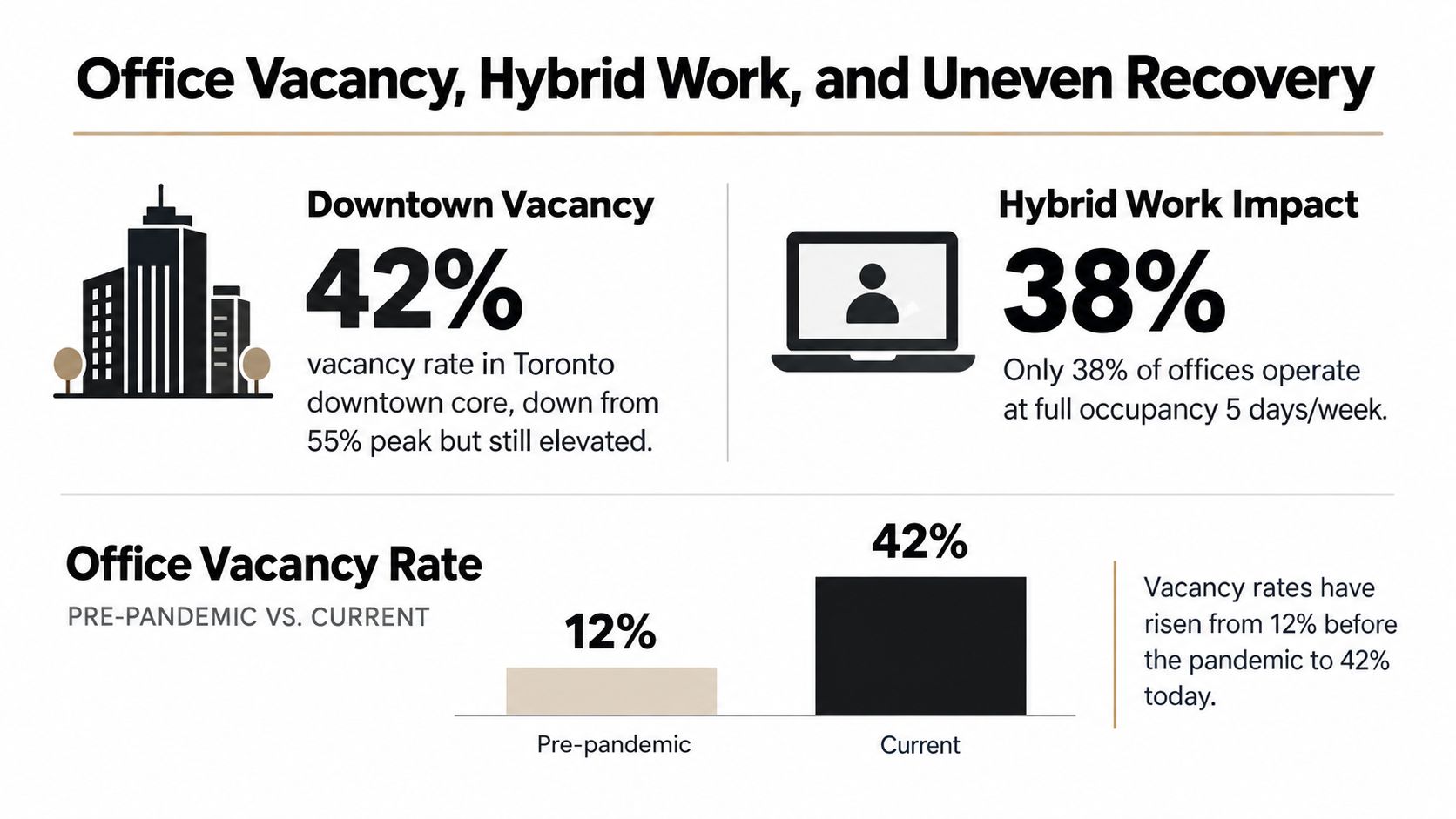
Office Vacancy, Hybrid Work, and Uneven Recovery
The office market recovered unevenly, and cleaning demand moved with it. Toronto downtown office vacancy fell to 13.1% in Q2 2026 after 13.6% in Q1, while downtown office absorption turned positive at more than 140,000 sq. ft. net absorption in Q2 2026 (CBRE downtown Toronto office figures). That pattern points to a market in motion, not a full return to pre-hybrid operating habits.
Why vacancy alone is the wrong lens
Cleaning volume follows occupancy density, fit-outs, turnover, and how often occupied areas need hygiene resets. In core downtown assets, tighter occupancy can still produce more frequent turnaround cleans and higher expectations for washrooms, shared amenities, and touchpoint cleaning. In suburban Class B and Class C stock, demand may look lighter on paper, but it is harder to plan because use is intermittent and service windows shift with attendance patterns.
The broader GTA picture remains mixed. One recent estimate put GTA office vacancy at about 10.6%, while another recent market snapshot put it around 8%, both still above pre-2019 conditions (GTA office market coverage). The exact figure matters less than the operating reality behind it. Uneven occupancy creates more scheduling complexity than a simple boom or bust reading suggests.
Vacancy has changed the type of cleaning, not removed the need for it.
How service expectations differ by asset type
Downtown towers with stronger tenant density usually need more coordination around access control, after-hours service, and amenity maintenance. Suburban office stock often needs lighter but more flexible service, with more emphasis on responsiveness and budget discipline. A provider that performs well in one setting may struggle in the other if its staffing model is too rigid.
For buyers, vacancy data should inform the contract, not define it. A half-empty building still needs reliable washroom service, waste management, entrance care, and periodic deep cleaning. The difference is that those tasks now have to fit around variable use rather than a single predictable pattern.
How to Choose a Commercial Cleaning Provider in Toronto
The market has not made cleaning less important. It has made bad procurement easier to spot. A low quote only works if the provider can cover the right scope, keep staff on site, and respond when the building's use changes.
A practical evaluation framework
Start with how the provider runs the work, not how it sells it. Ask for training records, ask how absences are covered, and ask what happens after the crew leaves for the night. If those answers are vague, the service model is likely too loose for a Toronto office or facility with mixed occupancy and tighter oversight.
| Commercial Cleaning Provider Evaluation Checklist | What to Verify | Why It Matters |
|---|
| Training and onboarding | WHMIS, product handling, site-specific instructions | Reduces safety risk and uneven execution |
| Workforce stability | How absences are covered, how long staff stay on sites | Protects reliability in a turnover-heavy market |
| Flexible scheduling | After-hours, day porter, hybrid occupancy support | Matches service to actual building use |
| Pricing clarity | Scope, frequency, exclusions, and change controls | Prevents surprise costs and scope drift |
| Quality assurance | Checklists, inspections, issue tracking | Shows whether the provider can sustain standards |
The pricing conversation should separate labour, frequency, and special tasks. A recurring office contract is not the same as a periodic deep clean, and a building with uneven occupancy needs a different cadence than one with steady use. A recent Toronto pricing analysis points to lower entry pricing for small offices, but the main variable is how the quote handles office size, headcount, service frequency, and whether the pricing is hourly or monthly.
For buyers comparing service models, insights from WipesBlog.com point to the same core issue, matching scope to actual use. The proposal matters less than the operating system behind it.
What to ask and what to avoid
- Ask for sample reports. They show whether the provider measures work or just promises it.
- Ask how substitutions are handled. That shows whether service survives turnover.
- Avoid vague scope language. Terms like “general cleaning” can hide major gaps.
- Avoid one-size-fits-all quotes. A small office, clinic, and industrial suite should not be priced from the same assumptions.
- Ask how site feedback is logged. Fast correction matters more than polished sales talk.
What the Market Shift Means for Toronto Businesses
The market did not disappear, it matured. Toronto cleaning buyers are dealing with a more specialised service market, where labour reliability, safety documentation, and flexible scheduling matter more than a simple low quote. That is especially true in offices that are partly occupied, frequently reset, or tied to higher expectations around hygiene and compliance.
For SMBs and facility operators, the smartest response is to treat cleaning as an operational partnership. The provider should be able to explain staffing coverage, product handling, and quality assurance in plain language. If it can't, the contract is likely to create more work for the buyer later.
The long-term direction is clear enough. The strongest providers will be the ones that combine trained crews, documented safety practices, and adaptable service models that work across downtown, suburban, office, and specialty environments. Buyers who understand that shift are better positioned to avoid unreliable vendors and negotiate realistic terms.
Further Reading
Internal links
External resources
If a Toronto office, clinic, or facility is still comparing service options, use the checklist above, ask for 2 or 3 quotes, and verify training, coverage, and quality controls before signing. A cleaning contract should make operations easier, not introduce new risk.








.webp)