If an office in Richmond Hill feels busy by day and patchy by night, cleaning often gets pushed into the same category as sorting recycling or ordering toner, important but easy to delay. That delay usually shows up later as complaints about washrooms, dust on meeting tables, or a front entrance that looks tired before noon. For office cleaning services Richmond Hill, the central question is not whether cleaning matters, it's how to buy it in a market where most businesses are small, schedules are tight, and compliance still applies.
Richmond Hill's local business base is dominated by small employers, with 9,911 employer businesses and 98.9% of them classified as small businesses with 1 to 99 employees, alongside a population of 202,022 source data. That mix points to a market where outsourced cleaning fits naturally, because many offices don't carry full in-house custodial teams. It also means buyers usually need a service that is flexible, documented, and easy to scale without adding internal overhead.
Why Richmond Hill Offices Outsource Cleaning
Small offices need repeatable service, not spare-time chores
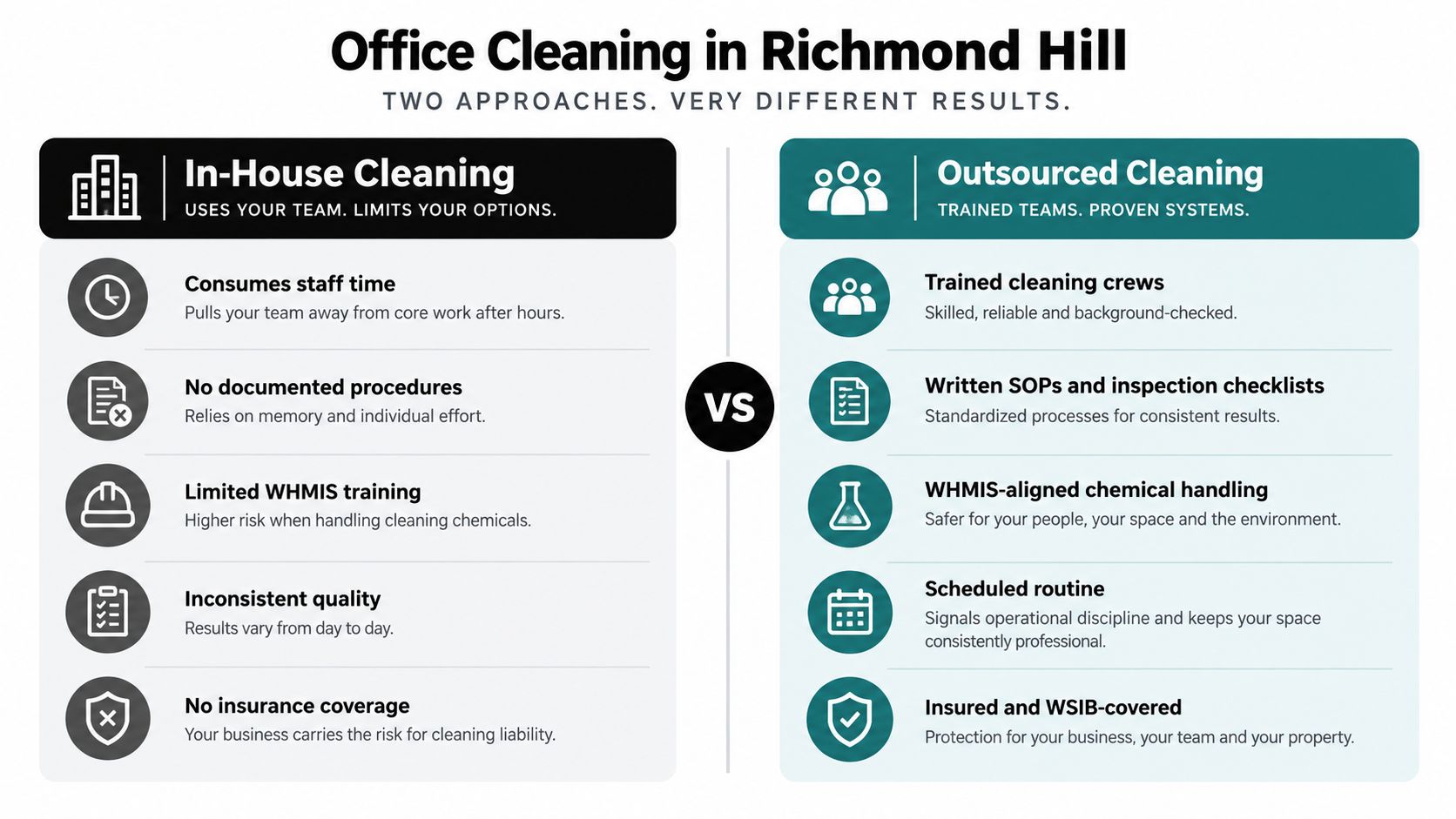
In a small professional office, cleaning rarely happens at the right moment. Staff wipe counters after a client meeting, empty bins before heading home, or leave deeper tasks for later, which often means they get pushed aside again. Outsourcing removes that drift and gives the workplace a routine that does not depend on who is available that day.
Richmond Hill has a large share of small firms, professional suites, clinics, and similar spaces, so many buyers want predictable service instead of carrying a full-time custodial role in-house. Public business data shows the area is shaped by employer businesses that are mostly small, which helps explain why outsourced cleaning fits the local market source data. It also gives landlords, property managers, and tenants a clearer record that the space is being maintained on a set schedule.
Practical rule: if a task repeats every week, and nobody owns it, it usually belongs in a cleaning scope.
Compliance turns cleaning into an operational decision
Ontario workplaces cannot treat cleaning products casually. Under WHMIS, hazardous workplace cleaning products need proper identification, safety data sheets, and worker instruction, and Ontario guidance says employers must pass hazard information to employees and provide worker education Ontario WHMIS guidance. That applies to offices, clinics, and shared commercial spaces that use disinfectants or other regulated products.
A professional cleaning partner brings procedures many small offices do not build internally, including trained staff, labelled products, and safer handling routines. A neutral labour and business profile for Ontario workplaces helps explain why this outsourcing choice is common, especially where office teams need to stay focused on client work and day-to-day operations.
Core Services Offered in Richmond Hill
Start with the baseline and then add only what the space needs
Most office cleaning contracts begin with a familiar set of tasks. Trash removal, vacuuming, dusting, restroom cleaning, kitchen or break room wipe-downs, and touchpoint cleaning are the core items most buyers expect. Significant differences appear in how often those tasks happen, how they're logged, and whether the provider adjusts scope for traffic patterns.
The right way to buy this is to treat the service as a menu, not a bundle. A small accounting office doesn't need the same floor care or supply cadence as a larger multi-room workplace. A provider should be able to explain what's included at each frequency and what changes when the office gets busier.
Specialised services fill the gaps between routine visits
Some offices need floor care beyond simple vacuuming and mopping. Others need carpet cleaning, glass cleaning, post-construction cleanup, or a day porter for busy buildings. Supply management can also matter, especially where paper products, soap, and liners are bundled into the service instead of being managed separately.
A useful reference point is a provider's service map, not its sales pitch. The internal scope should match the space's use, not just its square footage. That is why buyers should ask what happens on high-traffic days, after renovations, or during seasonal periods when entrances and floors get dirtier faster.
| Service Category | Typical Tasks | Best Fit For |
|---|
| Routine janitorial | Bins, restrooms, dusting, vacuuming, kitchen wipe-downs | Most offices and professional suites |
| Floor care | Vacuuming, mopping, periodic machine care | Spaces with mixed flooring or heavy foot traffic |
| Disinfection | High-touch point treatment, targeted sanitising | Clinics, shared offices, and client-facing spaces |
| Specialty cleaning | Windows, carpet, post-construction, day porter support | Buildings with variable occupancy or renovation work |
| Supply support | Soap, paper, liners, refill checks | Offices that want one vendor for upkeep |
Office cleaning service details for Richmond Hill offices
How Pricing and Contracts Typically Work
The cheapest quote is rarely the cheapest contract
Office cleaning in Richmond Hill is usually priced around scope and frequency rather than a flat hourly model. Buyers often get quoted per visit or against square footage, with the final number shaped by the number of washrooms, the amount of glass, the flooring mix, and whether access is limited to evenings or early mornings.
That means two offices with similar square footage can still land in different price bands. A quiet professional suite with one washroom and light traffic is simpler to maintain than a busier office with shared kitchens, multiple washrooms, or heavy client flow. The smart comparison is annualised cost, not just the monthly headline.
Contract length changes flexibility
Contracts commonly fall into three patterns. Month-to-month agreements give flexibility but less price stability. One-year terms usually balance stability and exit options. Longer terms can hold pricing, but they also make it harder to switch if the service slips.
Compare proposals on the full scope, not the monthly number alone. Supply charges, extra visits, after-hours access, and specialty add-ons often change the real cost more than the base line item does.
A useful buyer habit is to ask for the same scope in every quote, then compare what's included line by line. Richmond Hill offices don't need guesswork, they need a consistent way to judge whether the service matches the site.
Compliance and Safety Standards That Matter
WHMIS is part of the cleaning scope, not a side note
In a Richmond Hill office, especially where multiple small businesses share floors or service rooms, cleaning products often move through refill bottles and secondary containers. If a supplier label is removed or becomes illegible, it has to be replaced with a proper supplier or workplace label, and the workplace label must still show the product identifier and safe-handling information. That is the point where label control becomes practical, not theoretical.
Health Canada draws a line between ordinary cleaners and products that make antimicrobial claims. A cleaner used on environmental surfaces without that claim stays in the cleaning category, while a product that claims antimicrobial action falls under a different regulatory path Health Canada guidance. For an office buyer, the label has to match the task, the way a tool has to match the job.
Credentials should be verified before any start date
A compliant provider should be able to show WHMIS training records, current safety data sheet access, and a written process for chemical storage. Buyers should also confirm insurance and WSIB coverage, especially for after-hours work in occupied buildings. If a provider cannot show those basics, the risk shifts back to the building owner or tenant.
| Credential | What It Confirms |
|---|
| WHMIS training records | Staff have been instructed on hazardous product handling |
| Safety data sheets | Product information is available for site use |
| Insurance coverage | The business has liability protection in place |
| WSIB clearance | Workers are covered under Ontario's workplace safety system |
| Written cleaning procedure | Tasks are repeatable, not improvised |
What to Ask a Provider Before Signing
Treat the quote as a document review
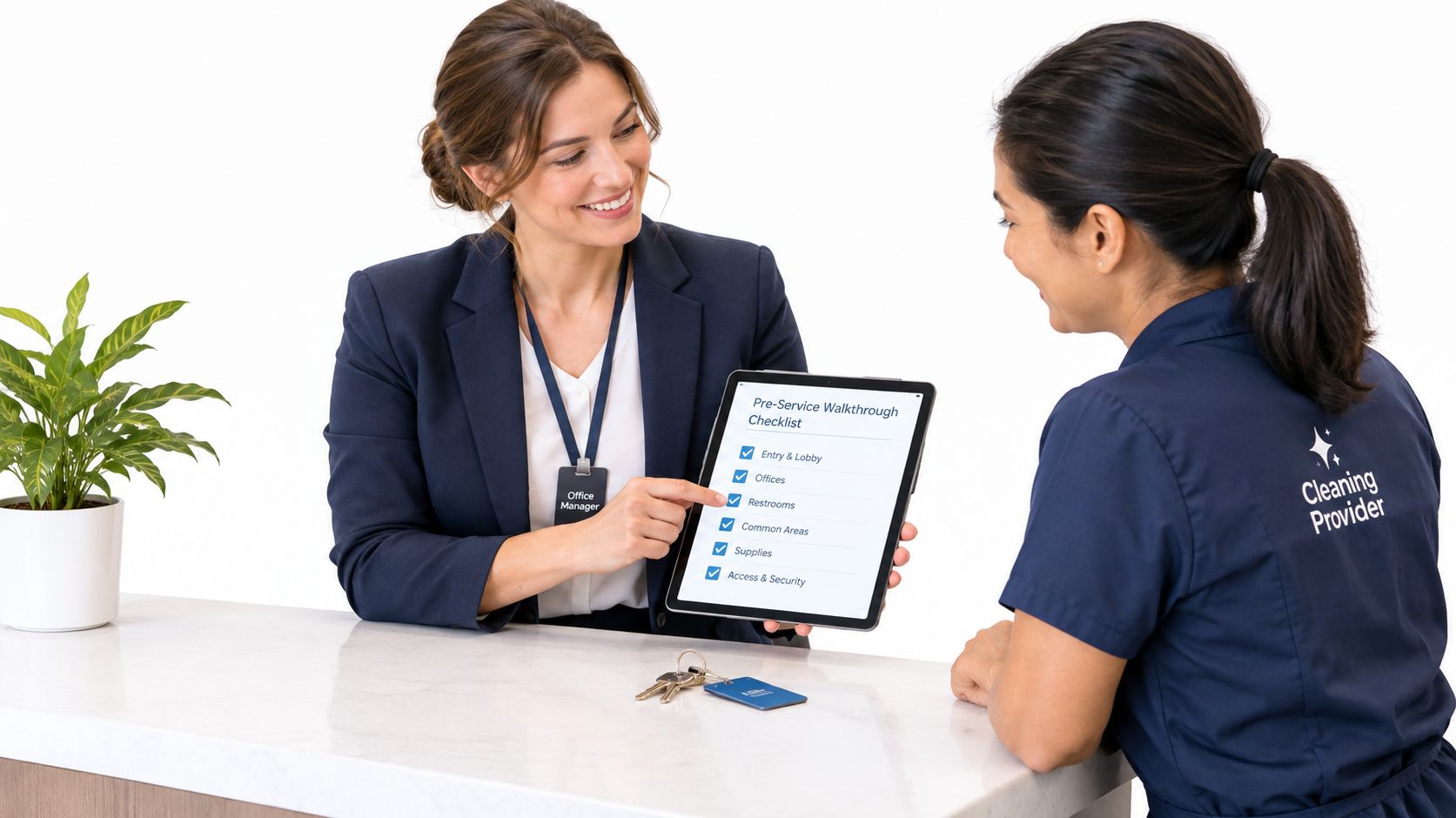
A serious sales call should feel like a short audit. Ask who performs the work, employees or subcontractors, because that changes training consistency and accountability. Then ask for the written scope, the inspection checklist, and the process for correcting missed tasks.
Scheduling matters just as much. Offices in Richmond Hill often need after-hours access, key handling, alarm protocols, and a clear plan for stat holidays. If the provider can't explain how those details are managed, the service will probably be awkward later.
Questions that expose weak offers quickly
- Who does the work: employees or subcontractors, and who supervises them on-site?
- What is included: can the provider describe the exact scope in writing, room by room if needed?
- How is quality checked: is there a checklist, a visit cadence, and an escalation path?
- What documents are available: can they share WHMIS information and safety data sheets when asked?
- What happens after hours: how are keys, alarms, and access codes controlled?
Red flags are easy to spot once you know to look. Verbal-only quotes, vague scopes, missing safety documents, and long contracts with heavy termination penalties are all signs the buyer should slow down.
Next Steps and Common Questions
A practical path forward
The cleanest buying process is simple. Shortlist two or three providers, request a written walk-through quote, compare the same scope across each proposal, and verify insurance plus WSIB documentation before signing. If the space is changing, ask for a trial period or a short termination clause so the contract can be tested in real use.
Richmond Hill location details and service coverage
Common questions buyers ask
How long does a typical contract run? Many buyers start with a 12-month term, often with a 30- or 60-day termination clause.
Do providers bring their own supplies? Reputable crews usually bring commercial vacuums, microfibre systems, and chemicals, while some clients supply paper products and hand soap.
Can service scale for seasonal deep cleans? Yes, seasonal add-ons are common when the building needs extra attention.
Will staff be background-checked? After-hours access usually calls for screening that fits the sensitivity of the site.
How should pricing be compared? Look at scope, frequency, and access requirements together, not just the monthly figure.
What's the main mistake buyers make? They compare price before they compare service definitions.
Further reading for Richmond Hill buyers, use the checklist, ask for 2 or 3 quotes, and verify the safety documents before you sign. If a buyer wants one more option to review, Arelli is one local office cleaning provider that offers Richmond Hill coverage alongside broader GTA service.








.webp)