Most advice about medical office cleaning services in Toronto starts with the wrong assumption. It treats a clinic like a standard office that just needs stronger chemicals and a better checklist, but Ontario's health environment demands a health care clean standard, not a hotel clean one, with disinfection, higher frequency, and audit-ready controls layered on top of routine cleaning Public Health Ontario. The practical question isn't whether a space looks clean. It's whether the cleaning programme matches infection risk, room use, and the records a clinic may need to show later.
Practical rule: if a provider can't explain its disinfection process, its cleaning frequency by surface type, and its proof-of-service records, it's not managing a medical environment properly.
The Regulatory Reality of Toronto Medical Cleaning
A Toronto clinic is not buying ordinary janitorial work with a medical label on it. Public Health Ontario says patient-care areas must meet a health care clean standard, which brings in disinfection, higher cleaning frequency, auditing, and other infection-control measures beyond a basic office clean Public Health Ontario. The College of Physicians and Surgeons of Ontario also expects a clean, safe health care environment, with environmental cleaning and disinfection done routinely and consistently CPSO IPAC standard-standard).
The “hotel clean” idea breaks down fast
That sales pitch misses the point. In an exam room, the cleaner needs to do more than wipe visible dust. The process has to include pre-cleaning, the right disinfectant for the surface, the correct wet contact time, and a way to show the work was done.
A practical reference for product choice is BacteriaFAQ.com disinfectant guidance, but the label alone does not solve the problem. A clinic also needs the right cloths, the right sequence, and staff who know which surfaces need disinfection and which need routine cleaning only.
What “compliance” really means
Compliance is a chain, and weak links show up fast. If a provider cannot explain how it cleans patient-contact surfaces, how it separates routine cleaning from disinfection, and how it records each visit, that is a risk. Ontario guidance expects environmental cleaning and disinfection to be routine and consistent, with operational discipline that goes beyond a quick wipe-down CPSO IPAC standard.
A clinic owner should expect a documented cleaning logic for any room touched by patients, staff, or contaminated items, not a generic daily promise.
That is why Toronto medical office cleaning services need to be judged as an infection-control function. If the provider talks mostly about shine, deodorising, or “deep cleaning,” it is thinking like a janitorial vendor, not a health-environment operator.
Building a Risk-Based Disinfection Schedule
Blanket checklists waste money and still miss the surfaces that matter most. A better schedule starts with contamination risk, not surface count. Public Health Ontario's environmental cleaning guidance says items that are not touched frequently and are not likely to become contaminated with blood or body fluids do not need daily cleaning, but should receive periodic scheduled cleaning and disinfection Public Health Ontario environmental cleaning guidance. That is the logic behind a risk-based schedule.
Match frequency to surface risk
High-touch clinical surfaces need a different plan from low-touch administrative areas. Ontario guidance for institutions says common areas should be cleaned at least once daily on low-touch surfaces and at least twice daily on high-touch surfaces, while outbreak situations require enhanced cleaning and disinfection twice daily CPSO IPAC standard. In some clinical settings, high-touch surfaces may need attention every four hours, which is why a single “daily clean” template is too blunt for a real clinic Public Health Ontario environmental cleaning guidance.
A practical schedule starts with room use, not a generic service package. Waiting rooms, exam rooms, staff-only zones, and storage areas do not carry the same risk profile, so they should not all be priced or serviced the same way.
Build the schedule around patient flow
The right schedule comes from mapping how people move through the clinic. High-traffic areas need more frequent attention, while low-touch zones can often be handled on a scheduled basis without slipping outside IPAC expectations. That distinction matters because it lets a clinic pay for actual risk control rather than for unnecessary repetition.
A strong plan also has to fit staffing and room turnover. Cleaners need clear assignment windows, especially around peak appointment blocks and after-hours access. Pebb cleaning team scheduling is a useful reference point for that kind of coordination because the work depends on timing discipline and clear handoffs.
Disinfection scope should track contamination risk, not surface count. Our guide to commercial disinfection and sanitising shows how that scope is defined in practice.
Simple decision rule: clean what people touch often, disinfect what carries clinical risk, and schedule low-touch spaces on a documented cadence instead of repeating them daily by habit.
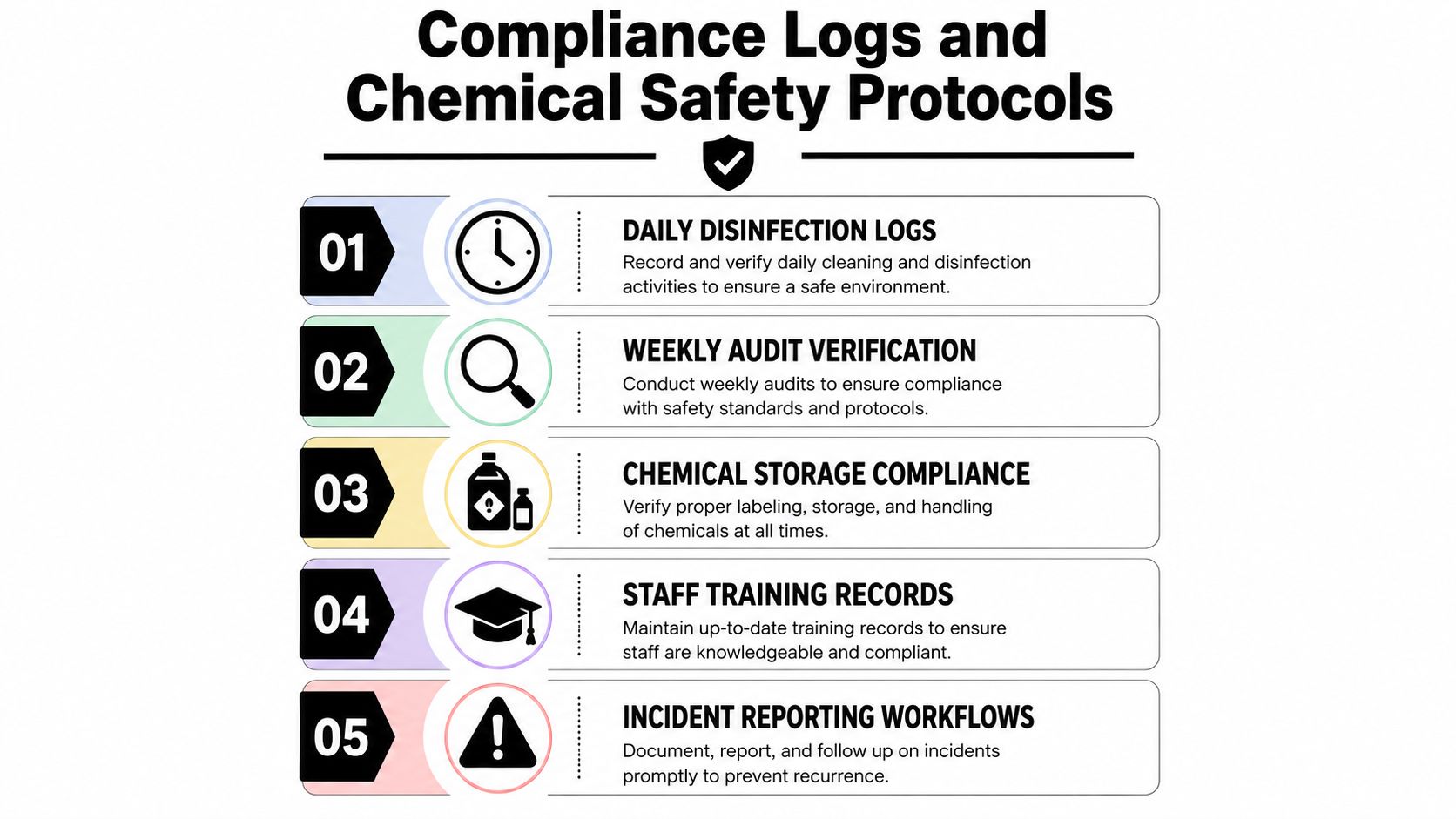
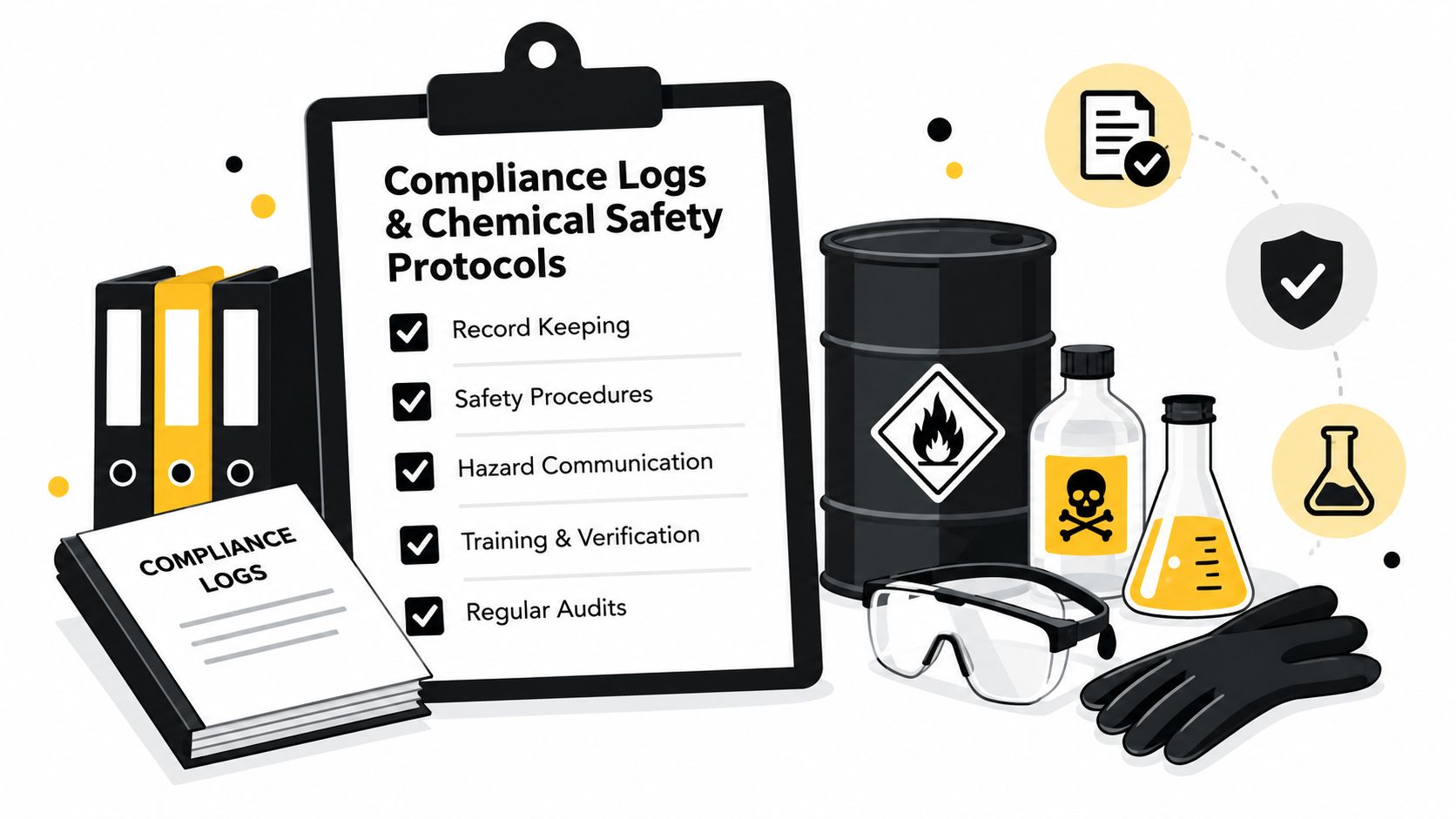
Compliance Logs and Chemical Safety Protocols
In Ontario, proof of cleaning matters almost as much as the cleaning itself. Employers must keep washroom-facility cleaning records available, and those records must show the date and time of the two most recent cleanings Ontario washroom cleaning records. For a clinic, that is not a side detail. It should shape the cleaning programme from the start.
The records that protect a clinic
A serious provider should be able to produce time-stamped logs, not just say the building was cleaned. That includes the date, the time, the rooms or zones serviced, the product used, and any exception notes if an area was delayed, skipped, or re-cleaned. If those fields are missing, the clinic has weak evidence in the event of a complaint or inspection.
A cheaper provider can be the better choice, but only if it is disciplined. A lower-frills cleaner that keeps clear logs, follows dwell times, and uses appropriate disinfectants can be a better risk-reduction choice than a polished provider that leaves the clinic with vague checklists and no usable record.
Chemical handling is not optional
Canadian cleaning staff working with hazardous products should review labels and safety data sheets, receive WHMIS training, wear appropriate PPE, and clean surfaces thoroughly before disinfecting CCOHS cleaning staff guidance. Ontario health-and-safety guidance also warns workers not to mix bleach with ammonia or other cleaners, because it can create a hazardous gas, and it stresses following manufacturer dilution and disposal instructions WHSC guidance.
Operational truth: a clinic does not need the loudest marketing claim, it needs the provider whose records, training, and chemical controls would survive an audit.
For offices that want a clear safety baseline, physician-office infection control guidance recommends cleaning visible soil first, then disinfecting with an appropriate low-level disinfectant, with sodium hypochlorite diluted 1:50 among suggested options for daily office-surface disinfection BCCDC physician office guidance. The product and the record both matter.
Navigating the Toronto Cleaning Market
Toronto clinics buy cleaning in a crowded market, but the divide is not between cheap and expensive providers. It is between vendors that can support clinical risk control and those that only sell general janitorial coverage. Ontario's facilities-cleaning market was estimated at about C$3.0 billion by 2025, representing roughly 38% of all contract cleaning-services revenue in Canada Ontario facilities market review. Canada's janitorial services market reached about C$8.9 billion in 2026 and grew about 2.0% year over year, with office and commercial real estate as the largest recurring-contract segment, while healthcare and medical sites were singled out as a high-requirement vertical Canada janitorial market overview.
Why scope beats hourly thinking
Pricing for Toronto medical office cleaning should be judged against recurring scope, not only labour hours. After-hours access, washroom sanitation logs, disinfection tracking, and clinical-area protocols add work that a standard office does not carry. A provider that prices only by square footage may understate the time needed to keep the site controlled.
The Greater Toronto Area concentrates demand because of office density, commercial real estate volume, and healthcare facilities that need tighter cleaning and disinfection controls than ordinary offices. For a sense of how providers cover the city, see Arelli's Toronto office cleaning service areas. In practical terms, the market includes many generalists, but only a smaller group is built for auditability and clinical process control.
Standard office versus medical office cleaning scope
| Feature | Standard Commercial Office | Toronto Medical Clinic |
|---|
| Cleaning objective | Appearance and general hygiene | Infection prevention and control |
| Surface priority | General desks, floors, washrooms | High-touch clinical surfaces, patient areas, shared devices |
| Documentation | Basic task completion | Time-stamped logs, audit trail, product tracking |
| Product control | General cleaners | Disinfectants suited to healthcare settings |
| Staffing focus | Routine janitorial skills | IPAC-style process control and training |
| Risk sensitivity | Low to moderate | High, especially in patient-care areas |
That table is the cleanest market test. If a proposal reads like a standard office package with a medical label added, it is probably not enough.
Vetting Prospective Medical Cleaning Partners
The best vendors don't just sell a promise, they explain how they control risk. Start with staff training. Ask whether workers are trained in WHMIS, whether they can describe the products they use, and whether their cleaning sequence includes pre-cleaning before disinfection. Those answers reveal more than a glossy brochure ever will.
Questions that expose real capability
Ask direct, operational questions. Keep them specific.
- Training proof: Are your cleaners trained in WHMIS, and how do you keep that training current?
- Product control: Which disinfectants do you use in clinical areas, and how do you verify they're suitable for the surfaces in the clinic?
- Dwell time discipline: How do you make sure the disinfectant stays on the surface for the required contact time?
- Spill response: What do you do when there's blood or body fluid contamination after hours?
- Log quality: What does your service record include, and how quickly can it be reviewed if a clinic asks for it?
- Exception handling: If a room is missed, late, or re-serviced, how is that recorded and escalated?
These questions are less about catching the vendor off guard and more about seeing whether their system is built for a healthcare site. A contractor that answers vaguely is telling you that the process probably lives in people's memory, not in a controlled workflow.
Look for process control, not polish
A clinic should also ask how the provider handles third-party risk, because cleaning teams often need access after hours, around sensitive records, and near occupied treatment areas. In that sense, the discipline is similar to managed IT for healthcare Canada, where access, documentation, and accountability matter as much as the service itself CloudOrbis third-party risk management. The parallel is useful, even if the work is different.
If a provider can't explain who checks the logs, who signs off on exceptions, and who responds when a disinfected area fails an inspection, the clinic is carrying hidden risk.
That's the standard worth using. Not “Do they sound experienced?” but “Can they prove they run a controlled process?”
Finalizing Your Contract and Next Steps
A good contract turns a cleaning service into a manageable operating system. It should define scope by room type, frequency by risk level, documentation expectations, access rules, and the response process for missed work or urgent re-cleaning. It should also make it clear what happens when the clinic needs short-notice changes, because medical schedules rarely stay static.
What to lock down before signing
Use a simple decision framework.
- Map the risk zones. Separate high-touch clinical areas from lower-risk admin spaces.
- Request written logs. Make time-stamped records part of the service, not an optional extra.
- Check product and training controls. Confirm WHMIS training, disinfectant use, and spill response.
- Compare proposals on scope. Don't judge them on price alone, judge them on what's included and what's documented.
- Ask for a sample clean. A trial visit can show how the crew handles sequencing, access, and communication.
A clinic should also ask about cancellation terms and whether the provider can scale frequency up or down without restarting the whole relationship. Flexible service matters because patient volume, staffing, and room use can change quickly.
Arelli Cleaning can serve as one benchmark for what this looks like in Toronto, because it offers no-term contracts, zero cancellation fees, 24/7 live support, app-based quality assurance, a price-match guarantee, and disinfection with Health Canada-approved products. Those features don't replace clinical due diligence, but they do illustrate the operational shape of a modern service relationship.
What to do next
Gather two or three quotes, ask for sample logs, and compare providers using the same checklist. Then review the contract line by line with the people responsible for operations, not just procurement. If a provider can't support audit-ready cleaning, documented chemical safety, and risk-based scheduling, it's not the right fit for a medical office.
For service planning, start with the internal location directory at Arelli's Toronto service areas, compare scope against your clinic's risk profile, and use the checklist above before signing anything.








.webp)