Green cleaning in Toronto workplaces is no longer a soft-sounding sustainability idea. In one widely cited workplace study, green cleaning reduced sick days by up to 46%, and a Toronto-focused article applies that to office settings by noting that a company with 100 employees could save more than 400 sick days a year (Toronto green cleaning benefits). That is why facility managers now treat product choice, indoor air quality, and cleaning method as operational issues, not just environmental ones.
For a Toronto office manager, the question is not whether a building can look clean. It is whether the cleaning programme reduces irritants, supports attendance, satisfies procurement expectations, and holds up under WHMIS and certification scrutiny. Eco-friendly commercial cleaning answers that question best when it is defined clearly, measured properly, and implemented with discipline.
Table of Contents
What Eco-Friendly Commercial Cleaning Means in a Toronto Workplace
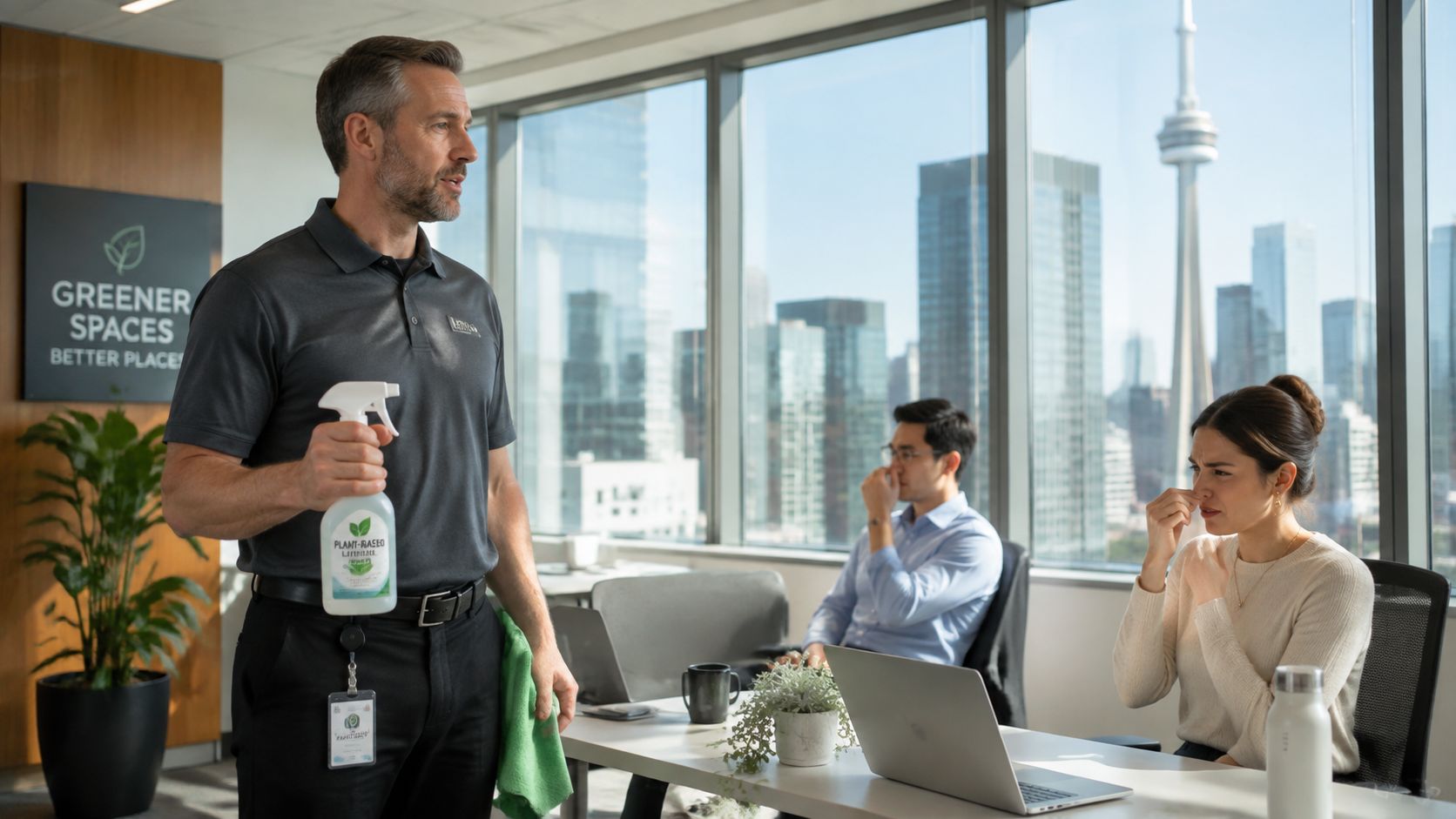
A mid-sized Toronto firm often notices the change first after a renovation. Staff start commenting on cleaning-product smells, a few people avoid certain rooms, and the office manager hears the same complaint twice in one week. That is usually the point where “eco-friendly” stops being a marketing phrase and becomes a facilities decision.
A practical definition that actually helps
Eco-friendly commercial cleaning means cleaning methods, products, and equipment selected to reduce occupant exposure to harsh chemicals, lower environmental impact, and meet recognised third-party standards. In plain language, it is not about making a workplace smell like citrus. It is about choosing inputs that are safer to handle, easier to document, and less likely to create indoor air complaints.
A useful way to test a provider's claim is to ask for the product standard, not the slogan. Certifications such as Green Seal, UL EcoLogo, and EcoCert are more meaningful than vague language like “natural” or “non-toxic”, because they point to outside criteria rather than self-declared branding. In procurement language, that distinction matters because a spec sheet can be reviewed, while a slogan cannot.
Practical rule: If a cleaning claim cannot be tied to a product name, certification, or Safety Data Sheet, it is probably just packaging.
For buyers who want to understand the equipment side as well as the chemistry, the janitorial supply overview at Material Handling USA janitorial line is a useful benchmark for the kind of tools that often sit behind a cleaning programme, even though the local specification still has to fit Toronto site conditions.
Greenwashing versus verifiable practice
Greenwashing usually shows up in one of three ways. A provider says “eco-friendly” but cannot name the product line. A proposal mentions sustainability but skips documentation. Or the crew uses a different chemical mix on site than the one discussed during sales.
A verifiable programme looks different. The product list is specific. WHMIS documentation is available. Training is written down. The method is repeatable. That is the level at which an office manager can defend the choice to ownership, tenants, or auditors without relying on a loose promise.
The simplest internal definition is this. Eco-friendly cleaning is the use of certified products and controlled methods that reduce exposure and waste without treating cleanliness as optional. That framing keeps the conversation grounded in operations, not sentiment.
How Green Cleaning Became a Standard in Ontario Workplaces
Ontario workplaces did not move toward green cleaning because of a single policy shift. The change came from procurement rules, certification pressure, and day-to-day facility management needs lining up at the same time. Once those pieces started pointing in the same direction, green cleaning stopped looking optional and started looking like the default operating model.
Why the standard changed
A Toronto commercial-cleaning source notes that LEED v4 Indoor Environmental Quality credits require cleaning products to meet Green Seal or UL EcoLogo standards. That changes the job of product selection. It is no longer just a housekeeping choice, it becomes part of the building's documentation trail. For an office manager, that means chemicals, labels, and product sheets need to be traceable in the same way other building records are traceable.
WHMIS pushes in the same direction. Office managers are expected to know what is stored, how it is labelled, and where the supporting documentation is kept. Green cleaning fits that structure because a verified product line is easier to document than a shelf of mixed bottles with unclear contents.
The office-level reason is practical. Odours, residue, and inconsistent results usually show up before anyone talks about certification. A cleaner routine reduces those complaints and gives tenants, staff, and owners a clearer sense that the workplace is being managed, not just wiped down.
Green cleaning became more standard because buildings are now judged on more than visible tidiness. They are judged on documentation, indoor air quality, and procurement discipline.
The broader North American pattern
Public guidance from New York State's Office of General Services explains that green cleaning reduces exposure to toxic chemicals, can lower asthma attacks caused by dust and chemical allergens, and supports LEED certification credits through structured cleaning programmes (New York State OGS green cleaning guidance). That is not a Toronto-specific rule, but it shows the larger North American logic behind the shift. The standards are moving toward cleaner inputs, clearer records, and fewer avoidable exposures.
Toronto facilities feel that shift in a very practical way. Green cleaning now sits inside conversations about compliance, purchasing, and indoor environment management. It also affects how managers explain energy use and occupancy controls internally, including lower standby power costs, because facility teams often review cleaning, ventilation, and equipment schedules together.
One more recent reference point matters here. As workplaces reopened and reset their cleaning expectations, guidance such as keeping the office clean as Ontario reopens reflected a broader shift toward documented routines instead of ad hoc cleaning. That kind of planning made green cleaning easier to justify because it tied product choice to the way buildings were already being managed.
What changed in the last planning cycle
The question is no longer whether a building wants to be greener in the abstract. The question is whether the workplace can show responsible product use, indoor air protection, and vendor discipline when asked. That is why eco-friendly commercial cleaning has moved from a nice-to-have to a facilities standard in Ontario workplaces. It gives office managers a cleaner line of defence when they need to explain costs, prove compliance, or show that the cleaning programme is controlled and documented.
Environmental, Health, and Operational Benefits Explained
The clearest case for eco-friendly cleaning becomes easier to defend once it is separated into three parts. Environmental, health, and operational benefits come from different mechanisms, and bundling them together usually makes the decision harder to explain to a Toronto office manager.
Environmental gains come from chemistry and logistics
The environmental benefit starts with lower chemical load. Cleaner formulations and controlled application can reduce the amount of harsh residue left on drains, floors, and high-touch surfaces. Concentrated products also reduce packaging burden, and in some cases they reduce shipping volume because less water is being moved around.
Toronto-oriented operational guidance notes that compact product formats can lower handling burden and reduce shipping costs when water is not transported. The business case still depends on the site, but the mechanics are easy to follow. Fewer bulky containers mean less storage pressure, less receiving congestion, and less waste generated through routine replenishment.
Health benefits show up in exposure and absenteeism
Health is where the practical impact is often easiest to notice. A workplace study in the cleaning field reports that green cleaning can reduce sick days by up to 46% (Toronto green cleaning benefits). A separate commercial-cleaning source gives a more conservative range of 15% to 25% lower absenteeism and links 10% to 15% productivity gains to better indoor air quality (Toronto green cleaning benefits). Those figures should be read carefully, but the direction is consistent. Lower exposure to harsh chemicals, VOCs, and strong fragrances can reduce irritation complaints and help attendance patterns hold steady.
For Toronto workplaces that need to defend product choices against internal scrutiny, this also ties back to compliance language. Facility teams that document product selection against LEED v4 procurement expectations, WHMIS, and Health Canada guidance usually have a clearer record when they are asked why one cleaning programme is safer than another. That record matters because it turns a general claim about wellness into a traceable purchasing decision.
Operational gains are often quieter but still real
Operationally, less corrosive green chemistry can extend the life of flooring, carpets, and fixtures, according to Toronto-oriented guidance (green commercial cleaning operations guide). That is not a dramatic cost drop, but it matters in buildings where floor finish, matting, or visible wear drive maintenance cycles.
The same logic applies to scheduling. Cleaning, ventilation, and equipment routines are often planned together, so even a small shift in product use can affect related systems, including lower standby power costs. Office managers do not need a perfect savings model to see the value. They need a reasonable case that one change can reduce friction across several operating areas at once.
Complaint reduction is another operational gain. When fewer staff members report odours, headaches, or residue concerns, the office manager spends less time mediating preventable issues between cleaning crews and occupants. The reputational value is softer, but the time saved is not.
A simple way to separate the categories is this.
- Environmental: less chemical burden, less packaging waste, less transport bulk.
- Health: fewer irritants, lower exposure to VOCs, better air quality.
- Operational: longer asset life, fewer complaints, easier tenant conversations.
For teams that need a method-level example, steam cleaning guidance for specialty cleaning shows how a more targeted cleaning process can support cleanliness while reducing reliance on chemical-heavy routines.
Which Toronto Workplace Types See the Strongest ROI
The strongest return usually appears where three things overlap, frequent contact, indoor occupancy, and a low tolerance for chemical residue. That makes the business case easier to defend because the benefits show up in day-to-day operations, not just in a policy document.
A useful way to sort Toronto workplaces is by who uses the space, how often surfaces are touched, and how much disruption the site can absorb. A clinic, a daycare, and a warehouse all clean differently because the risk profile is different. Eco-friendly cleaning pays off fastest when the cleaning method matches that risk profile.
Workplaces with the clearest health payoff
Dental clinics and childcare centres usually show the clearest health return. The reason is simple. The people in those spaces are more sensitive to irritants, and the same counters, door handles, and shared surfaces are handled again and again. Lower chemical exposure matters more there because the air and the contact surfaces affect patients, children, parents, and staff at the same time.
Corporate offices, law firms, and engineering firms often see the most noticeable gains in absenteeism control and indoor-air comfort. Staff spend long hours in the same rooms, and a small odour issue or residue complaint can turn into a recurring management problem. The return is usually less about visibly dirtier spaces and more about fewer interruptions, steadier attendance, and less time spent answering avoidable complaints.
That is also where LEED v4 procurement expectations can help the internal case. Green cleaning products and documented procedures fit better when a workplace needs cleaner records, clearer product specifications, and a more defensible approach to WHMIS and Health Canada compliance. For an office manager, that can matter as much as the cleaning result itself because the audit trail is part of the operating value.
Industrial and warehouse settings follow a different logic
Warehouses and manufacturing spaces can still benefit, but the mechanism changes. Less corrosive chemistry can help protect flooring, fixtures, and equipment touchpoints, while concentrated product formats may reduce storage pressure and handling burden. In those sites, the ROI often comes from operational discipline and asset care rather than occupant comfort alone.
Sector matters here. A green cleaning programme in a childcare centre is often justified by exposure control, while a corporate office may justify the switch through fewer complaints and more stable attendance. A warehouse may care more about storage efficiency and material handling than about the indoor-air argument. The same service can support each site, but the proof points are not the same.
| Toronto workplace type | Strongest benefit area | Typical ROI driver |
|---|
| Childcare centre | Health and exposure control | Vulnerable occupants and frequent contact |
| Dental clinic | Health and compliance support | Repeated surface-touch exposure |
| Corporate office | Absenteeism and air quality | Staff attendance and comfort |
| Law firm | Indoor environment and reputation | Client-facing expectations |
| Engineering company | Occupant comfort and continuity | Long desk time indoors |
| Manufacturing facility | Asset protection and storage efficiency | Less corrosive chemistry and easier inventory handling |
| Warehouse | Operational efficiency | Reduced storage burden and material handling |
For Toronto offices specifically, office cleaning in Toronto is the most relevant category when the goal is to improve day-to-day staff experience without adding unnecessary complexity to the contract.
Decision rule: The more vulnerable the occupants and the more frequent the touchpoints, the stronger the case for eco-friendly cleaning.
The practical takeaway is straightforward. Some workplaces justify green cleaning because they need better air quality and fewer complaints. Others justify it because they need stronger documentation, more predictable storage, or longer material life. The best programmes usually produce more than one of those outcomes, which is why the return can be easier to defend in some Toronto sites than in others.
A 90-Day Implementation Roadmap for Facility Managers
A green cleaning rollout works best when it is treated like a control change, not a product swap. The first 90 days should define who approves the change, which products are permitted, how WHMIS and Health Canada requirements are documented, and how the building will prove the switch is worth keeping.
A Toronto office manager also needs a clear internal case for the shift. That means tying the programme to practical outcomes such as LEED v4 procurement alignment, fewer complaints about odour or residue, and a cleaner storage footprint. The question is not whether the idea sounds good. The question is whether the building can show, in its own records, that the new system is easier to defend than the old one.
Days 1 to 30, align people and records
Start with stakeholder alignment. Building ownership, tenant representatives, and cleaning staff need the same short explanation of what is changing, why it is changing, and what will stay the same. If those groups hear different stories, the rollout turns into a rumour chain instead of an operations project.
A short communication script helps. The office manager can say the building is reducing exposure to harsh chemistry, tightening documentation, and testing whether the new programme lowers complaints and storage burden. That language is plain, but it still gives people the operational reason behind the switch.
Documents to collect in this phase:
- Product names and labels
- Safety Data Sheets
- Training records for cleaning staff
- Waste-handling and storage notes
- Any certification evidence for the product line
The point of this document set is simple. It gives the building a baseline. Without it, a facility team is guessing about what is in use, who approved it, and whether the current process can support a green-cleaning claim under procurement or audit review.
Days 31 to 60, vet products and procedures
This is the inventory phase. Existing chemicals should be listed, questioned, and either replaced or retained for a documented reason. The aim is not to change everything at once, it is to make sure every item in the supply chain has a purpose.
A clean vetting process should confirm whether products meet Green Seal or UL EcoLogo standards, whether the supplier can explain dilution controls, and whether the crew knows how cross-contamination is prevented. In a WHMIS context, that documentation helps the workplace show that the cleaning system is controlled rather than improvised.
Toronto managers should also test whether the product set fits the building's actual use pattern. A low-traffic professional office, a higher-touch clinic, and a mixed-use floor do not need the same chemistry mix, storage plan, or replenishment rhythm. Matching the process to the occupancy pattern helps keep the switch practical instead of symbolic.
For buildings that need a cleaner public-facing hygiene protocol, covid-conscious cleaning can be folded into the same review so the infection-control expectations and the green-cleaning standards are not working against each other.
Days 61 to 90, measure what changed
The final phase is measurement. Baseline absenteeism, indoor air quality complaints, and chemical storage volumes should be recorded before the change and checked again after the rollout. That gives the office manager something better than a feeling when reporting back to ownership.
The comparison should stay local to the building. One floor may show a drop in complaints while another shows little change because occupancy, ventilation, or cleaning frequency is different. That does not mean the programme failed. It means the result needs to be read the way a facilities team would read any operational change, by separating the product effect from the building conditions around it.
Keep the pilot narrow enough to manage, but wide enough to measure. One floor, one wing, or one tenant cluster usually tells a clearer story than a rushed building-wide switch.
For Toronto office managers, the strongest case is often the one that combines documentation, occupant comfort, and storage control in the same file. That is the kind of evidence ownership can compare against the current cleaning model without relying on broad promises.
Cost, ROI, and the Honest Trade-Offs
The first cost question is usually direct. Does green cleaning cost more? Sometimes, yes, at least at the start. Certified products can carry a modest per-unit premium, and staff training takes time, which means the transition has a real operational cost even before any savings show up.
Where the money goes
The main cost drivers are easy to name. Product certification, staff retraining, updated storage practices, and time spent phasing out old inventory all create friction. In some facilities, the biggest cost is not the product itself. It is the change management required to get the whole cleaning routine aligned.
The other side of the ledger is more complicated but often more persuasive. A workplace that reduces sick leave exposure may recover value through steadier staffing. A building that uses less corrosive chemistry may extend flooring and fixture life. A site that stores less water-heavy product can free up back-room space and reduce handling burden. Those are the benefits that matter to an office manager trying to defend the switch internally.
A simple decision framework
- Fast payback: workplaces with high occupant density, frequent complaints, or vulnerable users.
- Medium-term payback: offices and professional firms where air quality, attendance, and floor care all matter.
- Primarily reputational value: sites with lighter occupancy or lower exposure risk, where certification alignment matters more than direct labour savings.
The Toronto angle matters because the region's office and institutional market keeps asking for documented ESG and indoor-environment performance, not just cleaner-looking surfaces. That means a green cleaning programme can help a workplace answer both operational and procurement questions at once.
For a comparison point on service design, COVID-conscious cleaning is a useful internal reference because it shows how cleaning protocols can be built around occupant risk, not just appearance.
The honest trade-off is this. Eco-friendly cleaning is not automatically cheaper, and it's not a magic line item reducer. It becomes compelling when the buyer values fewer irritants, better documentation, and slower asset wear enough to justify the transition work.
How to Vet a Toronto Eco-Friendly Cleaning Provider
A Toronto office manager should expect a provider to explain its cleaning programme in plain, testable terms. If the answer stays at the level of slogans, the “eco-friendly” label still needs verification.
What to ask
- Which products are used? Ask for product names, and ask where the sheets are kept for review.
- Which third-party certifications apply? Green Seal, UL EcoLogo, or similar documentation should be available on request.
- Can the provider supply WHMIS Safety Data Sheets? If the paperwork is missing, the programme is not ready for a document review.
- How are staff trained? Training records should show how products are diluted, stored, and applied in the field.
- How is cross-contamination controlled? Colour-coded tools, microfibre systems, and clear zone separation all show that the crew is managing risk rather than improvising.
- What does the purchasing trail look like? A provider should be able to explain how it sources, stores, and tracks cleaning supplies for specialty services, because product control is part of the programme, not a side detail.
What to avoid
- Vague green language without proof. Words like “natural”, “safe”, or “eco” do not tell an office manager much unless they are tied to certification evidence.
- No documentation on site. If the crew cannot show SDS files or label consistency, the risk stays with the building.
- Inability to name products. A provider that avoids product names usually has a weak supply chain or weak control over substitutions.
- No explanation of procedure. The service should be able to describe how it protects occupants, not just the environment.
- Claims that stop at branding. If the answer does not address WHMIS, Health Canada product use, and how the process fits a LEED v4-style procurement review, the buyer still lacks the information needed to defend the switch internally.
A useful Toronto test is whether the provider can apply the same compliance mindset across office, clinic, and light-industrial settings. Arelli Cleaning is one Toronto option that states it uses certified eco-friendly products and follows WHMIS-aware processes, which makes it a relevant example in a document-heavy purchasing conversation, though any shortlist should still be based on site fit and evidence.
If a provider cannot explain what is in the bottle, who trained the crew, and how the paperwork is stored, the office manager should keep looking.
The goal is not the most polished sales pitch. It is the programme that can survive a document review, an occupant complaint, and a site audit without changing the story.
Key Takeaways and Frequently Asked Questions
Key takeaways
- Eco-friendly cleaning is a documented system, not a slogan, and the documents matter as much as the products.
- Toronto workplaces now connect cleaning to certification and procurement, especially where LEED and WHMIS shape purchasing reviews and recordkeeping.
- The clearest ROI often appears in health-sensitive settings, such as childcare centres and dental clinics, where occupant exposure and complaint patterns are easier to see.
- Offices often gain through attendance, air quality, and fewer complaints. The benefit is usually indirect, which is why managers need to track it carefully.
- The best provider is the one that can prove product choice, training, and control, including how substitutions are handled and how the site keeps records.
Frequently Asked Questions
What certifications matter most?
For product selection, Green Seal and UL EcoLogo are the most practical names to check because they point to third-party criteria rather than self-declared claims. In a Toronto procurement review, that matters because the buyer still has to show why a product was selected, not just describe it as green.
How does green cleaning fit with WHMIS?
It fits well when the site keeps current Safety Data Sheets, labels products clearly, and trains staff on handling and storage. Green cleaning does not remove WHMIS obligations. It usually makes those obligations easier to document because the chemical list is smaller and the routine is more controlled.
Does eco-friendly cleaning work for high-touch disinfection?
Yes, if the programme is designed for the site and the products are selected for the task. Cleaning and disinfection are related but not identical, so the process has to match the surface and the risk level. A corridor touchpoint, a clinic exam area, and a boardroom table do not require the same routine.
How long does a transition usually take?
A practical first pass often fits inside a 90-day rollout when the site starts with alignment, product vetting, and measurement. That usually means reviewing the current supply list, confirming labels and SDS files, then testing the routine on a limited area before wider use.
Where should a Toronto office manager start?
Start with the checklist, the current chemical inventory, and a request for product documentation from the provider. If the site is already using specialty methods such as steam cleaning for specialty services, ask how that process is documented and where it fits in the overall cleaning plan. Keep the discussion tied to the building's actual use, not just the label on the bottle.
Who benefits most from the switch?
Workplaces with vulnerable occupants, frequent contact points, or strong documentation requirements usually benefit first. Offices can also gain when the cleaner process supports fewer complaints and steadier attendance, while clinics and childcare settings often see the clearest operational case because exposure concerns are easier to explain internally.
Further reading for a Toronto facilities team includes the main Toronto service area page and office cleaning in Toronto. For external context, the earlier sections already cited the Toronto green cleaning benefits article, the Toronto commercial green cleaning guidance, and the New York State green cleaning guidance, which are useful starting points for document review and procurement discussions.
Toronto office managers who want a cleaner indoor environment, clearer documentation, and a more defensible cleaning programme can use this checklist to compare options in a structured way. Arelli Cleaning offers office and commercial cleaning services in the Greater Toronto Area, including green cleaning, WHMIS-aware processes, and documented service routines that fit this kind of decision-making. The next step is straightforward. Review the checklist, get two or three quotes, and ask each provider to show the product, training, and compliance evidence before making a choice.








.webp)