A Markham office can look fully leased on paper and still feel half empty by noon. One team comes in Tuesday to Thursday, another rotates desks, and a third uses only a small corner of the floor while the rest sits dark and untouched. That's where many cleaning plans break down. The contract still assumes the whole office needs the same nightly attention, even when occupancy has shifted.
For office managers, operations leads, and small business owners, that mismatch shows up as friction. Washrooms near active teams need more attention. Quiet zones don't. Shared kitchens swing from spotless to messy in a few hours. Reception has to stay presentation-ready even when part of the workplace barely gets used.
Markham's commercial base is large enough that this isn't a niche issue. The city's January 2026 economic profile shows 13,833,342 square feet of commercial inventory, a 10.70% commercial vacancy rate, and average net rent of $19.28 per square foot according to Markham market data referenced here. In practice, that points to a market with occupied offices, turnovers, partial vacancies, and a steady need for cleaning plans that can adapt.
Commercial office cleaning in Markham isn't just about making space look tidy. It's the organised care of active work areas, shared amenities, washrooms, floors, and touchpoints in a way that matches how people actually use the building.
This guide is built to help busy buyers make sense of the category without sales language. It focuses on scope, pricing logic, service process, compliance, and provider selection. It also gives more weight to two issues that deserve more attention in this market: occupancy-flex cleaning for hybrid offices and staffing reliability when service consistency matters more than a low quote.
Key takeaways
- Scope comes first: a useful cleaning plan starts with space use, not just square footage.
- Hybrid offices need flexible service: empty zones and busy zones shouldn't be cleaned the same way.
- Compliance matters: WHMIS, SDS access, product selection, and documented procedures aren't optional in commercial settings.
- Service quality is operational: scheduling, supervision, inspections, and absence coverage often matter more than the headline price.
- Comparison works better with a checklist: buyers should use a clear framework and compare 2 to 3 quotes before choosing.
Introduction to Commercial Office Cleaning in Markham
Tuesday morning is busy. Desks fill up, meeting rooms turn over, the kitchen gets used hard by noon, and washrooms show it first. By Thursday, one side of the office may be quiet while a client-facing area still needs close attention. A fixed cleaning plan can miss both realities. It may overservice empty zones and underservice the spaces employees and visitors touch.
That is why buyers in Markham often need to ask a different first question. Instead of asking for a flat price per square foot, it helps to ask how the cleaning plan will adjust when occupancy shifts from day to day. Businesses reviewing commercial office cleaning coverage in Markham are often trying to solve three practical problems: uneven cleanliness across the week, paying for work in low-use areas, and uncertainty about whether a provider can keep service consistent when staff call in sick or building use changes.
Cleaning for a hybrid office works more like route planning than like painting a wall. You do not set it once and walk away. You adjust for traffic, priority zones, and backup coverage.
Who this guide helps
This guide is for office managers, property managers, administrators, and tenant representatives who need a service plan that fits real building use. Some manage one professional suite. Others oversee multi-tenant floors, shared common areas, or offices with staggered in-office schedules.
Their questions are usually operational, not cosmetic:
- What belongs in scope: recurring tasks, periodic detail work, or both?
- What changes cost: traffic patterns, washroom demand, access windows, and room turnover, not just floor area?
- What shows staffing reliability: supervisor check-ins, absence coverage, training records, and inspection routines?
- What keeps service safe and documented: approved products, SDS access, and clear procedures?
A useful plan usually starts with occupied zones, shared touchpoints, and service risk. Square footage still matters, but it is only one input. In hybrid offices, reliability often matters just as much as price because a low quote loses value quickly if missed visits, rushed work, or replacement staff create complaints.
A direct answer buyers can use
Commercial office cleaning services in Markham usually cover recurring care for desks and work areas, common spaces, washrooms, kitchens, floors, glass, and waste handling. The right scope depends on how many people use the office, which rooms carry the most traffic, when access is available, and whether the provider can keep service stable when scheduling changes.
What Commercial Office Cleaning Means and What It Typically Includes
Commercial office cleaning is the operating routine that keeps a workplace usable from one day to the next. It usually combines recurring janitorial tasks with selected periodic work, but the mix is different from one office to another.
The easiest way to sort the terms is by scope. Janitorial service usually means scheduled upkeep such as washroom cleaning, waste removal, vacuuming, and surface wiping. Office cleaning applies that routine to desk areas, meeting rooms, reception, kitchens, and shared spaces. Commercial cleaning is the wider category that can also include heavier or less frequent work such as carpet extraction, floor restoration, high dusting, or post-construction cleanup.
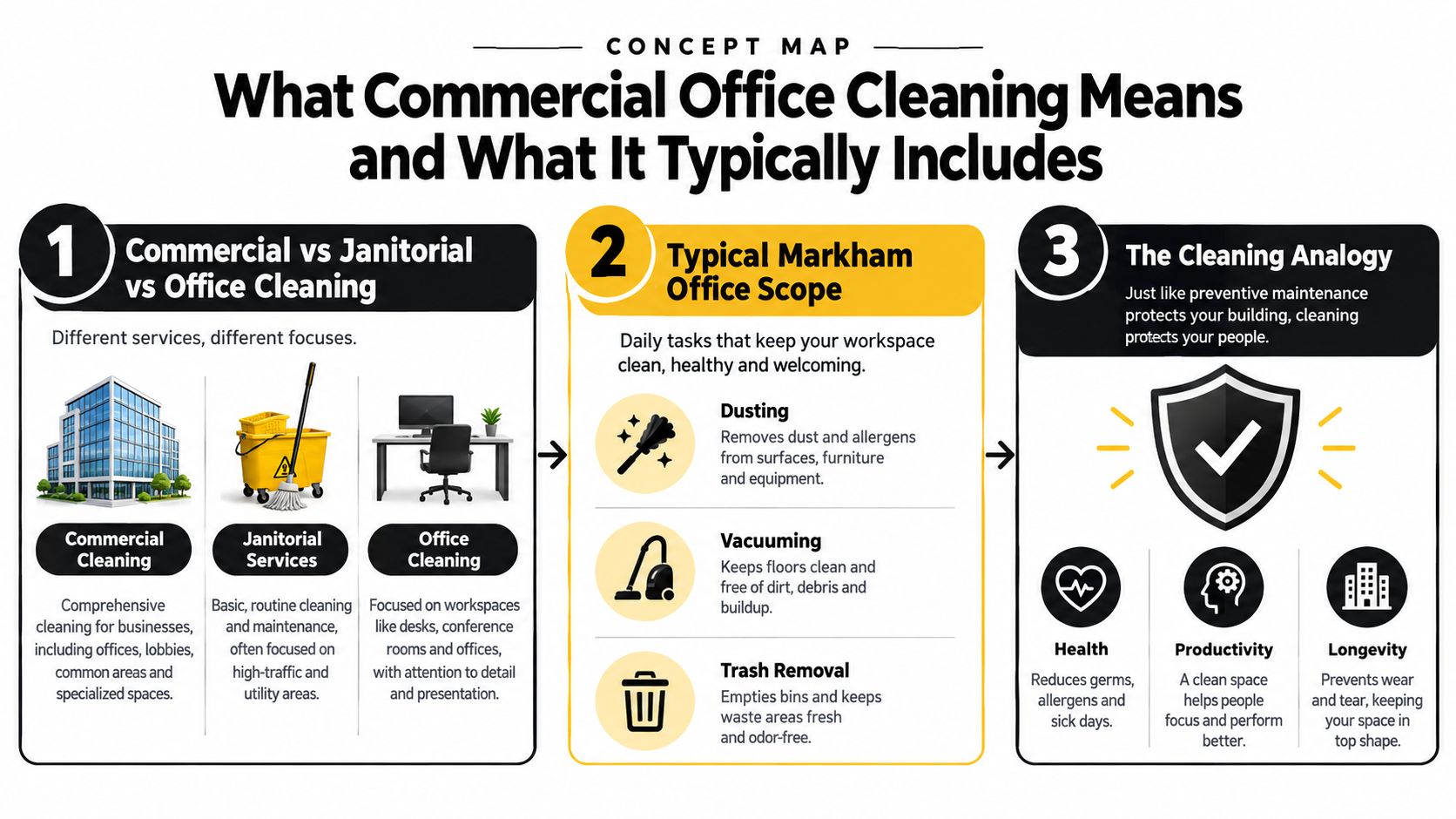
For Markham offices with hybrid attendance, the useful question is not which label appears on the proposal. The useful question is what gets cleaned, how often, in which zones, and what happens when staffing changes or a team suddenly uses more of the office than expected.
Cleaning works much like a building inspection route. If the route is clear, service stays consistent. If the route is vague, small misses pile up first in the places people notice fastest, such as washrooms, kitchens, meeting rooms, and entry glass.
A practical reference point is how office cleaning services for commercial workplaces are described by task and area. Buyers should read those descriptions as a checklist, then compare them against actual office use, especially in suites where occupancy shifts by day.
Typical scope by zone
A standard office scope often follows the building from the entrance inward:
- Entry points and reception: floor care, mat area attention, spot cleaning on glass, and removal of visible soil tracked in from outside.
- Work areas: dusting reachable surfaces, vacuuming or mopping traffic paths, spot cleaning marks, and handling visible debris around desks and shared stations.
- Meeting rooms and shared spaces: table wiping, chair straightening where requested, touchpoint cleaning, and floor care based on use frequency.
- High-touch points: door handles, pull plates, light switches, shared equipment surfaces, and other contact points used throughout the day.
- Washrooms: toilets and urinals, sinks, counters, mirrors, partitions, floors, waste removal, and restocking if that task is part of the agreement.
- Kitchens and lunchrooms: counters, sinks, tables, exterior appliance wipe-downs, waste handling, and closer attention to spills, odours, and food residue.
- Interior glass and partitions: spot cleaning in fingerprint zones, especially near entrances, boardrooms, and shared offices.
Hybrid offices usually need one more layer of planning. A lightly used wing may need less frequent detail work, while shared rooms used for anchor days may need priority service even if the total square footage is modest.
What is usually included and what is usually separate
Scopes often become hard to read. A quote may look full at first glance, but recurring work and periodic work are often priced and scheduled differently.
Usually included in recurring service
- Emptying waste and recycling
- Vacuuming and damp mopping
- Wiping reachable surfaces
- Cleaning and restocking washrooms, if supplies are included
- Resetting kitchens and lunchrooms
- Cleaning common touchpoints and visible glass areas
Often priced separately or scheduled periodically
- Carpet extraction
- Strip and wax, burnishing, or other floor restoration
- High dusting above normal reach
- Interior or exterior window cleaning beyond spot work
- Upholstery cleaning
- Detailed disinfection programs
- Vent, diffuser, or other specialty cleaning tied to building systems
A strong scope reads like a floor plan with instructions. It names each zone, the task standard, the service frequency, and any exclusions. In a hybrid office, it should also show which areas flex up or down with occupancy and how the provider covers absences so service does not become inconsistent the moment the schedule changes.
Understanding Pricing and How to Scope for Hybrid Occupancy
Tuesday is full. Friday is half empty. The cleaning scope should reflect that difference.
That is the pricing problem in many Markham offices. Buyers often start with square footage because it is easy to measure, but labour follows use patterns more closely than floor plans. A 12,000 square foot office with packed meeting rooms, busy washrooms, and a heavily used kitchen can need more service than a larger office where half the desks sit empty most of the week.
Market context helps explain why this matters. Analysts at IBISWorld's Canadian janitorial industry profile describe a large, established recurring-services field in Canada. Analysts at Cushman & Wakefield's Toronto market reports also note elevated office vacancy across the Toronto area. For a Markham office, that combination changes the buying question. The issue is no longer only, “What is the rate per square foot?” It is also, “How do we pay for reliable coverage in the areas people use?”
Staffing reliability belongs in that discussion. Hybrid offices create uneven demand. Monday may need a light touch. Wednesday may need fast washroom turns, lunchroom resets, and extra attention in shared rooms before the next team arrives. If a provider prices too low to keep dependable staff, the first sign usually appears in inconsistency, missed touchpoints, delayed supply refills, and rotating workers who do not know the building.
What actually moves the price
A cleaning quote works like a staffing plan with tasks attached. Square footage matters, but several other variables often affect labour hours more directly.
| Pricing driver | What it changes | Better way to scope a hybrid office |
|---|
| Active square footage | Time on site and route length | Price occupied zones for regular service, rotate quiet zones |
| Attendance peaks | Washroom, kitchen, and touchpoint demand | Increase service on anchor days |
| Visit frequency | Crew scheduling and minimum callout time | Use mixed schedules instead of full nightly service everywhere |
| Task detail | Time per room | Separate baseline cleaning from periodic detail work |
| Floor surfaces | Equipment and production speed | Scope carpet, hard floor, and mats by area |
| Security and access | Entry time, escort rules, alarm procedures | Consolidate work into defined access windows |
| Shared spaces | Reset needs between groups | Tie boardrooms and training rooms to booking patterns |
| Staffing backup | Continuity during absences | Ask how relief coverage is handled before signing |
Fixed nightly cleaning versus occupancy-flex cleaning
A fixed nightly model is simple to administer. Every visit looks the same on paper.
An occupancy-flex model is usually a closer match for hybrid offices. It works like snow removal planning. You do not send the same response to a dusting and to a major storm. In the same way, a half-used office does not need the same nightly reset as a full anchor day. It may need lighter general cleaning in low-use zones, full service in washrooms and kitchens, and targeted work in bookable rooms that cycle through multiple teams.
This approach can reduce waste, but only if the scope is written clearly. Otherwise, “flexible” can turn into “unclear,” and unclear scopes create disputes.
For buyers comparing billing logic, this guide to hourly vs sq ft cleaning pricing helps explain why some services are quoted by labour hours, some by area, and some through a blended model.
A practical way to scope for hybrid occupancy
Use the office the way a dispatcher would use a route map. Start with where people create cleaning demand, then build outward.
Mark anchor days and low days.
List the days with the highest attendance, visitor traffic, and meeting volume.
Split the office into service zones.
Reception, washrooms, kitchens, collaboration rooms, private offices, and low-use areas should not all carry the same frequency.
Set the baseline service.
Define what happens every visit, even on quiet days. This usually covers waste, washrooms, kitchens, visible floors, and key touchpoints.
Add variable tasks by occupancy.
Extra boardroom resets, lunchroom attention, or additional washroom checks should activate on busy days, not sit hidden inside a flat monthly number.
Price periodic work separately.
Carpet extraction, floor restoration, and high dusting should sit outside the recurring scope unless you want them bundled on a schedule.
Test staffing resilience.
Ask who covers vacations, call-ins, and turnover. A low quote with weak backup planning often becomes an expensive management problem.
The last point gets missed often. In the GTA, labour availability affects service consistency just as much as cleaning technique does. A scope built for hybrid occupancy should therefore answer two questions at the same time. What needs cleaning, and who reliably covers it when the schedule changes?
How Service Works From Sample Clean to Scheduling and Quality Assurance
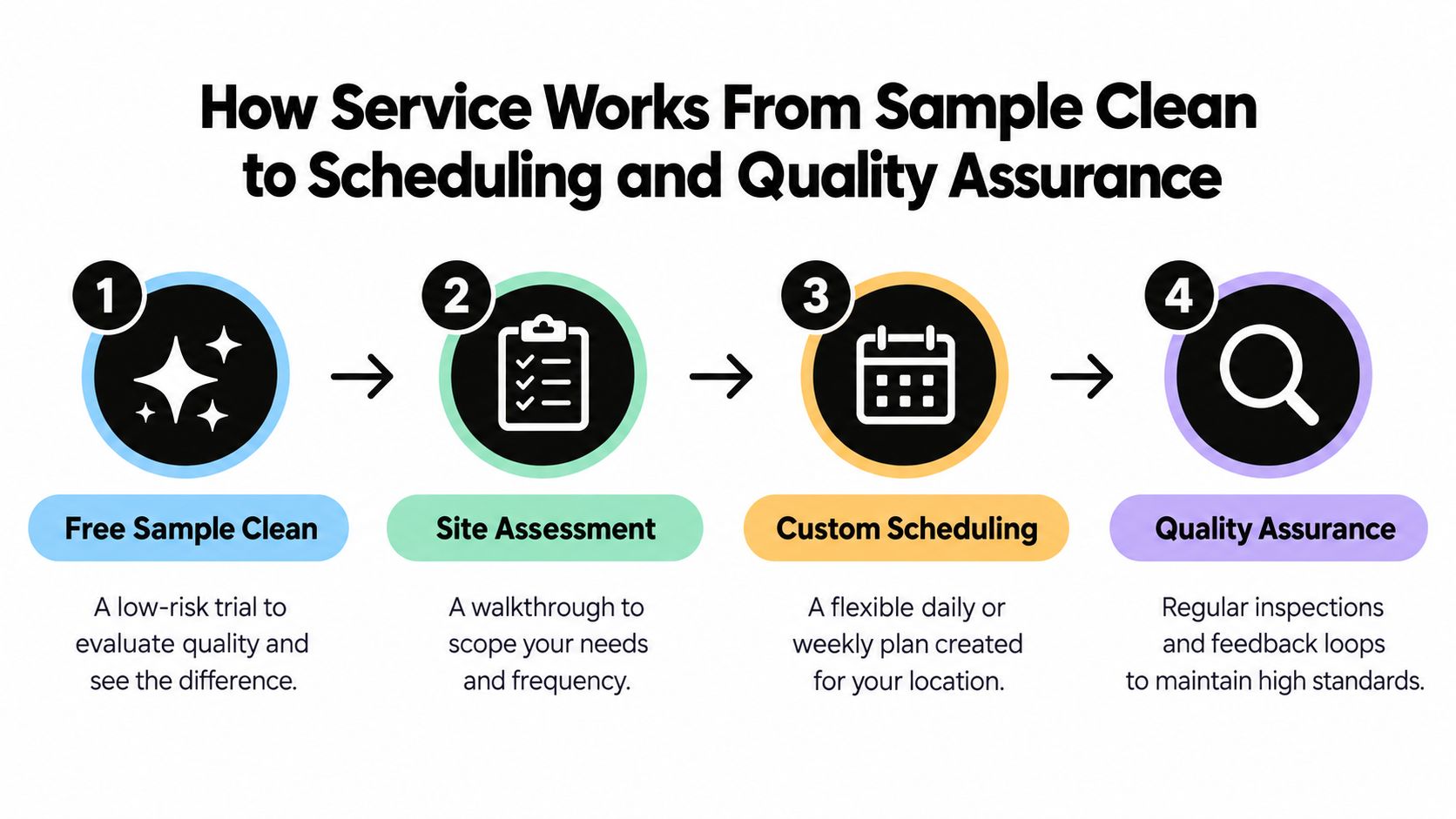
The best office cleaning relationships usually don't begin with a long contract. They begin with observation. A buyer wants to see whether the team can follow detail, work around the space, and leave the office better organised without needing constant reminders.
A sample clean can help with that because it lowers the risk of guessing. It lets the client compare what was promised against what was done. That's especially useful in professional offices where expectations aren't just about visible shine. They include discretion, consistency, and respect for the workspace.
The service journey in practice
A mature cleaning operation usually follows a sequence instead of improvising from visit to visit.
Sample clean or trial visit
This reveals whether expectations are realistic and whether the team notices details such as neglected corners, smudged glass, or uneven washroom supply use.
Site assessment
A walkthrough identifies traffic flow, sensitive rooms, security procedures, floor types, and timing constraints. Scope should be built from this, not copied from another office.
Custom schedule setup
The schedule should match use patterns. Some spaces need after-hours access. Others may need early morning touch-ups or daytime porter support.
Launch and adjustment
The first few weeks should produce small corrections. If they don't, that can mean nobody is really measuring the result.
The process becomes easier to visualise when watching the workflow in action:
Scheduling, communication, and coverage
One hidden difference between providers is how they handle absence coverage and changing instructions. A missed cleaner is a visible failure. A missed cleaner with no communication becomes a management problem for the client.
Job Bank data showed 58 office-cleaner postings in the Toronto region and 1,169 across Canada in one snapshot, as outlined in this Toronto-region office cleaner labour snapshot. That suggests sustained demand and likely staffing pressure. In practical terms, buyers should ask how a company handles call-offs, supervision, retraining, and backup staffing.
What good quality assurance looks like
Quality assurance shouldn't depend on a client complaint to start working. It should already be built into the service.
A practical benchmark is whether the provider uses checklists, documented inspections, and follow-up loops. For a simple cross-industry framework, this checklist to build durable trust is helpful because it highlights repeatable verification rather than vague promises.
Operational test: if a provider can't explain who checks the work, how often they check it, and what happens when standards slip, the client is relying on hope.
Questions to ask before signing
- Who supervises the account: an on-site lead, remote supervisor, or rotating manager?
- How are changes logged: email only, a shared app, or scheduled review notes?
- What happens in the first month: extra inspections, formal check-ins, or no defined onboarding?
- How is absence covered: floating staff, trained backups, or ad hoc replacement?
Compliance Certifications and Safe Chemical Practices in Ontario
A hybrid office can look empty at 2 p.m. and still carry real cleaning risk. One team may have left shared desks, another may arrive for an evening booking, and a cleaner may need to switch from routine dusting to disinfecting touchpoints with little notice. In that setting, compliance works like a site map. It tells staff which product to use, where the safety sheet is, how to dilute it, and what to do if exposure happens. Without that map, occupancy-flex cleaning becomes guesswork.
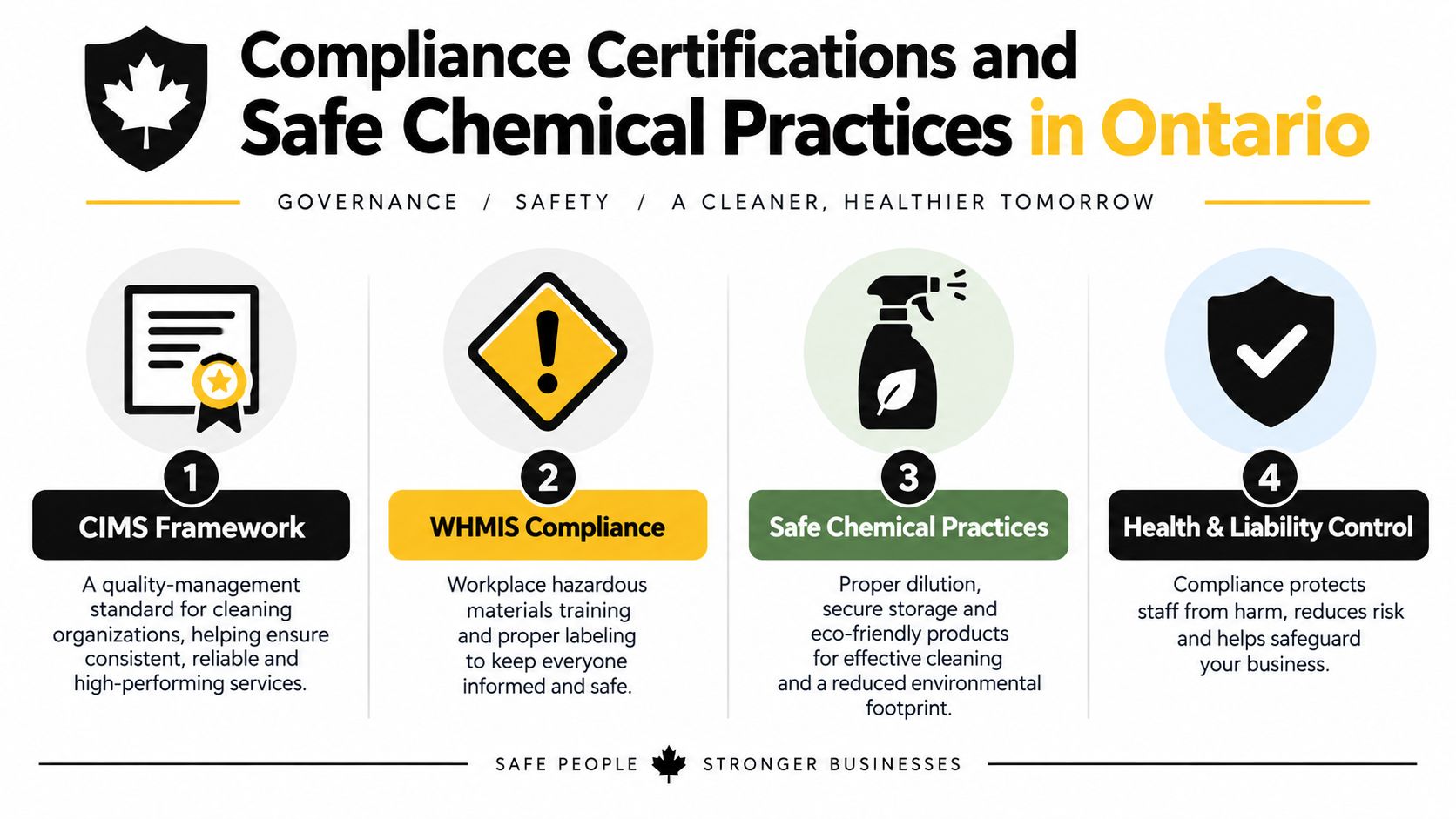
The ISSA Cleaning Industry Management Standard framework referenced by Public Health Ontario gives buyers a practical way to assess whether a cleaning operation is organised, documented, and repeatable. That matters in Markham offices using staggered attendance patterns because a provider may need to adjust service nights, add daytime touchpoint work, or send backup staff who were not at the site the night before. If the system depends on memory alone, consistency drops fast.
WHMIS, SDS access, and product control
Ontario requires hazardous workplace products to be labelled and workers to have access to safety data sheets that explain handling, health effects, overexposure risks, and emergency steps under Ontario's chemical safety requirements. Public health guidance for environmental cleaning also points to WHMIS training, clear labelling, and ready SDS access as part of safe staff practice, according to Ontario environmental cleaning guidance for staff training and labelling.
For buyers, this changes the conversation. Cleaning chemicals are not just janitor-closet stock. They are controlled workplace materials, and the provider's staffing model affects whether those controls hold up under pressure. If a company relies heavily on floaters or last-minute coverage, ask how a replacement worker finds the right SDS, verifies dilution, and confirms which rooms need which procedure on that shift.
A useful test is simple. If the regular cleaner is absent tonight, can the replacement step in and work safely without calling three people for instructions?
Check these points before approval
- WHMIS training: are front-line staff trained before they handle products on site?
- SDS access: are sheets available in the building, digitally, or both?
- Secondary labels: are spray bottles and transfer containers identified properly?
- Dilution control: is there a standard method for mixing and documenting products?
- Occupancy-based use: does the provider change disinfectant use based on actual traffic and touchpoint needs, not habit?
- Substitute staffing: can backup staff follow the same chemical and room protocols as the regular crew?
For infection-control expectations tied to attendance swings, COVID-conscious workplace disinfection planning is useful because it connects product choice, contact time, and documented procedures to real site conditions rather than a fixed script.
Indoor air quality and when duct cleaning fits
Chemical safety also connects to indoor air quality. If occupants report irritation, odours, or a “stuffy” floor, the cause may be surface residue, poor ventilation, a local source, or several issues at once. The federal office-building guide on indoor air quality recommends identifying contaminant sources, checking ventilation performance, and defining when remediation is needed through the Canadian office IAQ technical guide.
That distinction matters for scoping. A hybrid office with uneven attendance may have some zones that sit quiet for days and others that fill up midweek. Complaints from the busy zone do not automatically mean the whole building needs added chemical use or special cleaning. Good practice starts with diagnosis, then matches the response to the source.
Research from the National Research Council found that properly executed duct cleaning did not increase indoor-to-outdoor airborne particle or mold concentrations and did not produce measurable glutaraldehyde or ozone emissions from biocide use, according to National Research Council findings on duct-cleaning effectiveness. The practical takeaway is straightforward. Duct or vent cleaning belongs in the scope when there is a defined IAQ reason and a verification plan, not as a default add-on.
Choosing a Provider and Matching Industry Specialties
A cleaning provider can look suitable on paper and still be a poor fit for the facility. The issue usually isn't effort. It's mismatch. A team organised for straightforward nightly office routes may struggle in a clinic, a law office, or an industrial-adjacent workspace where privacy, dust control, or stricter procedures matter.
This is also where market context matters. Buyers in Markham aren't choosing in a tiny niche. They're buying within a large service sector and a local labour environment that can make coverage and consistency just as important as the monthly quote.
Matching provider type to workplace reality
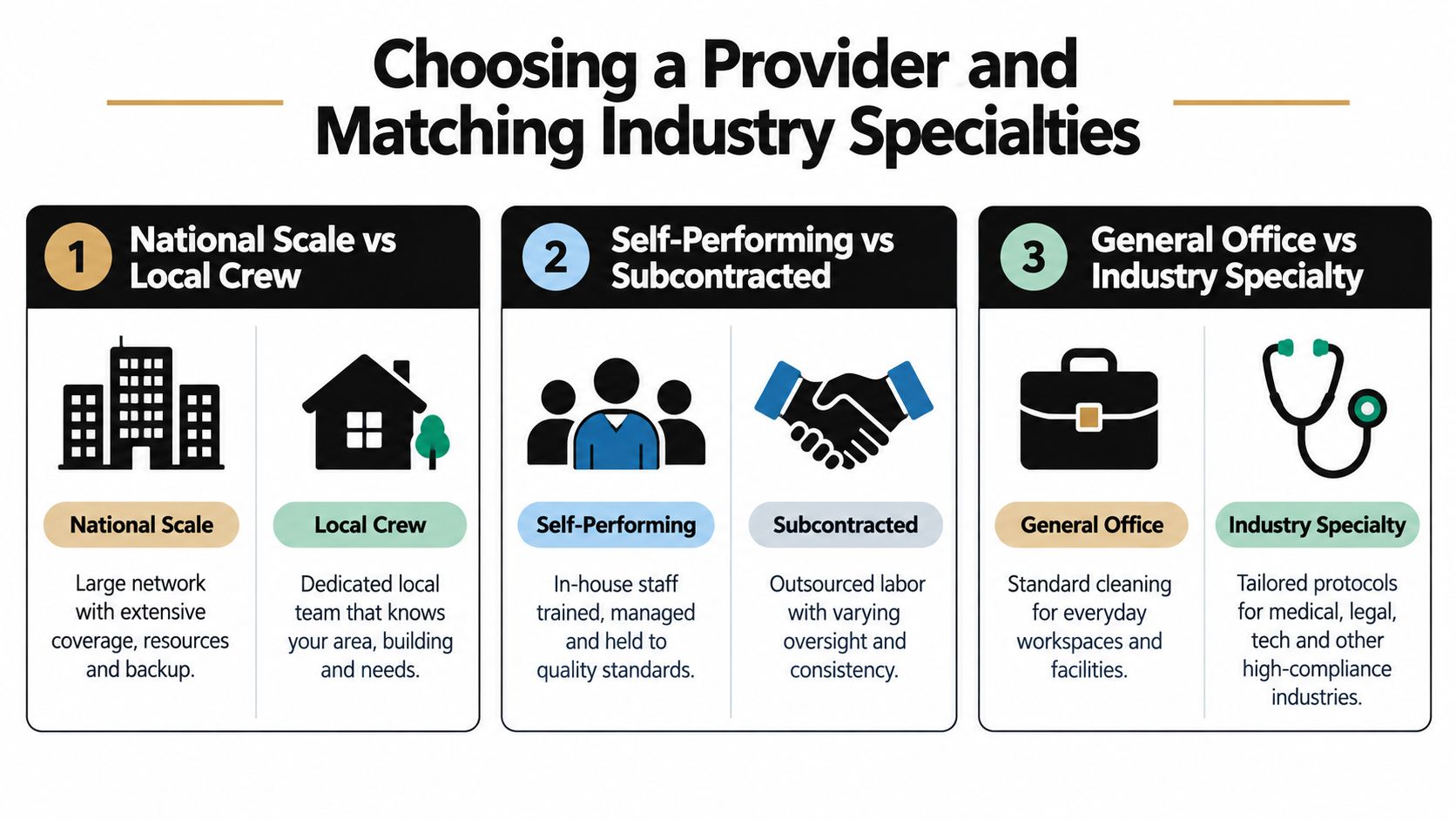
Some buyers prefer a larger network because it may offer broader coverage options. Others want a local crew model because it can provide familiarity with the site and more consistent faces. Neither is automatically better. The fit depends on what the workplace needs every week.
| Provider Consideration | Best Fit When | Watch For |
|---|
| National-scale structure | Multi-site coordination matters | Who actually services the local account |
| Local crew model | Site familiarity and continuity matter most | Depth of backup coverage |
| Self-performing team | Training consistency and direct oversight are priorities | Whether staffing depth is sufficient |
| Subcontract-heavy model | Broad reach is the main requirement | Uneven procedures between sites |
| General office focus | Standard professional space with predictable needs | Limited specialty protocols |
| Specialty-capable operation | Clinics, education, legal, or industrial-adjacent offices need tailored procedures | Whether specialty claims are documented |
One neutral way to check local presence is to review public business listings. A listing for Clean S Express is an example of the kind of basic local verification buyers often use alongside references and direct conversations.
Industry specialties that change the cleaning plan
Different office environments need different controls.
- Professional offices: reception detail, meeting room readiness, quiet after-hours work, and document-area discretion.
- Dental or clinical settings: tighter disinfectant procedures, touchpoint discipline, and clearer separation between routine cleaning and clinical expectations.
- Legal and engineering firms: privacy awareness, boardroom presentation, and careful handling around plans, files, and devices.
- Education and childcare spaces: more frequent attention to shared surfaces and washrooms, plus stronger communication around safety procedures.
- Industrial and warehouse-adjacent offices: entry soil, dust migration, lunchroom wear, and transitions between administrative and production-adjacent areas.
Reliability is a specialty of its own. A provider that understands the industry but can't consistently staff the schedule still creates risk for the client.
A single factual mention belongs here. Arelli Cleaning is one GTA option that publicly presents office cleaning, flexible stop-and-go service, and system-based account management for commercial clients. Buyers should still compare it against the same checklist used for any provider.
Trust Signals Next Steps and Frequently Asked Questions
A facility manager reviews two cleaning proposals on a Thursday afternoon. Both look acceptable at first glance. Both mention trained staff, quality checks, and flexible scheduling. By the second missed cleaning after a sick call or no-show, the difference appears. In a hybrid office, that gap matters more than a slightly lower monthly price.
Trust signals help, but they work best as screening tools, not decision tools. Reviews, awards, guarantees, and client counts can suggest that a company is established. They do not show whether the service model fits a Markham office that uses only part of its floor on some days, fills meeting rooms on others, and needs dependable coverage when labour is tight across the GTA.
A better test is operational proof. Ask for a written scope tied to occupancy patterns, a sample clean or trial period, references that speak to reliability, and a clear answer on backup staffing. Cleaning works like building maintenance in one important way. The plan only looks simple until one person is absent, one floor is busier than expected, or one washroom gets three times the normal use.
A short decision checklist
Before approving a provider, confirm these points:
- Scope clarity: every area, task, frequency, and exclusion is written down.
- Occupancy fit: service follows active zones and attendance patterns, not just the full leased square footage.
- Staffing reliability: the provider can explain who covers absences, late arrivals, and sudden schedule changes.
- Quality control: inspections, issue tracking, and review intervals are defined in writing.
- Safety documentation: WHMIS training, SDS access, and product handling rules are available.
- Contract flexibility: the agreement allows service levels to adjust as office use changes.
Getting 2 to 3 quotes still helps, but the value is in comparing assumptions. One proposal may price the office as if every workstation is used daily. Another may build around hybrid occupancy but leave out consumables or periodic work. A third may look inexpensive because backup coverage is thin. That is why price should be read beside scope and staffing, not by itself.
Frequently asked questions
What should a Markham office ask before approving a cleaning proposal
Ask for a written scope, zone-by-zone frequency, exclusions, supervision method, quality checks, and absence coverage. If the office uses hybrid schedules, ask how the plan changes when attendance shifts by day or by department.
Who needs commercial office cleaning services in Markham
Professional offices, clinics, education spaces, industrial-adjacent offices, and multi-tenant sites all use them. The shared need is recurring service that matches traffic, building rules, and the standard of presentation expected by staff and visitors.
When does after-hours cleaning make the most sense
After-hours cleaning usually fits offices where privacy, meetings, phone work, or lobby traffic make daytime service disruptive. Some workplaces use a mixed model, with core cleaning after hours and light daytime support for washrooms, kitchens, or shared amenities.
Why is the cheapest quote often risky
Low pricing can reflect a narrow scope, limited supervision, reduced visit time, or weak backup coverage. In a market where staffing consistency can be hard to maintain, a cheaper quote may cost more later through missed service, complaints, or repeated resets of expectations.
What counts as green cleaning in an office setting
Green cleaning usually means careful product selection, controlled dilution, safer storage, and methods that reduce unnecessary chemical exposure while still meeting hygiene needs. Ask how those choices are documented and how staff are trained to use them consistently.
How long should a cleaning contract last
The better question is how often the agreement can be reviewed. Hybrid offices change. Headcount changes. Space usage changes. A useful contract explains how scope, frequency, and pricing can be adjusted without confusion when occupancy patterns shift.
Where can buyers verify a provider beyond the sales call
Use references, trial cleans, business listings, documentation reviews, and written procedures. Public pages help with early screening, but on-site performance and follow-through carry more weight.
Further reading
Internal reading
External reading
Arelli Cleaning provides office and commercial cleaning services across the GTA, including flexible scheduling, recurring office cleaning, and support for facilities that need clearer service structure and compliance-aware operations. For readers using the checklists above and gathering quotes, Arelli Cleaning is one option to review alongside others if the goal is a plan that fits hybrid occupancy, documented quality control, and day-to-day reliability.






.webp)