A facility manager in Mississauga often faces the same problem on Monday morning. One floor is busy, another is half empty, the meeting rooms were used heavily on Tuesday and barely touched on Friday, and no one wants to pay for a cleaning scope built for full occupancy when the office isn't operating that way.
That's why commercial office cleaning services in Mississauga can't be treated as a generic checklist anymore. A professional office with hybrid schedules, shared desks, satellite teams, and uneven attendance needs a service model that follows actual use. Not assumptions.
Mississauga is large enough to support that kind of planning. The city's 2021 employment survey recorded 22,453 operating businesses, and the same dataset reported that 12% of business sites were vacant, with business vacancies rising 22% from 2,700 in 2019 to 3,310 in 2021 according to the City of Mississauga employment survey and historical business site data. That mix of active businesses, vacancy, turnover, and re-tenanting creates ongoing demand for routine office cleaning, move-in and move-out cleaning, and post-construction cleanup.
A local buyer usually doesn't need more hype. The buyer needs a practical way to decide what should be cleaned, how often, what compliance standards matter in Ontario, and how to compare quotes without overbuying service.
Key takeaways
- Commercial office cleaning covers more than nightly tidying. It includes routine maintenance, washroom hygiene, floor care, touchpoint disinfection, and specialty tasks.
- In Mississauga, occupancy swings matter as much as square footage when setting scope.
- Safe cleaning in Ontario depends on training, approved products, and documentation, not just effort.
- The best quote is usually the one with the clearest scope and verification process, not the lowest starting number.
- A good service plan should be easy to adjust when attendance patterns change.
Introduction to Commercial Office Cleaning in Mississauga
A facilities lead arrives Tuesday morning and finds the office half full. Reception was busy. The kitchen saw steady use. One bank of workstations stayed empty all day, while two meeting rooms turned over four times. In that setting, a cleaning plan based only on square footage misses the job.
That is the starting point for commercial office cleaning in Mississauga today. Many offices are active, but not evenly active. Attendance shifts by team, by weekday, and sometimes by floor. A good scope follows traffic patterns, shared-space use, and turnover pressure, not the layout on the leasing brochure.
Commercial office cleaning means the planned cleaning and upkeep of office space, including reception areas, workstations, boardrooms, kitchens, washrooms, corridors, and staff rooms. It usually combines recurring janitorial work with periodic tasks such as carpet care, interior glass cleaning, and high dusting. The practical question is not just what belongs on that list. The practical question is which parts of the office need daily attention, which need scheduled rotation, and which can be cleaned based on actual use.
That distinction matters in Mississauga because the local office market has seen both vacancy and uneven occupancy. Analysts in a city office market summary noted shifts in vacancy and broader commercial inventory in Mississauga, which helps explain why many buyers are reassessing service levels instead of renewing the same scope year after year, as noted in the Mississauga employment and office market analysis.
A useful way to picture scope is to treat cleaning like building maintenance triage. High-touch, shared areas are the front line. Washrooms, kitchen surfaces, entrances, elevator buttons, and reception counters collect use regardless of whether private offices sit empty. Low-use zones still need care, but often on a different rhythm.
That is where confusion usually starts for buyers:
- Standard work versus periodic work: Emptying waste, vacuuming, and cleaning washrooms are not the same as floor refinishing, carpet extraction, or post-renovation cleanup.
- Frequency versus visibility: A clean-looking desk row may need less attention than a small kitchenette used by 40 people in one afternoon.
- Cleaning versus compliance: Good results depend on trained staff, suitable products, and documented procedures, not effort alone.
For a 30 to 60 percent occupied floor, right-sizing service often produces a better result than cutting hours across the board. Shared spaces may need full daily attention. Light-use desk areas may need rotation. A tenant preparing for a move, restack, or re-entry may need a temporary reset instead of a permanent increase in nightly service.
The goal is simple. Match cleaning scope to present-day use so the office stays healthy, presentable, and cost-aware at the same time.
What Commercial Office Cleaning Services Include
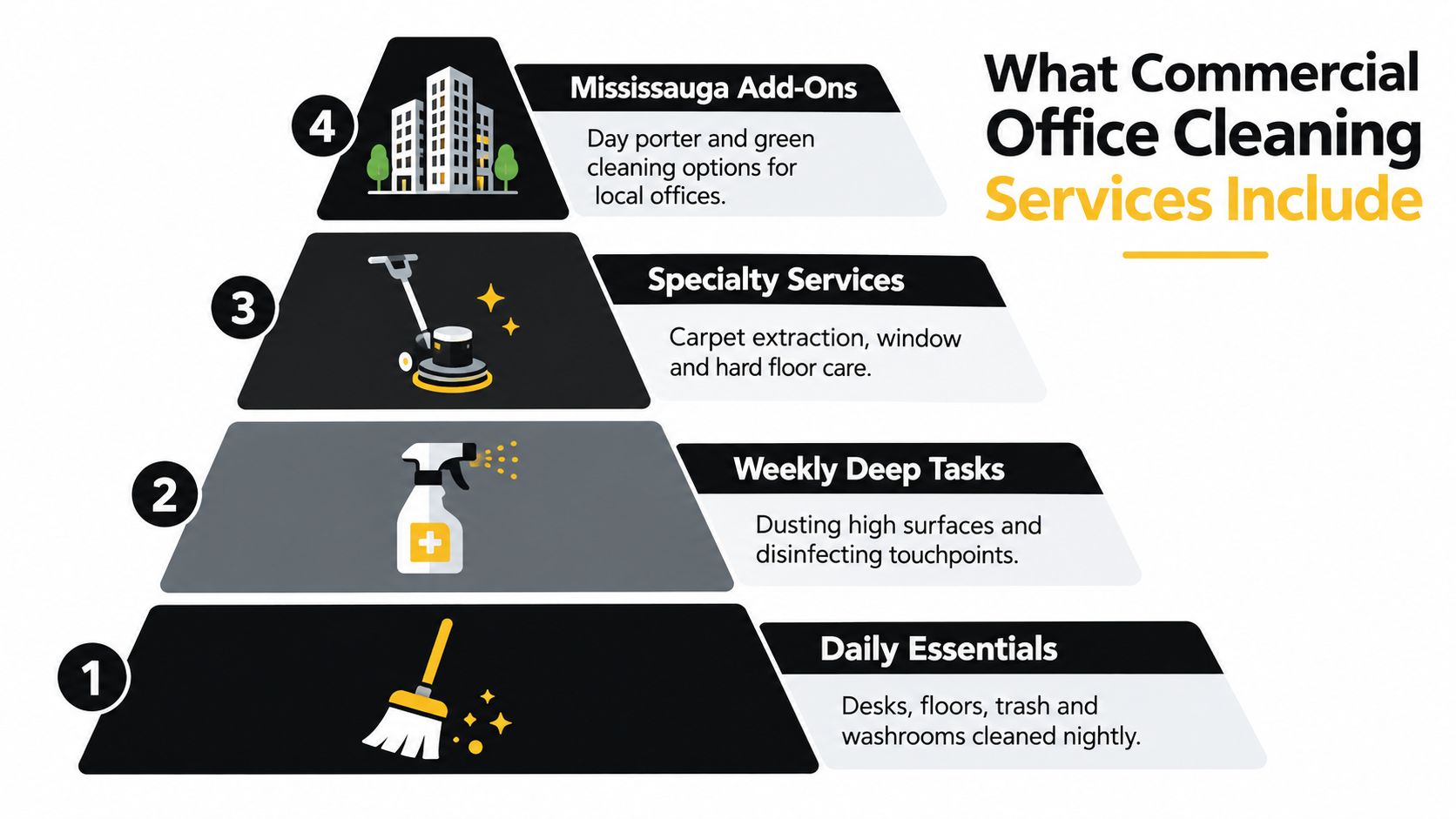
Commercial office cleaning is easiest to understand as layers of maintenance. Some tasks protect daily appearance. Others protect hygiene. A third group protects building finishes and indoor conditions over time.
The service categories below help buyers map needs to scope.
Commercial cleaning and janitorial cleaning
People often use these terms interchangeably, but they aren't always identical.
Janitorial cleaning usually refers to recurring maintenance tasks such as:
- Trash and recycling removal: Emptying bins and relining them
- Floor attention: Vacuuming carpet, damp mopping hard floors
- Washroom reset: Cleaning fixtures, mirrors, partitions, and replenishing supplies
- Surface wiping: Desks, counters, tables, and visible touchpoints
Commercial cleaning is broader. It includes janitorial work but also periodic and specialty services based on the facility's needs. That may include floor refinishing, window cleaning, deep kitchen detailing, high dusting, or post-renovation cleanup. Buyers comparing service descriptions can review a focused internal overview of office cleaning services for commercial spaces.
Core recurring services
Most office programs start with a stable routine.
- Reception and common areas: These spaces shape first impressions and usually need consistent dusting, floor care, and glass touch-up.
- Workstations and meeting rooms: Shared desks, tables, chair arms, and equipment-adjacent surfaces often need frequency tied to actual use.
- Washrooms: These require the most consistent sanitation because fixtures, dispensers, partitions, and touchpoints see repeated use.
- Kitchenettes and break rooms: Sinks, counters, appliance exteriors, handles, and lunch surfaces need methodical cleaning to prevent odours and residue buildup.
A simple way to picture it is this: daily cleaning protects function, while periodic deep cleaning protects the building.
For teams that handle restocking or site preparedness internally, it can also help to find janitorial supplies online so the office and the cleaning provider are working from the same supply plan.
A short visual walk-through can also help readers connect these categories to real office tasks.
Specialty and periodic services
These services are usually added on a schedule or after an event.
Carpet extraction and spot treatment
Useful where walk-off zones, corridors, and boardrooms collect soil faster than general vacuuming can manage.
Hard floor care
Scrubbing, burnishing, or refinishing helps preserve appearance and reduce wear in lobbies and high-traffic circulation paths.
High dusting
Vents, ledges, tops of partitions, and light fixtures collect dust that regular line-of-sight cleaning misses.
Interior glass and partition cleaning
Important in offices with many enclosed rooms, sidelights, and glass-front meeting spaces.
Post-construction and move-related cleaning
Needed after renovations, tenant improvements, furniture reconfigurations, or lease transitions.
Daily service keeps an office usable. Periodic service keeps it from declining slowly in ways occupants notice before managers do.
Pricing Drivers and How Occupancy Changes Scope
Cleaning buyers often ask for a price before they've defined the scope. That usually leads to weak comparisons. In practice, commercial office cleaning services in Mississauga are built from a set of operating variables, not one simple rate.
The most important shift today is that occupancy pattern has become a core pricing and scoping factor. An office that is half used most days doesn't need to be cleaned exactly like one that is fully staffed every day, but it also can't be ignored. Shared areas may still be under heavy pressure even when private offices sit empty.
What actually drives the quote
A realistic quote usually reflects a mix of the following:
- Cleanable square footage: Total area still matters, especially for floors and circulation routes.
- Frequency of service: Nightly, several times per week, day porter support, or periodic-only work.
- Type of space: General office space is different from a dental admin area, training centre, or client-facing suite.
- Flooring mix: Carpet, vinyl, tile, polished concrete, and entry matting all require different labour and equipment.
- Touchpoint density: Shared kitchens, copier zones, washrooms, handles, switches, and collaborative spaces increase workload.
- Specialty requirements: Interior glass, high dusting, post-construction cleaning, or sensitive rooms affect time and method.
Occupancy is now the scoping variable many buyers miss
The underserved question in the GTA isn't just “what does office cleaning cost?” It's “what service model fits a space that is only partly occupied most days?” Recent market commentary highlighted that issue directly, noting that buyers are navigating hybrid schedules, uneven floor use, and shifting occupancy patterns in the GTA office market in the CBRE Canada office figures discussion of occupancy and service-model questions.
That matters because a partly occupied office often needs targeted intensity, not blanket frequency.
| Occupancy Scenario | Recommended Frequency | Priority Areas | Cost Driver Impact |
|---|
| Fully occupied office | Frequent recurring service | Washrooms, reception, kitchens, meeting rooms, full workstation areas | Higher labour consistency across the whole site |
| Partially occupied floor | Zoned service with adjusted frequency | Active desk clusters, shared spaces, washrooms, entrances | Lower scope in unused zones, but not always lower touchpoint work |
| Flexible or rotating workspace | Flexible recurring service with close review | Shared desks, booking rooms, touchpoints, pantry areas | More change management and communication required |
How to right-size the service
A buyer can usually improve scope accuracy by separating the office into three categories:
- Always-active spaces: reception, washrooms, lunchrooms, elevator lobbies, main corridors
- Variable-use spaces: boardrooms, touchdown areas, training rooms, collaboration zones
- Low-use spaces: archived offices, overflow desks, seldom-used private rooms
That approach helps avoid paying for nightly work in underused areas while still protecting the spaces occupants touch every day.
A half-full office can still have full-pressure washrooms and kitchens. Underused desks don't cancel out heavily used common areas.
The most useful quote request includes a floor plan, occupancy pattern by day, any shared-desk policy, and a clear list of spaces that are active, intermittent, or mostly inactive. That gives the vendor something better than a square-foot guess.
Compliance Insurance and Safe Product Standards in Ontario
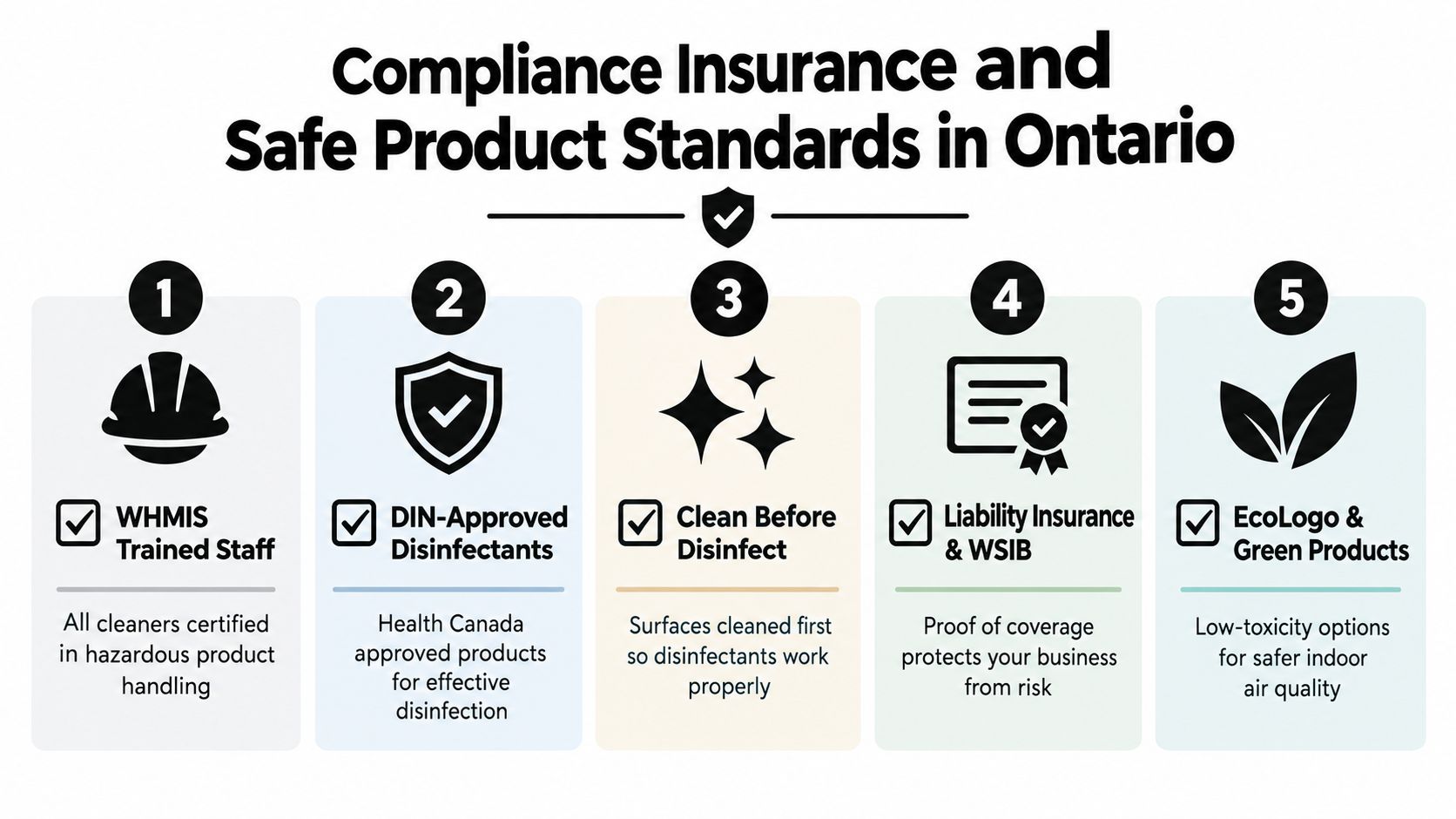
A clean office isn't automatically a safe office. Cleaning quality in Ontario depends on method, product selection, worker training, and proof that the process can stand up to review.
That matters even more in offices attached to dental clinics, childcare settings, education spaces, and professional environments where buyers may need documentation for inspections or internal audits.
Product safety and staff training
Canadian guidance is clear on a few basics. The Canadian Centre for Occupational Health and Safety says cleaning staff should participate in WHMIS training when using hazardous products, should use a disinfectant with a Drug Identification Number (DIN) because that means the product has been approved for use in Canada, and should clean visibly dirty surfaces before disinfecting them according to the CCOHS guidance for cleaning staff.
That “clean first, disinfect second” sequence is where many buyers get confused. Disinfectant isn't a substitute for removing soil. If residue remains on the surface, the disinfectant may not work as intended.
For workplaces that want an internal benchmark for infection-aware programs, a vendor may also describe its procedures through a documented COVID-conscious cleaning approach.
Indoor air quality and cleaning method
Health Canada's office-building guidance recommends proactive housekeeping that reduces dust generation by using damp wiping or wet dusting and mopping, choosing low-VOC cleaning products, and using vacuums with HEPA filtration when appropriate. The guidance also advises routine cleaning schedules and selecting Health Canada approved disinfectants with a DIN when disinfection is needed in office settings, as described in the Health Canada guidance on improving indoor air quality in office buildings.
Cleaning works best as part of a building system. Dust removal, ventilation, filtration, and moisture control have to line up.
What records a vendor should be able to provide
A facility team doesn't need paperwork for its own sake. It needs enough documentation to verify safe practice.
A practical checklist includes:
- Insurance confirmation: Proof of liability coverage and workplace coverage where applicable
- Training records: Evidence that staff handling products understand labels and safe use
- Product list: The disinfectants and cleaning chemicals used on site, including DIN where relevant
- Site-specific scope: A written task schedule matched to the building
- Issue log or inspection record: A way to track concerns, corrective action, and follow-up
Ontario buyers in sensitive environments often don't need more service. They need better verification.
How to Choose a Vendor and What to Avoid
Most cleaning problems start before the first shift. They start in the buying stage, when the quote looks complete but the scope is vague, the quality checks are unclear, and no one has explained how issues will be handled.
A better selection process compares systems, not just price.
What to ask before choosing
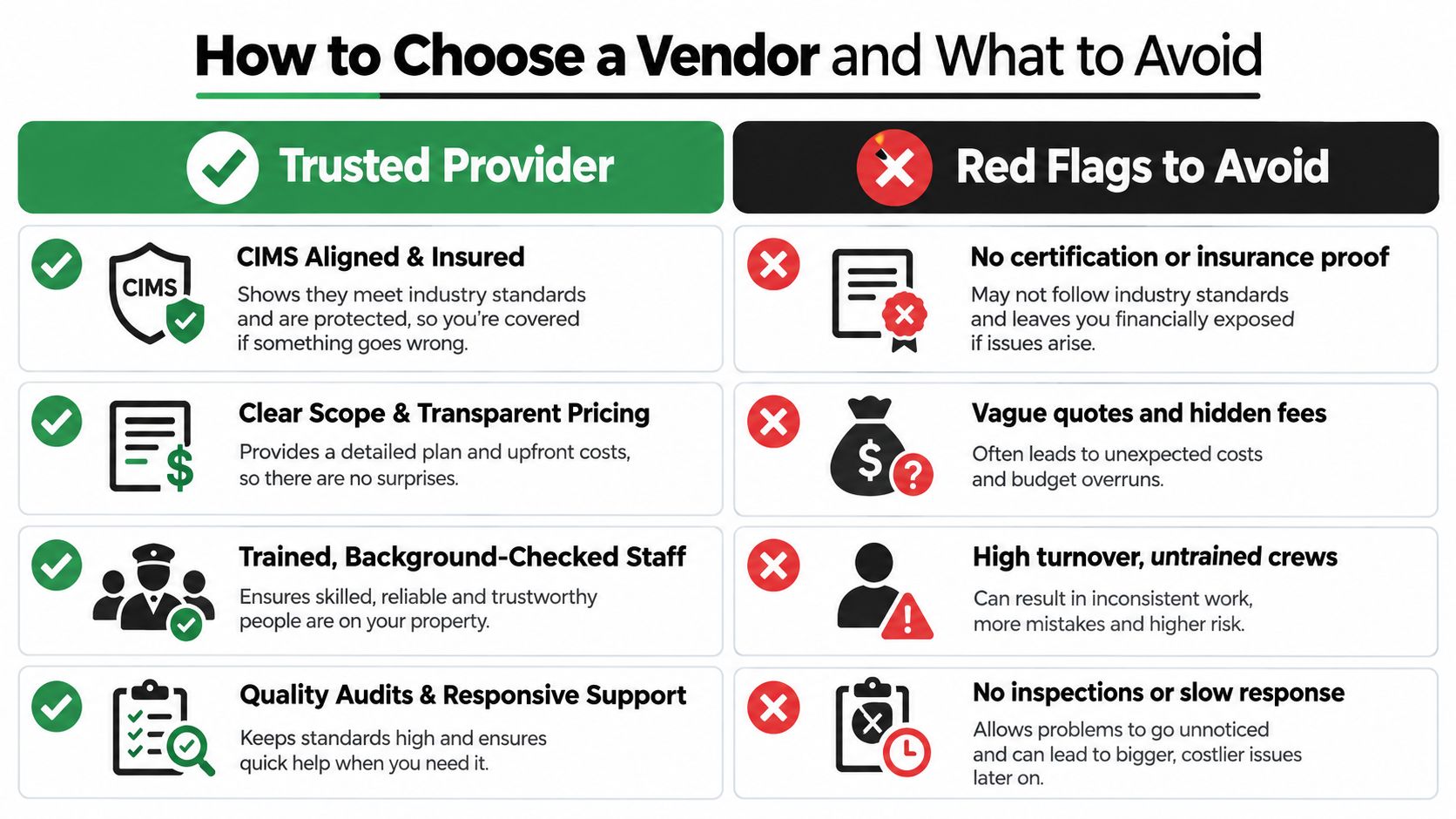
ISSA's Cleaning Industry Management Standard, or CIMS, is described by ISSA Canada as a certification program and the first consensus-based management standard for a successful, quality cleaning organization in the ISSA Canada overview of CIMS. Even when a vendor isn't formally presenting certification documents in a sales conversation, CIMS-style thinking gives buyers a useful benchmark.
Questions worth asking include:
- How is the scope documented? A good proposal identifies tasks, frequencies, exclusions, and periodic work.
- How are staff trained for this site? General training isn't enough for every office type.
- What quality assurance system is used? Inspections, checklists, and escalation paths should be defined.
- How are occupancy changes handled? A hybrid office needs adjustments without rewriting the relationship every month.
- What proof can the vendor provide? Insurance, training records, product information, and communication logs should be available.
Red flags that often lead to re-tendering
Some warning signs appear early.
- Vague scope language: Phrases like “clean all areas as needed” leave too much open to interpretation.
- No mention of training: If product handling and site procedures aren't discussed, the buyer may be assuming standards that aren't in place.
- No inspection routine: Without verification, complaints become the quality system.
- One-size-fits-all frequency: This often means the vendor hasn't thought through the office's usage pattern.
- Poor questioning during the walkthrough: If no one asks about occupancy, floor finish, shared desks, or washroom load, the quote may be little more than a guess.
The safest vendor usually isn't the one promising everything. It's the one defining exactly what will happen, where, and how it will be checked.
A simple decision framework for two or three quotes
A buyer can score proposals on four categories:
Scope clarity
Are tasks and frequencies specific?
Operational fit
Does the plan reflect partial occupancy, sensitive rooms, and timing needs?
Compliance readiness
Can the vendor support documentation, training, and approved product use?
Service management
Is there a named process for communication, inspections, and corrections?
One neutral example in the local market is Arelli Cleaning, which presents office and commercial cleaning as a system that includes app-based communication, flexible service changes, and documented support processes. That isn't automatically the right fit for every building, but it is the kind of operational detail buyers should look for in any proposal.
What to Expect From Onboarding and Quality Assurance
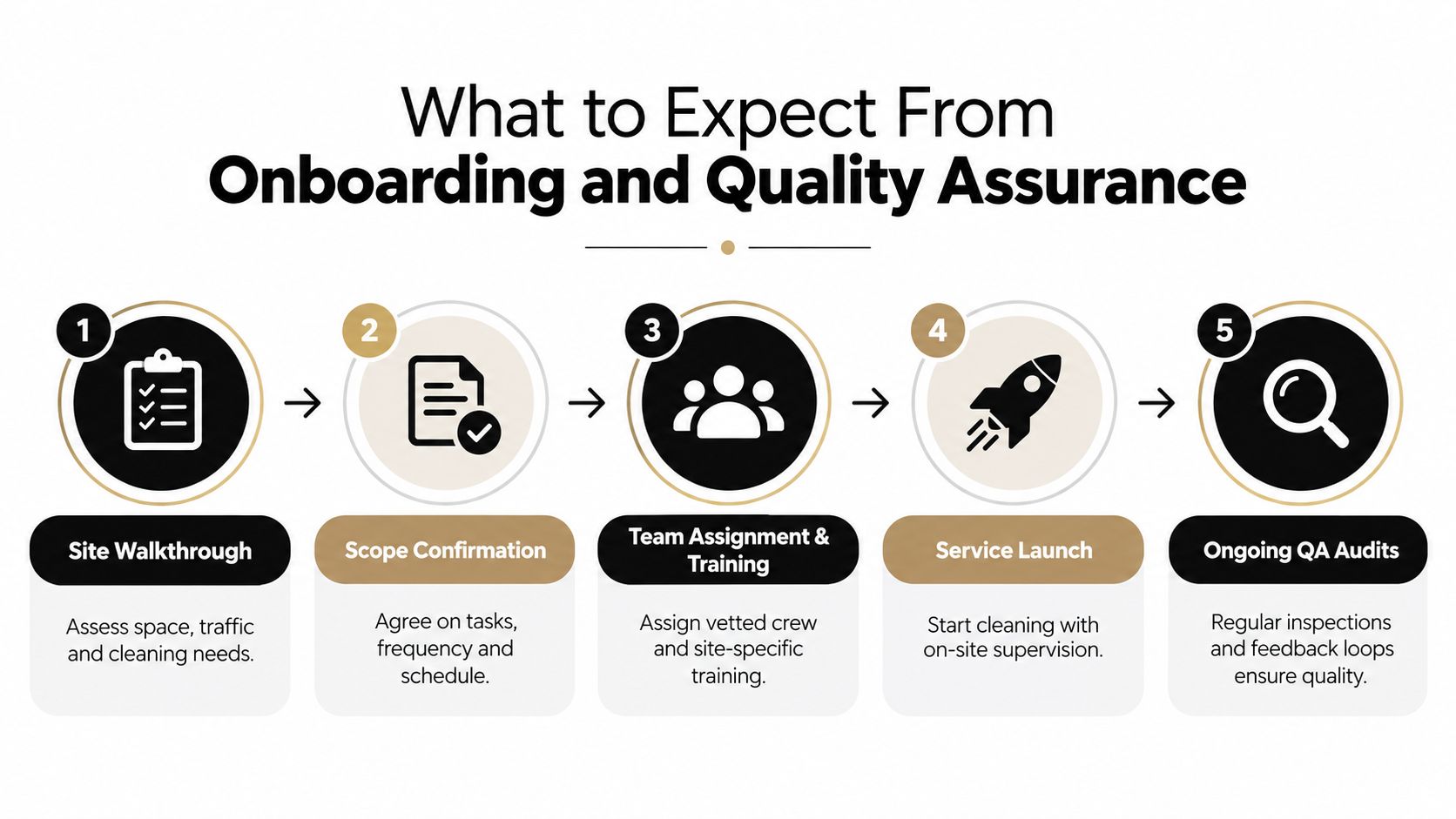
A cleaning contract shouldn't begin with guesswork. Good onboarding turns a quote into a repeatable operating routine. The office manager, property contact, and cleaning team all need the same understanding of priorities, access rules, supplies, and reporting.
That's where consistency starts.
The first steps after approval
A structured start usually includes these actions in order:
- Site walkthrough: The parties confirm active zones, restricted rooms, washroom count, floor finishes, and any sensitive surfaces.
- Scope confirmation: The written task list is matched to site conditions.
- Scheduling and access setup: Alarm procedures, key or card handling, loading access, and service windows are agreed.
- Supply alignment: The team confirms who provides liners, tissue, soap, paper products, and specialty consumables.
- Crew assignment: The site should be assigned to staff who know the building layout and cleaning sequence.
What early quality control should look like
The first few weeks matter because minor misunderstandings show up quickly. A meeting room may be cleaned properly but missed after a late booking. A kitchen may need more frequent attention than expected. A low-use office may be receiving unnecessary nightly work.
Good quality assurance catches those issues before they become complaints.
A practical system often includes:
- Regular inspections: Someone verifies that the scope is being delivered as written
- Deficiency tracking: Problems are recorded, assigned, and closed
- Communication loop: The client has a clear way to report issues and receive confirmation
- Scope adjustments: The service plan changes when occupancy patterns change
A stable cleaning program is rarely perfect on day one. It becomes reliable when the provider can detect gaps, respond quickly, and update the plan without friction.
What a buyer should notice
The easiest signs of a healthy onboarding process are operational, not cosmetic.
- The team knows which areas are high priority.
- Entry and locking procedures are consistent.
- Supply shortages are flagged before they become disruptions.
- Concerns are acknowledged clearly and resolved with visible follow-up.
When those basics are in place, cleaning stops feeling like a recurring problem to manage.
Benefits Local Considerations and Next Steps With Arelli Cleaning
A common Mississauga office pattern looks like this. The lease covers a full floor, but staff attendance shifts through the week, several offices stay dark, and the busiest pressure points are the front entry, washrooms, kitchen, and a cluster of shared desks. If the cleaning plan still treats every room as fully active every night, you pay for motion instead of need.
That is where local context changes the buying decision. In Mississauga, many offices are operating below their original headcount plan, so the right question is not just "What is included?" It is "Which areas are active often enough to justify daily work, and which areas should move to a lighter schedule?" Cleaning scope works like HVAC zoning. You do not heat every room the same way when half the floor is unused. Cleaning should follow the same logic.
The practical benefits are straightforward. A right-sized program keeps high-touch areas presentable, reduces avoidable wear in low-use spaces, supports a healthier shared environment, and gives property or facility teams a cleaner record of what is being serviced and why. It also cuts a common source of frustration. Complaints often come from missed busy areas, not from a private office that no one entered all week.
Mississauga buyers should also account for building type and tenant mix. A professional office near client meeting corridors will usually need tighter appearance standards in reception and boardrooms. A back-office suite with hybrid attendance may need stronger kitchen and washroom coverage but less nightly detail work in enclosed offices. Small differences in how a floor is used can change the best service model more than the total square footage does.
A useful next step is to map the office before requesting final pricing:
- Active zones: Entrances, washrooms, kitchens, reception, meeting rooms, and shared workstations
- Variable-use zones: Touchdown areas, training rooms, and offices used only on certain days
- Low-use zones: Storage rooms, vacant offices, and closed sections of the floor
- Review points: Ask how the scope changes if attendance rises, contracts, or shifts to different days
For companies reviewing local fit, the Mississauga office cleaning service area page can help confirm coverage and service alignment.
Arelli Cleaning offers office and commercial cleaning programs in Mississauga with flexible scheduling, app-based communication, and support for recurring, specialty, and occupancy-adjusted service models. For teams trying to match cleaning scope to real office use, Arelli Cleaning is one local provider to review alongside the zoning checklist and quote questions above.








.webp)