A healthy workplace usually gets discussed as a morale issue or a cleanliness issue. For operations managers, it should be treated as a risk control issue. In Canada, a 2022 Ipsos survey found that 47% of workers were concerned about hygiene in shared office spaces, and the same Canadian workplace hygiene source reports that regular cleaning can reduce workplace illness by up to 80%, while 94% of workers say they feel more productive in a clean workspace and 77% say they produce higher-quality work in a clean environment, according to Canadian workplace hygiene statistics.
That changes the conversation. Commercial cleaning isn't just about making a lobby look presentable. It's part of how an organisation protects attendance, supports concentration, manages liability, and keeps day-to-day operations stable.
The Foundation of a Healthy and Productive Workplace
A healthy workplace is one where people can do their jobs with lower exposure to contamination, dust, avoidable irritants, and preventable safety hazards. In practical terms, that includes clean washrooms, controlled soil and dust, safer floors, lower cross-contact risk on shared surfaces, and cleaning methods that don't create unnecessary chemical irritation.
For a new operations manager, the business case is straightforward. When cleaning is inconsistent, problems spread through the building. Shared kitchens become complaint zones. Washrooms lose user confidence. Reception areas make a poor impression. Dust builds up on vents, ledges, and flooring. Then the organisation starts paying for that disorder through sick days, distractions, reactive fixes, and strained staff expectations.
A structured commercial cleaning service helps turn cleaning from an ad hoc task into a managed operating function. That matters even more after leaks, flood events, or building incidents, where cleanup and normal maintenance often overlap. In those situations, teams may also need resources on Onsite Pro commercial restoration to understand where restoration work ends and routine facility hygiene begins.
Key takeaways
- Cleaning is an operational control: It supports health, continuity, and safer daily use of the workplace.
- Employee perception matters: Hygiene concerns affect how people feel about shared spaces and whether they trust the environment.
- Professional cleaning reaches beyond appearance: It addresses surfaces, air quality, residue, dust load, and task frequency.
- Documented routines reduce risk: Clear scopes and schedules make compliance and quality easier to manage.
- Buying on price alone creates blind spots: Product selection, training, and quality assurance matter as much as frequency.
Practical rule: If a cleaning task only happens after complaints, it isn't a cleaning program. It's a reactive workaround.
What a healthy workplace includes
- Clean high-touch areas: Door handles, switches, shared desks, lunchrooms, taps, and washroom fixtures need repeat attention.
- Controlled dust and soil: Floors, carpets, vents, and upholstered areas affect comfort and indoor conditions over time.
- Safer circulation paths: Spill response, floor care, and debris removal reduce avoidable incidents.
- Reasonable chemical exposure: Product choice matters, especially where staff share indoor air for long periods.
The Science of Surface and Air Hygiene
Dust is not just a cosmetic issue. In a commercial building, it works like fine grit in a machine. It settles on desks, vents, flooring, and fabric surfaces, then gets pushed back into circulation by foot traffic, HVAC movement, and everyday activity. Residue on shared touchpoints follows a similar pattern. Without scheduled removal, contamination spreads through normal use of the space.

That matters for two operational reasons. First, surfaces and air are connected. Soil left on floors and ledges does not stay put. Second, the cleaning method changes the result. A space can look orderly while still carrying dust load, residue, allergens, or chemical irritants that affect occupant comfort and increase complaints.
Cleaning, sanitizing, and disinfecting are different controls
Operations managers often hear these terms used as if they mean the same thing. They do not. Each serves a different purpose, and using the wrong one at the wrong time wastes labour, product, and attention.
- Cleaning removes visible dirt, films, and organic matter from a surface.
- Sanitizing lowers the level of certain contaminants on suitable surfaces.
- Disinfecting uses a product and contact time intended to address specific harmful microorganisms.
The sequence matters. Cleaning is the first step because soil can block later treatment from reaching the surface properly. A washroom fixture, a breakroom counter, and a shared printer station do not carry the same exposure pattern, so they should not receive the same process or frequency. That is why commercial disinfection and sanitizing services belong inside a broader facility hygiene plan instead of replacing routine cleaning.
A practical way to view this is risk layering. Floor care reduces tracked-in debris. Touchpoint cleaning reduces transfer. Targeted disinfection addresses higher-risk surfaces when appropriate. Tool separation and staff training reduce cross-contamination between areas. Together, those controls lower the chance that a minor hygiene gap turns into an absenteeism issue, a tenant complaint, or a preventable inspection problem.
Air hygiene starts on surfaces
Many workplace air concerns begin lower than people expect. Fine particles collect in entryways, carpet fibres, upholstery, vents, and horizontal ledges. Once disturbed, they re-enter the breathing zone. In other words, indoor air quality is affected by what cleaning removes and by what it leaves behind.
Facility teams looking for a plain-language primer on how particles and airflow affect occupied spaces sometimes review resources such as whole-home air quality. The example is residential, but the principle carries over to offices, clinics, retail spaces, and industrial support areas. If dust remains in the building, people will keep interacting with it.
Product selection matters too. Fragrance-heavy chemicals, overapplication, or poor ventilation during service can create irritation even when surfaces appear clean. A sound commercial program matches products to the space, the soil type, and the occupancy pattern. That protects both hygiene outcomes and occupant tolerance.
What strong day-to-day execution looks like
A healthy workplace cleaning program usually includes:
- Frequent touchpoint service for handles, switches, shared devices, washrooms, and breakroom surfaces.
- Scheduled floor and carpet maintenance to remove tracked soil and fine particulate matter before it spreads.
- High-dust removal at planned intervals from vents, ledges, light fixtures, and other overlooked collection points.
- Area-specific tools and procedures so washroom equipment does not move into kitchens, offices, or common areas.
- Ventilation-aware chemical use to reduce residue and avoid adding unnecessary irritation to occupied spaces.
Cleaning shifts from appearance management to operational control. The goal is a workplace that supports health, steadier occupancy, and fewer avoidable disruptions.
Reducing Illness and Enhancing Employee Wellbeing
Workers notice hygiene failures quickly. Research cited earlier in this article found that many employees worry about cleanliness in shared workplaces, and that concern has practical consequences for attendance, confidence, and day-to-day focus.
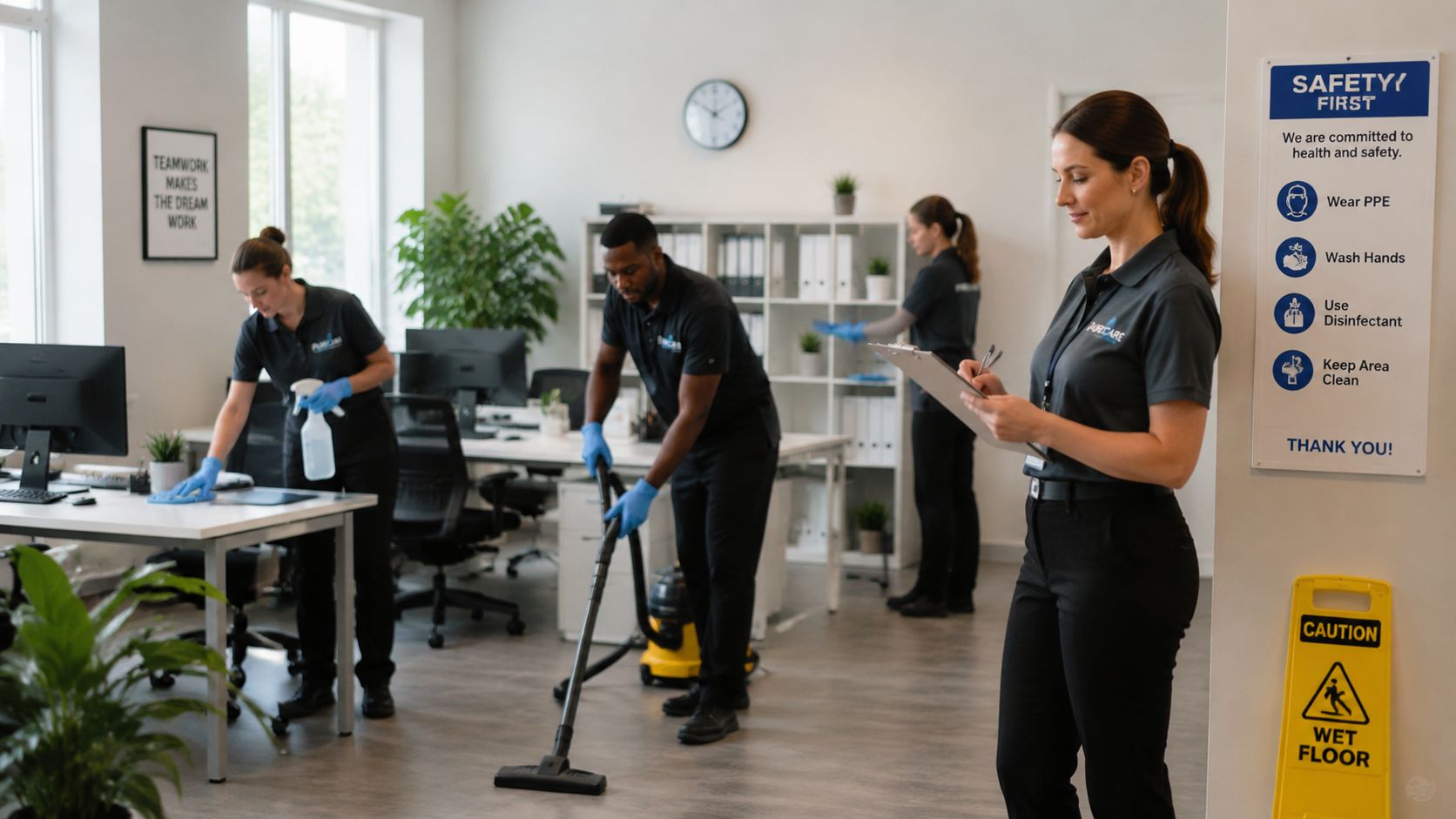
For an operations manager, the key point is simple. Cleanliness affects how reliably people can work in the space you provide. A neglected washroom, a sticky lunchroom counter, or dusty shared equipment does more than create a poor impression. It raises the perceived risk of getting sick, increases complaints, and can push small maintenance issues into larger disruptions.
A workplace cleaning program works like preventive maintenance for people-facing operations. You would not ignore a minor equipment fault until it became a shutdown. Cleaning deserves the same mindset. Regular service reduces exposure opportunities in breakrooms, washrooms, reception areas, and shared workstations before they show up as absenteeism, distraction, or avoidable tension between teams.
That is why professional office cleaning services for shared workplaces should be evaluated as an operating control, not just a presentation item. The value shows up in steadier occupancy, fewer hygiene-related complaints, and less time spent reacting to issues that should have been prevented by routine service.
Physical wellbeing and psychological wellbeing
Employee wellbeing has two connected parts.
Physical wellbeing improves when cleaning reduces the conditions that help contaminants circulate through a workplace. In offices, the highest impact areas are usually the ones people share without thinking about them much, such as washrooms, kitchenettes, copier stations, meeting tables, fridge handles, and door hardware. Consistent attention to those zones lowers day-to-day exposure risk.
Psychological wellbeing improves when the environment feels controlled and cared for. People make fast judgments from small signals. Empty soap dispensers, overflowing bins, and grime on fixtures suggest that standards are loose in other areas too. Clean, well-supplied spaces support trust, and trust affects how comfortable employees feel using common areas throughout the day.
This matters for productivity. Staff who avoid the lunchroom, hesitate to use shared rooms, or repeatedly report hygiene concerns are spending attention on the building instead of their work.
The often-missed issue of chemical sensitivity
Illness prevention is only part of the equation. Product choice and application method also affect wellbeing.
A space can look freshly cleaned and still create problems if the products leave heavy residue, strong fragrance, or airborne irritation. That risk is easy to miss because the room may appear spotless. For employees with asthma, skin sensitivities, or scent intolerance, poor chemical practices can reduce comfort and concentration as much as visible dirt does.
A qualified cleaning provider should be able to explain several things clearly:
- Which products are used in each area
- How those products match the surface type and occupancy pattern
- How staff prevent over-application and residue buildup
- How service timing supports ventilation and occupant comfort
- How tools and procedures reduce cross-contamination between spaces
The best outcome is usually quiet and predictable. Staff should notice that the workplace feels clean, stocked, and comfortable to use, without being distracted by odours, residue, or recurring hygiene concerns.
Ensuring Workplace Safety and Regulatory Compliance
A preventable slip, an unserviced washroom, or a missed high-touch cleaning round can create the same operational problem for a manager. The site becomes harder to run, and the organization takes on avoidable risk. In practice, that is why commercial cleaning belongs in the same conversation as safety checks, maintenance logs, and incident prevention.

For Canadian workplaces, especially in Ontario, cleaning is part of due diligence. Employers are expected to maintain sanitary conditions and address hazards that can reasonably injure workers or visitors. A cleaning program supports that duty by turning general expectations into scheduled tasks, assigned responsibilities, and records that can be checked later. The business value is straightforward. Fewer unmanaged hazards usually means fewer interruptions, fewer complaints, and less exposure if an incident leads to a review.
Cleaning works like preventive maintenance for the built environment. You do not wait for a floor to become dangerously slick before assigning floor care, and you do not wait for a complaint before checking whether washrooms are stocked and safe to use. The point is control.
Where compliance risk usually appears
Risk does not show up evenly across a facility. It collects where traffic, moisture, shared contact, and poor ownership overlap.
- Childcare and education settings have dense occupancy, frequent hand-to-surface contact, and fast recontamination of desks, washrooms, and shared items.
- Dental and clinic environments require tighter hygiene routines, clearer task separation, and stronger documentation.
- Manufacturing and warehouse sites face tracked-in soil, debris, loading-zone residue, and heavily used lunchrooms and washrooms.
- Professional offices still carry real exposure in kitchenettes, reception areas, meeting rooms, and shared washrooms, even if the risks look less obvious than they do on an industrial site.
Many operations managers underestimate the documentation piece. If a spill response was delayed, if floor residue contributed to a fall, or if washroom checks were inconsistent, a company may need to show what was supposed to happen, who completed it, and when. A verbal assurance is weak protection. A documented routine is much stronger.
Safety hazards that cleaning directly controls
Cleaning affects more than appearance and germ reduction. It directly shapes day-to-day physical safety and supports a cleaner audit trail.
| Hazard area | Cleaning control | Why it matters |
|---|
| Floors | Scheduled floor care and spot response | Reduces slip and trip exposure |
| Washrooms | Restocking, drying, and surface cleaning | Supports hygiene and safer use |
| Entryways | Soil control and mat maintenance | Limits tracked moisture and debris |
| Shared equipment | Routine touchpoint cleaning | Reduces cross-contact risk |
| High-dust zones | Periodic removal | Reduces irritation and contamination spread |
The table matters because each row represents a common failure point. Entry mats that are saturated stop trapping moisture. Floors cleaned with the wrong dilution can leave residue. Dust allowed to build up near vents, shelving, or production areas can affect both comfort and housekeeping standards. Small misses stack up into larger operating problems.
A documented COVID-conscious cleaning framework for touchpoints, frequencies, and reporting is still useful for many facilities because it formalizes who cleans what, how often checks happen, and how exceptions get recorded. Even where pandemic response is no longer the main concern, that level of structure helps organizations maintain consistency and show that hazard controls are active, not assumed.
A facility becomes safer when the right tasks happen at the right frequency, and someone verifies completion.
How to Choose the Right Commercial Cleaning Partner
Most buying mistakes happen before the first shift starts. A manager asks for a quote, compares line items, and chooses the lowest monthly number without testing how the work will be delivered. That often leads to vague scopes, unclear quality standards, and complaints that bounce between the site and the vendor.
One of the most overlooked buying issues is product strategy. As noted in this discussion of cleaning, air quality, and chemical exposure, workplace cleaning affects indoor air quality and chemical exposure, and low-toxicity, non-sensitizing products matter because respiratory symptoms and skin irritation are real workplace risks. Many buyers ask only about disinfection. Fewer ask about residue, fragrance, ventilation, or product fit.
What to ask before signing
Use these questions to move beyond price.
- How is the scope built: Ask whether frequencies are based on occupancy, touchpoint load, washroom use, and floor type.
- What training do staff receive: Look for WHMIS awareness, safe chemical handling, and task-specific procedures.
- How is cross-contamination prevented: Ask about colour-coded cloths, separate washroom tools, and workflow separation.
- How is quality checked: A provider should describe inspections, issue reporting, and correction procedures.
- Which products are used: Ask about low-irritant options, disinfectant selection, and how product choices are adjusted for sensitive environments.
- What documentation is available: You want service records, issue escalation paths, and a clear point of accountability.
Red flags to avoid
Some warning signs appear early.
- Vague scope language: "General cleaning as needed" leaves too much open to interpretation.
- No discussion of chemistry: If the provider can't explain product selection, they're treating cleaning as labour only.
- No quality assurance process: Without inspections or reporting, inconsistency becomes your problem.
- One-size-fits-all pricing: Different facilities need different frequencies and task mixes.
- No separation of routine and periodic work: Daily upkeep and deep cleaning shouldn't be blended into a fuzzy promise.
Evaluating Commercial Cleaning Providers
| Feature | Basic Janitorial Service | Advanced Cleaning Partner |
|---|
| Scope of work | General task list | Site-specific scope tied to use patterns |
| Product selection | Standard products with little explanation | Product choices matched to surfaces, occupancy, and sensitivity concerns |
| High-touch protocol | Informal or complaint-driven | Defined frequencies and touchpoint standards |
| Floor care | Basic mopping or vacuuming | Routine maintenance plus periodic floor care planning |
| Quality assurance | Occasional supervisor checks | Documented inspections, corrective action, and reporting |
| Communication | Reactive | Named contacts, escalation process, service records |
| Risk awareness | Appearance-focused | Health, safety, and compliance-focused |
One practical comparison point
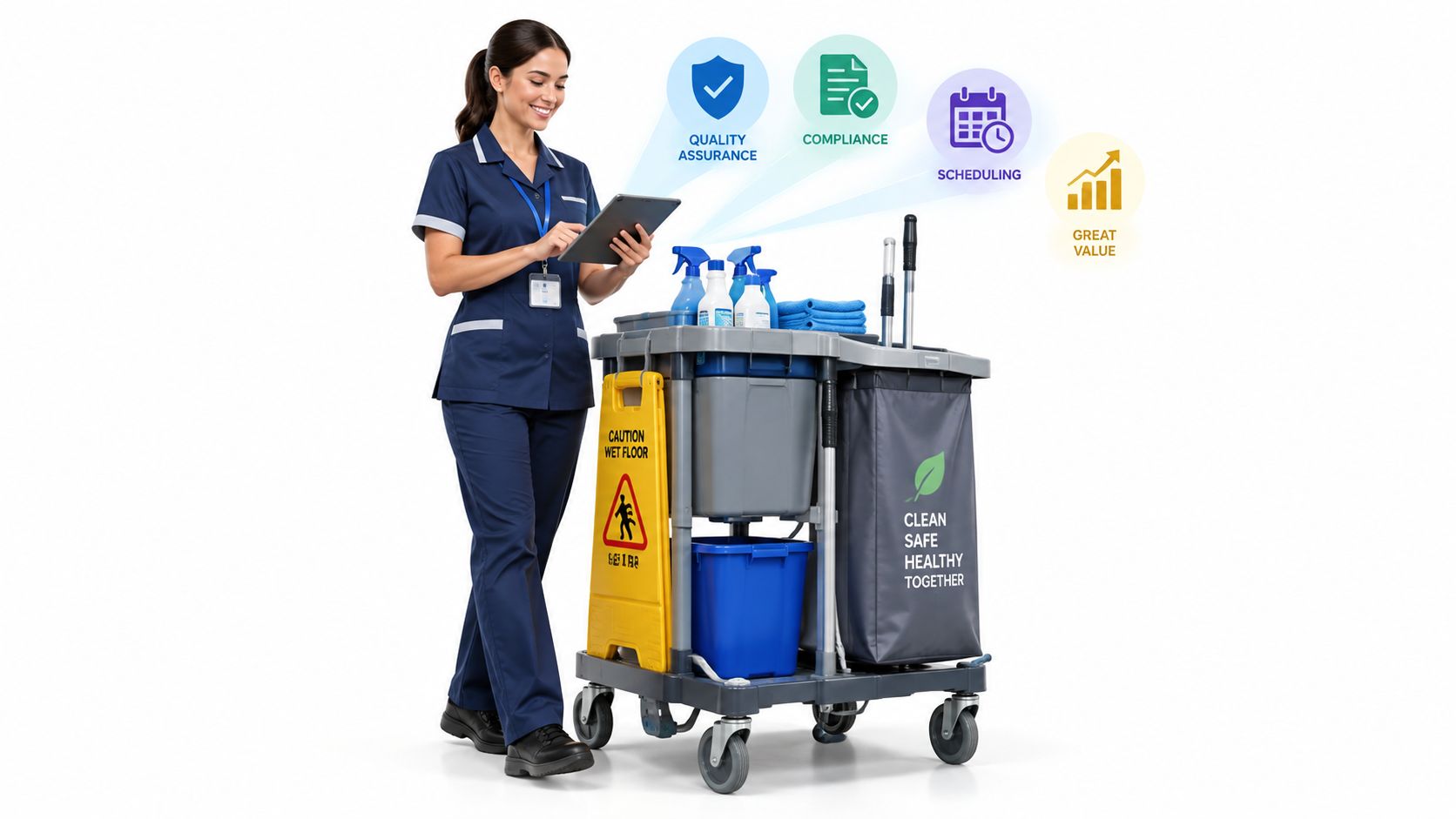
Some firms now use digital quality systems instead of relying only on paper logs and verbal follow-up. For example, Arelli Cleaning uses a mobile app and an advanced management system to support communication, quality assurance, and safety compliance. That's not the only model in the market, but it's a useful signpost for buyers who want visibility rather than guesswork.
Measuring the Return on Investment of Your Cleaning Program
Cleaning costs are easy to see. Cleaning failures are harder to track, even though they often show up elsewhere in the budget through sick time, supervisor interruptions, preventable wear, and compliance gaps.
For an operations manager, ROI is the difference between paying for a visible service and paying for fewer disruptions. A good cleaning program works like preventive maintenance. The value is not limited to what staff notice at a glance. It shows up in steadier attendance, fewer complaints, less emergency response, and longer life for floors, fixtures, and furnishings.
One area that often gets missed is exposure risk during cleaning itself. As noted earlier, peer-reviewed research on cleaning agents describes potential respiratory and skin irritation from some common ingredients and from poor handling practices. That matters because cleaning quality includes method, not just frequency. Product selection, dilution control, ventilation awareness, and staff training all affect whether the process supports occupant health or creates a new problem.
A practical ROI review usually starts with four categories.
Attendance and continuity
Track patterns in illness-related absences, hygiene complaints, and short operational disruptions. The goal is not to prove that cleaning solves every attendance issue. It is to see whether improved standards coincide with fewer avoidable interruptions.
Labour efficiency
Measure how much manager or front-line staff time gets pulled into complaint handling, supply issues, spill follow-up, or arranging urgent cleanup. Every hour spent chasing basic cleaning execution is an hour not spent on operations.
Safety and compliance performance
Review incident logs, washroom checks, floor condition issues, and service documentation. In regulated environments, incomplete records can become a risk of their own.
Asset life and replacement timing
Look at carpets, hard floors, partitions, fixtures, and high-touch surfaces. Routine care costs less than early replacement, much like regular oil changes cost less than engine repair.
This approach also improves buying decisions. Monthly price alone does not tell you whether the program is reducing risk or postponing it. Two vendors can quote similar rates while delivering very different outcomes if one includes clear inspection routines, trained staff, controlled chemical use, and periodic floor care planning.
Cleaning costs usually rise or fall for predictable reasons:
- Facility size and layout
- Service frequency
- Occupancy type and traffic patterns
- Number of washrooms, kitchens, and shared spaces
- Flooring mix and periodic maintenance needs
- Specialty work such as carpet extraction, high dusting, or post-construction cleaning
- Security, access, and after-hours service requirements
The strongest business case comes from comparing total operating impact, not just invoice totals. If a cleaning program reduces complaints, supports healthier indoor conditions, protects assets, and lowers the chance of safety or compliance problems, the return is real even when the monthly fee is not the lowest option.
Further Reading and Implementing Your Healthy Workplace Strategy
A healthy workplace is built the same way other operational controls are built. Through clear standards, regular checks, and documented follow-through. Cleaning supports employee health, but its management value is broader than that. It helps reduce preventable disruptions, lowers exposure to safety and compliance issues, and gives operations managers a more stable work environment to run.
The next step is not to collect more articles or bookmark more resources. It is to turn what you have already reviewed into an implementation plan.
Start with a short internal audit. Look at how the building is used in practice, not how the cleaning scope reads on paper. A site with heavy meeting room turnover, crowded washrooms, shared kitchens, and frequent visitors carries a different risk profile from a lightly occupied office, even if both lease the same square footage. Cleaning works like preventive maintenance. If the schedule does not match actual wear on the facility, small problems become recurring ones.
Focus on a few practical questions:
- Are high-touch points being cleaned at a frequency that matches occupancy and use?
- Do washrooms stay stocked, sanitary, and inspection-ready throughout the day?
- Are floors being maintained in a way that reduces slip risk and protects finish life?
- Are chemicals, dilution methods, and storage practices controlled and documented?
- Is there a clear process for inspections, issue escalation, and service verification?
- Do complaints point to isolated misses or to a scope that no longer fits the site?
These checks help separate cosmetic cleaning from operationally useful cleaning. That distinction matters. A tidy-looking space can still have inconsistent washroom servicing, poor touchpoint control, or gaps in floor maintenance that create avoidable risk.
Operations managers also benefit from treating vendor selection like a procurement exercise, not a housekeeping task. Ask two or three providers to quote against the same scope. Then compare more than price. Compare supervision, staffing stability, inspection routines, communication methods, response times, and whether periodic work is defined or left vague. A low monthly rate often hides future cost in complaints, extra callouts, faster asset wear, or uneven service delivery.
Common questions operations managers ask
What is commercial cleaning in a workplace
Commercial cleaning is the planned cleaning and maintenance of business premises such as offices, clinics, schools, warehouses, and shared facilities. It usually covers routine cleaning, washroom servicing, touchpoint care, floor maintenance, waste handling, and scheduled deeper tasks.
Why doesn't in-house tidying solve the whole problem
In-house tidying helps with appearance and day-to-day order, but it rarely covers the controls that protect health and operations. Professional cleaning programs are built around task frequencies, product selection, cross-contamination prevention, floor care methods, and documented accountability.
When should a business increase cleaning frequency
Review frequency when occupancy rises, washrooms are used more heavily, shared eating areas stay messy, complaints increase, or soil loads build up before the next scheduled service. Those are signs that the scope no longer matches the building's actual use.
Who needs a more specialised cleaning scope
Sites with higher contact rates, stricter sanitation expectations, or more complex safety duties usually need tighter protocols. That often includes clinics, childcare settings, schools, industrial spaces, and busy multi-tenant offices.
Where do many cleaning programs fail
Failures often show up in the less visible parts of the program. High dusting gets delayed. Periodic floor care is skipped. Products are changed without review. Inspections become informal. Over time, those gaps affect hygiene, appearance, safety, and asset life.
What should be in a cleaning quote
A useful quote should define task scope, service frequency, exclusions, periodic work, supplies, quality checks, communication procedures, and the assumptions behind pricing. If those details are missing, it is hard to compare vendors or hold performance to a clear standard.
A practical next step is to use the checklists above, review the current scope against actual building risks, and request 2 to 3 competitive quotes from qualified providers. For organisations in the GTA, Arelli Cleaning is one option to include in that comparison if a site needs office or commercial cleaning with documented processes, flexible service, and quality assurance.








.webp)