A Toronto office manager can be juggling three different realities at once. The lobby has to look presentable before clients arrive, the washrooms need a reliable cleaning routine, and a recent renovation has left dust in places that a normal nightly sweep won't touch. That's where commercial cleaning gets confusing, because the right answer isn't just “more cleaning,” it's the right mix of service type, frequency, contract structure, and proof that the work is being done.
Key takeaways
- Commercial cleaning is contracted facility care for non-residential spaces, not a one-size-fits-all tidy-up.
- Toronto buyers usually need to decide on service scope, cleaning frequency, pricing model, and compliance proof.
- The strongest contracts are clear about what gets cleaned, how often, and how quality is recorded.
- Toronto and Ontario rules can affect licensing, WHMIS, logs, disinfectants, and documentation.
- A useful quote compares the same scope, the same schedule, and the same expectations across providers.
Table of Contents
Why Toronto Businesses Are Rethinking Their Cleaning Contracts
A facilities manager in downtown Toronto can usually spot the problem before anyone writes it down. The office looks fine on a random weekday, but the entry mats are collecting grit, the boardroom glass needs attention after every client visit, and a small renovation project has changed the cleaning load completely. A contract that made sense for routine office work can feel wrong as soon as the facility's risk profile changes.
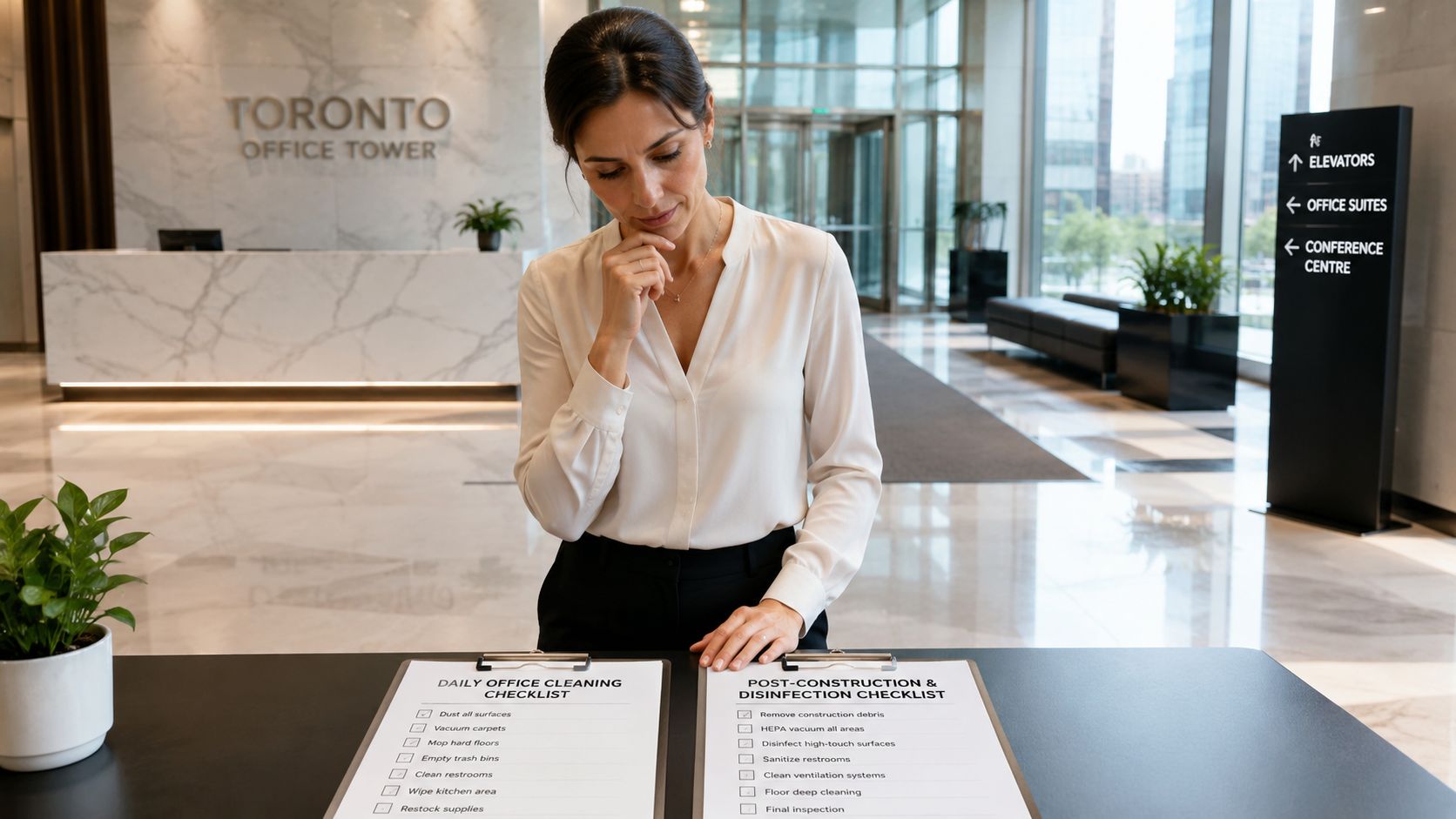
The core issue is that appearance alone no longer defines a good cleaning programme. Toronto buyers are weighing hygiene, uptime, complaint reduction, and documentation, not just visual polish. Commercial cleaning in Toronto also sits inside a mature service market, with Canadian janitorial services valued at $8.9 billion in 2026, supported by 34,443 businesses and a 4.3% CAGR from 2021 to 2026 commercial cleaning cost guide. That scale matters because it means buyers are comparing standardized B2B services, not a casual neighbourhood trade.
Practical rule: a cleaning contract should match the facility's actual operating risk, not the provider's broadest menu.
Toronto buyers also tend to spend meaningful budget on cleaning because local guidance places recurring service at about $30–$60 per cleaner-hour or roughly $0.08–$0.25 per square foot commercial cleaning cost guide. Ontario-facing pricing guides also show small offices, clinics, and larger facilities landing in different monthly bands depending on size and scope Toronto commercial cleaning cost breakdown.
What this guide helps decide
The best way to read a cleaning proposal is to split it into four questions.
- What is being cleaned? Daily office surfaces, washrooms, floors, windows, or post-construction dust all behave differently.
- How often is it being cleaned? Frequency should follow traffic and risk, not habit.
- How is quality verified? Good service needs documentation, inspection points, and a predictable response to issues.
- What contract terms control the relationship? Flexibility matters when needs change.
Toronto's own custodial standards and procurement references point toward documented systems, repeatable task frequencies, and auditable quality controls City of Toronto custodial background. That is why the strongest cleaning decision is usually not about the cheapest quote. It is about whether the contract can survive real operational change.
What Commercial Cleaning Actually Covers in the GTA
A Toronto office manager can ask for “cleaning” and still get three very different proposals. One may cover only visible office surfaces. Another may include washrooms, floors, and waste removal. A third may fold in periodic floor care, glass, and after-hours work. Commercial cleaning in the GTA is recurring, contracted cleaning for non-residential spaces, including offices, clinics, schools, warehouses, retail sites, and industrial buildings. It differs from residential housekeeping because the work has to fit occupancy patterns, compliance rules, shared washrooms, public-facing areas, and written service expectations.
The main service categories buyers usually need
A Toronto office often needs daily janitorial work for waste removal, surface wiping, washrooms, and common areas. A dental clinic usually needs tighter attention to disinfection, touchpoints, and reprocessing zones. A warehouse often puts more weight on dust control, floors, and loading-zone cleanup than on desk presentation. A childcare centre usually needs predictable sanitation of touchpoints and washrooms, with less emphasis on cosmetic detail and more on repeatable hygiene.
For product and chemistry decisions, the 2026 cleaning chemicals buying guide helps readers sort routine supplies from specialty choices. That distinction matters because a cleaner's toolkit should match the job, not the other way around.
Core commercial services in the GTA often include:
- Daily office cleaning, desks, touchpoints, waste, washrooms, kitchens, and common areas.
- Post-construction cleanup, dust removal, debris pickup, final detailing, and move-in readiness.
- Floor care, such as scrubbing, stripping, waxing, buffing, and carpet extraction.
- Window and high-dusting work, especially in atriums, lobbies, and tall office spaces.
- Washroom and kitchenette sanitation, where traffic and hygiene concerns are highest.
- Power washing, which suits entrances, exterior hardscape, loading areas, and some industrial surfaces.
- Disinfection work, which should be tied to a defined reason, a product standard, and a documented scope.
A good scope of work separates routine tasks from episodic tasks. That split keeps buyers from paying specialty prices for everyday work, and it also prevents a provider from treating a one-off project like a normal visit.
Bundled work versus add-ons
The biggest source of confusion is that many proposals bundle a basic set of tasks, then price extra work separately. Window cleaning, deep floor care, carpet extraction, and post-construction cleanup are commonly treated as specialty items, while daily waste removal and washroom service are usually part of recurring janitorial coverage. A law office may need recurring service and periodic glass work only. A manufacturing facility may need floor care and specialty cleanup after maintenance shutdowns. If you are reviewing an office-focused scope, the service mix on Arelli Cleaning's Toronto office cleaning page shows how office cleaning is often framed around recurring tasks first, then add-ons.
The cleanest way to request quotes is to write the scope in layers. Start with routine tasks, add periodic work, then list one-off projects. That gives Toronto buyers a clearer read on whether the provider is quoting the same job, or three different versions of it.
How Toronto Cleaning Pricing Actually Works
A Toronto office manager gets three quotes for what looks like the same job. One is priced by square foot, one by labor hours, and one as a monthly fee. The lowest number wins attention first, but that number means very little until you know what each model includes, what it leaves out, and how changes in traffic or scope will affect the bill.
That is why pricing should be read like a utility rate sheet, not like a menu. The format matters because it shifts risk between buyer and vendor.
The three pricing models buyers see most often
Toronto commercial cleaning quotes usually come in three forms. Some are priced per square foot. Some are priced hourly per cleaner. Others are quoted as a flat per-visit rate or monthly retainer.
Each model fits a different kind of site.
| Toronto Commercial Cleaning Pricing Models Compared | Best Fit For | Predictability | Main Risk |
|---|
| Per square foot | Standard recurring spaces with stable layouts | High when the task list stays fixed | Extra charges if the quoted scope is narrow |
| Hourly per cleaner | Variable sites, catch-up work, and project-based cleaning | Medium | Labor time can rise if the site condition or expectations are unclear |
| Flat per visit or monthly retainer | Recurring service with a stable schedule and defined scope | High for budgeting | Paying for more visits or more tasks than the facility actually needs |
Per-square-foot pricing works best when the layout, use pattern, and service level stay fairly steady. A quiet professional office with consistent occupancy is easier to price this way than a mixed-use facility with changing traffic.
Hourly pricing works better for uncertainty. If a site is still being set up, recovering from neglect, or adding tasks week by week, hourly billing can be more honest than a flat rate that guesses wrong.
Flat monthly pricing is often the easiest format for budgeting. It can also hide the most assumptions. If one proposal includes consumables, floor care touch-ups, and washroom checks between full cleans, while another excludes all three, the same monthly number does not buy the same result. Buyers comparing formats often use a guide to commercial cleaning bids to see how scope and pricing structure interact.
What actually changes the price
Square footage matters, but it is only the starting point. Cleaning time usually rises faster with use intensity than with floor area alone.
A 2,500 square foot office with one washroom, low foot traffic, and little food use may take less effort to maintain than a 1,500 square foot clinic reception area with constant turnover, touchpoints, and stricter cleaning documentation. Buyers often miss this because floor area is easy to measure, while workload drivers are hidden inside the day-to-day operation.
The main price drivers are usually:
- traffic level and occupancy pattern
- number and condition of washrooms and kitchens
- floor type, especially carpet, hard floor, and entry matting
- frequency of service
- access timing, such as after-hours or weekend work
- security, supervision, and sign-in requirements
- periodic work, such as floor refinishing, carpet extraction, or interior glass
- site condition at the start of the contract
A simple rule helps here. Price follows labor, and labor follows soil, touchpoints, and frequency more than floor plan alone.
Why quote comparisons often go wrong
The biggest pricing mistake is comparing totals instead of comparing scope. If two vendors are not quoting the same tasks at the same frequency under the same access conditions, the lower number may just reflect a smaller job.
One quote may include liner replacement, spot cleaning of glass, and monthly high dusting. Another may exclude those items and charge extra later. One may assume keys and unrestricted evening access. Another may build in extra time for concierge check-in, elevator delays, or restricted floors. Those details sound minor. Over a year, they change cost and service quality in a very real way.
Before signing, ask for the task list, frequency table, exclusions, and rules for extra work in writing. A practical set of commercial cleaning pricing questions can help buyers catch these gaps before contract approval.
Contract format matters as much as the rate
Pricing is only half the buying decision. The other half is contract flexibility.
A low monthly rate on a long fixed term can cost more overall if your staffing levels drop, your lease changes, or your site needs shift after a fit-out or hybrid work transition. A slightly higher rate with a clearer change-order process or shorter review cycle may be the better operating decision.
That is especially true in Toronto, where occupancy patterns can change quickly across offices, clinics, and light industrial sites. Buyers who want a plain-language explanation of common quoting and billing terms can review commercial cleaning service FAQs before comparing proposals.
Good pricing is not just a cheap number. It is a quote you can audit, compare fairly, and adjust without turning every small scope change into a dispute.
Choosing the Right Cleaning Frequency for Your Facility
A cleaning schedule should follow use, risk, and regulation, not preference alone. A small professional office does not need the same cadence as a clinic waiting room, and a warehouse does not need the same service mix as a corporate head office. The right schedule keeps the space functional without creating waste.
A simple way to start is to ask what the facility is trying to prevent. Dust buildup, washroom complaints, floor wear, and touchpoint contamination do not all move at the same pace, so the cleaning plan should not treat them the same way.
A simple frequency rule by facility type
For a low-traffic office, recurring weekly or multi-weekly cleaning may be enough if the site stays tidy between visits. A clinic or dental practice usually needs tighter attention to touchpoints, washrooms, and public areas because those surfaces are used and reset all day. A manufacturing or warehouse site often needs targeted floor and dust control, especially around entry points and traffic lanes. Schools and childcare settings usually need more frequent service because shared surfaces are touched by many people across the day.
The pattern is similar to maintenance on equipment. You do not service every part on the same timeline, you match the task to the wear pattern. Toronto's custodial standards point toward documented task frequencies rather than casual judgment, and Green Seal's GS-42 standard recommends building-specific written cleaning plans with routine, periodic, interim, and restorative schedules Green Seal guidebook. That approach turns frequency into a plan instead of a sales pitch.
A quick decision framework
Daily service usually fits busy public areas, shared washrooms, and spaces with heavy visitor traffic.
Multi-weekly service can work for smaller offices with lower occupancy and limited public use. Periodic service suits floor care, carpet extraction, window work, and deep cleaning tasks that do not need daily repetition. Project-based service is the better choice for post-construction cleanup or short-term remediation.
A schedule should also be clear enough to verify before work starts. Buyers who want a plain-language explanation of common contract terms can review the commercial cleaning service FAQ before comparing proposals.
If a schedule cannot be explained in plain language, it probably does not belong in the contract.
A useful way to test the schedule is to ask what problem it prevents. If the answer is “build-up in washrooms,” “dust on raised surfaces,” or “floor wear in the entryway,” the cadence is probably grounded in operations. If the answer is only “this is what we usually do,” the schedule deserves another look.
Toronto and Ontario Compliance Essentials Buyers Should Verify
Toronto buyers should treat compliance as part of the service, not an afterthought. The City of Toronto lists Cleaning, Exterior Building Cleaning, Janitorial as a business type that may require a Building Cleaner Licence, along with zoning requirements and, provincially, business registration and WHMIS training where applicable Toronto business regulations. That means a provider should be able to speak clearly about licences, safety training, and the paperwork that supports chemical handling.
The compliance questions that matter
The simplest check is whether the provider has a documented management system, because Toronto's custodial procurement references ISSA CIMS-GB certification within six months of contract start and uses a Custodial Standard Service Model to standardize task frequencies and expectations City of Toronto custodial background. That does not mean every buyer needs the same certificate, but it does mean a serious provider should be able to show structured controls, not just a cleaning roster.
Toronto and Ontario workplaces also need to think about recordkeeping. Industry compliance summaries say employers must track and post washroom cleaning records showing the date and time of the two most recent cleanings for worker-accessible washrooms, with records visible near the washroom or accessible electronically washroom cleaning compliance summary. For clinics and salon-like environments, Toronto Public Health also requires operators to notify Toronto Public Health at least 14 days before opening, moving, adding services, or renovating, and to provide a separate dedicated handwashing sink with constant potable hot and cold running water under pressure plus a separate reprocessing sink for multi-use items Toronto Public Health requirements.
What to verify before signing
- Training records, especially WHMIS and chemical handling.
- Safety data sheet access, so staff can check products quickly.
- Product approvals, especially for disinfectants used in regulated spaces.
- Logkeeping, including washroom records and task completion evidence.
- Licence readiness, where the service type or location triggers it.
A provider that can explain these mechanics clearly is usually easier to manage after the contract starts. That matters because compliance problems are rarely dramatic at first. They usually show up as missing logs, unclear product use, or confusion when the site changes.
How to Evaluate a Toronto Commercial Cleaning Provider
A Toronto cleaning provider should be judged on systems, not slogans. The best questions are about how the work is organised, how quality is checked, and how flexible the contract is when the facility changes. A polished brochure can't answer those questions, but a documented operating method can.
A practical comparison framework
The table below works well for buyer scoring. It keeps the focus on facts that matter in the GTA market.
| Provider Evaluation Criteria for the GTA | What to Look For | Why It Matters in the GTA |
|---|
| Documented management system | Written procedures, inspection steps, task tracking | Supports consistent work across shifts and sites |
| Training and supervision | Named training process, quality checks, site oversight | Reduces drift when staffing changes |
| Insurance and bonding | Proof of coverage and clear responsibility lines | Protects office, clinic, and industrial sites from avoidable risk |
| Contract flexibility | No surprise lock-ins, clear change process, stop-and-go options | Toronto buyers often change schedules as occupancy changes |
| Proof-of-quality | Inspection logs, photos, service notes, corrective actions | Makes service issues measurable |
| Responsiveness | Clear contact path and response timing | Complaints need fast correction, not a mystery inbox |
Red flags that should slow a buyer down
Long auto-renewing terms without a clear exit path are a problem when a facility's needs are still changing. Vague scope language is another problem, because “general cleaning” can mean very different things to different providers. If the proposal does not explain how quality is checked, who supervises the team, or how service changes are handled, the buyer is taking on avoidable risk.
A trial period only works when the scope is written tightly enough to judge the outcome.
References, sample cleans, and a short pilot period can help verify claims without locking in the wrong fit. Toronto buyers looking for a flexible, systems-based provider may also evaluate Arelli Cleaning as one option, especially when they want structured service controls and stop-and-go terms.
For sustainability-minded teams, a resource like refillable products for offices can be useful when they are comparing supply-side choices alongside service quality.
A Sample Scope of Work for a Toronto Office
A Toronto office can have a clean lobby and still carry weak service behind the scenes if the scope is vague. A workable scope separates daily tasks from periodic tasks, so the provider knows what must happen now and what can wait for a planned visit. That division also helps the buyer judge whether the quote matches the building's actual needs.
A simple working model
A daily weekday scope for a representative office building usually covers entry areas, shared work surfaces, washrooms, kitchenettes, waste removal, and touchpoint cleaning. Weekly tasks then move into more detailed dusting, targeted glass care, and extra attention in zones that see heavy traffic. Monthly work often handles deeper sanitation or a review of recurring problem areas. Quarterly work is where floor care, high-dusting, and window cleaning usually make more sense as a planned block than as an urgent call.
The scope should also name the inspection points that show whether the service is holding up. Washroom condition, floor appearance, bin replacement, supply restocking, and the state of high-touch areas are all easy to observe on site. Quality assurance turns those observations into a checkable record, with correction steps when the building drifts away from the agreed standard. For offices that need a more structured service model, a detailed office cleaning services scope can help the buyer see how routine work and periodic work fit together.
A compact template buyers can adapt
- Daily: washrooms, touchpoints, waste, kitchenettes, floors, entry areas.
- Weekly: detailed dusting, glass spot-cleaning, replenishment checks, higher-traffic zone review.
- Monthly: targeted disinfection tasks if justified by site use, supervisory inspection, problem-area review.
- Quarterly: floor care, high-dusting, windows, and any periodic project work.
A good scope reads like a service map, not a sales brochure. It should make it clear what happens every day, what happens less often, and who is responsible for noticing when something slips.
Toronto Cleaning Checklist, FAQs and Further Reading
A buyer can avoid most bad contracts with a short pre-quote checklist. The point is not to become a cleaning expert. The point is to ask enough informed questions to compare proposals fairly.
Toronto pre-quote checklist
- Licence check: Ask whether the provider's work type or operating model triggers a municipal building cleaner licence.
- Insurance proof: Request current insurance and bonding details in writing.
- Training records: Confirm WHMIS training and any site-specific chemical handling training.
- Compliance logs: Ask how washroom cleaning records and task logs are kept.
- Scope clarity: Make sure the quote separates daily, periodic, and specialty work.
- Contract terms: Check for renewal clauses, cancellation terms, and change-order rules.
- References and trials: Ask for a sample clean or a trial period before signing a long commitment.
FAQ
How does a buyer know if a cleaning frequency is too low?
If complaints cluster around washrooms, entry dust, or touchpoint buildup, the cadence is probably too light for the site's traffic.
Why do some quotes look much cheaper than others?
Cheaper quotes often leave out periodic tasks, supervision, or specialty work, so the apples-to-apples comparison is missing.
When should disinfection be added to a scope?
It belongs in the scope when the facility type, occupancy pattern, or risk profile justifies a defined disinfection plan.
Where do compliance issues usually show up first?
They usually show up in training records, product documentation, washroom logs, and unclear responsibility for task tracking.
Who should review the final scope of work?
Facility management, operations, and whoever is accountable for site risk should all review it before signature.
What should a fair trial period show?
It should show whether the crew follows the scope, whether inspection points are being met, and whether communication is prompt.
How should complaints be handled?
The contract should name one escalation path, one response standard, and one method for recording corrective action.
What should buyers avoid in a contract?
They should avoid vague scope language, hidden extras, and long lock-ins that don't match the building's changing needs.
Further reading
For service coverage in the city, the most useful starting point is the Toronto service areas page. Buyers can also review office cleaning services, commercial disinfection and sanitizing, office cleaning services overview, and office reopening cleanliness guidance for a practical view of recurring service and preparation work.
For external references, readers can also consult the City of Toronto custodial standards material, Green Seal's GS-42 guidebook, and the Toronto business regulations page for the most directly relevant public guidance on structured cleaning and compliance.
Arelli Cleaning provides office and commercial cleaning across the GTA with recurring service, specialty add-ons, and flexible contract terms that fit changing facility needs. Buyers who want to compare scope, frequency, and compliance details can review their options and then visit Arelli Cleaning to request a quote and apply the checklist above before signing anything.









.webp)