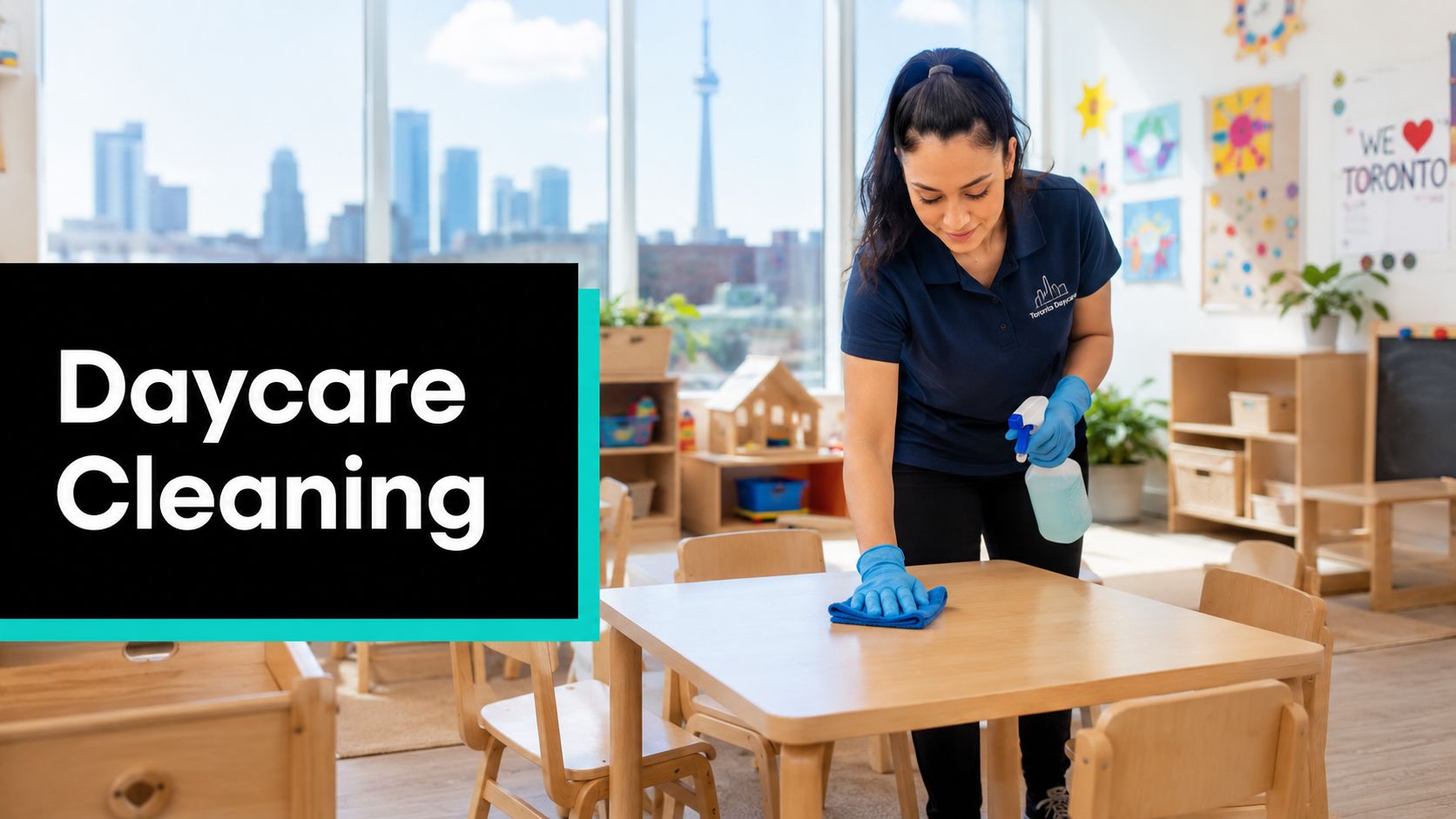
A Toronto daycare director often faces the same scene before the children even arrive. A parent asks about illness prevention. A staff member reports a spill in the toddler room. A licensing file needs to be updated. An inspection could happen at any time. In that setting, cleanliness isn't just about appearance. It supports child safety, staff workflow, and regulatory confidence.
Professional daycare cleaning services sit inside the broader commercial cleaning field, but the expectations are sharper in childcare. Products must be appropriate for young children. Cleaning sequences must be correct. Records need to stand up during review. The business case is also real. The Canadian janitorial services industry under NAICS code 56172CA reached $8.9 billion in 2026, with a projected 2.0% revenue increase for the year, according to IBISWorld's Canada janitorial services industry profile. That growth reflects how central cleaning has become across facilities, including childcare centres.
Your Complete Guide to Daycare Cleaning Services
A daycare can't rely on a generic evening tidy-up and assume the job is done. Children spend time on floors, share toys, touch everything, and often need hands-on care around meals, toileting, and naps. That creates a cleaning environment that's closer to a regulated care setting than a standard office.
For new operators, the confusing part usually isn't whether cleaning matters. It's how to separate routine housekeeping from work that is legally defensible, inspection-ready, and suited for childcare. The missing piece is often documentation. A surface can be cleaned properly, but if a centre can't show what was done, when, where, and with what product, the risk isn't gone.

Key takeaways
- Daycare cleaning services are specialised commercial cleaning services built around child-safe methods, high-touch routines, and room-by-room accountability.
- Ontario operators need more than visible cleanliness. They need repeatable procedures that support CCEYA expectations and daily health protection.
- Budgeting starts with scope. Size, room type, operating hours, and documentation requirements all affect the service model.
- The strongest providers don't just clean. They produce organised logs, clear scopes of work, and consistent quality controls.
- Hiring decisions should focus on risk reduction, not just price. A lower quote can still leave the centre exposed if records, training, or product controls are weak.
Practical rule: In childcare, a clean-looking room and a compliant room are not always the same thing.
A strong cleaning program helps directors answer basic but high-stakes questions with confidence. Was the diapering area handled correctly? Were food-contact surfaces addressed at the right times? Were high-touch points sanitised often enough? Is there a record ready if someone asks?
Those are the questions that shape this guide.
What Daycare Cleaning Services Actually Include
Daycare cleaning services are a form of specialised commercial cleaning for environments that care for infants, toddlers, and young children. They include routine cleaning, sanitising, and disinfecting, but the mix depends on the room, the activity, and the risk level.
That distinction matters. A general office cleaner may be used to desks, washrooms, and garbage removal. A childcare setting adds diapering surfaces, mouthed toys, nap equipment, food-service tables, cubbies, and shared sensory items. The cleaning plan has to reflect how children use the space.
Daily work versus periodic work
Most centres need a daily service layer and a scheduled deeper-clean layer.
Daily tasks often include:
- High-touch point care such as door handles, light switches, handrails, faucets, and shared touch surfaces
- Classroom floor care using methods that control soil without kicking particles back into the air
- Washroom and diapering area cleaning with the right product sequence for hygiene-sensitive zones
- Table and chair cleaning tied to classroom activities and meal periods
- Waste handling including liner changes and odour control for washroom and diaper-related bins
Periodic tasks usually sit on a weekly, monthly, or seasonal cycle:
- Detailed cubby and shelving wipe-downs
- Carpet or mat deep cleaning
- Interior glass and low-window cleaning
- Detailed toy rotation cleaning
- Floor restoration work in high-traffic circulation areas, if the flooring type requires it
What is often treated as an add-on
Some tasks fall outside the normal recurring visit and should be specified separately in the contract.
These often include outbreak response disinfection, post-incident cleaning, exterior play area cleaning, hard-floor stripping and refinishing, and after-hours emergency attendance. Centres that operate longer hours may also need split-shift service, because one nightly visit might not be enough to support safe turnover.
A useful way to think about scope is this: routine daycare cleaning services maintain the centre; specialised add-ons restore it, respond to unusual events, or address spaces that need separate timing.
A strong scope of work names each room, each task type, and each frequency. If the quote uses vague language, the centre will end up filling in the blanks later.
Some operators also review indoor air and residue concerns when selecting methods and products. For centres exploring supplementary air-treatment options, EcoQuest's Living Air cleaner is one example of the type of resource operators may examine alongside their broader environmental hygiene plan. It doesn't replace cleaning, but it illustrates how some facilities think about indoor conditions beyond surface care.
A simple definition that helps
Cleaning removes visible soil.
Sanitising lowers germ levels on appropriate surfaces.
Disinfecting is used on higher-risk surfaces and situations where stronger pathogen control is required.
Those three steps are related, but they aren't interchangeable. A daycare cleaning plan needs all three, assigned to the right surfaces and done in the right order.
Meeting Health and Safety Compliance in Ontario
A director opens the centre at 6:45 a.m. The rooms look tidy, the floors were done overnight, and the toy shelves are in order. By 10:30, a child becomes ill, a parent asks about sanitising practices, and an inspector later wants to see exactly what was cleaned, when it was cleaned, and which product was used. In Ontario childcare, the visible result matters, but the written record often decides whether your process holds up under review.
That is the part many centres underestimate. A daycare can have caring staff and a hardworking cleaner, yet still run into problems if the routine is not documented clearly enough to show CCEYA-ready compliance. Ministry-ready cleaning is less like a general housekeeping checklist and more like a chain of custody. Each step needs to be clear, repeatable, and easy to verify later.
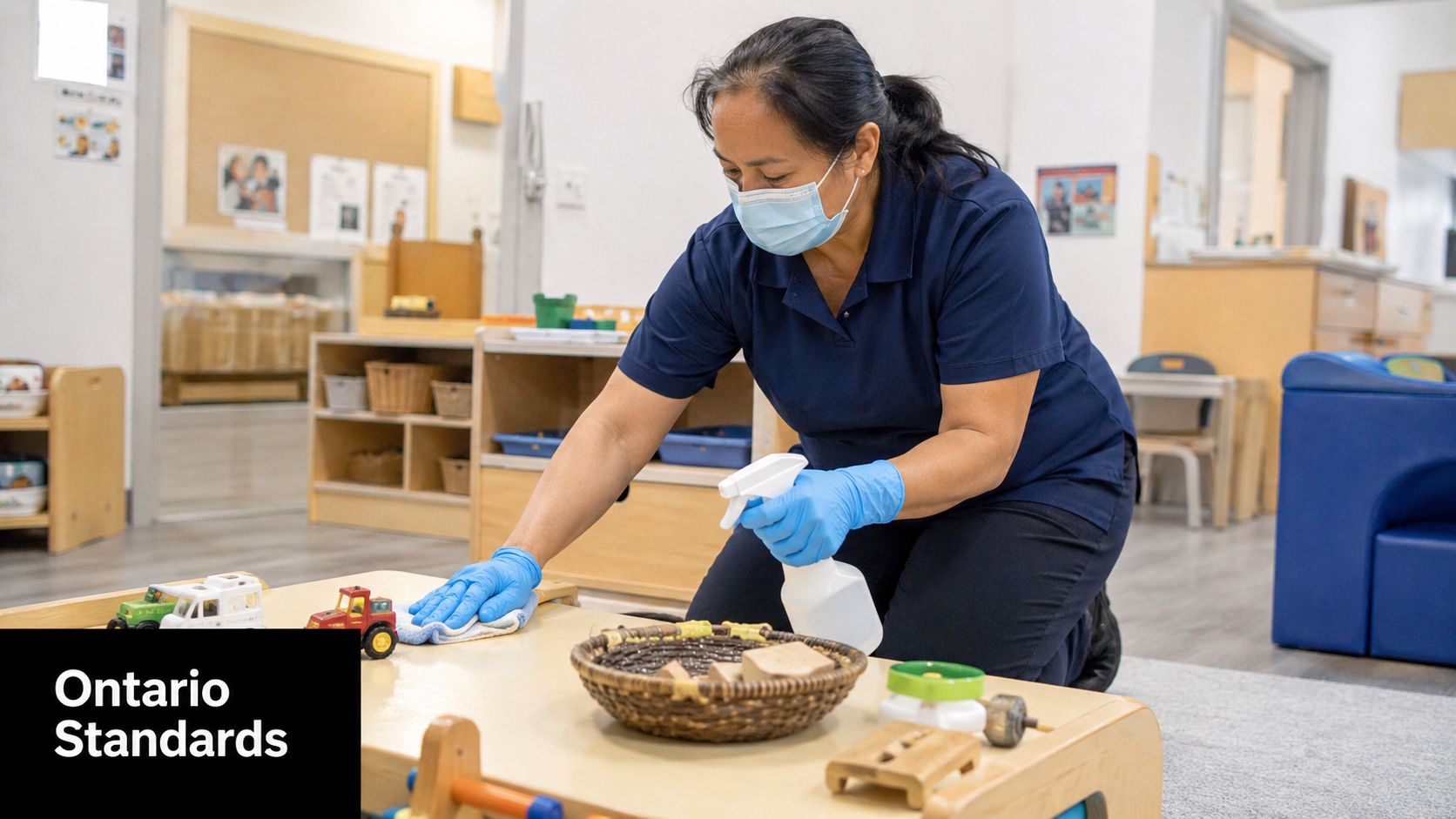
The three words that get mixed up
Cleaning, sanitising, and disinfecting are related, but they do different jobs.
- Cleaning removes dirt, food residue, bodily soil, and other visible contamination.
- Sanitising lowers germ levels on suitable surfaces used for routine contact.
- Disinfecting is reserved for higher-risk surfaces, illness events, and situations that call for a stronger pathogen-control step.
The order matters because residue blocks performance. A toddler table with dried yogurt on it may look better after a quick wipe, but the product cannot work properly until the soil is removed first. A useful comparison is washing a baking tray before using a fresh liner. If the old grease stays in place, the next layer cannot do its job.
Essential Daily Requirements
Ontario childcare routines need to be specific enough that staff can follow them the same way every day, across classrooms and across shifts. High-touch points, eating surfaces, toileting areas, diapering stations, and shared child-contact items usually need different frequencies and sometimes different products.
Contact time is where many otherwise good routines break down. If the label says a surface must remain wet for a set period, that time is part of the process, not an extra step. Wiping a product on and immediately drying it off is like rinsing soap off your hands after one second. The action happened, but the intended result may not.
A wiped surface is not automatically a sanitised or disinfected surface. The product has to stay wet for the full labelled contact time.
This is one reason written methods matter so much. If your logs say “tables done,” that note is too vague to defend. A stronger entry shows the room, the surface group, the product used, the time completed, and who completed it.
Product rules matter in childcare
Childcare settings should not treat every commercial product as interchangeable. Products used in the centre need to match the task, the surface, and the occupancy of the room. In practice, directors should confirm that disinfectants are approved for use in Canada, that staff can access and follow label directions, and that food-contact and child-contact surfaces are handled with the right follow-up steps where required.
Method matters too. Damp wiping and damp mopping usually create less airborne disturbance than dry sweeping, which is one reason many centres avoid dry methods during active programming hours. That choice supports hygiene, but it also supports calmer room conditions for children and educators.
Centres reviewing structured protocols for shared environments can also look at COVID-conscious cleaning practices for childcare and community spaces. The value is not only the disinfection step itself. It is the discipline of matching the method to the risk and recording what was done.
Documentation is part of compliance
For many Toronto-area centres, documentation is the difference between “we usually do that” and “here is the record.” Inspectors, supervisors, and parent inquiries do not rely on memory. They rely on logs.
A defensible cleaning record usually includes:
- Date and timestamp
- Room or area name
- Task completed
- Product used
- Staff initials, signature, or digital confirmation
- Exception notes for spills, illness events, or missed tasks with corrective action
That last item is often missed. If a cleaner could not enter a nap room at the scheduled time, the record should show when the task was completed instead. If a classroom had a vomiting incident, the log should show the response steps separately from routine cleaning. A good record does not pretend nothing changed. It shows that staff recognised the change and responded correctly.
This is why experienced operators build cleaning logs like attendance records. They must be legible, current, and tied to real rooms and real times. A binder full of unchecked sheets does not protect the centre.
Verification is changing the standard
Visual checks still matter, but visual checks alone are limited. A sink rim can shine and still have residue in the areas that matter most. Directors who rely only on appearance often discover too late that their “clean enough” standard varies from one staff member to another.
Verification closes that gap. Some centres use supervisor spot-checks, signed room-close inspections, product audits, or periodic objective testing for selected high-touch points. The point is consistency. Once the centre defines what acceptable performance looks like, it becomes easier to train staff, correct misses, and show that the system is being managed rather than guessed at.
A short visual review can help staff understand the difference between routine wiping and standard-based sanitising practices:
Small items deserve the same discipline. Cup lids, valves, and feeding parts often create hidden hygiene problems because moisture stays trapped in narrow spaces. InchBug's sippy cup cleaning tips offer a useful reminder that the hardest items to inspect are often the easiest to miss in a daycare setting.
Sample Daycare Cleaning Schedule and Checklist
At 5:40 p.m., the last child has gone home, one educator is finishing paperwork, and your closer is wiping tables before locking up. The room may look clean. That is not enough if a ministry inspector asks who cleaned the diapering area, what product was used on the eating surface, and whether the task was completed at the required time.
A workable daycare cleaning schedule has to do more than assign chores. It needs to show, in plain language, what was cleaned, when it was cleaned, who was responsible, and how completion was verified. That is what turns a routine into a defensible record. For Toronto-area centres, that distinction matters. A checklist should support daily operations and help the director show that cleaning standards are being managed room by room, not handled from memory.
The clearest format is built around three things: location, frequency, and proof. In practice, that means each task is tied to a real space, repeated at a set interval, and recorded in a way that can be reviewed later. A preschool room, infant room, and staff kitchenette may share some tasks, but they do not carry the same exposure points. One template for the entire centre usually creates gaps.
How to use this checklist
Use this sample as a starting draft, then adapt it to how your centre runs.
- Match each task to an actual room or zone so staff are not guessing what “classroom” or “common area” means
- Assign responsibility clearly if some cleaning is handled by educators and some by an outside provider
- Add time-based triggers such as after meals, after diapering, at room close, or before opening
- Record products or methods for food-contact and child-contact surfaces where the distinction matters
- Add a sign-off field so the checklist can function as evidence, not just a reminder list
If you are building a site-specific scope with a contractor, the schedule should line up with the service standard used for detailed disinfection in commercial childcare settings. The goal is consistency between what was quoted, what staff expect, and what can be shown during a review.
Sample Daycare Cleaning Checklist by Area and Frequency
| Area | Task | Daily | Weekly | Monthly |
|---|
| Infant Room | Clean and sanitise tables, chairs, and touch surfaces used during care routines | Yes | | |
| Infant Room | Clean floors with damp method appropriate to the flooring | Yes | | |
| Infant Room | Wipe cribs, storage handles, and room touchpoints | Yes | | |
| Infant Room | Detailed wipe-down of shelving, cubbies, and lower wall marks | | Yes | |
| Infant Room | Deep clean mats, soft furnishings, or floor coverings as scheduled | | | Yes |
| Toddler Play Area | Clean and sanitise tables and shared play surfaces | Yes | | |
| Toddler Play Area | Spot-clean visible toy bins and common contact points | Yes | | |
| Toddler Play Area | Detailed toy rotation cleaning and shelf wipe-down | | Yes | |
| Toddler Play Area | Deep carpet or rug maintenance if applicable | | | Yes |
| Kitchen or Food Prep Area | Clean and sanitise counters, sinks, handles, and eating surfaces | Yes | | |
| Kitchen or Food Prep Area | Empty waste and clean bin contact areas | Yes | | |
| Kitchen or Food Prep Area | Detailed wipe-down of storage fronts and non-food display surfaces | | Yes | |
| Kitchen or Food Prep Area | Interior detail cleaning of selected appliances and hard-to-reach surfaces | | | Yes |
| Washrooms | Clean and disinfect toilets, sinks, faucets, and high-touch points | Yes | | |
| Washrooms | Restock supplies and remove waste | Yes | | |
| Washrooms | Detailed partition, wall, and base cleaning | | Yes | |
| Washrooms | Full detail cleaning of vents, higher surfaces, and difficult corners | | | Yes |
| Staff Areas | Clean tables, counters, handles, and shared touchpoints | Yes | | |
| Staff Areas | Floor cleaning and waste removal | Yes | | |
| Staff Areas | Detailed cupboard and appliance exterior cleaning | | Yes | |
| Staff Areas | Interior glass and less-frequent detail tasks | | | Yes |
Checklist note: Add the date, time, initials, and product used for each completed task. That small step changes a cleaning table into documentation a supervisor can review and a centre can produce if questions come up later.
How to Budget for Daycare Cleaning Services in Toronto
A new director often sees the same problem in the first month. One quote looks affordable, another looks high, and both appear to promise a clean centre. Then the harder questions surface. Which one includes documented sanitising? Which one tracks products used in toddler rooms? Which one leaves a paper trail strong enough to show a ministry inspector that cleaning was performed, reviewed, and corrected when needed?
That is the primary budgeting question.
In childcare, you are not only paying for mopping, waste removal, and washroom cleaning. You are paying for a repeatable system. A low monthly price can become expensive if staff have to fill in missing logs, chase supply gaps, explain incomplete records, or respond to avoidable complaints after an inspection.
What actually shapes the monthly cost
Square footage matters, but it is only one part of the quote. A centre with several classrooms, multiple child washrooms, and a separate sleep area usually takes more labour to clean properly than an open-plan space of similar size.
Occupancy changes cost too. More children and staff means more hand-contact surfaces, more washroom traffic, more meal cleanup, and more frequent resets during flu season or after illness-related absences.
Timing also affects price. A provider working in a short evening window may need a larger crew or a tighter task sequence than one serving a site with a longer access period after close.
Then there is scope depth. Basic visible cleaning costs less than a childcare-specific program that includes room-by-room checklists, product control, supervisor review, and corrective action notes. Those records are often what protect the centre later. Cleaning without documentation is a bit like attendance without sign-in sheets. The task may have happened, but proving it becomes harder.
Supply handling can change the structure of the quote as well. If the provider manages approved products and restocking, directors should ask how that is priced and documented. It helps to review what falls under commercial cleaning supply support for childcare operations before treating supplies as a minor add-on.
A simple way to read a quote
Separate the price into three buckets. This makes two similar-looking proposals easier to compare.
| Budget bucket | What it usually covers | What directors should check |
|---|
| Core recurring service | Floors, washrooms, waste, visible touchpoints, routine room resets | Are all classrooms and support spaces named clearly? |
| Documentation and compliance work | Sanitising records, product logs, supervisor verification, issue tracking | Are records included in the price, and who reviews them? |
| Periodic or extra service | Carpet care, high dusting, outbreak response, detail cleaning, emergency call-ins | What triggers an added charge, and how is approval recorded? |
This distinction matters because many budget surprises come from work that was assumed, not written down. One provider may include verification logs in the monthly rate. Another may treat them as the centre's responsibility. On paper, the second quote looks lower. In practice, the centre may absorb that cost through administrator time, staff overtime, or rushed recordkeeping.
Questions that prevent budget mistakes
A careful director usually asks five pricing questions before signing anything:
- Which rooms are included by name?
- What cleaning records are produced after each visit?
- Which tasks are daily, which are weekly, and which are billed separately?
- Who supplies approved products, and how are substitutions documented?
- How are missed tasks, service complaints, and follow-up corrections recorded?
Those questions do more than clarify price. They show whether the provider understands childcare standards or is adapting a general office-cleaning model directly to a daycare.
A workable budget in Toronto should support two outcomes at the same time. The centre needs to look clean each day, and it needs records that stand up when a supervisor, parent, public health contact, or ministry inspector asks for proof. That second part is easy to underbudget. It is also the part that often protects the operator most.
Evaluating and Hiring a Daycare Cleaning Provider
A new director often discovers a cleaning provider's true capabilities after the first difficult morning. The floors look fine. The washrooms smell clean. Then a parent reports a hygiene concern, a room schedule changed the day before, or an inspector asks for proof of what was done, where, and when. If the provider cannot produce clear records and a site-specific process, the centre is left exposed.
That is why hiring for childcare cleaning has to go beyond appearance. A daycare needs a provider that can support a cleaning system you can explain, supervise, and defend if questions arise under Ontario childcare requirements.

Start with the scope of work
The scope of work is the blueprint. If it is vague, the service will usually be vague too.
A strong provider should be able to show a written, site-specific scope that identifies each room, the tasks assigned to that room, the frequency, the expected result, and the method for updating the document when your centre changes. That approach aligns with the ISSA CIMS standard, which centres on documented, managed cleaning operations rather than informal promises.
A daycare director should expect to see:
- Named rooms and areas, not broad labels such as “common areas”
- Defined task frequencies for each space
- Special handling instructions for food-contact, diapering, and child-used surfaces
- Clear exclusions so extra work is visible before billing starts
- A revision process for room changes, added programs, or temporary use changes
If a proposal says “full cleaning” but cannot tell you what happens in the toddler room versus the staff washroom, you do not have a scope. You have a sales summary.
Ask for records that stand up during review
A clean room and a documented clean room are not the same thing. In childcare, records work like attendance sheets. You may remember who was present, but memory is not the document an inspector reviews.
Ask the provider to show the actual forms or digital records used after service. Do not settle for “we can provide something if needed.” The format should already exist.
Useful questions include:
- What does the daily service log include?
- Are entries timestamped?
- Can the centre review completion by room or area?
- How are product substitutions recorded?
- How are missed tasks, delayed visits, or follow-up corrections documented?
- Who signs off that the work was completed?
The provider should reduce your administrative burden, not create a second job for your supervisors.
Check for process discipline
Cleaning quality in a daycare should not depend on which staff member happened to be assigned that night. Good providers run on written procedures, documented training, supervision, and quality checks. The ISSA CIMS framework is helpful here because it emphasizes written quality systems, standardized procedures, and accountability records across the organization.
This matters in practical ways. A provider with process discipline can answer questions such as who entered the site, what procedure was followed in a diapering area, how an outbreak-related request was communicated, and how corrective action was confirmed. A provider without that structure usually falls back on verbal updates and after-the-fact explanations.
What to ask
Training and safety
How are cleaners trained on product handling, contact times, cross-contamination control, and childcare room protocols?
Staff accountability
Who was on site, and how is attendance verified?
Change control
If a classroom becomes mixed-use or a routine changes, how is the scope revised and approved?
Quality assurance
How does the company inspect its own work, and is that review documented?
Incident response
If there is a body-fluid event, outbreak concern, or missed visit, who responds and how is the response recorded?
Warning signs
- General promises without room-by-room detail
- Short quotes with no frequencies, exclusions, or documentation examples
- No sample logs or reluctance to show record formats
- Unclear product controls for childcare settings
- Unclear supervision for multi-room centres or sites with tight cleaning windows
Use a comparison framework that reflects childcare risk
Price still matters, but a daycare should compare providers the way an inspector would review operations. The central question is simple. Could this company help the centre show consistent cleaning and consistent proof?
| Evaluation area | Strong answer | Weak answer |
|---|
| Scope | Room-specific, written, and updated when needs change | General promises with little detail |
| Records | Timestamped, reviewable, and tied to areas cleaned | Informal notes or verbal confirmation |
| Procedures | Written methods and staff training | Staff memory and inconsistent practices |
| Accountability | Clear supervision and sign-off | Unclear chain of responsibility |
| Childcare fit | Understands food-contact, washroom, diapering, and child-contact requirements | Treats the site like a standard office |
Arelli Cleaning is one example of a commercial cleaning company that offers childcare-focused service. The useful question is not the company name. It is whether the provider can show a defined scope, dependable communication, and records that help your centre answer hard questions with confidence.
Getting two or three quotes still makes sense. Judge them the way you would review a serious policy. If one proposal looks cheaper because it leaves out logs, revisions, supervision, or follow-up records, the centre may end up paying for that gap later in staff time, inspection stress, or avoidable compliance problems.
Frequently Asked Questions About Daycare Cleaning
What makes daycare cleaning services different from standard office cleaning?
Daycare cleaning services are built around child-contact surfaces, food-related areas, washroom and diapering hygiene, and room-by-room accountability. They also need methods and records that support regulated childcare operations.
How often should high-touch surfaces be addressed in a childcare setting?
In CA-regulated childcare facilities, high-touch surfaces must be sanitised multiple times through the day according to the requirements noted earlier. The key issue is consistency and logging, not occasional spot cleaning.
Is cleaning the same as sanitising?
No. Cleaning removes dirt and residue. Sanitising lowers germs to a safer level on appropriate surfaces. Disinfecting is reserved for higher-risk surfaces or situations. If staff skip the cleaning step first, the later step may not work properly.
Do daycare directors need cleaning logs even if the centre looks clean?
Yes. Appearance helps with parent confidence, but logs help with operational proof. In childcare, records show what happened, where, and when. That matters during internal reviews, illness concerns, and inspections.
Can eco-friendly products be used in a daycare?
Possibly, but the deciding factor is whether the product is appropriate for the required task and accepted for use in that setting. Child-friendly language on a label doesn't replace the need for correct approval status, correct application, and correct contact time.
What should a director ask for in a cleaning proposal?
A proposal should identify rooms, task frequencies, products or product standards, exclusions, and documentation methods. If any of those pieces are missing, the director may end up assuming coverage that wasn't priced.
Should cleaning happen while children are present?
Some light housekeeping tasks may happen during operating hours, but higher-sensitivity work is often easier to control when spaces are less occupied. Centres should be especially careful about timing, ventilation, and room access when chemical products are in use.
Are visual inspections enough to confirm proper cleaning?
Not always. A room can look tidy but still miss required process steps. That's why providers with formal quality controls and objective verification methods tend to give directors more confidence than visual checks alone.
Further Reading and Resources
A strong daycare cleaning program should still make sense when an inspector asks for proof on a busy afternoon, not just when a parent walks through a tidy classroom in the morning. That is the standard to measure against. If your current system depends on memory, informal verbal updates, or a checklist that does not match the rooms in your centre, you still have work to do.
Use this section as a practical closing audit. Revisit the checklist in this guide and read it like a licensing file, not a housekeeping note. Look for gaps between what your centre expects and what is documented, such as diapering areas grouped with general washrooms, sensory bins missing cleaning frequency, or shared-touch items listed without any record of who signs off and when. Small documentation gaps often create bigger compliance problems because they are hard to defend after the fact.
Helpful next steps:
- Review each room separately and confirm that cleaning tasks, frequencies, and sign-off methods are written clearly.
- Check whether your product list matches the task. A general cleaner, sanitizer, and disinfectant do different jobs, and your records should show that staff know which one is used where.
- Ask 2 to 3 providers to explain their logging process, quality checks, and how they help a centre produce ministry-ready records during questions or inspections.
- Confirm who supplies products and backup stock, and how shortages are documented so required tasks are not unaccounted for.
Internal resource:
External resources already referenced earlier in this guide can help you tighten internal procedures, train staff, and review whether your documentation would hold up under inspection.
A director usually does not need more marketing language. A better next step is to compare providers on scope clarity, recordkeeping discipline, and accountability. For centres that want to include one more option in that review, Arelli Cleaning is a commercial cleaning provider serving the Greater Toronto Area.








.webp)