A Toronto business owner usually starts looking for cleaning help after something has already gone wrong. The bins are getting missed. Washrooms look fine at a glance but never quite feel clean. Staff notice dust on desks after a “full service” visit. Or a new lease, renovation, or return-to-office plan has made the old routine stop working.
That's when the market can feel crowded. The Greater Toronto Area holds the largest share of Ontario's facilities-cleaning market, and Ontario's market is estimated at over C$3 billion. Nationally, the industry includes more than 34,000 businesses, which makes commercial cleaning in Toronto a mature, competitive buying environment rather than a small local niche (Ontario facilities-cleaning market overview).
A buyer in that kind of market doesn't need a “top company” list. A buyer needs a way to judge scope, safety, price, and follow-through.
Your Guide to Choosing a Commercial Cleaning Service in Toronto
Choosing a commercial cleaning service in Toronto is less about finding a company that says the right things and more about finding one that can deliver the same standard every week. That sounds simple, but many service problems begin with unclear scope, weak communication, or a quote that looked cheap because important work was left out.
Toronto buyers also face a practical challenge. There are many providers, and many of them are small or mid-sized operators. That can be a good thing because it creates competition and flexibility. It also means proposals can vary widely in how they define “office cleaning,” “deep cleaning,” or “disinfection.”
Practical rule: If two quotes look far apart in price, compare the task list before comparing the total.
A new business owner often asks the wrong first question. They ask, “Who's the cheapest?” A better first question is, “What exactly will be done, how often, and how will issues be handled?” That shift prevents most contract frustration later.
Key takeaways
- Start with scope: Separate routine janitorial work from specialty tasks so the quote reflects the actual need.
- Check risk controls: Ask for insurance details, safety training, and clear site procedures before signing.
- Read pricing through labour: A very low bid may signal skipped tasks, rushed work, or unstable staffing.
- Review the contract carefully: Frequency, supplies, add-on work, response times, and cancellation terms should be written down.
- Judge the system, not just the promise: Strong vendors have inspection routines, issue tracking, and a clear contact process.
- Get multiple quotes: Two or three detailed proposals usually show where the market rate and service differences exist.
Core Janitorial Services vs Specialty Cleaning Solutions
A lot of cleaning problems start with one simple mismatch. The business owner expects a caretaker for the whole building. The cleaning company prices a routine visit for visible surfaces and washrooms. Both sides feel they were clear, but they were talking about different levels of service.

The easiest way to avoid that confusion is to split the work into two groups. Core janitorial services cover the repeatable tasks that keep a space functional during normal operations. Specialty cleaning solutions cover work that needs extra equipment, more labour hours, added training, or a different schedule.
That difference affects price more than many Toronto buyers expect. Routine janitorial work is usually built around predictable labour. A cleaner follows a set route, a set checklist, and a fixed frequency. Specialty work breaks that pattern. It may need two people instead of one, longer site access, machine use, or work outside regular hours. In a market where labour is the main cost driver, that changes the quote quickly.
What core janitorial work usually includes
Core janitorial work is the maintenance layer of your building. It keeps the space usable the way regular oil changes keep a vehicle dependable. You do it on schedule because waiting creates bigger problems later.
For many offices, that includes emptying bins, vacuuming, mopping, washroom cleaning, surface wiping, and restocking basic consumables if the contract includes supplies. These tasks are usually performed daily, several times a week, or weekly based on foot traffic, staff count, and how visible the area is to visitors.
A reception area and washroom near client meeting rooms often need more frequent attention than a back office used by a small internal team. A hybrid workplace may need fewer total visits, but stronger service on the days the office is full. The goal is not to clean every inch at the same intensity. The goal is to match effort to actual use.
What specialty cleaning usually covers
Specialty cleaning starts where routine maintenance stops. These are planned interventions, not simple repeat visits.
| Service Category | Core/Janitorial Services (Usually Included) | Specialty Services (Quoted Separately) |
|---|
| Standard vs. Specialty Commercial Cleaning Services | Bin removal, vacuuming, mopping, washroom sanitation, dusting, kitchen wipe-downs, spot cleaning | Carpet extraction, floor strip and wax, post-construction cleanup, high dusting, exterior window work, pressure washing, detailed disinfection programs |
Floor care is a common example. Daily dust mopping or damp mopping may sit inside the base scope, but strip-and-wax work on resilient flooring usually does not. The same logic applies to post-renovation dust, high dusting above normal reach, or intensive fabric and carpet extraction. These jobs take different tools and more time, so they are often priced as separate projects or scheduled add-ons.
Businesses that need indoor air quality support may also need services beyond visible surface cleaning. A warehouse office, medical-adjacent clinic, or older commercial property with heavy dust buildup may review options such as NADCA certified commercial duct cleaning while aligning cleaning and building maintenance plans.
Why the distinction matters in Toronto
This is not just a terminology issue. It is an operating budget issue.
If a provider includes specialty work inside a low monthly price, one of two things often happens. The work is performed less often than the client expected, or the contractor tries to recover margin by rushing routine tasks. Neither outcome helps the buyer. A clear split between janitorial and specialty work gives you a more honest budget and a cleaner way to approve occasional extras.
It also helps with service levels. Modern workplace expectations are shaped by more than appearance. Buyers now pay closer attention to washroom hygiene, touchpoints, shared kitchens, indoor air quality, and how cleaning supports healthier occupancy patterns. That shifts the conversation from "How much per square foot?" to "What kind of environment are we trying to maintain, and what work is needed to keep it there?"
For businesses that already know routine service will not cover everything, a dedicated specialty cleaning services page can help separate recurring tasks from project-based work before the contract is priced.
A good scope works like a site map. It shows what gets cleaned every visit, what happens occasionally, and what costs extra, so there are fewer surprises on the invoice and fewer disputes about performance.
Navigating Compliance and Safety Requirements in Ontario
You sign a cleaning contract, hand over alarm instructions, and expect the work to happen in the background. Then a cleaner uses the wrong product on a floor finish, a key goes missing, or an incident happens after hours and no one knows who was on site. That is why compliance and safety checks matter. They protect your space, your staff, and your operating budget.
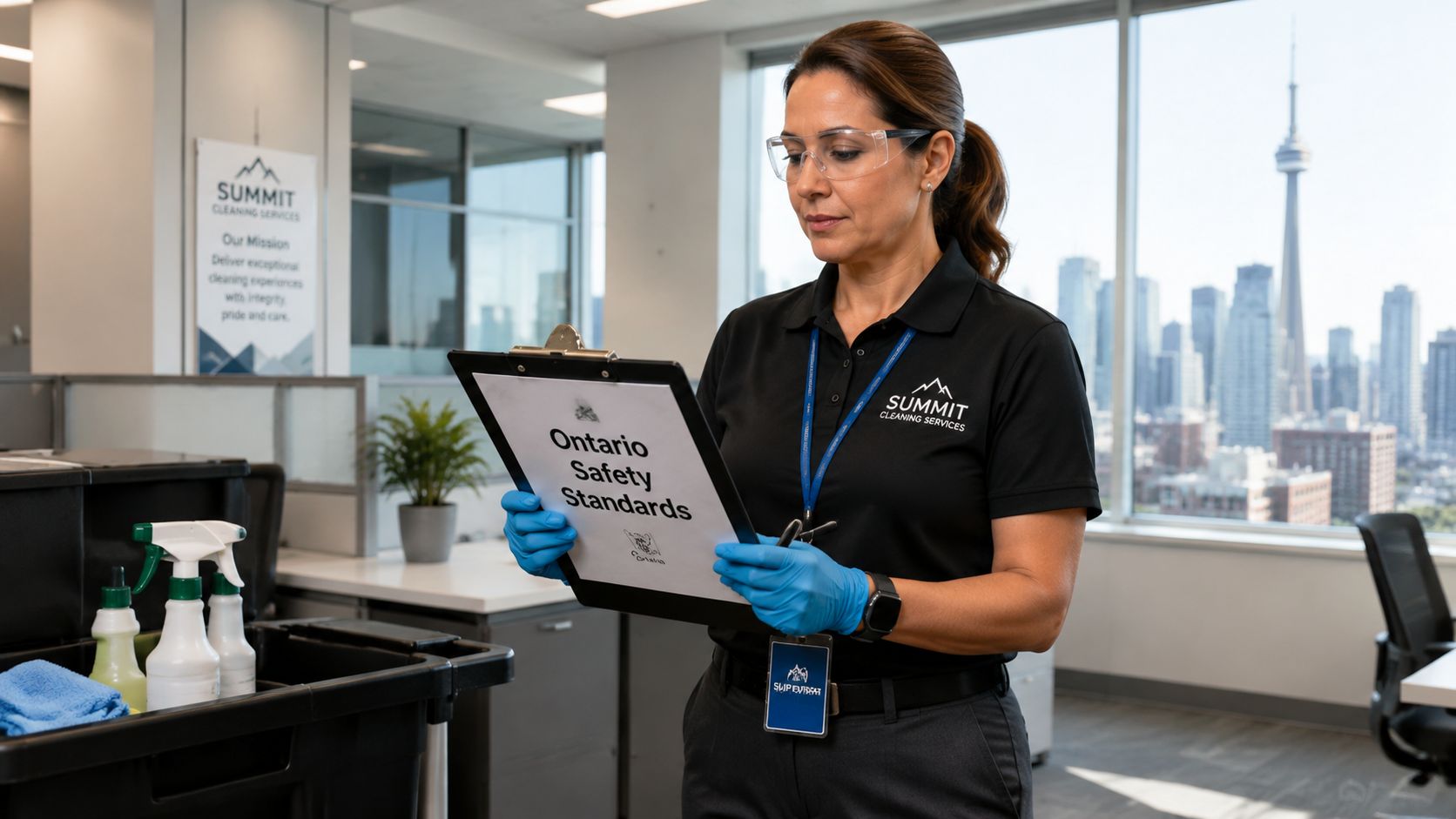
A cleaning quote is partly a service plan and partly a risk plan. The crew will work inside your premises, often with limited supervision from your team, while handling chemicals, equipment, keys, alarms, and restricted areas. If the provider cannot explain how they control those risks, the low price on the quote can become the expensive part later.
The basic documents to ask for
A legitimate commercial cleaning company in Ontario should be able to explain its safety practices in plain language. If the answer sounds vague, that usually means the process is vague too.
Ask for:
- Liability insurance: This helps if service activity leads to property damage or injury.
- Worker coverage and standing: Buyers commonly request current clearance documentation where applicable, so they know the company is meeting its obligations.
- WHMIS training: Staff should know how to store, label, dilute, and use cleaning products safely.
- Site-specific procedures: Access rules, alarm steps, locked rooms, elevator use, and incident reporting should be written down.
These documents do more than satisfy a checklist. They reduce interruption. A company that trains people properly is less likely to damage surfaces, mishandle chemicals, or create avoidable after-hours problems that pull your managers into cleanup mode the next morning.
Why safety standards affect service quality
Safety and quality usually rise or fall together. A contractor that is careless with labels, dilution, or hazard reporting is often careless with schedules, supply use, and follow-up as well. The pattern is the same. Weak control in one area usually shows up somewhere else.
This matters even more in Toronto because service expectations have changed. Many offices now want visible hygiene standards, cleaner shared kitchens, better washroom care, and clearer procedures for high-touch surfaces. That does not always mean full disinfection protocols across the whole site. It means the cleaning plan should match the risk level of the space. If you are comparing routine janitorial tasks with higher-hygiene work, a commercial disinfection and sanitizing service overview can help clarify what belongs in the regular scope and what should be treated as a separate service.
A good way to think about it is this. Compliance sets the guardrails. Service quality is how well the company drives within them.
A practical compliance check during the quote process
Use the walkthrough and quote stage to test how the provider operates, not just how the proposal reads.
- Ask for proof, not verbal assurance: Current insurance and coverage documents should be easy to provide.
- Confirm product handling procedures: Staff should know what products are used on which surfaces, what needs dilution, and what must never be mixed.
- Review after-hours access controls: Keys, fobs, alarm codes, lock-up steps, and restricted rooms should be clearly assigned.
- Clarify incident reporting: Ask who gets notified, how quickly, and what written record is kept.
- Check supervisor involvement: Regular oversight helps keep standards consistent after the first few weeks of service.
A cleaner works inside your operation, not beside it. Safety, documentation, and accountability are part of the service you are buying.
Decoding Commercial Cleaning Prices and Contracts
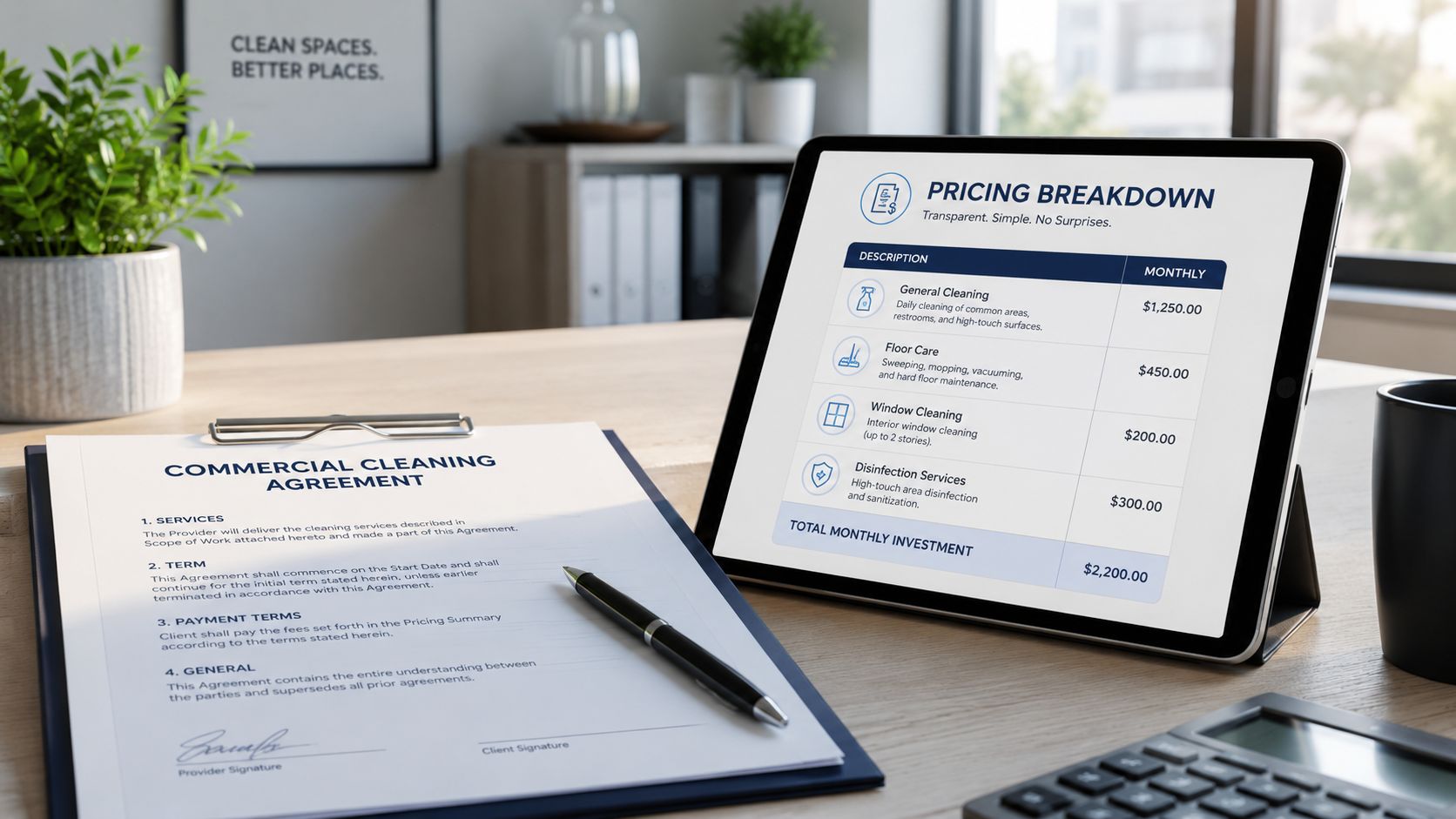
Price is usually the first topic raised and the least understood. Most buyers know they need a clean workplace. Fewer know what drives the quote or how to tell whether a low bid is efficient, unrealistic, or missing part of the job.
What usually changes the price
Commercial cleaning service Toronto pricing is shaped by labour first, then by scope and complexity. The same square footage can price differently if one site has many washrooms, frequent visitors, food prep areas, or flooring that needs more detailed care.
Ontario wage pressure is a major reason prices don't stay flat. Labour is the single largest cost driver, and Ontario's average hourly wage in 2024 was $19.12 for building cleaners and $21.08 for janitors, caretakers and building superintendents. Persistent labour shortages have also put upward pressure on prices, which is why a very low bid can be a warning sign rather than a bargain (Ontario labour wage context for commercial cleaning).
Main cost drivers buyers should ask about
Instead of asking only for a monthly total, ask what assumptions sit behind it.
- Facility type: Offices, clinics, childcare settings, and light industrial spaces don't carry the same workload.
- Cleaning frequency: More visits usually reduce visible buildup but increase labour time and supervision needs.
- Scope detail: Washrooms, kitchens, glass, touchpoints, and consumable restocking all affect labour.
- Time of access: Evening, overnight, or restricted-hour sites can be harder to staff.
- Special surfaces: Carpet, stone, resilient flooring, and high dust areas change methods and equipment.
A quote should make these drivers visible. If it doesn't, the buyer has no reliable way to compare one proposal with another.
How contract models affect flexibility
The contract structure matters almost as much as the price. Some vendors prefer fixed-term agreements with defined renewal periods. Others offer more flexible arrangements with fewer lock-in conditions.
A fixed-term contract can work well when occupancy is stable and budgeting needs predictability. It may also suit larger facilities that want a set scope and scheduled review points.
A flexible arrangement may fit businesses with changing attendance, uncertain growth, or seasonal fluctuation. It allows the cleaning schedule to move with the operation instead of forcing the operation to fit the contract.
What to read before signing
Buyers should scan the service agreement for practical friction points.
| Contract Item | Why It Matters |
|---|
| Scope of work | Prevents disputes over what is and isn't included |
| Frequency and timing | Aligns cleaning with occupancy and site access |
| Supplies and consumables | Clarifies who pays for paper products, liners, soap, or specialty chemicals |
| Extra work process | Defines how one-off tasks are approved and billed |
| Issue response | Sets expectations when something is missed or urgent |
| Exit terms | Reduces conflict if service needs change |
If one bid is much lower than the others, the buyer should slow down and inspect the assumptions. Often the cheapest quote is missing labour time, periodic work, supervision, or realistic service recovery.
A Framework for Evaluating Toronto Cleaning Companies
A strong proposal should answer one basic question. If something goes wrong on Tuesday night, what system fixes it by Wednesday morning? That's the practical difference between a vendor that cleans and a vendor that manages service well.

Canada's commercial cleaning market is largely made up of small to mid-sized operators, and firms are estimated to lose 25% to 35% of clients annually due to service issues or re-bidding. That's a useful buyer signal. Retention in this industry depends heavily on consistency, responsiveness, and contract management, not just on getting the first quote accepted (Canadian commercial cleaning market churn and structure).
What to ask during the quote process
A good meeting with a cleaning company shouldn't feel like a sales pitch. It should feel like an operations review.
Ask questions such as:
- Who supervises the site: Is there a named contact, or is support only through a general inbox?
- How are issues logged: Phone, email, log book, app, or inspection report.
- How is quality checked: Scheduled inspections, supervisor visits, or client sign-off.
- How are staff trained for this type of facility: General office cleaning is different from childcare, legal, or clinical environments.
- What happens when attendance changes: Can the schedule be adjusted if the office shifts to hybrid or expands usage?
- How are special requests approved: Buyers need a clear path for add-on work.
One practical resource for buyers who want to make service expectations more concrete is to prevent service disputes with a checklist. A checklist doesn't replace management, but it helps both sides inspect the same work against the same standard.
What to look for in the proposal itself
The proposal often reveals more than the meeting does. A vague proposal usually leads to vague results.
Look for:
- Detailed task descriptions: “Clean washrooms” is too broad. The proposal should say what that means.
- Defined frequencies: Daily, weekly, periodic, and on-request work should be separated.
- Named exclusions: Buyers should know what is not included.
- Communication method: Someone should own problem resolution.
- Review process: The provider should explain how service quality is monitored over time.
Buyers usually regret vague promises before they regret a detailed quote.
Traditional management vs modern management
Some companies still run on paper checklists, text messages, and reactive issue handling. That can work on a small site with close owner involvement, but it often becomes fragile as schedules, staffing, or client requests get more complex.
A more modern model uses digital inspection records, real-time issue logging, and clearer supervisor accountability. For example, some Toronto office-cleaning providers, including Arelli's Toronto office cleaning service, describe app-based communication and structured quality assurance as part of their operating system. That isn't automatically better on its own, but it does give a buyer something concrete to evaluate.
A simple shortlist method
When comparing vendors, score each one against the same criteria:
Scope clarity
Did the proposal define routine and periodic work clearly?
Operational discipline
Is there a clear inspection and issue-resolution process?
Fit for the site
Does the vendor understand how your business uses the space?
Contract practicality
Are terms workable if occupancy, layout, or schedule changes?
Responsiveness
Did the company answer questions directly and specifically?
This framework is more useful than reputation alone. In a fragmented market, a buyer needs evidence of how the service will hold together after the first month.
The Onboarding Process What to Expect After Signing
The contract is only the beginning. The first weeks of service usually decide whether the relationship becomes stable or turns into a cycle of missed expectations and correction emails.
A well-run onboarding process starts with a site walk-through. The cleaning supervisor, operations lead, or account contact should review access points, alarm procedures, priority areas, supply storage, and any surfaces that need special treatment. This is also the right time to flag problem zones such as lunchrooms, reception glass, shared meeting rooms, or washrooms with peak traffic.
The first things that should be finalised
The written cleaning checklist should be tightened up early. If the quote said “general office cleaning,” onboarding should translate that into task-level instructions the crew can follow.
That usually includes:
- Room-by-room expectations: Reception, private offices, boardrooms, kitchens, washrooms, and break areas.
- Frequency notes: What happens every visit, what happens weekly, and what is periodic.
- Supply rules: Who orders liners, soap, paper products, and backup stock.
- Access instructions: Locked rooms, alarms, elevator use, and after-hours entry.
- Escalation contacts: Who the cleaner calls, who the client contacts, and how urgent issues are reported.
What a smooth launch looks like
The best onboarding feels boring in a good way. Everyone knows the checklist. The crew knows where supplies go. The client knows who to contact. Small issues are logged and corrected before they become recurring complaints.
A smart buyer should also expect a review point early in the relationship. That gives both sides a chance to adjust frequency, timing, or task detail once the service has been tested in real conditions. Cleaning works best as an operating partnership, not as a one-time transaction with assumptions left unspoken.
Frequently Asked Questions and Further Reading
A Toronto business often realizes what it really bought from a cleaning contract only after the first month. The office may look fine at a glance, but the actual test is whether washrooms stay stocked, touchpoints stay under control during flu season, and the invoice still makes sense after add-ons. That is why the last set of questions matters. They help you connect service decisions to operating cost, staff health, and day-to-day reliability.
FAQ
What's the difference between cleaning and disinfecting?
Cleaning removes dust, spills, fingerprints, and other visible soil. Disinfecting uses a product and contact time meant to reduce germs on targeted surfaces. A good way to separate the two is this. Cleaning makes a surface look and feel clean. Disinfecting is used where health risk is higher, such as shared touchpoints, washrooms, and some food areas. In many Toronto offices, daily cleaning is the base service and disinfecting is applied where traffic and risk justify the extra labour.
How often should an office be professionally cleaned?
The schedule should match how the space is used, not just its square footage. A quiet hybrid office with limited visitors may need lighter recurring service than a medical-adjacent clinic, a fitness space, or a client-facing workplace downtown. More visits mean more labour hours, and in Toronto that cost is shaped heavily by local wages, travel time, and whether service happens after hours. Frequency should follow usage patterns first, then budget.
Should a business choose the lowest quote?
The safer approach is to choose the clearest quote. A very low price often means fewer labour hours, fewer periodic tasks, lower supervision, or a narrow scope that leaves out problem areas. Cleaning contracts work like maintenance budgets. If the hours are cut too tightly, the missing work shows up later as complaints, supply issues, and special callouts that cost more than the original savings.
Why does vendor stability matter?
A stable cleaning company is easier to manage because the systems are usually settled. Crews are more likely to stay consistent, supervisors are easier to reach, and quality problems are more likely to be corrected quickly. Industry Canada's Canadian Industry Statistics for janitorial services is one reference point for understanding the sector, but for a buyer the practical question is simpler. Can this company keep staffing, supervision, and service quality steady over time?
For common questions about scheduling, scope, and what clients are typically asked during setup, the Arelli Cleaning FAQ page for commercial cleaning questions is a useful starting point.
Further reading
Internal resources
External resources
A practical next step is to use the checklist above, gather two or three detailed quotes, and compare scope before price. Businesses that want one more local option can review Arelli Cleaning alongside other Toronto providers and ask the same operational questions of each company.









.webp)