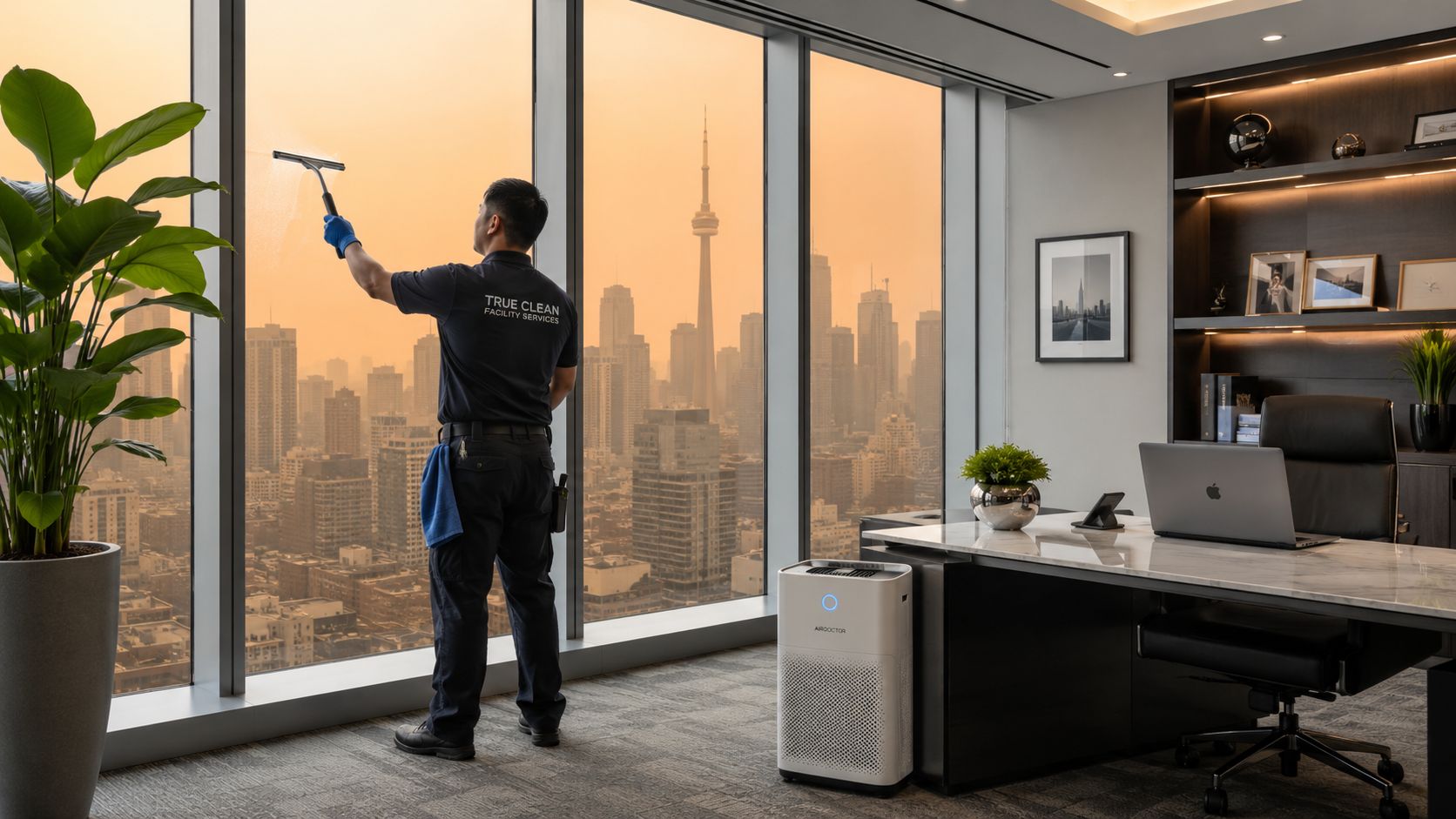
A Toronto office manager walks in on a smoky July morning, sees the skyline washed in orange, and assumes the main job is to keep windows shut. That's only the first step. The harder problem is what has already entered the building, settled on desks, moved through vents, and collected in filters before anyone noticed.
That's why how the wildfire in Northern Ontario impacts office cleaning in Toronto isn't just an air-quality question. It's an operations question. When smoke drifts into the GTA, normal janitorial routines often stop being enough. Fine particles can settle on floors, electronics, window ledges, fabric panels, and HVAC components, and the wrong cleaning method can push them back into the air.
Commercial buildings need a response that's practical, staged, and safe. During an active smoke event, the focus should be on containment and low-resuspension cleaning. After conditions improve, the work shifts to restoration. That means removing residue methodically, protecting indoor air quality, and documenting the process for staff, tenants, and property managers.
Table of Contents
The Unseen Impact of Distant Wildfires on Toronto Workspaces
In July 2026, many Toronto businesses were again watching wildfire coverage from Northern Ontario and asking the same practical question. If the fire is far away, why does the office smell smoky, look dusty, and feel harder to keep clean? The answer is simple. Smoke travels, and commercial buildings rarely operate as sealed boxes.
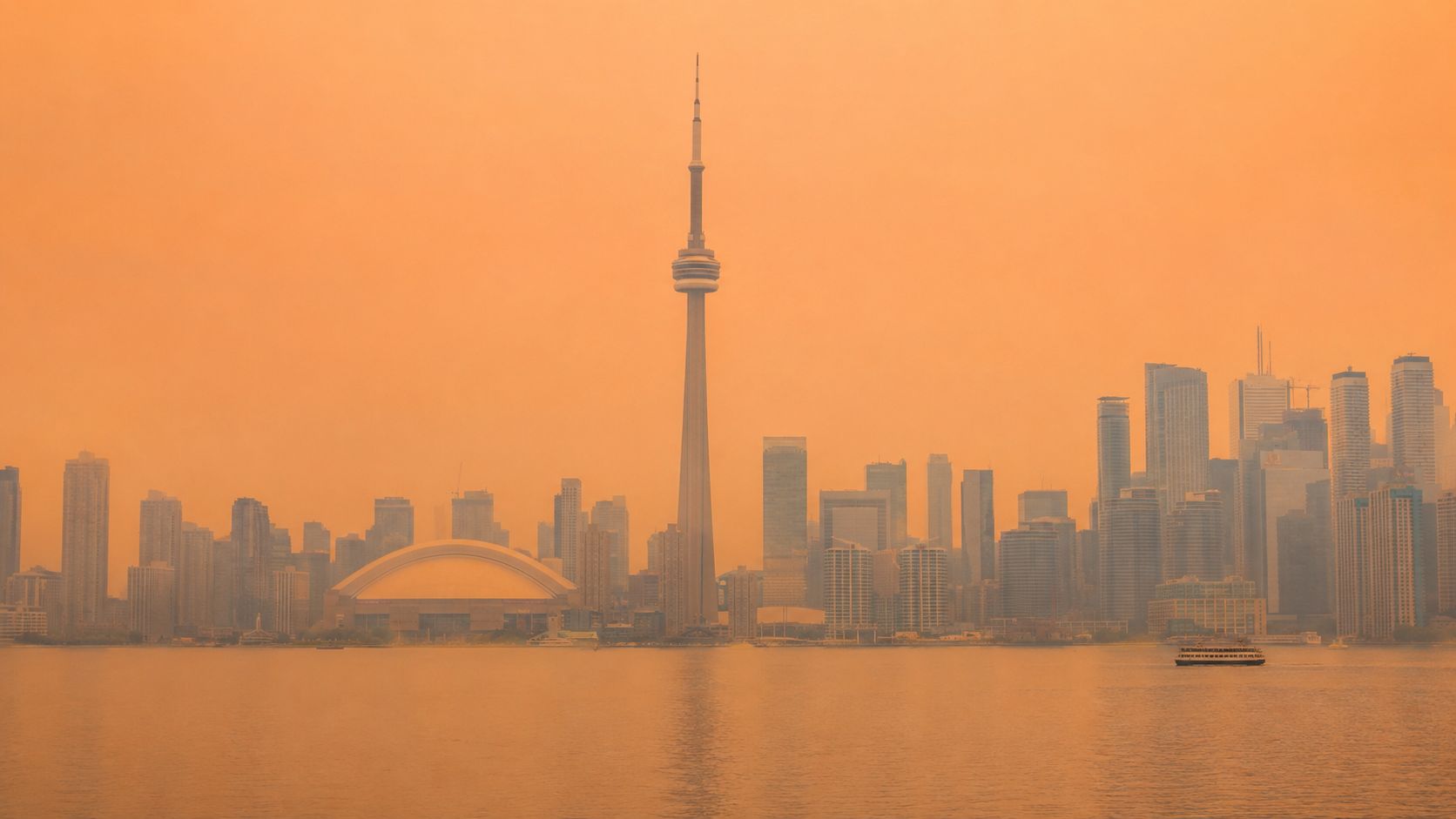
A hazy skyline is the visible part. The less visible part is the residue that arrives with it. Smoke particles and soot can land on reception counters, meeting room tables, workstation dividers, windowsills, supply shelves, flooring, and upholstered seating. In buildings with heavy foot traffic, those settled particles don't stay put. Staff movement, carts, and standard vacuuming can lift them back into the breathing zone.
For Toronto businesses that rely on office cleaning support in the city, this changes the scope of work. The concern isn't only appearance. It's whether cleaning methods reduce particle load or keep recirculating it indoors.
Why a distant fire becomes a local cleaning problem
Wildfire smoke creates a layered cleaning issue:
- Air contamination means particles enter occupied space.
- Surface deposition leaves a fine film on horizontal and higher areas.
- HVAC loading makes filters and vents collect residue faster than usual.
- Routine task limits become obvious because standard dusting and normal vacuuming aren't designed for smoke events.
Practical rule: If a building smells smoky or shows visible ash-like dust after a regional wildfire event, the cleaning plan should be treated as an indoor environmental response, not just a cosmetic tidy-up.
Key takeaways
- Wildfire smoke affects indoor cleaning scope, even when the fire is far from Toronto.
- Fine smoke particles can settle on surfaces and inside HVAC systems, then become airborne again if handled poorly.
- Standard daily cleaning usually isn't enough after a significant smoke event.
- HEPA vacuuming, damp wiping, wet-mopping, and filter attention matter more than fast dry cleaning.
- A staged plan works best, with immediate containment first and deeper post-event restoration second.
Understanding the Indoor Threat from Wildfire Smoke
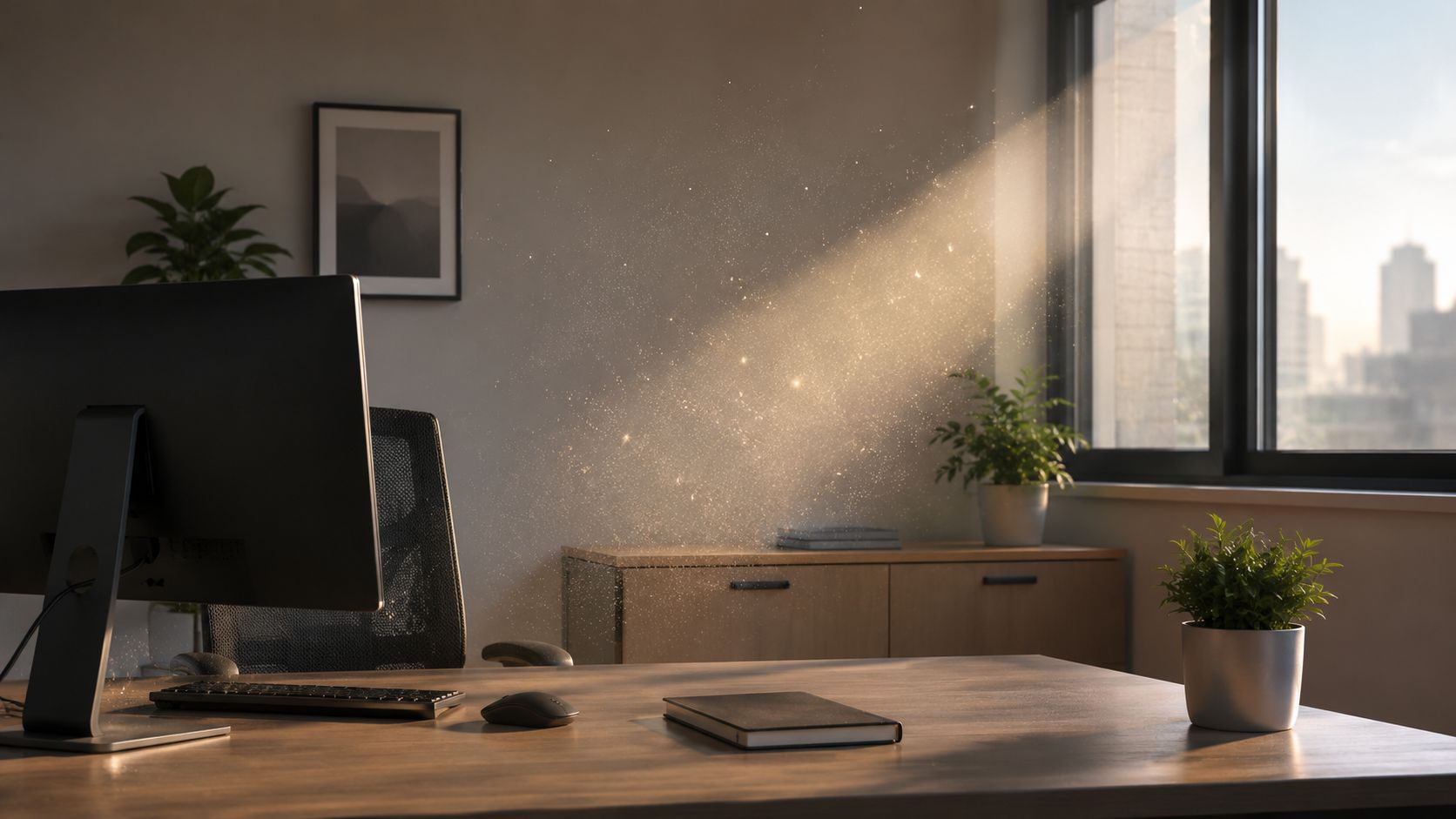
Wildfire smoke is not just a smell. It's a mix of gases and particles, and the cleaning challenge comes mainly from the smallest particles. In office environments, those particles can move through entry doors, loading areas, gaps in the building envelope, and ventilation pathways without leaving dramatic visible residue at first.
What PM2.5 means inside an office
PM2.5 refers to very fine particulate matter. These particles are small enough to remain suspended in air and small enough to evade casual cleaning methods. During the June 2023 wildfire event, Toronto's air quality reached severe levels. Wildfire smoke from Northern Ontario raised Toronto's Air Quality Health Index to “High” (10+) levels, and PM2.5 concentrations exceeded 35 µg/m³, more than triple the Health Canada daily guideline of 12 µg/m³, which pushed facilities to adopt wet-mopping and MERV-13+ filtration to manage increased particulate deposition, according to Health Canada's guidance on cleaner air spaces during wildfire smoke events.
For office managers, the practical meaning is straightforward. When outdoor smoke rises, indoor contamination doesn't stop at the front door. It often shifts from obvious outdoor haze to hidden indoor loading on surfaces and filters.
How smoke contaminates indoor spaces
Smoke usually affects a workplace through three pathways.
Direct entry from outdoors
Doors open. Delivery bays cycle. Small air leaks around windows and mechanical penetrations add up. Even buildings with decent envelope control can still admit smoke during prolonged events.
Recirculation through HVAC systems
Buildings depend on air movement. That's helpful for comfort, but it also means smoke-related residue can accumulate on filters, diffusers, and nearby surfaces. Once filters load up, performance can drop and cleaning needs increase.
Surface settlement
Particles don't stay airborne forever. They settle as a light film on desks, ledges, vents, blinds, shelves, and flooring. This is why offices can look normal from the doorway but still fail a wipe test on darker surfaces.
Offices often discover the problem late because smoke contamination is partly invisible. By the time residue is obvious on a sill or tabletop, other surfaces usually already need attention.
Indoor air quality matters because people spend long periods in these spaces, especially in enclosed offices, boardrooms, and shared work areas. A practical explainer on how indoor air quality impacts health is useful background for managers who need to communicate the issue without turning it into alarm.
For cleaning teams, the key lesson is that smoke residue should be captured, not scattered. Dry methods alone often do the opposite.
A related protection measure in sensitive environments is a more controlled hygiene approach such as COVID-conscious cleaning, where product choice, contact practices, and risk reduction are built into the workflow.
An Immediate Response Checklist for Facility Managers
When smoke is actively affecting Toronto, the first objective is control. Deep restoration can wait until outdoor conditions improve. During the event, facility managers should reduce infiltration, protect occupants, and avoid cleaning practices that make indoor air worse.
Air management during an active smoke event
Use this as a live checklist:
- Keep the building closed where practical. Limit window opening and reduce unnecessary door cycling in low-traffic entrances.
- Check HVAC filter status early. If the system supports higher-efficiency filtration, use the highest compatible level specified for the equipment and monitor loading more closely than usual.
- Use portable HEPA units in occupied problem areas. Reception zones, smaller meeting rooms, wellness rooms, and enclosed offices often benefit most.
- Review pressure relationships. Negative pressure near entrances or loading areas can pull smoky air inward.
- Protect intake areas. If residue appears around vents or louvers, flag those spots for later detailed cleaning.
The goal isn't to create perfect conditions during an active smoke event. It's to keep the indoor environment stable enough that contamination doesn't spread faster than staff can manage it.
Employee communication that reduces confusion
A short, plain-language notice is better than a technical memo. Staff need to know what's changing and why.
A useful internal message should cover:
What's happening
Outdoor wildfire smoke is affecting indoor operations.
What the building is doing
Filtration is being monitored, entry points are being managed, and cleaning has shifted to low-resuspension methods.
What employees should avoid
Don't prop doors open. Don't use personal fragranced sprays to mask odour. Don't dry dust workstations.
What to report
Visible ash-like residue, unusual odours, dusty vent covers, or comfort complaints in enclosed rooms.
Clear communication reduces improvised cleaning by occupants, and improvised cleaning is often what spreads settled smoke particles.
Safe initial cleaning steps
During an active smoke event, not every cleaning task should continue in its usual form. Some methods should be paused or modified.
- Use damp wiping on hard surfaces. This traps particles instead of lifting them.
- Wet-mop floors rather than relying on dry dust tools. Dry sweeping can reintroduce settled matter into the air.
- Target entry zones more often. Lobbies, vestibules, elevator landings, and perimeter offices usually accumulate residue first.
- Delay non-essential agitation cleaning. Carpet beating, aggressive brushing, and similar disturbance-heavy tasks can wait.
- Separate visibly affected materials. Cleaning cloths and disposable materials used on smoky residue shouldn't be mixed casually with standard supplies.
What doesn't work well is just cleaning more quickly. Speed without the right method often creates a false sense of progress.
A staged response also helps in facilities planning broader recovery work. For buildings preparing for a more detailed intervention once conditions settle, a structured facility pre-clean process can help define zones, priorities, and sequencing.
The Professional Post-Smoke Office Cleaning Protocol
Once outdoor smoke improves, the job changes. The focus moves from short-term control to full removal of settled particulate and residue. Many buildings, however, err when they resume the usual cleaning schedule and assume the problem has passed. In practice, residual contamination often remains on high surfaces, in soft furnishings, around vents, and inside neglected edges such as window tracks.
Ontario's 2024 wildfire season made that operational pressure visible. The season caused a 37% spike in commercial cleaning requests in Toronto for specialized services such as air filter replacement and surface disinfection, and facilities following CIMS-aligned protocols added post-smoke work such as high-dusting of ceiling vents and window tracks, which are usually outside standard contracts, as described in the Ontario wildfire smoke and air quality reference document.
What changes after outdoor air improves
A post-smoke clean is not a single pass. It's a restoration sequence. The order matters because cleaning lower surfaces before removing overhead residue often means doing the same work twice.
A professional workflow usually follows the building's airflow and gravity patterns. That means starting where particles collect overhead and in recirculation points, then moving downward to occupied surfaces and floors.
A top-down restoration workflow
HVAC and air movement components first
The highest priority is the system that kept moving air during the event.
- Inspect and replace loaded filters as needed
- Clean accessible grilles, diffusers, and vent faces
- Check visible residue around intake-adjacent areas
- Coordinate with HVAC specialists where internal mechanical cleaning exceeds janitorial scope
This part matters because a beautiful desk clean means very little if residue remains active in the supply path.
High-dusting of overlooked surfaces
Ceiling lines, tops of partitions, ledges, cabinet tops, conduit runs, light housings, and exposed structural elements can hold a surprising amount of fine residue.
That's why high-dusting service becomes a central task after wildfire smoke, not an optional add-on. In many offices, the smoke film is most obvious only after a cloth touches higher surfaces.
Field note: If cleaning staff skip high surfaces after a smoke event, occupants often keep noticing “new dust” for days because particles continue settling from places nobody addressed.
HEPA vacuuming of floors and fabric surfaces
Standard vacuuming isn't enough for smoke residue control if the machine doesn't capture fine particles effectively. Floors, entry mats, upholstered task chairs, panels, and soft seating should be vacuumed with equipment designed to retain fine particulate rather than exhaust it back into the room.
This is also where zoning matters. A carpeted boardroom used infrequently may need less attention than an open office perimeter beside exterior glazing and frequently used entrances.
Wet cleaning of hard surfaces
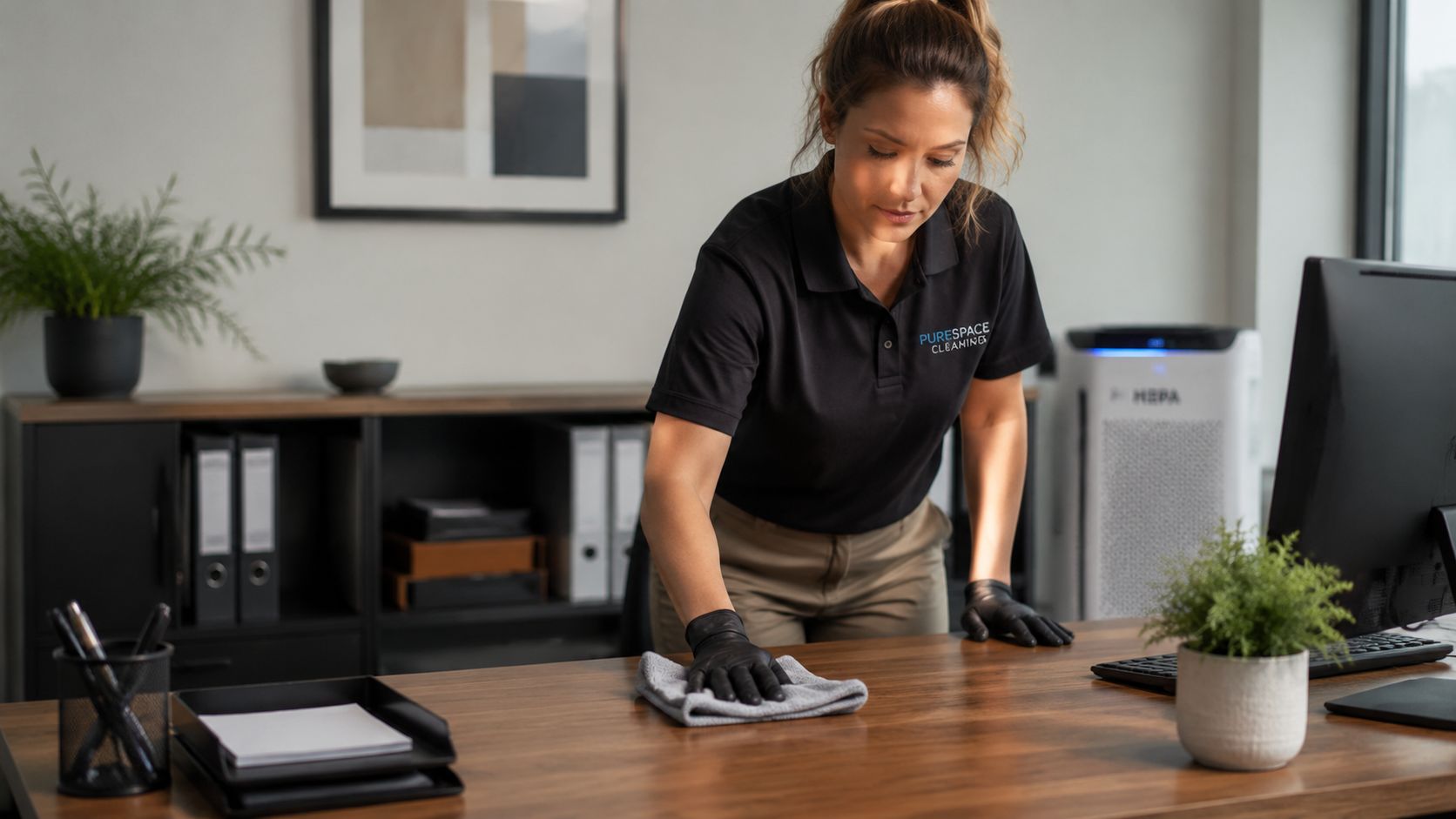
After overhead residue and loose particulate are addressed, crews can clean desks, counters, sills, shelving, chair arms, door hardware, glass edges, and hard floors. Damp wiping and wet-mopping are usually more effective than dry methods because they remove rather than redistribute residue.
Special care is needed around:
- Electronics and monitors
- Paper storage and file tops
- Blinds and window frames
- Break room shelving
- Reception furniture with mixed hard and soft finishes
Odour follow-up where fabrics are involved
Smoke odour can linger in textiles even when visible residue is gone. Managers dealing with soft seating, drapery, fabric panels, or other absorbent materials may find practical steps in this guide on cleaning smoke smell from fabrics. The principle is relevant in offices too. Odour control works best after particulate removal, not before it.
What works and what does not
A few trade-offs matter in real buildings.
| Approach | Usually works | Usually fails |
|---|
| Dust removal | HEPA vacuuming, damp wiping, wet-mopping | Dry dusting, dry sweeping |
| Overhead cleaning | Top-down high-dusting before floor finishing | Cleaning desks first and vents later |
| Filter strategy | Inspection and timely replacement | Leaving visibly loaded filters in service |
| Odour response | Remove residue first, then address fabrics | Masking smell with fragrance |
| Scope planning | Add window tracks, vents, ledges, fabric seating | Limiting work to visible desk surfaces only |
The practical lesson is simple. Smoke remediation is successful when the building stops releasing hidden residue back into occupied space. That takes sequence, equipment, and patience.
When to Manage In-House vs Hiring a Professional Service
Some workplaces can handle a light smoke-related cleanup internally. Others shouldn't try. The decision depends less on building size than on risk, equipment, staffing depth, and the level of contamination across ventilation paths and soft surfaces.
Decision framework DIY vs professional wildfire smoke cleaning
| Criteria | In-House Staff (DIY) | Professional Service |
|---|
| Best use case | Light residue in a small office with limited spread | Broad contamination, visible settling, HVAC-adjacent residue, or multiple floors |
| Equipment | Usually basic carts, cloths, standard vacuums | HEPA-capable equipment, specialised high-access tools, structured workflows |
| Safety control | Depends on internal training and supervision | Better suited where low-resuspension methods must be followed consistently |
| Coverage of hidden areas | Often limited to visible surfaces | More likely to include vents, tracks, ledges, upholstery, and high surfaces |
| Operational disruption | Can seem cheaper but may pull staff off routine tasks | More organised for after-hours or staged recovery work |
| Result quality | Acceptable for minor events | Stronger choice when indoor air restoration matters |
A useful internal benchmark is this. If the team can't inspect, capture, and remove residue without spreading it, the job is no longer a simple janitorial task.
For managers evaluating office support options more broadly, it helps to understand what a full office cleaning service should and should not include during a smoke-related event.
What to ask a cleaning company
Use direct questions. Vague answers usually lead to vague results.
- Ask about sequence. Do they clean top-down, starting with vents and higher surfaces before desks and floors?
- Ask about equipment. Can they explain when HEPA vacuuming is used and when damp or wet methods are preferred?
- Ask about filter-related coordination. Do they address accessible vent contamination and communicate clearly about work that belongs to HVAC specialists?
- Ask about scope exclusions. Are window tracks, partition tops, upholstery, and high ledges included or excluded?
- Ask about staff training. Can they explain how crews avoid resuspending smoke particles during cleanup?
- Ask for a post-event checklist. A structured scope is easier to approve and defend internally.
A good provider should be able to explain the method in plain language. If the explanation is fuzzy, the execution usually is too.
Red flags to avoid
- Very low quotes with no scope detail
- Promises that one quick disinfecting pass will solve smoke residue
- No mention of HEPA vacuuming, damp wiping, or high-dusting
- No distinction between janitorial cleaning and post-event restoration
- Heavy reliance on deodorisers without particulate removal first
Price still matters, but wildfire smoke cleaning should be judged by scope and method first. The least expensive proposal can become the most expensive if residue remains and the building needs to be cleaned again.
Frequently Asked Questions and Additional Resources
Smoke events create a lot of uncertainty for office managers because the visible haze usually clears before the indoor problem is fully resolved. These are the questions I hear most often after a wildfire smoke episode affects Toronto buildings.
FAQ
How long does smoke residue last indoors
Until it is removed. Larger particles settle fast, but finer smoke particulate can stay on supply grilles, workstation edges, carpet fibres, fabric panels, and other surfaces that release it back into the air when people walk through the space or the HVAC system cycles.
What areas are most often missed after a smoke event
The missed areas are usually the ones outside the normal janitorial route. Window tracks, blind slats, partition tops, vent covers, shelving edges, monitor backs, chair upholstery, and high horizontal ledges are common examples.
Is regular disinfecting enough
No. Smoke cleanup is a particle-removal job first. A disinfectant pass may leave the residue in place if the surface has not been HEPA vacuumed or wiped with the right damp-cleaning method.
Should carpets be cleaned after wildfire smoke
Often, yes. Carpet acts as a reservoir for fine particulate, especially near entrances, perimeter offices, and traffic lanes. The right method depends on how much residue is present and whether dry soil removal can be completed before any moisture is introduced.
What are the main cost drivers
Scope drives cost more than square footage alone. Buildings with many high surfaces, fabric chairs, panel systems, accessible vents, and detailed perimeter areas usually take longer to restore properly than open areas with mostly hard surfaces. After-hours access, lift requirements, and work sequencing with HVAC service also affect pricing.
Who should lead the response inside a business
One accountable contact should lead it. In most offices, that is the facility manager, operations manager, property manager, or health and safety lead. That person should control scope approval, vendor communication, occupant updates, and the decision on when spaces are ready to return to normal use.
When should a business bring in outside help
Bring in outside help when odour lingers, visible dust returns soon after cleaning, staff complaints continue, or the affected area includes high ceilings, ventilation components, extensive soft furnishings, or multi-zone occupancy. Those conditions usually point to a wider particulate issue than an in-house team can handle with routine tools.
Additional resources
Internal resources
The practical next step is to use the checklists earlier in this guide, classify the issue by affected area and surface type, and request quotes based on a written scope. Ask each provider to explain the cleaning sequence, the equipment they will use, which surfaces are included, and what work must be handled separately by an HVAC specialist.
Businesses that need help evaluating wildfire-related office cleaning can contact Arelli Cleaning as one option, alongside other qualified providers. Compare scopes carefully. A clear method for particle removal, surface cleaning, and re-occupancy review matters more than a generic promise to deep clean.






.webp)