Toronto is the centre of Canada's window cleaning market. The city holds 40% of the national market share with 422 window cleaning businesses, according to Canadian window cleaner market data. For property managers, that statistic changes the usual question from “Can a provider be found?” to “Which provider can handle the building safely, consistently, and with the right documentation?”
That matters because window cleaning services in toronto aren't a simple commodity purchase. A ground-floor retail unit, a mid-rise office, a school, and a downtown tower all carry different access risks, scheduling constraints, chemical considerations, and procurement requirements. Clean glass is the visible result. The actual buying decision is about risk control, occupant experience, and service reliability.
Your Guide to Commercial Window Cleaning in Toronto
A large provider pool in Toronto gives property managers options, but it also increases procurement risk. Many proposals cover the same square footage on paper while leaving major variables undefined. The gaps usually show up in access planning, site protection, supervision, insurance limits, and what happens if weather or tenant activity delays the work.
For commercial properties, window cleaning is a scope-control and compliance decision before it is a line-item cleaning purchase. Glass condition matters, but so do contractor onboarding requirements, occupant safety, public liability exposure, and building-specific access rules. The right vendor is the one that can clean the glass without creating preventable risk for the owner, manager, or tenants.
Toronto adds practical complications. Salt film, traffic residue, seasonal weather shifts, narrow service lanes, suspended stages, and restricted daytime access all affect how the work should be priced and scheduled. If those conditions are not defined at tender stage, disputes usually appear after the crew arrives on site.
Property teams that buy multiple site services should also look at how window work fits into the broader commercial cleaning services for GTA workplaces. That matters when lobby glass, interior partitions, post-construction cleanup, and exterior touchpoints are assigned to different contractors and the scope starts to overlap.
Key takeaways
- Define the risk profile before requesting quotes: Ground-level storefront glass, interior office partitions, boom-lift work, and rope-access cleaning require different controls, permits, and crew qualifications.
- Request the safety file early: Proof of insurance, WSIB clearance, worker training records, and site-specific hazard procedures should be reviewed before price discussions go too far.
- Access drives cost and execution: Height, roof tie-off conditions, public sidewalks, atriums, loading areas, and after-hours restrictions often affect the price more than the number of panes.
- Match the method to the building: Pure water poles, hand detailing, lifts, and suspended access each have limits based on height, glass type, surrounding surfaces, and pedestrian exposure.
- Compare bids on equal terms: Vendors should price the same service frequency, inclusions, access assumptions, and deficiency process, or the quote comparison will not be reliable.
Clean glass supports appearance. A properly scoped and documented contract protects operations, compliance, and liability control.
Defining Your Window Cleaning Service Needs
Scope errors are one of the main reasons window cleaning quotes fail in procurement. A request that only says "window cleaning" forces each bidder to guess the glass type, access method, site restrictions, and service frequency. That usually produces prices that cannot be compared and leaves safety assumptions unresolved until after award.

Start by separating the work into service categories. Interior glass, low-rise exterior glass, and high-rise access work should rarely sit under one vague line item because the labor, equipment, risk controls, and scheduling constraints are different. If your team needs a baseline description of specialty window cleaning services, use it to frame the scope, then tailor the tender to the building.
Interior glass cleaning
Interior glass cleaning covers glazing inside the occupied space. That usually includes lobby panels, office partitions, boardroom walls, entry doors, sidelights, and glass near reception, elevators, and stairwells.
For property managers, the trade-off is usually access and disruption, not height. Daytime cleaning may be easier to supervise, but it can interfere with reception traffic, meetings, patient flow, or tenant privacy. After-hours work reduces disruption, though it may increase coordination costs if security access, alarms, or freight elevator bookings are required.
A clear interior scope should state:
- Which glass surfaces are included
- Whether frames, tracks, ledges, and mullions are included
- Whether adhesive residue, paint specks, and post-construction film are excluded or priced separately
- Whether the work is recurring, move-in or move-out related, or tied to renovation closeout
Typical applications include corporate offices, clinics, schools, and other buildings with high-touch interior glazing that shows fingerprints and traffic film quickly.
Exterior low-rise cleaning
Low-rise exterior cleaning usually fits storefronts, plazas, schools, office buildings, industrial units, and other properties where crews can work from grade or with limited access equipment. The main procurement issue here is access, not just square footage.
A street-facing retail unit may need early-morning service to avoid pedestrian conflict. A business park may allow daytime work but restrict hose routing across entrances. An industrial site may have loading activity, uneven pavement, or vehicle movement that affects setup. Those conditions should be written into the scope before pricing starts.
Define the service in operational terms:
- Maximum working height expected from grade
- Approved access methods for the site
- Water availability and drainage constraints
- Whether canopies, signs, or landscaping create obstructions
- Whether frames, sills, and exterior doors are part of the base price
This is also where expectations matter. Some buildings need detailed glass presentation at the main entrance. Others need a practical maintenance standard across large exterior elevations. If the finish standard is not stated, one bidder may price hand detailing while another prices a faster maintenance clean.
High-rise rope access cleaning
High-rise cleaning should be treated as a separate procurement package or, at minimum, a separately defined line item. Suspended access, rope access, roof anchor use, and rescue planning introduce a different level of contractor review.
The first question is simple. How will the contractor reach the glass safely on your building?
That answer affects everything else, including crew qualifications, equipment staging, roof access procedures, public protection, and the documents you need before work starts. On towers, stepped roofs, podium levels, and irregular façades, the access plan should be specified in the bid request or clearly required in the submission.
High-rise scopes often include:
- Exterior façade glazing above low-rise access limits
- Elevations blocked by setbacks, canopies, or podium roofs
- Glass near terraces, parapets, and complex façade lines
- Recurring maintenance for office towers, mixed-use properties, and condo common areas
If the property has unusual conditions, say so early. Examples include limited roof tie-off points, heritage frontage, crowded sidewalks, adjacent transit stops, or strict after-hours noise controls. Those details affect contractor selection and risk review as much as the cleaning itself.
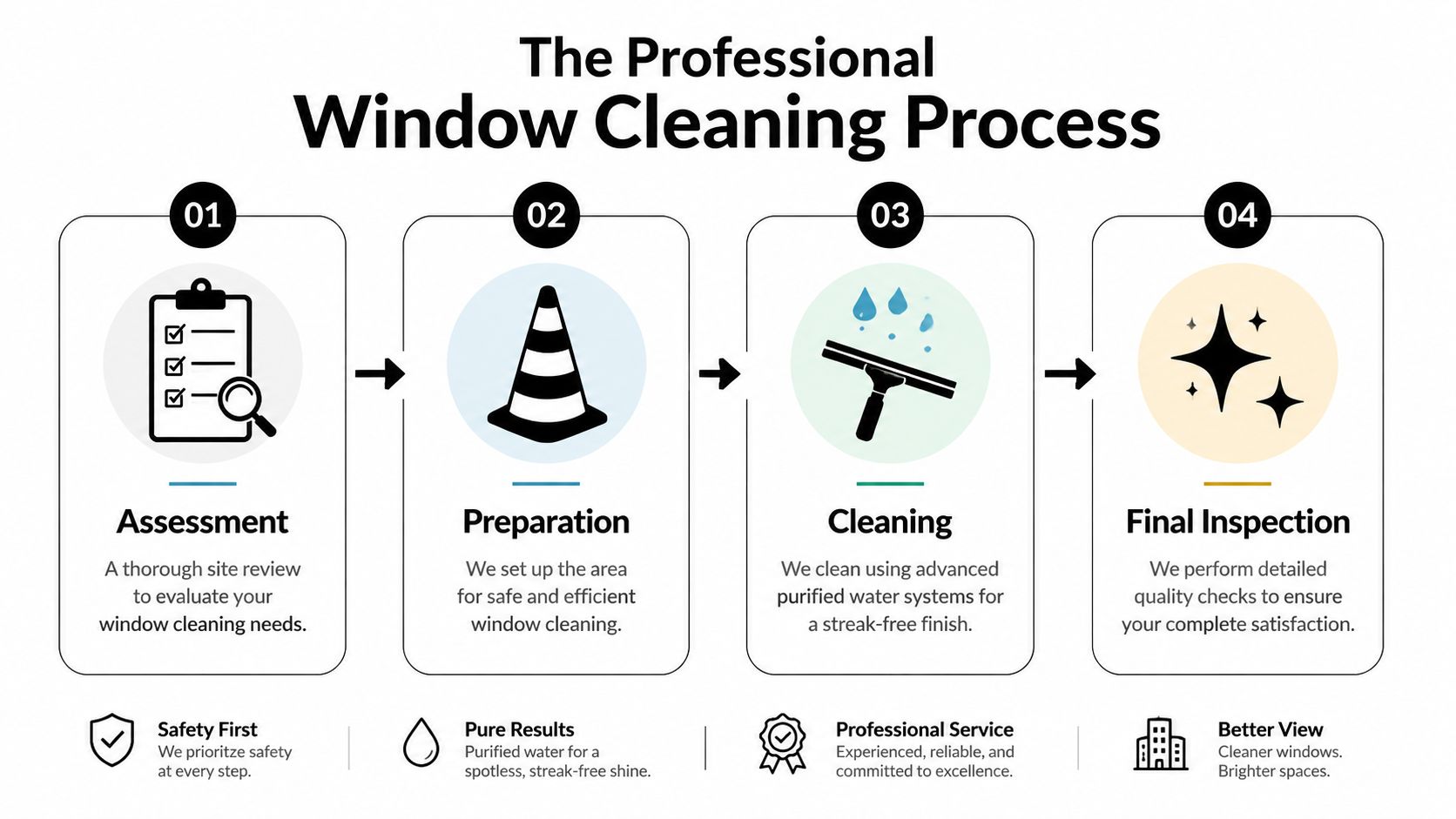
The Professional Window Cleaning Process and Equipment
Method selection affects more than appearance. It affects access risk, time on site, pedestrian exposure, and whether the finish standard can be met without rework. For commercial properties in Toronto, the best process is usually the one that matches the building's glass type, soil load, occupancy pattern, and access constraints.
Pure water systems and water-fed poles
Pure water cleaning is a standard choice for low-rise exterior glass because it reduces ladder work and improves production on repetitive elevations. Technicians scrub the glass with a water-fed pole and rinse with purified water so fewer mineral deposits are left behind as the surface dries.
This method fits routine exterior maintenance on:
- Multi-unit office and industrial buildings
- Schools and institutional sites
- Long runs of standard exterior glazing
- Properties where ground-based access reduces risk and disruption
The trade-off is finish control. Pure water systems are efficient on lightly soiled exterior glass, but they are less effective on adhesive residue, paint specks, heavy grease, bird droppings baked onto the glass, or neglected frames that bleed dirt back onto the pane. Procurement documents should distinguish between maintenance cleaning and restoration-level work so bidders are pricing the same result.
It also helps to define related scope at entrances and lower façades. On many sites, power washing for commercial properties is scheduled alongside window cleaning because dirty concrete, mullions, and splash zones can undermine the finished appearance even when the glass itself is clean.
Hand detailing and interior finishing
Hand cleaning remains the better method for interiors, storefronts, partition glass, and areas where tenants will notice edge detail immediately. Squeegees, applicators, scrapers used within glass-safe procedures, and lint-free cloths give crews more control around frames, corners, hardware, and adjacent finishes.
This is also where quality disputes usually start. If a contractor prices a fast maintenance pass and the property team expects full edge detailing, sticker residue removal, and frame wipe-downs, the mismatch shows up at inspection. The scope should state whether detailing includes tracks, sills, frames, fingerprints near door pulls, and residue from temporary signage.
Later in the process, this walkthrough gives a useful visual reference:
Site preparation and final inspection
A professional crew should prepare the site before tools come out. That includes checking pedestrian routes, placing warning controls where runoff or hoses could create slip hazards, protecting nearby finishes, confirming water access, and verifying any tenant or security restrictions that affect the work window.
Final inspection should be treated as a control step, not a courtesy. The review needs to cover glass edges, corners, frames, drips on lower panels, and any marks caused by runoff from seals or dirty gaskets. On commercial properties, that closeout process matters because it catches scope gaps before tenants complain and before a second mobilization adds cost.
A clean pane is only part of the deliverable. The actual standard is a safe job, a documented process, and a finish level that matches the contract.
Understanding Window Cleaning Costs in the GTA
Window cleaning quotes in Toronto often miss the primary factors that influence cost. The number on the first page matters, but procurement problems usually come from unclear scope, bad access assumptions, and missing allowances for risk controls.
A low quote can become the expensive option if the contractor priced basic ground-level production and the site requires controlled access, tenant coordination, or restorative cleaning. For commercial properties, cost has to be read alongside service method, scheduling limits, and the contractor's planning discipline.
Why one quote is higher than another
Two buildings with a similar amount of glass can produce very different pricing. A simple retail frontage with open daytime access is faster to service than an office property with roof restrictions, security procedures, underground parking conflicts, or residue left from construction and signage.
The main cost factors are operational:
- Building height: More height usually means slower production, different access methods, and more supervision.
- Window layout: Large runs of standard glazing are faster than divided panes, atriums, recessed glass, or clerestory sections.
- Accessibility: Landscaping, canopies, loading areas, locked sections, and limited staging space all add labour time.
- Glass condition: Routine dirt is one scope. Adhesive, paint specks, hard water staining, and neglected buildup are another.
- Service frequency: Recurring maintenance generally costs less per visit than one-time cleanup because buildup is lighter and planning is repeatable.
- Work window restrictions: Evening access, tenant blackout periods, and escorted entry slow the job and should be priced in from the start.
Key Drivers of Commercial Window Cleaning Costs in Toronto
| Cost Driver | Description | Impact on Price |
|---|
| Building height | Low-rise work is usually simpler to access than taller buildings requiring advanced methods | Higher complexity usually increases price |
| Window count | More panes can increase labour, though repetitive layouts may improve efficiency | Can raise total cost, but layout matters |
| Accessibility | Obstacles, restricted zones, roof access issues, or tenant coordination add time | Difficult access usually increases price |
| Level of soiling | Post-construction residue and neglected glass need more labour than routine maintenance | Heavier buildup usually increases price |
| Cleaning frequency | Recurring service often reduces the effort per visit compared with one-time deep cleaning | More frequent service can improve value |
| Scope detail | Frames, tracks, sills, partitions, and final touch-ups may or may not be included | Broader scope increases price |
How to read a quote properly
A usable quote should spell out what is included, not just state a rate. Check whether the price covers interior glass, exterior glass, frames, sills, tracks, partitions, hard water treatment, sticker removal, and cleanup of runoff or debris. If those items are silent, they are where change orders usually appear.
Access assumptions need the same scrutiny. If the contractor priced the work on the basis of open daytime access but your property requires after-hours entry, security escorting, elevator reservations, or restricted roof use, the quote is incomplete.
I usually advise property managers to ask for routine cleaning and restorative work as separate line items. That keeps the annual maintenance budget realistic and makes it easier to compare bidders on the same basis.
Risk planning also affects cost. A contractor that documents hazards, sequencing, and control measures before arriving on site is less likely to lose time, damage finishes, or trigger disputes during the job. For buyers reviewing that part of the submission, Growth 4 Trades' guide to assessments is a useful reference for what a structured assessment should cover.
The best comparison is not rate versus rate. It is one clearly defined scope against another, with the same service level, the same access conditions, and the same compliance expectations.
Essential Safety and Compliance Standards
A low price does not reduce liability. It can shift it to the property manager if the contractor arrives without the right training, documentation, or site controls.
For commercial window cleaning in Toronto, compliance review starts with the work method. Ground-level storefront glass, mid-rise façade work, and high-rise rope access do not carry the same exposure. The contractor should be able to explain why the proposed access method fits the building, what hazards it creates, and what controls will be in place before work starts. If that explanation is vague, the bid is incomplete no matter how competitive the rate looks.

What a property manager should require
Ask for current proof, not verbal assurances. At minimum, the file should include:
- WSIB coverage: Confirmation that the crew is properly covered for the work being performed
- Liability insurance: Evidence of protection for property damage and third-party injury claims
- WHMIS training: Records for any staff using or storing chemical products on site
- Site-specific planning: A method statement or risk assessment that reflects your building, access points, occupants, and restrictions
- Worker training records: Documentation for ladder safety, working at heights, rope access, or lift use, depending on the job
For buyers who want a practical primer on documenting hazards and controls, Growth 4 Trades' guide to assessments is a useful operational reference. It helps non-specialists review whether a contractor has identified the actual risks on site instead of submitting generic paperwork.
High-rise standards and practical trade-offs
High-rise cleaning needs more than certified workers. It needs a building-specific plan.
Rope access can be the right method on towers with limited swing stage practicality, tight urban setbacks, or complex façades. It gives technicians better mobility across certain elevations and can reduce setup time. The trade-off is that rope work depends on disciplined anchor review, rescue planning, exclusion zones at grade, and strict weather limits. A contractor that cannot explain those controls in plain terms is not ready for the assignment.
The strongest submissions usually address:
- Roof access permissions and anchor verification
- Public protection at sidewalks, entrances, and loading areas
- Crew communication procedures during active work
- Rescue readiness and emergency contacts
- Wind, rain, and stoppage thresholds
- Chemical handling and runoff control near finishes and pedestrian areas
I usually tell new property managers to read the safety file with one question in mind: does this plan describe my building, or could it have been copied from another job?
Compliance beyond the exterior
Low-rise and interior work still deserves scrutiny. Offices, schools, clinics, and mixed-use buildings introduce risks that do not appear in a simple exterior quote. Wet floors near lobbies, overspray near electronics, privacy concerns in occupied rooms, and interference with public access all need control measures.
The better contractors account for those conditions before arrival. They specify signage, floor protection, restricted-area procedures, washroom access, disposal of wastewater, and who on site has authority to approve changes. That level of detail protects operations as much as it protects glass.
Good compliance documents do not win jobs because they look polished. They matter because they reduce incidents, service interruptions, and disputes after work begins.
How to Evaluate and Choose a Service Provider
Vendor selection for window cleaning in Toronto is a risk decision before it is a price decision. The market includes capable operators, occasional subcontracting chains, and firms that are stronger at sales than site control. A polished quote can still hide weak supervision, incomplete insurance, or a work plan that does not fit the building.
The safest procurement process is simple. Compare providers on auditability. If a contractor can explain the scope, access method, supervision, documentation, and correction process in plain language, the file is usually easier to manage after award.

What to ask before accepting a quote
Ask questions that expose how the work will be delivered on your site.
- Scope definition: Does the price cover glass only, or also frames, sills, mullions, interior partitions, and final edge detailing?
- Access method: What equipment will be used at this property, and what site conditions could change the method or price?
- Crew and supervision: Who will be on site, who supervises them, and who has authority to approve changes if conditions differ from the quote?
- Scheduling and tenant impact: Can the work be phased, completed outside business hours, or coordinated around loading, reception, or patient traffic?
- Quality control: How are missed areas, call-backs, and client sign-off handled?
- Product selection: For clinics, schools, food environments, or occupied offices, what products are used and how are residues, odours, and storage handled?
Good answers are specific. Weak answers stay generic because the provider has not planned the job yet.
What to verify independently
Do not rely on verbal assurances for anything tied to liability, access, or site disruption. Request current documents and read them against the actual conditions at the property.
A practical file review includes:
- Insurance certificate with limits and operations that fit the work being proposed
- WSIB clearance that is current at the time of award
- Training records tied to the access method and work environment
- Site-specific work plan for jobs with unusual access, sensitive occupants, or restricted hours
- Exclusions and change-order terms so extra charges are controlled before work starts
Effective property managers often save time later by following this approach. A clear exclusion list prevents disputes about stain removal, post-construction debris, hard water spotting, lift rental, or return visits caused by weather.
One commercial option is Arelli Cleaning, which includes window cleaning within a wider commercial service mix. That can help managers who prefer one vendor relationship for recurring janitorial work and periodic specialty services. The same review standard still applies. Their commercial cleaning FAQ for service buyers is useful for shaping document requests and screening questions before award.
Red flags that deserve caution
Some warning signs show up before the first pane is cleaned.
- A bid that is far below the pack: Low pricing often means omitted access assumptions, limited detailing, thin supervision, or unrealistic production rates.
- No written method of work: If the provider cannot describe how the job will be performed, the operational risk has been left to the crew to solve on site.
- Heavy reliance on long contract terms: Retention should follow performance, response time, and clean reporting.
- Vague language around height or specialty access: Providers with real experience use precise terms because the method, permissions, and contingency planning matter.
- Slow or incomplete document turnaround: Procurement delays at the quoting stage usually become service delays after mobilization.
A useful selection test is straightforward. Choose the provider whose quote is easiest to audit, whose paperwork matches the property, and whose operating plan reduces the chance of incidents, complaints, and unplanned cost.
Frequently Asked Questions
How often should commercial windows be cleaned in Toronto
Cleaning frequency should follow building use, exposure, and the standard promised to tenants or customers. Street-level retail, entrance systems, and food-service storefronts usually need more attention than upper-floor office glass because fingerprints, splash marks, and traffic film build up faster. For many commercial properties, a practical starting point is monthly or quarterly exterior service, with lobby and entrance glass handled more often.
The better approach is to set a service interval after one site review, then adjust it based on results, complaint volume, and seasonal conditions.
Are eco-friendly products available for clinics and schools
Yes. In clinics, schools, and other sensitive environments, the question is less about marketing claims and more about product disclosure, residue control, and occupant safety. Ask the contractor which solutions will be used, whether low-odour or low-VOC options are available, and how staff handle storage, dilution, and labelling under WHMIS requirements.
Buyers should also confirm whether the method fits the setting. Pure water systems can reduce chemical use on some exterior work, but interior glass, partition walls, and touchpoint-heavy areas may still need manual detailing. For broader procurement questions, Arelli's commercial cleaning FAQ for service buyers is a useful reference when building a vendor questionnaire.
What's the difference between routine cleaning and post-construction cleaning
Routine cleaning addresses normal soil load such as dust, fingerprints, rain spotting, and everyday grime. Post-construction cleaning involves a different risk profile. Crews may need to remove adhesive, paint specks, silicone residue, stickers, and renovation debris without scratching tempered or coated glass.
That work should be priced separately and reviewed carefully. Scraper use, stain removal methods, and responsibility for pre-existing damage should be clear before approval.
Can window cleaning be scheduled outside business hours
Often, yes. After-hours service is common in medical offices, schools, retail sites, and multi-tenant buildings where daytime access creates disruption or security concerns. The trade-off is coordination. Keys, alarms, elevator use, loading access, and contact protocols should be confirmed in writing so the crew is not solving access problems on site.
Some providers also apply different pricing where supervision, security clearance, or restricted-hour access increases labour time.
Should frames and sills be included
Only if the scope says they are. Some quotes cover glass only. Others include frames, tracks, ledges, or spot detailing on adjacent surfaces.
Disputes usually start with assumptions rather than poor cleaning. A written scope should list exactly what is included, what is excluded, and what triggers extra charges.
Is pure water cleaning always the best option
Pure water cleaning works well for many low-rise exterior applications, especially where reach-and-wash methods reduce ladder use. It is not the right method for every condition. Interior glass, greasy residue, hard water staining, construction debris, and detailed edge work often need hand cleaning with different tools and more time.
Method selection should follow the surface condition and access plan, not a one-size-fits-all sales pitch.
What should a property manager prepare before service day
Good preparation lowers delays and avoids preventable risk. Confirm site access, restricted areas, parking or loading rules, and any timing limits before the crew arrives. Share security procedures, contact names, and notice requirements for tenants or occupants.
If the building has fragile landscaping, high pedestrian flow, infection-control areas, or weather-related access restrictions, note those early. Small details at this stage often decide whether the job runs smoothly or turns into a change order.
Further Reading and Resources
Property managers usually make better cleaning decisions when window cleaning is treated as part of a broader facility standards program. Glass condition affects image, but procurement discipline affects service continuity, safety, and budget control. The most reliable results usually come from a written scope, a documented safety review, and quotes that are easy to compare line by line.
Internal resources for GTA buyers
The following pages are useful when window cleaning is being reviewed alongside other site services:
Practical reading checklist
When reviewing any resource on window cleaning services in toronto, readers should look for a few basics:
- Clear service definitions: Interior, low-rise exterior, and high-rise work shouldn't be blended together.
- Real scope detail: Good guidance explains what is included, excluded, and priced separately.
- Safety language that matches the job: Height access, site controls, and chemical handling should be addressed plainly.
- Procurement usefulness: The material should help a buyer ask better questions, not just market a service.
A simple decision framework
Before requesting quotes, a property manager can run through this sequence:
- Define the building type and access method
- List interior and exterior glass separately
- Flag any sensitive areas such as clinics, schools, or secure offices
- Decide whether this is routine maintenance or restorative work
- Request comparable quotes with the same assumptions
That process won't eliminate every service issue, but it usually prevents the most common procurement errors. In this category, clarity at the quote stage saves time, protects the building, and reduces rework.
A practical next step is to use the checklist above, gather 2 to 3 quotes, and compare them on scope, safety documentation, and access method rather than headline price alone. For GTA businesses that want window cleaning integrated with broader facility services, Arelli Cleaning is one option to include in that review.









.webp)