Ontario's facilities cleaning market is projected to reach roughly $3 billion in Ontario revenue by 2025 and about $9 billion across Canada according to the market report. For Toronto businesses, that scale changes the conversation. Professional office cleaning is not a cosmetic extra, it is part of how offices, clinics, schools, warehouses, and shared commercial spaces stay usable, presentable, and compliant in a dense urban market.
The practical question is no longer whether cleaning matters. It is which Office Cleaning and Commercial Cleaning model fits the building, the occupancy pattern, and the risk profile. In Toronto, that means treating cleaning as an operating system with clear standards, documentation, and frequency, not as a vague line item that gets adjusted only when someone complains.
Table of Contents
Next Steps and Decision Checklist
The Scale of Professional Cleaning in Ontario and Canada
Ontario's cleaning market is large enough to show why professional office cleaning has become part of normal business operations in Toronto. A 2025 market report projects roughly $3 billion in Ontario revenue by 2025 and about $9 billion across Canada. Canadian industry data also point to strong recurring demand in janitorial services, which helps explain why this work is built into everyday facility planning.
What that scale means for Toronto buyers
Toronto sits inside a market with enough depth to support specialised service, recurring contracts, and cleaning plans that fit different areas of a building. That matters because office managers are not just buying clean floors. They are buying predictable washroom care, lobby presentation, kitchen hygiene, trash removal, and documented task completion across the property.
Practical rule: If a cleaning category is large, mature, and profitable, it usually means buyers depend on it for routine operations, not occasional touch-ups.
The market depth also explains why Toronto businesses have so many service options. IBISWorld estimates 40,874 janitorial-services businesses in Canada in 2026 and projected industry revenue of $9.4 billion in 2026 for the national market. A separate Canadian industry summary cites about 34,443 janitorial-services businesses in 2026, which points in the same direction, a large and continuing provider base. In other words, buyers are not searching for a niche vendor, they are selecting from a mature service ecosystem.
The municipal side matters too. Toronto's own commercial cleaning guidance links cleaning plans to WHMIS training, Safety Data Sheets, product handling, and written plans for shared spaces in its facilities guidance. For a business owner, that is the signal. Professional cleaning is not just about appearance, it is part of how the building's day-to-day operational controls are documented.
For companies that track overall building cost, a resource on utility billing for commercial buildings can be useful alongside cleaning planning, because both are recurring operating functions that affect occupancy cost and service discipline. Toronto offices do best when they treat cleaning, utilities, and tenant experience as linked parts of facility management. The Ontario reopening facilities infographic also gives a useful visual reference for how reopening-era cleaning expectations translated into day-to-day office routines.
Health and Infection Control in Toronto Office Environments
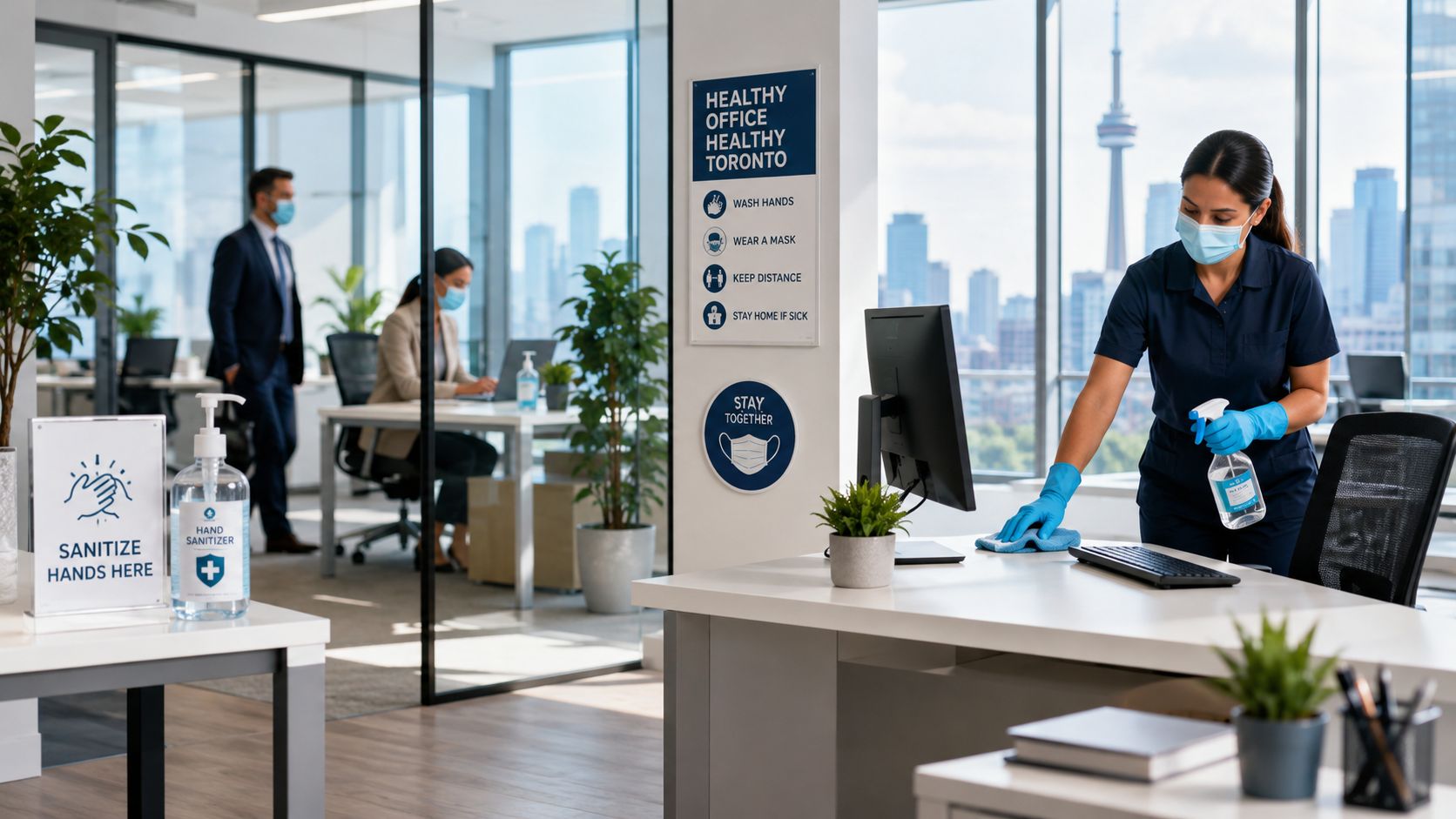
Toronto offices deal with contamination patterns that generic “healthy workplace” language often ignores. Winter salt and slush get tracked into lobbies, high HVAC use drives heavier reliance on indoor circulation, and commuter traffic constantly brings in dirt and pathogens. The result is not just a dirty floor. It is a building that accumulates risk in the places people touch and walk through most often.
Where the real contamination risk sits
The highest-value tasks are the ones that interrupt transmission and reduce build-up at the source. That usually means high-touch surface disinfection, washroom sanitation, kitchen and break-area cleaning, and floor care in the months when slush, grit, and salt are moving through the building. Those tasks are more defensible than broad promises about “making the office healthier”, because they target the parts of the workplace where contamination collects.
A useful distinction is between visible cleanliness and operational cleanliness. Shiny reception counters matter for presentation, but the deeper health value usually comes from consistent cleaning of door handles, shared desks, switch plates, washrooms, and kitchen touchpoints. Ventilation-adjacent cleaning also matters because dust and grime around vents, returns, and high surfaces can contribute to poor indoor environment conditions if ignored.
Toronto businesses get the most value from cleaning when the schedule matches the building's actual traffic and HVAC reality, not when it follows a generic checklist.
That is especially relevant in the winter shoulder season. Salt and slush shorten the life of flooring, raise slip risk, and leave residue that gets pushed deeper into carpets and entrance mats if it is not handled quickly. A cleaning plan that gives extra attention to entry points, transition mats, and hard floors during the coldest months is usually more effective than just increasing general cleaning everywhere.
The broader office-health argument is simple. Clean workspaces support cleaner touchpoints, less visible grime, and a more controlled indoor environment. For Toronto employers, that translates into fewer complaints, better visitor experience, and more stable day-to-day operations, especially in dense multi-tenant buildings where one poorly maintained common area affects everyone.
Defining Cleanliness Standards with APPA Levels
A “clean office” means very little unless the expectation is defined. APPA-style cleanliness levels solve that problem by turning broad promises into area-specific standards. In practice, general office areas usually target Level 2–3, executive lobbies often need Level 2, and warehouse or storage areas can be managed at Level 3–4.
Turning a promise into a measurable scope
The strength of the APPA approach is not the label itself. It is the discipline it brings to the contract. Instead of writing “clean office daily,” the buyer can specify the target level for each zone, the inspection method, and the corrective response when the result falls short.
A written scope should separate spaces by function, because each area carries a different kind of risk and wear. Reception and lobbies need higher visual standards, quicker response to dust, fingerprints, and floor marks, and more attention to the surfaces visitors see first. General work areas need steady cleaning that supports normal occupancy. Storage and warehouse-adjacent zones need durable standards focused on safety, dust, and debris control rather than showroom appearance.
That structure helps prevent disputes. If the front desk looks acceptable but the break room is neglected, the issue is no longer subjective. It is a missed standard in a defined zone.
Inspection matters more than language. Written specifications, documented walk-throughs, and corrective-action logs tell a buyer more than “high-quality service” ever will.
Toronto businesses also need to match the standard to actual use. A professional office with regular client traffic needs a different target than a back-office suite with sparse occupancy. The same applies to clinics, educational spaces, and storage-heavy facilities. APPA levels give each area a proper benchmark instead of forcing one standard across the whole property.
Winter conditions in the GTA make that structure more important. Salt, slush, and tracked-in grit change what “clean” means at the door, on hard floors, and in carpeted transition areas. If the contract does not separate those zones, crews can spend time polishing low-risk areas while the entry points keep wearing down. The most practical programs pair APPA standards with the right commercial cleaning supplies and specialty services for the surfaces and soil loads in each part of the office.
The contract should also spell out how inspections happen, who records them, and how corrections are verified. That makes the service auditable. It also gives facilities teams a practical way to judge whether the provider is meeting the work that was sold.
The supplier relationship improves when the standard is visible. Cleaning teams know what counts as done, and management knows how to judge performance without guessing.
Employee Productivity and Retention Benefits
A clean workplace does more than look professional. It shapes how employees feel about the organisation they work for, and that affects retention, attention, and day-to-day morale. In a city like Toronto, where labour is competitive and workers have options, the workplace environment is part of the employment offer whether leadership wants it to be or not.
Why the human side matters to operations
Employees notice the condition of the environment before they notice the service plan. Clean washrooms, orderly kitchens, clear entrances, and uncluttered shared spaces signal that management pays attention. That reduces friction in the workday and makes the office easier to use.
The practical benefit is straightforward. Better upkeep supports fewer distractions, more consistent first impressions for clients, and a steadier sense of professionalism across the site. It also cuts down on the small irritations that build when staff have to work around dirty surfaces, full bins, or recurring odours.
A clean office is also easier to justify internally when finance teams ask why the contract matters. The answer is not just appearance. It is employee experience, workplace steadiness, and the lower cost of avoidable disruption.
A workplace that feels maintained usually gets used more responsibly. Staff are less likely to treat neglected space like discarded space.
Toronto employers should treat cleaning as part of retention culture, not just maintenance. When a business wants people to commute into an office, the office has to feel worth the trip. Cleanliness is one of the clearest signals that leadership has invested in the daily experience of the team.
That matters for client-facing firms, professional services, and organisations competing for scarce talent. A tidy environment does not solve culture problems, but a neglected one makes every other improvement harder to believe.
Professional cleaning also helps standardise what employees experience from one week to the next. That consistency matters in hybrid workplaces, where people may judge the office by the few days they are physically present. If those days begin with clean desks, usable washrooms, and a controlled common area, the office feels dependable rather than incidental. For Toronto businesses comparing service options, the Toronto office cleaning locations page is a practical place to review coverage by area and match cleaning support to the way each office is used.
Toronto's hybrid pattern changes the retention question in a practical way. Some teams are in the office only on certain days, which means people notice the state of the space immediately and compare it against the commute, the weather, and the workload. In winter, that comparison is even sharper. Salt at the entrance, damp floors, and tracked-in grit make the office feel neglected fast if cleaning is not timed to the traffic patterns that matter most. A professional schedule that matches occupancy keeps the workplace presentable without paying for unnecessary attention in empty zones.
That kind of consistency is what employees remember. It supports morale, makes the commute feel worthwhile, and gives managers one less avoidable source of turnover pressure to deal with.
In-House Versus Professional Cleaning Trade-Offs
Some Toronto businesses can handle light cleaning internally, but that does not mean internal cleaning is the better operational choice. The primary trade-off is between control and consistency. In-house cleaning gives direct oversight, but it also brings staffing, training, coverage, and quality-control burden into the business itself.
Where each model tends to work
In-house cleaning can make sense in very small spaces with simple needs. It may also suit sites where the same staff already handle housekeeping as part of a broader role. The downside is that cleaning often becomes inconsistent when workloads rise, sick days appear, or standards vary from person to person.
Professional cleaning is usually stronger when the site needs routine coverage, after-hours service, or a clean that has to look and perform the same every week. That is especially true in Toronto, where wage pressure and uneven occupancy make fixed staffing harder to manage than many owners expect.
The hybrid-work factor changes the calculation further. More cleaning is not automatically better if the office is partly empty most days. A low-occupancy workplace may do well with reduced frequency in some zones and regular attention in others. Matching service intensity to actual use is usually smarter than paying for full-service cleaning across an underused floor.
Here is the practical comparison:
| Factor | In-house cleaning | Professional cleaning |
|---|
| Staffing | Managed inside the business | Handled by the provider |
| Coverage | Can break down during absences | Easier to scale |
| Quality control | Depends on internal supervision | Usually tied to contract scope and inspection |
| Flexibility | Limited by staff availability | Better suited to stop-and-go or after-hours needs |
| Cost predictability | Can drift with overtime and turnover | Often more predictable through contract terms |
The better choice depends on how much reliability the site needs. Offices with visitors, shared amenities, or regulated work areas usually benefit from outside support because the work has to happen consistently, even when internal staff are busy with other priorities.
Toronto businesses should also avoid over-cleaning low-occupancy areas just because a legacy schedule says so. The right answer is often a mixed model, targeted professional service for the highest-risk zones and lighter coverage elsewhere.
Compliance and Risk Management Requirements
For Toronto buyers, compliance proof is part of the buying decision. A serious cleaning provider should be able to show WHMIS training, access to Safety Data Sheets, product handling procedures, and clear documentation for tasks completed in washrooms and shared spaces. For medical or healthcare tenants, IPAC-aligned protocols and visit logs matter because inspectors and building managers need evidence, not verbal assurance.
What to verify before a contract starts
A practical vendor review should ask for the following:
| Compliance Item | What to Verify | Why It Matters |
|---|
| WHMIS training | Current training records | Confirms staff can handle products safely |
| Safety Data Sheets | Ready access to SDS documents | Supports safe chemical use and incident response |
| Insurance | Proof of coverage, with $2M+ liability insurance worth confirming for office and clinic tenants | Reduces exposure if damage or injury occurs |
| Scope by zone | Written tasks for each area | Prevents scope drift and missed spaces |
| Visit logs | Documented cleaning or room checks | Creates auditability for shared or regulated spaces |
| Product approvals | Confirmation of approved disinfectants where needed | Supports compliance in controlled environments |
That checklist is not bureaucratic noise. It separates a sales pitch from a service that can stand up to inspection, tenant complaints, and internal audit review.
Toronto businesses should also ask whether the work triggers a municipal building-cleaner licence requirement. That question matters most in buildings with after-hours access, multi-tenant shared areas, or regulated spaces where access control is part of the risk profile. In those settings, the core issue is not whether a crew shows up, it is whether the provider can document who entered, what was cleaned, and how the work was controlled.
Compliance proof should be visible before the contract starts, not promised after the first problem.
A vendor that cannot produce training records or documentation discipline creates avoidable risk for the buyer. That risk can surface in inspections, tenant complaints, insurance questions, or internal audit findings, and it usually shows up at the worst possible time, after a missed task or an incident report.
The safest approach is straightforward. Verify the paperwork, then verify the process, then sign only when both fit the site.
Cleaning Frequency by Facility Type and Season
A Toronto office can look orderly on paper and still need a very different cleaning rhythm once you account for foot traffic, access patterns, and winter grime. Cleaning frequency should follow facility risk, not habit. A high-traffic clinic, retail entrance, or busy shared workspace needs a different schedule than a quieter corporate office or a low-occupancy support suite. Toronto's winter conditions make that difference even more pronounced because salt and slush increase floor maintenance needs from winter into early spring seasonal commercial cleaning guidance for Toronto businesses.
Scenario-based scheduling
A corporate office often works well with 2–3 cleaning sessions per week, or with daily and weekly task splits depending on traffic and how the space is used. High-traffic retail and healthcare settings usually need daily cleaning because more people touch more surfaces, more often, and turnover is constant. Educational sites tend to sit in the middle, with washrooms, common areas, and high-touch zones needing the most consistent attention.
Industrial and warehouse spaces need a different kind of discipline. These sites usually care less about polish and more about dust control, debris removal, and safe walking surfaces. The APPA-style zone approach from earlier fits these environments well, because storage and operational areas do not require the same cosmetic standard as reception areas. If you need a broader service model that matches those differences, commercial cleaning services in Toronto should be scoped around the actual space, not a generic checklist.
Seasonal pressure is easy to underestimate. Toronto buildings can look fine in October and become harder to maintain once winter starts pushing grit and moisture indoors. Entry mats fill faster, hard floors need more attention, and salt residue starts showing up in transitions, corners, and walk-off paths.
When the season changes, the cleaning plan should change with it. A fixed schedule across the whole year usually wastes effort somewhere and leaves gaps somewhere else.
The strongest schedule is usually layered, not uniform. Daily attention goes to washrooms, kitchens, reception, trash removal, and high-touch points. Weekly or periodic work covers deeper dusting, glass, and carpet care. More intensive seasonal floor work takes over when slush and salt begin to affect the building, and Toronto operators often need to use compare HVAC-integrated solutions alongside that cleaning plan when indoor air quality and particle control become part of the workload.
Toronto businesses that set frequency this way usually get a better result without paying for unnecessary routine. The goal is not maximum service. The goal is the right service for the facility's actual use.
Evaluating Cleaning Proposals and Provider Selection
A cleaning proposal should be judged first by its scope of work, because price means very little until the buyer knows what is included. Office size, foot traffic, cleaning frequency, and the number of washrooms and kitchens all affect the final quote and the service model as noted in Toronto office-cleaning guidance. A small suite with one washroom is not comparable to a multi-floor office with kitchens, client areas, and shared common space.
A decision framework that works
The most useful comparison is not “Who is cheapest?” It is “Who can show the cleanest scope, the clearest verification, and the most workable terms?” That usually means reviewing four things side by side:
- What is cleaned. The proposal should specify zones, not vague categories.
- How often it is cleaned. Daily, weekly, and periodic tasks should be separated.
- How quality is verified. Walk-throughs, inspection logs, and corrective responses should be included.
- What the contract says. Term length, exit terms, access rules, and escalation steps matter as much as the service list.
Toronto buyers should also think about whether the cleaning schedule needs to coordinate with air quality or filtration planning. For spaces where indoor circulation and occupancy are closely tied, it can help to compare HVAC-integrated solutions alongside cleaning planning so the building's maintenance approach stays coherent. The point is not to replace cleaning with air equipment. It is to avoid treating indoor environment management as separate silos.
One practical way to screen proposals is to ask for the zone map and the verification method before discussing price. If the provider cannot define how service is measured, the quote is too early to trust.
The internal link to commercial cleaning services is also useful for buyers who want to compare scope categories before they request quotes, because the service list should match the building's actual use.
A low quote is only useful if the scope, proof, and exit terms are all strong enough to survive a busy month.
For Toronto businesses, the safest provider is the one whose paperwork, staffing model, and inspection process match the building's risk, not the one with the most attractive opening number.
Next Steps and Decision Checklist
A short, disciplined checklist leads to better hiring decisions. Toronto buyers should confirm proof of insurance, a written scope by zone, contract length and exit terms, and whether staff are background-checked or bonded when after-hours access is involved. For clinics or healthcare tenants, IPAC-aligned protocols and visit logs should be part of the discussion before any work begins.
A practical selection sequence works best in real office settings, especially where winter salt, slush, and hybrid occupancy create uneven wear across the space. A lobby that sees constant foot traffic needs a different cadence from a boardroom that sits empty for part of the week, and a provider should be able to explain that difference without guessing.
- Collect two to three quotes. That gives a realistic view of scope differences without turning the process into a bidding war.
- Compare scope before price. The cheapest proposal is often just the thinnest one, which can leave out entry glass, touchpoint sanitation, or seasonal floor care.
- Ask for training and compliance records. WHMIS, SDS access, and documentation should be easy to produce.
- Match frequency to occupancy. Low-use areas do not need the same service rhythm as high-traffic spaces, and winter conditions may require extra attention at entries.
- Set inspection rules early. A good vendor welcomes clarity because it reduces future disputes.
Toronto businesses get better results when they treat office cleaning as a managed facility function. That means asking informed questions, defining the work by zone, and choosing a provider that can show both operational discipline and compliance proof. It also means asking how the team handles salt residue, damp mats, and the wear patterns that show up when occupancy changes from day to day.
For organisations ready to proceed, the simplest next step is to use the checklist above, request a few structured quotes, and compare them against the specific needs of the building rather than against a generic cleaning promise. If the goal is a service that can handle Toronto's commercial pace, the right partner will be the one that can document the work, explain the schedule, and adapt to the site without guesswork. A provider that can also speak clearly about APPA cleanliness levels gives buyers a better basis for comparing what “clean” means in practice.
Arelli Cleaning provides office and commercial cleaning services across the GTA, including scheduled janitorial work, disinfection, and flexible service plans for offices, clinics, and other commercial spaces. Businesses that want to compare options against a clear scope can visit Arelli Cleaning and use the checklist in this article to ask better questions before they request quotes.








.webp)