A common facility problem shows up late on Friday. Staff are still working, bins are full, floors need more than a quick pass, and someone asks whether the deep clean can wait until Monday. In many buildings, Monday is the wrong answer. It disrupts people, delays operations, and turns cleaning into a visible obstacle instead of a support function.
That's why many GTA businesses look at weekend cleaning services. The core decision isn't only about convenience. It's about whether after-hours cleaning reduces disruption enough to justify the added labour and access complexity, while still meeting security and compliance expectations.
Your Guide to Weekend Commercial Cleaning
A property manager closes up on Friday expecting a quiet weekend. By Saturday night, a cleaning crew needs alarm access, chemical handling rules, lockup procedures, and a clear record of what was cleaned in a mostly empty building. Weekend cleaning changes more than the day on the calendar. It changes risk, supervision, and cost.
Weekend cleaning services are commercial cleaning visits scheduled outside a facility's normal operating week, usually on Saturday, Sunday, or during a long weekend shutdown. Businesses use them for work that benefits from open space and fewer interruptions, such as floor care, washroom resets, kitchen cleaning, detailed dusting, and post-project cleanup. In regulated settings, the goal is often broader than appearance. Managers may need a service model that protects access control, follows site safety rules, and leaves a paper trail if questions come up later.
That is why the buying decision should be handled like an operations decision, not a simple janitorial purchase. A weekend crew may work with no client contact on site, enter restricted rooms, use controlled products, and secure the premises after completion. In a clinic, that raises questions about treatment-room protocols and documented chemical use. In a warehouse, it may involve traffic-free cleaning near equipment, lockout boundaries, or loading areas. In an office tower, it often comes down to keys, alarms, elevator access, and proof that the work matched the scope.
Facility managers who follow best practices for pristine properties usually assess cleaning as part of a larger building system. The same logic applies here. A weekend program works like preventive maintenance for occupancy readiness. If it is planned well, Monday starts cleanly. If it is planned poorly, the business pays extra for access confusion, incomplete work, or avoidable compliance gaps.
Businesses comparing options often begin with a broad review of commercial cleaning services in the GTA, then separate weekday tasks from tasks best suited for after hours.
Key takeaways
- Weekend cleaning is an operating model, not just a different time slot: Empty buildings create different supervision, access, and reporting requirements.
- The main benefit is controlled working conditions: Crews can complete floor work, detailed resets, and access-sensitive tasks with fewer interruptions.
- Price should be read line by line: Weekend premiums often reflect scheduling, staffing minimums, alarm procedures, documentation, and travel timing.
- Security risk rises when the building is quiet: Key custody, entry logs, restricted-area rules, and lockup checks need to be defined before service starts.
- Compliance can shape the scope: In WHMIS- and OHSA-aware workplaces, product handling, labeling, training records, and incident reporting matter as much as visible cleanliness.
- The right provider is the one with the clearest controls: A lower quote has less value if the vendor cannot explain who enters the site, what gets documented, and how exceptions are handled.
What Weekend Cleaning Services Entail
Weekend cleaning isn't just weekday janitorial service moved to a Saturday. It's a different operating model. The crew often works in a mostly empty facility, handles longer uninterrupted tasks, follows stricter access rules, and may need to document what happened because no site contact is present.

What it usually includes
A typical weekend visit may combine routine work with project-style tasks. For example, a law office may want washrooms, kitchens, boardrooms, and floors reset before Monday. A warehouse may need machine-adjacent floor cleaning once traffic stops. A dental clinic may need more careful treatment of treatment rooms, waiting areas, and back-office spaces when patients are gone.
That's also why equipment and supply choices matter. Buyers reviewing provider methods may find it helpful to look at examples of shop janitorial solutions to understand how auto scrubbers, floor machines, microfiber systems, and chemical dispensing setups affect both quality and speed.
What it is not
Weekend cleaning is not automatically “deep cleaning.” Some clients only need a light reset on weekends. Others need a highly technical service, such as floor stripping, carpet extraction, post-construction detailing, or high dusting.
It's also not automatically cheaper. In some buildings, weekends are the most efficient time to clean because no one is in the way. In others, access restrictions, security sign-ins, elevator controls, or overtime rules make weekend service more expensive than an evening weekday slot.
Weekend cleaning works best when the task needs time, space, or privacy that the normal workweek doesn't allow.
Which facilities benefit most
Several facility types tend to get the most value from weekend schedules:
- Professional offices: Law firms, engineering firms, accounting practices, and corporate offices often want Monday-ready spaces without weekday interruptions.
- Clinics and regulated environments: Dental and medical offices often need predictable after-hours hygiene and clearer documentation.
- Schools and childcare settings: Weekend windows allow more complete washroom, classroom, and common-area work.
- Industrial and warehouse sites: Crews can clean more safely when traffic is lower and equipment is shut down or isolated.
- Retail and mixed-use properties: Weekend overnight or early-morning cleaning may fit around customer-facing hours better than weekday daytime work.
The Strategic Advantages of After-Hours Cleaning
A manager arrives Monday at 7:00 a.m. The floors look finished, washrooms are reset, and there are no caution signs blocking staff or customers. That result usually comes from timing, not just effort. Weekend cleaning gives a crew the one thing many weekday schedules do not: uninterrupted control of the space.
That control changes the quality of the work.
Better conditions for technical work
Some cleaning tasks work like paint. They need proper prep time, application time, and recovery time. Floor scrubbing, burnishing, stripping, and finish application all suffer when people cross the area too early. Weekend access gives floors time to dry and cure properly, which protects both appearance and slip resistance.
The same principle applies to carpet extraction, detailed washroom descaling, partition cleaning, and high dusting. In an occupied building, cleaners often have to stop, reroute, and return later. In an empty or low-traffic building, they can follow a logical sequence from top to bottom and clean to a consistent standard. For businesses that need periodic project work beyond routine janitorial service, this is often the right window for specialty cleaning services.
Lower interference with revenue-producing work
A daytime cleaning program always competes with something. It may compete with client meetings, production flow, patient privacy, classroom activity, or staff concentration. Weekend service reduces that conflict.
The financial benefit is easy to miss because it does not always appear on the cleaning quote. It shows up in fewer interruptions, less time spent escorting vendors through restricted areas, and fewer situations where a task is postponed because the space is still in use. For a law office, that may mean less disruption to confidential meetings. For a clinic, it may mean better control of patient-facing areas. For a warehouse, it may mean less interference with forklift routes and loading activity.
A practical fit for hybrid occupancy
Hybrid work has changed how many offices get dirty. The old pattern was predictable. Five fairly even days of use across the week. Now many workplaces see heavy traffic on certain days, while other zones sit relatively untouched.
That makes fixed weekday cleaning frequencies less efficient in some buildings.
A better approach is to match service timing to actual use. Shared kitchens, washrooms, entrances, and collaboration areas may need a strong reset after peak occupancy. Closed offices and low-use rooms may not. Weekend cleaning helps a manager place labour where it produces visible value instead of spreading hours evenly across the whole site out of habit.
Stronger control in regulated or security-sensitive facilities
Weekend cleaning becomes more than a convenience decision. In regulated environments, after-hours work can reduce disruption, but it also raises the stakes for supervision and compliance.
For example, a contractor working in a healthcare setting, childcare site, lab-adjacent area, or industrial facility may need clear chemical labelling, documented handling procedures, restricted-area protocols, and worker training that aligns with WHMIS and OHSA requirements. Security controls matter too. Keys, alarm codes, card access, visitor logs, and incident reporting all need tighter discipline when fewer client staff are on site.
In other words, weekend cleaning can lower operational friction while increasing the need for process control. The right provider treats that trade-off seriously.
Decision rule: Weekend cleaning usually makes financial sense when the cost of interrupting operations is higher than the added cost of after-hours labour, access coordination, and compliance controls.
For industrial and mixed-use sites, there is one more advantage. Cleaning around powered-down equipment or reduced foot traffic is often easier to schedule and inspect. That does not remove lockout, hazard communication, or site-specific safety requirements. It does make the work easier to organize, verify, and document.
Standard Weekend Cleaning Schedules and Task Lists
A property manager opens the building on Monday and finds two problems. The floors are clean, but a storage room was left unsecured and a chemical bottle sits without clear labeling. That is the risk in treating weekend cleaning as a simple chore list. A sound schedule has to control access, sequence the work, and leave a clear record of what was done.
Weekend cleaning works like a shutdown checklist in maintenance. The cleaning tasks matter, but the order matters too. If the crew enters without confirmed access rules, site contacts, restricted-area instructions, and closeout steps, small gaps turn into security or compliance issues.
A typical weekend workflow
A well-run visit usually follows five stages:
Entry and site verification
The crew signs in, confirms authorized access, checks for alarm instructions, and identifies rooms or zones that are off-limits. Any visible hazards or unusual conditions are noted before work starts.
Pre-clean setup
Supplies and equipment are staged near the work area. Wet floor signs, caution barriers, and any site-required safety controls are put in place first so the crew does not clean one area while creating risk in another.
Core cleaning by priority zone
The team starts with spaces that affect Monday operations right away. In an office, that often means washrooms, kitchenettes, entrances, and shared meeting rooms. In a warehouse or plant support area, it may mean aisles, breakrooms, locker rooms, and approved production-adjacent floors.
Periodic project work
Weekends are often the best window for slower or more disruptive tasks such as carpet extraction, machine scrubbing, interior glass, washroom descaling, or high dusting in permitted areas. Sites that need heavier project work often add specialty cleaning services for floor care and restoration instead of expecting a routine janitorial crew to handle it with standard tools.
Inspection and closeout
Before leaving, the crew checks the scope against the work order, removes safety signage, secures the building, resets alarms if authorized, and logs any damage, supply shortages, or hazards for client review.
The practical point is simple. A weekend schedule should read more like an operations document than a loose to-do list.
Sample Weekend Cleaning Task Comparison
| Task Area | Corporate Office Focus | Industrial Site / Warehouse Focus |
|---|
| Entry areas | Glass touch-up, lobby vacuuming, mat cleaning, spot removal | Sweeping debris, entrance floor scrubbing, vestibule cleanup |
| Work surfaces | Desk perimeter dusting, partition wiping, boardroom detailing | Exterior wipe-down of approved surfaces, breakroom tables, supervisor stations |
| Floors | Vacuuming, edging, hard-floor machine scrubbing, periodic finish work | Auto-scrubbing, degreasing in approved zones, dust and debris removal |
| Washrooms | Fixture descaling, partition cleaning, restocking, odour control | Washroom sanitation, locker-room reset, soap and paper restock |
| Kitchens and staff areas | Appliance fronts, sinks, counters, cupboard exteriors, lunchroom floors | Breakroom cleaning, sink sanitation, table cleanup, vending area floors |
| High dusting | Vents, ledges, tops of partitions, reachable light areas | Racking edges, beams where permitted, high ledges, overhead dust in non-production zones |
| Waste handling | Bin emptying, liner replacement, recycling consolidation | Waste consolidation by site rule, cardboard collection, approved disposal points |
| Closeout | Visual QA, photo/report if requested, secure lockup | Incident note, hazard flagging, secure lockup, access log completion |
Where buyers often get confused
The phrase “weekend clean” hides a lot of variation. One quote may cover a standard janitorial reset on Saturday evening. Another may include machine work, extra labor, detailed reporting, and restricted-area procedures. The line item can look similar while the actual service is very different.
That confusion gets expensive in regulated or security-sensitive sites. If the scope does not state which rooms are included, who can enter them, which chemicals can be used there, and what records must be left behind, the provider is guessing. In a clinic, child care setting, lab support area, or controlled industrial space, guessing is a poor operating model.
Use three plain-language categories in the task list:
- Every visit: work that must happen each weekend without separate approval
- Periodic tasks: monthly, quarterly, or seasonal items that need planned timing
- Excluded work: anything outside scope unless the client approves it in writing
That format helps you compare quotes on the same basis. It also reduces disputes, missed tasks, and after-the-fact add-on charges.
How Weekend Cleaning Services Are Priced
A weekend cleaning quote can look simple and still hide meaningful cost differences. Two providers may both price a “Sunday clean,” but one may be quoting a basic janitorial reset while the other is pricing controlled access, floor machine work, documented closeout, and trained staff for regulated spaces. That gap matters because weekend work is priced by operating conditions, not by the calendar alone.
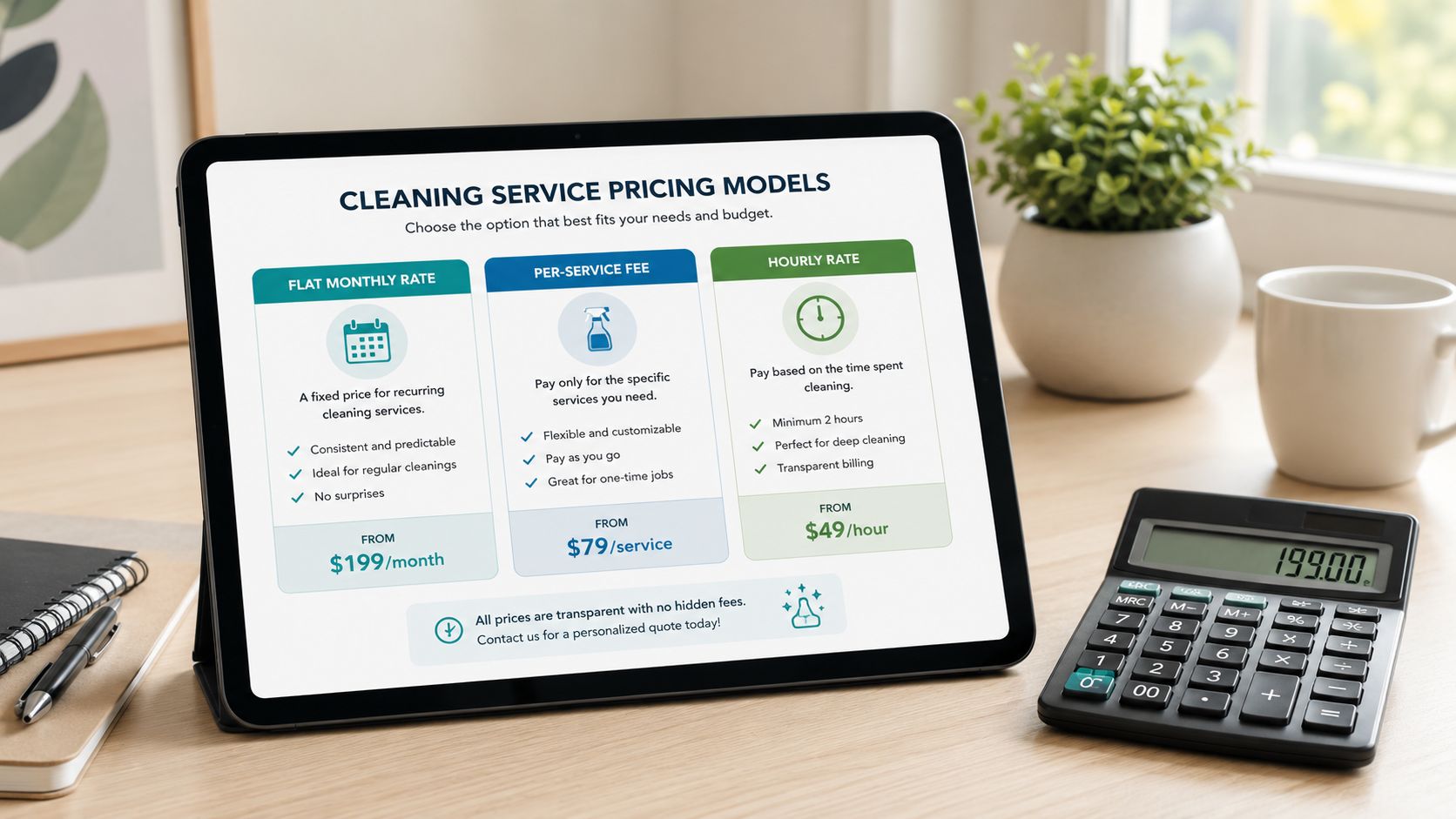
A useful way to read pricing is to separate the job into two buckets. The first is cleaning labour and supplies. The second is after-hours overhead, such as opening procedures, restricted-area access, supervision, reporting, and lockup. In regulated environments across the GTA, that second bucket can shape the quote as much as the cleaning itself.
Common pricing models
Providers usually structure weekend pricing in three ways.
- Per-visit pricing: Often used for scheduled but infrequent work, such as a Saturday deep clean once or twice a month.
- Hourly pricing: Common when the scope may change, access takes time, or the client wants approval-based add-on work.
- Fixed monthly pricing: Best suited to recurring weekend service with a stable task list, stable square footage, and predictable access.
Each model shifts risk between client and provider. Hourly pricing gives flexibility but can make budgeting harder. Fixed monthly pricing helps with budgeting, but only if the scope is tightly defined. If it is not, the contract can become a container for assumptions, missed tasks, and change-order disputes.
What actually drives the cost
Weekend pricing usually rises or falls for practical reasons.
- Facility type and risk level: A general office, medical clinic, child care site, and light industrial facility do not use the same methods, chemicals, or documentation.
- Task intensity: Dusting and washroom cleaning require a different labour mix than autoscrubbing, carpet extraction, or floor finish work.
- Access time: Waiting for elevators, signing in with security, opening separate suites, and handling alarm procedures all add paid time.
- Frequency and consistency: Regularly scheduled visits are usually easier to staff and supervise than one-off or irregular bookings.
- Reporting requirements: Photo verification, issue logs, and closeout records add administrative time, but they also reduce Monday-morning disputes.
- Compliance controls: Sites that require WHMIS-aware chemical handling, OHSA-aligned procedures, or area-specific product restrictions often need more training and tighter supervision.
For example, a provider quoting work in a clinic may need to account for product selection, labelled chemical storage, and documented procedures for higher-touch areas. If the scope also includes commercial disinfection and sanitizing for shared and regulated spaces, the quote should show whether that work is built into the visit price or billed separately.
Why weekend quotes often differ more than weekday quotes
After-hours work behaves a bit like a service call and a cleaning visit combined. The crew is not only cleaning. They are also managing entry, verifying room status, handling issues without onsite staff, and closing the building correctly. A quote that leaves out those steps may look cheaper because part of the job has been left undescribed.
This is one reason low prices deserve a closer read. If a provider does not show who supplies machines, who handles rework, whether travel time is built in, or how long the crew is expected to stay onsite, the missing detail often turns into extra charges later.
How to judge value, not just price
A useful comparison starts with the scope sheet, not the total at the bottom. The best quote is usually the one that makes the fewest assumptions.
Ask questions like these:
- Does the quote define included areas, excluded areas, and periodic tasks clearly?
- Are weekend premiums, minimum call-out charges, or holiday rates stated in plain language?
- Are consumables, equipment, and specialty floor services included or listed as extras?
- Does the provider show how completion will be verified after-hours?
- Who pays for return visits if a problem is found on Monday morning?
A practical rule helps here. If you cannot explain the quote to another manager in two minutes, the scope is still too vague. Clear pricing is not only about cost control. It is also part of risk control for buildings that need reliable records, controlled access, and compliant cleaning procedures.
Security Compliance and Service Level Agreements
A crew arrives Saturday night, the building is empty, and no manager is onsite to answer questions. One propped-open side door, one unlabeled chemical bottle, or one missed alarm step can turn a routine cleaning visit into a security incident, a safety problem, or a dispute about what was done. Weekend cleaning works best when the service is managed like controlled after-hours access, not like a daytime janitorial visit shifted to a different clock.
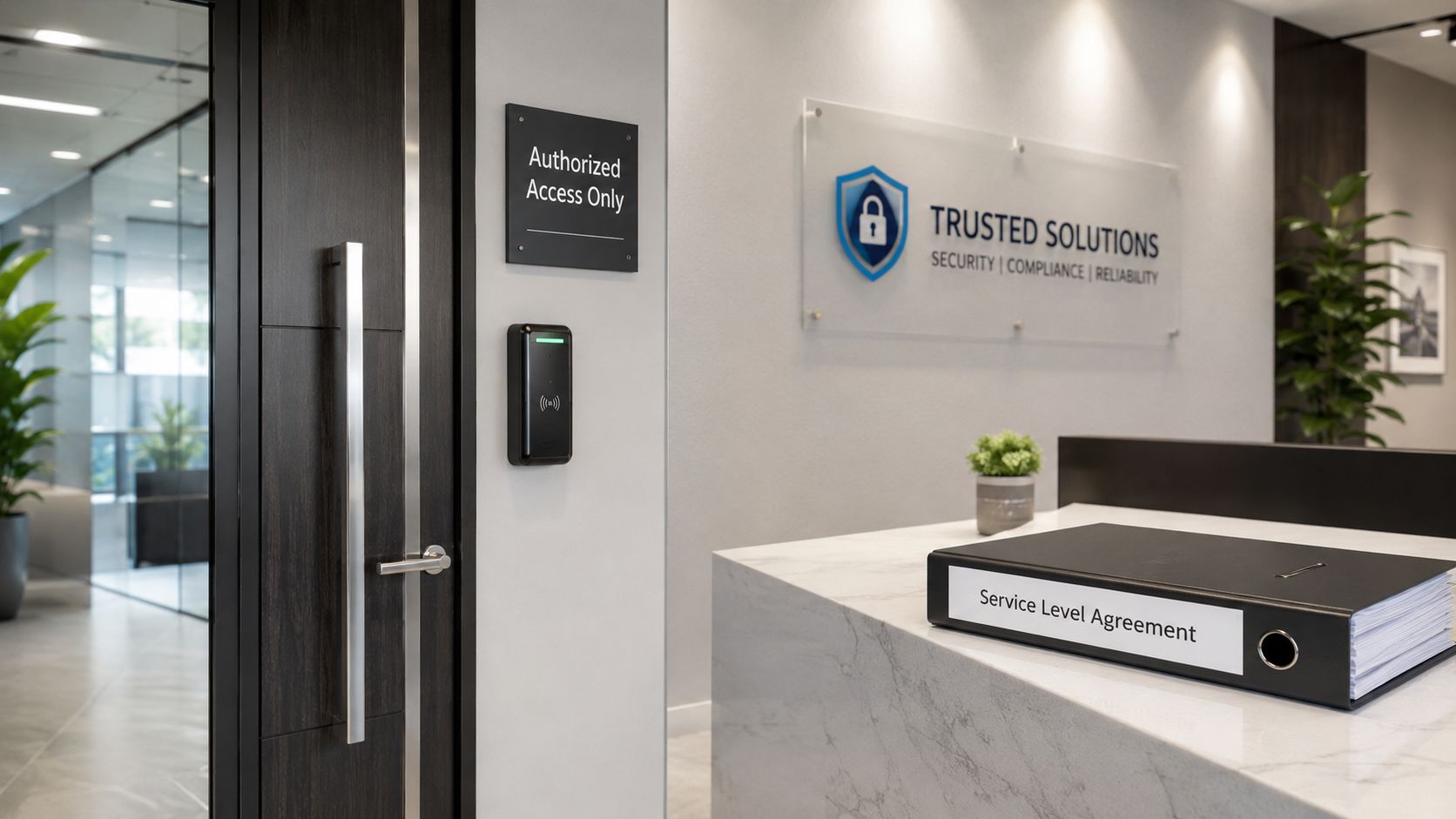
Security controls should be written down
In an occupied building, small problems are often corrected in real time. After hours, the system has to do that work. The provider should be able to show, in plain language, who can enter the site, how access is issued, what areas are off-limits, and what happens if something goes wrong.
That usually means:
- Named, authorised staff: The client knows which workers and supervisors may enter the building.
- Controlled key and fob handling: Access tools are signed out, tracked, and not passed informally between workers.
- Clear alarm procedures: Entry, disarming, re-arming, and lockup steps are documented.
- Restricted-area rules: Server rooms, records storage, treatment rooms, labs, and executive offices are identified in advance.
- Incident escalation: Leaks, damage, broken fixtures, suspicious activity, or access failures are reported to the right contact without delay.
A simple test helps here. If a provider cannot explain its after-hours access process in a few sentences, the process is probably too loose for a regulated site.
Compliance needs to hold up when no one is watching
Weekend cleaning in Ontario carries the same workplace safety duties as weekday work. The difference is visibility. If staff are using chemicals, handling waste, or working alone or in low-occupancy conditions, the client should expect documented training, product controls, and reporting that can stand up to review. Ontario's workplace rules under the Occupational Health and Safety Act and WHMIS are set out by the province, including employer duties, worker information, and hazardous product requirements on the official Ontario OHSA and WHMIS guidance.
For a business owner, the practical question is straightforward. If an inspector, auditor, property manager, or internal compliance lead asks what happened in the building over the weekend, can the provider produce records that match the work? Useful records may include site-specific instructions, safety data access, task completion logs, supervisor check-ins, incident notes, and confirmation that restricted procedures were followed.
Sites with heightened hygiene requirements often need one more layer of alignment. If your facility also has documented infection-prevention or product-handling protocols, the cleaning scope should match those commercial disinfection and sanitizing requirements before the first after-hours visit begins.
Monday-morning confidence comes from records, not assumptions.
What a strong SLA should actually say
A service level agreement works like the operating manual for the relationship. If the quote describes what you are buying, the SLA explains how the service will be delivered, verified, and corrected when conditions change.
For weekend cleaning, a useful SLA should define:
- Site scope: Exact rooms, touchpoints, floor types, washrooms, waste points, and excluded areas
- Service window: Approved arrival times, completion deadlines, and holiday or long-weekend rules
- Access protocol: Entry method, alarm steps, escort requirements, and lockup responsibility
- Quality verification: Inspection method, photo or digital reporting, and rework timeframes
- Compliance records: What documentation is kept, who receives it, and how long it is retained
- Issue response: Missed service, damage, spills, leaks, security events, and emergency contacts
- Change control: Who can approve extra work, added rooms, specialty cleaning, or chemical substitutions
Vague language creates expensive grey areas. Clear language reduces them. In regulated industries, that difference affects more than service quality. It affects security exposure, audit readiness, and the true cost of fixing problems after the fact.
Hiring Checklist and Questions for Potential Providers
A provider can look qualified on paper and still be a poor fit for weekend work. The gap usually shows up on Sunday night, when the building is empty, an alarm panel is armed, a spill is found in a restricted room, and no one is sure who has authority to act.
That is why hiring for weekend cleaning should work like vendor prequalification, not casual price shopping. You are not only buying labour hours. You are choosing who can enter your site after hours, handle chemicals safely, follow your building rules, and leave a record that stands up if there is a complaint, incident, or audit.
A practical hiring checklist
Start by defining the job with enough detail that two providers would price the same work in roughly the same way. If one quote assumes basic janitorial service and another includes machine floor care, waste removal, and disinfection, the lower price is not better. It is just based on a smaller scope.
Then review the operating conditions that make weekend cleaning different from daytime service:
- Define the need: Separate recurring cleaning from periodic tasks such as carpet extraction, strip and wax work, project cleanup, or detailed washroom resets.
- Map site and compliance risks: Identify alarms, keycard zones, freight elevator rules, server rooms, treatment areas, chemical storage, and any hazard communication requirements.
- Standardize the quote request: Give each bidder the same site notes, task list, service window, and expectations for reporting.
- Check proof documents: Ask for insurance, worker coverage information, safety procedures, WHMIS training practices, and after-hours incident reporting methods.
- Assess communication early: The quoting process often reflects the service process. If answers are delayed or vague now, issue handling may look the same later.
- Run a pilot if possible: A trial clean, one floor, or one weekend schedule can expose access problems, quality gaps, or reporting weaknesses before you commit broadly.
What to ask providers
Good questions save money because they expose hidden cost drivers before the contract starts. A clear answer also tells you how disciplined the provider is operationally.
Ask direct questions such as:
- Who exactly will enter the building after hours, and how is that list controlled?
- How are keys, fobs, alarm codes, and lockup steps issued, tracked, and returned?
- What staff training covers WHMIS, workplace safety, and site-specific hazards?
- How do you document completed work when no client representative is on site?
- What is the escalation process if your team finds a leak, damage, an unsecured door, or a safety issue?
- Which tasks are included every visit, and which items trigger extra charges?
- How do you price periodic floor care or other specialty work?
- Who approves add-on work during a weekend shift?
- Can service scale up, scale down, or pause if occupancy or production schedules change?
One more useful test. Ask the provider to explain its process in plain language. A capable company should be able to walk you through access, cleaning sequence, reporting, and issue response without hiding behind general terms.
What to avoid
Several warning signs tend to create expensive disputes later.
- Vague scopes: “General cleaning” does not tell you what will be cleaned, how often, or to what standard.
- Loose access control: Shared codes, undocumented key handoffs, and informal lockup routines increase security risk.
- Weak documentation: If there is no closeout report, photo record, or exception log, missed work becomes hard to prove.
- Unclear change orders: Weekend requests often expand subtly. Without written approval rules, invoices can drift away from the original quote.
- No fit for regulated sites: If a provider cannot explain safety training, chemical handling, or site restrictions clearly, the risk sits with you.
Arelli Cleaning is one GTA example that presents no-term contracts, round-the-clock support, app-based quality communication, and sample cleans as part of its service approach. Those are useful comparison points, not a substitute for due diligence. Use them as benchmarks while you compare two or three providers, review their answers carefully, and check whether their process matches your building's risk level. For more buyer-side questions, review this commercial cleaning FAQ for service process and communication.
Frequently Asked Questions
Is weekend cleaning always more expensive than weekday cleaning
Not always. Weekend cleaning can cost more when labour rules, access controls, or special tasks add complexity. It can also deliver better value if it prevents disruption during business hours.
Who should supervise the work if the building is closed
Usually the provider handles on-site supervision, but the client should still name a contact for alarms, emergencies, or approval questions. Clear escalation rules matter.
What happens if the alarm is triggered
That should be covered in writing before service starts. The provider should know who to call, what to document, and how to secure the site.
Can a business book one-time weekend cleaning instead of recurring service
Yes. Many companies use weekend cleaning for one-time deep cleans, floor care, post-construction cleanup, or seasonal resets.
What types of buildings benefit most
Offices, clinics, schools, warehouses, and light industrial sites often benefit because weekday disruption is costly or unsafe.
How flexible are weekend schedules
It depends on staffing, building access, and scope. Many providers can offer weekly, bi-weekly, monthly, or project-based visits if the work is defined clearly.
Where can buyers find more answers about service process
A provider's own commercial cleaning FAQ resource can help clarify scheduling, scope, and communication expectations before quoting.
Further Reading and Resources
A manager reviewing weekend cleaning bids on Friday afternoon usually does not need more articles. What helps at that point is a decision file. Put the scope, access rules, safety requirements, and pricing assumptions in one place so each provider is bidding on the same job.
Start with your own records. Gather the cleaning scope, alarm and lockup procedures, contractor sign-in rules, SDS information, restricted-area rules, and any site-specific safety instructions. For clinics, schools, food-adjacent spaces, and light industrial facilities, weekend cleaning often carries a higher compliance burden because the crew may be working without your staff present to answer questions or correct mistakes.
Then compare quotes the way you would compare any contracted building service. Use a side-by-side sheet for frequencies, task details, supply responsibility, supervision, response times, key control, incident reporting, and all after-hours charges. A low price can be legitimate. It can also mean the bidder excluded floor care, consumables, periodic deep cleaning, or on-site supervision.
That review process matters because weekend cleaning is partly an operations decision and partly a risk decision.
Earlier sections already covered service scope, pricing logic, and the questions that reveal whether a provider can handle after-hours work under WHMIS and OHSA expectations. Use those points as your checklist rather than collecting duplicate sources.
If you are comparing weekend cleaning services in the GTA, the practical next step is straightforward. Define the work clearly, document security and compliance expectations, and request comparable quotes from qualified providers. Arelli Cleaning can be one company included in that evaluation for office and commercial cleaning in the Greater Toronto Area.










.webp)