Most office managers don't start their day thinking about sustainable facility management. They're thinking about a leaking washroom tap, a cleaning complaint, a stubborn HVAC comfort issue, rising supply costs, or whether the next utility bill will cause another budget conversation.
That's exactly why sustainability matters.
For a small or medium-sized facility in Ontario, sustainability isn't mainly about branding language or a framed certificate in reception. It's about running a building with less waste, fewer avoidable costs, better indoor conditions, and clearer operating discipline. In practical terms, that means choosing cleaning products more carefully, reducing unnecessary lighting and HVAC runtime, managing waste streams properly, and buying supplies with their full life cycle in mind.
Key takeaways
- Sustainable facility management means operating a building in a way that supports cost control, occupant well-being, and environmental responsibility at the same time.
- For Ontario facilities, the most practical starting point is usually low-cost operational change, not a major retrofit.
- Waste and procurement deserve as much attention as energy and water.
- Measurable progress comes from tracking a few simple indicators consistently.
- Cleaning operations often influence sustainability more than managers first realise.
What Is Sustainable Facility Management
A sustainable facility is one that costs less to waste money in.
Sustainable facility management is the practice of running, maintaining, cleaning, and improving a building so resources are used carefully, occupants are supported, and operating decisions still hold up financially over time.

For an Ontario office manager, that definition becomes clearer with a familiar scenario. The lights are on in a meeting room no one has used since noon. Washroom paper products were ordered twice because no one checked the storeroom. Recycling bins are contaminated, so more material goes out as garbage. The rooftop unit starts too early and runs too long. None of those issues look dramatic on their own, but together they act like small leaks in a budget.
Sustainable facility management is the system for finding those leaks and closing them.
Energy is only one part of that system. A well-run facility also pays attention to waste handling, purchasing decisions, cleaning methods, maintenance timing, indoor conditions, and compliance duties. That broader view matters for small and medium-sized facilities because major retrofits are not always the first or best move. In many Ontario buildings, the fastest return comes from better daily operating habits.
A useful comparison is household budgeting at a larger scale. If a family leaves lights on, throws usable items away, buys low-quality products that need constant replacement, and ignores a small plumbing leak, costs rise from several directions at once. A facility works the same way, except the stakes include occupant comfort, service quality, health expectations, and regulatory risk.
What makes it “sustainable”
The idea is simple. A practice belongs in sustainable facility management if it does three jobs at once:
- reduces wasted energy, water, materials, or labour
- supports a cleaner, safer, healthier space for occupants and staff
- makes financial sense over the life of the decision
That last point often causes confusion. Some managers hear “sustainability” and assume higher costs, longer approvals, and complicated reporting. In smaller facilities, the opposite is often true. Better supply controls, more accurate cleaning frequencies, earlier maintenance response, and clearer waste separation can improve performance without a large capital spend.
The stewardship mindset helps here. The building is not just a place to keep operational until something fails. It is an asset that needs consistent care, sensible purchasing, and fewer avoidable losses. The idea overlaps with understanding business stewardship, especially for managers trying to connect environmental goals with day-to-day operating discipline.
What it looks like in practice
In day-to-day operations, sustainable facility management often shows up in plain, unglamorous decisions that produce measurable ROI:
- adjusting cleaning tasks to actual traffic and use patterns
- buying consumables that last longer, create less waste, or come with less packaging
- fixing minor issues before they become comfort complaints or equipment damage
- making recycling and waste sorting easier for both occupants and custodial staff
- reviewing simple compliance routines so disposal, storage, and documentation do not drift
This is one reason waste and procurement deserve more attention than they usually get. Energy bills are easy to notice because they arrive every month. Poor purchasing decisions and weak waste processes hide inside supply spend, hauling costs, staff time, and avoidable rework.
Managers who want practical examples can review facility cleaning and operations articles on the Arelli Cleaning blog, where routine service decisions are treated as part of overall building performance.
For small and medium-sized Ontario facilities, that is the essence of sustainability. It is not a side program. It is a better operating model.
The Core Pillars of a Sustainable Facility
A sustainable facility works like a five-part operating system. If one part is weak, the others have to work harder. For a small or medium-sized Ontario site, that matters because the fastest returns often come from fixing ordinary process gaps, not from chasing large capital projects first.

Energy efficiency
Energy gets attention first for a practical reason. Managers can see the cost every month.
In smaller offices, schools, clinics, and mixed-use buildings, energy performance usually depends less on complex strategy and more on control. A building that runs lights, ventilation, and heating as if every room is full all day will waste money even if the equipment itself is fairly efficient. The goal is simple. Run what you need, where you need it, for as long as you need it.
A strong starting point includes:
- Occupied scheduling: align lighting and HVAC runtime with real occupancy
- Drift correction: find spaces that are consistently too hot or too cold
- Maintenance support: keep filters, seals, and controls working properly
This pillar often produces some of the quickest savings, especially where settings drifted over time and no one noticed.
Water conservation
Water is easy to overlook because the bill is often smaller than the hydro bill. The operating risk is still real.
A washroom fixture that keeps running, a hose used inefficiently, or a floor-care routine that uses more water than needed can increase cost and create maintenance issues. In Ontario facilities, water performance often improves through better observation and faster reporting rather than expensive upgrades alone.
A useful rule is to treat water like inventory. If it is being used, someone should know where, why, and whether that level of use makes sense. Low-flow fixtures help, but so do cleaner handoff procedures between custodial staff and maintenance when leaks, moisture, or faulty shutoffs appear.
Waste management
Waste is where many facilities find hidden operating loss. It is also where small process changes can produce measurable ROI.
Poor waste performance usually comes from ordinary mistakes. Bin stations do not match the signage. Staff throw food containers into the wrong stream because the rules are unclear. Custodial teams inherit contamination problems created upstream. Hauling costs rise, diversion stalls, and managers assume the issue is behaviour alone when the setup itself is causing failure.
For that reason, waste should be managed like traffic flow in a parking lot. If the markings are confusing, drivers make mistakes even when they mean well. Good waste systems make the right action obvious.
The purchasing side matters just as much. A facility that buys heavily packaged items, short-life consumables, or products that cannot be reused creates disposal cost before the item is even opened. Managers reviewing supplies can compare factors such as packaging, dilution, refill formats, and product longevity by using references like commercial cleaning supplies for facility operations.
For many Ontario facilities, this pillar is underused. Energy gets the spotlight. Waste often holds the easier first-round gains.
Indoor environmental quality
Indoor environmental quality is the part occupants feel first.
Air quality, dust levels, washroom condition, odour control, chemical use, and cleaning consistency all shape whether a building seems healthy and well run. A site can cut utility use and still frustrate staff if meeting rooms feel stale, surfaces stay dusty, or strong product residues trigger complaints.
This pillar works like customer service for the building. People may not notice every good decision, but they notice quickly when the environment feels off. Product selection, dilution control, microfibre systems, HEPA-filtered vacuuming, and timing high-impact tasks outside peak occupancy all help improve conditions without adding unnecessary cost.
Sustainable procurement
Procurement sets the direction for every other pillar because it determines what enters the building in the first place.
If the facility buys supplies that wear out quickly, equipment that is hard to maintain, or products that generate excess packaging and disposal work, operations spend the next year compensating for that decision. Good procurement reduces total cost over the life of the item, not just at purchase.
A simple screen helps busy managers make better choices:
- Need: is this purchase necessary or routine habit
- Use: will staff use it properly and consistently
- Life cycle: how long will it last, and what waste comes with it
- Replacement: can parts, refills, or reuse extend service life
- Compliance: does storage, handling, or disposal create extra obligations
That last point matters in Ontario. The wrong product choice can create avoidable documentation, storage, and disposal problems that take staff time long after the invoice is paid.
Key Standards and Performance Indicators
A small Ontario facility does not need a wall full of plaques to prove it is improving. It needs a short set of standards to guide decisions and a few numbers that show whether those decisions are paying off.
That distinction matters.
Standards are the rulebook. KPIs are the scoreboard. If you mix them up, teams often spend time chasing certification language before they have a clear picture of day-to-day performance in waste, purchasing, cleaning quality, and compliance.
Standards that set direction
Well-known frameworks such as LEED and BOMA BEST can help organize building improvement work. They give managers a shared structure for topics like energy, indoor conditions, operations, and documentation. That structure can be useful when ownership wants a formal plan or tenants expect recognized benchmarks.
Cleaning and maintenance processes need standards too. A documented approach to training, inspection, product use, and corrective action usually matters more to a small facility than a logo on a report. The practical question is simple. Can the team perform the task the same way each time, check the result, and fix problems before they become complaints or waste?
For many Ontario sites, that is the right starting point. Get the operating basics under control first. Then decide whether formal certification supports your business case.
KPIs that a small facility can actually track
A good KPI works like a dashboard light in a car. It does not explain every mechanical detail, but it tells you where to look before a small issue turns into a costly one.
For small and mid-sized facilities, the best indicators are usually the ones that connect directly to utility bills, supply orders, occupant feedback, and disposal costs. A practical starting set includes:
- Energy use intensity: energy use relative to building size or occupancy pattern
- Water use intensity: water use tracked over time so leaks, fixture issues, or schedule problems stand out
- Waste diversion rate: how much material is reused or recycled instead of sent for disposal
- Waste contamination rate: whether recycling and organics streams are being spoiled by the wrong materials
- Supply consumption trend: whether paper products, liners, chemicals, and other consumables are rising, stable, or falling
- Indoor service complaints: trends in odour, dust, stale rooms, washroom issues, or comfort concerns
- Compliance tasks completed on time: whether required inspections, storage checks, and disposal records are current
That last metric is easy to overlook. It should not be. In Ontario, a product or waste decision can create handling, storage, or documentation work that subtly adds labour time and risk.
Track measures that lead to action. If a site team cannot change the result through scheduling, training, purchasing, maintenance, or bin setup, the metric will sit on a report and do very little.
How to review indicators without creating extra admin work
Busy office managers do not need a complex sustainability portal on day one. A one-page monthly review is often enough.
Use the same simple sequence each month:
- What moved? Check utilities, waste volumes, supply orders, complaint logs, and overdue compliance items.
- What likely caused it? Look for occupancy changes, event days, seasonal HVAC shifts, poor bin placement, product misuse, or maintenance drift.
- What is the lowest-cost fix? Adjust schedules, retrain staff, change a product, repair a fixture, or tighten ordering controls.
- Did the fix work? Compare the next month to the last one.
Many facilities achieve their quickest ROI in specific operational areas. Energy gets attention, but waste errors, over-ordering, and missed follow-up often drain just as much value in smaller buildings. Managers who need a simple visual aid for ownership or department heads can use facility operations infographics for internal reporting.
What to avoid
Do not overload the scorecard.
If a facility tracks fifteen indicators but reviews none of them consistently, the programme becomes paperwork. A short list reviewed every month is far more useful than a larger list no one trusts or understands.
Another common mistake is choosing metrics that only fit large campuses or flagship buildings. Small and medium-sized Ontario facilities usually get better results from measures tied to controllable costs, service quality, waste handling, and compliance follow-through.
The goal is steady operational proof. Lower waste hauling costs. Fewer supply spikes. Fewer occupant complaints. Fewer preventable compliance issues. Those are the signals that a sustainable facility programme is working.
A Practical Roadmap for Your Facility
It is Monday morning in a 35,000 square foot office in Ontario. The hydro bill looks high, the waste room is fuller than it should be, washroom supplies run out too often, and no one is sure which problem deserves attention first. That is the situation for many small and medium-sized facilities. The best sustainability plan is the one a busy team can run without adding a second job to everyone's day.
A useful way to approach this is to treat sustainability like preventive maintenance for operating costs. You do not start by replacing every major system. You start by stopping the obvious leaks in money, materials, and effort. For many Ontario facilities, that means looking beyond energy alone and fixing waste practices, purchasing habits, cleaning scope, and compliance follow-through first.
Earlier research cited in this article noted that large certification-style projects can take longer to repay, while lower-cost operating changes often show results sooner. For a site working within an annual budget, that usually means starting with process discipline before major capital work.
Start where small changes are easiest to measure
Quick wins work because they affect daily routines. They are easier to explain to staff, easier to track month to month, and easier to correct if something misses the mark.
Focus on five areas first:
- Schedules: Match cleaning, lighting, and HVAC runtime to actual occupancy instead of default habits.
- Supplies: Reduce duplicate products and standardise dispensers so staff use the right amount more consistently.
- Waste handling: Improve bin placement, signage, and training so recycling and organics streams are less contaminated.
- Issue reporting: Give cleaners, occupants, and maintenance staff a simple way to report leaks, fixture problems, and repeat service issues.
- Procurement: Review where a low sticker price leads to higher replacement, storage, or disposal costs.
That order matters.
In smaller facilities, waste hauling errors, over-ordering, and inconsistent service routines often erode ROI just as much as energy waste. A building does not need a capital project to fix liners being overused, dispensers being mismatched, or rooms being cleaned on a schedule that no longer fits occupancy.
Build a two-track plan
A practical roadmap has two lanes. The first lane covers operating changes you can test now. The second covers capital projects that make more sense after your baseline is stable.
| Initiative | Estimated Cost | Typical Payback Pattern | Primary Benefit |
|---|
| Cleaning schedule optimisation | Low | Quicker | Better labour alignment, less overservicing, improved task matching |
| Waste sorting training and bin reset | Low | Quicker | Lower contamination, clearer diversion results, fewer hauling mistakes |
| Standardising consumables and dispensers | Low to medium | Quicker | Less product waste, easier stocking, reduced packaging complexity |
| Leak reporting and routine fixture checks | Low | Quicker | Lower avoidable water loss, fewer surprise repairs |
| Procurement review for frequently used items | Low | Quicker | Lower total ownership cost, less duplicate ordering |
| Smart controls or HVAC retrofit | Higher | Longer | Better system performance and comfort stability |
| Large lighting or envelope upgrade | Higher | Longer | Lower resource use, improved building efficiency |
Use the table as a sequencing tool, not a pricing guide. It helps answer a simple question: what can this site improve first with the people, budget, and data already in place?
A simple test for choosing the next step
Busy managers do not need another long scoring model. A short filter is more useful.
Ask these four questions about any proposed change:
- Can we put it in place without disrupting occupants or operations?
- Can our staff or vendor keep doing it the same way every week?
- Will we be able to see the result in regular reporting, invoices, complaints, or usage patterns?
- Does it reduce waste, risk, or service friction even before the financial impact is fully clear?
If a project clears most of those checks, it belongs near the top of the list.
Small facilities usually improve faster by stacking ordinary fixes. A corrected cleaning frequency, better bin placement, and tighter consumable ordering can produce visible savings long before a major retrofit is approved.
What to ask a cleaning provider
Cleaning vendors affect more than appearance. They influence supply consumption, waste stream quality, indoor conditions, and how quickly small problems get reported. In many Ontario facilities, they are also the people who notice leaks, empty spaces being serviced unnecessarily, or recurring contamination in bins before management does.
That makes procurement more important than many managers expect.
Use questions like these during vendor reviews:
- Product use: Which chemicals and consumables are used regularly, and how is overuse prevented?
- Dilution control: Are products dispensed accurately, or mixed manually on site?
- Waste handling: How does the team manage recycling, contamination, liner use, and collection routines?
- Training: How are staff trained on safe handling, washroom hygiene, and issue reporting?
- Escalation: Will the team report leaks, fixture failures, and repeated occupant issues promptly?
- Equipment fit: Are vacuums, floor tools, and washroom tools suitable for the building and finish types?
- Schedule logic: Is the scope tied to occupancy and use patterns, or only to a fixed routine?
- Supply review: Can the vendor help simplify consumables and reduce unnecessary product variation?
A factual comparison of commercial cleaning services for Ontario facilities can support that review process. The useful provider is not the one with the broadest green claims. It is the one that can explain how its methods reduce waste, improve consistency, and support measurable results.
Common mistakes that slow progress
Some facilities try to launch everything at once. That usually creates confusion, not savings.
Others focus only on energy and miss the quieter cost centres. Waste contamination, excessive consumable use, poor ordering controls, and weak vendor reporting can all undermine a sustainability program. They also tend to be easier to fix than a large equipment upgrade.
A practical roadmap should feel manageable. If the plan cannot fit into monthly routines, vendor meetings, and budget reviews, it will not hold. The stronger approach is simple: fix what you can measure, document what works, then expand.
Technologies That Power Sustainable Operations
Technology helps sustainable facility management move from guesswork to verification.
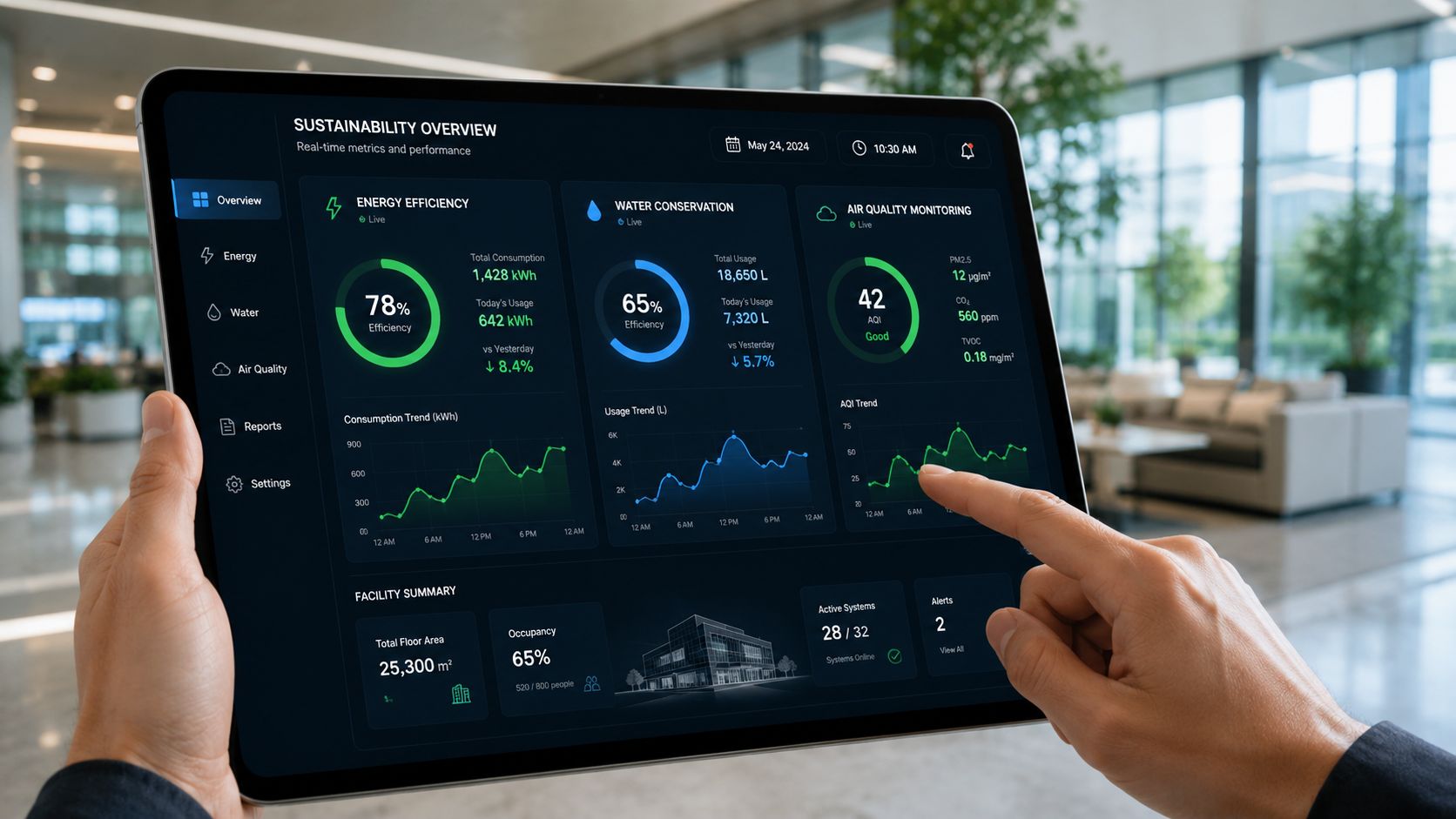
In Canada, sustainable facility management is increasingly driven by IoT sensors and smart meters that optimise energy, water, and air quality, and for Toronto-area facilities the key is pairing that technology with preventive maintenance so savings persist over time, according to this overview of sustainability in facility management.
What the tools actually do
The phrase “smart building technology” can sound expensive or overly technical. In reality, many of the most useful tools are straightforward.
- Occupancy sensors help reduce unnecessary lighting or conditioning in rooms that sit empty.
- Smart meters show when energy or water use shifts unexpectedly.
- Leak-detection sensors can flag problems before they become damage claims or long-running water loss.
- Building automation controls help operators align equipment runtime with actual occupancy.
- Air-quality monitoring gives facility teams a better picture of ventilation and comfort conditions.
Why maintenance still matters
Some managers get disappointed. They install technology, see early improvement, and assume the problem is solved.
It isn't.
Sensors and software don't replace maintenance. They make maintenance more targeted. If dampers stick, filters clog, fixtures wear out, or schedules stop matching occupancy, the dashboard may show the problem, but someone still has to act on it.
Field advice: Technology is most useful when it tells staff where to look first, not when it becomes another screen nobody reviews.
Where smaller facilities should start
A small or medium-sized site doesn't need a full building-automation overhaul to begin. The most sensible entry points are usually the ones tied to recurring headaches:
- Frequent comfort complaints
- Unexplained water use
- After-hours energy drift
- Repeated washroom fixture issues
- Areas cleaned or conditioned despite low occupancy
Even simple monitoring can help validate whether a schedule change, cleaning adjustment, or maintenance intervention is working.
Sustainable Facility Management FAQs and Further Reading
A busy office manager in Ontario usually hits the same point first. Utility costs are rising, staff notice comfort or cleanliness issues, and leadership asks for a sustainability plan that does not depend on a major retrofit.
That is why the right questions matter. Good sustainable facility management works like a housekeeping routine for the whole building. If you only look at one closet, such as energy, you miss the overflowing bins, the overordered supplies, and the reporting gaps that create avoidable cost month after month.
FAQs
What is the first step for a small office starting sustainable facility management
Start with a baseline review of daily operations. Check what the site buys, what gets thrown out, how cleaning is scheduled, which maintenance issues repeat, and where utility use looks inconsistent. The goal is to find waste you can remove in the next quarter, not to build a five-year capital wish list on day one.
Is sustainable facility management mostly about energy
Energy is one part of the picture. Small and medium-sized facilities in Ontario often find faster returns in waste handling, purchasing controls, cleaning methods, water use, and simple compliance checks. Those areas are easier to adjust because they depend more on routine and purchasing discipline than on large equipment upgrades.
How does commercial cleaning affect sustainability
Cleaning shapes supply use, packaging waste, indoor air conditions, floor life, and labour efficiency. A good program uses the right product, in the right amount, at the right frequency. It works like portion control in a kitchen. Too little causes complaints and rework. Too much raises cost and waste without improving results.
Do small facilities need a formal certification
Many do better by improving operations and tracking a few useful indicators first. Certification can make sense later if a client, tenant, board, or procurement process expects it. Until then, a simple record of utility trends, waste issues, supply consumption, and recurring occupant complaints is often more useful than a certificate that staff cannot support day to day.
What should an office manager measure first
Keep the list short enough so it is reviewed each month.
Start with:
- utility bills and unusual spikes
- supply purchasing by category
- waste or contamination problems
- repeat maintenance calls
- comfort, air quality, or cleanliness complaints
If one measure does not lead to an action, it probably does not belong on the first dashboard.
Why do sustainability efforts stall
The plan usually becomes too broad, or no one owns follow-up. Another common problem is buying lower-impact products while leaving the old process in place. If storage is messy, dispensing is uncontrolled, and staff training is inconsistent, the facility still wastes product and time.
Where do waste and procurement fit in
Near the centre. Purchasing decisions set off a chain reaction. They affect storage needs, chemical handling, packaging volume, waste streams, replacement cycles, and even custodial time. For smaller Ontario facilities, better procurement is often one of the fastest ways to improve both sustainability and operating cost.
Further reading
If you want to keep learning, focus on resources that help with Canadian compliance, operations, and benchmarking rather than broad sustainability theory.
Internal resources
External resources
A practical next step is to use the checklist above, review current cleaning and maintenance routines, and get two or three informed quotes before making changes. For organisations that want an operationally focused option in the GTA, Arelli Cleaning is one provider to compare on reporting, supply management, and day-to-day commercial cleaning fit.










.webp)