A Toronto property can look under control at 8 a.m. and feel neglected by mid-afternoon in July. Entrance glass picks up storm residue, lobby floors turn tacky from humidity and foot traffic, vents start showing dust, and washrooms work harder under higher occupancy and heat. Facilities that keep the same spring or winter cleaning scope usually see the gap first in complaints, then in appearance, and finally in maintenance costs.
Summer cleaning plans need tighter operating standards, not just more labour hours. Warm, humid conditions increase the risk of odours, residue buildup, staining, and moisture-related deterioration, especially in offices, medical clinics, childcare facilities, warehouses, and mixed-use buildings across Toronto. The pressure points are predictable. High-touch surfaces need shorter service intervals, HVAC components need closer attention, entrances need more aggressive soil control, and waste areas need stricter monitoring.
The operational question is straightforward. Which tasks need to change, by how much, and what standard should a cleaning vendor be held to?
This guide answers that with a Toronto-specific seven-point plan built for facility managers, property managers, and operations teams. It focuses on summer cleaning tasks that affect occupant health, presentation, compliance, and spend control, with practical benchmarks tied to site conditions. CIMS-style process control, WHMIS-safe chemical handling, documented frequencies, and inspection-based adjustments matter more than generic promises to clean more often.
For exterior presentation and seasonal building upkeep, Pine Country Window Cleaning's guide to commercial building cleaning services offers a useful supporting reference. The sections below concentrate on where summer conditions change cleaning requirements, what good execution looks like, and where the return on effort is highest.
Table of Contents
7-Point Summer Cleaning Comparison, TorontoImplementing Your Summer Cleaning Strategy
1. Implement High-Frequency Disinfection Protocols for High-Touch Surfaces
At 10 a.m. on a humid Toronto workday, the front door pull has already seen delivery drivers, staff, clients, and food couriers. By lunch, elevator buttons, washroom fixtures, and shared kitchen handles have been touched hundreds of times. A once-per-day cleaning schedule rarely holds up under that kind of summer traffic.
For facility managers, the better approach is a frequency-based disinfection plan tied to real use patterns, risk level, and building type. High-traffic zones such as lobbies, elevators, and restrooms often need daily attention, and busy restrooms may require service more than once during the day, according to this property management cleaning guide for Toronto. That is not just a hygiene issue. It affects occupant confidence, audit readiness, and labour efficiency.

Summer cleaning failures usually come from one of two gaps. Teams either disinfect too broadly and waste labour on low-contact surfaces, or they miss the short-interval touchpoints that drive complaints and contamination risk. A law office with back-to-back client meetings needs a different service map than a light industrial office with shared time clocks. A dental clinic, daycare, or medical admin space usually needs tighter turnaround protocols because touch frequency and exposure risk are higher.
Start with a site walk. List every high-touch surface by zone, then assign a service interval based on occupancy, contact frequency, and consequence of missed cleaning. That framework aligns better with CIMS-style process control than a generic “nightly disinfect” instruction, and it gives supervisors something measurable to inspect.
Build the schedule around risk and dwell time
A workable summer protocol should cover four points.
- Identify recurring touchpoints by zone: Door pulls, push plates, elevator controls, reception counters, faucet levers, flush handles, microwave buttons, fridge handles, photocopier panels, and shared desks should be mapped before any frequency change is approved.
- Set cleaning intervals by traffic level: Public entry points and washrooms often need daytime service windows. Staff-only areas may only need one scheduled disinfection pass plus spot response.
- Use products correctly: Ontario cleaning teams need WHMIS training, current SDS documentation, and disinfectants applied according to Health Canada label instructions, including required dwell time.
- Verify execution: Timestamped checklists, supervisor sign-offs, and simple ATP or fluorescent marker audits help confirm that the process happened as scheduled, not just that supplies were used.
One trade-off matters here. More frequent disinfection raises labour cost and can shorten the life of some finishes if product selection is poor. Overuse of aggressive chemistry on stainless steel, touchscreen coatings, and painted hardware creates avoidable replacement cost. The answer is not less disinfection. It is targeted disinfection with the right chemistry, microfiber rotation, and clear contact-time standards.
Tool control matters too. Colour-coded cloths and mop systems should stay separated by washroom, food-service, and general office zones to reduce cross-contamination. Teams that clean touchpoints after emptying waste or cleaning washrooms without changing tools usually create the very risk they are trying to control.
If building staff report recurring dust or vent-side grime while the disinfection program is running properly, the issue may extend beyond surface contact points and into air movement and distribution. In those cases, facility managers often coordinate janitorial scheduling with HVAC support such as Can Do Duct Cleaning for commercial HVAC.
2. Optimize Air Circulation and Indoor Environmental Quality Through Strategic Vent and Ductwork Cleaning
A Toronto office can look clean at 8 a.m. and still feel stale by noon. In summer, air conditioning runs longer, doors open more often, and outside pollen, fine dust, and street-level contaminants get pulled into the building envelope and redistributed through supply and return paths.

Facility managers usually see the first warning signs at the room level. Diffuser edges collect dust faster, meeting rooms feel stuffy despite low thermostat settings, and occupants start reporting musty odours or uneven cooling. Those complaints point to an air distribution issue, not a basic housekeeping failure.
The operational standard is straightforward. Vent covers, returns, and visible buildup around air delivery points should be inspected on a scheduled summer cycle, while filters should be checked and replaced according to equipment load, occupancy, and manufacturer guidance. In higher-use buildings, monthly review is a practical benchmark because summer runtime is high and airborne debris changes quickly.
Janitorial teams and HVAC contractors have different roles, and mixing them creates missed work. Cleaning staff can remove dust from vent faceplates, surrounding ceiling tiles, and accessible grilles. Internal ductwork, filter service, balancing issues, and mechanical deficiencies belong with qualified HVAC professionals. For facilities reviewing duct and vent service options, commercial HVAC duct cleaning information helps explain the operational side.
What to ask the HVAC and cleaning team
- Set a documented summer inspection schedule: Monthly checks are a reasonable starting point for filters, vents, returns, and visible debris around supply points. Buildings near major roads, active construction, or heavy pedestrian traffic may need tighter intervals.
- Define scope clearly: Janitorial scope should cover accessible vent exteriors and surrounding surfaces. Mechanical scope should cover filters, internal inspection, and any corrective HVAC work.
- Prioritize complaint-sensitive zones: Boardrooms, reception, perimeter offices, server-adjacent rooms, clinics, and childcare rest areas tend to show airflow and air-quality problems early.
- Track patterns, not isolated comments: Repeated complaints from the same zone should trigger inspection logs, not just another wipe-down.
- Tie the work to standards: Cleaning procedures should align with documented site protocols and staff training expectations under programs such as CIMS and WHMIS where applicable.
One trade-off deserves attention. Over-cleaning every visible grille without checking the upstream cause can waste labour, while delaying mechanical inspection can increase occupant complaints, trap allergens in circulation, and make the cleaning program look ineffective. The issue may stem from a summer maintenance schedule that never adjusted to higher cooling demand, longer system runtime, and heavier outdoor contaminant load.
3. Increase Exterior Power Washing and Entrance Maintenance to Manage Summer Debris and Pollen
A Toronto property can look under control at 8 a.m. and carry a visible film of pollen, sidewalk dust, leaf fragments, and gum residue by late afternoon. In summer, the entrance works as the transfer point between outdoor contamination and indoor cleaning costs. If the exterior program is light, lobby floors soil faster, mats fail sooner, and front-of-house complaints rise even when the interior team is meeting schedule.
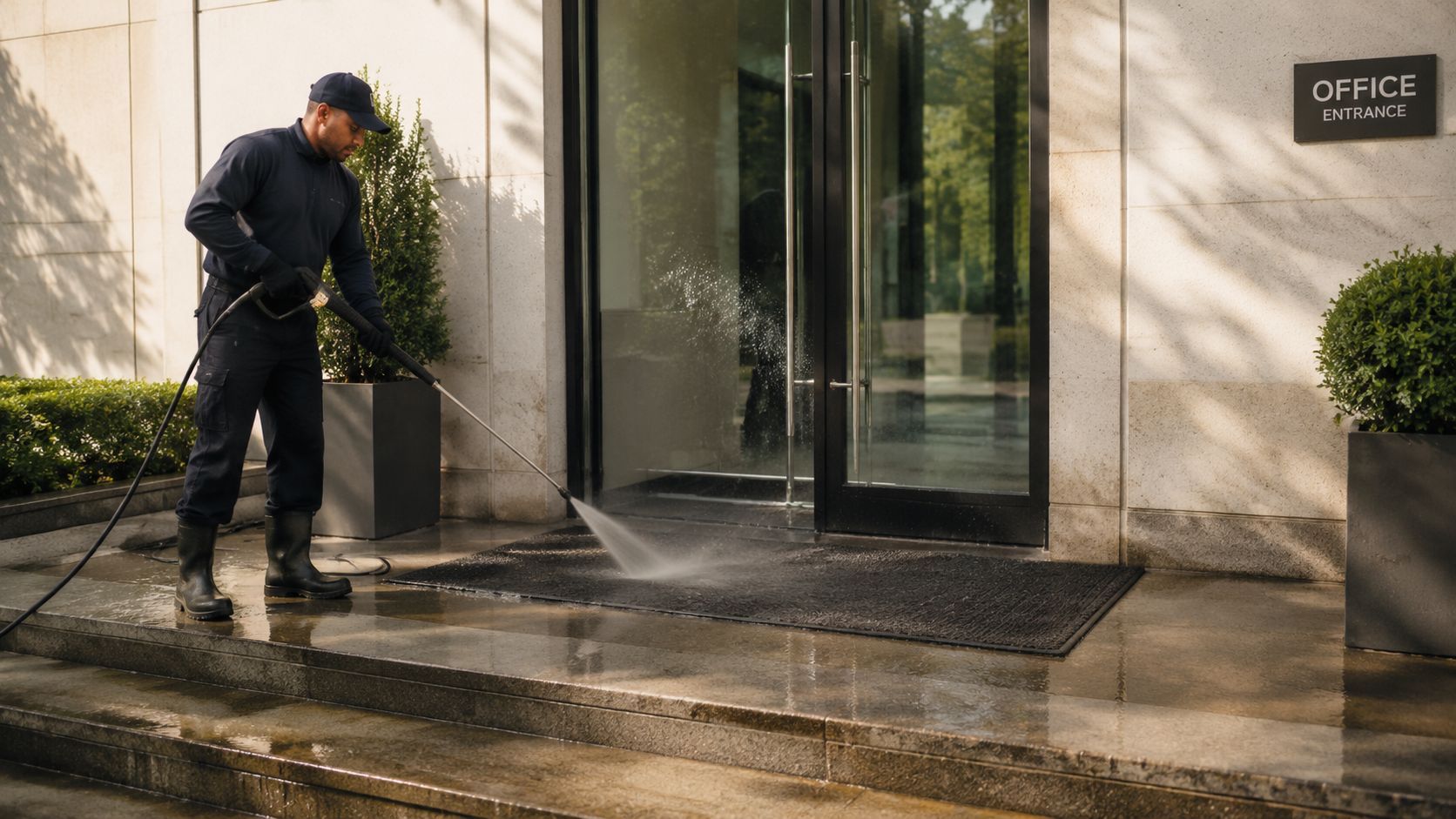
The practical fix is to treat exterior washing and entrance care as one control point. Sidewalks, vestibules, door frames, pulls, glazing, grates, and mat wells should be scheduled together, then adjusted by traffic and weather. A tower near transit foot traffic usually needs tighter hardscape cycles than a low-traffic office park. A warehouse or industrial site often needs more attention on loading approaches, windblown dust, and debris tracking from yard surfaces.
Frequency matters, but method matters just as much. Pressure that is appropriate for unfinished concrete can scar coated surfaces, loosen joint sand in pavers, or damage aging masonry. Facility teams should match pressure, nozzle type, dwell time, and detergent choice to the surface condition. That reduces rework and avoids the common mistake of making an entrance look clean for one day while shortening the life of the material.
The matting program is usually the weak point. If exterior and interior mats stay loaded with fine soil and pollen, power washing the walkway only solves part of the problem. Mats need inspection for saturation, edge curl, backing failure, and coverage length. In high-traffic buildings, replacing or laundering mats on a fixed summer cadence often delivers a better return than adding more frequent interior floor passes.
Where summer entrance programs usually break down
- Only the front pad gets cleaned: Debris also enters from side doors, smoking areas, service corridors, delivery routes, and parking-lot pedestrian paths.
- Storm response is too slow: Summer rain can leave silt, organic residue, and slip hazards that need same-day attention.
- Vestibule details get skipped: Door glass, hardware, frames, thresholds, and mat wells collect visible residue and should be part of the entrance scope, not an occasional add-on, as outlined in deep cleaning guidance for Toronto facilities.
- No benchmark is set: Teams should inspect entrances against clear conditions such as visible pollen film, pooled dirty water, gum spotting, mat saturation, and debris accumulation at edges and corners.
- Cleaning scope ignores compliance and documentation: Under a CIMS-aligned program, exterior and entrance tasks should have documented frequencies, inspection criteria, and chemical handling procedures that fit WHMIS training requirements.
A clean entrance reduces soil transfer, lowers interior labour demand, and presents the building the way tenants expect. In practice, that means fewer complaint tickets, better floor appearance retention, and less wasted effort inside the first 20 feet of the building.
4. Implement Humidity and Moisture Control Cleaning in High-Risk Zones
A Toronto office can look clean at 9 a.m. and still be carrying a moisture problem in the basement, janitorial closet, or washroom exhaust chase. By the time staff notice a musty odour or a stained ceiling tile, routine cleaning is no longer the whole answer. The job has shifted into damage control, tenant communication, and sometimes remediation.

Summer moisture control needs a separate operating plan because risk is uneven across the building. Below-grade storage, washrooms, utility rooms, shower areas, waste rooms, and HVAC-adjacent spaces do not fail for the same reasons, so they should not be inspected or cleaned on the same template. A CIMS-aligned program works better when teams define high-risk zones, assign inspection frequencies, document findings, and set clear escalation points for maintenance. Under WHMIS, staff also need the right product handling procedures for disinfectants, neutral cleaners, and any chemistry used in damp or poorly ventilated areas.
The practical benchmark is simple. Keep surfaces dry, air moving, and residue low enough that moisture cannot sit on dust, grout film, paper stock, or stored materials.
High-risk zones need inspection standards, not generic summer cleaning
A good summer scope for moisture-prone areas should include:
- Below-grade rooms: Check for condensation on pipes, damp odours, staining at wall-floor joints, and boxes or supplies stored tight against exterior walls.
- Restrooms and locker areas: Remove standing water, clean around toilet bases and under partitions, and log any failed exhaust fans or slow drying conditions.
- Janitorial closets: Inspect mop heads, buckets, floor drains, and shelving. Poorly dried tools can create odour and microbial growth inside the room meant to support hygiene.
- Mechanical and electrical support spaces: Remove settled dust with methods that do not spread it into equipment. Dust mixed with humidity can hold moisture and hide early leaks.
- Storage shelving and ledges: Clean fine debris from horizontal surfaces because it traps moisture and transfers odour to cartons, files, and supplies.
One trade-off matters here. Increasing cleaning frequency without fixing airflow or drainage rarely solves the problem for long. If washroom floors stay wet for hours after service, or a basement archive room repeatedly smells damp, the cleaning team should document the condition and push it to building operations the same day. That reporting step protects the facility manager and prevents crews from being judged against a problem cleaning alone cannot correct.
Visual checks are not enough. In higher-risk areas, supervisors should use a short inspection form with objective pass-fail conditions such as dry floor edges, no visible condensation, no persistent odour, no saturated mop storage, and no residue buildup at drains or baseboards. That creates a record the site can use for audits, service reviews, and seasonal scope changes.
The return is measurable in fewer mould complaints, less material damage, lower slip risk, and less disruption to occupied spaces. In Toronto summer conditions, moisture control is not an add-on task. It is part of asset protection.
5. Deploy Specialized Carpet and Upholstery Deep Cleaning for High-Traffic Summer Areas
A Toronto office lobby in July can look clean at 9 a.m. and still carry enough embedded grit, moisture, and fabric residue to shorten carpet life by the end of the season. The problem is not always visible. Summer foot traffic brings in fine street dust, food oils, sunscreen transfer, rain splash at entrances, and pollen that settles into carpet backing and upholstered seating.
That mix changes the maintenance standard. Vacuuming is still the base task, but it does not remove the material packed below the surface in high-traffic lanes. In practice, facilities get better results when carpet and upholstery schedules are set by traffic load, soil conditions, and drying capacity, not by a fixed monthly habit.
Set cleaning intervals by traffic class and recovery time
High-use summer areas usually need more than one service level. Entry carpets, reception walk paths, waiting rooms, breakout zones, and conference rooms used for client traffic should be assessed for interim spotting, pile lifting, and scheduled extraction or low-moisture deep cleaning. Lower-use offices and enclosed rooms can stay on a longer cycle if inspections confirm that appearance, odour, and drying performance remain acceptable.
Use a simple classification approach:
- Priority 1 zones: Main entrances, vestibule transitions, elevator lobbies, reception paths, and waiting areas. These areas need the shortest deep-cleaning interval and frequent spot treatment.
- Priority 2 zones: Shared meeting rooms, staff lounges, and corridors with steady daytime traffic. These usually need scheduled deep cleaning during summer, with touch-up work between visits.
- Priority 3 zones: Private offices and limited-access rooms. These can often stay on a condition-based schedule if routine vacuuming and prompt spot removal are consistent.
- Fabric seating and panels: Upholstered guest chairs, bench seating, and fabric dividers near windows or entrances should be included in the summer scope, not treated as separate occasional work.
The method matters as much as the frequency. Hot water extraction removes embedded soil well, but it needs proper drying control and should not be used carelessly in spaces that must reopen quickly. Low-moisture encapsulation or bonnet methods can reduce downtime, though they are better for interim maintenance than full restorative cleaning when heavy soil has already migrated deep into the fibres. A facility manager should expect the cleaning contractor to explain that trade-off clearly.
Inspect for conditions that routine service misses
Summer carpet problems often start at the edges of the route. Soil lines build along baseboards, under chair rails, around reception desks, and at hard-floor transitions where sticky residue transfers back onto carpet. Upholstery also holds fine particulate on armrests, seat fronts, and seams long before the fabric looks dirty from a standing position.
A useful inspection standard includes:
- visible soil at transition points
- recurring spots that reappear after drying
- dull or matted traffic lanes
- odour in seated areas or enclosed meeting rooms
- extended dry times after cleaning
- residue along edges, corners, and furniture contact points
These checks support a more defensible schedule. They also create records a facility team can use in service reviews, scope changes, and procurement discussions.
Surface vacuuming improves appearance, but embedded summer residue usually requires extraction, low-moisture deep cleaning, or upholstery cleaning based on fabric type and drying constraints.
One operational detail gets missed often. Hard-floor edges beside carpet need to be cleaned to the same standard. If grit and sticky residue remain on tile or vinyl at transitions, shoes carry that contamination straight back into the carpeted path, and the deep-cleaning interval shortens again.
The return is practical. Cleaner carpets last longer, dry faster after spot incidents, hold less odour, and generate fewer occupant complaints in client-facing areas. For Toronto facilities managing summer traffic, carpet and upholstery care is not cosmetic work. It is asset preservation tied to appearance, indoor cleanliness, and replacement cost control.
6. Establish Allergen Management and Pollen Control Protocols Throughout Facilities
A Toronto office can look clean at 8 a.m. and still trigger complaints by noon. Doors cycle open, outdoor air carries pollen inside, and fine particles settle on workstations, window ledges, diffusers, and fabric surfaces before staff notice any visible buildup. Once that material enters the building, it stops being an exterior housekeeping problem and becomes an indoor air quality, cleaning frequency, and occupant-comfort issue.
Facility teams get better results when pollen control is treated as a route design problem, not a one-time seasonal cleanup. The objective is simple. Reduce what enters, remove what settles, and keep it from recirculating through occupied areas. That requires coordination between janitorial routines, HVAC maintenance, and the way traffic moves through the site.
A practical pollen control framework
The controls should match the building type and risk level. A clinic, professional office, school, and mixed-use commercial property will not use the same frequencies, but the operating standard is consistent.
- Control entry contamination at the door: Use matting that is long enough to capture debris across several footsteps, and inspect it daily during high-pollen periods. Saturated or overloaded mats stop trapping particulates and start releasing them back into the air and onto hard floors.
- Clean horizontal dust-collection points on a defined schedule: Window sills, partition tops, ledges, millwork, cable trays, return-air grilles, and printer areas should be on the summer scope. If these surfaces are skipped, particles are pushed back into circulation during HVAC cycles and routine movement through the space.
- Use HEPA-filter vacuuming where soft surfaces hold fine particulate: Upholstered seating, fabric panels, and carpet edges often collect allergen load that dry dusting misses. This is especially relevant in reception areas, meeting rooms, and perimeter offices near operable windows.
- Set waste removal by heat and use, not by habit: Kitchens, lunchrooms, and washrooms need daily removal in warm weather to reduce odour and limit conditions that make air feel stale or unclean.
- Correct moisture and airflow issues in problem rooms: Storage rooms, enclosed offices, and low-air-movement corners may need dehumidification or HVAC adjustment. Cleaning alone will not solve recurring allergen and odour complaints in those spaces.
Inspection matters here. If staff report irritation, check supply and return grilles, tops of lockers or cabinets, and the edges around entry matting before increasing whole-building cleaning frequency. In many Toronto facilities, the issue is not a lack of cleaning effort. It is missed surfaces and poor capture at entrances.
A defensible summer protocol should also tie back to standard operating controls. Cleaning teams need WHMIS-compliant chemical handling, documented frequencies, and clear inspection points that a supervisor can verify during site reviews. For facility managers using CIMS-aligned practices, allergen control is easier to defend when the scope identifies touchpoints, high-settling surfaces, equipment type, and response thresholds for complaints.
The payoff is measurable in fewer dust complaints, better appearance at eye level and above, and less rework after pollen-heavy days. That is the practical standard. Clean what enters, remove what settles, and verify the areas that occupants feel before they see.
7. Optimize Waste Management and Recycling Protocols for Increased Summer Volume
A typical July problem in Toronto looks like this. The office is half full on Fridays, but the lunchroom bins are overflowing by 2 p.m., the organics container smells by the loading area, and recycling is contaminated with coffee cups, food containers, and mixed packaging from tenant events. The fix is not a blanket increase in cleaning hours. It is a waste plan that matches heat, occupancy patterns, and stream type.
Summer changes the waste profile in ways winter scopes often miss. Food waste breaks down faster. Outdoor containers generate more odour complaints. Event-driven packaging spikes can overwhelm recycling stations that were sized for normal office traffic. For facility managers, that means reviewing pickup frequency, bin placement, liner strength, and inspection points as an operating control, not just a janitorial task.
What to ask and what to avoid
Set waste removal by volume and risk area. Kitchenettes, staff lunchrooms, washrooms, loading zones, and exterior containers usually need the highest summer frequency, even when desk areas need less attention. In mixed-use buildings, this often means reducing detail work in low-occupancy office zones while increasing checks in shared amenity spaces and waste rooms.
A workable summer waste program should include:
- Variable pickup schedules by zone: Service lunchrooms, organics, and washroom waste on a higher frequency than low-use workstation areas.
- Clear stream separation: Label garbage, recycling, and organics consistently and place them where waste is generated, not where there was wall space.
- Contamination checks during daytime rounds: One quick correction at the bin station prevents a full bag of recyclables from being rejected.
- Exterior container controls: Keep lids closed, clean residue from bin surrounds, and inspect for leakage, pests, and odour build-up.
- Written summer scope changes: Document temporary frequency increases, event cleanup expectations, and who approves extra pulls.
There is also a contract trade-off to manage. Some Toronto offices see lower headcount in July and August, but waste does not decline evenly across the building. A static scope can leave high-risk areas under-serviced while paying for unnecessary work elsewhere. The practical approach is to reallocate labour hours to the spaces where heat and food waste create the highest complaint risk.
Training matters here. Staff need WHMIS-compliant handling for liners, cleaning chemicals, and any odour-control products used in waste rooms. Supervisors should also audit bin placement, contamination rates, and missed pickups during site reviews. For teams using CIMS-aligned processes, this is easier to defend when frequencies, inspection logs, and corrective actions are documented.
Summer waste scheduling should follow occupancy, waste type, and heat exposure. That is how facilities reduce odours, limit pest pressure, and control labour cost without lowering standards.
7-Point Summer Cleaning Comparison, Toronto
A Toronto facility can look stable on paper in July and still underperform by mid-afternoon. Entry mats load up with pollen, meeting rooms cycle through visitors, waste rooms heat up, and humidity shifts what needs attention first. The comparison below is meant to help facility managers set priorities by risk, labour impact, and operational return, not just by task list.
| Measure | Implementation complexity | Resource requirements | Expected outcomes | Ideal use cases | Key advantages |
|---|
| High-frequency disinfection of high-touch surfaces | Moderate. Requires multiple daily cycles, staff training on contact times, and WHMIS-aligned chemical handling | More labour hours, approved disinfectants, and a simple tracking system for completed rounds | Lower cross-contact risk, cleaner audit trails, and fewer service gaps during busy periods | High-occupancy offices, dental clinics, conference rooms, and shift-change areas | Fast risk reduction, clear documentation, and phased rollout by priority zone |
| Vent and ductwork cleaning to optimize IEQ | High. Requires contractor coordination, access planning, and possible HVAC downtime | Qualified HVAC cleaning specialists, HEPA equipment, inspection tools, and budget for testing and remediation if needed | Better airflow, fewer dust and allergen complaints, and more stable indoor conditions during heat and humidity swings | Buildings with central HVAC, health-sensitive facilities, and sites preparing for peak summer occupancy | Lower strain on HVAC components, better indoor air quality records, and cleaner supply paths |
| Exterior power washing and entrance maintenance | Low to moderate. Scheduling depends on weather, pedestrian traffic, and surface type | Power washing equipment or service support, surface-appropriate chemistry, labour, and signage for temporary access control | Cleaner approaches, better first impression, and lower slip risk from grime, residue, and tracked-in debris | Client-facing entrances, urban sites near trees, and parking or loading areas | Strong visual impact, practical risk control, and protection for exterior finishes |
| Humidity and moisture control in high-risk zones | High. Requires inspection, source identification, and in some cases restricted access during cleanup | Moisture meters, dehumidification equipment, trained remediation staff, and documentation for findings and corrective action | Reduced mould risk, better material protection, and fewer recurring odour or staining issues | Basements, storage rooms, mechanical spaces, washrooms, and below-grade areas | Early intervention, cleaner compliance records, and lower chance of costly remediation work |
| Specialized carpet & upholstery deep cleaning | Moderate. Requires scheduling around drying time, occupant use, and fabric or fibre type | Extraction equipment, suitable pretreatments, trained technicians, and ventilation planning to support drying | Soil and allergen removal, improved appearance, and longer service life for soft surfaces | Lobbies, conference rooms, high-traffic corridors, waiting areas, and shared seating zones | Noticeable appearance improvement, better indoor cleanliness, and reduced wear in peak-use areas |
| Allergen management and pollen control | Moderate. Depends on consistent execution at entrances, horizontal surfaces, and air handling points | Entrance matting, effective filtration, dust-control tools, and clear routines for daytime touch-up work | Fewer occupant complaints, less visible dust transfer, and better control during peak pollen periods | Medical and dental offices, childcare settings, and office buildings with frequent visitor traffic | Predictable seasonal control, modest operating cost, and easy-to-audit routines |
| Optimized waste management & recycling for summer volume | Moderate. Requires audits, collection adjustments, and staff training on sorting and bin placement | Added bin capacity, revised pickup frequency, clear signage, and tracking for overflow, contamination, and missed service | Less overflow, fewer odours, lower pest pressure, and better diversion performance | High-volume offices, food-service sites, event spaces, and large commercial facilities | Better compliance, fewer tenant complaints, and clearer reporting on waste performance |
Use this table as a budgeting and scheduling tool. Some measures are labour-heavy but easy to phase in, such as disinfection rounds or allergen control. Others carry more planning and contractor coordination, such as vent cleaning or moisture remediation, but they address higher-cost failure points that can affect complaints, compliance, and asset condition for the rest of the season.
Implementing Your Summer Cleaning Strategy
A Toronto office can look fine at 8 a.m. and feel neglected by mid-afternoon in July. Entrance glass picks up storm residue, washrooms turn faster under higher occupancy, odours build sooner in waste rooms, and moisture issues show up first in the areas teams tend to ignore.
An effective summer cleaning plan treats those conditions as operating variables, not one-off problems. The right approach is to set task frequency by risk, assign clear inspection points, and document what gets cleaned, when, and why. That gives facility managers a practical way to control labour hours, defend budgets, and avoid the expensive pattern of reacting to complaints after standards have already slipped.
Summer scope also needs to be defined properly. Commercial cleaning covers routine janitorial work, washroom sanitation, floor care, periodic deep cleaning, and appearance maintenance across a business property. A summer program adjusts that baseline for Toronto conditions such as humidity, pollen, rainfall, construction dust, and shifting occupancy. Costs vary by building type, traffic level, finish materials, and whether the scope includes items like exterior washing, duct-related cleaning support, or moisture response, so quote comparisons need to focus on scope detail rather than a single price line.
Use a simple evaluation standard when reviewing providers. Ask how service frequencies change by zone, how WHMIS and SDS requirements are managed on site, how staff escalate mould, condensation, or ventilation concerns, and what records are available for inspections and audits. Good answers are specific. Vague answers usually lead to scope gaps.
For local due diligence, compare two or three proposals line by line. Review the provider's service footprint through the Arelli Cleaning locations page. Then check whether the schedule, staffing assumptions, quality-control process, and seasonal task list match the risk profile of your building. A medical clinic, multi-tenant office, industrial office, and retail site should not be buying the same summer program.
If you are building a plan internally or validating an outsourced scope, use the seven tasks in this guide as your operating checklist. Start with the highest-risk zones, set measurable frequencies, and revisit the plan after the first few weeks of hot weather. That is usually enough to catch gaps before they become complaints, indoor air quality concerns, or avoidable maintenance costs.
Businesses that want a more structured summer cleaning plan can review Arelli Cleaning as one Toronto option, then compare it with two or three other quotes using the same checklist. That approach usually leads to a better scope, clearer compliance expectations, and fewer surprises once humidity, pollen, and summer traffic peak.






.webp)