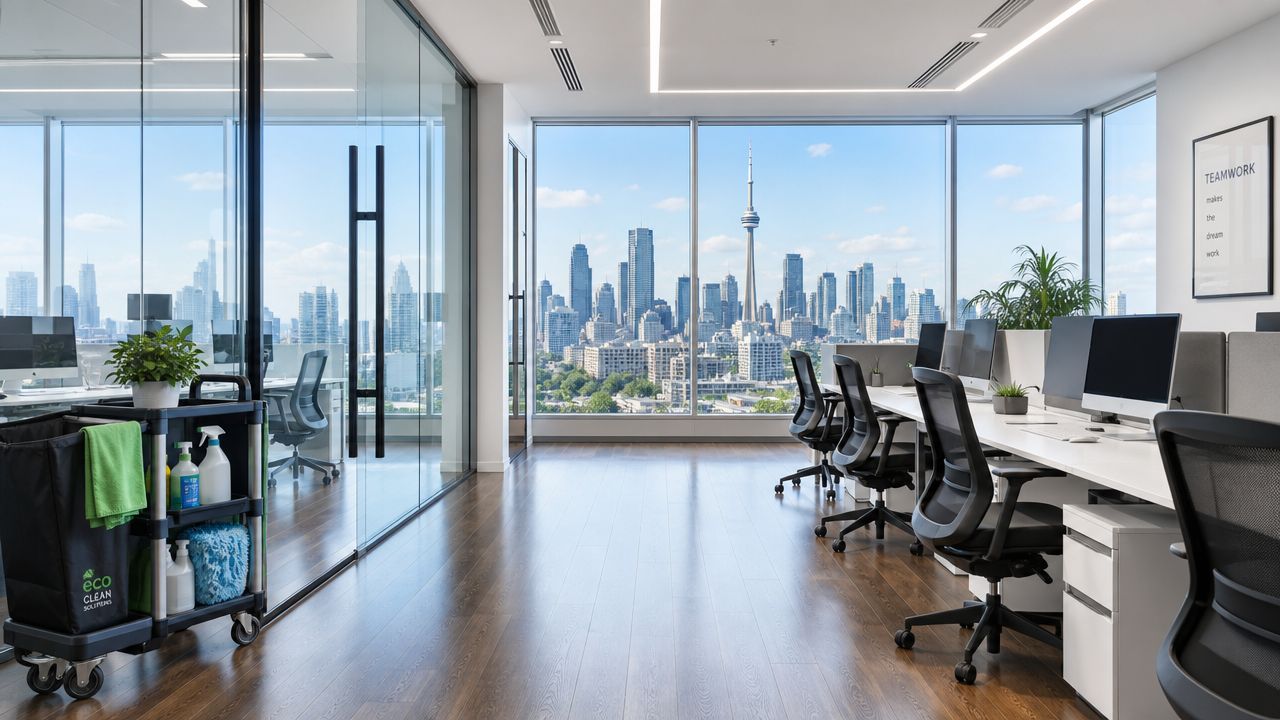
A Toronto office can look fine at 9 a.m. and still need a deep clean.
That usually becomes obvious in small ways. Smudges around door hardware. Dust sitting on top of partitions and return-air grilles. Washrooms that are disinfected daily but still show buildup around hinges, grout, and baseboards. Boardrooms look presentable, yet chairs, vents, fabric panels, and cable-heavy corners haven't had detailed attention in months. That's the gap between routine cleaning and restorative cleaning.
For business owners and facility managers, a deep clean in Toronto isn't just about appearance. It's part of facility upkeep, risk reduction, and preserving how the workplace feels to staff, visitors, and tenants.
When Your Toronto Workspace Needs More Than a Surface Clean
Toronto buyers aren't dealing with a niche service category. Ontario's facilities cleaning sector has been estimated at over C$3 billion, with 3 to 5 per cent projected annual growth, and the province accounts for about 38 per cent of contract cleaning revenue in Canada, according to an Ontario facilities cleaning market analysis. That matters because a large, mature market tends to support more specialised services, including periodic office deep cleaning in Toronto.
A deep clean makes sense when regular janitorial work is maintaining the obvious surfaces but not resetting the space. In practice, that often shows up after seasonal transitions, before tenant visits, after fit-outs, during occupancy changes, or when employees start commenting that the workplace feels dusty even though it's being cleaned.
Key takeaways
- Deep cleaning is periodic restorative work, not a substitute for daily janitorial service.
- Toronto sits inside Canada's largest provincial contract-cleaning market, which supports more specialised commercial service options.
- The value is operational, not cosmetic alone. Deep cleaning protects finishes, improves presentation, and addresses neglected buildup.
- Good providers define outcomes clearly, including what is included, what is excluded, and what requires specialty treatment.
- Smart buyers compare scope before price, especially when reviewing office, clinic, warehouse, or mixed-use quotes.
A commercial deep clean is maintenance work with hygiene benefits. It removes accumulated soil that routine cleaning is not designed to tackle.
What routine cleaning misses
Routine office cleaning is designed to keep spaces usable. It empties bins, vacuums open areas, wipes touchpoints, and keeps washrooms and kitchens serviceable. That work is necessary. It's also intentionally selective.
Deep cleaning reaches the neglected zones that gradually affect the whole environment:
- High dusting points such as vents, ledges, partition tops, light housings, and exposed pipes
- Detail cleaning zones including corners, edges, grout lines, hardware, kick plates, and under furniture
- Shared contact areas like chair arms, phones, door frames, appliance handles, and breakout surfaces
- Finish recovery tasks such as spot removal, floor edge work, and built-up residue removal
For Toronto offices considering a broader service review, this is also where a provider's base program matters. A regular office cleaning service in Toronto should support deep cleaning rather than conflict with it.
Why businesses treat it as maintenance
The most practical way to think about deep cleaning is this. It resets the parts of the building that daily cleaning preserves but doesn't restore.
That's why businesses often schedule it around operational needs, not marketing campaigns. A law office may need quieter after-hours detail work. A school may need holiday-period floor and touchpoint recovery. A warehouse may need high-dust removal near racking, dock doors, and mezzanine edges. The task list changes by facility, but the logic is the same. Remove what routine cleaning leaves behind before it affects hygiene, assets, or perception.
What a Commercial Deep Clean Actually Entails
A commercial deep clean is often described too loosely. In facility terms, it isn't “a more thorough clean” in the abstract. It's a planned, top-to-bottom service that targets accumulated soil, neglected surfaces, and detail work outside the normal janitorial cycle.
Definition: A commercial deep clean is a periodic, labour-intensive cleaning service that restores areas, fixtures, and surfaces that routine maintenance cleans only lightly or not at all.
That definition matters because many buyers in the deep clean Toronto market are comparing proposals that use the same label for very different scopes.
The labour difference is the real difference
The clearest distinction is labour intensity. Toronto provider data shows a deep clean can take 4 to 5 hours for a space that would take 1.5 to 2 hours for regular cleaning, which means about a 2x to 3x increase in time-on-task for the same environment, as outlined in this Toronto deep cleaning cost guide.
That extra time goes into tasks routine crews usually don't perform on every visit:
- Above-eye-level work such as vents, shelf tops, diffusers, frames, and ledges
- Edge and detail cleaning around baseboards, corners, furniture feet, and partitions
- Residue removal in kitchens, washrooms, and high-touch common areas
- Targeted fabric and floor treatment where standard vacuuming or mopping won't reset the finish
What's usually included
A proper commercial deep clean is best understood in phases rather than a flat checklist.
High and hidden areas
Crews start where dust migrates. That includes tops of cabinets, door frames, HVAC covers, window ledges, light fixtures, partition caps, and storage shelving. If these aren't addressed first, dust falls back onto the areas cleaned later.
Detailed surface work
Desks may only need a light wipe in a regular service. A deep clean focuses instead on the less obvious points: chair bases, monitor stands, cable paths, handles, trim, kick plates, sink surrounds, and corners where grime bonds to the surface.
Floor and textile recovery
This phase usually determines whether the space feels reset. Hard floors may need machine scrubbing or finish-specific treatment. Carpeted zones may need extraction or commercial steam cleaning where embedded soil is the issue rather than loose dust.
What it does not automatically include
Many buyers misinterpret the scope of deep cleaning. Deep cleaning doesn't automatically mean mould remediation, odour source removal, duct cleaning, or hazardous contamination work. If a facility has water damage, persistent mustiness, or visible fungal growth, a cleaning crew may need to coordinate with a specialty contractor. For example, facilities dealing with moisture-related contamination may need separate GTA mold removal solutions rather than expecting a standard deep clean to resolve the underlying problem.
A useful rule is simple. If the issue involves hidden moisture, active contamination, or regulated remediation, ask whether the scope is cleaning, restoration, or environmental control. Those aren't the same service.
Industry-Specific Deep Cleaning Checklists
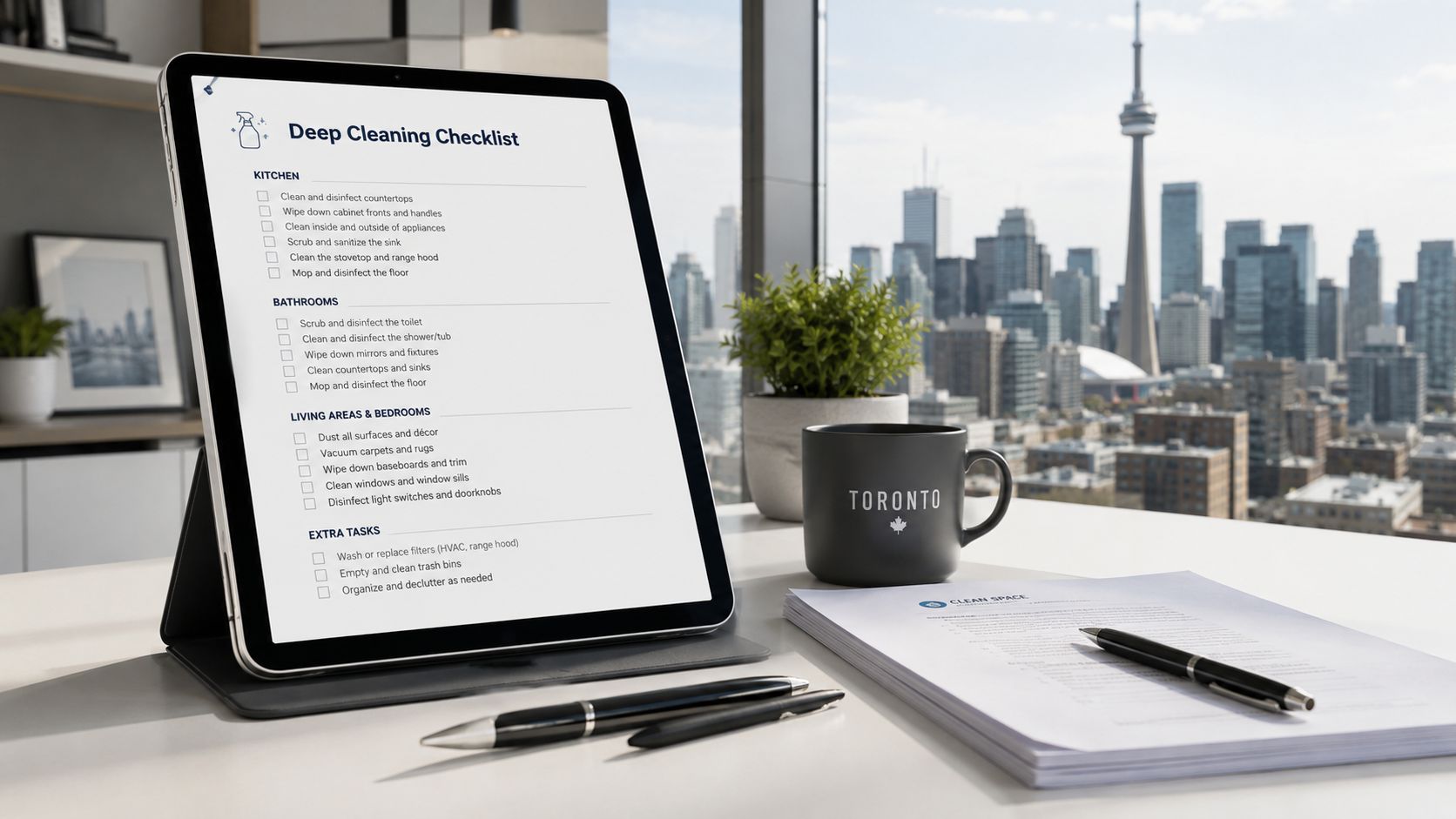
A useful checklist does more than name tasks. It reflects how the building is used. A corporate office has occupancy and presentation issues. A clinic has patient-flow and touchpoint risk. A warehouse has dust migration, equipment sensitivity, and access constraints.
Core checklist for most commercial spaces
Most deep clean Toronto projects should at least review these items:
- Entry and reception areas. Clean door glass, hardware, vestibules, mats, baseboards, ledges, and front-facing furniture.
- Shared work areas. Detail partition tops, desks where permitted, chair arms and bases, phones, monitors exteriors, and reachable cable clutter zones.
- Kitchens and break rooms. Remove grease and residue from fronts, handles, splash areas, sinks, faucets, appliance exteriors, and bin surrounds.
- Washrooms. Detail partitions, hinges, dispensers, grout, floor edges, behind fixtures where accessible, and residue-prone hardware.
- Floors. Treat edges, corners, transitions, and traffic lanes rather than only open visible areas.
- High dusting points. Address vents, grilles, light housings, pipe runs, top shelves, and signs.
Clean first for soil removal, then for sanitation where required. Reversing that order wastes product and labour.
Corporate offices
Office deep cleaning is usually about accumulated contact wear and visual trust. Staff notice grime around the edges before they notice the middle of the floor.
Office priority list
- Meeting rooms. Chair backs, arms, table bases, switch plates, remotes, whiteboard rails, and glass partitions.
- Open-plan zones. Partition tops, task chairs, monitor stands, under-desk dust, and baseboards along workstation runs.
- Reception. Front desk transaction ledges, seating upholstery contact points, entry glass, and floor transitions from exterior to interior.
- Technology-safe cleaning. Use low-moisture methods around screens, keyboards, docking stations, and cable-heavy desks.
Medical and dental clinics
Clinical spaces need a tighter workflow. Not every room requires the same treatment, and not every cleaner is appropriate for every surface.
For medical environments, the biggest mistake is assuming “deep cleaning” automatically equals compliant infection control. It doesn't. The provider should define room categories, touchpoint protocols, dwell-time expectations where relevant, and product suitability. Buyers looking at clinic-specific support should expect a scope similar to professional medical office cleaning, with clear separation between routine cleaning, deep cleaning, and disinfection tasks.
Clinic priority list
- Reception and waiting areas. Armrests, transaction counters, child-height touchpoints, door pulls, and seating junctions.
- Treatment rooms. Non-critical surfaces, stools, carts, sink zones, cabinet pulls, and frequently handled equipment exteriors where approved.
- Washrooms. Full fixture detailing, splash-prone surfaces, and dispensers.
- Staff areas. Break areas, lockers, charting counters, and shared appliance fronts.
Industrial facilities and warehouses
Industrial deep cleaning shifts from appearance to contamination control. In technical environments such as data-centre style spaces or manufacturing zones, recommended methods include HEPA-filtered, ESD-safe vacuums, ESD-safe and non-conductive solutions, and minimal-moisture, rapid-drying methods, as described in this technical cleaning checklist for contamination-control environments.
That matters because the cleaning objective isn't only dust removal. It's preventing particulate movement and avoiding moisture-related risk around equipment.
Warehouse and technical priority list
- Racking and overhead dust. Top beams, rack caps, conduits, and mezzanine edges
- Equipment-adjacent zones. Exteriors of panels, housings, and protected surfaces using approved methods
- Air movement points. HVAC exteriors, intake surrounds, and dust accumulation points that feed redistribution
- Floor strategy. Use methods that control dust rather than pushing it around with dry sweeping
- Inspection during cleaning. Watch for leaks, corrosion, cable wear, and residue around sensitive areas
In these environments, a cheap quote can become expensive if the crew uses the wrong vacuum, too much moisture, or a floor method that puts particulate back into the air.
Decoding Deep Cleaning Costs in Toronto
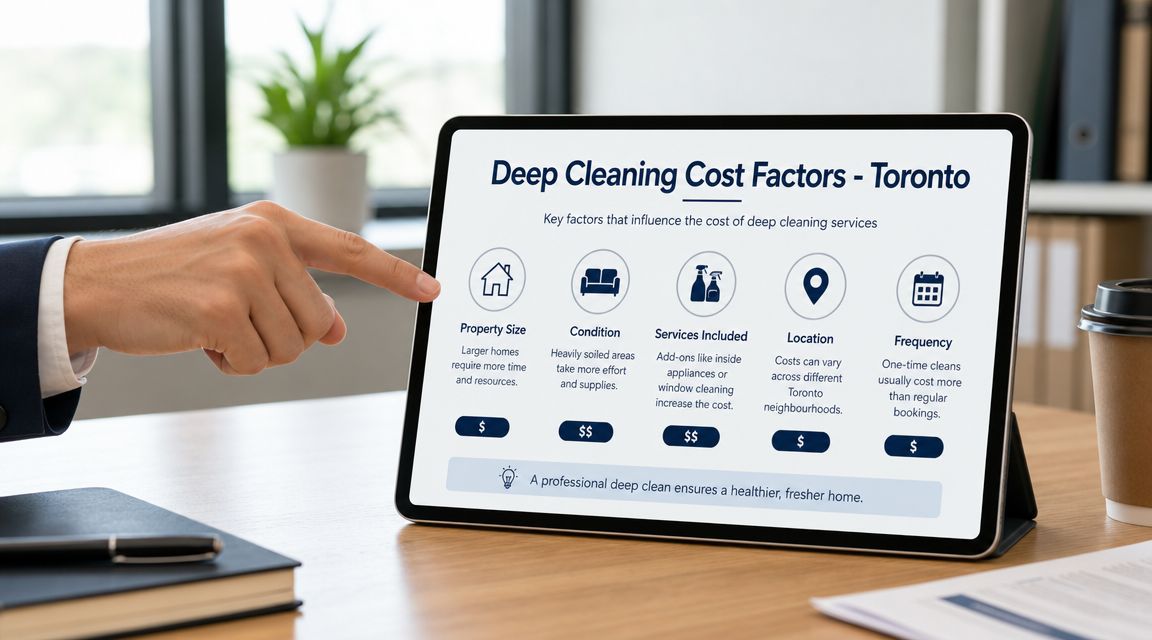
Commercial buyers usually ask the right question in the wrong way. The question isn't “What does a deep clean cost?” The better question is “What work is the quote covering?”
Residential pricing gives a useful anchor. Toronto guides list deep-clean ranges of $200 to $400 for condos, $300 to $500 for townhouses, $400 to $700 for single-family homes, and $500 to $900 for larger properties, according to a Toronto deep cleaning pricing guide. That tells you two things. Deep cleaning is already treated as a premium service, and price rises with size and complexity.
Why commercial quotes vary so much
Commercial deep clean Toronto pricing is almost always custom because the labour plan changes with the facility. Two offices with similar square footage can price differently if one has glass partitions, a crowded floorplate, heavy kitchenette use, and strict after-hours access rules.
The main cost drivers are usually:
- Facility type. Office, clinic, school, warehouse, and mixed-use spaces require different methods and supervision.
- Level of buildup. A maintained office reset is different from a neglected tenancy turnover.
- Access and scheduling. Tight service windows, weekend work, and restricted floors affect crew planning.
- Floor and surface mix. Carpet, resilient flooring, tile grout, stone, fabric panels, and delicate finishes all change the method.
- Specialty equipment. Lifts, autoscrubbers, extractors, HEPA vacuums, or ESD-safe tools change labour and setup.
- Compliance requirements. Site orientation, safety documentation, product controls, and reporting add administrative work.
How to compare quotes properly
A low quote often means one of three things. The scope is thin, the assumptions are vague, or the provider expects to upsell once the crew is on site.
Use this quick comparison lens:
| Quote element | Strong quote | Weak quote |
|---|
| Scope detail | Names areas, tasks, exclusions, and access assumptions | Uses broad phrases like “full deep clean” |
| Floor care | Specifies method by floor type | Bundles all floors into one line item |
| Equipment | States when specialty tools are required | Assumes standard mop-and-vac service |
| Timing | Explains crew size and service window qualitatively | Offers a price with no operating plan |
| Quality closeout | Includes inspection or deficiency process | No mention of verification |
The cheapest deep clean quote is often the least defined quote. Buyers should compare scope density, not just the total.
How to Choose the Right Deep Cleaning Provider in Toronto
Most service pages make providers look interchangeable. They aren't. In Toronto, many businesses struggle to compare deep cleaning quotes because vendors rarely explain what drives price or what service guarantees cover. In a market with many small firms and rising labour costs, buyers should assess contract flexibility, quality assurance systems, and compliance, not just the quoted number, as noted by Earth Concerns on commercial cleaning decision factors.
What to ask
A serious vendor should answer operational questions clearly and without dodging.
- Insurance and worker coverage. Ask for proof of liability coverage and worker protection documentation relevant to Ontario operations.
- Training and safety. Ask how staff are trained on WHMIS, site hazards, washroom protocols, floor care, and equipment use.
- Product controls. Ask whether the provider can supply Safety Data Sheets and explain where a neutral cleaner, disinfectant, degreaser, or specialty product is appropriate.
- Scope control. Ask what is excluded. Inside cabinets, inside appliances, ceiling work, lift access, and stain removal should never be assumed.
- Quality assurance. Ask how deficiencies are reported, reviewed, and corrected.
- Communication. Ask who your site contact is when access changes, alarms fail, or an issue is discovered during service.
What to avoid
Poor-fit providers usually reveal themselves early.
- Vague language. “We deep clean everything” is not a scope.
- Flat pricing without inspection. Some spaces are simple. Many aren't.
- No exclusions listed. If exclusions aren't written down, disputes usually follow.
- No discussion of access. Toronto buildings often have elevator bookings, loading windows, and alarm procedures.
- Overreliance on disinfection language. That can hide a weak cleaning plan.
Vendor evaluation framework
| Evaluation Criterion | What to Look For | Potential Red Flags | Example of a Strong Offering (e.g., Arelli) |
|---|
| Scope clarity | Written task list by area, plus exclusions | “Full sanitisation” with no detail | Area-by-area scope with add-on options |
| Compliance | Safety training, SDS access, documented procedures | Can't explain products or protocols | Documented WHMIS process and product information |
| Quality assurance | Site inspections, issue tracking, follow-up process | No review method after service | Digital inspection workflow and service follow-up |
| Contract flexibility | One-time or periodic options without unnecessary lock-in | Pressure to sign a long term agreement for a single reset | No-term structure for buyers who need project-based work |
| Communication | Named contact, clear escalation path, service notes | Generic inbox only | Real-time communication app and live support |
| Specialty capability | Floor care, high dusting, carpet care, post-construction support | Only offers basic mop-and-vac work | Provider can bundle deep cleaning with related specialty services |
One example in the Toronto market is Arelli Cleaning, which offers no-term contracts, real-time communication tools, and quality-assurance systems. That doesn't make it the automatic choice. It does show the type of operating model buyers should look for when comparing vendors.
Preparing Your Workspace for an Effective Deep Clean
A deep clean works best when the cleaning crew spends time cleaning, not waiting for access or moving avoidable obstacles. Most service inefficiency starts on the client side.
Pre-service checklist
- Declutter key surfaces. Remove loose papers, dishes, personal items, and unnecessary desktop objects so detail cleaning can happen properly.
- Provide access. Confirm keys, codes, loading instructions, elevator bookings, and alarm procedures in writing.
- Mark sensitive areas. Identify server rooms, legal files, confidential storage, and any spaces that need escort access or restricted treatment.
- Flag problem zones. Note spill history, washroom odours, winter salt buildup, adhesive residue, or rooms with unusual dust loads.
- Secure valuables and fragile items. A deep clean often involves moving around furniture and tight corners. Delicate items should be cleared or protected in advance.
- Confirm the scope lead. One contact person should walk the site assumptions with the vendor before work begins.
For facilities that need a clearer handoff before sanitation or disinfection work, a formal facility pre-clean process can help separate decluttering, access control, and cleaning readiness.
The best deep cleans start before the crew arrives. Clear access and clear instructions improve results more than last-minute requests do.
Frequently Asked Questions About Commercial Deep Cleaning
How often should an office get a deep clean?
It depends on occupancy, layout, season, and the kind of work done in the space. A quiet professional office may only need periodic restorative cleaning tied to traffic patterns and seasonal conditions. A clinic, school, warehouse, or heavily used shared office usually needs a more structured schedule.
Is deep cleaning the same as disinfection?
No. That distinction is often blurred in local marketing. A critical gap in many Toronto service descriptions is the failure to separate aesthetic deep cleaning from validated infection control. Deep cleaning removes buildup and dust reservoirs, but it may not meet the specific protocols needed during respiratory virus periods, when additional disinfection steps and attention to ventilation may be required, as discussed in this Toronto deep cleaning article on infection-control limits.
Are the products safe for staff and visitors?
They should be appropriate to the surface and the setting. Buyers should ask for Safety Data Sheets, product names, and any occupancy-related precautions. In offices, the main issue is usually residue, fragrance, and surface compatibility. In clinics or technical spaces, the issue is method control and product suitability.
Should the work happen after hours?
Usually, yes. Deep cleaning is detailed work and often requires access to edges, furniture, washrooms, and circulation paths without interruption. After-hours scheduling also reduces safety issues around wet floors, equipment movement, and occupied workstations.
What if the result isn't satisfactory?
That's where the provider's closeout process matters. Ask in advance how deficiencies are documented, how quickly touch-ups are handled, and who approves completion. If a vendor can't explain that before the work starts, the service recovery process will likely be weak.
Can one vendor handle offices, clinics, and industrial sites?
Sometimes, but don't assume broad claims equal broad competence. Many vendors clean all three categories, yet their strongest systems may only fit one or two. Buyers should ask for a site-specific method, not just a general company capability statement.
Further Reading and Next Steps
For continued research, review Arelli's service areas across the GTA, along with its pages on office cleaning, medical office cleaning, and specialty steam cleaning if those match your facility. For external reading, industry buyers often consult ISSA for cleaning-industry guidance and Public Health Ontario for health-related workplace considerations.
The practical next step is simple. Use the checklists and vendor questions above, then request 2 to 3 quotes from qualified providers with clearly written scopes.
If you're gathering quotes, include Arelli Cleaning as one option in the comparison. The useful approach isn't to look for the lowest headline price. It's to compare scope clarity, communication, compliance, and how each provider defines a successful deep clean for your Toronto workspace.






.webp)