Is Your Cleaning Service Helping or Hurting Your Business? Choosing a commercial cleaning provider is a significant investment in a facility's health, safety, and professional image. But when service quality slips, it can be hard to tell whether the problem is a one-off mistake or a pattern that's affecting operations. In Ontario, that question matters even more because cleaning touches not only appearance, but also workplace risk, chemical handling, and compliance obligations tied to WHMIS and the Occupational Health and Safety Act that has been in force since 1979 xiri.ai guide on switching cleaning companies.
This guide gives a direct, practical way to judge whether a provider is still a fit. It focuses on observable red flags, what they usually mean, and what a facility manager should ask before the problems spread. For industrial and manufacturing facilities, schools, clinics, and office buildings in the Greater Toronto Area, the decision often comes down to whether the vendor can prove consistency, not just promise it System 1's guide to upgrading janitorial service.
Table of Contents
1. Visible Dirt, Dust, and Debris Accumulation in High-Traffic Areas
When a lobby, corridor, break room, or reception area keeps showing dust and debris soon after service, the issue is usually bigger than housekeeping aesthetics. High-traffic spaces need reliable attention because they shape first impressions and reveal whether a provider is following a stable routine or improvising from visit to visit. A Toronto law office that sees dust on conference room furniture within a day of cleaning, or a dental clinic that keeps finding debris under reception seating, is seeing a process problem, not just a missed spot.
The most useful check is simple and repeatable. Walk the site several times each week, look at the same areas, and compare them over time. High-touch points, baseboards, corners, blinds, and the tops of work surfaces tell a clearer story than a quick glance down a hallway.
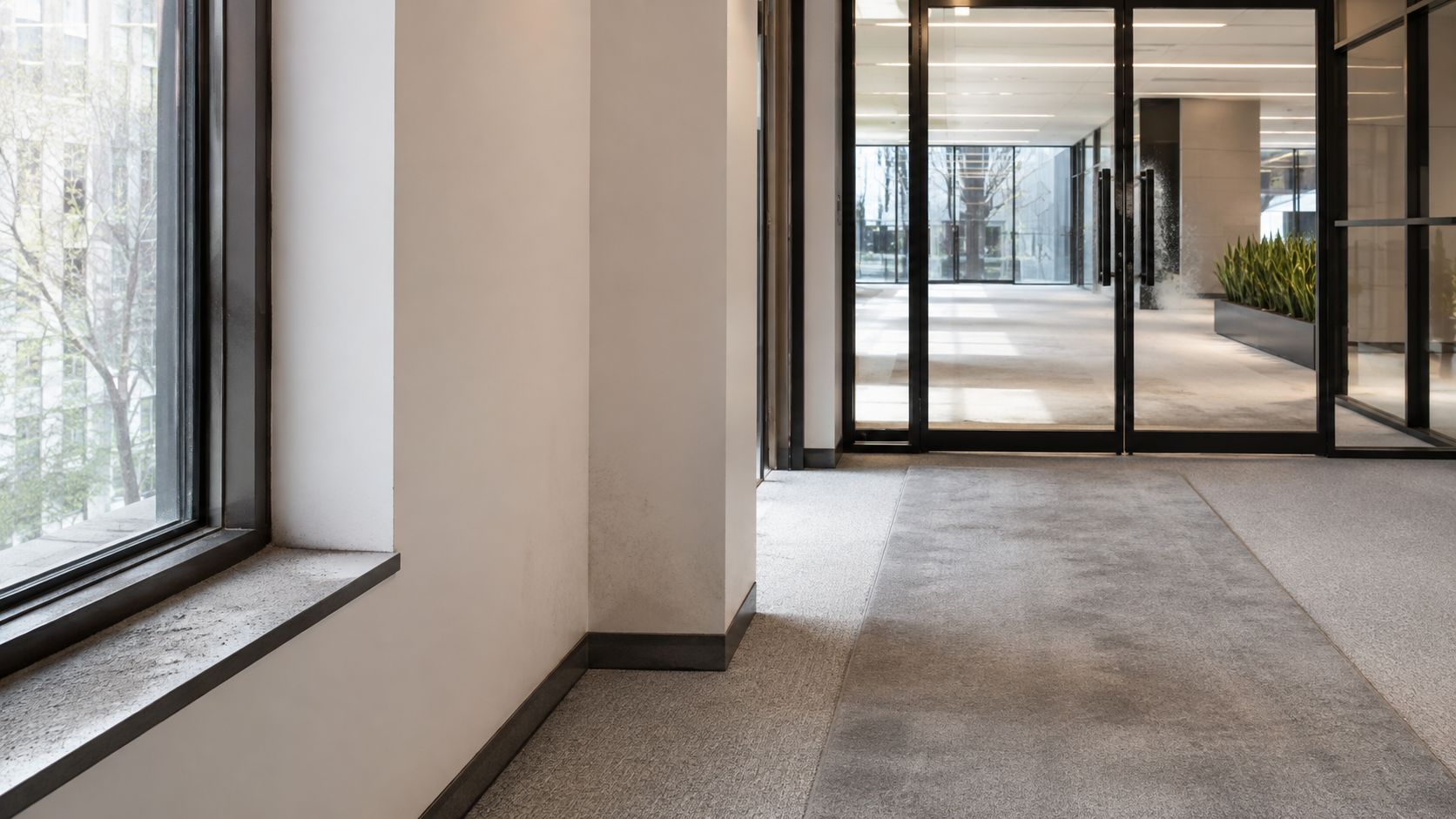
Practical rule: If the same dust patterns keep returning, the provider may not have the staffing, training, or inspection discipline needed for the site.
A quick validation checklist helps separate a temporary miss from a chronic failure:
- Inspect the same zones repeatedly. Compare lobbies, hallways, and workstations on different days, not just after one complaint.
- Use dated photos. Visual records make patterns obvious and reduce debate.
- Check missed edges. Baseboards, shelf tops, and window blinds often show where the service is weakest.
- Spot-check after hours. A surprise walk-through shows what the space really looks like, not what it looks like during a scheduled visit.
For sites that rely on consistent appearance, the question is whether the vendor can sustain standards without reminders. If the answer is no, it's reasonable to start comparing other providers. The internal reference on high dusting and hard-to-reach areas is useful when a site keeps failing in high or overlooked spaces.
2. Unpleasant Odours and Poor Air Quality
Persistent odours are one of the clearest signs that surface cleaning isn't reaching the root cause. A restroom that still smells off, a break room that turns musty, or a clinic area that carries a lingering chemical odour usually points to weak waste handling, poor ventilation coordination, or the wrong products for the task. In Ontario workplaces, commercial cleaning often involves disinfectants and detergents, so the provider's product choices and procedures matter as much as the final appearance CCOHS guidance on cleaning product exposure.
A childcare centre that notices diaper odours despite daily service, or an industrial warehouse that develops an ammonia-like smell near floors and waste areas, is dealing with a sanitation gap. Odour control is not about masking smells with fragrance. It's about removing source material, managing moisture, and using the correct cleaning sequence.
The most effective check is to assess the building at different times of day. Odours often become stronger as temperature, humidity, and occupancy change. That timing can point directly to the source, which saves wasted effort on the wrong area.
A provider worth keeping should be able to explain its disinfectants and waste procedures in plain language. If the team can't identify the products used, or can't show how they handle spills and organic waste, the service is too loose for a clinic, office, school, or warehouse.
The right response to an odour problem is usually process, not perfume.
A practical review should include:
- Source tracing. Identify where the smell starts and when it appears.
- Product verification. Ask which disinfectants are used and whether they're approved for the intended use.
- Moisture review. Check carpets, upholstery, washrooms, and sink areas for hidden dampness.
- Deep-clean escalation. If the smell survives routine service, ask whether targeted carpet or upholstery cleaning is needed.
If odours keep returning after repeated service calls, the provider may not be controlling the underlying conditions. That's often the point when switching becomes a business decision, not a comfort preference.
3. Missed or Inconsistent Cleaning Appointments and Unreliable Scheduling
A cleaning provider that misses appointments or arrives unpredictably creates avoidable friction across the whole facility. Staff may be interrupted, security procedures may get disrupted, and after-hours access can become a recurring problem. In an engineering office or manufacturing site, that sort of inconsistency can affect work readiness the next morning and expose gaps in sanitation routines.
The scheduling issue is usually a sign of weak operations. It can come from poor route planning, overextended staffing, or the absence of a real backup process when someone calls in sick. Whatever the cause, the result is the same, the facility can't rely on the service when it's supposed to happen.
A written service agreement should state the cleaning window, frequency, and who gets notified if a visit changes. A provider that can't commit to clear timing is asking the client to absorb the uncertainty. That's fine for a casual arrangement, but not for a workplace with occupancy, deliveries, or regulated workflows.
The fastest way to test reliability is to track actual arrival and completion times for a month. Noticing a pattern of late starts or no-shows gives a far clearer picture than a single complaint. It also creates a record that can be used in a contract review.
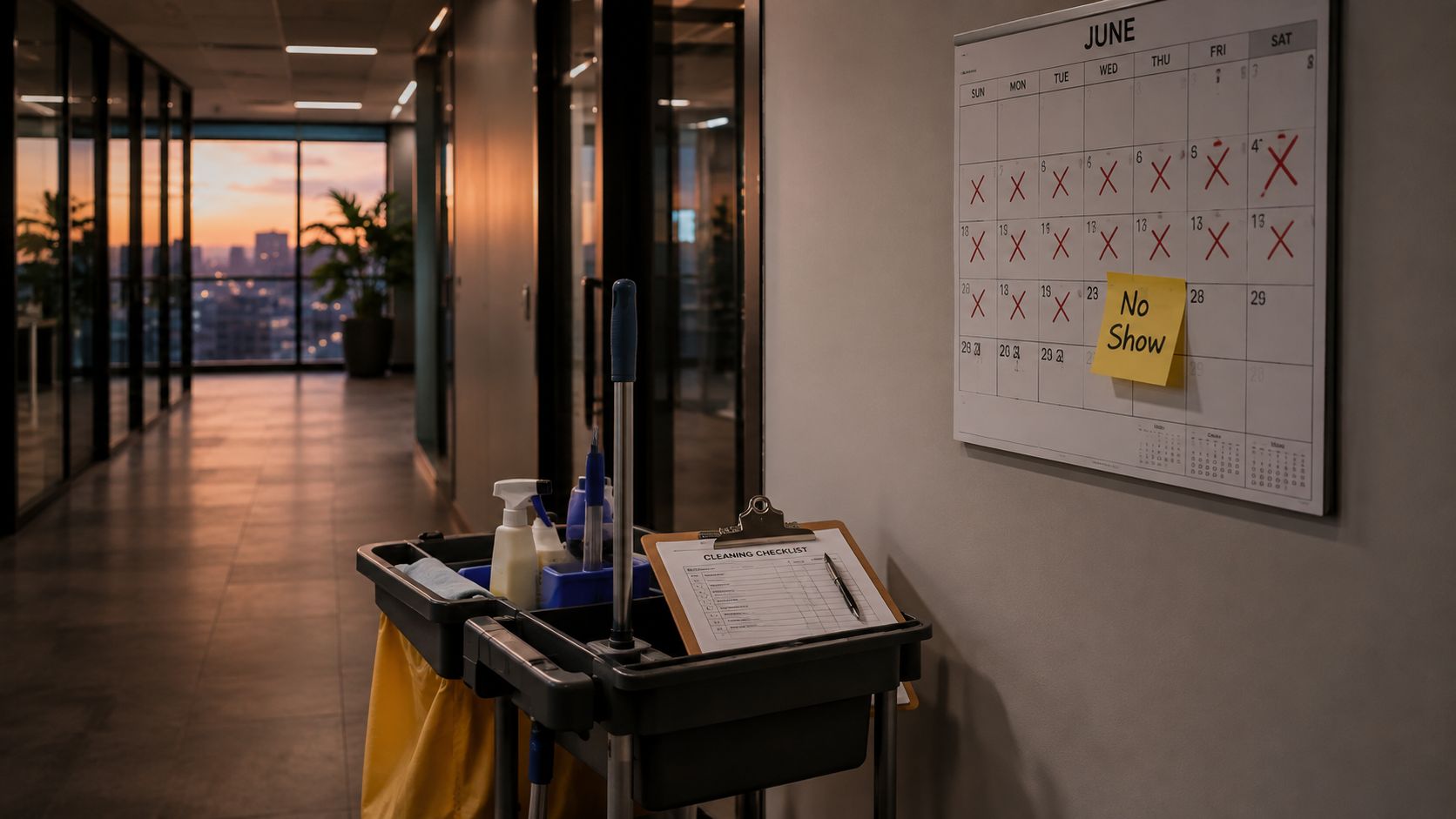
Practical rule: A provider that needs repeated reminders to appear on time is already costing the facility time, not just cleaning quality.
For a cleaner switch decision, ask for:
- Exact service windows. Vague “evening service” language makes accountability weak.
- Advance notice expectations. Schedule changes should be communicated before the missed visit, not after.
- Backup crew protocols. A provider should explain how it covers absences.
- A documented communication trail. Shared calendars or service logs reduce disputes about what happened.
The internal FAQ resource is worth keeping handy when a provider's answers stay vague. If scheduling cannot be trusted, the relationship is already in trouble.
4. Inadequate Disinfection, Health, Safety, and Compliance
A space can look clean and still be unsafe. That's why disinfection, chemical handling, and compliance documentation matter so much in dental clinics, childcare centres, schools, and manufacturing environments. Ontario's Occupational Health and Safety Act has been in force since 1979, and WHMIS was updated in Canada on December 11, 2018, so cleaning vendors handling chemicals need current training and documentation, not outdated habits xiri.ai guide on switching cleaning companies.
The clearest warning sign is a provider that cannot prove how its staff handle products, contact times, SDS sheets, or hazard communication. The Canadian Centre for Occupational Health and Safety notes that commercial and institutional cleaning can involve exposure to disinfectants, detergents, and other hazardous products, which makes training and product control a practical risk issue, not a formality CCOHS on cleaning product exposure.
A dental clinic that sees generic cleaner used on clinical touchpoints, or a childcare centre that notices cleaning chemicals stored unsafely, should treat that as a serious escalation. The same applies when a warehouse crew lacks proper protection around hazardous residues. In each case, the problem is not only service quality, it's liability exposure.
The best test is documentation. Ask for WHMIS certification, Safety Data Sheets, a written disinfection protocol, and proof of insurance before the next renewal. If the provider hesitates, the answer is already informative.
A useful comparison is simple. A strong provider can explain which surfaces get disinfected, which product is used, and how long it must remain wet to work. A weak one relies on general language and assumes the space “looks fine.”
Here's a quick decision framework:
- Ask for training proof. Every assigned cleaner should be covered.
- Request product lists. The facility should know exactly what enters the space.
- Verify site-specific procedures. A clinic, office, and warehouse should not be cleaned the same way.
- Confirm liability coverage. Damage and biohazard issues need a formal response path.
Ontario facilities that demand compliance are not being difficult. They're applying the standard that the site requires. The comparison with a detailed disinfection service model can help frame what a more disciplined protocol looks like.
5. Excessive Turnover of Cleaning Staff and Lack of Crew Consistency
Frequent changes in crew members usually show up in small ways first. One week the conference room is handled carefully, the next week the same surfaces are missed. The next month a new team shows up and seems unfamiliar with access rules, supply storage, or the building's priority areas. That pattern is common in facilities where the provider has weak retention, uneven supervision, or poor training.
Crew consistency matters because regular staff learn the site. They know which rooms need extra attention, which materials scratch easily, and which spaces need to be ready before morning occupancy. A constant rotation of unfamiliar workers keeps resetting that learning curve.
This issue is especially important in clinics, schools, and manufacturing sites, where the procedure matters as much as the appearance. If one team disinfects differently from the next, the client is left guessing about what standard is in place.
The question to ask is straightforward. Does the provider assign a stable team, or does it treat the site like a rotating shift board? The answer usually predicts the service quality over time.
A simple check:
- Track team changes. Note how often the crew changes across a few months.
- Watch detail areas. Conference tables, restroom edges, and break room surfaces reveal familiarity.
- Ask about retention. Providers should be able to talk about continuity.
- Meet the crew. A brief introduction helps set expectations and surfaces gaps early.
The careers page can also be useful context when evaluating whether a provider appears to invest in staffing continuity. Stable service usually starts with stable employment practices.
Crew continuity is not a luxury. It's part of how a provider earns trust with a fixed site.
6. Lack of Transparent Communication and Poor Responsiveness to Issues
Poor communication is often the first sign that a service relationship is drifting out of control. If an account manager doesn't respond, if complaints sit unresolved, or if no one confirms a completed correction, the facility loses the ability to verify what's happening. A Toronto office manager waiting days for a callback, or a dental clinic receiving no confirmation after a service request, should view that as an accountability issue.
Strong cleaning providers use clear contacts, service logs, and a repeatable issue-escalation process. That matters because cleaning is not only about physical labour, it's about follow-through. Without a reliable record, the client ends up relaying the same problem multiple times and still not knowing whether the fix happened.
This is also where documentation becomes a management tool. A simple spreadsheet that records the issue, the date reported, and the reply time can reveal whether the provider is responsive or merely polite during sales conversations. If the problem keeps reappearing and no written resolution follows, the relationship is deteriorating.
A provider that uses a portal or mobile app for logging, photos, and service notes usually has better internal discipline than one that relies on scattered calls and vague promises. That doesn't guarantee quality, but it does make accountability easier to verify.
What to ask before renewal:
- Who is the main contact? There should be a named account manager and backup.
- How are issues logged? A written trail is much safer than memory.
- How quickly are problems addressed? The provider should state its process clearly.
- How are changes confirmed? Every schedule update and scope change should be documented.
For teams focused on workplace coordination, the workplace communication advisory is a useful lens. When communication breaks down, service quality usually follows.
7. Unexplained or Unjustified Price Increases and Hidden Costs
A price increase is not automatically a problem. Cleaning costs can change when scope changes, supplies become more expensive, or the building adds new requirements. The issue is when the provider raises rates without explanation, adds fees mid-contract, or starts charging for things that were presented as included.
That lack of transparency makes budgeting harder and makes market comparison nearly impossible. A Toronto office that receives a higher invoice with no service change, or a dental clinic that sees a new “biohazard cleanup” line item without prior notice, is facing a trust problem as much as a cost problem. In a well-run contract, pricing changes are discussed in advance and tied to specific reasons.
The practical move is to ask for an itemized quote before signing or renewing. The quote should spell out what's included, what's optional, and what triggers extra charges. That level of clarity also helps separate a fair increase from a vague excuse.
A second check is to compare at least two or three quotes annually so the facility can see whether the current pricing still makes sense for the scope delivered. Competitive comparison is not disloyal. It's basic vendor management.
Consider these questions:
- Was the increase explained in writing?
- Did the scope change, or only the invoice?
- Are extra fees listed upfront?
- Can the provider show why the new price is justified?
The internal service areas overview can help when the next provider conversation needs to cover geography, scope, and service fit. If pricing keeps shifting without clarity, the current relationship may no longer be sustainable.
8. Damage to Facility, Equipment, or Furnishings and Lack of Accountability
Damage is one of the clearest reasons to reassess a provider. Scratched floors, stained carpet, broken furnishings, or chemical damage to equipment are not minor service issues when they affect the building's assets and operations. The bigger red flag is denial, delay, or refusal to take responsibility after the fact.
A law firm that finds a stained conference room carpet after floor service, or a manufacturing site that sees corrosion from improper chemicals, needs more than an apology. It needs a documented claims path and proof that the provider carries appropriate liability insurance. Without that, the client is left managing the loss and the process at the same time.
The best practice is to establish baseline condition before service begins. Photos, walkthrough notes, and a signed scope sheet create a reference point if anything goes wrong later. Specialized facilities should also ask for references from similar sites, because a provider that handles standard office surfaces well may still be the wrong fit for delicate equipment or specialty finishes.
A damaged site usually exposes a training gap, a supervision gap, or both. If the provider can't explain what happened and how recurrence will be prevented, the problem is likely systemic.
Practical rule: A careful provider documents condition before cleaning and responds in writing if damage occurs.
Helpful checks include:
- Baseline photos. Record high-value areas before the contract starts.
- Insurance proof. Make sure liability coverage is current and relevant.
- Written incident reporting. Report damage immediately and in writing.
- Responsibility clauses. The agreement should say who covers what.
The terms of service can serve as a reminder that accountability needs to be written, not assumed. The related note on setting expectations for field reps also reinforces why clear ownership matters in the field.
8-Sign Comparison: When to Switch Your Commercial Cleaning Provider
| Issue | Implementation complexity | Resource requirements | Expected outcomes | Ideal use cases | Key advantages |
|---|
| Visible Dirt, Dust, and Debris Accumulation in High-Traffic Areas | Low, increase frequency and QC | Additional staff time, spot-check inspections, basic supplies | Improved appearance, clearer service accountability | Lobbies, hallways, break rooms, classrooms | Easy to detect and document; objective evidence of failure |
| Unpleasant Odors and Poor Air Quality | Moderate, may require HVAC or deep-clean interventions | Deep-cleaning, carpet/upholstery services, HVAC assessment, approved disinfectants | Reduced odors, better air quality, improved comfort | Restrooms, break rooms, carpeted or moisture-prone areas, clinics | Directly impacts health and perception; often measurable |
| Missed or Inconsistent Cleaning Appointments and Unreliable Scheduling | Low-to-moderate, process and scheduling fixes | Scheduling software, backup crews, clear contracts and notifications | Reliable service delivery, fewer sanitation gaps | After-hours cleaning, operations sensitive to timing | Easily documented; strong contractual justification for action |
| Inadequate Disinfection, Health, Safety, and Compliance | High, requires protocols, training, audits | WHMIS/SDS records, PPE, Health Canada–approved products, staff certification | Regulatory compliance, lower infection risk, legal protection | Healthcare, dental, childcare, laboratories | Non-negotiable safety standard; clear regulatory framework |
| Excessive Turnover of Cleaning Staff and Lack of Crew Consistency | Moderate, HR and retention measures | Recruitment, training programs, dedicated crew assignments | Greater continuity, consistent quality, accountability | Facilities needing institutional knowledge or specialized care | Reveals systemic HR issues; trackable over time |
| Lack of Transparent Communication and Poor Responsiveness to Issues | Low-to-moderate, establish protocols and tools | Named contacts, SLAs, mobile app/portal, documented processes | Faster issue resolution, better records, proactive management | Multi-site facilities, client-facing environments | Indicator of operational maturity; easy to monitor |
| Unexplained or Unjustified Price Increases and Hidden Costs | Low, clarify contract and pricing terms | Detailed, itemized quotes, market comparisons, contract clauses | Predictable budgeting, fair pricing, fewer surprises | Long-term contracts, budget-sensitive organizations | Measurable via invoices; grounds for competitive bids |
| Damage to Facility, Equipment, or Furnishings and Lack of Accountability | Moderate, preventive protocols and insurance verification | Liability insurance, pre-service walk-throughs, documented baselines | Reduced risk of damage, clearer claims process, financial protection | Sites with specialty equipment, high-value finishes | Photographic evidence supports claims; signals training gaps |
Making the Switch A Strategic Decision Framework
Switching providers can feel disruptive, but staying with a weak one usually creates a slower, more expensive problem. Missed cleanings, weak communication, compliance gaps, and preventable damage all compound over time, especially in office, clinical, educational, and industrial settings where hygiene and reliability shape day-to-day operations. The decision should be based on evidence, not frustration alone.
A practical framework helps. First, list the red flags that showed up repeatedly, not just once. Then separate appearance issues from risk issues. Dust and dull floors are inconvenient, but weak WHMIS documentation, poor disinfection procedures, or repeated scheduling failures have a more serious operational impact.
The next step is to compare providers on the things that prevent repeat problems. Look for transparent pricing, a clear communication process, documented training, and evidence that the team understands the facility's actual needs. A provider that can't explain its procedures, or can't prove who is responsible for what, is asking the client to carry too much uncertainty.
A simple switching checklist can keep the process grounded:
- Collect evidence. Use photos, service logs, and written complaints.
- Review contract terms. Check notice periods, scope, and insurance requirements.
- Request 2 to 3 quotes. Compare service scope, not just headline price.
- Ask about training and compliance. WHMIS, SDS handling, and site-specific procedures matter.
- Confirm communication channels. Named contacts and response expectations reduce friction.
- Look at continuity. Stable crews and documented quality control usually predict better service.
Ontario facilities face a real trade-off. The cost of changing vendors is visible, but the cost of staying with the wrong one often shows up later as risk, rework, and frustration. WSIB reported that in 2023 Ontario accepted 227,489 claims and 37,719 of those were lost-time injuries, a reminder that preventable workplace hazards carry real consequences for operations and premiums WSIB-related Ontario service-provider guide. That's why a switching decision should be treated as a management step, not an emotional reaction.
For some sites, a provider like Arelli Cleaning may fit the brief if the priority is no-term flexibility, documented communication, and service options that match changing facility needs. The main point remains the same, though. The right choice is the one that can prove consistency, compliance, and accountability on site.
Further Reading
Internal resources
External resources
Arelli Cleaning offers commercial cleaning and office cleaning support in the Greater Toronto Area, with flexible service options that can fit a move away from a provider that's missed the mark. If a facility needs clearer communication, documented processes, and a cleaner way to compare options, it's worth visiting Arelli Cleaning and reviewing the service fit before the next contract decision.








.webp)