Cleanliness has moved from back-of-house discipline to front-of-house business risk. In the GTA, 75% of Canadian restaurant consumers avoid venues with negative cleanliness reviews according to cleaning services market research. For a new owner, that changes the conversation. Restaurant commercial cleaning isn't just about appearance. It protects food safety, inspection readiness, staff safety, and the reputation guests now judge in real time.
Restaurant commercial cleaning means cleaning designed for food-service environments, not general after-hours tidying. It includes sanitising food-contact areas, degreasing kitchens, managing washrooms, reducing slip risks, documenting completed work, and handling specialised tasks such as hood cleaning and deep disinfection. The difference is compliance. A restaurant has to clean for health codes, operational uptime, and public trust at the same time.
Why Spotless is the New Standard in Dining
A dining room can look neat and still fail the essential test. If the floor edges are greasy, the washroom smells off, or the POS terminal feels sticky, guests notice. Staff notice too. Cleanliness shapes how people judge food quality long before the plate arrives.

Restaurant commercial cleaning goes further than standard janitorial work. It focuses on grease, food residue, cross-contamination points, washroom hygiene, and the cleaning of equipment and surfaces that affect service and safety. It also requires procedures staff can repeat during a busy week, not just a big clean before an inspection.
Direct answer: Restaurant commercial cleaning is a structured cleaning program for food-service spaces that combines sanitation, degreasing, safety controls, and documented routines.
For an owner, the practical questions are usually simple. What must staff clean daily. What requires a specialist. How should a schedule be built. What should a service provider prove before being hired. Those are the decisions that keep a restaurant organised instead of reactive.
Navigating Health and Safety Compliance
Ontario restaurants don't get much room for interpretation on sanitation. Compliance with Food Premises Regulation (O. Reg. 493/17) is mandatory, and restaurants that outsource to specialised providers using compliant protocols achieve 28% higher audit pass rates during unannounced health inspections according to industry analysis on commercial cleaning and sanitation services.
The three compliance pressures
The first pressure is food safety. Floors, prep tables, drains, handles, and equipment seams all create cross-contamination risk if cleaning is inconsistent or done in the wrong order.
The second is fire prevention. Grease doesn't stay where staff can see it. It moves into filters, hoods, and ductwork, where it becomes both a hygiene problem and a safety issue.
The third is worker safety. Cleaning chemicals need proper labelling, handling, dilution, and training under WHMIS. A strong program protects both the line cook and the dishwasher, not just the guest.
A restaurant passes inspection through habits, not last-minute scrambling.
Pest control belongs in the same compliance conversation. Cleaning reduces attractants, but it doesn't replace a proper prevention plan. For owners reviewing sanitation risk across the full kitchen, guidance on professional restaurant pest management in Crown Point is a useful companion resource because pests and cleaning failures often show up together during inspections.
For higher-risk touchpoints and outbreak response planning, a documented commercial disinfection and sanitising program helps connect routine cleaning with verification, chemical safety, and response procedures.
What inspectors and operators both care about
A practical compliance routine usually includes:
- Cleanable surfaces: Equipment has to be cleaned often enough that residue doesn't build up in seams, undersides, and edges.
- Sanitising sequence: Cleaning removes soil first. Sanitising comes after. Reversing that order wastes product and leaves risk behind.
- Written logs: If a task matters, it should be recorded. Logs create accountability during shift changes and manager absences.
- Shared responsibility: Staff can own routine cleaning, but management has to verify it.
The Complete Restaurant Cleaning Checklist
A restaurant stays clean when the schedule matches the pace of service. Daily tasks should be short and essential. Weekly tasks should target buildup. Monthly and quarterly work should tackle what staff can't safely or realistically handle between lunch and dinner rushes.

Daily tasks
Front of house and back of house need different standards, but both need consistency.
- Dining surfaces: Wipe and sanitise tables, chair backs, host stand surfaces, condiment containers, and payment devices.
- Touchpoints: Clean door handles, washroom latches, light switches, faucet handles, and POS screens on a set schedule.
- Floors: Spot mop spills immediately. End-of-day floor cleaning should include corners, under mats, and transitions between kitchen and service areas.
- Washrooms: Refill soap and paper, disinfect fixtures, check odour control, and clean around the base of toilets and sinks.
- Food-contact areas: Clean and sanitise prep counters, slicers, cutting boards, smallwares, and handles on reach-ins.
- Waste control: Empty bins, sanitise bin lids and surrounding floor area, and check exterior waste staging for leaks or residue.
A supply system matters here. When cloths, dilution bottles, gloves, and food-safe chemicals are scattered or substituted, cleaning quality drops fast. A standardised approach to commercial cleaning supplies for specialty cleaning needs makes routines easier to train and easier to repeat.
Weekly tasks
Weekly work should focus on what daily wipe-downs miss.
- De-lime beverage equipment: Coffee machines, kettles, and related components accumulate mineral buildup that affects both hygiene and performance.
- Move light equipment: Clean behind fryers where safe, under prep stations, beside coolers, and around casters.
- Detail floor drains: Remove debris, scrub covers, and address odours before they become a recurring complaint.
- Wash lower walls and splash zones: Grease mist and splatter usually collect where staff stop looking.
- Clean shelving: Dry storage and walk-in shelving should be wiped, organised, and checked for spills or expired product.
Practical rule: If a surface is touched every shift but only cleaned weekly, the schedule is too light.
Monthly and quarterly work
Many restaurants fall behind in this area because the tasks are awkward, technical, or disruptive.
- Deep clean walk-ins and freezers: Empty sections, clean gaskets, shelving, fan guards, and floor edges.
- High dusting: Remove dust from vents, pipe runs, ledges, and high shelving where debris can migrate downward.
- Machine detailing: Clean under and inside equipment panels where residue affects airflow or creates odour.
- Tile and grout restoration: Treat stained grout and greasy floor lines before they become permanent.
- Hood, duct, and exhaust servicing: Coordinate specialist work based on kitchen output and risk.
A checklist works best when each task names the area, frequency, product type, responsible role, and sign-off requirement. That turns cleaning from a vague expectation into an operating system.
Specialized Services for Critical Areas
Some restaurant cleaning jobs shouldn't be assigned to staff with a mop and a spare half hour. They need training, access equipment, chemical control, or technical verification.
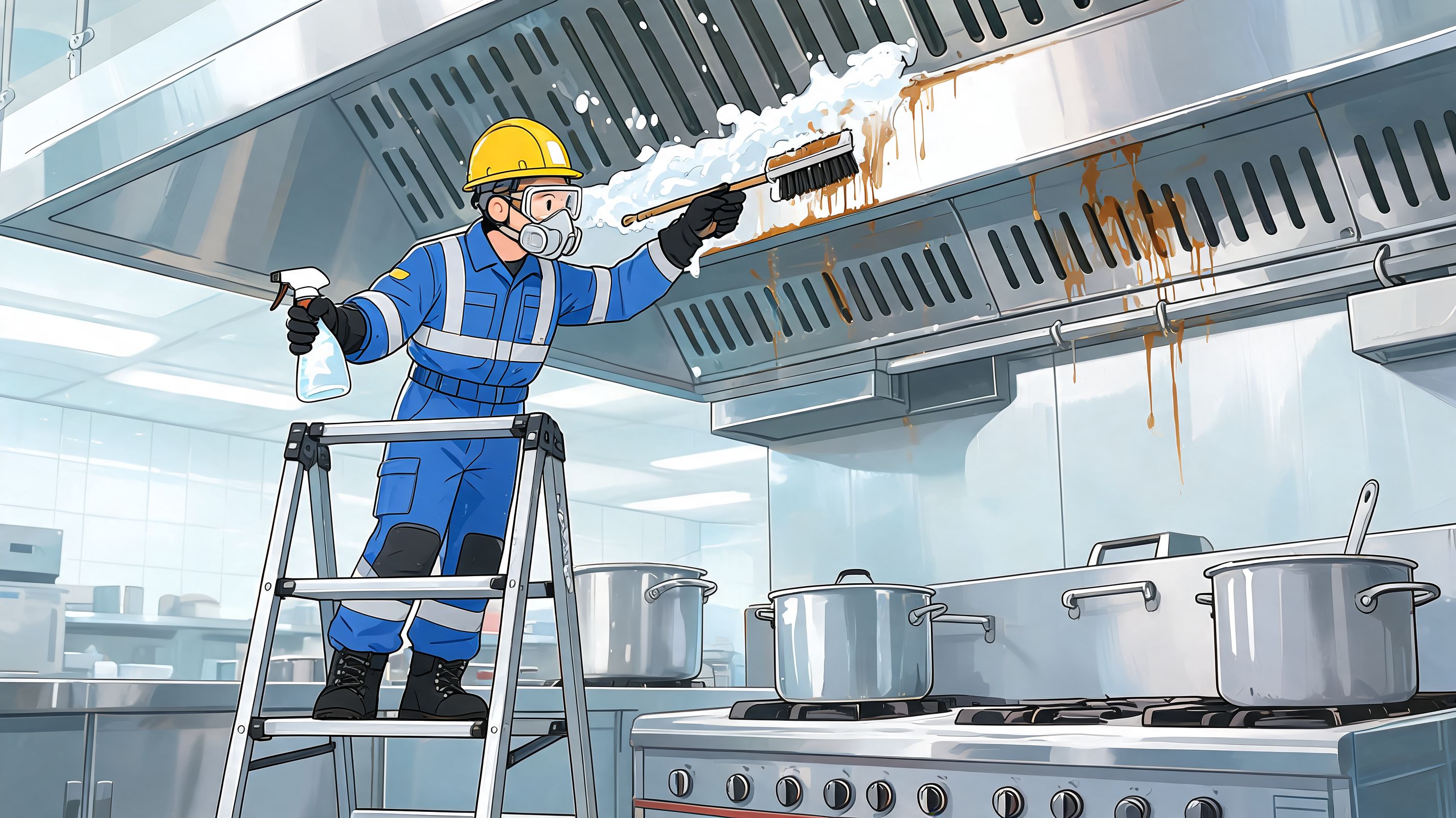
Hoods, ducts, and exhaust systems
Kitchen exhaust cleaning is one of the clearest examples. Prioritising Clean-In-Place (CIP) systems for kitchen hoods can cut grease buildup by 65%, helping reduce fire risk that affects 1 in 5 Canadian restaurants annually, as noted in the earlier industry analysis. That matters because visible hood surfaces are only part of the problem. Fire risk lives deeper in the system.
Grease traps, drains, and hidden buildup
Grease traps and floor drains don't create many customer complaints until they create a major one. Overflow, odour, slow drainage, and pest attraction often start with poor maintenance in hard-to-reach places. These areas need scheduled servicing, not reactive cleaning after a backup.
Specialist disinfection can also be necessary after contamination events, renovations, flooding, or illness-related incidents. In those cases, a defined deep disinfection process for commercial facilities helps separate routine sanitising from true restoration work.
This short video gives useful visual context for the kind of hood cleaning conditions many operators underestimate:
Air quality and pest-linked cleaning
HVAC grilles, ceiling vents, and returns collect grease-laden dust in kitchens and fine dust in dining areas. If left alone, they affect odour, surface fallout, and overall indoor cleanliness.
Integrated pest management also depends on cleaning discipline. Crumbs under shelving, syrup around stations, and unclean drain areas create conditions a pest contractor has to fight around. Specialist service is often worth the cost because it prevents closures, emergency callouts, and insurance headaches that cost more than routine upkeep.
How to Choose a Commercial Cleaning Partner
Hiring a cleaning provider for a restaurant isn't the same as hiring basic office cleaning. Food service needs verification, clear scope, and a crew that understands risk points. The most useful question isn't “Can they clean?” It's “Can they prove what was cleaned, how it was cleaned, and whether the result met a standard?”
Facilities using digital proof-of-clean apps show a 22% revenue uplift, and those systems achieve 95% user satisfaction versus 67% for manual methods according to cleaning services market research. When owners vet providers, they should ask how service is verified and how the team works toward ATP swab readings below 10 RLU.
What to ask before signing
- Food-service experience: Ask how the company separates restaurant sanitation from standard janitorial routines.
- Training and safety: Confirm WHMIS training, incident reporting, and chemical handling procedures.
- Verification: Ask for photo logs, supervisor checks, or other proof that tasks were completed.
- Scope clarity: Require a written list of daily, weekly, and periodic tasks by area.
- Escalation process: Find out who responds if a washroom issue, spill event, or inspection concern appears outside normal hours.
For operators who also maintain countertop appliances and smaller kitchen tools in-house, practical maintenance habits matter too. Advice on Lumehra's gentle air fryer solutions is a good example of the kind of low-abrasion cleaning approach that helps protect equipment finishes while keeping food-contact areas manageable.
Evaluating Commercial Cleaning Providers
| Feature | Basic Service | Professional Partner (e.g., Arelli Cleaning) |
|---|
| Scope of work | General visible cleaning | Detailed restaurant-specific scope with task frequencies |
| Verification | Paper checklist or verbal confirmation | Digital proof-of-clean, photos, supervisor review |
| Food safety approach | Surface appearance focused | Cleaning and sanitising sequence tied to risk areas |
| Quality control | Irregular spot checks | Routine QA process with documented follow-up |
| Flexibility | Fixed routine with limited adaptation | Service plan adjusted to traffic, events, and seasonality |
| Communication | Standard business hours | Faster support pathways and clearer accountability |
| Documentation | Minimal | Useful records for managers and audits |
A provider should also explain how contract terms work, how deficiencies are corrected, and how missed tasks are documented. The company story matters less than the operating discipline behind it, though some owners still review a provider's background through pages such as the company overview for Arelli Cleaning to understand service philosophy and support structure.
A good cleaning contract defines outcomes, not just visits.
Frequently Asked Questions About Restaurant Cleaning
What does professional restaurant cleaning usually cost in Toronto
Thorough restaurant cleaning in the Toronto area typically follows a per-square-foot model, with benchmark pricing of $2.50 to $4.00 per square foot, depending on scope and frequency, based on the earlier industry benchmark.
Can restaurant staff handle all cleaning tasks
No. Staff can manage routine daily and some weekly tasks, but specialist work such as hood systems, certain deep disinfection jobs, and difficult high-access cleaning usually needs trained professionals.
What should be in a service agreement
The agreement should list task frequency, areas covered, excluded work, reporting steps, supply responsibilities, and how quality issues are corrected.
How often should a kitchen hood be professionally cleaned
The correct interval depends on cooking volume, grease production, and fire risk. High-grease operations need closer attention than lighter-use kitchens.
What is ATP testing in simple terms
ATP testing is a quick way to check whether organic residue remains on a surface after cleaning. It helps verify cleaning quality instead of relying only on appearance.
What's the biggest hiring mistake owners make
Choosing on price alone. A low quote with vague scope, weak documentation, and no verification often costs more once rework and compliance issues appear.
Further Reading and Resources
Useful internal pages for operators comparing providers and planning coverage include the Arelli Cleaning service areas page. Additional internal reading can include service pages on disinfection, deep cleaning, and supplies already referenced above.
For broader operational reading, external resources already cited in this guide include the commercial cleaning market research linked earlier and the pest-management resource referenced in the compliance section. Those are most useful when reviewed alongside a restaurant's own written cleaning schedule, chemical list, and inspection logs.
Restaurant owners who want a cleaner, more defensible operation should use the checklist above, get 2 to 3 quotes, and compare providers on scope, verification, and response standards instead of price alone. For businesses in the GTA that want another option in that process, Arelli Cleaning can be reviewed alongside other commercial cleaning partners.








.webp)