Eco-friendly cleaning products stopped being a side initiative once procurement, compliance, and occupant expectations started pulling in the same direction. The global market was valued at USD 13.2 billion in 2025 and is projected to reach USD 14.3 billion in 2026, according to GM Insights on the eco-friendly cleaning products market. For a facility manager, that matters because scale changes supply, certification depth, and buyer scrutiny.
The practical question isn't whether a building should “go green.” The practical question is whether the organisation can switch to eco-friendly cleaning products without losing cleaning performance, creating WHMIS confusion, or raising labour costs. That makes this a management project, not a simple product swap.
Key takeaways
- Eco-friendly cleaning products are now mainstream procurement items, not niche alternatives.
- Certified products matter more than marketing claims because compliance, safety, and efficacy are separate issues.
- The right comparison is total cost of use, not shelf price.
- Training and dilution control decide results as much as product chemistry does.
- Ongoing measurement is necessary because “green” doesn't automatically mean safe, effective, or economical.
The Business Case for Eco-Friendly Cleaning in 2026
Commercial purchasing has already shifted. By 2026, eco-friendly cleaning products are established procurement categories, and that changes what suppliers carry, what health and safety teams will approve, and what building occupants expect from facility operations.
For a facility director, the business case is broader than product substitution. It includes chemical approvals, dispenser compatibility, staff training, waste handling, audit readiness, and service quality across the full building portfolio. In Canadian facilities, the switch works best when it is treated as a managed rollout with clear standards and performance checks.
Why this shifted from housekeeping choice to management priority
Three pressures usually drive the decision.
First, procurement and compliance requirements have tightened. Public sector buyers, larger employers, and multi-site operators are under more scrutiny on chemical use, documentation, and sustainability reporting. Teams that delay the review often end up making rushed purchases after a tenant complaint, an internal ESG request, or a policy change from head office.
Second, occupant expectations are different now. People notice odour, residue, and irritation quickly, especially in offices, schools, clinics, and shared commercial buildings. Once those complaints start, they do not stay with the janitorial team. They move to HR, operations, tenant relations, and sometimes legal or risk management.
Third, cleaning is now tied more directly to brand trust and workplace confidence. During return-to-office planning, many managers learned that visible cleaning standards influence whether staff and visitors believe the site is being run properly. Arelli's office cleaning expectations during Ontario reopening remains a useful reference for that operational reality.
What a credible business case actually includes
A weak proposal focuses on shelf price. A credible one looks at cost of use and risk reduction over the full program life.
That means asking practical questions:
- Will the product meet required cleaning outcomes on the soils your teams face?
- Does it work with existing dilution systems, bottles, labels, and storage controls?
- Will supervisors need extra training time to avoid misuse or overapplication?
- Can the site maintain WHMIS documentation and safe handling procedures without creating confusion?
- Will the switch reduce complaints, rework, or chemical exposure concerns enough to justify the change?
Often, junior buyers get pushed off course. A cheaper conventional product can still cost more if it increases re-cleaning time, creates stronger odour complaints, or forces you to carry more SKUs because one product cannot handle multiple use cases. A certified eco-friendly option can also disappoint if it requires unrealistic dwell times or fails on high-soil areas. The point is not to buy the greenest label. The point is to choose products that hold up operationally and fit the site standard.
Where ROI usually shows up
In practice, return on investment tends to appear in four places:
- Lower compliance friction, especially when product records, safety documentation, and purchasing standards are easier to defend during internal review.
- Lower complaint volume from occupants who react to strong fragrances, lingering residues, or inconsistent cleaning outcomes.
- Better standardization across sites when teams can reduce SKU sprawl and align training around a smaller, controlled product set.
- Stronger alignment with broader sustainability spending, including projects such as efficient loading dock solutions by Wilcox.
The trade-off is straightforward. The switch usually requires more upfront work in testing, procurement review, and staff training. Done properly, it gives the facility team tighter control over compliance, service consistency, and total operating cost.
Decoding Green Certifications and Canadian Regulations
A procurement file for green cleaning fails in predictable places. The team accepts a vague environmental claim, skips a proper SDS review, or assumes a certification settles the performance question. In Canadian facilities, those shortcuts create risk at three points at once. Regulatory review, worker safety, and service consistency.
An eco claim on a label does not help much on its own. Facility directors need to separate marketing language from evidence that a product has been assessed against defined criteria for ingredients, toxicity, biodegradation, packaging, and directions for use. Certification helps with that first screen, but it does not replace site-level review.

What certifications actually do in a Canadian buying process
Treat certification as a procurement filter, not a final approval stamp. It helps reduce the number of products worth testing and gives your team a documented reason for shortlisting one formulation over another. That matters when purchasing, health and safety, and operations all want different answers from the same product file.
In practice, I look for three things:
- A recognised third-party certification that applies to commercial cleaning products, not a supplier-created badge or broad sustainability statement.
- Canadian regulatory fit, including compliant labelling, an accessible SDS, and handling instructions that align with WHMIS requirements in the workplace.
- Use instructions that match the task, because a product that works for daily hard-surface cleaning may be a poor fit for washroom scale, grease, or infection-control protocols.
That last point is where junior buyers get caught. A certified product can still fail operationally if the chemistry is wrong for the soil load, the dwell time is unrealistic, or the dilution method depends on staff behaviour you cannot control across shifts.
The Canadian compliance lens
Canadian buyers need to review more than the environmental claim. They need to confirm how the product will be stored, mixed, labelled, transported inside the facility, and used by staff under WHMIS rules. If the supplier cannot provide current documentation or clear use instructions, the product is not ready for rollout, no matter how strong the marketing copy sounds.
This is also where the project becomes broader than a product swap. Facility teams usually need alignment across procurement, EHS, operations, and training. A product that looks acceptable in a catalogue can still create problems if dispensing equipment is inconsistent between sites, bilingual labelling is incomplete, or supervisors cannot coach correct dilution and contact time.
Greenwashing usually shows up in the paperwork
Greenwashing is usually easy to spot once procurement asks technical questions instead of brand questions.
Watch for these red flags:
- Vague claims such as "eco-safe" or "natural" without a named standard or certification body.
- Missing or outdated SDS documents.
- Unclear dilution and dwell-time instructions, especially for commercial cleaning tasks.
- No explanation of task fit, such as whether the product is intended for neutral floor cleaning, descaling, degreasing, or disinfecting.
- Strong emphasis on fragrance or packaging, with weak answers on PPE, residue, soil removal, or compatibility with existing dispensing systems.
A disciplined review process prevents expensive mistakes. Confirm the certification claim. Review the SDS and label. Check whether the chemistry matches the job. Then test the product under actual building conditions with your staff, tools, and soil loads.
For teams building standards across multiple sites, Arelli's commercial cleaning blog library is useful for reviewing cleaning requirements by environment and task category.
A product is only suitable for commercial use when it clears all three tests. Environmental screening, Canadian compliance, and day-to-day performance.
How to Evaluate Product Efficacy and Total Cost
A green product line that misses soil, leaves residue, or slows a shift is a failed procurement decision, even if the label checks every environmental box. Facility directors need a use-case review, not a catalogue review. In practice, that means testing cleaning performance, dilution control, labour impact, dispenser fit, documentation, and replacement frequency before approving a broader rollout across Canadian sites.
Unit price belongs on the spreadsheet, but it should not drive the decision. Total cost of use is what matters. Measure the product at its working dilution, the number of refills required per month, the time needed to complete each task, the rate of rework, and any effect on inventory space, training time, and incident risk. A concentrated product can lower freight, storage, and packaging volume, but only if the site can control mixing and staff can follow contact time and task-specific instructions.
I usually tell junior managers to separate cost into three buckets. Chemical spend, labour spend, and failure cost. Failure cost is the one teams miss. It shows up as repeat cleaning, customer complaints, damaged finishes, slips from residue, staff irritation, or a supervisor stepping in to fix avoidable errors.
For sites standardizing supplies across multiple buildings, the best starting point is a controlled list of commercial cleaning supplies for facility operations matched to task category, dispensing method, and surface type.
Cost analysis table
| Cost Factor | Conventional Cleaner | Concentrated Eco-Cleaner |
|---|
| Purchase view | Often appears simpler to compare on shelf price | May look more expensive per container |
| Dilution impact | Ready-to-use or inconsistently mixed products can drive waste | Concentration can reduce use volume when dilution is controlled |
| Storage footprint | More containers may be needed for equivalent output | Concentrates can reduce storage pressure |
| Labour effect | Familiarity may shorten training at first | Good systems reduce rework if staff follow dwell and dilution instructions |
| Compliance burden | Can involve stronger odours or harsher handling profiles | Still requires SDS review and WHMIS control |
| Rework risk | Underperformance or residue can mean repeat cleaning | Bad mixing can erase all savings |
| Procurement result | Lower apparent entry cost | Better value when matched to the right task and dispenser control |
A practical pilot checklist
A pilot should answer one question. Does the product work in this building, with this staff group, on these soils, under normal shift conditions?
Use a limited test area with typical traffic, realistic soil load, and the same tools staff use every day. Do not let a supplier demo stand in for an operating trial. A quiet corridor cleaned by a sales rep proves very little.
- Pick representative spaces such as washrooms, break rooms, reception areas, and one harder-use zone.
- Test by soil type rather than by room name. Grease, soap residue, tracked soil, fingerprints, and body-contact residue behave differently.
- Measure labour reality by noting whether staff need extra passes, extra rinsing, or secondary products.
- Watch finish and residue on glass, floors, touchpoints, stainless steel, and sealed surfaces.
- Check dilution discipline because an excellent product fails quickly if staff mix by guesswork.
- Review occupant response for odour, irritation, and perceived cleanliness.
Add a basic scorecard. Rate each trial on soil removal, appearance after drying, time to complete, refill frequency, staff acceptance, and any safety or compatibility issue. If a product only works with perfect technique, budget for stronger supervision and retraining before calling it a savings opportunity.
What to ask a supplier
Strong procurement questions sound like site operations questions.
- What dilution range is approved for this task
- What dwell time is required
- What surfaces should be avoided
- What soils is the product designed to remove
- What training material is included for frontline staff
- How is dispensing controlled and documented
- What WHMIS documentation accompanies the rollout
Add two more questions during the review. Ask what happens when the product is over-diluted or under-diluted, and ask how performance changes in hard-water conditions. Those answers matter in multi-site Canadian operations, where building age, water quality, and staffing consistency vary more than procurement teams expect.
Sticker price is the easiest number to compare and often the least useful one.
A Framework for Procurement and Implementation
A phased rollout usually outperforms a full conversion. In multi-site facilities, trying to replace every cleaner, dispenser, training sheet, and storage practice at once creates avoidable confusion, stock write-offs, and inconsistent results between buildings.
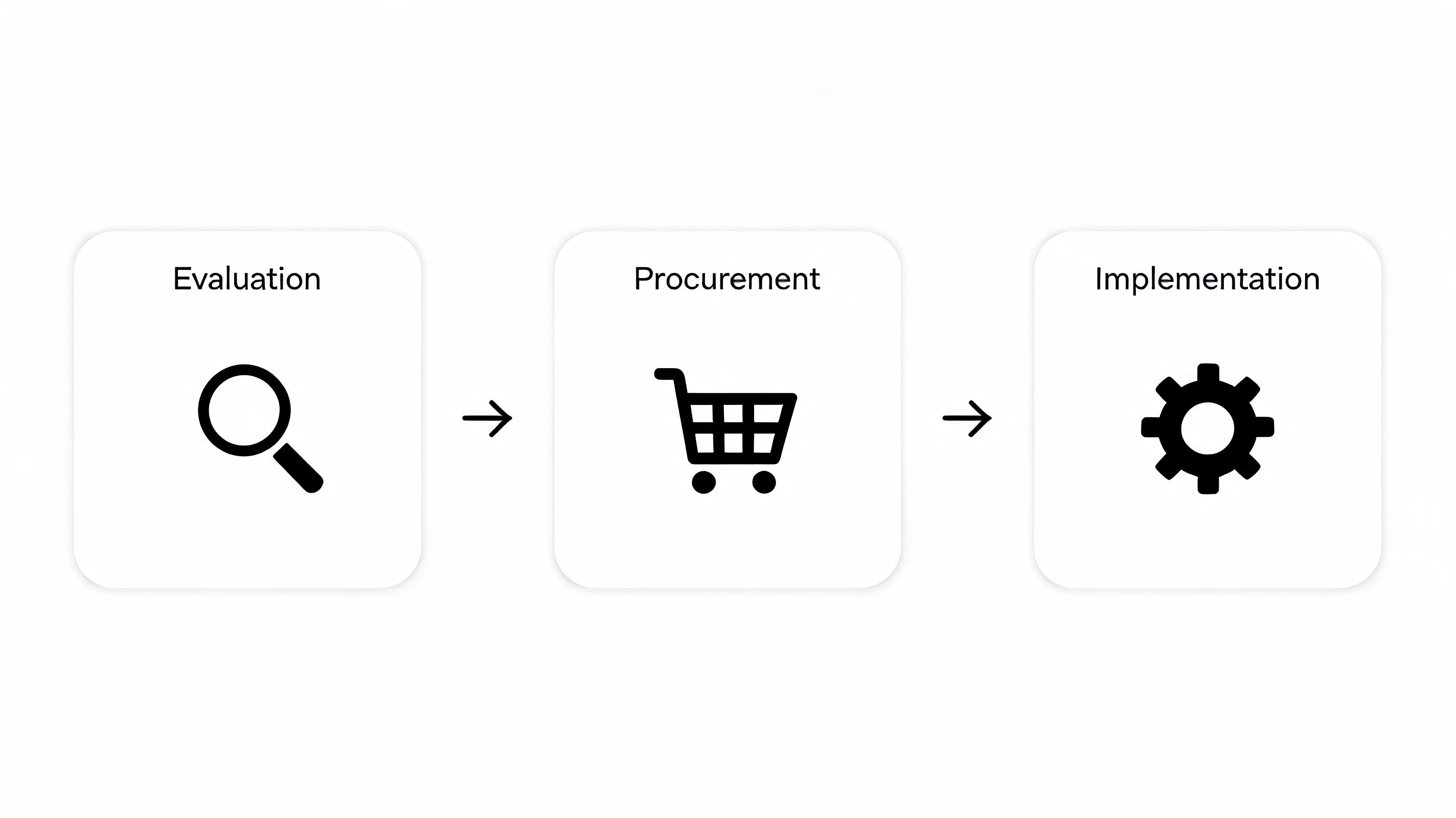
Treat the switch as an operations project, not a product order. Facility directors in Canada have to line up procurement rules, WHMIS documentation, site-level training, bilingual labelling where required, inventory controls, and performance follow-up. If one part slips, the whole programme costs more than it should.
Phase one with a controlled pilot
Start small enough to measure properly. A short list is usually enough: one general-purpose cleaner, one washroom cleaner, one glass cleaner, one neutral floor cleaner, and one disinfecting product that fits your infection-control requirements.
Run the pilot in buildings that reflect real operating conditions. Pick at least one site with heavier traffic, one with older finishes or harder water, and one with a stable team that follows process well. That mix gives procurement and operations a clearer read on whether a product works across the portfolio or only under ideal conditions.
Assign roles before the trial starts. Procurement collects specifications, SDS documents, and contract terms. Supervisors watch dilution, dwell time, and refill habits on shift. Health and safety reviews handling requirements. Frontline staff report where the product saves time, where it slows them down, and where it leaves residue or misses a common soil.
Occupants do not need a sustainability message. They notice whether washrooms smell cleaner, glass dries clear, and touchpoints stay presentable through the day.
Phase two with procurement discipline
Once a pilot performs consistently, lock the system down. Standardisation is what turns a good trial into a repeatable result with controlled labour and supply costs.
Each approved product needs a defined task, approved dilution range, storage point, dispenser method, and reorder trigger. Without that level of control, sites drift back into duplicate SKUs, partial bottles with unclear labels, and staff choosing chemistry by habit instead of by task.
Use a simple implementation checklist:
- One approved product for each routine task where practical
- Posted mixing instructions at janitorial sinks and dispensing stations
- Updated item codes and par levels in the purchasing system
- A timed phase-out plan for legacy stock so old and new systems do not overlap for months
- Site inspections during the first 30 to 60 days to catch misuse early
For facilities that want outside support, some managers use providers that combine supply access with rollout support and staff standardisation. Arelli Cleaning's commercial cleaning supplies support shows the type of coordinated sourcing model that can reduce SKU sprawl and simplify implementation.
Budget for conversion costs up front. Dispensing equipment, relabelling, trainer time, supervisor audits, and disposal of obsolete stock all affect first-year ROI. Those costs are manageable, but they need to be counted or the business case will look better on paper than it does in operations.
Phase three with training and vendor accountability
Training determines whether the switch holds after launch month. Staff need direct instruction on what changed, what stayed the same, and where the new products have tighter tolerances for dilution, dwell time, or surface compatibility.
This embedded overview is useful when discussing operational rollout with internal teams:
Keep the training practical. Show the product at the point of use. Demonstrate the dispenser. Confirm the correct cloth, mop head, or applicator. Then test understanding on shift, because classroom sign-off alone does not prove the process will stick on evenings, weekends, or relief coverage.
Vendor management matters too. If you outsource cleaning or use distributor-led training, set written expectations for site support, corrective action, and product substitution approval. A green programme loses credibility fast when a vendor swaps in an unapproved item during a stock shortage and nobody updates the documentation.
Questions for an external cleaning vendor should stay operational:
- Which certified product categories are approved for this site
- How are dilution errors prevented and documented
- How are new hires trained on WHMIS, SDS access, and task instructions
- How are service complaints logged, investigated, and closed
- Who approves substitutions when a product is unavailable
- What support is provided if performance drops at one building but not another
Procurement succeeds when the building can repeat the result without the original project team standing beside every cleaner.
Ensuring Safety, Compliance, and Performance
A cleaning programme succeeds or fails on daily control, not on the label alone. Eco-friendly products still need the same discipline facility teams apply to any chemical system. Storage, labelling, SDS access, worker instruction, and task-specific PPE all remain part of the operating standard.
Problems usually show up in ordinary places. A spray bottle gets refilled without a label. A dispenser drifts off ratio and no one catches it for weeks. Relief staff use the right product on the wrong surface because the task card was written for the old lineup. Those are management failures, not product failures.
Home-style DIY approaches also create risk in commercial settings. They are hard to standardise, hard to document, and difficult to defend during an inspection or incident review. In a multi-site Canadian operation, the safer approach is a controlled product list, documented dilution methods, and site-level verification that the process is being followed.
Safety controls that still apply
For most facilities, the baseline controls are straightforward:
- Current SDS records that staff can access quickly on every shift
- Clear secondary container labelling for transferred or diluted products
- WHMIS refreshers tied to the actual chemicals and tasks used on site
- Segregated storage for incompatible materials
- Routine checks on dispensing equipment so concentration stays within spec
- Documented escalation steps when a product, dispenser, or label is missing
Disinfection planning also needs to sit beside green procurement, not outside it. Sites with higher-touch environments, outbreak protocols, or regulated sanitation requirements should align their cleaning standard with a documented commercial disinfection and sanitizing plan. Treat that as one operating system, not two separate conversations.
Indoor air quality belongs in the same review cycle. Cleaning chemistry, ventilation, and housekeeping standards affect the occupant experience together, especially in sealed office buildings, schools, and mixed-use properties. For a useful external reference, review insights on OSHA air quality from Purified and then map the implications to your own Canadian compliance and building operations context.
What performance should be measured
If you cannot measure it, you cannot defend the switch at budget time. Product cost matters, but operating results matter more.
Use a short KPI set that supervisors can review without building a separate reporting burden:
- Occupant complaints about odour, irritation, residue, or slipperiness
- Chemical consumption trends by building, floor, or task type
- Rework frequency after washrooms, touchpoints, floors, and food-service areas
- Exposure or handling incidents involving spills, mixing errors, or missing PPE
- Audit scores for labels, SDS access, dilution stations, and storage rooms
- Training compliance for new hires, refreshers, and contractor staff
Review monthly during rollout. Once the programme is stable, a quarterly governance check is usually enough, provided site inspections continue and exceptions are logged.
The practical test is simple. The building should stay clean, the staff should work safely, and the process should hold up when the original project team is no longer on the floor.
Frequently Asked Questions and Further Reading
FAQ
What counts as an eco-friendly cleaning product in a commercial building
A commercial product should be assessed for environmental profile, worker safety, and task performance. In practice, that means looking for recognised certification support, reviewing SDS documents, and checking whether the product is suitable for the actual soils and surfaces in the building.
Are eco-friendly cleaning products strong enough for offices and industrial spaces
Some are, and some aren't. The category shouldn't be judged by retail products or DIY mixtures. Commercially certified products can perform well, but they must be matched to the task, diluted correctly, and tested in the actual facility.
Do green products replace disinfectants
Not always. Cleaning and disinfecting are different functions. Facilities with healthcare, childcare, high-touch public use, or outbreak-response requirements still need a clear disinfection plan.
Is the switch always cheaper
Not at container level. It can become more economical when concentration, dosing, storage, and rework are managed properly. If staff over-dilute or under-dilute, the financial case weakens quickly.
How should a manager handle staff resistance
Start with task clarity. Show which product replaces which legacy product, where it is used, and how it is mixed. Resistance usually drops when staff stop guessing and stop being asked to clean difficult soils with the wrong chemistry.
Can a facility use homemade alternatives to save money
That may work in a household for limited tasks, but it is not a reliable commercial strategy. Workplace cleaning needs consistency, documented handling practices, and performance on commercial soils.
What should be reviewed during vendor or supplier selection
Ask for certification information, SDS documents, dilution instructions, use-case guidance, and a pilot process. Then verify whether the proposed system is realistic for the building's staffing and supervision model.
Further reading
Internal resources
External resources
A facility team planning a switch to eco-friendly cleaning products should use a written checklist, run a pilot, and get two or three quotes before changing the full programme. Arelli Cleaning is one option for organisations that want help with commercial cleaning, supply coordination, and implementation support in the GTA.








.webp)