A business usually starts looking at a pressure washer for business after the same pattern repeats a few times. The front walk looks tired again. Delivery areas hold grease and tyre marks. The building still feels well-run inside, but the exterior no longer matches that standard. At that point, the question isn't just what machine to buy. A more fundamental question is whether buying a machine is even the right move.
That decision matters more than many teams expect. A pressure washer can be a productive asset, a maintenance headache, or a compliance risk, depending on how well it matches the work. For offices, warehouses, clinics, schools, and industrial sites, the smart choice usually comes from looking at full lifecycle cost, operator skill, and site conditions rather than headline PSI alone.
Table of Contents
Further ReadingKey Takeaways
A pressure washer for business earns its keep only when it matches the work, the labour plan, and the expected service life. The right machine cuts cleaning hours and protects surfaces. The wrong one ties up capital, creates downtime, or pushes jobs back to outside contractors.
- Choose based on the work mix, not the headline spec. Sidewalks, loading docks, grease areas, building exteriors, and post-construction cleanup put different demands on pressure, flow, heat, and run time.
- Treat the purchase like an asset decision. Upfront price matters, but labour savings, maintenance hours, repair frequency, fuel or power use, and operator time usually decide the actual return.
- Flow rate matters because it drives productivity. Buyers who focus only on PSI often end up with a machine that hits hard but cleans too slowly for commercial schedules.
- Compliance affects cost. Wastewater control, detergent handling, emissions, noise, and training all influence liability, job planning, and where the machine can be used.
- Build quality shows up later in ownership. Pump design, engine or motor quality, hose and reel durability, and local parts support have a direct effect on downtime and lifecycle cost.
- Buy, rent, or hire based on utilization. Frequent recurring work often supports ownership. Seasonal or occasional jobs may justify rental. Specialized, high-risk, or labour-heavy work can be cheaper to outsource, especially for sites that also need related support such as warehouse cleaning services for industrial facilities.
- The business case includes revenue, not just cleaning. For contractors adding exterior washing, the decision also depends on how reliably the company can win and retain accounts. Polaris Marketing business growth tips are useful if client acquisition is part of the plan.
Why Your Business Needs a Commercial Pressure Washer
A facility rarely gets judged only by its reception area. Clients, staff, inspectors, tenants, and visitors see the approach to the building first. They notice stained sidewalks, loading bays, dumpster pads, algae on concrete, and grime on lower wall sections long before they notice polished floors inside.
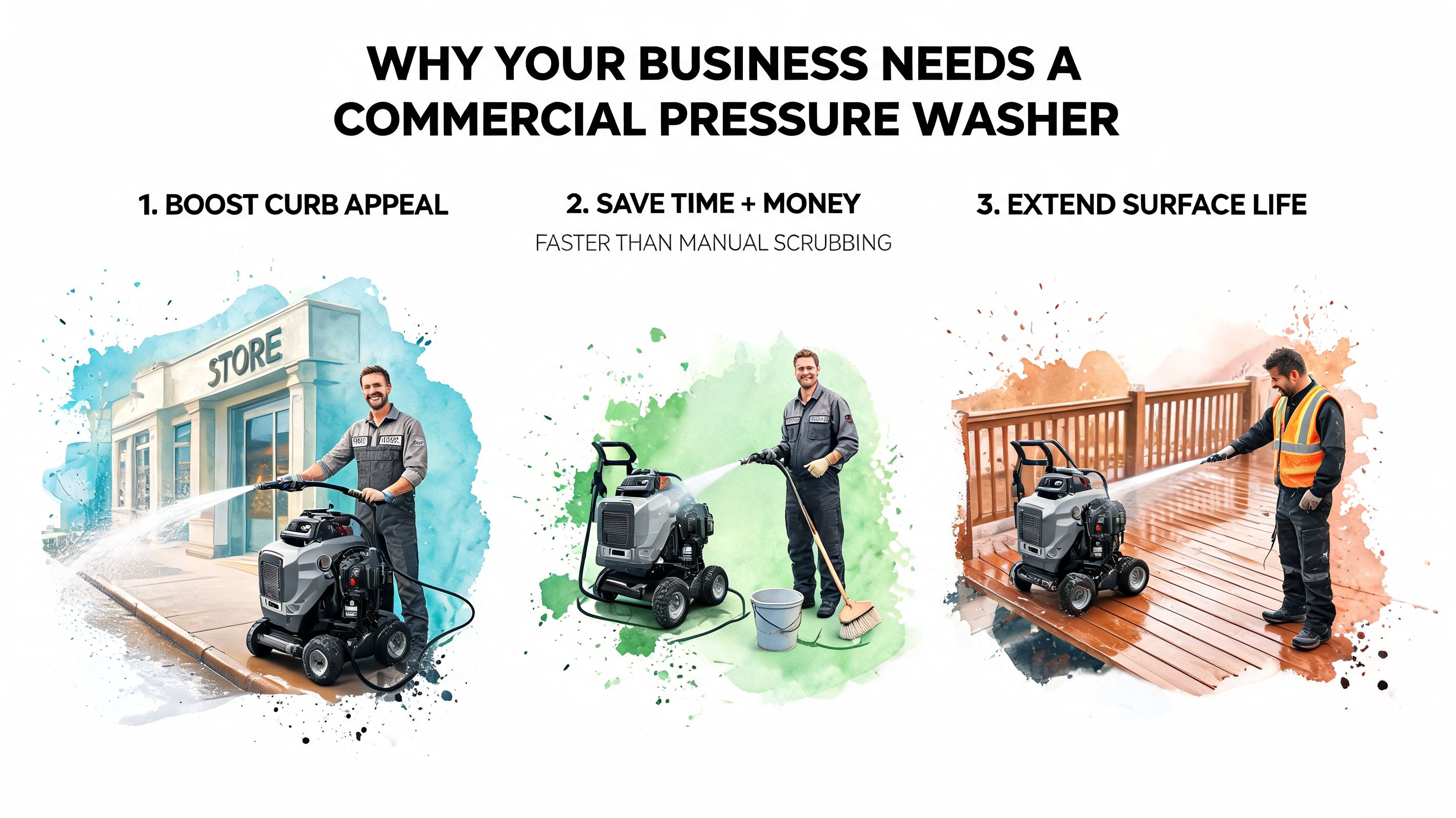
In Ontario, this isn't a niche maintenance issue. The cleaning and maintenance services sector generated over $4.2 billion in revenue in 2022, with the Greater Toronto Area accounting for approximately $1.89 billion. Pressure washing for commercial exteriors represents about 12 to 15 per cent of these services, according to Ontario and GTA pressure washing market data. That scale reflects a practical reality. Exterior cleaning is part of routine asset care, tenant presentation, and property compliance.
What makes a unit commercial
A commercial pressure washer isn't just a louder residential machine. It is built for a heavier duty cycle, more durable components, longer hose runs, steadier output, and repeat use across tougher surfaces.
Three features usually separate business-grade equipment from consumer models:
Durability under repeat use
Commercial units are expected to work on schedules, not occasional weekends. Frames, hoses, pumps, and engines need to handle transport and daily starts without becoming a repair project.
Output that matches production work
Business cleaning often involves long sidewalks, loading areas, masonry, equipment pads, and warehouse aprons. Those jobs need rinsing capacity and consistent pressure, not just a sharp spray.
Accessory compatibility
Surface cleaners, extended hoses, downstream injectors, lance options, and reclamation attachments matter in commercial settings because they shape labour time and finish quality.
A commercial machine earns its keep when it reduces labour hours and rework, not when it posts the most aggressive spec sheet.
Why exterior cleaning belongs in facility planning
For many properties, pressure washing is tied to three business outcomes.
First, it protects appearance. A clean entry sequence signals that the property is managed. That matters for offices, clinics, schools, and industrial sites where trust and order matter.
Second, it supports safety. Slippery buildup, grease, food waste residue, and organic growth can turn routine traffic areas into avoidable risk zones. On sites with carts, forklifts, or public foot traffic, neglected surfaces can create operational friction.
Third, it protects workflow. A proper machine lets staff deal with stubborn outdoor buildup faster than manual scrubbing or underpowered equipment ever will. On facilities with recurring exterior soil, that can be the difference between routine upkeep and repeated catch-up work.
Businesses that also market their services locally often find that visible property standards influence lead quality. For teams building that side of the business, resources such as Polaris Marketing business growth tips can help connect operational discipline with client acquisition.
Where facilities have larger outdoor work zones, such as distribution and logistics spaces, the cleaning requirements are more demanding than office frontage alone. That is especially true for warehouse cleaning environments, where dust, tyre residue, packaging debris, and weather exposure all affect what kind of pressure washer for business makes sense.
Decoding Pressure Washer Specs PSI GPM and Power
A common buying mistake shows up after the invoice is paid. The machine looks strong on paper because the PSI is high, but crews still spend too long on rinse passes, rework, and setup. For a business buyer, that is not a spec problem alone. It is a productivity and cost problem.
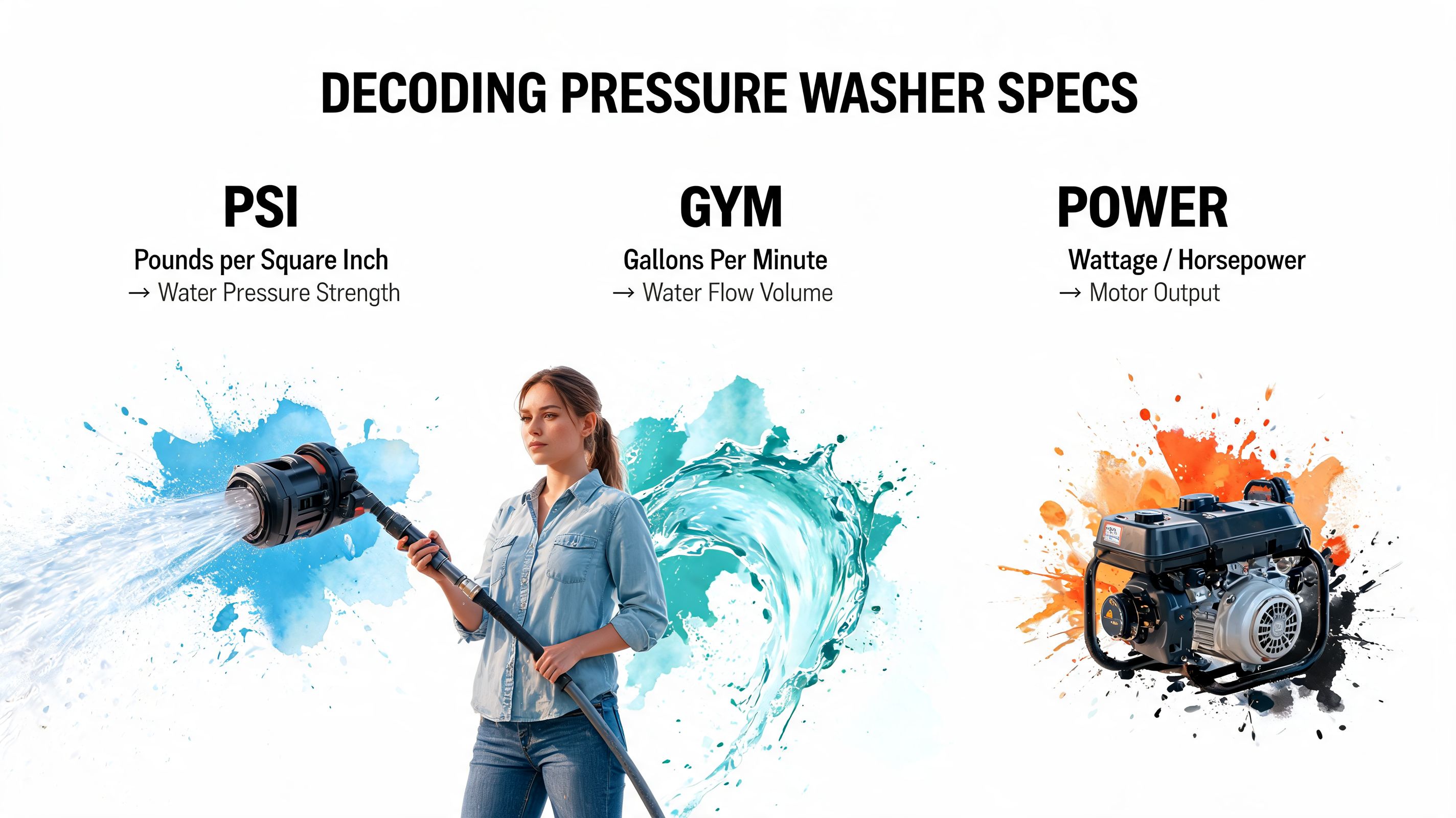
PSI and GPM do different jobs
PSI is the force at the surface. It helps break contamination free, which matters for compacted dirt, failed coatings, and stubborn buildup.
GPM is the water volume. It carries that material away and determines how quickly the operator can keep moving without stopping to chase slurry or rinse lines.
For commercial work, these numbers need to be read together. A machine with high PSI and low flow can look impressive in a sales sheet but perform poorly on sidewalks, loading areas, and other broad surfaces because the cleaning path stays narrow and the rinse takes too long.
A simple working rule helps:
- PSI breaks the bond
- GPM clears the surface
- The nozzle and tip angle control how safely that output hits the material
For concrete and other hard exterior surfaces, many commercial buyers end up in the mid-to-higher output range because it balances cutting power with usable production speed. The exact target depends on soil load, nozzle choice, operator skill, and how often the machine will be used. The main point is practical. On large flatwork, water volume is often the factor that changes labour hours.
Practical rule: If the job includes sidewalks, aprons, yard pads, or post-construction residue, treat GPM as a production spec tied directly to labour cost.
Matching machine type to business use
There is no single best machine. The right unit is the one that fits the work mix, the site constraints, and the financial model behind the purchase.
| Business setting | Usually works well | Trade-off to watch |
|---|
| Small office entrances and light exterior touch-ups | Electric cold-water unit with moderate output | Quiet and easy to store, but slower on heavy buildup and broad flatwork |
| Retail fronts and routine sidewalks | Mid-range commercial unit with enough hose reach and accessory support | Faster deployment, but low-flow units can stretch labour time |
| Warehouses, industrial aprons, and post-construction cleanup | Gas-powered commercial unit with higher output | Better mobility and throughput, but more maintenance, fuel handling, and operator discipline |
| Grease-heavy service areas and equipment cleaning | Hot-water commercial washer | Better soil removal on oils and food residue, but higher purchase and service cost |
Power source changes more than convenience. It changes where the unit can work, how often it gets used, and what it costs to keep ready.
Electric units fit indoor-adjacent areas, noise-sensitive properties, and sites where exhaust is a concern. They are often easier for occasional operators. Their limits usually show up on larger exterior jobs, long hose runs, and locations with weak or inconvenient power supply.
Gas units suit exterior commercial work where mobility and stronger output matter. They avoid dependence on building power, which helps on larger sites and remote areas. In exchange, the owner takes on engine maintenance, fuel storage, winterization, and more downtime risk if service is neglected.
Diesel or skid-based systems make sense for contractors, fleet operations, and sites with frequent heavy-duty washing. Many facilities do not need that level of capital cost or system complexity.
Hot versus cold water is another business decision, not just a cleaning preference. Cold water is enough for many routine exterior tasks. Once the soil shifts to grease, oil, gum, or food-service residue, hot water can cut chemical dwell time and reduce repeat passes. That higher upfront cost can pay back if those jobs are frequent. If they are occasional, renting a hot-water unit or outsourcing the work may be the cheaper choice.
The best way to choose is to build a short job inventory before comparing machines. List the surfaces, the type of soil, cleaning frequency, available power and water, operator skill level, transport needs, and any runoff control requirements. Facilities handling heavier-duty exterior cleaning, such as industrial facility cleaning work, usually need a different machine profile than a property team maintaining entrances and light pedestrian areas.
That inventory does two things. It points to the right PSI, GPM, and power source. It also shows whether buying the machine will produce enough annual use to justify ownership, or whether renting or hiring out the work is the better asset decision.
Safety Compliance and Environmental Responsibility
A pressure washer becomes an expensive mistake fast when runoff reaches a storm drain, an operator cuts a seal on a loading door, or overspray hits electrical equipment. On a commercial property, safety and environmental control affect labor cost, liability, and whether the work should be done in-house at all.
Safety starts before the trigger is pulled
Good pressure washing starts with a site review, not with machine startup. The operator needs to know what is being cleaned, what can be damaged, where foot traffic will go, and where the water will end up. That matters more than squeezing a little more PSI out of the machine.
A workable pre-job routine usually includes:
PPE matched to the task
Eye protection, gloves, slip-resistant footwear, and hearing protection are common baseline requirements. Chemical use or overhead cleaning may add more.
Surface and material check
Painted block, aged concrete, wood, sealants, soft stone, and coated metal all respond differently to pressure, nozzle angle, heat, and dwell time.
Work-zone control
Cones, caution signage, barriers, and pedestrian rerouting reduce injury risk and keep vehicles and bystanders out of overspray.
Operator training
Staff should know nozzle selection, trigger discipline, shutdown procedure, chemical handling, and how to avoid forcing water into joints, vents, and electrical areas.
On sites with production residue, washwater concerns, or sensitive equipment, pressure washing often sits inside a broader industrial facility cleaning scope. In those environments, contamination control and coordination with operations matter as much as cleaning speed.
Runoff control is part of the equipment decision
The machine has to fit the site, not just the soil load. A unit that works fine in an open yard may create a compliance problem in a parking structure, near storm drains, or at a site with food, oil, chemical, or wastewater sensitivity.
For Ontario businesses, the safest approach is to verify discharge and wastewater obligations against the law itself and site-specific municipal rules. Ontario's O. Reg. 903 under the Environmental Protection Act sets out requirements tied to air pollution and industrial operations, and it should not be treated as a casual sales talking point. For discharge planning, businesses should also confirm where washwater can go before the job starts, especially if detergents, oils, sediment, or other contaminants are involved.
That changes the buying decision in practical ways.
If runoff must be captured, filtered, or hauled off, a low-cost machine without a reclaim plan is not really low cost. If the site has tight pedestrian traffic, noise restrictions, or indoor-adjacent work, engine choice matters for more than convenience. If operators need chemicals to do the job safely and on schedule, the business also needs documented handling procedures and storage discipline.
A responsible setup usually includes clear runoff control, approved chemistry, trained operators, and a written go or no-go rule for sensitive areas. That adds planning time up front. It also helps prevent rework, property damage, cleanup labor, and compliance problems that wipe out any savings from buying the cheapest unit available.
Understanding the Total Cost of Ownership
The sticker price on a pressure washer is the easiest number to compare and often the least useful one. What matters over time is whether the machine stays productive, how often it needs repair, how long it lasts under actual workload, and how much downtime it creates.
The pump usually decides lifecycle cost
For commercial equipment, the pump is one of the clearest separators between short-term affordability and long-term value. Many lighter-duty units use axial pumps. They can be acceptable for occasional use, but they usually aren't the strongest fit for recurring business work.
According to Pressure Washers West guidance on commercial machine selection, commercial-grade triplex plunger pumps have a lifespan of over 1000 hours, lasting 2 to 3 times longer than the 300-hour lifespan of typical axial pumps. That design difference directly reduces downtime and long-term maintenance cost for high-volume operations.
The practical takeaway is simple. If a business expects frequent use, transport between sites, or long cleaning sessions, a triplex plunger pump is usually the better business decision even if the initial spend is higher.
| Pump type | Typical fit | Ownership implication |
|---|
| Axial pump | Light, occasional work | Lower entry cost, but shorter service life and more risk of replacement |
| Triplex plunger pump | Repeated commercial use | Higher upfront cost, stronger durability, better fit for planned maintenance |
A maintenance routine protects ROI
A pressure washer becomes expensive when a business treats it like a disposable tool. Commercial machines need routine care if they're going to deliver steady output and predictable scheduling.
A basic ownership routine should cover:
Engine and pump servicing
Follow the manufacturer's intervals for oil and inspection. Delayed servicing is a common reason machines lose reliability.
Nozzle and hose checks
Worn nozzles change spray performance. Damaged hoses create both safety and productivity problems.
Water quality awareness
Dirty supply water shortens component life. Filters and strainers need attention.
Winterisation
In Canadian conditions, storage procedures matter. A good machine can still fail early if residual water freezes in the system.
Record keeping
A simple maintenance log helps facilities spot recurring issues and decide when repair no longer makes economic sense.
A full cost review should also include staff time, training, accessory replacement, detergent use, transport, and storage. Those items don't look dramatic on day one, but they decide whether the machine improves operations or gradually drains margin over time.
A Strategic Framework Buy Rent or Hire
The best pressure washer for business may be no purchase at all. Some facilities benefit from owning equipment. Others should rent for specific projects. Many are better served by hiring a specialist and keeping pressure washing out of the internal maintenance load.
Decision Framework Buy vs Rent vs Hire a Service
| Criteria | Buy | Rent | Hire a Service |
|---|
| Frequency of work | Best when exterior cleaning is recurring and predictable | Best for occasional projects or one-off cleanup | Best when needs are periodic but quality expectations are high |
| Staff capability | Works if trained staff can operate, maintain, and store the machine properly | Works if staff can use the unit safely for a short-term job | Best when the business doesn't want operator risk or training burden |
| Equipment control | Full control over scheduling and setup | Limited to rental availability and return windows | Service provider controls equipment and deployment |
| Compliance burden | Stays with the business | Still largely stays with the business during use | Often reduced because the provider manages the operating process |
| Upfront cash impact | Highest | Moderate and project-based | Variable operating expense rather than equipment purchase |
| Maintenance responsibility | Fully internal | Minimal after return, but operational care still matters during rental | Externalised |
| Best fit | High-use sites, repeat flatwork, in-house facility teams | Seasonal work, testing demand, emergency cleanup | Sensitive sites, specialised cleaning, or businesses focused on core operations |
For companies that prefer outsourcing, commercial power washing services are one practical route. Providers such as Arelli Cleaning can fit the “hire” column when a facility wants the result without taking on equipment ownership, operator training, and maintenance administration.
How to choose without overbuying
A useful decision process starts with five questions.
How often does the same cleaning problem return?
If the answer is weekly or built into seasonal operations, ownership becomes easier to justify.
Is pressure washing part of the facility team's core role?
If staff already handle grounds, exterior maintenance, and minor repairs, adding a machine may fit. If not, the unit can become neglected.
Does the site involve compliance sensitivity?
Schools, clinics, industrial discharge concerns, and busy public areas often push the decision toward trained external support.
Will the business maintain the machine properly?
If maintenance discipline is weak, buying premium equipment doesn't fix the underlying problem.
What is the cost of downtime or poor results?
A retail frontage can tolerate some delay. A food-adjacent service area or a safety-sensitive loading zone may not.
Renting is useful when a business still needs to learn its actual workload. Buying too early locks money into a machine before usage patterns are clear.
In practice, buying makes sense when the work is recurring, the staff are capable, and the business wants scheduling control. Renting makes sense for infrequent projects, unusual cleanup, or when comparing machine types before committing. Hiring a service makes sense when the site is sensitive, the work is specialised, or leadership wants a predictable result rather than another equipment category to manage.
Frequently Asked Questions about Commercial Pressure Washers
What PSI is good for a pressure washer for business?
It depends on the surface and soil. Commercial buyers should avoid choosing by PSI alone. Concrete, loading areas, and post-construction residue usually call for stronger output than painted surfaces, storefront trim, or delicate materials.
Is GPM more important than PSI?
On many commercial jobs, yes. PSI helps break contamination loose, but GPM often decides how quickly the operator can rinse and move across the surface. That is why broad flatwork can feel slow on an underpowered machine even if the PSI looks impressive.
Does every business need a hot-water unit?
No. Cold water handles many routine outdoor cleaning tasks well. Hot water becomes more useful when the job involves grease, oils, food residue, gum, or equipment with oily buildup.
What nozzle should a business use?
Nozzle selection depends on the surface, stand-off distance, and contamination. Narrower spray patterns hit harder but increase the risk of etching or damage. Wider patterns are safer for many surfaces but may slow production. A test area is usually the right starting point.
Is electric or gas better for commercial use?
Electric works well where noise, indoor-adjacent use, or emissions are key concerns. Gas usually makes more sense for larger exterior areas and mobile work where power access is limited. The right answer depends on site conditions, not brand preference.
How should a machine be stored in winter?
The system needs proper winterisation before freezing weather. Hoses, pump components, and water pathways should never be left with residual water if the unit is stored in unheated conditions. A machine that was working perfectly in autumn can fail fast after poor winter storage.
When should a business rent instead of buy?
Renting is usually sensible for rare projects, emergency cleanup, testing a machine category, or handling a temporary spike in work. It can also help a facility avoid buying the wrong unit before its usage pattern is clear.
What should be on a procurement checklist?
A short checklist should include job types, cleaning frequency, power source, pump type, hose length needs, nozzle set, chemical compatibility, wastewater plan, storage conditions, maintenance support, warranty terms, and who will operate the machine.
Further Reading
Internal resources:
External resources:
The most sensible next step is to use a simple checklist, define the actual workload, and get two to three quotes before committing. That applies whether the business plans to buy a machine, rent one for a project, or hire a specialist. A pressure washer for business pays off when the decision is tied to labour, risk, and lifecycle cost rather than impulse buying.










.webp)