A facility manager in the GTA often notices the problem slowly. Salt haze lingers on the front walk after winter. Loading areas collect oil and grime. Brick, concrete, and siding start to look older than they are. Nobody complains right away, but the building sends a message to staff, visitors, tenants, and inspectors every day.
That’s where a pressure cleaning business fits into commercial property operations. For offices, clinics, warehouses, schools, and industrial sites, professional exterior cleaning isn’t just about appearance. It supports maintenance planning, site safety, environmental compliance, and vendor accountability.
Ontario’s market reflects that shift. Over 5,000 cleaning service establishments were operating in Ontario as of 2023, and many offer power washing. A 2024 survey also found that 68% of Ontario commercial property managers reported increased budgets for exterior cleaning services according to Jobber’s pressure washing industry statistics. That doesn’t mean every property needs the same scope or schedule. It does mean more decision-makers now treat exterior cleaning as part of facility stewardship rather than an occasional cosmetic purchase.
An Introduction to Commercial Pressure Cleaning for Your Business
Commercial pressure cleaning usually starts with a simple question. Is the property just dirty, or is the site beginning to create risk?
For a dental clinic, that risk may be patient perception at the front entrance. For a warehouse, it may be slippery residue near receiving doors. For a school or childcare facility, it may be the need to maintain a visibly clean exterior without creating avoidable safety issues. The service looks straightforward from a distance, but the business case is broader than many buyers expect.
Key takeaways
- Pressure cleaning is a facility maintenance service, not just a cosmetic add-on.
- Different methods suit different surfaces, and the wrong method can waste money or damage finishes.
- Commercial sites in the GTA need to think about runoff, safety practices, and vendor qualifications.
- A good buying decision depends on scope, compliance, and commercial experience, not just price.
- Facilities teams should compare quotes with a checklist, then ask focused questions before awarding work.
A useful way to think about commercial pressure cleaning is to place it beside other preventive services. It belongs in the same conversation as floor care, window cleaning, post-construction cleanup, and exterior maintenance. When a site is cleaned at the right interval, teams can spot cracks, staining patterns, drainage issues, and material wear earlier.
Direct answer: For most GTA businesses, professional pressure cleaning is best viewed as a practical maintenance tool that supports appearance, safety, and compliance at the same time.
Some readers get stuck on terminology, especially the difference between pressure washing, power washing, and soft washing. That confusion matters, because the right method depends on the surface, the soil load, and the environmental controls required on site.
Understanding Pressure Cleaning Services and Applications
A property manager in Mississauga may be looking at the same buildup on two surfaces and need two very different cleaning methods. Oil on a loading dock slab usually calls for heat and pressure. Painted cladding near a main entrance often needs a low-pressure wash with the right cleaning solution and controlled dwell time. The surface, the soil, and the surrounding drainage conditions determine the method.
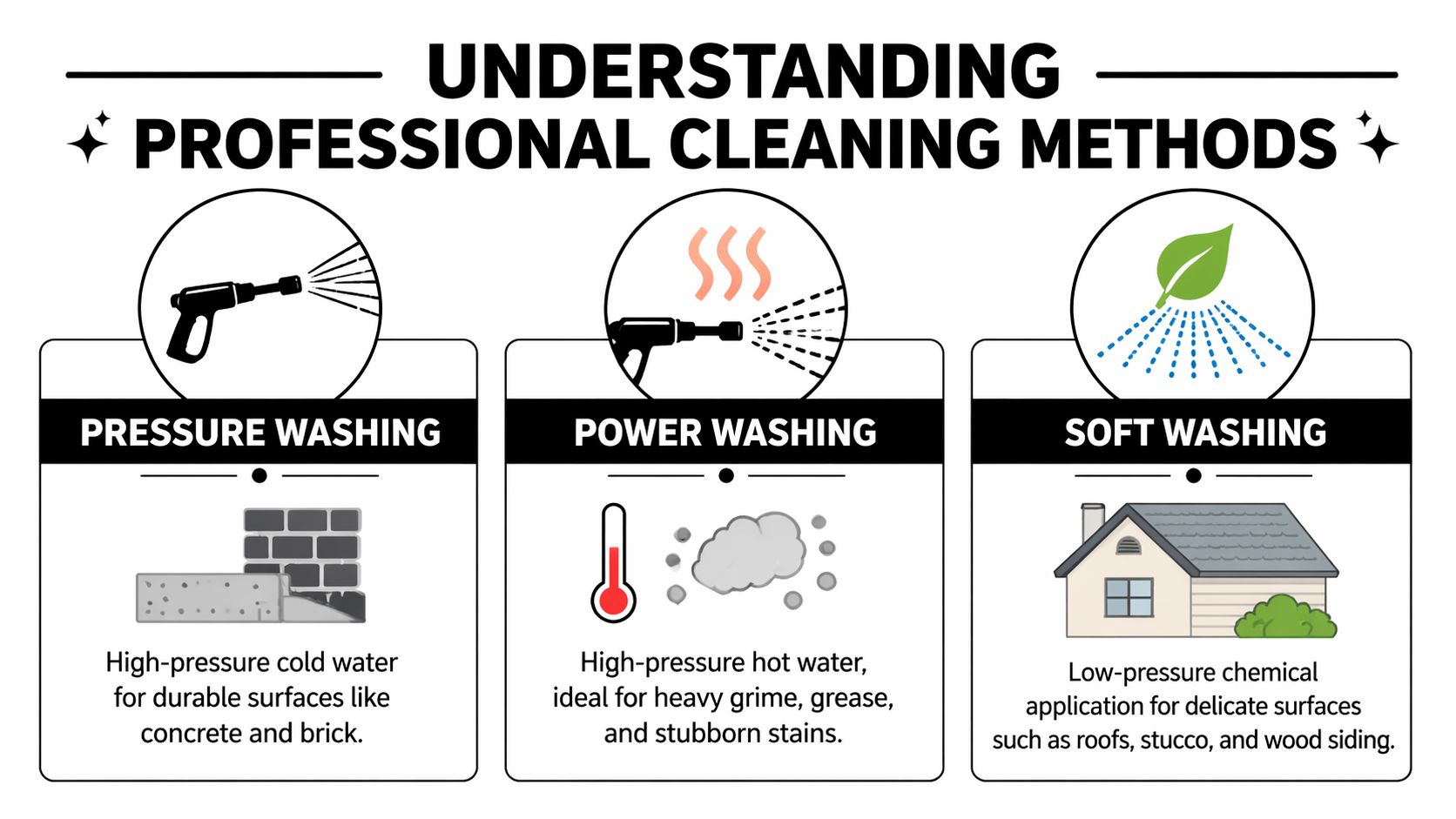
Pressure washing, power washing, and soft washing
Commercial buyers hear these terms used interchangeably, but each points to a different toolset.
Pressure washing uses high-pressure water, usually without heat. It suits durable surfaces such as concrete, some masonry, and other exterior areas that can handle mechanical force.
Power washing adds heated water. Heat matters on sites with grease, oil, traffic film, food residue, or heavy grime because it helps break contamination away from the surface instead of relying on force alone.
Soft washing uses lower pressure, cleaning agents, and contact time. It is often the safer choice for painted finishes, trim, siding, sealants, and delicate façade materials where too much pressure can scar the surface or force water into joints.
A practical comparison helps. Pressure washing works like scrubbing with force. Power washing combines force with heat, much like washing greasy cookware with hot water instead of cold. Soft washing relies more on chemistry and time than raw pressure.
Matching the method to the property
Commercial sites in the GTA rarely have one material and one type of soil. A retail plaza may have gum and salt residue on sidewalks, algae near shaded walls, and grease around waste areas. An industrial site may have loading zones, service bays, painted bollards, metal doors, and precast panels within the same cleaning scope.
That is why a site assessment matters.
A parking garage deck or warehouse apron usually needs a stronger approach than the entrance canopy of a professional office. Post-construction work is another common example. Concrete splatter, dust, adhesive marks, and glass residue may all appear on one property, but each responds differently to pressure, temperature, and cleaning agents.
Typical applications include:
- Loading docks and service lanes with grease, tyre marks, and embedded dirt
- Storefront sidewalks and concrete pads with salt residue, foot traffic film, and staining
- Building exteriors and trim that need lower pressure to protect finishes
- Waste enclosures and back-of-house areas where sanitation and odour control matter alongside appearance
- Post-construction exterior cleanup where surface protection is as important as soil removal
For facility teams, the lesson is simple. The machine does not decide the method. The surface and the contamination do.
Where buying decisions often go wrong
One common mistake is treating PSI as the whole story. Pressure matters, but it is only one control. A qualified contractor also adjusts nozzle type, flow rate, water temperature, chemical selection, stand-off distance, and rinse method. On a commercial property, that calibration affects more than cleaning quality. It affects coating life, slip risk during the work, water runoff, and the chance of damage claims.
This is also where compliance starts to enter the conversation. In Ontario, exterior cleaning can create wastewater, overspray, pedestrian hazards, and access restrictions if the work is not planned properly. A competent vendor scopes the work like a maintenance task, not like a simple spray-and-go service.
Soft washing often gets misunderstood. It is not a lesser version of pressure washing. It is a controlled method for surfaces that need precision.
Facilities teams comparing providers can review examples of commercial power washing services to see how experienced contractors separate concrete cleaning, building exterior work, and specialty applications. Businesses that market these services also face a separate challenge, which is why many operators study SEO strategies for service-based businesses as they build their local presence.
The Business Case for Professional Power Washing
A clean exterior creates a stronger first impression, but that’s only one part of the value. The primary business case is that regular power washing can support safer access routes, protect surfaces, and make maintenance issues easier to see before they become larger repairs.

Why operations teams budget for it
A neglected exterior often creates hidden costs. Dirt and residue can make surfaces harder to inspect. Stains near entrances can signal poor upkeep to clients and prospective tenants. On industrial properties, grime can also interfere with routine housekeeping standards.
Three business reasons usually drive the decision.
First, risk control. Slippery contamination, visible buildup, and neglected access points can raise concerns for staff and visitors. A cleaning contractor won’t solve every facility risk, but a disciplined cleaning programme can remove hazards that are otherwise left to accumulate.
Second, asset protection. Salt, pollutants, grease, and biological growth don’t affect every material in the same way. Over time, they can shorten the useful life of coatings and make surfaces look older than they are. Cleaning is often cheaper than premature repair or repainting.
Third, presentation and trust. In client-facing sectors such as dental clinics, legal offices, and engineering firms, the exterior is part of the service environment. The building doesn’t need to look luxurious. It does need to look controlled and well managed.
Standards matter because buyers use them as signals
Commercial buyers often struggle to judge quality before the work starts. That’s one reason recognised standards matter in this industry.
Ontario’s Cleaning Industry Management Standard introduced in 2015 boosted adoption of professional cleaning practices such as pressure washing by 35% among certified firms, according to Aspire’s 2025 cleaning industry report. For facility teams, that statistic supports a practical point. Standardised operating practices tend to build confidence because they suggest the vendor treats cleaning as a managed process rather than an informal side service.
A useful ROI lens
Pressure cleaning is easiest to justify when it’s tied to outcomes the business already cares about:
- Safer surfaces for employees, visitors, and deliveries
- More credible site presentation for customers and auditors
- Better preservation of finishes and hardscape materials
- Cleaner conditions for sectors with higher hygiene expectations
Property managers also benefit when vendors communicate clearly online. Buyers researching providers may find broader guidance on SEO strategies for service-based businesses useful, because a vendor’s digital footprint often reveals how clearly they define services, locations, and operating standards.
A pressure cleaning budget is easier to defend when it’s framed as maintenance and risk reduction, not as a vanity expense.
Critical Safety and Environmental Compliance Standards
Commercial pressure cleaning in the GTA isn’t just a hose, a wand, and a truck. It involves worker safety, chemical handling, wastewater control, and site-specific operating procedures. If a vendor gets those basics wrong, the property owner or manager may inherit the consequences.

The compliance issue buyers should take seriously
The most important regulatory concern on many commercial pressure cleaning jobs is wastewater. Runoff can carry dirt, oil, cleaning agents, and suspended solids away from the work area. On a commercial property, that isn’t something a vendor should improvise.
In the GTA, improper wastewater discharge into storm sewers can lead to fines of up to $100,000 per day for a commercial operation, and compliant vendors use water reclamation systems to avoid those violations, according to guidance citing Ontario and municipal wastewater requirements. For a facility manager, that one point changes the buying conversation. Price matters, but compliance controls matter more.
A responsible vendor should be ready to explain:
- How runoff will be contained
- Whether water reclamation equipment is required for the site
- What cleaning products will be used
- How wastewater will be handled after recovery
- What site restrictions apply near drains, loading areas, or vegetated zones
Safety isn’t just about slips and PPE
Buyers often think of safety in visible terms such as gloves, boots, cones, and caution tape. Those are important, but they’re only the surface level.
Commercial work can involve chemical handling under WHMIS, work near pedestrian traffic, electrical awareness around exterior fixtures, and in some cases access at height or awkward hose runs across active sites. On a school, clinic, or office property, the vendor may also need to plan around occupancy and access routes so the cleaning operation doesn’t create a new hazard while removing an old one.
A competent contractor should speak comfortably about site controls, crew training, and communication protocols. If answers are vague, that’s useful information.
What to ask and what to avoid
A short compliance screen can prevent most preventable problems.
Ask these questions
- Runoff plan. Where will the wash water go, and how will it be captured?
- Training records. Are crew members trained for chemical handling and commercial site safety?
- Site protection. How will entrances, drains, signage, and pedestrian routes be managed?
- Insurance and documentation. Can the vendor provide current commercial coverage and operating documents?
- Surface-specific method. Why is this cleaning method appropriate for this property?
Avoid these warning signs
- “We’ll figure it out on site.” That usually means no written plan.
- One-method-fits-all proposals. Commercial sites rarely have only one surface type.
- No discussion of drains or wastewater. That’s a major red flag in the GTA.
- Residential language for a commercial scope. It can signal a mismatch in experience.
Practical rule: If a vendor can describe the cleaning method but can’t explain the wastewater plan, the proposal isn’t complete.
Evaluating Vendors and Understanding Costs
Buying commercial pressure cleaning is partly a procurement task and partly a risk review. A low quote may still be expensive if it excludes containment, insurance, or the right equipment. A higher quote may be justified if it reflects a more realistic scope.

Start with commercial experience
One of the biggest buying mistakes is assuming a capable residential operator is automatically equipped for commercial work. The operating environment is different. The equipment, documentation, scheduling, and liability profile are different too.
Industry guidance points to a significant gap in how many providers move from residential to commercial work, even though commercial contracts require different equipment, insurance, and liability management according to King of Pressure Wash’s discussion of why pressure washing businesses fail. For buyers, the implication is simple. Ask for experience that matches your property type.
A clinic, warehouse, school, and engineering office may all buy “power washing,” but they don’t buy the same operating model.
Vendor checklist for commercial buyers
Use a practical screen before comparing final prices.
| Checkpoint | What to verify | Why it matters |
|---|
| Commercial scope | Similar properties and comparable job conditions | Reduces the risk of under-scoping |
| Insurance and worker coverage | Current proof of coverage | Protects the client if something goes wrong |
| Safety process | Written site controls and crew training | Shows the vendor can work around active facilities |
| Environmental controls | Runoff containment and wastewater plan | Critical for GTA compliance |
| Equipment fit | Hot water, soft wash, surface cleaners, recovery tools | The wrong setup often leads to poor results |
| Communication | Site contact, scheduling plan, reporting method | Important for occupied buildings |
A few modern providers also use digital QA tools, photo documentation, and mobile checklists. For example, Arelli Cleaning presents technology-supported quality assurance and service communication as part of its commercial offering. That doesn’t make it the default choice, but it does illustrate what some business buyers now expect from a structured vendor relationship.
What actually drives the price
Commercial pressure cleaning quotes usually reflect a combination of conditions rather than a simple flat rate. That’s why two buildings that look similar from the street can price very differently.
Common cost drivers include:
- Surface type. Concrete, brick, painted siding, glass-adjacent areas, and coated floors don’t require the same method.
- Soil load. Light dust and winter salt residue are different from grease, gum, algae, or post-construction debris.
- Access. Tight loading zones, long hose runs, parking structures, and restricted entry windows add labour complexity.
- Water recovery needs. If reclamation is required, labour and equipment needs increase.
- Business-hour constraints. After-hours or phased work often costs more than open-access daytime scheduling.
- Scope detail. Entrances only, full façade, parking area, loading dock, dumpster pad, and curbs each add work.
Many buyers get confused. They expect a quote to answer “what does pressure washing cost?” when the better question is “what conditions make this job more involved?”
Comparing bids without getting lost
A useful procurement exercise is to ask each bidder for the same scope outline. Request a breakdown by area, method, and assumptions. That makes it easier to spot what one quote includes and another omits.
If you want to understand why equipment lists matter, even outside the cleaning industry, a practical example comes from the way service operators think through vehicles, tools, and job setups in resources such as this mobile detailing equipment list. The industries are different, but the purchasing logic is similar. Equipment choice affects efficiency, risk, and service quality.
Don’t ask only, “What’s your price?” Ask, “What is included, what is excluded, and what assumptions did you make about the site?”
What to ask and what to avoid
Ask vendors
- What commercial properties like ours have you serviced?
- What cleaning method will you use on each surface?
- How will you manage runoff and protect drains?
- What site access do you need from us?
- Will you provide before-and-after documentation or a service report?
Avoid
- Quotes with almost no scope detail
- Vendors who describe every job the same way
- Proposals that ignore occupancy and scheduling realities
- A decision process based only on the lowest number
Frequently Asked Questions and Further Reading
A common GTA scenario looks like this. A property manager approves exterior cleaning to fix stained walkways and winter grime. The work gets done, but no one clarified runoff controls, access restrictions, or which surfaces needed a lower-pressure method. The site looks cleaner for a day. The risk sits in what was missed.
That is why the final questions matter. Pressure cleaning is part of facility maintenance, but it also touches tenant experience, slip prevention, surface preservation, and environmental obligations. A good FAQ should help you judge whether a vendor understands the job as an operations issue, not just a washing task.
FAQ
How often should a commercial property be pressure cleaned
Set frequency the same way you would set HVAC maintenance intervals. Start with site conditions, then adjust for exposure and consequence. A restaurant loading area, medical entrance, underground ramp, and office façade collect different types of buildup and create different risks.
For Ontario properties, the schedule should reflect traffic, winter salt, grease, shade, organic growth, and how visible the area is to staff, tenants, and visitors. If buildup returns quickly or creates slip concerns, the cleaning cycle should be shorter.
Will pressure cleaning disrupt business operations
It can, but disruption should be planned and contained. The better question is whether the vendor can work around your operating hours, delivery windows, pedestrian routes, and tenant access requirements.
For busy commercial sites, phased work often makes more sense than treating the property as one open work zone. That approach works like shutting down one lane for road repairs instead of closing the whole street.
Can pressure cleaning damage building surfaces
Yes. Pressure is only one part of the method. Water temperature, nozzle choice, stand-off distance, detergents, and surface condition all affect the result.
Older masonry, painted surfaces, sealants, wood, EIFS, and decorative finishes often need a lower-pressure or soft-wash approach. A qualified contractor should identify those differences before starting, not after surface etching or coating failure appears.
Who is responsible for wastewater compliance during the job
The contractor should arrive with a clear runoff control plan. The owner or facility manager should verify that plan before approving the work.
That shared attention matters because wastewater can carry oils, sediments, detergents, and other contaminants. If runoff enters the wrong drain or is handled poorly, the problem shifts from cleaning quality to regulatory exposure.
What documents should a business request before approving work
Request proof of commercial liability insurance, worker coverage documentation, a written scope, a site-specific method summary, and a description of runoff controls. For higher-sensitivity sites, ask for a traffic or access plan, a hazard assessment, and a post-service report with photos.
Those documents serve the same purpose as a maintenance log for a roof or fire system. They show what was planned, how the work was performed, and whether the vendor treated the site with appropriate care.
What’s the difference between hiring a pressure cleaning business and adding the task to general janitorial services
General janitorial work and exterior pressure cleaning solve different problems. One focuses on routine interior upkeep. The other often requires specialized equipment, outdoor surface knowledge, water recovery planning, and crew training tied to exterior hazards.
Some janitorial providers subcontract or coordinate this work well. The point is not the company label. The point is whether the team assigned to your property can handle commercial exterior cleaning to the standard your site requires.
Further reading and resources
| Resource Type | Title/Link | Description |
|---|
| Internal | Arelli Cleaning service areas | GTA coverage for commercial cleaning support across multiple municipalities. |
| External | ISSA | Cleaning industry education and operational guidance. |
| External | Ontario Water Resources Act information | Provincial legal context relevant to water protection and discharge issues. |
| External | Toronto Sewer Use Bylaw overview | City-level guidance that helps buyers ask better questions about wastewater handling. |
| External | IFMA | Broader facility management resources on maintenance planning, vendor oversight, and building operations. |
A practical next step is to gather 2 to 3 quotes and compare the assumptions behind each one. Start with scope, method, documentation, and compliance readiness. Then compare price.
Businesses that want a structured commercial option can include Arelli among those quotes, along with other qualified GTA vendors, and choose based on site fit, risk control, and clarity of execution.
If you're buying pressure cleaning for a commercial property, the most useful move is to ask questions that protect the building, the people using it, and the organization responsible for it.




.webp)