A building supervisor usually notices a concrete floor problem in the same way. The warehouse aisle starts looking dusty even after cleaning. The clinic back hall keeps showing dull traffic lanes. The receiving area feels slightly slick on wet days, and staff begin to work around the floor instead of trusting it.
That’s when concrete floor cleaning stops being a housekeeping task and becomes a facility management issue.
In commercial buildings, concrete takes abuse from grit, salt, pallet traffic, carts, moisture, spills, and aggressive spot cleaning. If the cleaning method is wrong, the floor doesn’t just look poor. It gets harder to maintain, less safe to walk on, and more expensive to keep in service.
A Strategic Approach to Concrete Floor Cleaning
A supervisor usually gets pulled into concrete floor cleaning after routine cleaning stops holding. Dust returns by mid-shift. Traffic lanes stay dark. Entry areas track in salt and moisture through an Ontario winter, then dry into a gritty film that wears the surface and affects traction.
At that point, cleaning needs a plan, not another pass with a mop.
Commercial concrete floor cleaning is part of floor management. The standard is simple: keep the surface safe to walk on, practical to maintain, and protected against premature wear. In an active facility, that means accounting for traffic volume, soil type, drying time, chemical handling, and worker exposure. In Ontario, it also means treating the work like a controlled maintenance task under OHSA and WHMIS requirements, especially when chemicals, slip hazards, or occupied spaces are involved.
Concrete also changes through the year. Freeze-thaw conditions, road salt, sand, slush, and wet footwear create a different cleaning problem in January than in July. A floor care program that works in a dry warehouse aisle may fail at a loading entrance, in a food production back room, or along a clinic corridor with constant foot traffic. Good results come from matching the method to the floor’s use, its condition, and the type of residue sitting on it.
What good concrete care looks like
A sound program usually includes four parts:
- Preparation that protects the surface, so grit, salt, and debris are removed before scrubbing grinds them into the concrete
- A cleaning method suited to the area, based on soil load, water control, access, and how quickly the floor must return to service
- Targeted treatment for stains and residue, since oil film, rust, tyre marks, and spill damage often need separate chemistry or dwell time
- A maintenance schedule that prevents recovery cleaning, which is always more disruptive and usually more expensive
One trade-off matters in every building. Aggressive cleaning can improve appearance fast, but it can also shorten the life of coatings, densified surfaces, or joint edges if the pad, brush, or chemical is too harsh. Conservative cleaning protects the floor, but if it leaves residue behind, the surface gets harder to maintain and slip risk can rise. The right approach balances soil removal with surface preservation.
Practical rule: Clean based on contamination and floor condition. Habit-based cleaning usually wastes labour and gives inconsistent results.
Key takeaways
- Concrete floor cleaning supports safety first. Appearance matters, but traction, residue control, and predictable drying matter more in commercial space.
- Season, traffic, and building use affect the method. Ontario entryways, loading zones, and unheated areas usually need a different approach than interior office or warehouse sections.
- Mechanical scrubbing is the standard starting point for many interiors. It recovers soil better than manual mopping and leaves less residue when set up properly.
- Spot treatment should be planned, not improvised. Oil, rust, salt, and rubber transfer respond differently, and the wrong product can set the stain or damage the surface.
- Long-term cost is driven by maintenance discipline. Floors that are cleaned correctly and protected after deep cleaning stay safer and cost less to keep in service.
Essential Preparation and Safety Precautions
A concrete floor cleaning job usually goes wrong before the machine touches the floor. A supervisor opens an entry corridor after a fast scrub, then finds grit still underfoot, salt film pushed into the joints, and pedestrian traffic tracking moisture into occupied space. The cleanup takes longer than the original work, and the floor is less safe than it was an hour earlier.
Preparation prevents that outcome. On commercial concrete, especially in Ontario buildings dealing with snow, slush, freeze-thaw grit, and de-icing salt, the setup stage protects both the floor and the people using the area. It also keeps the work aligned with OHSA duties around hazard control and WHMIS requirements for chemical handling.
Start with a floor condition check
Walk the space first. Do it slowly enough to see what will affect the cleaning result and what could be damaged by the cleaning process.
Check for open joints, spalls, coating wear, old patch repairs, oil-saturated areas, rust staining, tyre marks, and heavy salt buildup near entrances or shipping doors. In winter and early spring, Ontario floors often hold fine abrasive grit that is easy to miss until it gets under a scrubber pad. That grit wears the surface and can scratch coated sections.
A simple pre-job inspection should cover:
- Access and obstructions: Move carts, bins, floor mats, and portable equipment so the machine can run full passes without constant turning or missed strips.
- Dry soil removal: Sweep or dust mop before applying any solution. Loose grit under a pad acts like abrasive media.
- Problem areas: Mark grease, rust, rubber transfer, and entry lanes for separate treatment so crews do not over-apply chemical across the whole floor.
- Traffic control: Set signs and barriers before work starts. Wet concrete in a busy facility becomes a slip hazard fast.
- Recovery and drainage: Confirm where dirty solution will go and how it will be recovered. On interior jobs, slurry should be picked up, not pushed into corners or floor drains unless site procedures allow it.
If an area may need exterior washing because soil is packed into a loading apron or service lane, review the site conditions before choosing that method. Commercial power washing services for concrete and exterior hard surfaces only make sense where drainage, containment, and pedestrian separation are properly planned. The same applies when evaluating methods described in guides on power washing concrete.
Chemical safety and indoor air quality
Cleaner choice affects more than appearance. It affects residue, drying time, indoor air conditions, worker exposure, and whether the floor can return to service safely.
Use the mildest product that will remove the soil you identified during inspection. Stronger chemistry is not better if it leaves residue, attacks a guard or sealer, or creates odour problems in occupied space. Offices, healthcare settings, schools, childcare environments, and mixed-use commercial buildings need tighter control than a ventilated service bay.
Review the Safety Data Sheet before the job. Confirm dilution, dwell time, required PPE, and any incompatibilities with the floor finish or nearby materials. Staff should know what they are handling and what to do if there is a splash, spill, or overexposure. That is basic WHMIS practice, not paperwork for its own sake.
Required safety controls on every job
The safest concrete cleaning crews follow the same controls every time:
- Use WHMIS-labelled products and keep SDS access current: Staff need clear product instructions on site.
- Match PPE to the task: Gloves, eye protection, and slip-resistant footwear are the usual baseline. Add protection if the SDS or task conditions require it.
- Ventilate occupied interiors: Use building HVAC where appropriate and avoid trapping odours or moisture in enclosed areas.
- Measure dilution accurately: Over-concentrated solution creates residue, increases exposure risk, and often makes rinse recovery harder.
- Protect reopening time: Keep traffic off the floor until it is dry enough for normal use and free of cleaning residue.
- Check machine condition before use: Worn squeegees, the wrong pad, or poor vacuum recovery leave standing water and create preventable slip hazards.
One mistake shows up often in new programs. Crews finish the cleaning pass and assume the area is ready because the visible dirt is gone. It is not ready if moisture remains at joints, chemical residue is still on the surface, or tracked slurry has reached adjacent flooring.
A floor is only clean when it is safe to reopen and the cleaning method has not shortened the life of the concrete, its coating, or its surrounding components.
Choosing Your Deep Cleaning Method
A new supervisor usually sees the same problem after the first winter storm. Salt film is building at entrances, forklift tires are tracking grime through the warehouse, and one crew member suggests mopping everything because it is quick to start. That choice often creates more work by spreading slurry, extending dry times, and leaving residue that pulls in more soil on the next shift.
Method selection should be based on the floor’s full service life, not just today’s appearance. In Ontario facilities, freeze-thaw residue, tracked de-icing salts, spring sand, and wet boots change the soil load for months at a time. The right process protects the concrete, keeps reopening times reasonable, and helps the site stay aligned with OHSA and WHMIS expectations for controlled chemical use and slip prevention.
Comparison of concrete floor cleaning methods
| Method | Best For | Efficiency (sq. ft./hr) | Water Usage | Key Advantage |
|---|---|---|---|---|
| Automatic floor scrubber | Interior commercial and industrial floors with routine or heavy soil | Varies by machine size and layout | Controlled and recoverable | Cleans and recovers slurry in one pass |
| Pressure washer | Exterior pads, garages, loading zones, and some service areas with drainage | Varies by operator, pressure, and containment setup | High | Strong flushing action for embedded grime |
| Mop-and-bucket | Small rooms, detail work, and temporary touch-ups | Low relative to mechanical methods | Moderate to high, often poorly controlled | Low equipment barrier for small areas |
The table gives the decision points that matter on site. How much water goes down, where the slurry goes, how fast the floor dries, and whether the method can be repeated without wearing the surface or disrupting operations.
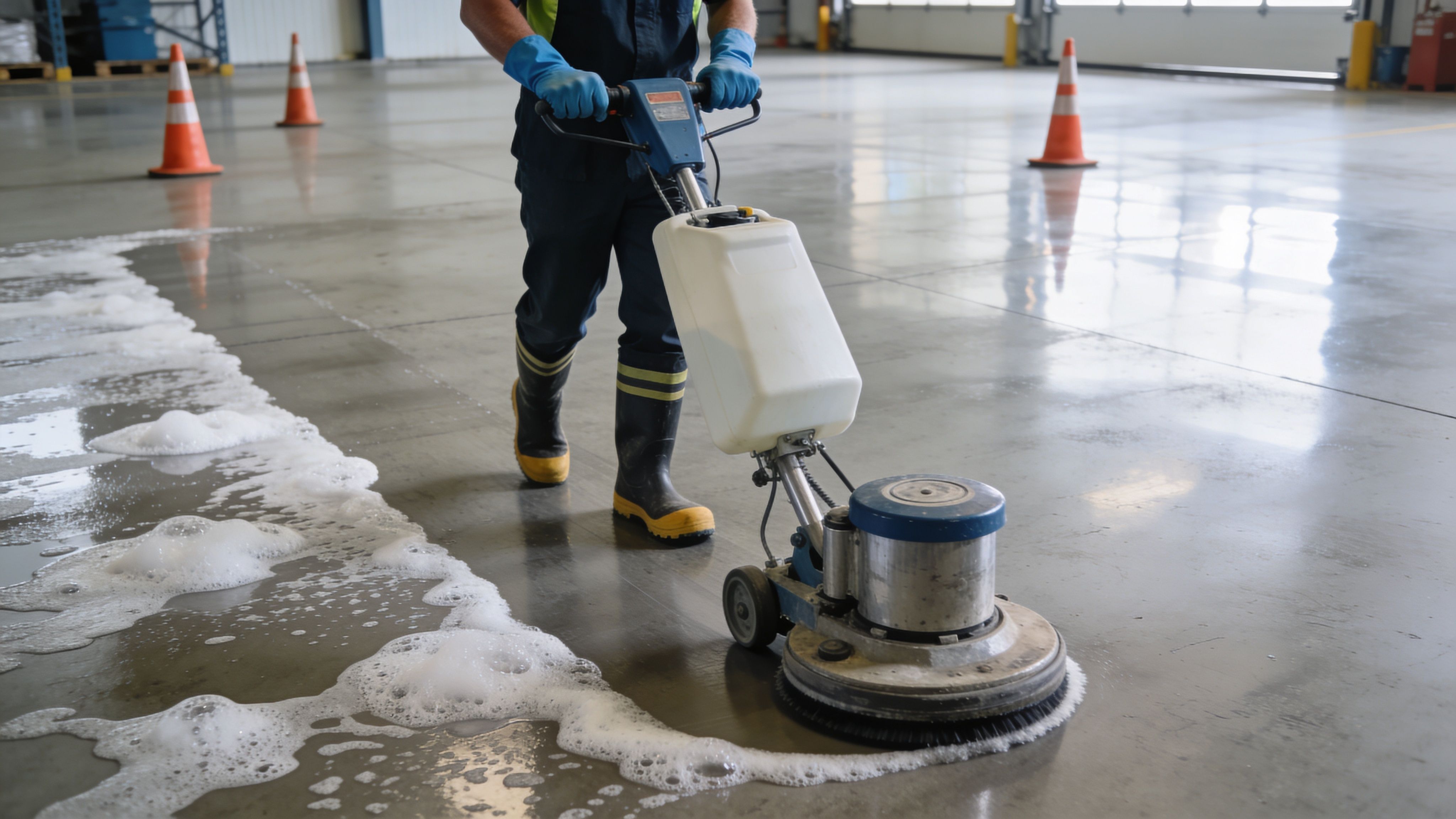
For most interior commercial concrete, the autoscrubber is the working standard. It applies solution evenly, scrubs with consistent pad or brush contact, and recovers dirty water in the same pass. That control matters in schools, healthcare settings, retail back rooms, condominium common areas, and warehouse aisles where people are still moving through the building.
When an autoscrubber is the right choice
Choose an autoscrubber where soil is spread across a broad area and the floor has to return to service without long delays. It is usually the safest option for polished concrete, sealed concrete, and smooth trowelled slabs because the operator can control solution flow and avoid over-wetting joints and edges.
It also supports a maintenance program that can last. Supervisors can standardize pads, chemicals, pass patterns, and inspection points, then train new staff to the same result. That consistency lowers rework, reduces premature wear on coatings and guards, and makes seasonal adjustments easier when winter tracking gets heavier.
Where pressure washing fits
Pressure washing has a place, but it is usually outside or in service areas built to handle rinse water. Loading docks, parking structures, waste rooms, exterior aprons, and some maintenance bays can benefit from high-pressure cleaning when embedded grime will not release with standard scrubbing. For readers comparing methods and site conditions, this guide to power washing concrete gives a practical overview of where high-pressure cleaning makes sense and where it creates avoidable risk.
Some facilities also review specialist power washing services as part of a broader hard-surface maintenance plan. The decision should come down to containment, runoff control, noise, access, and drying conditions. If overspray can reach pedestrians, door thresholds, electrical points, or nearby finished surfaces, a different method is usually the better call.
Where mopping still fits, and where it does not
Mopping has a narrow role. It works for a small room, a quick response to an isolated spill, or detail work around fixtures where machines cannot reach.
It is a poor primary method for large concrete areas. Once soil is suspended in the bucket, crews tend to redeposit it across the floor, especially on porous or lightly textured concrete. The floor may look clean while it is wet, then dry with haze, streaks, or a residue line along edges and joints.
That matters over time. Residue holds grit, grit increases abrasion, and abrasion shortens the life of polished surfaces, sealers, and coatings.
A good supervisor chooses the method that cleans effectively, reopens safely, and supports the next cleaning cycle instead of making it harder.
A Guide to Mechanical Floor Scrubbing
For most commercial interiors, mechanical floor scrubbing is the method that delivers repeatable results without flooding the floor. The machine matters, but the operating sequence matters more. A good scrubber used badly still leaves haze, residue, and missed edges.
Pre-operation checks
Before loading solution, inspect the machine. Check pad or brush wear, squeegee condition, vacuum hose connection, battery or power status, and tank cleanliness. If the recovery tank smells sour or the squeegee edge is nicked, the floor will show it.
Then confirm the chemistry. Neutral or site-approved concrete cleaner is the usual starting point. Follow the product label. Overmixing doesn’t improve cleaning. It usually increases residue and causes streaking.
Standard operating sequence
A practical operating routine looks like this:
- Dry remove soil first
Sweep or dust mop thoroughly. Fine grit will reduce pad life and scratch polished surfaces. - Pre-treat heavy spots
Apply a suitable degreaser or spot cleaner to obvious oil, tracked-in grime, or stubborn marks. Give it dwell time according to the product instructions. - Scrub in overlapping passes
Run straight, slightly overlapping lines so no strip is missed. Keep pace steady. Going too fast reduces agitation and pickup. - Watch slurry recovery
The squeegee and vacuum should leave the floor only slightly damp. If there’s a visible trail, stop and correct it before continuing. - Change solution when it stops working
Dirty solution loses effectiveness. If the recovery tank is filling quickly and the floor still looks hazy, reset before pushing on.
The double-scrub method for neglected floors
On heavily soiled concrete, one pass often isn’t enough. The better approach is a controlled double scrub.
- First pass: Apply solution and scrub to break the bond between soil and floor.
- Dwell briefly: Let the chemistry work without allowing it to dry.
- Second pass: Scrub again with recovery engaged so the loosened contamination is lifted away.
This is especially useful in receiving areas, maintenance rooms, and entry zones where residue has layered over time.
Field note: If the floor looks cleaner while wet but dull again when dry, the problem is often suspended soil or detergent residue left behind, not a lack of scrubbing pressure.
Common operator mistakes
A supervisor should watch for a few recurring errors:
- Too much chemical: This leaves a sticky or cloudy film.
- Worn pads or brushes: The machine runs, but soil removal drops sharply.
- Rushed corners and edges: Wide machines miss detail areas unless someone follows with edge work.
- Poor tank hygiene: Dirty tanks contaminate fresh solution and create odour.
The finish standard should be simple. The floor should dry evenly, feel clean underfoot, and show no visible slurry lines, detergent haze, or splash marks.
Targeted Treatments for Stubborn Stains
Deep scrubbing improves the general condition of the floor, but it won’t solve every stain. Concrete is porous, and some contaminants migrate below the surface. That means stain removal often requires a separate treatment plan instead of harder scrubbing.
Oil and grease
Oil is one of the most common commercial concrete problems. It penetrates fast and tends to spread if water is applied too early. Start by absorbing any fresh residue with appropriate absorbent material. Then use an alkaline degreaser or a manufacturer-approved oil treatment suitable for concrete.
For older stains, a poultice approach often works better than surface wiping. The treatment sits on the stain to draw contamination upward rather than pushing it outward.
Rust and metal staining
Rust usually needs a different chemistry than grease. Acid-based rust removers are commonly used, but they must be selected carefully and tested first. On decorative, polished, or sealed concrete, aggressive products can change the surface appearance.
Supervisors should always ask two questions before rust treatment:
- Is the stain on top of the surface or in it
- Will the chemical affect the finish that’s already there
Paint, coatings, and tyre marks
Paint splatter and coating drips should be approached mechanically first where possible. Plastic scraping, controlled dwell from a suitable remover, and local agitation are usually safer than broad harsh stripping. Tyre marks and rubber transfer often respond to scrubber passes with the correct pad and cleaner, but only after dry grit has been removed.
This walkthrough is useful when training staff to distinguish stain types before picking a product:
What to avoid during stain removal
Don’t escalate straight to the harshest chemical. On concrete, that often trades one visible problem for another.
Avoid these habits:
- Using vinegar, bleach, or strong acids by default: They can alter the surface or interfere with finishes.
- Scrubbing with very aggressive metal tools: These can leave permanent marks.
- Overwetting the area: Excess liquid can drive contamination deeper into porous concrete.
- Skipping a test patch: Even a correct chemical can react badly on a particular floor finish.
The right stain treatment is narrow and controlled. The wrong one creates a larger repair area.
Finishing and Protecting Your Concrete Floor
A floor can look clean at handover and still be set up to fail by February. In Ontario facilities, that usually shows up after the first rounds of salt, meltwater, pallet traffic, and repeated wet-dry cycles. The finish you choose determines how well the concrete handles that abuse and how much labour the building team will spend correcting avoidable wear.
A commercial concrete floor may be left unsealed, treated with a penetrating product, protected with a topical sealer, or maintained as polished concrete. Each option changes cleaning methods, slip resistance, repair planning, and long-term cost. The right choice depends on use, exposure, and whether the site can support the maintenance cycle.
Sealed versus unsealed concrete
Sealed concrete usually releases soil faster during routine cleaning, but that advantage only holds if the product matches the traffic, moisture, and contaminants the floor sees. In Ontario, winter salt carry-in is hard on the wrong finish. Lobbies, loading approaches, service corridors, and vestibules often fail first because the surface protection was chosen for appearance or price instead of exposure.
Unsealed concrete avoids a coating reapplication cycle, but it absorbs more readily and usually takes more effort to keep presentable. Penetrating treatments can reduce absorption without leaving a surface film, which helps in areas where peeling or visible wear would be a problem. Topical sealers can improve day-to-day cleanability, but once they start wearing unevenly, the floor often looks dirty even after it has been scrubbed.
Polished concrete sits in its own category. It can be efficient to maintain, but only with the correct pads, cleaner, and traffic controls. If crews use the wrong chemical, over-rinse, or let grit stay in the lane, gloss drops and the recovery work gets expensive.
A practical decision framework
Choose the finish based on the operating conditions.
| Surface approach | Usually suits | Main benefit | Main caution |
|---|---|---|---|
| Unsealed concrete | Utility rooms, back-of-house spaces, low-visibility service areas | No film to peel or recoat | Higher porosity, easier staining, more dusting risk |
| Penetrating treatment | Warehouses, service corridors, spaces needing low-build protection | Reduces absorption while keeping a natural surface profile | Performance depends on matching the product to moisture and contaminant exposure |
| Topical sealer | Retail, light industrial, and public-facing areas needing easier wash-down | Faster routine cleaning and a more uniform appearance | Wear paths, recoat timing, and slip resistance need close monitoring |
| Polished concrete | High-traffic interior spaces with a planned maintenance program | More efficient daily cleaning when maintained correctly | Requires correct pad selection, neutral chemistry, and disciplined grit control |
Finish selection in mixed-floor facilities
Many commercial buildings do not run one floor type. A supervisor may be managing polished concrete in the main corridor, ceramic tile in washrooms, and resilient flooring in offices, all under the same cleaning schedule. That is where product discipline matters. One chemical cabinet should not become a universal solution.
When comparing maintenance products across hard surfaces, a reference on best stone tile cleaner is useful for the same reason concrete care plans need surface-specific chemistry. Mineral-based floors do not all react the same way to the same cleaner, and compatibility checks matter before anything goes into routine use.
From an OHSA and WHMIS standpoint, the finish decision also affects worker exposure and training. A floor that needs frequent stripping, recoating, or stronger specialty products adds handling requirements, PPE decisions, ventilation planning, and more chances for misuse. A simpler system that the staff can maintain correctly is usually the better asset-protection choice.
The standard I use is straightforward. Pick the finish the site can maintain through all four seasons, not the one that looks best on day one.
Ongoing Maintenance and Professional Support
A concrete floor usually fails slowly. Dust control slips. Spot cleaning gets inconsistent. Entry protection breaks down in winter. Then the site needs an expensive recovery clean that could have been avoided with routine care.
A better programme is tiered and predictable.
A simple maintenance rhythm
- Daily care: Dry dust mop or sweep high-traffic zones, remove spills quickly, and inspect entrances for salt and grit carry-in.
- Weekly attention: Spot treat visible marks, clean edges and corners missed by machines, and check for residue haze in traffic lanes.
- Periodic review: Inspect joints, worn finish areas, recurring stain points, and any sections where traction seems to be dropping.
What to ask a cleaning provider
If internal staff can’t keep up, get quotes and compare methods, not just price.
- Ask how they assess the floor: They should ask whether the concrete is sealed, polished, coated, or raw.
- Ask about chemical selection: They should explain product suitability for occupied spaces and WHMIS handling.
- Ask how slurry is recovered: Especially on interior jobs, runoff control matters.
- Ask how they handle winter residue: Ontario conditions change the cleaning approach.
- Ask for a maintenance recommendation: A good provider should propose a schedule, not only a one-time clean.
What to avoid
- Avoid one-price-fits-all proposals: Concrete condition varies too much for that to be reliable.
- Avoid vague language: If the provider can’t explain pads, brushes, dwell time, or drying controls, the process probably isn’t well managed.
- Avoid aggressive chemistry as the default answer: That often signals a recovery mindset rather than long-term floor care.
FAQ
What is the best method for commercial concrete floor cleaning
For most occupied commercial interiors, an automatic floor scrubber is the most practical method because it applies solution, agitates the surface, and recovers dirty water in one process.
How often should a concrete floor be deep cleaned
That depends on traffic, soil load, and whether the floor is sealed or polished. A warehouse receiving area may need much more frequent attention than a private office corridor. The right schedule comes from observed use, not guesswork.
Can concrete floors be cleaned with a mop only
They can, but large-area results are usually inconsistent. Mops often spread suspended soil and leave more residue than mechanical scrubbing.
Are sealed concrete floors easier to maintain
Generally, yes. They’re often easier to clean day to day. The trade-off is that sealed floors require periodic reapplication, and that timing is often underestimated.
Is pressure washing safe for indoor concrete floors
Sometimes, but only in the right setting. It’s usually better suited to exterior or service areas where drainage, splash control, and drying can be managed properly.
What cleaner should be used on concrete in clinics or childcare spaces
Use site-approved products with attention to indoor air quality, ventilation, and safe handling. Avoid assuming that a strong-smelling product is a better cleaner.
Why does a concrete floor still look dirty after cleaning
Common causes include detergent residue, poor slurry recovery, worn pads, dirty solution tanks, or stains that need targeted treatment rather than general scrubbing.
When should a facility call a professional
Call for help when the floor has embedded staining, widespread residue, uncertain finish type, recurring slip concerns, or when in-house staff don’t have the right machine and recovery controls.
Further reading
A concrete floor program holds up when the documentation holds up. Before approving a chemical, machine setting, or outside contractor, review your site records, manufacturer instructions, and workplace safety documents together. In Ontario, that means checking product labels and Safety Data Sheets under WHMIS, confirming worker instruction requirements under OHSA, and making sure the cleaning method matches the floor’s actual condition and use.
For local service coverage and facility support options in the GTA, review Arelli Cleaning service locations.
Use this article as a working SOP reference, then compare it against your own inspection logs, incident reports, and seasonal maintenance plan. Salt tracking, freeze-thaw moisture, and entryway grit change the cleaning load across the year, so a plan that works in July may need adjustment in January.
If the work is beyond routine in-house maintenance, walk the floor before approving any method and get 2 to 3 quotes. For GTA facilities that want outside support, Arelli Cleaning is one option to include in that comparison.