
Slip-and-fall incidents remain a steady facility risk, and floor condition is one of the variables teams can control. In GTA warehouses, plants, clinics, schools, and office buildings, industrial floor cleaning affects more than appearance. It shapes traction, indoor cleanliness, maintenance costs, and how well a site meets health and safety expectations.
The starting point is simple. Different floors fail in different ways. Concrete collects abrasive grit. Vinyl loses finish and shows traffic lanes. Tile and grout trap soil in joints. A cleaning plan works only when the method matches the floor, the type of soil, the traffic level, and the operating hours of the building.
That is why this guide goes beyond a list of methods. It treats floor care as a decision framework. The useful question is not “Which cleaning method is best?” The better question is “Which method fits this facility, this floor, this risk profile, and this maintenance budget?” That framework also includes equipment choice, chemical selection, WHMIS handling requirements, and a practical vendor checklist for GTA facilities.
Mechanized cleaning has shaped that decision process for decades. As noted in historical notes on industrial cleaning machine development, floor equipment evolved from basic labor-saving machines into specialized tools designed for polishing, scrubbing, extraction, and controlled chemical application. That shift matters because each machine solves a different problem, much like using a squeegee, a mop, and a pressure washer for three separate tasks instead of forcing one tool to do all of them.
For facilities that also depend on clean water in related operations, industrial water purification systems can be part of the wider hygiene picture.
The sections that follow examine eight common methods, compare where each one fits, and show how to choose a provider that can support results, documentation, and compliance rather than just a cleaning visit.
1. High-Speed Burnishing and Polishing
A glossy floor can shape first impressions in seconds, but burnishing is not a cleaning shortcut. It is a finish-maintenance method for hard floors that already have a protective coating, usually on vinyl composition tile, other resilient floors, or sealed surfaces approved by the manufacturer. The machine spins a pad at high speed to smooth light scuffs, restore shine, and refresh the top layer of finish.
Burnishing works like buffing a scratched clear coat on a car. It improves the surface you already have. It does not correct deep wear, heavy soil buildup, or finish that has broken down.
That distinction matters when choosing a method for a GTA facility. If a floor still has an intact finish but looks dull from traffic, burnishing may restore appearance at a lower cost and with less downtime than full restoration. If the finish is peeling, yellowed, or worn through to the base material, burnishing may only make the defects more visible.
When it works best
High-speed burnishing fits spaces where appearance matters and traffic creates fine surface wear between scheduled maintenance cycles. Common examples include office lobbies, clinic corridors, school hallways, and retail aisles with finished hard floors.
It works best after dry soil and residue have already been removed.
If grit stays on the floor, the pad can grind that debris into the finish. The result is similar to polishing a window with sand still on the glass. Shine drops, and the finish wears faster.
A practical example is a medical office that wants a polished look without daytime disruption. The crew can dust mop, damp clean, confirm the finish is still intact, and burnish after hours so staff and patients return to a brighter floor the next morning.
What to check before approving it
Burnishing is only one part of a floor-care decision framework. The better question is whether the floor, the coating, the equipment, and the site conditions all support it.
- Floor type: Confirm the surface is finished and suitable for high-speed burnishing. Some sealed floors respond well. Others can be damaged or left uneven.
- Current condition: Light scuffs and dull traffic lanes are good candidates. Embedded soil, heavy scratches, or failing finish usually point to a different method.
- Pad and machine speed: The wrong pad can haze the floor or remove too much finish. Equipment selection should match the coating, not just the desired shine level.
- Chemical use: Some programs pair burnishing with restorer products. WHMIS labeling, storage, and staff training still apply, even when chemical use is limited.
- Timing and access: High-speed machines create noise and need clear floor space, so after-hours service is often the better fit.
For facility managers comparing vendors in the GTA, this is a useful test case. A qualified provider should explain why burnishing fits the floor, what finish is already in place, which pad and machine speed they plan to use, what chemicals are involved, and what safety controls are required on site. If the answer is only “it will make the floor shiny,” the assessment is too shallow.
2. Strip and Wax Floor Restoration
Strip and wax is a reset, not a touch-up. The old finish is removed, residue is cleaned away, the floor is neutralized and dried, and then new coats of finish are applied.
This method is common where traffic has worn visible paths into the floor, where old layers have yellowed, or where a tenant turnover leaves the surface uneven. A school can schedule it during a break. A warehouse office can use it before reopening renovated space. A healthcare setting may use it to restore appearance and improve cleanability.
Practical planning points
The quality of a strip-and-wax job depends on timing and site control as much as the chemical process itself.
- Choose a quiet window: Weekends, shutdown periods, and semester breaks reduce disruption and allow proper drying.
- Control ventilation: Air movement matters for worker comfort and curing, especially in enclosed commercial areas.
- Match the finish to traffic: A light-duty office floor and a service corridor don’t need the same maintenance cycle.
Field note: If the floor needs repeated spot repairs, a full strip and wax is often more predictable than patching small sections over and over.
3. Power Washing and Pressure Cleaning
Power washing is for hard, durable surfaces with embedded grime, not for every interior floor. It’s especially useful on exterior pads, loading docks, waste areas, service bays, and heavily soiled concrete around manufacturing operations.
A Toronto warehouse might use pressure cleaning to remove tire marks, tracked-in dirt, and oily residue from the dock apron. A food production support area might use it to clear stubborn buildup where standard mopping won’t reach into texture and joints.
Where operators make mistakes
Too much pressure can damage grout lines, coatings, or soft concrete. Too little drainage planning can turn cleaning into a slip hazard or push contaminated water where it shouldn’t go.
For industrial floor cleaning, the better approach is usually to test a small area first, protect nearby electrical points, and confirm where runoff will go before starting. Hoses, connectors, and pressure setup also matter in these jobs. In larger washdown applications, teams often pay close attention to components such as a 1 inch hose for industrial use.
A short visual example helps show the method in action.
4. Microfibre and Dust Control Mopping
Dust is one of the most common floor contaminants in support spaces, and the challenge is not just appearance. Fine particles act like grit under shoes and carts, spreading farther with each pass and gradually wearing finishes. In offices, clinics, classrooms, and light industrial support areas, microfibre mopping is often the most controlled way to remove that soil during daily cleaning.
Microfibre works like a dense network of tiny hooks. Instead of pushing dust and residue around, the fibres are designed to trap and hold them until the pad is changed or laundered. That makes the method useful where low moisture matters, such as treatment-adjacent clinic floors, school corridors during occupied hours, or office areas where a long dry time creates disruption.
The decision is not only about the mop head. A good program combines three parts. The right pad for the floor type, the right chemical or plain water for the soil load, and a laundering process that preserves fibre performance. In a GTA facility, this also connects to WHMIS practice. Staff should know what product is in the bottle, how it is diluted, and when a neutral cleaner is enough instead of a stronger chemical.
Good use cases
Microfibre and dust control mopping fit spaces that need repeatable maintenance, low residue, and fast return to use.
- Dental clinics: Daily removal of tracked dust in reception areas, hallways, and treatment-adjacent circulation zones.
- Childcare centres: Lower-moisture cleaning that limits slippery floors and chemical residue.
- Office corridors: Quick soil removal between periodic machine scrubbing or restorative floor care.
Practical rule: Damp is usually better than wet. Excess water turns fine soil into a film and extends dry time.
A common failure point is pad management. If teams keep mopping with an overloaded pad, the floor may look freshly cleaned but still hold a grey film. Fabric softener causes a similar problem because it coats the fibres and reduces pickup. For managers comparing vendors in the GTA, this is a useful checkpoint. Ask how often pads are changed, how they are laundered, what dilution controls are used, and whether staff training covers both floor compatibility and WHMIS handling.
5. Enzymatic and Eco-Friendly Floor Cleaning
Organic residue is one of the most common reasons a floor still looks dirty after routine cleaning. Food sugars, drink spills, grease traces, and biological matter can leave behind a film that plain detergent does not fully break apart. Enzymatic cleaners address that problem by targeting the residue itself. They work like a digestion step for soil, breaking larger organic material into smaller pieces that are easier to remove from the floor.
This method makes the most sense when the soil type matches the chemistry. On a warehouse aisle with pallet dust, enzymes may add little value. In a lunchroom, food plant, clinic support area, or waste handling zone, they can reduce odour and residue more effectively than a stronger general-purpose cleaner. Eco-friendly floor cleaning follows the same decision logic. The goal is not to use a "green" product by default. The goal is to choose a product with lower residue, lower odour, or lower VOC impact when it still meets the cleaning requirement.
That distinction matters in GTA facilities, where floor care decisions often involve more than appearance. Managers may need to balance worker exposure, indoor air quality, slip risk, and WHMIS training at the same time. A low-odour product is easier to tolerate in occupied spaces, but staff still need to know what is in the bottle, what PPE is required, and whether the product is a cleaner, a disinfectant, or both. Those are different categories with different handling rules.
A GTA compliance angle
Post-construction and renovation cleaning is a good example. New or renovated areas often have a mix of fine dust, adhesive residue, and light organic contamination from worker traffic and break areas. The wrong product can leave strong solvent odours in an occupied building or create residue that attracts more soil. Industrial facility cleaning programs in the GTA usually work better when the vendor matches the chemistry to each residue type instead of treating the whole floor with one aggressive product.
A practical example helps. A renovated warehouse office may have drywall dust across the main path, tacky adhesive near door transitions, and coffee spills in the kitchenette. An enzyme cleaner may help in the kitchenette. A low-VOC residue remover may fit the adhesive spots. A mechanical two-pass clean can then lift remaining dust without flooding the floor. That sequence is easier to control than using one heavy chemical for every problem.
For vendor selection, ask four direct questions. Which soils are enzymatic products used for. Which products require WHMIS training and SDS access. How is dilution controlled on site. What proof does the vendor offer that a low-residue or low-VOC product still matches the floor finish, soil load, and occupancy conditions. Those answers reveal whether the cleaning plan is based on marketing terms or on actual floor science.
6. Automated Floor Scrubbing Machines
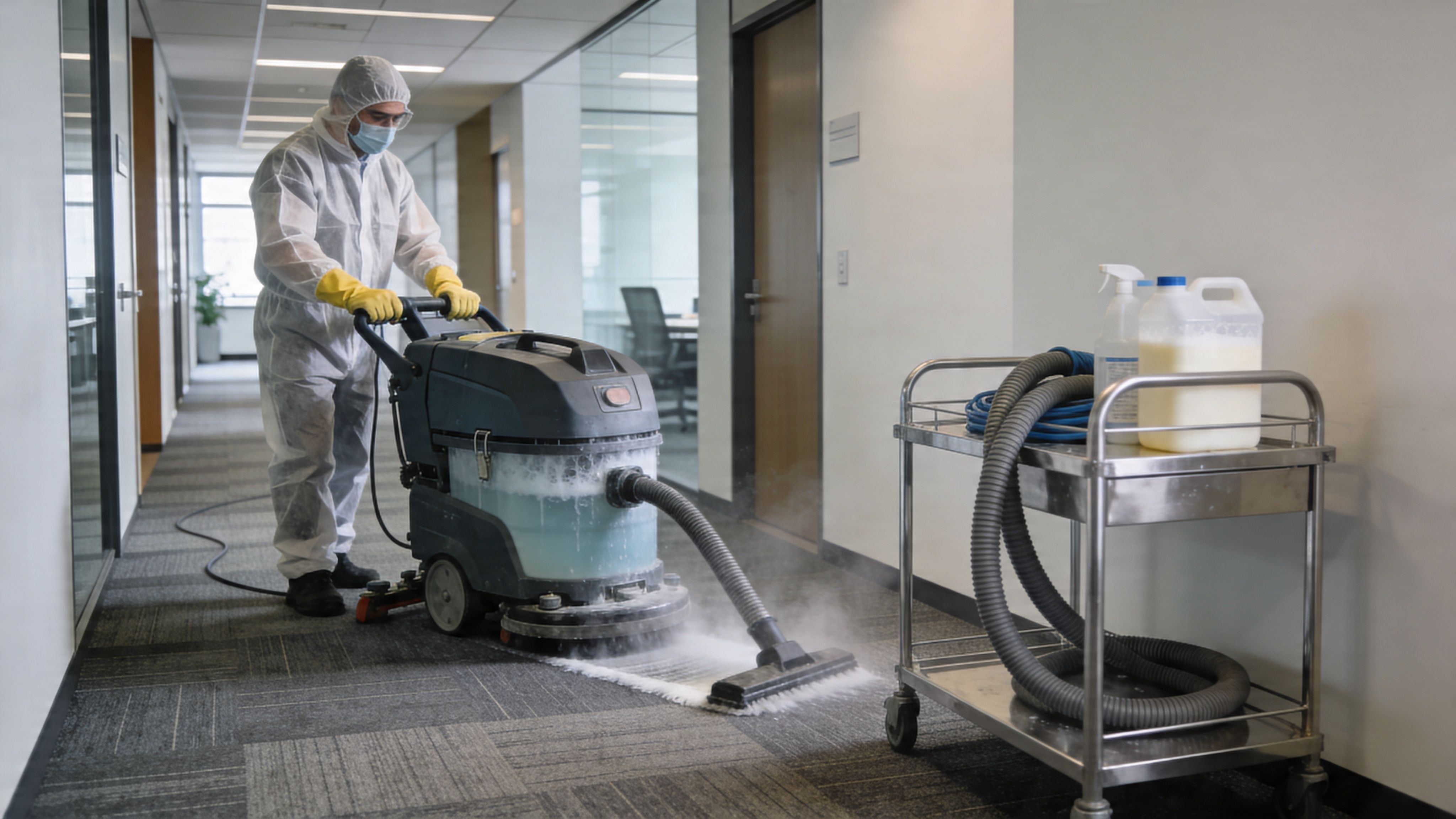
Large facilities can lose hours each week to slow floor care. Automated scrubbers reduce that burden by combining four steps in one pass: applying cleaning solution, scrubbing the surface, recovering dirty water, and leaving the floor ready for traffic sooner than a mop-and-bucket process.
The simplest way to understand a scrubber is to compare it to washing a floor with a sponge and then immediately vacuuming up the dirty water. That recovery step matters. If soil and solution stay on the floor, they can redeposit, leave residue, or increase slip risk.
How to match the machine to the building
Machine choice starts with the building, not the brochure. A ride-on unit may cover open warehouse lanes efficiently, but it can become awkward in narrow aisles, around packing stations, or in mixed office and production areas. A walk-behind unit usually gives better control in tighter layouts and around obstacles.
Floor material also changes the setup. Smooth sealed concrete, epoxy, and resilient flooring do not all respond the same way to pads, brushes, down pressure, or water volume. Using an aggressive brush on the wrong surface is like using a stiff wire brush on finished wood. It may clean, but it can also shorten the life of the floor.
A GTA facility manager usually needs to check five points before approving a machine or service plan:
- Layout and turning space: Measure aisle width, dock areas, and congested corners.
- Soil type: Fine dust, pallet debris, grease film, and tracked-in moisture require different pad, brush, and pre-sweep decisions.
- Dry time expectations: Busy sites often need fast recovery so forklifts and foot traffic can resume safely.
- Chemical control: Confirm which detergent is used, how it is diluted, and whether staff need WHMIS training and SDS access.
- Labour model: Decide whether internal staff will operate and maintain the unit, or whether a contractor providing industrial facility cleaning for warehouses and mixed-use sites will handle machine selection, operator training, and service records.
A practical example makes the trade-off clearer. In an office-distribution hybrid site, a large ride-on scrubber may work well on the warehouse floor but waste time in reception corridors and small break areas. A walk-behind model with the right squeegee width can clean the back-of-house efficiently while smaller tools handle edges, entrances, and detail work.
Vendor review should go beyond machine type. Ask how often pads or brushes are changed, how dirty-water tanks are sanitized, what battery charging process is used, and how the operator adjusts the cleaning method when the floor shifts from dust to oily residue. Those answers show whether the program is built around real operating conditions, safety compliance, and total upkeep cost, rather than around machine size alone.
7. Disinfection and Antimicrobial Floor Treatment
Cleaning removes soil. Disinfection targets microorganisms using approved products and label-specific contact times. Those aren’t the same task, and many facilities blend them too loosely.
In high-risk or highly regulated spaces, floor disinfection may be appropriate after contamination events, during outbreak response, or in settings like dental clinics and treatment spaces. In lower-risk offices, it may be used selectively rather than as a daily whole-floor approach.
Documentation matters
The product has to be suitable for the surface, approved for the intended use, and applied after visible soil is removed. Staff also need WHMIS training, PPE where required, and a record of what was used and when.
A useful real-world example is a childcare centre after a stomach illness event. Standard cleaning may remove visible mess, but the facility may then require a second, documented disinfection step using a Health Canada-approved product and the correct dwell time.
Floors don't stay safer because a stronger chemical was chosen. They stay safer when staff clean first, apply correctly, and keep records.
8. Real-Time Monitoring and Maintenance Scheduling Systems
The newest shift in industrial floor cleaning isn’t only equipment. It’s visibility. Managers increasingly want proof of what was cleaned, when it was cleaned, and whether the result met the site standard.
That’s one reason autonomous and connected systems are getting attention. A market report states that autonomous floor scrubbers command 43% of the global autonomous industrial cleaning market in 2025, with North America showing the highest adoption rates, according to this autonomous industrial cleaning market report. Even where a facility doesn’t adopt robotics, mobile logs and digital inspections can still tighten accountability.
Why scheduling systems matter in GTA facilities
The operational value isn’t just efficiency. It’s also audit readiness, communication, and safety coordination. One under-discussed issue in Ontario is aligning cleaning activity with workplace safety and presence logging in higher-risk industrial environments, including concerns raised around Bill 168 and environmental controls in this discussion of factory floor cleaning problems and compliance gaps.
For example, a warehouse with off-hours cleaning may want timestamped task logs for isolated zones, incident follow-up, and supervisor review. Arelli Cleaning describes a technology-based operating model and serves over 300 clients in the GTA, as stated in the provided company background, which makes this kind of system relevant as one local example of digital oversight in commercial cleaning.
Industrial Floor Cleaning: 8-Method Comparison
| Technique | 🔄 Implementation Complexity | ⚡ Resource Requirements | ⭐📊 Expected Outcomes | Ideal Use Cases | 💡 Key Advantages |
|---|---|---|---|---|---|
| High-Speed Burnishing and Polishing | High, specialized machines and trained operators; prep required | High energy use, burnishing pads, trained staff; low chemical use | ⭐⭐⭐⭐, Mirror-like gloss; extends topcoat life (~25–30%); quick turnaround | Professional offices, high-traffic commercial facilities needing pristine appearance | Cost-effective vs full strip; minimal chemicals; fast results |
| Strip and Wax Floor Restoration | Very high, multi-step process, skilled crews, facility closure often needed | High labour, chemical strippers, machines, curing time (24–48+ hrs) | ⭐⭐⭐⭐⭐, Complete revitalization; long-term protection (5–10 years) | Industrial/warehouse floors, tenant transitions, heavily degraded surfaces | Deep restoration; maximum protection; removes deep stains |
| Power Washing and Pressure Cleaning | Moderate, equipment handling, pressure calibration, runoff control | High water use, pressure washers, hoses, trained operators; hot-water option | ⭐⭐⭐⭐, Rapid, deep removal of oil/grease, mould, and stains; improves safety | Outdoor concrete, loading docks, heavy-duty industrial areas, parking lots | Fast large-area cleaning; effective on stubborn contaminants; eco detergent options |
| Microfibre and Dust Control Mopping | Low, simple to use but requires protocol training and pad care | Low water and chemical use; microfibre pads and laundering facilities | ⭐⭐⭐⭐, Superior dust/bacteria capture; faster reoccupancy; improved air quality | Healthcare, dental, childcare, daily-maintenance offices | Excellent infection control; water/chemical savings; quiet operation |
| Enzymatic and Eco-Friendly Floor Cleaning | Low–Moderate, product-specific dwell times and temperature needs | Biodegradable enzymatic products, time for activation; sometimes repeat apps | ⭐⭐⭐, Highly effective on organic soils; slower action; eco‑friendly | Food service, childcare, healthcare, sustainability-focused facilities | Safe for workers/environment; targets organics; regulatory friendly |
| Automated Floor Scrubbing Machines | Moderate–High, capital investment, operator training, maintenance | High upfront cost ($5k–$50k+), power/batteries, service infrastructure | ⭐⭐⭐⭐⭐, Consistent, uniform cleaning; large labour savings (5–10×) | Large warehouses, manufacturing plants, extensive office spaces | Dramatically reduces labour/time; precise chemical use; data tracking |
| Disinfection and Antimicrobial Floor Treatment | Moderate, requires strict protocols, contact times, possible area closure | Approved disinfectants (Health Canada/EPA), PPE, ventilation, documentation | ⭐⭐⭐⭐, Pathogen elimination; residual protection (up to ~30 days) | Healthcare, dental clinics, childcare, high-contact commercial sites | Strong infection control; regulatory compliance; reduces liability |
| Real-Time Monitoring & Maintenance Scheduling Systems | High, tech integration, customization, staff training, security needs | IoT sensors, software platform, ongoing IT support and training | ⭐⭐⭐⭐⭐, Optimizes frequency, cuts costs (15–25%), improves QA and response | Large facilities, complex schedules, orgs needing cost transparency and compliance | Data-driven scheduling; predictive maintenance; transparent reporting |
Choosing the Right Partner for Your Facility
The right industrial floor cleaning method depends on the floor, the soil, the risk profile, and the building schedule. A law office may need appearance-first polishing and low-disruption maintenance. A warehouse may need scrubbers, pressure cleaning, and documented spill response. A dental clinic may prioritize microfibre systems, disinfection protocols, and product control.
Vendor selection should be just as structured as method selection. Ask whether the provider trains staff on WHMIS, how they document chemical use, what equipment they use for your specific floor type, and how they handle after-hours access, safety reporting, and quality checks. It’s also worth asking how they separate routine cleaning from restoration work, because those are different skill sets.
A practical approach is to compare 2 to 3 quotes and judge them on scope clarity, safety process, communication, and fit for your facility, not just price. Local familiarity matters in the GTA because many buildings combine office, light industrial, warehouse, and regulated-use areas under one roof.
Readers who want to compare providers by region can review Arelli’s service areas in the Greater Toronto Area. Arelli Cleaning is one local option among many and, based on the company information provided, offers industrial floor care, disinfection with Health Canada-approved products, and technology-supported quality tracking. The key is to use informed questions and choose the partner that best matches long-term safety, compliance, and asset-protection goals.