A Toronto property manager usually notices the need for power washing in small ways first. The front walk darkens from traffic and road film. Loading areas pick up grease. Brick near entrances starts to look older than it is. Then the issue stops being cosmetic and turns operational. Staff mention slippery spots, tenants comment on appearance, and regulated facilities start asking whether exterior cleaning fits their compliance routines.
That’s where a practical approach to power wash Toronto decisions helps. For commercial sites, the question isn’t just “How do we make this look better?” It’s also “How do we clean it safely, document it properly, and avoid creating a runoff, liability, or disruption problem?”
Key takeaways
- Commercial power washing is a maintenance service, not just a visual upgrade. It supports safety, presentation, and asset care.
- Toronto buyers should assess compliance as closely as cleaning results. Chemical handling, runoff control, and site protection matter.
- Different property types need different methods. A warehouse yard, school entrance, dental clinic exterior, and office façade shouldn’t be treated as the same job.
- Quotes make more sense when buyers understand the cost drivers. Surface type, access, stain severity, equipment, and service frequency all affect price.
- A strong procurement process reduces risk. Ask for documentation, method statements, and a clear post-service walkthrough.
What Is Commercial Power Washing
A commercial building in Toronto can look tired long before it deteriorates. Snowmelt residue, traffic film, organic growth, gum, food spills, and airborne pollution build up slowly. Owners often assume this is normal aging. In many cases, it’s surface contamination that can be removed with the right method.
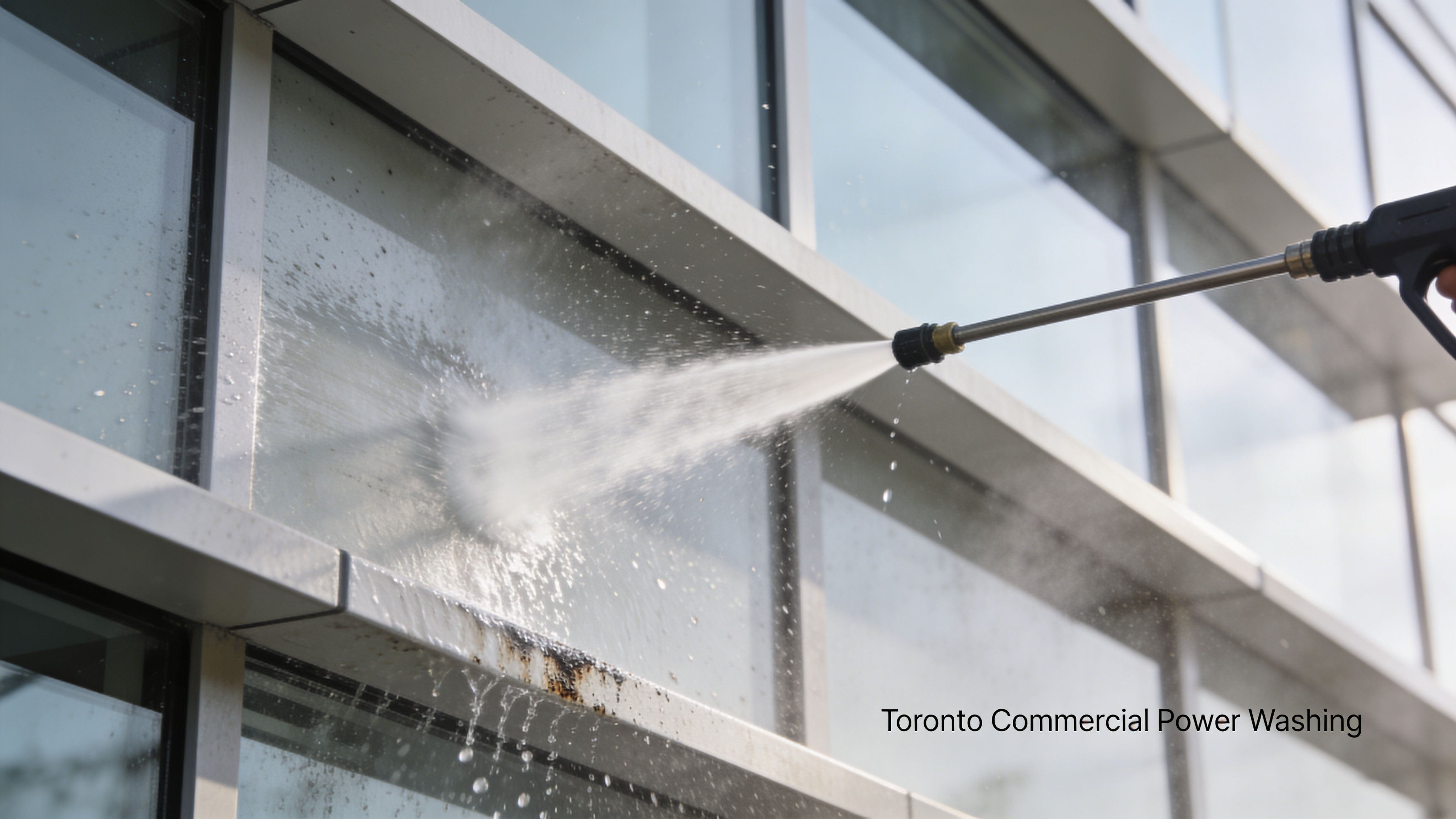
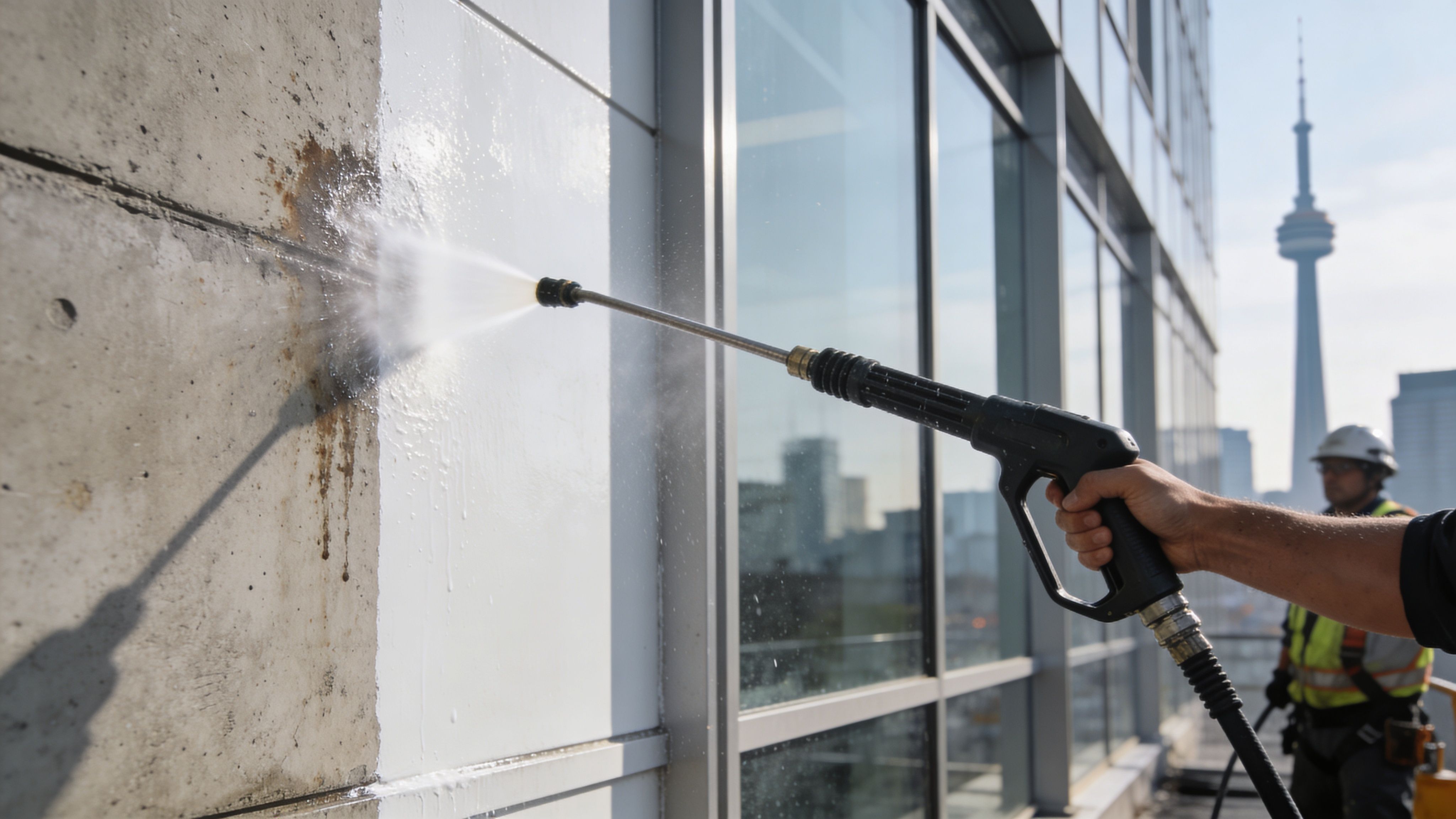
Commercial power washing is the professional cleaning of exterior surfaces using pressurised water, often with heat when the soil load calls for it. In everyday conversation, people often use “power washing” and “pressure washing” as if they mean the same thing. In practice, many contractors use the terms interchangeably, but buyers should still ask what equipment and water temperature will be used.
Why the distinction matters
Heated water is often more effective on grease, oil, and stubborn commercial grime. Cold-water pressure cleaning can still be appropriate for many surfaces, especially when the goal is rinsing away dirt, dust, or seasonal buildup. The important procurement question isn’t the label. It’s whether the contractor has matched the method to the surface and the contamination.
For example:
- Concrete loading zones may need stronger degreasing and careful rinsing.
- Painted surfaces may need lower pressure and more stand-off distance.
- Masonry may need a gentler approach than a heavily soiled service yard.
- Storefront approaches may need stain and gum removal without overspray onto glass or pedestrians.
Practical rule: Ask what surface is being cleaned, what soil is being removed, and what water temperature and pressure range will be used. That answer says more than the service label.
Why Toronto businesses are paying attention
This is an established commercial service category, not a niche add-on. The Canada pressure washer market was valued at USD 338.91 million in 2024 and is projected to reach USD 532.68 million by 2033, with a projected 5.18% CAGR. That growth reflects increasing demand from commercial sectors for efficient cleaning solutions.
For a Toronto facility manager, the business case is straightforward. Exterior cleaning supports first impressions, reduces slip-related residue in some areas, and helps prevent stubborn buildup from becoming harder and more expensive to remove later. It also fits broader property care alongside façade cleaning, window cleaning, and envelope maintenance. Readers comparing service categories may also find this overview of professional exterior restoration for businesses useful because it places power washing within a wider building-maintenance context.
Common Commercial Power Washing Applications in Toronto
Toronto’s commercial sites vary widely, but the underlying pattern is familiar. High traffic creates buildup. Weather drives staining. Operations leave behind residue. A good power wash Toronto plan starts by matching the task to the property type.
The local demand base is large. In the GTA, there are over 500 million square feet of industrial and office space, and 78% of warehouse operators schedule monthly power washing to maintain compliance and safety standards, according to these GTA power washing industry statistics.
Office buildings and commercial fronts
An office building rarely needs the same aggressive cleaning as an industrial yard, but it often needs more finesse. Entrances, sidewalks, exterior walls near grade, and garbage staging areas attract the kind of dirt that undermines a well-managed property. In client-facing sectors such as legal, engineering, and professional offices, this affects perception quickly.
Typical applications include:
- Entrance walk cleaning for traffic film, spills, and seasonal grime
- Façade touch-up cleaning on lower walls and architectural features
- Sidewalk stain removal near smoking areas, planters, and drop-off zones
- Waste-area washdowns where odour and residue become tenant complaints
A downtown building may also combine power washing with glass care and façade access planning. Buyers comparing bundled exterior services can review high-rise window cleaning solutions Toronto to understand where window access and pressure washing scopes may overlap, and where they should remain separate.
Warehouses, loading docks, and manufacturing support areas
Industrial properties have a different soil profile. Forklift traffic, packaging waste, dust, carbon residue, and occasional oil staining create both a housekeeping issue and a safety issue. Here, power washing is less about “freshening up” and more about operational control.
Common uses include:
- Loading dock cleaning where grease, dirt, and tyre marks accumulate.
- Service corridor washing to reset heavily used concrete surfaces.
- Dumpster pad and compactor area cleaning to reduce residue and improve sanitation conditions.
- Exterior wall and bay door cleaning where dust and splashback collect.
A warehouse manager usually notices the benefit after the clean, but the true value appears between cleans. Dirt becomes easier to monitor, spills are easier to spot, and scheduled maintenance becomes more organised.
This short video gives a visual sense of commercial exterior cleaning conditions and equipment in use.
Restaurants, schools, and post-construction sites
Restaurant patios and food-adjacent exteriors often need careful timing and sanitation-minded planning. Schools and childcare facilities need perimeter control, safe scheduling, and residue-free completion. Post-construction cleanup often requires removal of dust, mud, and site-related surface contamination before handover or occupancy.
Exterior cleaning scope should follow actual use conditions. A patio, a school entrance, and a shipping yard may all need pressure cleaning, but they don't need the same process.
Navigating Safety and Environmental Regulations
A commercial power wash Toronto project can create risk if it’s handled casually. Water under pressure can damage surfaces, force contaminants into drains, or create slip hazards in occupied areas. Cleaning chemicals add another layer. For Toronto businesses, especially those in regulated environments, the contractor’s process matters as much as the visible result.
Equipment standards and why buyers should care
Municipal standards provide a useful way to think about professional-grade cleaning. Toronto’s TS 411 sewer cleaning specification requires combination hydro-jet equipment to deliver a minimum flow of 4.1 L/s at 13,800 kPa (2,000 psi), as set out in the City of Toronto TS 411 specification. That standard applies to sewer maintenance, not general building washing, but the principle is relevant: the City expects demanding cleaning work to be done with properly specified equipment, controlled methods, and backflow protection.
For a property owner, that translates into practical questions:
- Is the contractor using commercial-grade equipment suited to the task?
- Do they understand pressure, flow, nozzle selection, and surface sensitivity?
- How do they prevent overspray, backsplash, and water intrusion?
- What’s their approach to hydrant or water access, if applicable?
The point isn’t to ask a sidewalk-cleaning contractor to meet a sewer-cleaning specification. The point is to avoid hiring on appearance alone when the work requires real technical judgement.
Chemical handling and documentation
Commercial cleaning teams working around detergents and degreasers should operate within WHMIS requirements and use products appropriate for the site. This matters even more for dental clinics, schools, and facilities with stricter health expectations. In those environments, exterior cleaning can’t be treated as a disconnected task.
Ask for a simple method statement that covers:
- Products used and whether they align with site requirements
- How runoff will be controlled
- How occupied zones will be isolated
- What documentation will be provided after service
A clean surface is not enough if the contractor can't explain what went down the drain, where the water went, or how the area was made safe for re-entry.
Environmental controls and runoff planning
Many providers describe themselves as “eco-friendly,” but buyers should look past the label. The useful question is operational: what happens to wastewater, loosened debris, and chemical residue during the job?
A sound answer usually includes containment, controlled flow, drain awareness, and site-specific adjustments. The buyer doesn’t need a technical dissertation. They do need confidence that the contractor has thought about stormwater pathways, nearby landscaping, pedestrian routes, and any sensitive receiving areas on the property.
For properties near public walkways, planted areas, or drainage points, ask the vendor to point out the runoff plan on-site before work starts. If they can’t explain it clearly, the risk is being transferred back to the client.
Understanding Power Washing Costs in Toronto
A Toronto property manager usually asks the same question first: what will this cost? The hard part is that two buildings with the same square footage can price very differently. One may be a straightforward sidewalk and facade wash. The other may involve heavy grease, tight pedestrian areas, sensitive drainage points, and work that has to happen after hours to reduce business disruption.
Price follows risk and labour more than it follows appearances.
A useful quote reflects the cleaning task itself, but it also reflects what the contractor must control while doing it. For commercial sites in Toronto, that often includes runoff management, occupied-area protection, access planning, and documentation. Those items do not make a quote look dramatic. They do explain why a low number on page one can become an expensive decision later.
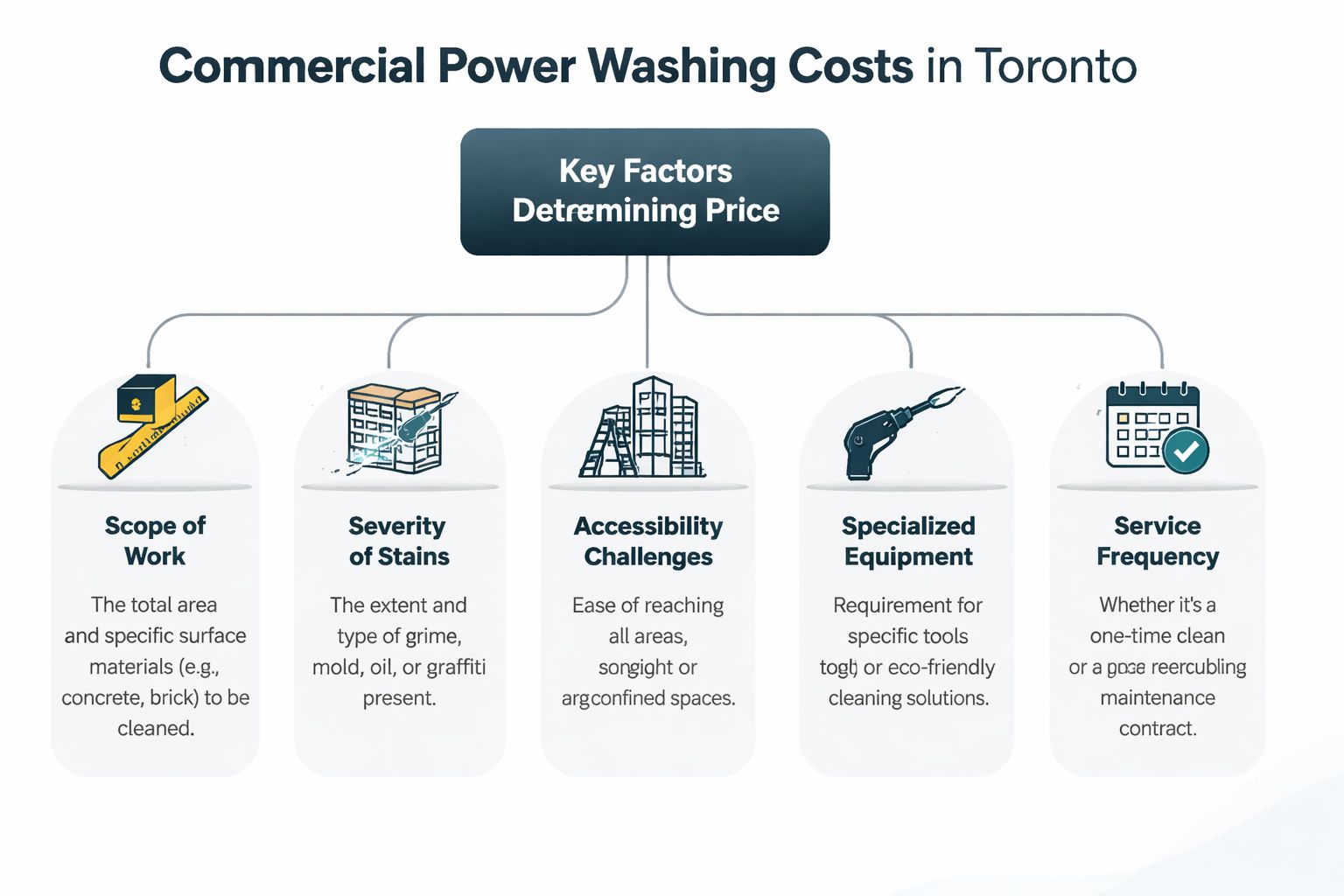
The five cost drivers buyers should look for
| Cost driver | What it affects |
|---|
| Scope of work | Total area, number of surfaces, and whether the work includes spot treatment or full cleaning |
| Severity of stains | Cleaning time, detergent choice, repeat passes, and cleanup requirements |
| Accessibility | Lift access, long hose runs, traffic control, and scheduling around tenants or customers |
| Specialised equipment | Hot water systems, recovery equipment, and tools matched to concrete, masonry, or coated surfaces |
| Service frequency | One-time restoration usually costs more per visit than planned maintenance |
How providers may structure pricing
Commercial power washing is usually priced in one of three ways:
- Per square foot for large, repeatable surfaces
- Hourly when access or soil conditions are difficult to predict
- Flat project fee after a site assessment defines the scope clearly
The pricing model matters because it changes who carries the uncertainty. Hourly pricing puts more variability on the client if site conditions are unclear. A flat fee shifts more estimating risk to the contractor, which is why experienced vendors insist on seeing the property first.
For budgeting, treat power washing like pavement repair or window restoration. The visible cleaning is only one part of the service. The rest is planning. If a contractor is accounting for drain protection, safer chemical use, staging, and rework risk, the quote will often come in higher than one built around labour alone. Buyers comparing proposals can review the scope on a commercial power washing service page to see how different providers describe inclusions, exclusions, and site conditions.
What makes a quote expensive for the right reason
A higher quote can be justified when it reduces exposure for the property owner or facility team.
Look for value in items such as:
- Surface-specific cleaning methods that reduce the chance of etching, striping, or joint damage
- Runoff control measures for areas near drains, planted edges, or public walkways
- Access and pedestrian planning for retail fronts, schools, clinics, and occupied office sites
- Clear documentation on scope, assumptions, and completion status
A cheap quote often leaves out the parts that prevent complaints, call-backs, and liability questions. It may still produce a clean surface for the day. It may also leave the client explaining damage to a sign face, overspray near an entrance, or wastewater concerns after the crew has left.
The practical question is not just, “What does this job cost?” It is, “What risks are included in that price, and which ones are being left for my team to handle?”
What to Expect During a Professional Power Washing Service
A well-run project should feel organised from the first visit to the final walkthrough. Most clients don’t need to know every nozzle type or pump detail. They do need to know what will happen on-site, when people will be working, and what preparation is expected.
Before the crew arrives
The process usually starts with an assessment. The contractor reviews surfaces, access points, drainage conditions, operating hours, and any sensitive zones such as entrances, air intakes, patios, windows, or garden beds. A useful quote describes what is included, what is excluded, and what assumptions have been made.
Clients should also expect scheduling coordination. On a busy property, the best service window may be early morning, after hours, or during lower traffic periods. If the work is part of a broader cleaning plan, some buyers also review related service information such as commercial power washing support to compare scope, preparation, and service fit.
What happens on service day
On the day of work, the crew should arrive with a clear plan for water access, hose routes, equipment staging, and pedestrian control. Sensitive areas are usually protected first. Then the team performs the cleaning in sections so runoff and site safety remain manageable.
A client may notice:
- Noise from equipment, especially on larger jobs
- Temporary restricted access around active work zones
- Pre-treatment of stains before the main wash begins
- Final rinsing and debris collection before reopening the area
Good contractors don't just clean. They control the site while they clean.
What completion should look like
A professional finish includes more than a wet surface and packed-up hoses. The client should get a walkthrough, especially for larger or more sensitive sites. This is the time to confirm any permanent staining, areas that improved but didn't fully restore, and any recommendations for future maintenance.
The area should be left orderly, with barriers removed when safe and obvious hazards addressed before handover. If the site is regulated or inspection-sensitive, ask for written confirmation of products used and any site notes relevant to compliance records.
A Hiring Checklist for Your Power Washing Contractor
Many buying mistakes happen because the discussion stays too general. “Can you clean this building?” is easy for almost any vendor to answer. A better approach is to ask questions that reveal how the contractor thinks about risk, surfaces, documentation, and occupied sites.
For regulated environments like dental clinics or schools, it’s especially important to ask how the service integrates with Health Canada-approved disinfection protocols and how the provider documents the work for compliance reviews, as noted in this discussion of a common market gap in Toronto pressure washing service content.
Contractor vetting checklist
| Category | Question to Ask | Why It Matters |
|---|
| Insurance and compliance | Do you carry liability coverage and can you provide proof before work starts? | Exterior cleaning can affect people, vehicles, glazing, and surfaces. Documentation reduces client exposure. |
| Insurance and compliance | Are your staff trained on chemical handling and site safety procedures? | The client needs confidence that detergents, equipment, and occupied areas are being managed properly. |
| Site-specific planning | What is your runoff and wastewater control plan for this property? | This helps the buyer assess environmental risk, drain protection, and cleanup quality. |
| Site-specific planning | How will you protect doors, windows, signage, electrical points, and landscaping? | Good surface care includes protecting adjacent assets, not only cleaning the target area. |
| Equipment and method | Will you use hot or cold water, and why is that method appropriate here? | The answer shows whether the contractor understands the surface and soil type. |
| Equipment and method | What pressure-control approach do you use for delicate materials? | “High pressure” is not a method. Surface-specific control prevents etching, paint failure, and water intrusion. |
| Operational fit | Can you work around our business hours or patient, student, or tenant traffic? | Cleaning quality means little if the site becomes disruptive or unsafe during operations. |
| Operational fit | What access, water source, and shutdown coordination do you need from us? | This reduces delays and avoids service-day confusion. |
| Documentation | Will you provide a written scope, exclusions, and completion notes? | Written records make quotes comparable and support internal approval processes. |
| Regulated environments | How does your process align with our hygiene or inspection requirements? | Clinics, schools, and similar facilities often need more than visual cleaning. They need documented process control. |
| Experience | Have you cleaned similar property types before? | Surface type and operational context matter. A restaurant patio and a warehouse yard are not interchangeable jobs. |
| Quality assurance | Who signs off on the work, and how are deficiencies handled? | Buyers need a clear path for follow-up if part of the scope is missed. |
What to avoid during procurement
Some warning signs are simple:
- Vague scope language such as “full cleaning as needed” without listing surfaces
- No explanation of runoff control
- One-method proposals that don't distinguish between materials
- No mention of scheduling controls for occupied sites
- No written exclusions on stains, access limits, or permanent surface damage
A careful buyer doesn’t need the longest quote. They need the quote with the fewest assumptions left unstated.
Developing a Maintenance Schedule and Next Steps
Most commercial power washing works best as a maintenance cycle, not a rescue project. A neglected property usually takes more effort, more chemistry, and more disruption to restore. A scheduled approach keeps surfaces manageable and makes budgeting easier.
A simple planning framework
Use site conditions to set frequency:
- High-traffic entrances and sidewalks may need more frequent attention because appearance and slip risk change quickly.
- Loading docks, waste pads, and service yards often benefit from recurring cleaning tied to operational demands.
- Office façades and lower exterior walls are commonly reviewed on a periodic basis rather than cleaned only when they look poor.
- Schools, clinics, and other regulated sites should align cleaning windows with occupancy, inspection needs, and hygiene protocols.
The right schedule is the one that matches actual dirt load, use patterns, and risk. It doesn’t need to be aggressive. It needs to be deliberate.
Further reading
Internal resources
External resources
One practical next step is to shortlist 2 to 3 qualified vendors, walk the site with each one, and use the checklist above to compare them on method, risk control, and documentation. For buyers who want another option in that comparison set, Arelli Cleaning is one Toronto provider that offers commercial power washing as part of a broader cleaning program, with details on support structure and service scope available through its public materials.
Use the checklist. Ask specific questions. Compare quotes on process, not just price. That’s how Toronto businesses turn power washing from a reactive purchase into a controlled maintenance decision.








.webp)