Some office cleaning problems don't look serious at first. A bin gets missed in one meeting room. The kitchenette counter stays sticky until noon. Washroom supplies run low because everyone assumed someone else had checked them. Over a few weeks, those small misses turn into a pattern that staff notice and visitors remember.
That's usually the moment a business owner starts searching for an office cleaning schedule template. Not because they want more paperwork, but because they want a system that keeps standards steady without constant follow-up. A useful template does exactly that. It turns cleaning from a set of vague expectations into a repeatable operating routine.
Why a Cleaning Schedule Is More Than a Checklist
Monday starts calmly enough. By 10:30, a client has noticed smudged entry glass, the kitchen bin is full, and someone is looking for paper towels in the washroom. Nothing has failed in a dramatic way. The problem is that cleaning is being handled as a series of interruptions instead of a managed routine.
That difference matters.
A proper office cleaning schedule template sets a standard, assigns responsibility, and creates a record of what was done. In practice, it works like a maintenance map for cleanliness. It tells your team what must happen, how often it must happen, and how to confirm it happened. For Canadian businesses, that structure also supports a more disciplined approach to workplace hygiene, health expectations, and vendor coordination.
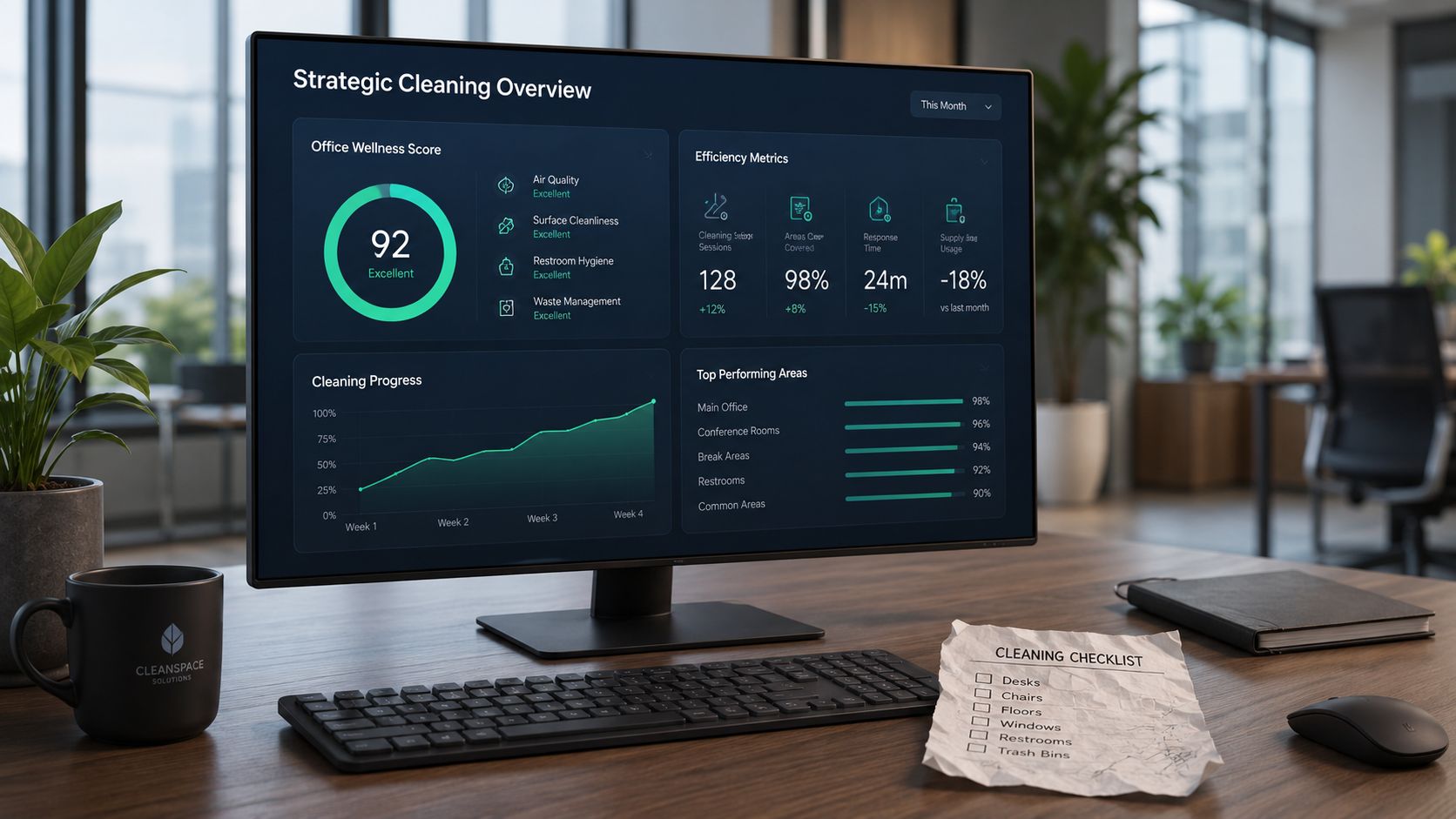
In a real office, “clean” is not one universal condition. A law office with frequent visitors has different pressure points than a small accounting firm where staff use the kitchen all day and clients rarely come on site. A schedule should reflect traffic, risk, and business priorities. That is why many owners begin by reviewing local service standards and practical examples such as Toronto office cleaning services for commercial spaces.
What the schedule actually manages
The schedule is doing several jobs at once. Cleaning is only one of them.
It sets the baseline for appearance, but it also controls communication between staff, supervisors, and any outside cleaning provider. It reduces the common problem of assumed responsibility, where everyone believes someone else handled the task. It also gives managers something more useful than memory. It gives them proof.
A good schedule usually answers four questions:
- What needs attention
- How often it needs attention
- Who is responsible for it
- How completion is checked or recorded
Those four points are simple, but they change the whole system. Without them, standards drift. With them, cleaning becomes repeatable.
Why this matters for Canadian offices
In Canada, office cleaning is tied to more than appearance. It supports workplace health, safer shared spaces, and documented due diligence. In Ontario, employers are expected to maintain a workplace that is safe and properly supplied, and public health guidance has long emphasized routine attention to high-touch surfaces and shared amenities. The exact schedule will vary by office, but the principle stays the same. Tasks with health, safety, or occupant-impact consequences should never rely on memory alone.
That point is easy to miss in a small business. Owners often assume formal cleaning systems are for larger companies with multiple floors and a facility team. In fact, smaller offices usually feel the effects of inconsistency faster because one missed task is more visible, and responsibilities are often split between an office administrator, employees, and a cleaning contractor.
From task list to operating system
A checklist says, “wipe counters” or “empty bins.”
An operating system says who checks the counters after lunch, what bins are emptied daily versus twice daily, where the restocking supplies are stored, and how missed work is reported. That is a true jump in quality.
The easiest way to understand it is to compare it to snow removal. If you only respond after someone slips, you do not have a winter plan. You have a reaction. Office cleaning works the same way. Professional standards come from defined routines, clear thresholds, and documented follow-through.
That is why a cleaning schedule deserves more respect than a one-page list on a clipboard. Used properly, it becomes the control panel for consistency, compliance, and service quality.
The Structure of an Effective Cleaning Schedule
A strong office cleaning schedule template works like a route map for the building. It shows what must be done, how often, by whom, and how completion is recorded. Without that structure, cleaning turns into a string of good intentions. One person wipes what they notice. Another skips a task because they assume it was already handled. Standards drift fast.
Many small offices make the same mistake at this stage. They build the schedule around rooms first, then keep adding tasks until the list becomes hard to use. A better method is to build the schedule around time. Frequency creates order. Rooms and task details fit into that order afterward.
Build the schedule by time cycle
Start with the rhythm of the building.
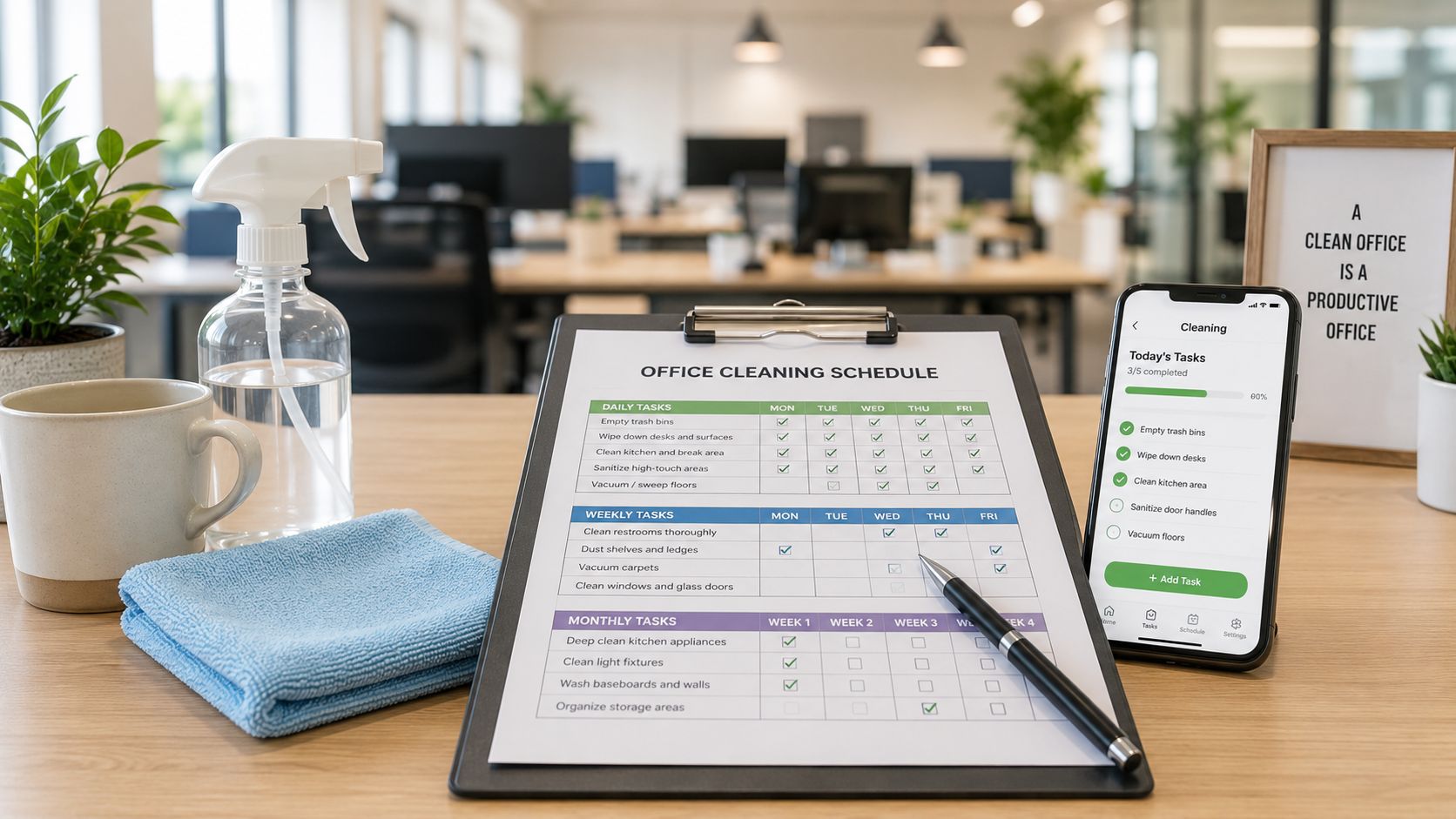
Daily work protects hygiene, appearance, and supply levels. Weekly work removes the buildup that starts to show after several days of normal traffic. Monthly work covers the edges, vents, fixtures, and low-attention areas that shape overall cleanliness even when people do not notice them right away.
That time-based structure matters because cleaning is partly about health and partly about drift control. Dust, odour, grime, paper waste, fingerprints, and depleted supplies do not all build at the same speed. A useful schedule matches the task to the rate of decline.
A workable schedule gives each task a clear time cycle, a clear owner, and a clear standard.
Sample office cleaning schedule framework
| Area | Daily Tasks | Weekly Tasks | Monthly Tasks |
|---|
| Reception and lobby | Empty bins, spot-clean entry glass, wipe high-touch points, tidy seating | Dust ledges and trim, clean interior glass more thoroughly, vacuum edges | High dust vents, detail baseboards, clean behind movable furniture |
| Workstations | Remove waste, disinfect shared-touch surfaces, tidy common equipment areas | Dust surfaces, vacuum or mop around desks, wipe partitions | High dust shelves, clean upholstery, detail low-traffic corners |
| Meeting rooms | Wipe tables, disinfect shared controls and touchpoints, reset chairs | Clean glass panels, detail presentation equipment surfaces, vacuum thoroughly | High dust fixtures, spot-clean walls, deep detail furniture |
| Washrooms | Sanitize toilets, sinks, counters, mirrors, restock consumables, empty bins | Deep-clean partitions, detail dispensers, scrub edges and corners | Detail vents, walls, baseboards, descale problem areas if needed |
| Kitchen and break area | Wipe counters, sinks, appliance handles, tables, empty waste and recycling | Clean appliance exteriors, mop thoroughly, detail cabinet fronts | Clean vents, detail behind movable items, deep-clean upholstery and neglected edges |
This matrix also works well when paired with a broader preventive maintenance schedule. In real facilities, cleaning and maintenance affect each other every day. Dust from neglected vents settles onto surfaces. Worn flooring traps soil. Poorly maintained washroom fixtures create stains and odours that no cleaner can fully solve with surface work alone.
What the template should include
The task list is only one layer. A usable template also needs operating details so different people can follow the same standard.
- Area names: Reception, washrooms, kitchen, meeting rooms, workstations, copy area
- Task descriptions: Short, visible actions such as “disinfect door handles” or “restock paper products”
- Frequency markers: Daily, weekly, monthly, plus extra checks for high-use areas if needed
- Responsible party: In-house staff, porter, evening cleaner, or outside contractor
- Verification method: Initials, date, digital sign-off, or supervisor review
- Notes field: Spills, supply shortages, blocked access, or tasks deferred for a reason
For Canadian businesses, a simple template starts becoming an operating system. The schedule should support basic workplace health expectations, document who handled sanitation-sensitive areas, and make it easy to show consistency if a manager, client, or inspector asks how cleaning is controlled. Digital checklists can help, but even a paper form can do the job if the fields are clear and the records are kept.
Supplies also need to match the schedule. If the template calls for floor care, washroom sanitizing, and glass detailing, the site must have the right tools and consumables available. Many offices review their cleaning supplies setup and storage plan while building the schedule so the written standard matches what can be delivered.
Common template mistakes that cause failure
Vague wording is the first problem. “Clean kitchen” leaves too much to judgment. “Wipe counters, sink, table surfaces, microwave handle, and fridge pull” is far easier to check and repeat.
The second problem is copying a large-office template into a small business without adjusting for staffing, traffic, or budget. A schedule only works if the people assigned to it can complete it consistently.
Ownership failures are just as common. If reception bins are emptied by whoever notices them, they will sometimes sit too long. If the break room is “everyone's job,” it often becomes nobody's routine.
The last problem is leaving no space for exceptions. Weather, client events, staff meetings, illness outbreaks, and seasonal mud can all change cleaning demand. Good schedules leave room for notes, extra service requests, and documented follow-up.
The best template is easy to read, easy to audit, and easy to adapt without lowering the standard.
Customizing Your Template for Your Unique Office
Monday morning often exposes the weakness of a generic cleaning template. The reception floor still shows Friday's salt and slush. The kitchenette is spotless, but no one cleaned the shared printer station that twenty people touched before 9 a.m. The problem is not effort. The problem is that the schedule was built as a list of rooms instead of a map of how your office works.
A good template works like a maintenance plan for a vehicle. You do not service every part at the same interval. You pay closer attention to what gets the most use, the most wear, and the highest scrutiny. Office cleaning works the same way. Two businesses with the same square footage can need very different routines because traffic, layout, client expectations, and seasonal conditions change the standard.
Canadian offices often feel this more sharply. Winter moisture, entry salt, flu-season precautions, and shared hybrid schedules all change cleaning demand. A useful template should reflect local operating conditions, basic health-and-safety expectations, and the practical question every owner asks: what must be cleaned, how often, by whom, and to what standard?
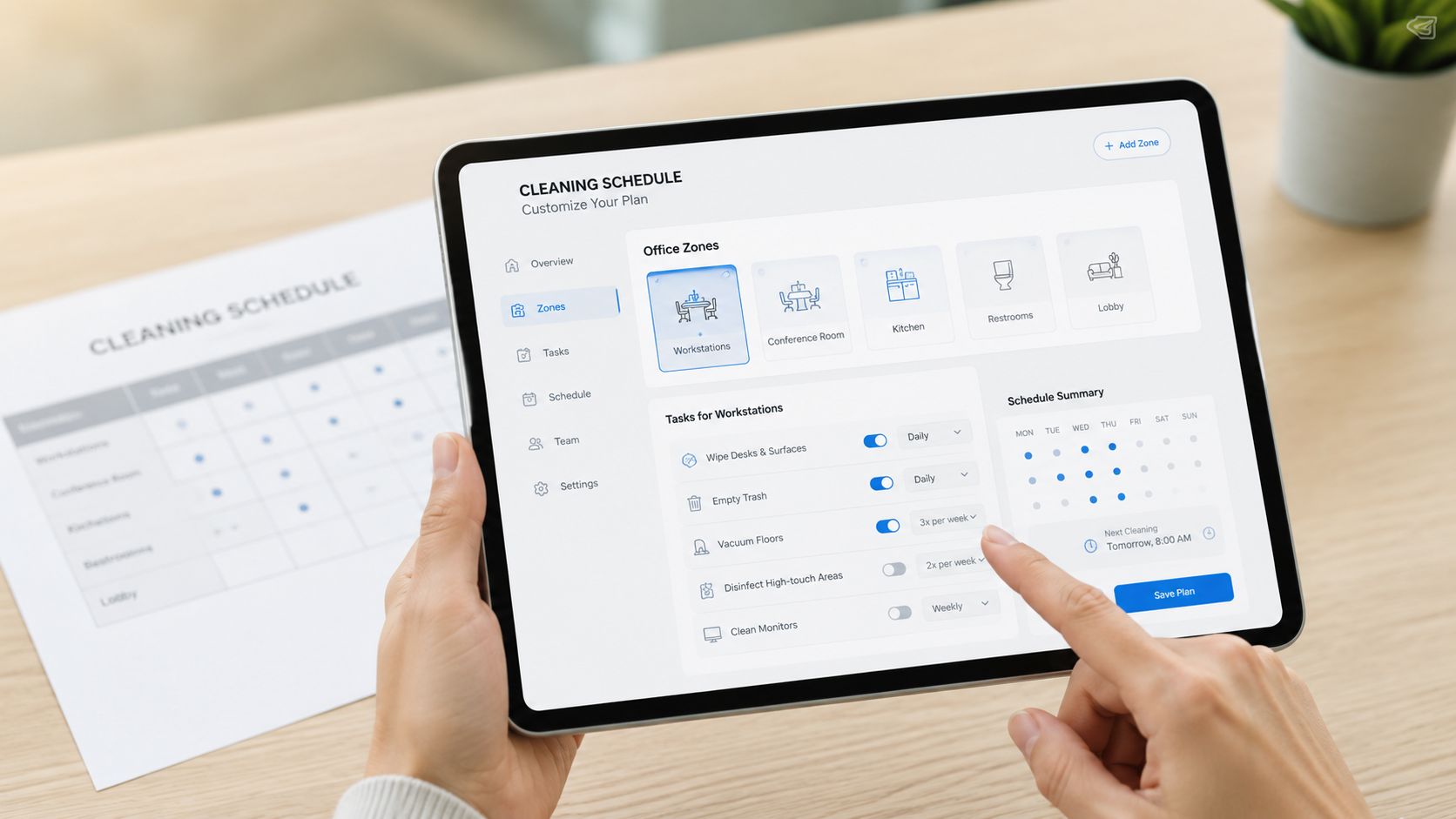
Three variables that should change the template
Industry and business type
Your business model shapes your cleaning priorities. A client-facing office needs polished first-impression areas. A staff-dense office usually needs tighter control of lunchrooms, washrooms, and shared touchpoints. A warehouse office connected to operations may track in dust, grit, and moisture all day.
Examples:
- Law office: Reception seating, entry glass, meeting rooms, and client washrooms deserve close attention because visitors judge the business before a meeting even starts.
- Dental or medical admin office: Front-desk counters, payment areas, pens, door hardware, and washrooms need clear, repeatable touchpoint cleaning.
- Warehouse office: Floor edges, entry mats, breakroom floors, and dust transfer zones often need more frequent service than desks or private offices.
Layout and shared space design
Layout changes how soil moves. Open offices spread debris and fingerprints across shared equipment. Private-office layouts often concentrate mess in corridors, kitchens, and common washrooms. One central lunchroom can create a daily surge of crumbs, spills, and waste that several small kitchenettes might spread out more evenly.
This is why room names alone are not enough. “Kitchen” is too broad if one kitchen serves forty people and another is just a coffee station.
Occupancy rhythm
Usage patterns matter more than assumptions. Hybrid offices are the clearest example. If staff gather mainly from Tuesday to Thursday, your template should put more labour on those days for washrooms, kitchens, meeting rooms, waste removal, and front-entry care.
A shorter schedule can outperform a longer one if it follows real traffic.
Build the template by zone, then by risk
A practical way to customize your schedule is to sort each area into one of four categories:
- High-touch zones: Entry doors, elevator buttons, printer panels, fridge handles, faucet handles
- High-visibility zones: Reception, boardrooms, front glass, guest seating, client washrooms
- High-soil zones: Entrances, mats, lunchrooms, copier areas, warehouse-office transitions
- Low-use zones: Storage rooms, archive areas, closed offices, seldom-used meeting rooms
That structure makes the schedule easier to adjust without lowering standards. It also makes audits easier because you can explain why one area is checked three times a day and another once a week.
Use these questions to refine the template:
- Which surfaces are touched by nearly everyone?
- Which spaces shape a visitor's first impression?
- Which rooms spike on certain days or times?
- Which tasks are appearance-driven, and which are health-driven?
- Which low-use spaces can move to a reduced frequency without creating dust, odour, or clutter problems?
Business owners often get stuck on the split between in-house duties and contractor duties. A practical reference point is a defined office cleaning service scope for commercial workplaces, then adjusting it to your site, staffing, and budget. That turns a basic template into an operating system instead of a wish list.
A practical example
Consider a hybrid professional office with eighty staff assigned to the space but only half present on most Mondays and Fridays. Tuesday through Thursday are the heavy-use days. If the same cleaning routine runs every weekday, labour gets wasted in quiet zones while busy zones fall behind.
A better template would increase service on peak days for:
- Conference rooms: Table disinfection, chair resets, whiteboard cleaning, touchpoint wiping
- Kitchen: Counter cleaning, sink care, microwave handle wiping, bin checks, floor spot cleaning
- Washrooms: Restocking, mirror touch-ups, fixture sanitation, waste removal
- Reception: Entry glass, seating surfaces, door hardware, mat checks
Then Monday and Friday can carry different work. Those quieter days are well suited to detail dusting, interior glass, low-use office cleaning, supply counts, and periodic tasks that are easier to complete when rooms are empty.
That is the main shift small businesses need to make. Stop treating the template like a calendar with equal boxes. Treat it like a staffing plan tied to use, risk, appearance, and compliance. Once you do that, the schedule becomes easier to follow, easier to adapt, and much easier to defend if standards are ever questioned.
Implementing Your Schedule for Accountability and Compliance
Tuesday at 10:30 a.m., a client arrives early for a meeting. The reception desk looks fine, but the washroom is low on soap, fingerprints are visible on the boardroom glass, and the kitchen bin is already full. On paper, cleaning was "done." In practice, the schedule failed because no one could prove what was cleaned, who checked it, or what standard was expected.
That is the difference between a checklist and a system. A good office cleaning schedule assigns work, sets a clear standard, records completion, and creates a simple way to confirm that the work matches the condition of the space.
It also supports compliance. Canadian businesses need more than good intentions when they maintain shared workplaces. High-touch surfaces, washrooms, kitchens, and waste areas need routine attention as part of normal hazard control and workplace hygiene. If a staff concern, inspection, contractor dispute, or illness complaint comes up, a documented schedule helps show what was planned, what was completed, and where follow-up was required.
Build a simple responsibility matrix
Many small businesses get stuck here because "everyone helps" sounds practical. It rarely works for recurring cleaning. Shared responsibility works like a hallway with no name on the office door. People assume someone else has it.
A simple matrix fixes that by giving each task one primary owner, one backup, and one method of verification.
| Task type | Primary owner | Backup owner | Verification |
|---|
| Daily washroom service | Cleaning staff or contractor | Office administrator | End-of-shift check |
| Kitchen wipe-down and bin removal | Cleaning staff | Designated site contact | Visual inspection |
| Supply restocking | Day porter or office staff | Cleaner | Stock check |
| Weekly floor care | Cleaner or contractor | Supervisor | Checklist sign-off |
| Monthly deep-detail tasks | Supervisor-scheduled cleaner | Contractor lead | Logged completion |
The point is not bureaucracy. The point is clarity. If a task slips, you can see whether the issue was workload, training, timing, or follow-through.
Set inspection rules before problems appear
A weekly inspection should be short enough to happen every week and specific enough to catch drift. Ten focused minutes often tells you more than a stack of unchecked forms.
Look for signs that standards are slipping:
- Are high-touch points clean at hand level, not just at eye level?
- Are washrooms stocked, dry, and free from buildup around fixtures?
- Does the kitchen smell clean rather than perfumed?
- Are corners, edges, vents, and glass getting missed?
- Do completed logs match the actual condition of the area?
If the record says the work was finished but the room shows otherwise, the gap is usually one of four things. The task was unclear, the time allowed was unrealistic, the cleaner was not trained on the standard, or nobody verified the result.
Keep records that people will actually use
A cleaning log should work like a shift handoff notebook. It needs enough detail to be useful, but not so much detail that staff stop filling it out by Wednesday.
For most offices, a practical log includes:
- Date and time
- Area serviced
- Task completed
- Name or initials
- Issue noted
- Follow-up required
That small record does real work. It helps during contractor transitions, covers recurring complaints, shows patterns in supply use, and gives managers something concrete to review instead of relying on memory.
For Canadian offices, this matters even more in shared environments where staff, visitors, and service providers all use the same kitchens, washrooms, meeting rooms, and entry points. A schedule without records is hard to defend. A schedule with simple, consistent documentation is much easier to manage.
Create an escalation path for exceptions
No cleaning template should treat every problem as routine. Coffee spills, body fluid incidents, broken soap dispensers, overflowing sanitary bins, and wet floor hazards need a separate response.
Write that into the schedule. Staff should know:
- What must be handled immediately
- What should be reported to maintenance
- What requires protective equipment or restricted access
- Who has authority to call the cleaning contractor back
- Where the incident is recorded
This is one of the main differences between a basic checklist and an operational system. The schedule handles routine work. The escalation path handles exceptions without confusion.
Questions that strengthen accountability
Use these questions when reviewing your template with office staff or a cleaning provider:
What to ask
- Can a new person understand the task without verbal explanation?
- Is each shared space assigned to a person, shift, or vendor?
- Do high-risk areas have a clear cleaning frequency and verification step?
- Can you tell, at a glance, what was completed today and what was missed?
- Does the schedule reflect your actual office hours, occupancy pattern, and local compliance needs?
What to avoid
- Vague sign-offs: "Done" without an area, time, or name.
- One-size-fits-all frequencies: A busy lunchroom and a quiet storage room should not be scheduled the same way.
- No backup coverage: Vacations, sick days, and contractor changes should not stop routine cleaning.
- Hidden quality standards: If reception glass, boardroom setup, or washroom restocking must look a certain way, state it directly.
- Paperwork no one reviews: Logs only matter if someone checks them and acts on problems.
A useful cleaning schedule does more than list chores. It creates a visible chain of responsibility, supports workplace hygiene expectations, and gives your business a record you can rely on when standards are questioned.
Integrating Your Schedule with Professional Services and Technology
A cleaning schedule becomes even more valuable when a business grows beyond ad hoc cleaning. It gives structure to outsourcing, helps compare quotes properly, and makes service quality easier to monitor. That matters because the Canadian business environment is heavily made up of smaller employers. Statistics Canada reported about 1.7 million businesses in Canada in 2023, and 95.6% of employer businesses had fewer than 100 employees, as cited in this office cleaning checklist and inspection template reference. For offices in that size range, repeatable systems matter more than custom paperwork for every site.
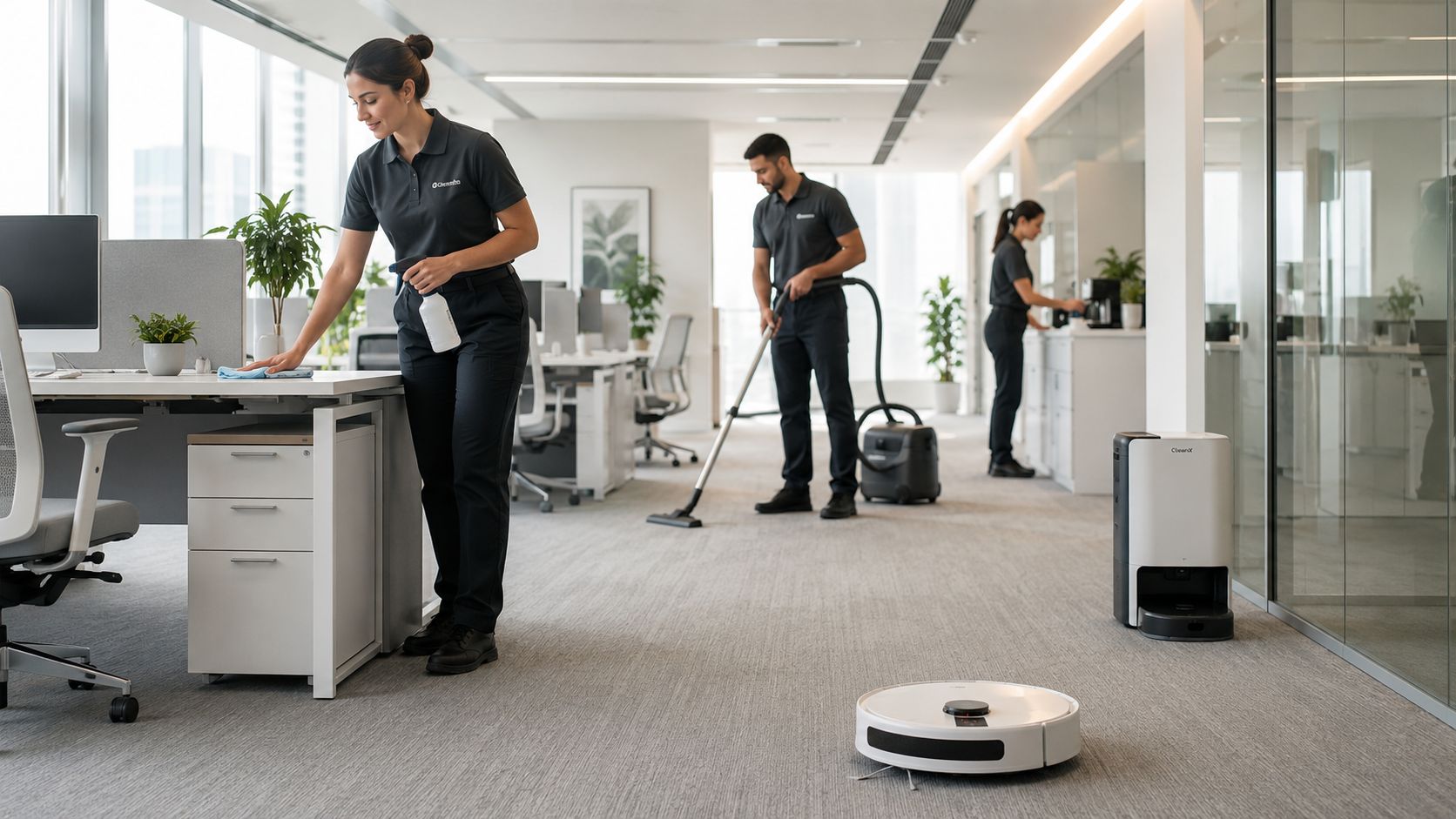
Use the template as a scope of work
When a business asks for quotes without a schedule, it usually gets uneven proposals. One company may price for basic nightly service. Another may include washroom restocking, interior glass, and periodic deep-detail tasks. The numbers aren't directly comparable because the scope isn't controlled.
A better approach is to send the same template to each provider and ask them to mark:
- What's included
- What's excluded
- Which tasks are periodic
- Who supplies consumables
- What quality checks are used
That turns the office cleaning schedule template into a working scope of work.
Where technology helps
Digital tools are useful when they solve specific management problems. For office cleaning, that usually means three things:
- Task visibility: Supervisors can see whether scheduled work was completed.
- Real-time notes: Cleaners can flag spills, low stock, or access problems as they happen.
- Consistent inspections: Site contacts can review the same standards each time.
Some businesses still do fine with laminated checklists and initials. Others prefer app-based tracking. The right choice depends on how often the site changes, how many people are involved, and how much after-hours service needs to be monitored.
One example in the GTA market is commercial disinfection and sanitizing support, where scheduled high-touch routines and documented completion often matter as much as the actual task list. The technology layer helps only if it reinforces that discipline.
When to outsource and when to keep it in-house
A business doesn't always need a full outsourced contract. Sometimes the right model is mixed.
Keep tasks in-house when:
- Staff can reasonably handle light daytime resets
- The office is small and occupancy is stable
- The work is simple and easy to verify
Outsource when:
- Cleaning quality is inconsistent
- Shared spaces create regular complaints
- Deep cleaning and floor care are being postponed
- Managers are spending too much time supervising basics
Specialized environments need even tighter scope language. For example, a healthcare-adjacent office will often need room-by-room specificity, touchpoint control, and stronger inspection routines. A practical comparison point is this guide for Greater Hartford medical offices, which shows how much more precise service expectations become in regulated or semi-clinical spaces.
Professional cleaning works best when both sides can point to the same written standard.
FAQs and Further Reading
A cleaning schedule often looks settled on paper, then real office life starts pressing on it. Staff change desks. Meeting rooms sit empty for two days, then fill up all afternoon. A washroom that seemed low-use suddenly becomes a problem area. That is why the questions at the end matter. They show whether the schedule can hold up as an operating system, not just a checklist.
FAQ Block
| Question | Answer |
|---|
| What's the difference between cleaning, sanitizing, and disinfecting? | Cleaning removes dust, soil, spills, and other visible residue. Sanitizing reduces contamination on surfaces where that standard is appropriate. Disinfecting uses a product meant to control harmful microorganisms on higher-risk surfaces, and it only works when the label instructions are followed. In practice, the choice depends on the surface, the product, and how the space is used. |
| How often should an office cleaning schedule be updated? | Review it whenever occupancy, layout, staffing, or business activity changes. For many Canadian offices, that means checking it seasonally as weather, foot traffic, and hybrid attendance patterns shift. A good rule is simple: if the building is being used differently, the schedule should be adjusted too. |
| Who should own the schedule inside the business? | One person should control the master version. That is usually the office manager, operations lead, or facility contact. Tasks can be shared across staff or vendors, but one owner keeps revisions, sign-offs, and service expectations from drifting. |
| Should small offices use the same template as larger ones? | They can use the same framework, but not the same level of detail. A small office usually needs fewer zones, fewer line items, and clearer priority levels. The structure stays the same. The complexity changes. |
| How should cleaning supplies be budgeted? | Budget from the schedule backward. List the tasks first, then match the right products, tools, and consumables to those tasks. That prevents a common problem in small businesses, where the team has a cleaning plan but not enough liners, hand soap, or floor-care product to carry it out consistently. |
| What's the biggest mistake when hiring a cleaning company? | Accepting a quote before the scope is written clearly. If daily, weekly, periodic, and special-project tasks are not defined in plain language, the schedule becomes open to interpretation. That is where missed work, complaints, and billing disputes usually start. |
Further reading
Good references should fill gaps, not repeat what you already read. The resources below are useful if you want to strengthen policy, training, documentation, and vendor oversight.
Internal resources
External resources
A practical next step is to run your template for a few weeks like a pilot program. Track missed tasks, supply shortages, complaint patterns, and areas that are cleaned too often or not often enough. That review turns a generic schedule into a site-specific system that fits your office, supports health expectations, and gives outside cleaners or in-house staff a clearer standard to work from.
If a business wants help turning a checklist into a workable service scope, getting 2 to 3 quotes and comparing them against the same written schedule is a sensible approach. Arelli Cleaning is one option in the Greater Toronto Area for businesses that want a structured office and commercial cleaning program built around clear tasks, accountability, and practical site communication.









.webp)