More than a to-do list. That's the right way to think about an office cleaning list in Ontario workplaces.
The legal backdrop matters. Ontario's Occupational Health and Safety Act has required employers to take every reasonable precaution to protect workers since 1978, which helps explain why modern office cleaning programs focus on repeatable routines for touchpoints, washrooms, and waste handling instead of casual tidying (Ontario cleaning compliance context). In practice, the strongest office cleaning list is a working system with assigned tasks, frequencies, supplies, safety rules, and proof that the work was done.
That's also why many Canadian offices now split cleaning into daily, weekly, monthly, and quarterly routines. This structure supports consistency, training, and recordkeeping, especially in shared offices, clinics, childcare settings, and multi-tenant buildings. A good list helps office managers reduce missed tasks, set expectations, and make cleaning easier to supervise.
Digital operations are shaping the category too. Grand View Research estimates the global cleaning services market at USD 442.09 billion in 2025, with North America holding over 31.85% of global share, and notes that 62% of cleaning-service bookings are made through mobile apps and online platforms (cleaning services market outlook). That matters because even a simple office cleaning list now often lives inside a work order, inspection app, or dispatch system.
For readers who also manage exterior appearance, this professional window cleaning checklist is a useful companion resource.
1. Daily Office Desk and Workstation Sanitization
Most germs in an office don't sit in obvious places. They move through daily hand contact on desks, keyboards, mice, phones, armrests, drawer pulls, and shared equipment.
That's why workstation cleaning should be treated as a daily operating routine, not an occasional wipe-down. In a Toronto accounting office, for example, one missed row of shared desks can affect an entire team by the next morning, especially during busy periods when people rotate between stations or use common devices.
What belongs in the daily workstation routine
A practical office cleaning list for desks and workstations usually includes:
- Clear loose debris first: Remove cups, paper scraps, and visible dust before any disinfectant is used.
- Clean before disinfecting: Soil blocks chemistry. Wipe dirt away first so the disinfectant can contact the surface properly.
- Focus on high-touch items: Keyboards, mice, desk phones, chair arms, light switches, and shared docking stations need the most consistent attention.
- Use the right cloth: Microfibre cloths help lift soil without leaving lint on screens or equipment.
- Respect product instructions: Dwell time matters. A surface has to stay visibly wet for the product's required contact time.
Practical rule: Electronics should be cleaned with methods approved for the device surface. Over-wetting a keyboard or monitor creates a maintenance problem, not a hygiene solution.
In a law office, cleaners often work desk by desk after hours. In a dental reception area, they may need a quicker turnover approach between shifts. In a call centre with shared headsets and phones, the list should identify exactly which items belong to cleaners and which belong to staff users.
For offices that need a more formal process for touchpoint sanitation, commercial disinfection and sanitizing services can support a documented routine.
Common misses at the workstation
A desk may look clean while the dirtiest contact points remain untouched. Missed areas often include monitor buttons, chair adjustment levers, headset cradles, power buttons, and shared printer touchscreens nearby.
An office manager should also separate “tidying” from “sanitizing.” Straightening papers and aligning chairs improves appearance. It doesn't replace cleaning.
2. Bathroom and Restroom Deep Cleaning
Restrooms set the hygiene standard for the entire office. If the washroom is poorly maintained, occupants assume the same about kitchens, touchpoints, and shared equipment.
That's why the restroom section of an office cleaning list should be specific. “Clean bathrooms” is too vague to supervise. A stronger version names fixtures, consumables, inspection frequency, and the order of work.
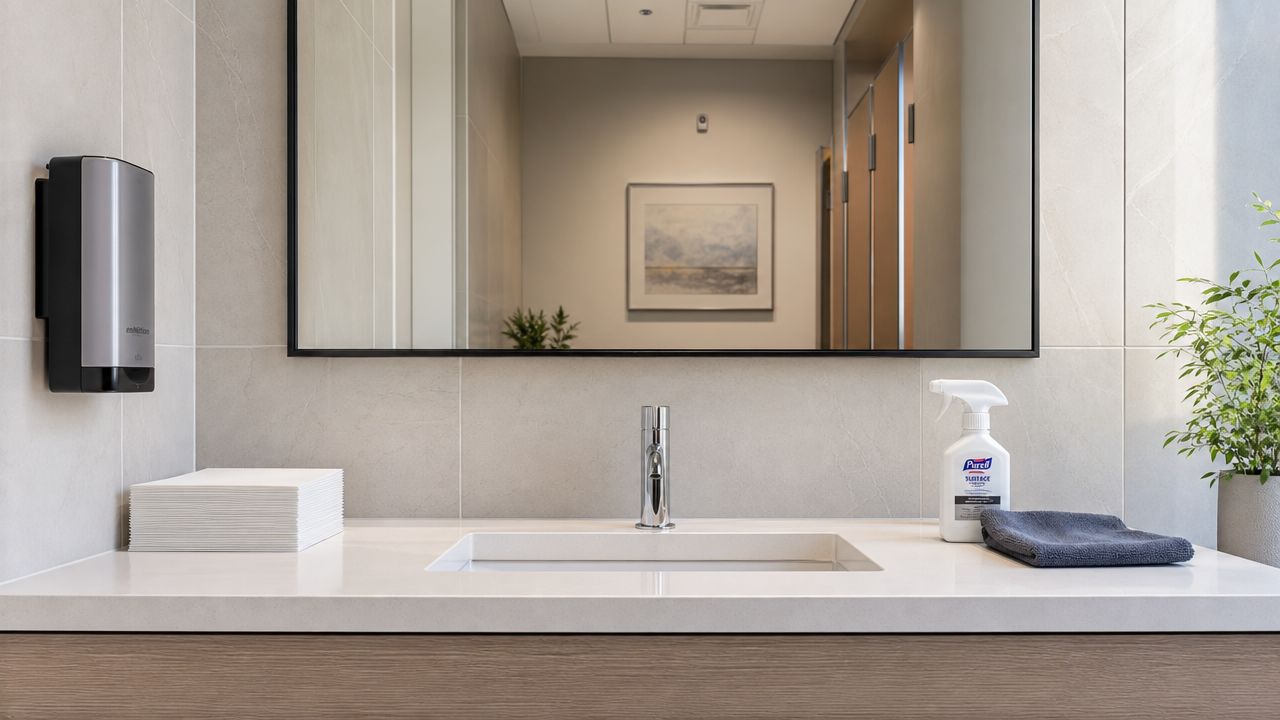
A better restroom sequence
A reliable sequence helps prevent cross-contamination:
- Start high: Dust vents, ledges, partitions, and dispensers before lower surfaces.
- Clean sinks and counters next: Faucets, basins, splash walls, and mirror edges need detail work.
- Handle toilets and urinals separately: Use dedicated cloths, tools, and often colour-coded supplies.
- Finish with floors: Mop last so the room doesn't get re-soiled during fixture cleaning.
- Restock at the end: Soap, tissue, paper towel, and sanitary supplies should be checked before the cleaner leaves.
A downtown professional office may need several inspections per day in high-use washrooms. A smaller engineering firm may only need one full clean plus a mid-day supply check. A childcare office connected to parent traffic may require a more frequent sanitation routine and stronger documentation.
Restroom logs aren't just for appearances. They help show that cleaning was scheduled, completed, and checked.
What to ask cleaning staff or providers
Office managers should ask simple but direct questions:
- Which tools stay only in washrooms?
- How are touchpoints like flush handles and stall locks disinfected?
- Who checks consumables during the day?
- How are odours investigated if cleaning is already happening?
What to avoid is just as important. Avoid vague language like “sanitized as needed,” shared cloths between sink and toilet areas, or a process with no visible inspection record.
3. Kitchen, Break Room, and Lunch Area Sanitization
The office kitchen often creates the biggest gap between “looks clean” and “is clean.” A counter may be wiped while the microwave handle, fridge pull, coffee machine buttons, and sink tap remain heavily used all day.
For that reason, kitchen cleaning should be treated as food-adjacent sanitation, even in a standard office. The list needs daily surface care, weekly fridge control, and scheduled deep cleaning behind appliances.
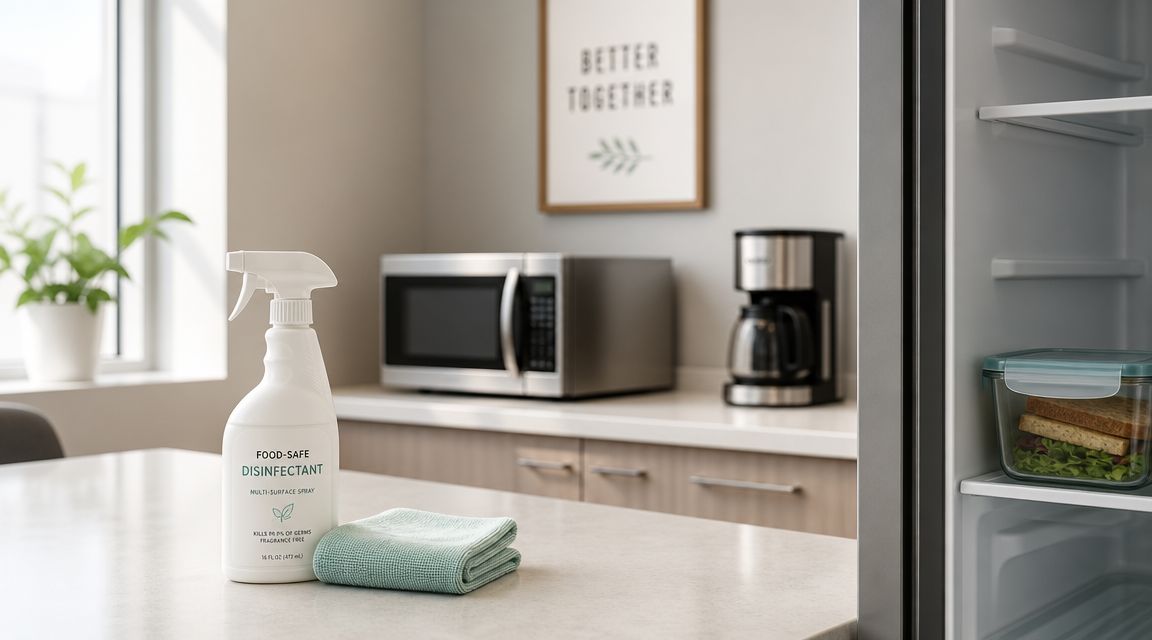
Areas that need more attention than most teams expect
In a tech office with a popular lunch room, cleaners usually spend more time on touchpoints than on the table surfaces themselves. Coffee stations become traffic hubs. Fridge doors, kettle handles, dishwasher buttons, and cabinet pulls all need regular attention.
A practical office cleaning list for break rooms should include:
- Countertops and tables: Clean and sanitize after visible spills and on the daily schedule.
- Appliance touchpoints: Microwave panels, fridge handles, coffee machine controls, and toaster levers need routine disinfection.
- Sinks and taps: Food residue and standing water should be removed before disinfecting.
- Waste zones: Garbage, recycling, and compost stations need liner replacement and exterior wipe-downs.
- Inside-appliance checks: Fridges should be reviewed on a set schedule for expired food and spills.
A legal office hosting clients may focus on polished presentation and odour control. A manufacturing office with staggered breaks may need repeated garbage handling and floor care. In either case, unclear ownership causes failure. If staff are expected to “clean as they go,” the professional cleaning list should still define what cleaners inspect and reset.
Product and safety notes
Food-prep-adjacent surfaces need products suitable for the surface and the setting. Staff should also know where chemicals are stored, how they're labelled, and what PPE is required under WHMIS procedures.
One frequent omission is underside cleaning. The floor under the fridge, the wall behind the coffee machine, and the toe-kick area below cabinets often hold crumbs and residue that attract pests.
4. Floor Care Daily Vacuuming and Sweeping
Floors do constant work in an office. They trap soil, absorb moisture, and show wear faster than almost any other surface.
Daily floor care protects appearance, but it also supports hygiene and safety. Dirt at the entrance gets tracked into corridors, meeting rooms, and workstation areas unless the office cleaning list treats lobbies, mats, carpets, and hard floors as one connected system.
How daily floor care should work
Carpeted and hard-surface areas need different methods, but they should follow the same discipline. The cleaner should move through the building with a route, not randomly.
- Vacuum carpeted traffic lanes daily: Entry corridors, reception zones, and shared work areas collect the most soil.
- Sweep or dust mop hard floors first when needed: This removes loose debris before damp mopping.
- Spot-clean spills immediately: Dried residue is harder to remove and can stain grout or carpet.
- Check corners and edges: Debris often gathers along baseboards, under desks, and around chair casters.
- Maintain entrance matting: Mats reduce how much soil reaches interior finishes.
An office manager in a professional services firm may care most about the front corridor and client-facing zones. In a childcare or industrial office, floor care also supports safer circulation by reducing tracked dirt and fine debris.
A helpful companion for hard-surface maintenance is this guide to easy steps to deep clean hardwood.
What gets missed in routine vacuuming
Rushed vacuuming usually skips under meeting tables, behind reception furniture, and along perimeter walls. On hard floors, cleaners sometimes mop over grit instead of removing it first, which can dull the finish.
For offices with mixed flooring, the list should also note transition points. Carpet-to-tile thresholds and vestibule edges often show the earliest wear and need more frequent attention than open office areas.
5. Window and Glass Surface Cleaning
Glass shows neglect faster than almost any other material. Fingerprints on entry doors, smudges on boardroom panels, and haze on interior sidelights make the whole office feel less controlled.
An effective office cleaning list treats glass in layers. Interior touch glass needs frequent attention. Higher or exterior glass usually follows a scheduled service cycle.
Interior glass priorities
Not all glass needs the same frequency. In many offices, the most important panes aren't the largest windows. They're the surfaces people touch and see at eye level every day.
A strong routine includes:
- Entry door glass: Clean both sides, plus push plates and surrounding frames.
- Meeting room partitions: Remove handprints and marker haze near handles and edges.
- Reception glazing: Keep sightlines clear where visitors first interact with the office.
- Mirrors and reflective panels: Detail the edges so they don't show drip marks or residue.
- Sills and frames: Dust and wipe separately so dirt doesn't transfer back onto clean glass.
A dental clinic may prioritize patient-facing partitions and interior doors. A modern engineering office with many glazed meeting rooms may need a mid-week touch-up in addition to the regular schedule.
Clean glass is partly a cleaning issue and partly a route-planning issue. The right panes need the right frequency.
When glass care becomes a maintenance issue
Cloudiness isn't always dirt. Mineral spotting, failed seals, scratched film, and frame deterioration can make glass look dirty even after cleaning. A good checklist leaves room for cleaners to flag defects instead of masking them.
Exterior window work should also be coordinated with building access, weather, and safety planning. For office managers, the useful question isn't “Are the windows included?” It's “Which glass, at what frequency, and to what standard?”
6. High Dusting and Ceiling Cleaning
Dust above eye level often tells the true story of a cleaning program. It gathers on vents, light diffusers, cabinet tops, door frames, and ledges long before most occupants notice it.
Many office cleaning lists often prove too basic. They cover desks and floors but ignore the upper surfaces that affect appearance, housekeeping quality, and coordination with ventilation maintenance.
High dusting is part of a full cleaning system
A mature janitorial model uses recurring, checklist-driven scopes with defined frequencies. Fortune Business Insights projects the global janitorial services market at USD 221.02 billion in 2025, rising to USD 290.81 billion by 2034, reflecting demand for structured service and measurable quality assurance (janitorial services market projection). For office managers, that supports a practical point: high dusting shouldn't be “done when someone notices.” It should be scheduled.
Typical high dusting tasks include:
- Air vents and returns: Remove visible dust buildup without damaging grilles.
- Light fixtures and diffusers: Clean accumulated film that reduces brightness and makes ceilings look neglected.
- Top edges and ledges: Cabinet tops, door frames, partition caps, and signage collect dust quickly.
- Corners and ceiling lines: Cobwebs, soot lines, and settled debris need periodic removal.
- Upper wall surfaces: Spot-clean marks near vents or supply grilles where airflow moves dust.
For offices with atriums, warehouse-front offices, or difficult access points, specialty cleaning services may be needed to reach higher surfaces safely.
Ventilation and indoor air quality belong in the conversation
Many office-cleaning articles stop at surfaces, but shared workplaces increasingly need a ventilation lens too. California workplace guidance continues to emphasize evaluating indoor-air hazards and maintaining HVAC filtration, yet many generic checklists barely mention vent cleaning, filter coordination, or occupancy-based scheduling (office cleaning and indoor air quality gap).
That gap matters well beyond California. In any office dealing with dust events, seasonal air issues, or heavy occupancy, cleaners and facility managers should coordinate around vents, returns, and HVAC access, not treat them as separate worlds.
7. Trash Removal and Waste Management
Waste removal sounds simple until it isn't. Overflowing bins, leaking liners, food waste, and mixed streams can turn a tidy office into a sanitation problem quickly.
A proper office cleaning list treats waste handling as a route, a timing issue, and a compliance issue. That's especially true in clinics, childcare settings, and offices with food-heavy break rooms or shared copy areas that generate a lot of paper and packaging.
What good waste handling looks like
The strongest routines are boring in the best way. They happen consistently, at the right times, with the right separation.
- Empty bins before overflow starts: Waiting until a bin looks full often means odours and spill risk have already started.
- Replace liners every time needed: A bagged bin is faster to service and more sanitary to reset.
- Separate streams clearly: Garbage, recycling, compost, and regulated waste should never depend on guesswork.
- Wipe bin lids and touchpoints: The exterior of the container often gets dirtier than the inside.
- Check hidden waste points: Under desks, printer rooms, kitchens, and reception counters often have small bins that are easy to miss.
A dental practice may also have sharps or controlled waste procedures that sit outside general office trash handling. A standard office shouldn't copy those methods, but it should still identify what belongs in regular waste and what doesn't.
Recordkeeping matters in regulated settings
Some workplaces need more than a general office checklist. In regulated California settings such as dental clinics, childcare, and food-adjacent workplaces, sanitation procedures may require more documented controls, including restocking logs, PPE rules, and chemical handling steps (regulated workplace cleaning considerations).
The same management lesson applies broadly. If a workplace has inspection risk or specialized waste streams, the office cleaning list should identify who removes what, how often, and under which safety procedure.
8. Lobby and Entryway Cleaning and Maintenance
The lobby carries the highest visual pressure in the building. It's where weather, foot traffic, and first impressions collide.
A clean reception area doesn't happen because someone wipes the desk once a day. It depends on repeated care of floors, glass, metal, mats, counters, and visible clutter.
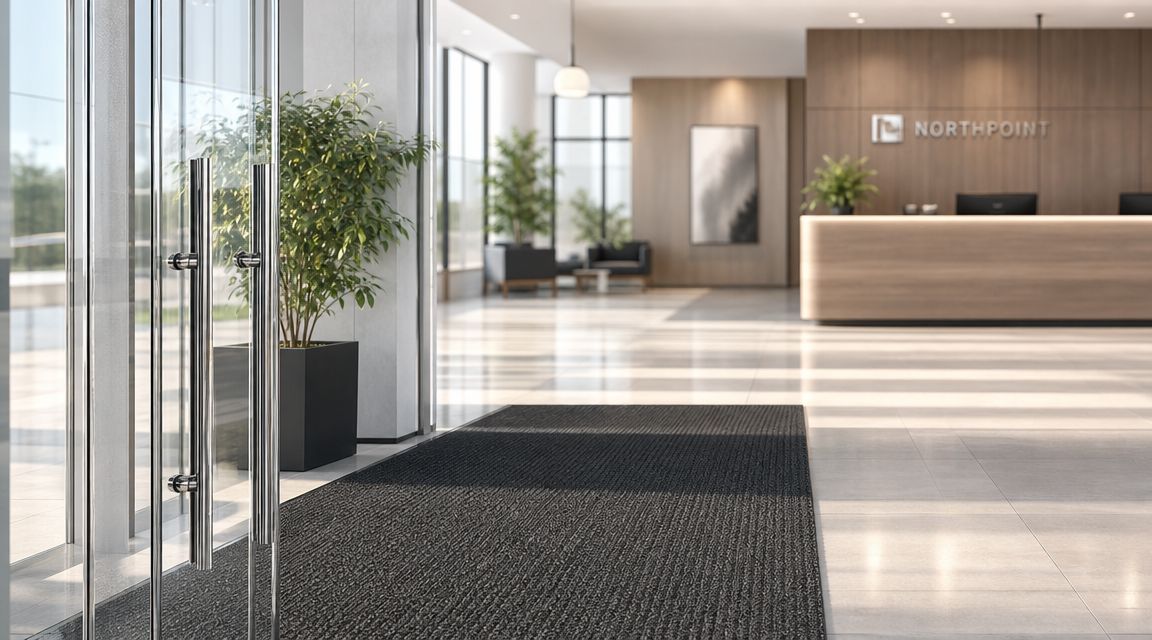
The parts of the lobby people notice first
Visitors usually notice the same details. Smudged glass, tracked-in debris, dusty corners, stained mats, and cluttered reception counters all signal weak upkeep.
An entryway routine should usually include:
- Door glass and hardware: Clean fingerprints from glass, pulls, plates, and frames.
- Mats and vestibules: Vacuum or shake out loose soil and check for curling edges.
- Reception desk touchpoints: Counters, pens, tablets, and visitor sign-in surfaces need regular disinfection.
- Hard floors: Remove grit quickly so it doesn't scratch finishes or spread deeper into the office.
- Visible presentation items: Brochures, chairs, décor surfaces, and waste bins should be reset neatly.
A law office may want pristine boardroom access from the front entrance. A medical or dental office may care just as much about reassurance. In both cases, the lobby should have more frequent checks than the average workstation zone.
A simple standard for office managers
An effective lobby standard is easy to explain: the entry should be clean enough at any moment that a client can walk in unannounced and see control, not catch-up.
That standard usually requires at least one mid-day inspection in busy offices, especially during wet weather or winter salt season.
9. Meeting Room and Conference Area Cleaning
Meeting rooms are high-visibility spaces with low cleaning tolerance. People notice crumbs on a boardroom table, fingerprints on a screen, and stale odours in a closed room immediately.
These rooms also turn over quickly. A conference room can host an internal meeting at 9:00, a client presentation at 10:00, and a hiring interview at noon. The office cleaning list should reflect that reality instead of treating meeting rooms like ordinary offices.
The quick-turn method works best
For shared meeting spaces, a “reset” routine is often more useful than a single nightly clean. That reset may be done by cleaners, reception staff, or office support staff, depending on the workplace.
A good quick-turn checklist includes:
- Tabletops and chair arms: Wipe and sanitize visible touchpoints.
- Remote controls and shared tech: AV remotes, speakerphones, control panels, and adapters collect heavy hand contact.
- Whiteboards and glass boards: Remove marker residue fully, not just in the centre.
- Waste and dishes: Clear cups, paper, and food waste immediately after use.
- Visual reset: Straighten chairs, align supplies, and remove cables or clutter from the table surface.
An executive boardroom in a financial office may need silent, discreet after-hours detailing. A training room in a larger workplace may need several quick resets during the day.
A meeting room should be ready for the next user, not just cleaned eventually.
Don't forget the technology surfaces
Cleaners are sometimes told to avoid electronics entirely. That can leave the dirtiest shared devices untouched. A better approach is to define approved methods for touchscreens, conference phones, remotes, and table connection hubs.
This is also where role delegation matters. The office manager should decide which items cleaners handle, which IT supports, and which users are expected to reset after meetings.
10. Carpet Cleaning and Spot Treatment
Daily vacuuming keeps carpet presentable. It doesn't remove everything embedded in the fibre.
Carpet needs both routine care and periodic deep treatment. Without that combination, stains set, traffic lanes darken, and odours linger even when the room appears tidy from a distance.
A visual example of commercial carpet cleaning methods can help teams understand the difference between maintenance and restoration:
Spot treatment should happen immediately
The best time to treat a spill is right after it happens. If coffee, juice, toner dust, or tracked soil sits too long, the carpet may hold both the stain and the odour.
A practical office cleaning list should include:
- Blot, don't scrub: Aggressive rubbing spreads the stain and damages fibres.
- Identify the source if possible: Food, oil, ink, and organic spills respond differently.
- Use approved spotting products: Random household products can set stains or bleach colour.
- Protect the area while drying: Wet carpet in a traffic lane quickly becomes re-soiled.
- Escalate recurring spots: Repeat stains may point to wicking, residue, or a larger spill below the surface.
A childcare office may need rapid response to frequent accidents. A corporate office may see more coffee and toner incidents. The treatment plan should match the environment.
Deep cleaning should be scheduled, not reactive
Carpet extraction, encapsulation, or other restorative methods should happen on a planned cycle based on traffic and use. Waiting until the carpet “looks bad” usually means wear has already advanced.
Office managers should also ask what happens after cleaning. Drying time, ventilation, access control, and furniture protection all affect results and occupant safety.
10-Point Office Cleaning Comparison
A useful office cleaning list works like a maintenance schedule, not a pile of unrelated chores. The table below helps office managers compare each task by effort, supplies, expected results, and where it fits best, so the cleaning program can be assigned by frequency, area, and responsibility.
| Service | Implementation complexity | Resource requirements | Expected outcomes | Ideal use cases | Key advantages |
|---|
| Daily Office Desk and Workstation Sanitization | Low to Medium: simple procedure, but access to each desk is required | Microfiber cloths, EPA or Health Canada approved disinfectants, 3 to 5 minutes per workstation | Lower germ transfer and stronger employee confidence in shared spaces | Open-plan offices, call centres, post-pandemic workplaces | Helps reduce illness spread and supports a consistent preventive routine |
| Bathroom and Restroom Deep Cleaning | High: multi-step work with PPE, product control, and training | Toilet tools, hospital-grade disinfectants, dedicated colour-coded supplies, service time twice daily in high-traffic sites | Better infection control, less odour, and reduced mould or mildew risk | Clinics, high-traffic offices, schools, manufacturing sites | Direct health protection and stronger compliance performance |
| Kitchen, Break Room, and Lunch Area Sanitization | Medium to High: food-safe procedures and shared-user habits must be managed | Food-safe disinfectants, enzyme degreasers, fridge checks, frequent touchpoint cleaning | Lower food contamination risk, fewer pests, and better odour control | Offices with shared kitchens, manufacturing break rooms, childcare | Supports food hygiene and keeps shared spaces usable |
| Floor Care: Daily Vacuuming and Sweeping | Low to Medium: routine work that expands quickly in larger floorplans | HEPA commercial vacuums, push brooms, walk-off mats, daily labour time | Cleaner air, longer floor life, and safer walking surfaces | Lobbies, corridors, childcare, educational settings | Reduces dust and allergens while protecting appearance |
| Window and Glass Surface Cleaning | Medium to High: access and safety planning matter for tall or exterior glass | Microfiber cloths, squeegees, extension poles, lifts, streak-free cleaners | Brighter interiors, clearer visibility, and a cleaner visual standard | Retail storefronts, meeting rooms, glass-heavy offices | Improves natural light and strengthens first impressions |
| High Dusting and Ceiling Cleaning | High: specialized tools, access equipment, and safe work procedures are required | Extension poles, HEPA vacuums, ladders or lifts, trained staff | Less airborne dust, cleaner vents and fixtures, and improved light output | Office towers, manufacturing, healthcare, controlled environments | Lowers dust load and helps protect HVAC and lighting performance |
| Trash Removal and Waste Management | Low to Medium: simple daily work with disposal rules that vary by waste stream | Liners, recycling and compost bins, biohazard containers where needed, disposal access | Better odour control, lower pest pressure, and safer waste handling | All offices, dental or medical clinics, food-service areas | Prevents buildup and supports sustainability and regulatory requirements |
| Lobby and Entryway Cleaning and Maintenance | Medium: frequent multi-surface attention with seasonal soil control | Entrance mats, floor care products, glass cleaners, spot-cleaning supplies | Cleaner first impressions, less tracked-in dirt, and better floor protection | Corporate headquarters, client-facing firms, reception areas | Protects high-traffic finishes and improves visitor experience |
| Meeting Room and Conference Area Cleaning | Medium: must be timed around bookings and handled carefully around AV equipment | Microfiber cloths, electronics-safe cleaners, whiteboard products, quick-turn procedures | Cleaner presentation spaces and less germ transfer between users | Boardrooms, client meeting spaces, conference centres | Supports productive meetings and reduces wear on shared technology |
| Carpet Cleaning and Spot Treatment | High: professional equipment, drying control, and operator skill are needed | Hot water extraction machines, specialty spotting agents, trained operators | Deep soil and allergen removal, better appearance, and longer carpet life | High-traffic offices, hotels, childcare, hospitality | Removes embedded soils and odours, and helps delay replacement costs |
The comparison becomes more useful when it is read as a system. Daily tasks handle health and appearance at the surface level. Higher-complexity tasks, such as high dusting, restroom deep cleaning, and carpet work, usually need trained staff, documented procedures, and tighter supervision.
This is also where supplies and safety rules matter. A desk wipe-down may only need a labelled disinfectant and microfiber cloth. Restroom chemicals, food-contact surface products, and ladder-based dusting should be tied to WHMIS training, PPE, storage rules, and clear role delegation so the right people do the right work safely.
Putting Your Office Cleaning List into Action
A useful office cleaning list does more than assign chores. It creates a repeatable cleaning system that office managers can supervise, improve, and document.
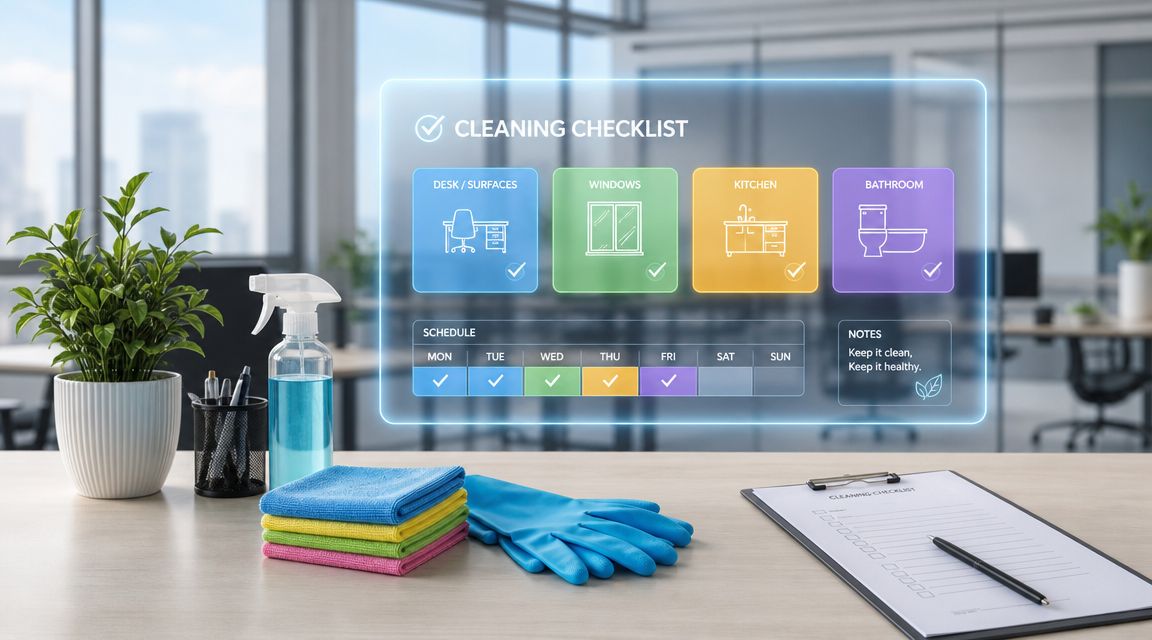
The strongest version usually has five parts. It names the area, the exact task, the cleaning frequency, the person or team responsible, and the method or product notes. That structure helps prevent the most common failures, which are vague wording, unclear ownership, and no follow-up.
For most offices, the best setup is a layered schedule. Daily tasks handle visible soil, touchpoints, washrooms, kitchen surfaces, waste, and floor care. Weekly tasks usually cover deeper vacuuming, glass detailing, appliance checks, and more thorough attention to shared rooms. Monthly or quarterly work often includes high dusting, ventilation coordination, carpet treatment, upholstery care, and higher-level detailing.
Role delegation matters as much as frequency. Some tasks belong only to trained cleaners. Others are shared between cleaners, reception staff, facilities staff, and employees. A meeting room reset, for example, may be partly an occupancy issue and partly a cleaning issue. A kitchen may need both professional sanitation and employee housekeeping rules.
Safety can't sit outside the list. Product labelling, PPE, chemical storage, and worker training should be tied to the cleaning program, especially where WHMIS applies. This is one reason many businesses move from an informal checklist to a managed schedule with logs, inspections, and supply controls. The list becomes part of health protection and due diligence, not just appearance management.
Office managers can also use the list as a quoting tool. When requesting proposals, it helps to send the actual task schedule instead of asking for “general office cleaning.” That makes it easier to compare scope, frequency, exclusions, and service assumptions. It also reduces disputes later because both sides are working from the same written standard.
A few practical questions make provider comparisons stronger:
- What is cleaned daily, weekly, monthly, and quarterly?
- Which touchpoints are included in routine disinfection?
- How are washroom checks, restocking, and logs handled?
- Who supplies consumables and specialty products?
- How are missed tasks reported and corrected?
- What tasks require specialty access or separate pricing?
What to avoid is broad language without a schedule, undefined “deep cleaning,” or a proposal that doesn't identify responsibilities for kitchens, high dusting, vents, glass, and waste streams.
For businesses in the Greater Toronto Area, the Arelli Cleaning service areas page is one place to review local coverage. Arelli Cleaning may also be one option for companies that want office cleaning, disinfection, floor care, and specialty support under a structured commercial program.
The most practical next step is simple. Build or revise the office cleaning list, walk the site with it in hand, and check whether the written standard matches what the workplace needs. Then get two or three quotes based on that same scope so the comparison is fair.
A business that wants help turning an office cleaning list into a working routine can review Arelli Cleaning as one option, then compare that scope with two or three other quotes, ask detailed questions, and choose the provider that matches the facility's needs, schedule, and compliance expectations.








.webp)