A new office manager usually starts the same way. The bins are overflowing by midday, washrooms feel inconsistent, the boardroom looks fine on some mornings and neglected on others, and the previous cleaner's quote is impossible to decode. The problem isn't just cleanliness. It's the lack of a reliable system.
That's why hiring from among local office cleaning companies should be treated like vendor selection, not casual purchasing. A cleaning company works inside the office, often after hours, around confidential documents, employee spaces, and client-facing areas. The right fit protects the work environment. The wrong fit creates avoidable risk, wasted time, and constant follow-up.
This is also a large, professionalising market. The global cleaning services market was estimated at $442.09 billion in 2025 and is projected to reach $770.76 billion by 2033, with commercial offices and healthcare facilities identified as major demand drivers, according to Grand View Research's cleaning services market report. For buyers, that matters because office cleaning is no longer just mop-and-bucket work. It increasingly involves compliance, documentation, scheduling discipline, and quality control.
Starting Your Search for a Cleaning Partner
Most businesses don't start searching because they want a new cleaner. They start because something has already gone wrong. Complaints are coming in. Staff are noticing missed tasks. Leadership wants the office to feel more organised. A client visit is approaching. The search often begins under pressure.
That pressure can lead to rushed decisions. A buyer asks for three quotes, compares the bottom line, and assumes the cheapest option is efficient. In practice, that approach usually creates more work later. Office cleaning contracts need a clear scope, a method for quality checks, and a realistic way to handle changes in occupancy or service needs.
A practical way to frame the search is to treat cleaning as part of facility operations, not as a commodity. Resources on facility management best practices for 2026 are useful here because they reinforce the same principle: a support service works best when expectations, accountability, and reporting are defined before the contract starts.
For businesses with multiple sites or a Greater Toronto Area footprint, local coverage also matters. A provider with service capacity near the workplace is usually easier to schedule, monitor, and escalate with than a distant operator. Buyers comparing neighbourhood availability can review Arelli Cleaning's service locations across the GTA as one example of how a company maps its coverage.
What a buyer is really hiring
A local cleaning company isn't just being hired to remove dust and empty bins. The buyer is hiring for:
- Consistency: the office should feel maintained on ordinary days, not just after complaints.
- Risk control: cleaners should work safely, use appropriate products, and operate within documented procedures.
- Communication: missed tasks, access issues, and special requests should move through a clear channel.
- Adaptability: the service should match actual office use, including hybrid attendance and meeting-heavy days.
Direct answer: The best local office cleaning companies aren't simply low-cost labour. They're organised service partners that can execute a defined scope reliably.
Key takeaways
- Start with operations, not price: a cheaper quote can become expensive if quality fails.
- Expect professionalism: market growth and demand from offices show why standards are rising.
- Think locally: route density and nearby coverage often support better response times.
- Use a framework: a cleaner selection process works better when scope, vetting, and contract terms are separated.
Defining Your Office Cleaning Scope of Work
Most quote problems start before the first vendor replies. The buyer asks for “office cleaning” without spelling out what that means. One company prices basic nightly janitorial work. Another includes washroom consumables. A third assumes periodic floor care. The quotes look different because the request was different.
Industry data shows that commercial cleaning accounts for over 70% of the cleaning market segment, and commercial real estate occupancy is a primary driver of demand, according to SBDCNet's cleaning services business snapshot. For office managers, the practical lesson is simple. The scope should match how the office is used.

A law office, dental clinic, school office, warehouse office, and small design studio may all use the phrase “office cleaning,” but their priorities are different. One may care most about washroom sanitation and reception appearance. Another may need strict treatment of hard floors and breakrooms. A clinic-adjacent office may need clearer documentation around product use and touchpoint cleaning.
Separate daily tasks from periodic tasks
A strong scope of work should split service into two categories.
Routine janitorial tasks are the recurring duties that keep the office functional:
- Waste and recycling removal: deskside bins, kitchen waste, and central collection points
- Washroom cleaning: fixtures, mirrors, floors, dispensers, and restocking responsibilities if included
- Vacuuming and floor care: carpeted areas, hard floors, entrance mats
- Surface cleaning: desks if permitted, counters, tables, reception surfaces, shared touchpoints
- Kitchen and lunchroom cleaning: sinks, counters, exterior appliance wipe-downs, table cleaning
Periodic or specialty tasks happen on a schedule that may be monthly, quarterly, seasonally, or as needed:
- Carpet extraction
- Interior window cleaning
- Floor scrubbing, stripping, or refinishing
- High dusting
- Post-construction cleanup
- Deep cleaning after events or occupancy changes
A simple scope template
A buyer doesn't need a complex procurement document. A practical scope can fit on one or two pages.
| Scope item | What to define |
|---|
| Areas included | Reception, offices, washrooms, lunchroom, meeting rooms, hallways, storage areas |
| Frequency | Daily, weekdays only, alternate days, weekly, monthly, as needed |
| Access | After-hours entry, alarm procedures, key or fob handling, restricted rooms |
| Supplies | Who provides liners, paper products, soap, and specialty consumables |
| Standards | What “clean” means for each area, including visible appearance and restocking expectations |
| Exclusions | Private desks, server rooms, sensitive records areas, tenant-owned equipment |
A buyer looking for service examples can review office cleaning services in the GTA to see how office-focused cleaning is typically grouped into routine and specialty work.
A quote becomes comparable only when every bidder is pricing the same rooms, the same frequency, and the same responsibilities.
Common scope mistakes
- Using vague words: “deep clean regularly” means different things to different vendors.
- Ignoring occupancy: a hybrid office may need fewer full cleans but better washroom and kitchen attention on peak days.
- Bundling special work into nightly service: floor restoration and routine cleaning shouldn't be mixed without clear frequency.
- Forgetting supply responsibility: disputes often start when nobody defined who provides consumables.
Your Vetting Checklist for Cleaning Companies
Once the scope is clear, the next job is verification. At this stage, many buyers slip. A company sounds professional on the phone, sends a polished proposal, and promises flexibility. None of that replaces due diligence.
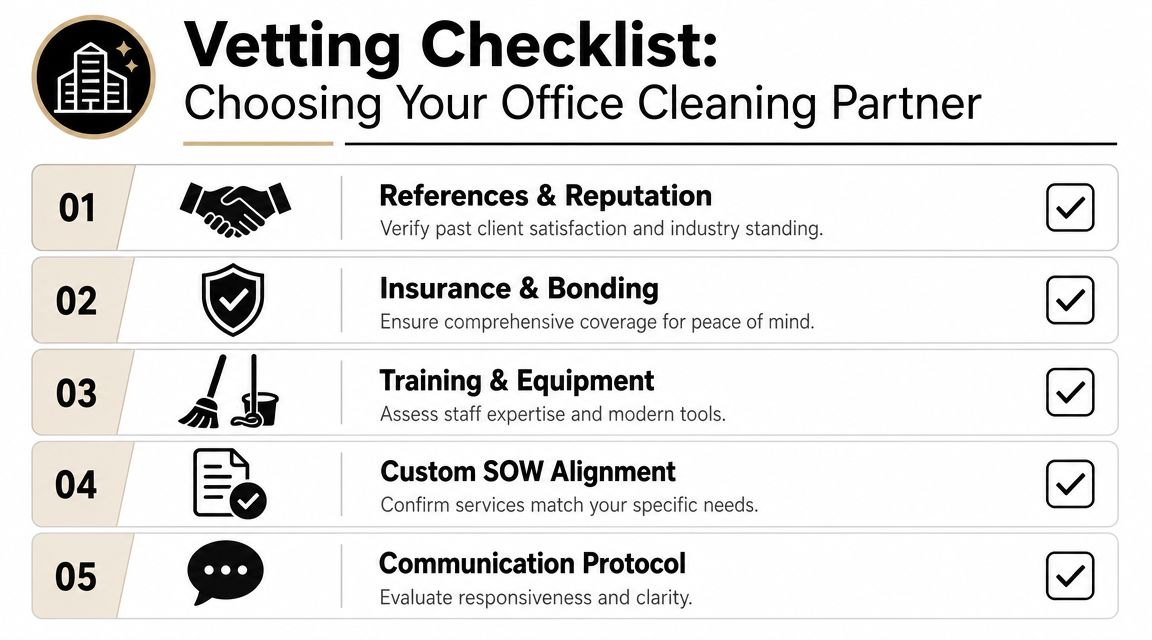
The goal isn't to interrogate every cleaner. It's to confirm that the company has operating discipline. In a fragmented local market, quality often comes down to supervision, documentation, and responsiveness rather than company size.
The non-negotiables
A short vetting list catches most avoidable problems.
Insurance documentation
Ask for proof of commercial liability coverage and confirmation that workplace injury obligations are handled properly in the relevant province. The office manager doesn't need to be an insurance specialist. The job is to confirm that documentation exists, is current, and matches the company name on the contract.
Worker screening and training
Cleaners often work after business hours with access to sensitive areas. Ask how staff are screened, how they're trained, and how new staff are introduced to a site. A strong answer should describe a process, not just a promise.
Supervision model
Many service failures happen when no one checks the work. Ask who inspects sites, how often inspections occur, and what happens if standards slip.
Complaint handling
Every provider will eventually miss something. The difference is whether there's a clear correction path. Ask for the reporting method, expected response process, and how issues are tracked until resolved.
Supply and chemical control
Buyers should know who manages product selection, dilution, storage, and labelling. This matters for safety, consistency, and compliance.
A useful visual summary sits below, and it works well as a shortlist checklist during calls or site walks.
Why technology now belongs on the checklist
Many buyers still evaluate cleaners as if the only variables are headcount and hourly rate. That's outdated. Modern service quality depends heavily on whether the company can document what happened at the site.
Market guidance notes that local providers using mobile apps, real-time quality assurance, and documented compliance workflows can reduce service variance, and buyers should evaluate response time, inspection cadence, and documented protocols, according to Fortune Business Insights' cleaning services market analysis.
That doesn't mean every office needs an advanced dashboard. It means the buyer should ask practical questions such as:
- How are inspections recorded?
- How are missed tasks reported and closed out?
- Who receives updates when something urgent happens?
- Can the company show a site checklist or communication workflow?
Practical rule: If a company can't explain how it tracks quality, the buyer should assume quality depends on memory.
What to ask and what to avoid
Ask for
- Current insurance proof: documents, not verbal assurances
- A sample inspection form: paper or digital
- A site-specific onboarding plan: especially for alarm procedures and restricted rooms
- Clear contact hierarchy: who handles routine issues versus urgent ones
Avoid
- Vague answers: “the team just knows what to do”
- No documentation: if nothing is written down, accountability is weak
- One-person dependency: service shouldn't collapse when one supervisor is unavailable
- No site walk before quoting: a serious provider usually wants to see the space
One factual example fits here. Arelli Cleaning is one provider in the GTA that describes a technology-based operating model with mobile communication and documented quality workflows. That kind of system is what buyers should look for generally, whether the provider is large or small.
Interview Questions and Quote Comparison
A good interview reveals how a company thinks when things are normal and when things go wrong. That's more useful than a polished sales pitch. The aim isn't to trap the vendor. The aim is to hear whether their process is stable enough for a real office environment.
A helpful comparison mindset comes from other service categories too. The same logic behind On The Move's guide to moving quotes applies here. A low quote can hide missing scope, vague assumptions, or add-on charges that surface later. Cleaning quotes deserve the same level of scrutiny.
Questions that expose operating quality
These questions usually produce better answers than “What do you charge?”
Who will be the day-to-day contact for the account?
The buyer needs a name, not a generic office line.
What happens when a cleaner is absent?
This shows whether the company has backup planning or runs too lean.
How are site instructions communicated to replacement staff?
Offices often have unique access rules and room priorities.
What is the process for a missed task or complaint?
The best answers describe acknowledgment, correction, and follow-up.
How do you inspect quality over time?
Look for inspection routines, not general statements about pride and professionalism.
Which tasks are included in the base quote and which are separate?
This prevents later disputes over floor work, inside glass, consumables, or emergency cleans.
How to compare quotes fairly
A quote should be normalised before it's judged. That means converting each proposal into the same decision categories.
| Comparison point | What to check |
|---|
| Scope match | Are all bidders pricing the same rooms, tasks, and frequencies? |
| Labour model | Is the quote built around recurring service or assumed extra visits? |
| Supervision | Does the proposal include inspections and account management? |
| Supplies | Are liners, soap, paper products, or equipment included or excluded? |
| Special services | Are carpet care, floor work, and window cleaning itemised separately? |
| Contract terms | Are there notice periods, cancellation limits, or renewal clauses? |
A simple decision rule
If one quote is much lower, the buyer should ask one calm question: “What are you excluding that the others may have included?”
That question often uncovers the significant difference. One provider may have excluded supervision. Another may have assumed fewer visits. Another may not have priced consumables, special requests, or complaint response time.
The best quote is the one the office can understand, monitor, and hold accountable. It isn't automatically the lowest.
Budgeting for Professional Office Cleaning
Budgets become easier to manage when the buyer understands the pricing model behind the quote. Without that, every proposal feels arbitrary.
In the North American market, office cleaning is generally priced around $0.10 to $0.20 per square foot per month or $20 to $80 per hour, with variation based on service frequency, facility type, and labour conditions in regions such as the Greater Toronto Area, according to IBISWorld's janitorial services industry data.
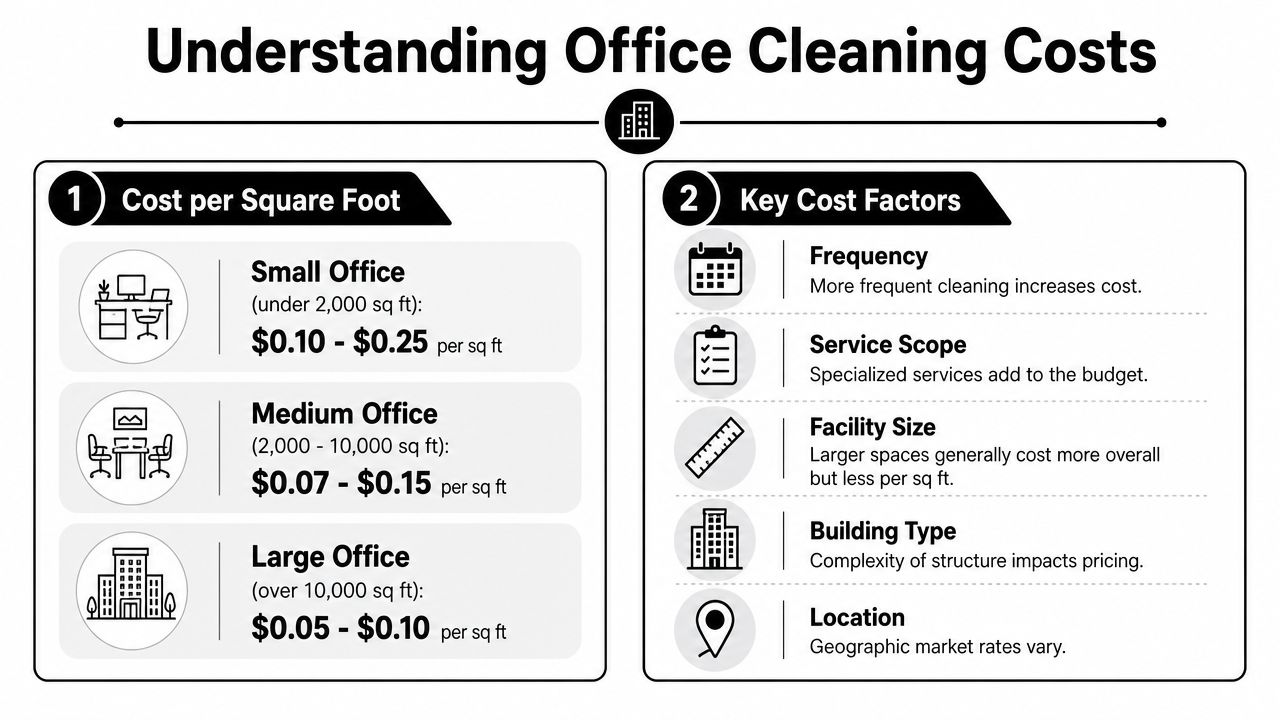
Those numbers are benchmarks, not guaranteed local prices. The useful part is understanding why one office lands near the lower end and another doesn't.
The three common pricing models
Per square foot works well for recurring office cleaning because it ties cost to the space being maintained. It's easy to budget, but only if the scope is clear. A lightly used office and a heavily trafficked office of the same size may still need different service intensity.
Hourly pricing is common for smaller jobs, one-time work, or variable scopes. It offers flexibility, but buyers should be careful. Hourly billing without a defined task list can create uncertainty about what gets done.
Flat monthly pricing is often the easiest for operating budgets. It can work very well when the scope, frequency, and exclusions are clearly documented.
What pushes a quote up or down
A buyer should expect price movement when these conditions change:
- Frequency: more frequent service usually raises monthly cost
- Facility type: general offices are often simpler than medical-adjacent or industrial spaces
- Density of use: crowded lunchrooms and busy washrooms take more labour than quiet private offices
- Floor mix: carpet, hard floors, entrance matting, and finish requirements affect effort
- Specialty work: periodic deep cleaning, carpet care, high dusting, and post-construction work are different from standard nightly tasks
Medical and industrial environments can command higher hourly pricing than standard office cleaning because they often require more specialised methods and controls. That's why buyers shouldn't compare a simple office quote to a more regulated space as if they are equivalent.
Budgeting without overbuying
A smart budget doesn't start from the highest possible service level. It starts from real office use. A hybrid office might not need the same pattern as a fully occupied office, but it may still need strong washroom care, entrance cleaning, and kitchen support on busy days.
Buyers usually get better value by refining frequency and task timing than by stripping out quality checks.
Identifying Red Flags and Finalizing Your Contract
The riskiest cleaning contracts often look attractive at first glance. The price is low, the proposal is brief, and the vendor seems ready to start immediately. That combination can hide the most expensive problems.

A very low quote may mean the company misunderstood the scope. It may also mean the provider is relying on thin staffing, weak supervision, or undocumented labour practices. The buyer doesn't need to assume bad intent. The buyer does need to verify that the contract supports sustainable service.
Red flags worth taking seriously
- Unclear exclusions: if the proposal doesn't say what isn't included, disputes are likely
- Pressure to sign quickly: rushed signatures usually favour the seller, not the buyer
- No meaningful site walk: quoting without seeing the space can signal weak process
- No reference to quality checks: that usually means no one owns service consistency
- Complicated cancellation terms: hard exits often trap buyers in mediocre service
Contract terms that deserve close review
The service agreement should answer a few practical questions in plain language.
| Contract item | Why it matters |
|---|
| Scope attachment | Prevents arguments over what was promised |
| Service frequency | Locks in the actual schedule |
| Issue resolution process | Defines how problems are reported and corrected |
| Notice and cancellation | Protects the client if service quality drops |
| Renewal terms | Avoids surprise extensions |
| Supply responsibilities | Clarifies who buys and stocks what |
A flexible contract often aligns incentives better than a restrictive one. If a cleaning company has to earn the business each month through performance, the buyer usually gets better communication and faster problem resolution. Some providers, including Arelli Cleaning, offer no-term contracts and zero cancellation fees. That kind of structure can be useful for buyers who want accountability tied to ongoing satisfaction rather than lock-in.
Frequently Asked Questions About Office Cleaning
What's the difference between office cleaning and janitorial service
Office cleaning usually refers to the cleaning needs of office spaces specifically, such as desks, meeting rooms, reception areas, kitchens, and washrooms. Janitorial service is a broader term that often includes recurring maintenance tasks across many commercial property types.
How often should an office be cleaned
That depends on occupancy, traffic patterns, washroom usage, food preparation areas, and client-facing expectations. A lightly used office may need a different schedule than a busy workplace with frequent visitors and shared spaces.
Should a buyer choose hourly pricing or monthly pricing
Monthly pricing is often easier to manage for recurring service because it supports predictable budgeting. Hourly pricing can work for smaller or irregular scopes, but it should still be tied to a clear task list.
What should be included in a first quote request
A quote request should include the address, approximate layout, rooms to be cleaned, service frequency, access hours, supply responsibilities, and any special tasks or restricted areas.
Why do office cleaning quotes vary so much
Quotes vary because scope, frequency, supervision, supplies, floor types, and specialty requirements vary. Two quotes that look far apart may not be pricing the same work.
Should references matter if the price is good
Yes. References help confirm reliability, communication, and consistency. A low price doesn't offset weak follow-through if the office manager has to spend time chasing basic tasks.
What technology should a buyer ask about
The buyer should ask how the company handles inspections, communication, issue tracking, and site documentation. The specific software matters less than whether the process is clear and usable.
When should a business change cleaning companies
A change may be justified when service problems repeat, communication stays vague, documentation is weak, or the provider won't correct issues in a timely and accountable way.
Further Reading and Resources
A useful resources section should help you make a decision, not send you in circles through the same links again.
At this stage, the goal is simple. Gather materials that help you test whether a cleaning company can follow a defined scope, document its work, and communicate clearly when something goes wrong. If a resource does not help with one of those three jobs, it is probably background reading, not a buying tool.
Start with practical documents you can use at your desk. A sample scope of work template is one of the most helpful references because it turns a vague request into a measurable one. A good template lists room types, service frequency, day porter needs, supply responsibilities, inspection expectations, and any restricted areas. It works like a bid sheet in construction. Everyone prices the same job, so quote comparisons become more accurate.
Technology criteria also belong in your reading file. Modern vendor reviews should include examples of how a company handles inspections, issue tracking, after-hours communication, and site notes. The software name matters less than the process behind it. If a provider cannot show how missed tasks are logged and corrected, the office manager usually ends up doing that follow-up manually.
It also helps to keep a short evaluation worksheet for references, insurance documents, quality control records, and contract terms. That gives you a repeatable framework for future renewals or multi-site comparisons.
Businesses in the Greater Toronto Area that want to compare one local option with others can review Arelli Cleaning as part of that process. The useful question is not whether one website looks polished. The useful question is whether the company can match your office's scope, reporting needs, and service hours with a clear operating system behind the quote.









.webp)