An office manager in Etobicoke often inherits cleaning rather than choosing it. The previous vendor may have been “fine,” complaints may arrive only when washrooms run out of supplies, and leadership may ask for lower costs without defining what must stay the same. That's where office cleaning gets confusing. It looks simple from a distance, but procurement decisions affect hygiene, staff experience, safety, and the credibility of the business itself.
Good office cleaning isn't just about whether the lobby looks tidy at 9 a.m. It's an operating system for how a workplace handles waste, washrooms, floors, touchpoints, and routine wear. In Etobicoke, that matters across professional offices, medical-adjacent spaces, industrial administration areas, childcare settings, and mixed-use buildings where the cleaning standard has to match the actual risk in the space.
Introduction A Guide for Etobicoke Businesses
A new office manager in Etobicoke often sees the first cleaning problem after something has already gone wrong. A washroom complaint reaches HR, a tenant notices streaks in the lobby before a client visit, or a cleaner misses a sensitive area in a mixed office and industrial facility. At that point, cleaning stops being a background task and becomes an operating risk.
That is the right way to evaluate office cleaning in Etobicoke. Cleaning works like preventive maintenance for the built environment. If the scope is vague, the result is usually inconsistent service, weak documentation, and disputes about what the vendor was supposed to do in the first place. If the scope is clear, managers can inspect work, track issues, and connect service levels to the actual use of the space.
This matters in Etobicoke because the local business base is varied. A professional office, a logistics administration area, a medical-adjacent clinic suite, and a childcare operator may all ask for "office cleaning," but their risk profile is different. The cleaning plan should reflect traffic levels, shared-touch surfaces, waste handling, supply management, and any recordkeeping the site may need for internal audits or compliance reviews.
A useful procurement test is simple. If a vendor cannot explain what will be cleaned, how often it will be checked, how deficiencies will be logged, and who is accountable when standards slip, the quote is incomplete even if the price looks attractive.
Local buyers who want area-specific service context can review Etobicoke commercial cleaning coverage. Teams that need to understand how vendors schedule recurring work and track completion can also review this guide to choosing cleaning software, which helps clarify how service documentation is handled behind the scenes.
Key takeaways
- Office cleaning is an operations decision: It affects hygiene, occupant confidence, supply continuity, and day-to-day facility control.
- Documentation matters: Site logs, inspection records, product lists, and escalation procedures reduce ambiguity when issues arise.
- Risk should shape the cleaning plan: Higher-touch or higher-trust workplaces usually need tighter quality control and clearer reporting.
- Price only makes sense after scope is defined: A low quote is hard to evaluate if tasks, frequencies, and consumable responsibilities are unclear.
- Local fit matters: Vendors should understand the building type, access constraints, and service expectations common in Etobicoke properties.
- Vendor accountability should be visible: Buyers should be able to see how missed tasks, complaints, and corrective actions are tracked.
Direct answer: Office cleaning in Etobicoke should be purchased as a managed facility service with clear scope, inspection standards, and documented accountability, especially for workplaces where health, safety, and operational consistency matter.
Defining the Scope of Office Cleaning Services
A common Etobicoke procurement problem starts like this. Two vendors both promise “general office cleaning,” both quotes look reasonable, and neither document tells you what happens if washroom supplies run out on a Friday afternoon or salt residue builds up in the lobby through winter. The issue is not wording alone. It is scope control.
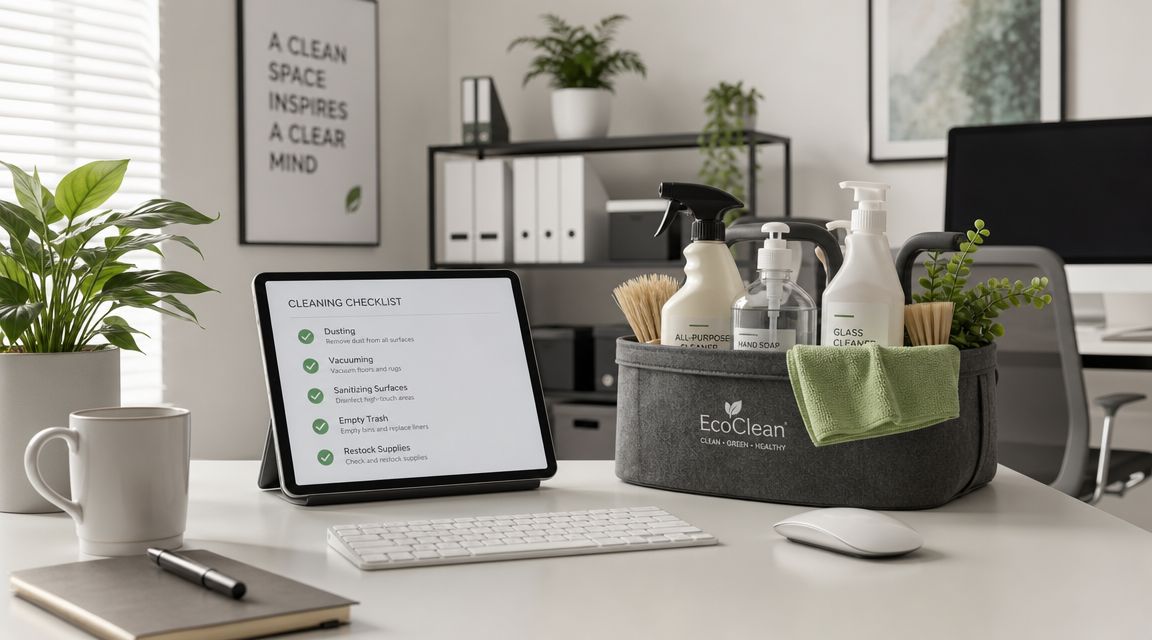
A useful cleaning scope works like a maintenance schedule for a vehicle. Oil changes, brake inspections, and tire rotations do different jobs and happen at different intervals. Office cleaning needs the same logic. Daily tasks control immediate hygiene and appearance. Weekly tasks prevent gradual buildup. Periodic tasks protect finishes, reduce wear, and limit problems that later become complaints, safety issues, or avoidable repair costs.
For office managers, the practical way to write scope is to define each task by three things. What gets cleaned. How often it gets cleaned. How completion is checked and recorded. That third piece is often missed, but it matters in multi-tenant buildings, medical-adjacent offices, professional firms, and other workplaces where service proof and follow-up can matter as much as the cleaning itself.
Routine work that should usually be specified
Daily cleaning should focus on areas with the highest traffic, the highest touch frequency, and the greatest compliance risk if neglected.
- Washrooms: Clean and sanitize fixtures, refill soap, paper, and tissue, spot-clean partitions, and note shortages or maintenance issues.
- Waste and recycling: Empty containers, replace liners, and remove waste from shared spaces before odour, overflow, or contamination becomes a tenant issue.
- Entrances and traffic paths: Vacuum or mop floors that collect soil, moisture, and winter residue that can increase slip risk.
- Touchpoints: Wipe door handles, counters, shared equipment surfaces, and other hand-contact points that should be included in the site standard.
- Kitchens and break areas: Clean sinks, counters, appliance exteriors, and tables, especially where food residue can attract pests.
Weekly work usually covers the surfaces that do not fail in one day but do decline steadily if ignored.
- Dusting: Desks with agreed access rules, ledges, shelving, reception furniture, and low-reach fixtures.
- Glass and mirrors: Interior glass, partition panels, and mirror surfaces with visible marks.
- Detail wiping: Chair arms, switches, baseboards in key areas, and edges around furniture where buildup becomes noticeable.
- Conference rooms and shared spaces: Reset presentation areas, remove fingerprints, and clean surfaces that affect client-facing appearance.
Periodic work is where contract gaps usually appear
Many service problems start in the monthly and quarterly category. A floor can look acceptable for weeks while finish protection wears down. Carpet can appear fine until staining sets, odours persist, or allergens collect below the surface. By that point, the office manager is no longer buying routine cleaning. They are buying correction.
Periodic scope should usually address:
- Carpet care: Spot treatment, low-moisture interim cleaning, or extraction based on traffic and material.
- Floor maintenance: Machine scrubbing, burnishing, polishing, or finish preservation suited to the flooring type.
- Upholstery and fixtures: Fabric seating, partitions, and detailed surface cleaning that removes gradual buildup.
- High-detail areas: Vents, grilles, door frames, corners, and other surfaces that affect both presentation and indoor cleanliness over time.
This distinction matters because routine cleaning preserves conditions. Restorative cleaning recovers them. If a proposal mixes those categories together without frequencies or inspection standards, it becomes hard to compare vendors and harder to enforce the agreement after start-up.
Scope should also assign responsibility
A strong specification does more than list tasks. It assigns ownership. Who supplies consumables. Who reports defects such as leaking faucets or broken dispensers. Who signs off on after-hours work. Who documents missed visits, corrective actions, and complaints. In Etobicoke offices with security desks, shared access rules, or regulated client areas, these details affect service reliability and audit readiness.
For office managers building a scope, scheduling and verification should be considered at the same time as the task list. The guide to choosing cleaning software shows how teams can organize recurring tasks, inspections, and service communication so the written scope turns into repeatable execution.
Businesses that want to compare their draft against a real-world office cleaning services scope for commercial workplaces can use that review as a reference point. The goal is not to copy a template word for word. It is to make sure the final specification is clear enough that two vendors can bid on the same requirements, and your team can verify whether the work was done.
Understanding Cleaning Prices in Etobicoke
A new office manager often gets three quotes for the same suite and wonders why one is much lower than the others. The reason is usually not mystery or markup. It is that each vendor priced a different operating model.
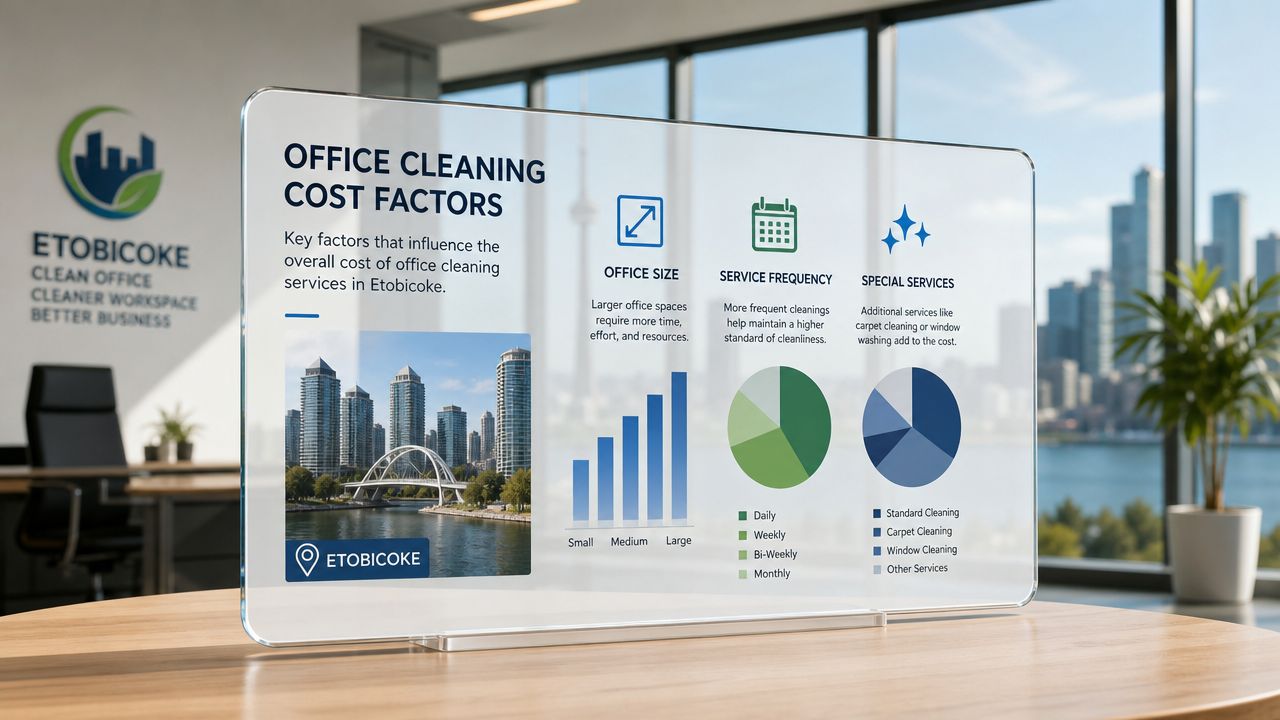
In Etobicoke, pricing is shaped by labour availability, travel time between sites, building access rules, and the amount of supervision needed to keep service consistent. Square footage still matters, but it is only the shell. The true cost sits inside the details, much like a lease rate tells you little until you read the operating costs, exclusions, and service standards.
That is why price should be read as a risk signal as much as a budget line. A quote that looks efficient on day one can become expensive later if it leaves out inspections, floor care, consumables management, or incident reporting. In multi-tenant buildings, medical-adjacent offices, and client-facing workplaces, those omissions affect compliance and service recovery, not just appearance.
What usually changes the quote
The biggest drivers are time, complexity, and verification.
A small professional office with low traffic may need straightforward evening cleaning. A larger workplace with shared kitchens, multiple washrooms, visitor areas, and glass-heavy layouts needs more labour hours and tighter quality control. If the vendor is also expected to document issues, restock supplies, or follow enhanced commercial disinfection and sanitizing protocols, the administrative load rises with the cleaning load.
Common cost drivers include:
- Size and layout: Open areas are faster to service than offices with many doors, corners, and touchpoints.
- Visit frequency: Five visits per week requires a different staffing plan than two or three.
- Washrooms and kitchens: Wet and food-service areas create more cleaning time and higher inspection needs.
- Floor surfaces: Carpet, tile, resilient flooring, and entry matting each require different tools and periodic care.
- Access conditions: Security sign-in, elevator booking, after-hours restrictions, and key control all add time.
- Documentation: Cleaning logs, inspection reports, work orders, and escalation procedures increase service discipline and cost.
- Risk areas: Entryways, spills, and weather-tracked floors require extra attention to reduce slip and trip liability.
How to read a quote without guessing
A cleaning proposal works like a maintenance contract. If the scope is vague, the low number is hard to test and harder to enforce.
Read each quote in layers. First, check what tasks are included. Then check how often each task is performed. Then check what proof of performance the vendor provides. A vendor that separates routine cleaning from periodic work usually gives you a more usable price because you can see what is covered every visit and what is scheduled less often.
A strong quote should make these items visible:
| Quote element | What to look for |
|---|
| Scope | Specific tasks with named areas, not broad terms like “general cleaning” |
| Frequency | Daily, weekly, monthly, and as-needed items listed separately |
| Supplies | Clear statement on liners, paper products, soap, and dispenser checks |
| Quality control | Site inspections, issue reporting, corrective action, and response times |
| Exclusions | Interior glass beyond standard height, carpet extraction, floor refinishing, and emergency work |
One warning sign deserves attention. If two bids differ sharply, compare supervision and periodic work before comparing hourly assumptions. Low pricing often comes from fewer visits, lighter washroom standards, no scheduled floor maintenance, or limited follow-up when something is missed.
For budgeting, it helps to group quotes by service level rather than chase a single market rate. One tier covers basic appearance. Another supports steady daily operations. A higher tier supports audit readiness, occupant health expectations, and documented service performance. For many Etobicoke businesses, that third layer is where cleaning shifts from a janitorial expense to an operating control.
Navigating Health Safety and Local Regulations
A manager arrives Monday morning after a busy weekend. The reception floor looks fine, the garbage is gone, and the washrooms smell clean. By noon, an employee asks where the cleaning log is after a stomach illness report, and the answer is unclear. That is the point where office cleaning stops being an appearance issue and becomes an operations issue.
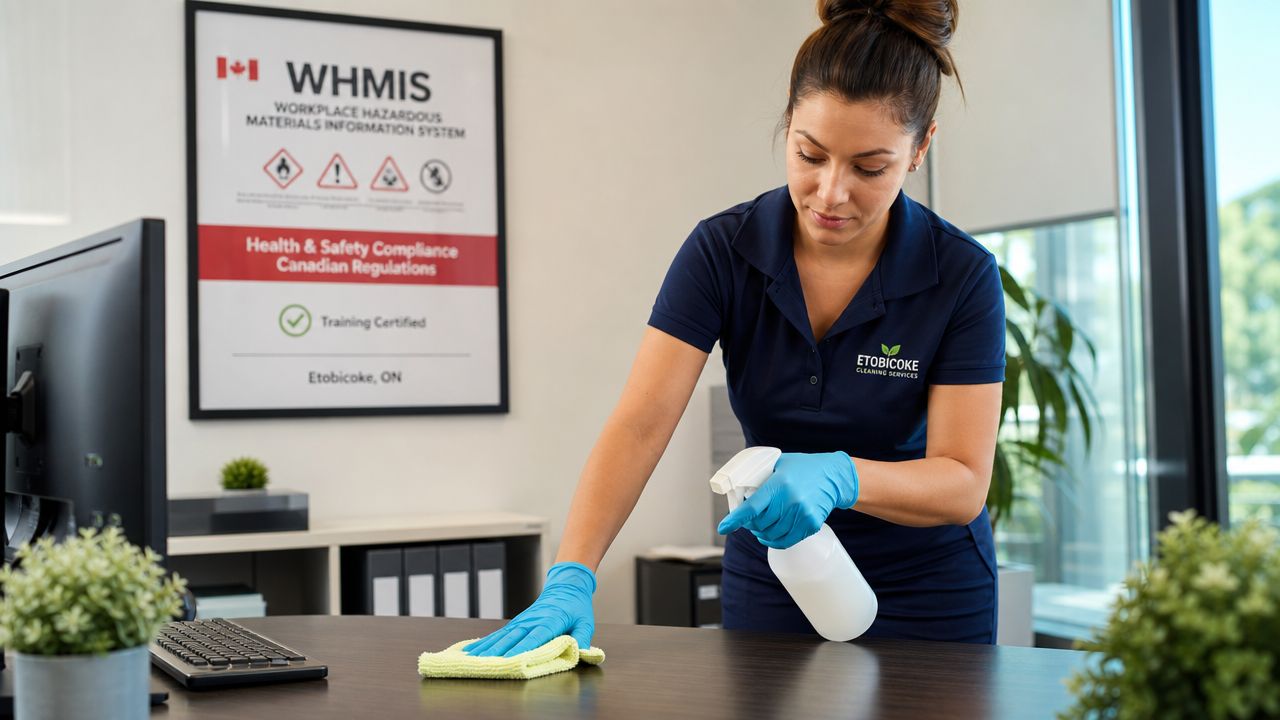
For Etobicoke businesses, especially those with shared kitchens, client traffic, washrooms, and common equipment, cleaning should be treated like any other building control. The standard is not merely whether a surface looks tidy. The standard is whether the vendor can support safe occupancy, proper product handling, and a paper trail when questions come up.
In Ontario, employers must take reasonable precautions to protect workers under the Occupational Health and Safety Act. In practical terms, that means a buyer should confirm that the cleaning provider uses Health Canada authorized disinfectants where disinfection is required, follows label contact times, and can provide safety data sheets and service records on request.
The common mistake is easy to understand. Buyers hear “disinfected” and assume the strongest chemical or the highest frequency is the safest option. Cleaning works more like a maintenance program than a fragrance spray. The result depends on matching the method to the risk, using the right product on the right surface, and applying it correctly every time.
That distinction matters more in some workplaces than others:
- Dental clinics and treatment-adjacent offices: Shared surfaces, patient flow, and reputational risk usually require written protocols and clear escalation steps.
- Childcare and education spaces: Product approval, touchpoint routines, and incident response often matter as much as basic appearance.
- Labs and regulated workplaces: Different surface types and contamination concerns usually call for more specific procedures.
- Busy offices with hoteling or shared devices: Desks, handles, counters, and meeting rooms need consistent high-touch routines, not occasional extra wiping.
Documentation is part of the service. A cleaning contractor who cannot show what was done leaves the office manager to fill the gap during a complaint, inspection, or internal review.
Ask for four items. Cleaning logs for sensitive or high-use spaces. Safety data sheets for the products on site. Escalation procedures for illness events, spills, and unusual contamination. Inspection records that show a supervisor checks results instead of assuming the route was completed.
Floor care belongs in the same conversation. Wet entrances, residue left by improper mopping, and neglected hard floors can create preventable incident exposure. For managers reviewing broader building controls, this resource on how to reduce slip and trip liability helps explain why housekeeping practices affect safety performance as much as appearance.
Some Etobicoke organizations also need a documented process for higher-risk touchpoints or illness response. In those cases, it helps to review what a vendor includes in its commercial disinfection and sanitizing services and whether the scope, products, and records match the workplace profile.
A useful rule is simple. If the vendor can explain the method, the contact time, the exceptions process, and the recordkeeping, the service is being managed. If the answer is only “we sanitize everything,” the buyer still carries the risk.
A Decision Making Checklist for Hiring a Vendor
A common Etobicoke procurement mistake starts like this. Two cleaning quotes look similar, one comes in lower, and the lower price wins. Three months later, complaints appear, a washroom inspection fails internal expectations, or no one can show what was cleaned after a spill event. The problem was not the quote. The problem was buying a service without testing how it would be managed.
Cleaning procurement works like buying a maintenance program, not a commodity. A vendor is taking responsibility for recurring tasks, site access, chemical use, floor care, reporting, and issue response inside an occupied workplace. For office managers, the better question is not “Who is cheapest?” It is “Who can carry this operational responsibility with the least risk to the business?”
Hiring checklist for office cleaning in Etobicoke
Use this checklist to compare vendors on control, consistency, and documentation.
Define the building profile clearly
List washrooms, kitchens, meeting rooms, floor finishes, entry conditions, shared equipment areas, and any spaces with stricter hygiene expectations. A vendor can only price and staff accurately when the site profile is specific.
Set the required service standard before asking for quotes
Decide what clean means for your office. For one business, that may mean presentable surfaces by morning. For another, it may mean documented washroom checks, detailed touchpoint cleaning, and scheduled floor restoration. If you do not set the standard first, each bidder is quoting a different job.
Separate routine work from periodic work
Daily and weekly tasks keep the office usable. Periodic work protects assets. Carpet extraction, machine scrubbing, floor finish work, vent cleaning, and upholstery cleaning should be named separately so they do not disappear inside a vague “full service” promise.
Confirm who owns supervision
Ask who inspects the site, how often they visit, how deficiencies are recorded, and who approves corrective action. Without account supervision, the service can drift unnoticed until a complaint, audit, or tenant concern brings it to the surface.
Check training against your workplace risks
Product handling, dilution, contact time, floor care methods, and safe work practices should match the site. An office attached to a warehouse, clinic, or childcare setting has a different risk profile from a small professional suite.
Review the vendor's proof system
A serious contractor should be able to show inspection forms, digital reports, task logs, or another method for confirming work quality. The goal is not paperwork for its own sake. The goal is a record you can rely on if service quality is questioned.
Test response procedures before signing
Ask what happens after a missed visit, bodily fluid incident, after-hours spill, security concern, or urgent client event. A good answer includes response times, escalation contacts, and a clear chain of responsibility.
Questions that reveal how a vendor actually operates
Some questions sound simple, but they expose whether the contractor runs a controlled operation or just dispatches cleaners.
How do you inspect completed work?
Listen for specifics such as supervisor checks, scored inspections, photos, or digital reporting.
What is excluded from the quoted price?
This helps catch supply assumptions, consumables, periodic floor care, or special cleanup work before the contract starts.
How do you document service in higher-risk areas?
This matters for offices with shared kitchens, reception traffic, illness concerns, or regulated client-facing spaces.
Who communicates service issues to us, and how fast?
A named contact and a defined escalation process usually prevent small failures from turning into larger ones.
What staffing backup do you use for absences?
Reliability depends on coverage planning, not good intentions.
Warning signs during vendor selection
Watch for gaps that increase management burden on your side.
- Vague language such as “we clean everything” without a task schedule
- Quotes that combine routine and periodic work into one unclear line item
- No defined inspection process
- No site-specific onboarding questions
- No written process for complaints, incidents, or urgent requests
- Heavy focus on price with little discussion of scope control or reporting
One simple test helps tie all of this together. Ask the vendor to explain how a missed task becomes a recorded issue, who corrects it, and how you would know it was closed. If the answer is clear, the vendor probably has a working management system. If the answer stays at the level of general promises, the office manager will end up carrying the follow-up work.
Comparing Service Models and Finding the Right Fit
Not every business in Etobicoke needs the same cleaning model. A law office with predictable traffic has different needs from a childcare centre, a dental clinic, or an office attached to a warehouse. The cleanest way to compare options is to look at service design, not just labels.
Sample Office Cleaning Service Packages
| Feature | Basic Maintenance Package | Standard Business Package | Premium Health & Compliance Package |
|---|
| Visit pattern | Lower-frequency routine service | Recurring service built around business activity | Recurring service with added logs and risk controls |
| Core tasks | Waste, visible floor care, washrooms, basic touchpoints | Core tasks plus broader detail cleaning and stronger common-area coverage | Standard scope plus higher-touch protocols and documented procedures |
| Floor care | Basic upkeep | Routine upkeep plus scheduled restorative items | Routine and restorative work tied to inspection findings |
| Documentation | Limited | Regular communication and issue tracking | Cleaning logs, product records, escalation documentation |
| Best fit | Small, low-traffic offices | Most professional offices and shared workplaces | Regulated, medical-adjacent, childcare, or higher-trust environments |
How to match the model to the workplace
A basic package can work when traffic is low, surfaces are simple, and the office has few shared amenities. It tends to suit spaces where appearance matters, but the operational risk is limited.
A standard business package usually fits the widest range of offices because it balances daily presentation with enough detail work to prevent slow decline. This is often the right middle ground for firms that want consistent results without overbuying.
A compliance-focused package makes sense when the buyer needs records, product traceability, tighter supervision, or clearer response steps after incidents. The value comes from control and defensibility, not from “more cleaning” in every area.
One provider feature set that maps to those concerns is the use of app-based quality assurance, flexible scheduling, and no-term service structures. For example, Arelli Cleaning describes support elements such as a price-match guarantee, 24/7 support, and mobile quality-management workflows. Those features matter only if they solve a real procurement problem, such as delayed issue resolution, weak communication, or difficulty verifying work.
The right fit is the model that matches the building's risk, traffic, and management style. Buyers who know their required scope, documentation needs, and escalation expectations usually choose better vendors than buyers who start with cost alone.
Frequently Asked Questions and Further Reading
Frequently asked questions
What's the difference between office cleaning and janitorial service
Office cleaning usually refers to the work performed in offices and administrative spaces. Janitorial service is the broader industry category that includes that work.
How often should an office be cleaned
That depends on traffic, washroom use, food areas, floor types, and risk profile. Daily, weekly, and periodic tasks should be separated rather than treated as one bundle.
Should buyers ask for a site visit before quoting
Yes. A site visit helps the vendor assess layout, access, floor conditions, washrooms, and any special requirements.
Is disinfection always included in regular office cleaning
Not necessarily. Buyers should ask what is routine cleaning, what is targeted disinfection, and how products and contact times are documented.
What makes one quote much cheaper than another
Usually a difference in scope, frequency, supervision, periodic work, or supplies. The task list often explains the price gap.
Do small offices need a formal cleaning specification
Yes. Even a short checklist prevents confusion and makes vendor comparison easier.
Where can buyers find answers to common service questions
A practical starting point is this commercial cleaning FAQ resource.
Further reading
Internal resources
External resources
If a business is reviewing office cleaning in Etobicoke, the most practical next step is to write a simple scope checklist, get 2 to 3 quotes, and compare vendors on documentation, supervision, and service clarity rather than price alone. Arelli Cleaning is one option to include in that process.






.webp)