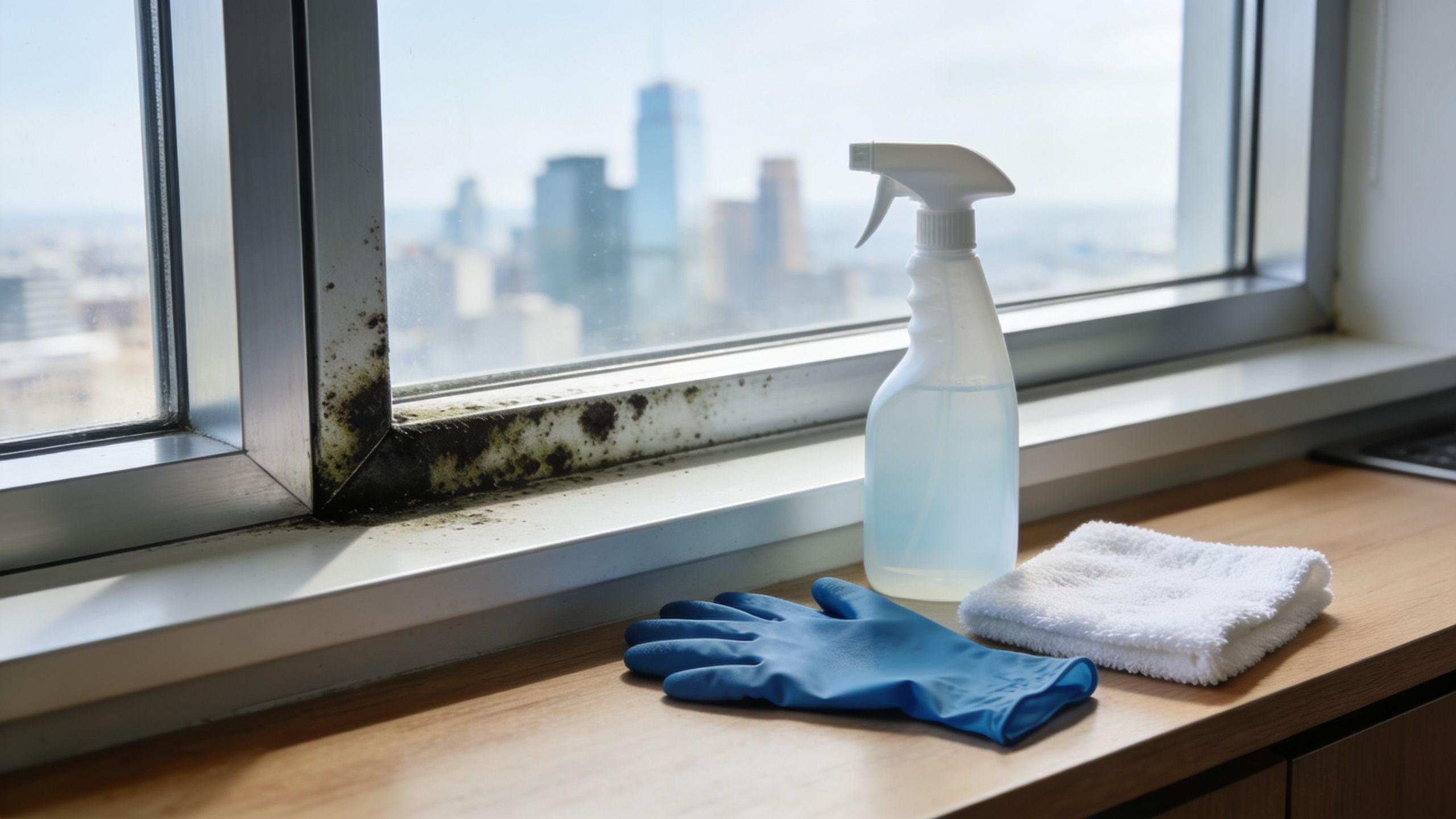
Dark specks on a sill rarely stay a small housekeeping issue for long. A property manager notices staining at one office window, asks for it to be wiped down, and then sees the same growth return a few weeks later. That pattern usually means the problem isn't the stain. It's the moisture feeding it.
In commercial buildings, mold in windows sits at the intersection of cleaning, maintenance, HVAC performance, and envelope condition. That's why the right first question isn't “What product should staff use?” It's “Is this a surface cleanup, or is the building signalling a moisture failure?”
What to Do When You Find Mold on Office Windows
When mold appears on an office window, the first move is to slow down and classify the problem. Staff often jump straight to spraying and wiping. That can remove visible residue, but it doesn't answer the more important questions: Is the glass sweating every morning? Is the frame leaking? Is water getting behind trim or into adjacent drywall?
For a commercial site, the immediate priority is risk control. The area should be documented, nearby materials should be checked for dampness, and the source of moisture should be considered before anyone treats it like routine janitorial work.
Key takeaways
- Window mold is usually a moisture problem first. Surface cleaning matters, but it won't solve recurring growth if condensation, leakage, or seal failure continues.
- Windows often contaminate nearby materials. Sills, drywall returns, trim, insulation, and debris in tracks can all support growth once they stay damp.
- Speed matters after wetting events. If water is found, drying and source correction should happen quickly to reduce the chance of growth becoming established.
- Recurring mold changes the scope of work. If it keeps returning, the issue may involve the building envelope, glazing, or HVAC performance rather than cleaning alone.
- Commercial liability rises when growth is ignored. Complaints, odours, material damage, and occupant concerns all become harder to manage once hidden moisture spreads.
Practical rule: If mold reappears after cleaning, assume the first cleanup addressed appearance, not cause.
A useful starting checklist is simple:
- Photograph the area: Capture the sill, frame corners, adjacent drywall, and any staining.
- Check for patterns: Note whether growth is worst on north-facing glass, shaded rooms, perimeter offices, or spaces with closed blinds.
- Look for moisture clues: Condensation beads, peeling paint, soft trim, swollen drywall, or musty odours all point to a broader issue.
- Separate tasks properly: Cleaning staff can report and isolate. Maintenance or remediation staff should diagnose water entry and material impact.
Understanding Why Mold Grows on Commercial Windows
Mold in windows needs three basic conditions. It needs moisture, it needs a food source, and it needs enough time under suitable indoor conditions to establish itself. Commercial windows supply all three more often than many teams realise.

The moisture pathways that matter
The most common cause is condensation. Warm indoor air hits a colder glass or frame surface, water forms, and the sill or surrounding finish stays damp. In offices, this often shows up in perimeter rooms, boardrooms with poor air movement, or spaces where blinds stay shut and air doesn't circulate against the glass.
The second pathway is leakage. Water can enter through failed perimeter sealant, poor flashing, frame joints, or cracks around the opening. This kind of moisture often leaves clues such as localised staining, bubbled paint, or growth concentrated at one corner rather than evenly across the sill.
The third pathway is hidden wetting inside the assembly. A failed insulated glass unit, air leakage around the rough opening, or moisture intrusion behind trim can keep materials damp even when the visible surface looks mostly dry.
Why window areas become mold hotspots
The U.S. CDC's mold facts identify Stachybotrys chartarum as a greenish-black mold that grows on cellulose-rich materials such as fibreboard, gypsum board, and paper when constant moisture is present. That matters around windows because the surrounding materials often include painted drywall, wood trim, backing paper, dust, and debris. The window itself may not be the food source. The adjacent materials usually are.
A clean-looking frame can still sit beside contaminated drywall returns or trim backs. That's why repeated wiping of visible spots can give a false sense of control.
Condensation versus active leakage
These two problems need different responses.
| Condition | Typical clues | Likely response |
|---|
| Condensation-driven mold | More widespread spotting, recurring moisture on glass, seasonal pattern, worse in humid or poorly ventilated rooms | Lower indoor humidity, improve air movement, inspect thermal performance |
| Leak-driven mold | Localised damage, stained corners, softness in trim, moisture after rain, deterioration at joints | Investigate sealants, flashing, frame joints, and envelope details |
Window mold that follows a pattern across multiple rooms often points to humidity and temperature conditions. Window mold that concentrates at one opening often points to a defect.
What doesn't work
Several common responses fail because they treat symptoms only:
- Painting over stains: Coatings don't fix damp substrates.
- Caulking over contaminated material: This can trap moisture and hide spread.
- Assigning every case to cleaners: Some sites need envelope and HVAC review, not another wipe-down.
Health Concerns and Business Liabilities of Window Mold
A stained sill may look minor, but commercial risk rarely stays confined to what's visible. The bigger concern is what repeated wetting does behind trim, inside wall returns, and around frame cavities. Once those materials stay damp, the issue moves from appearance to occupancy risk and asset management.

Why hidden growth changes the risk profile
Visible growth is only part of the story. NCBI's indoor environment remediation guidance notes that fungal spores on common building materials can germinate in less than five days if wetted with liquid water. In practical terms, a leak or persistent cavity wetting around a window can create hidden growth before inspectors can schedule a follow-up assessment.
That timing matters in offices, clinics, schools, and warehouses because complaints often start after the cavity problem is already established. By then, the organisation isn't just dealing with cleaning. It may be dealing with odours, occupant concerns, wet insulation, stained finishes, and damaged scheduling.
Commercial consequences
Property teams usually face four kinds of exposure:
- Occupant health concerns: Employees or tenants may report irritation, odours, or discomfort, especially in enclosed perimeter rooms.
- Operational disruption: Rooms may need to be taken out of use for inspection, drying, containment, or repair.
- Documentation pressure: Lease issues, internal reporting, and health and safety follow-up all become more serious when growth is recurrent.
- Material damage: Window mold often sits beside damaged paint, soft trim, swollen drywall, and debris accumulation that complicate routine cleaning programmes.
A common mistake is treating every complaint as an isolated janitorial defect. That creates a paper trail showing repeat cleanup, but not source correction.
A risk management view
If staff can see mold, managers should assume that nearby porous material may also need inspection.
That doesn't mean every dark mark is a major remediation event. It does mean window mold deserves a decision process. A site should determine whether the issue is limited to a cleanable surface or whether moisture has moved into the assembly.
The liability question is straightforward: if the building already knows a window area repeatedly gets wet, then repeating cosmetic cleaning without addressing the moisture path becomes difficult to defend. A better practice is to log recurrence, inspect adjacent materials, and escalate when the pattern suggests hidden contamination.
A Safe DIY Removal Framework for Minor Mold Spots
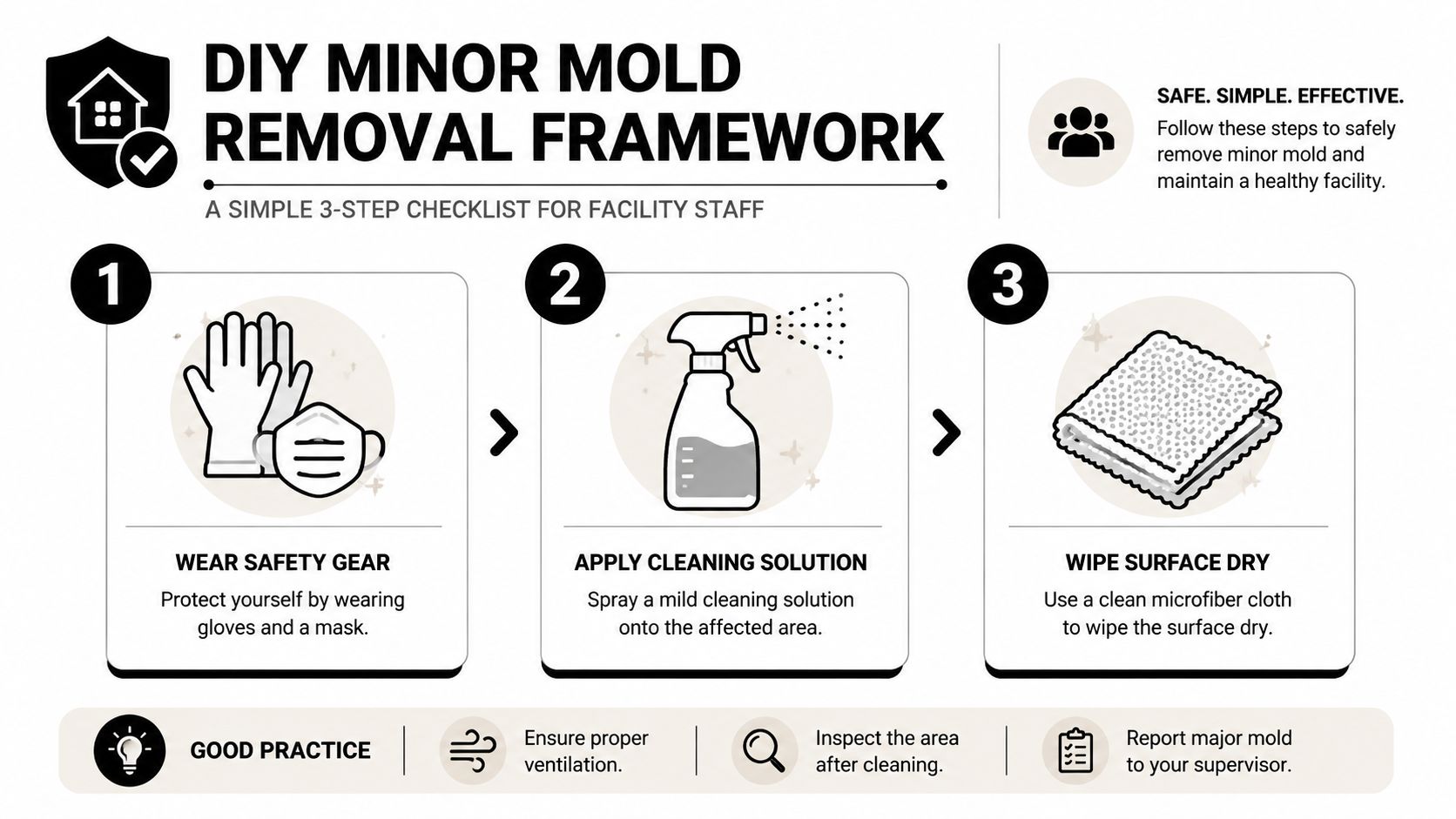
Small, isolated spots on non-porous or lightly affected surfaces can sometimes be handled by trained in-house staff. The key phrase is small and isolated. A staff wipe-down is only appropriate when the issue appears superficial, the surrounding materials are dry, and there's no sign of damage behind the visible area.
Start with safety and scope
Before any cleaning begins, the area should be assessed. If drywall is soft, trim is swollen, odour is strong, or the same window has already been cleaned before, in-house treatment should stop there.
For minor spots, staff should use basic protective measures and avoid aggressive dry brushing. The goal is controlled removal, not spreading residue through the room.
- Wear appropriate protection: Gloves and a mask reduce direct exposure during handling.
- Protect the immediate area: Use disposable cloths and keep traffic low while cleaning is underway.
- Avoid dry disturbance: Don't scrape or sand contaminated material.
A facilities team that stocks appropriate consumables can keep response more controlled. For example, commercial cleaning supplies for maintenance teams should include disposable cloths, gloves, bags, and basic cleaning agents suitable for surface work.
Follow a moisture-first process
The EPA's guide to mold and moisture advises that if wet or damp materials are dried within 24 to 48 hours, mold will typically not grow. That principle should drive the workflow. Cleaning visible spots comes after the moisture source is addressed, not before.
Identify the wetting source
Check whether the problem came from condensation, a leak, or a recent spill or cleaning issue. If the source is still active, stop and escalate.
Clean the visible residue
Use a mild cleaning solution appropriate for the surface and wipe with disposable or washable cloths. The motion should be controlled rather than forceful.
Dry the area completely
Residual dampness is what allows the problem to return. Dry the sill, frame edges, gasket area, and nearby surfaces.
Inspect adjacent materials
If staining extends into caulk lines, painted drywall, wood trim, or window tracks packed with debris, the issue may be broader than a simple wipe-down.
A practical visual summary helps when staff need a repeatable process:
Know the limits of DIY work
DIY work stops being appropriate when any of the following is true:
- The mold keeps returning: Repeat growth usually means source failure.
- Porous materials stayed wet: Drywall, trim, insulation, and backing materials may need removal, not surface cleaning.
- There's uncertainty about the source: If staff can't tell whether it's condensation or leakage, diagnosis comes first.
- The area affects occupied risk-sensitive spaces: Clinics, childcare settings, and sensitive work environments usually warrant a more cautious approach.
Cleaning is successful only when the surface is clean and the moisture path is closed.
Preventing Mold Recurrence in Commercial Spaces
Prevention is a building operations task. Once mold in windows has been cleaned, the site still has to remove the conditions that allowed it to form. That usually means controlling humidity, improving air movement, and catching leaks before they become recurring wetting events.
Control indoor humidity
Industry and public health guidance referenced here recommends keeping indoor relative humidity at or below 50% to reduce condensation and mold growth. In practice, that means property teams should measure humidity instead of guessing. If windows are sweating regularly, the building should assume the indoor environment needs review.
Good prevention habits include:
- Use hygrometers in problem zones: Perimeter offices, meeting rooms, and enclosed corners often behave differently from open work areas.
- Coordinate with HVAC settings: Overnight setbacks, low air movement, or poorly balanced zones can leave glass surfaces cold and still.
- Watch seasonal transitions: Heating season and shoulder season often expose weak ventilation patterns.
Treat window moisture as a maintenance trigger
A dark sill shouldn't be the first sign of trouble. Buildings can reduce recurrence by making windows part of regular inspection rounds.
- Inspect seals and joints: Failed sealant, cracked caulking, and deteriorated frame interfaces invite repeated wetting.
- Check tracks and weep paths: Dirt and organic debris hold moisture and interfere with drainage.
- Review nearby materials: Trim, drywall returns, blinds, and furnishings can block airflow or stay damp longer than the frame itself.
For teams building a practical leak checklist, even a residential guide such as finding concealed water leaks in Sydney homes can still be useful conceptually because it trains staff to look for subtle signs like staining patterns, repeated moisture, and hidden water paths. The commercial version adds envelope detail and documentation discipline.
Build a recurrence-prevention routine
A strong prevention routine usually includes:
| Task | Why it matters | Who usually owns it |
|---|
| Humidity checks | Confirms whether condensation risk is being managed | Facilities or building operations |
| Window inspections | Finds seal failures, staining, and drainage issues early | Maintenance staff |
| Prompt drying after incidents | Limits wetting time and reduces chance of growth taking hold | Maintenance and response teams |
| Occupant reporting process | Helps catch odours and repeat condensation quickly | Site management |
A recurring mold spot on a window is often a delayed maintenance signal, not a cleaning failure.
When to Engage a Professional Remediation Service
The decision point is simple. If the problem looks larger than a wipeable surface issue, the site should stop treating it like ordinary cleaning.
Red flags that require escalation
Professional assessment is usually the safer route when any of these conditions appear:
- Growth returns after prior cleaning
- Drywall, trim, insulation, or caulk appears damaged
- There's a musty odour near the opening
- Water staining suggests rain intrusion or hidden leakage
- The source can't be confirmed
- The area affects a sensitive or high-liability space
Facilities teams need to separate two scopes of work here. A commercial cleaner can remove light surface contamination in appropriate conditions. A remediation specialist is brought in when containment, material removal, hidden moisture inspection, or source-led corrective work may be necessary.
Cleaning service versus remediation service
| Need | Commercial cleaning scope | Remediation scope |
|---|
| Visible spot cleaning | Often appropriate | Sometimes unnecessary |
| Hidden cavity suspicion | Not the right scope | Appropriate |
| Recurring moisture problem | Limited value without repairs | Appropriate with moisture diagnosis |
| Porous material removal | Typically outside scope | Appropriate |
For managers reviewing provider capabilities, a general overview of commercial mold solutions can help clarify what remediation work typically includes beyond cleaning alone, such as containment and source-focused correction.
What to ask before hiring
- How will the provider determine the moisture source
- Will they inspect adjacent porous materials, not just the visible stain
- What containment approach will they use if material removal is needed
- How will the site verify drying and closure after work
- Where does standard commercial window cleaning for office buildings end and remediation begin
A neutral procurement approach works best. Use a checklist, get two or three quotes, and make sure the scope addresses both the visible growth and the reason it formed.
Frequently Asked Questions About Window Mold
| Question | Answer |
|---|
| Is mold in windows always caused by a leak? | No. Condensation from indoor humidity and cold glass is also a common cause. The pattern of staining often helps separate condensation from active leakage. |
| Can staff just wipe it off and move on? | Only if the issue is minor, isolated, and clearly superficial. If it returns, the site should assume the moisture source remains active. |
| Is all black-coloured mold the same thing? | No. Dark colour alone doesn't identify the species. What matters operationally is that visible growth signals moisture and warrants proper assessment. |
| Should a manager paint over stained trim after cleaning? | No. Coating over a damp or contaminated surface usually fails and can hide continuing damage. |
| Where does mold usually spread around a window? | Common areas include the sill, frame corners, drywall returns, trim, tracks, and sometimes hidden cavity materials beside the opening. |
| Who should handle recurring mold in commercial space? | Usually a combination of facilities, maintenance, and a qualified remediation or envelope professional, depending on whether the issue is condensation, leakage, or material damage. |
| What's the first tool a property manager should use? | A simple inspection and documentation process. Photos, notes on recurrence, and moisture clues are often more useful at first than a stronger cleaner. |
Further Reading and Resources
For teams dealing with mold in windows, the safest next step is usually a scoped inspection, not another blind cleanup. Arelli Cleaning is one option for businesses that need support with commercial cleaning coordination and related facility service planning. Use the checklists above, get two or three quotes, and make sure any provider addresses both the visible mold and the moisture source behind it.









.webp)