An office manager in Markham can get three cleaning quotes that look comparable until the first month of service. One provider may price a light nightly tidy, another may include washroom restocking and floor care, while a third may be the only one documenting chemical training, missed tasks, and corrective action. The difference isn't the word “cleaning” in the proposal. It's the relationship between the facility type, occupancy pattern, service frequency, and compliance risk.
Commercial office cleaning services in Markham should be evaluated as an operating system, not a list of mopping and vacuuming tasks. A professional contract should define what gets cleaned, how often, with which products, by whom, and how the client verifies completion.
What Commercial Office Cleaning in Markham Actually Entails
A professional office in a Markham business park doesn't operate like a dental clinic, a law office, or a warehouse administration suite. Reception areas need consistent presentation, shared kitchens accumulate food residue, meeting rooms change occupancy throughout the day, and washrooms require documented attention. A clinic adds surface-disinfection requirements, while a light industrial office may combine carpeted administrative space with dusty entrances, loading areas, and shared production corridors.
That is why commercial office cleaning services Markham buyers should reject a generic scope that treats every square metre identically. Commercial cleaning means maintaining an occupied business environment through scheduled cleaning, periodic detail work, specialty treatments, inspection, reporting, and controlled chemical use. Janitorial service is often one component of that broader programme, focused on recurring tasks such as waste removal, washrooms, floors, and touchpoint care.
Markham has a substantial commercial base to support recurring contracts. The City of Markham's 2024 Economic Profile reports 13,986,858 sq. ft. of commercial office inventory, a 10.2% vacancy rate, and an average net rent of $18.47 per sq. ft. (Markham commercial cleaning market data). The same profile records 37,247,733 sq. ft. of industrial inventory and 0.8% vacancy, so local cleaning demand extends beyond conventional offices into warehouses, production environments, and shared administrative facilities.
A practical definition for buyers
A managed cleaning programme answers five operational questions:
- Scope: Which rooms, surfaces, fixtures, and service points are included?
- Frequency: Which tasks happen daily, weekly, periodically, or after an event?
- Method: What equipment, products, dilution, dwell time, and PPE does the crew use?
- Accountability: How does a supervisor confirm completion and resolve missed work?
- Adaptability: Can the service change when occupancy, tenants, construction, or operating hours change?
Practical rule: If a proposal only names rooms and never defines task standards, inspection, exclusions, or escalation, it isn't detailed enough to compare fairly.
A credible Markham scope should distinguish routine office cleaning from post-construction cleanup, floor restoration, carpet care, high dusting, window cleaning, and disinfection. Buyers can review Arelli Cleaning's Markham service area as one example of a location-specific service framework, then use the same questions with other providers.
The best contract isn't necessarily the one with the longest task list. It's the one that connects each task to the building's actual use, risk profile, and operating calendar.
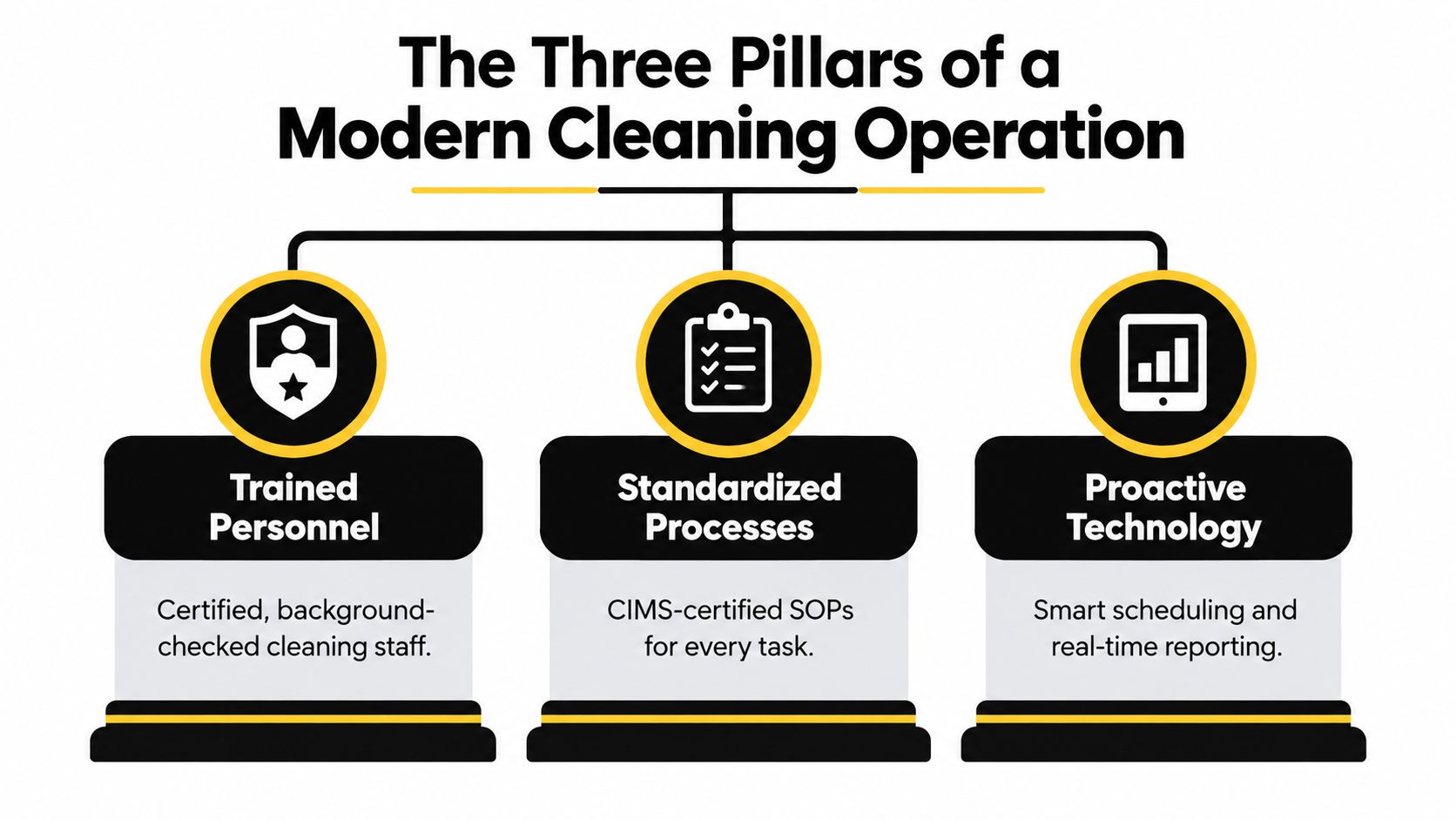
The Three Pillars of a Modern Cleaning Operation
A reliable cleaning operation depends on people, process, and technology. Remove one pillar and the contract becomes fragile. Skilled cleaners without a repeatable scope produce inconsistent results. Detailed procedures without trained staff become paperwork. Digital reporting without supervision only records failures faster.
Trained personnel
The cleaner entering a Markham office needs more than general experience. Staff should understand surface compatibility, washroom hygiene, floor chemistry, safe equipment handling, spill response, and the difference between cleaning and disinfecting. They also need site-specific instruction, particularly where the building includes clinics, childcare areas, food preparation, or industrial activity.
Screening, onboarding, refresher training, and clear supervision matter because turnover can otherwise transfer knowledge from one person's memory to nobody's. A mature provider can explain who trains staff, how replacements learn the site, and how supervisors verify work rather than assuming a familiar uniform equals competence.
Standardized processes
Standard operating procedures turn expectations into observable work. A useful procedure identifies the surface, soil type, product, application method, contact time where applicable, equipment, PPE, and completion standard. It also states what the crew should do when a task can't be completed, such as a blocked room, damaged fixture, inaccessible spill, or missing supply.
ISSA Canada describes CIMS and CIMS-GB as standards intended for in-house service providers and commercial cleaning contractors of different sizes. ISSA Canada also states that re-certification occurs every two years, making the standard a concrete management-system reference for buyers evaluating operational maturity (CIMS certification information).
Proactive technology
Technology should close the gap between the contract and the shift, not distract from cleaning. Mobile task lists, attendance records, issue reporting, photo documentation, supply alerts, and client communication can help supervisors act before a complaint becomes a pattern.
An advanced commercial cleaning management system is useful when it supports human judgement. A supervisor still needs to inspect a washroom, assess a floor finish, or speak with a client. The system should make that work visible, assign corrective action, and preserve a record of what happened.
The useful test is simple: Can the provider show what was assigned, what was completed, what was missed, and how the issue was closed?
The three pillars work together. Training explains the standard, procedures define it, and technology makes execution traceable. A proposal that advertises an app but can't explain supervision is no more dependable than a proposal that promises quality without defining it.
Core Services, Specialty Treatments, and Pricing Drivers
A sensible cleaning scope separates recurring work from periodic treatments. Routine service keeps the facility operational. Specialty work addresses accumulated soil, unusual events, renovation residue, or surfaces that need a different method.
| Service Category | Typical Application | Key Consideration |
|---|
| Routine janitorial cleaning | Offices, corridors, washrooms, kitchens, reception areas | Match frequency to occupancy and use |
| Floor care | Carpet maintenance, machine scrubbing, stripping and refinishing | Confirm finish type and equipment requirements |
| Disinfection | Hard, non-porous surfaces in higher-risk or regulated settings | Verify product authorisation and exact claim |
| Post-construction cleaning | Renovated offices, tenant improvements, newly completed spaces | Remove fine dust, labels, residue, and construction debris |
| High dusting | Light fixtures, vents, ledges, exposed beams, and overhead surfaces | Plan access, fall prevention, and area control |
| Window and glass cleaning | Interior glazing, entrances, partitions, and accessible exterior glass | Define access, height, and water-control needs |
Match frequency to the facility
A lawyer's office with stable occupancy may need a different routine than a shared technology workspace with frequent room turnover. A dental clinic requires careful separation of general cleaning from disinfection procedures. A warehouse office may need stronger entrance and dust controls even when its administrative rooms are lightly occupied.
A practical scope begins with a walkthrough that maps:
- Occupancy: Staff count, visitors, shift changes, hybrid schedules, and shared desks.
- Surface mix: Carpet, resilient flooring, stone, glass, stainless steel, laminate, and painted walls.
- Risk areas: Washrooms, kitchens, treatment rooms, reception points, waste storage, and loading entrances.
- Timing: Service windows, security restrictions, tenant access, and noise limits.
- Exceptions: Events, construction, seasonal salt, spills, and urgent response needs.
Understand what drives the quote
Price changes with square footage, service frequency, density of fixtures, soil load, access conditions, staffing, equipment, and specialty chemistry. A smaller clinic can require more controlled work than a larger low-traffic office. Nightly service can cost more than occasional visits because it creates a recurring labour commitment, while a flexible arrangement may change the effective cost of each visit.
Hourly and square-foot pricing can both be reasonable. Hourly pricing may suit irregular work or a small office with changing requirements. A scope-based or square-foot approach can make recurring service easier to budget, provided the proposal states assumptions about frequency, included tasks, supplies, and exclusions. Broad local ranges such as CAD 30 to CAD 60 per hour or CAD 0.10 to CAD 0.25 per sq. ft. appear in market content, but the assumptions behind those ranges aren't uniform.
For disinfecting hard, non-porous surfaces, Health Canada classifies most products as disinfectant drugs requiring pre-market assessment and a Drug Identification Number, or DIN, before sale in Canada (Health Canada disinfectant requirements). The buyer should ask for the product name, DIN, intended surface, dilution, dwell time, and documentation process. “Disinfected” shouldn't be a vague marketing label.
Businesses needing periodic treatments can review specialty cleaning services, then request the same scope detail from every bidder.
Navigating Compliance and Safety Standards
Compliance changes the value calculation. A low quote isn't low-cost if it leaves the client unable to identify chemicals, train workers, respond to spills, or demonstrate how disinfection claims were carried out.
Ontario workplaces use WHMIS for hazard communication. Cleaning staff handling hazardous products need training, workplace labels must be present, and Safety Data Sheets must be maintained and updated within 90 days when significant new information becomes available in Ontario (Ontario workplace chemical guidance). The provincial guide also states that employers must identify hazardous products, obtain SDSs, make them available, and provide instruction and training (Ontario WHMIS employer guide).
What this means on site
A provider should maintain a controlled product list rather than allowing every cleaner to bring a different chemical. The site file should show product labels, SDS access, dilution instructions, PPE requirements, spill response, storage controls, and staff training records. Standardisation makes a multi-tenant portfolio easier to supervise and reduces the chance that a worker improvises with an unsuitable product.
Health Canada identifies WHMIS as the national system for communicating hazardous-material information in Canadian workplaces, while Ontario enforcement responsibilities sit within the provincial workplace framework (Health Canada WHMIS overview). The practical result is shared responsibility. The cleaning contractor must train and equip its workers, and the workplace must support safe access, storage, and communication.
A concise resource on common cleaning risks and safety can help office managers identify hazards that may be overlooked during a quote review. For regulated or higher-touch environments, the scope should separately define commercial disinfection and sanitizing, including product controls and records.
ISSA Canada's Institutional and Commercial Clean Standard includes ATP testing protocols, measurement evaluation, corrective action, recordkeeping, technical training, and alternative methodologies (ISSA clean standards). That doesn't mean every office needs ATP testing for every routine task. It does show that quality can be assessed through documented methods rather than visual impressions alone.
How to Choose a Commercial Cleaning Provider in Markham
The strongest provider comparison starts with the building, not the salesperson. Each bidder should receive the same floor plans, room list, service window, occupancy notes, surface information, and specialty requirements. Otherwise, the cheapest quote may omit work that another proposal included.
A practical decision matrix
| Evaluation area | Basic provider model | Managed-service model |
|---|
| Scope | General task list | Room-by-room and task-level specification |
| Quality control | Complaint-led inspection | Scheduled inspections and corrective action |
| Communication | Phone or email follow-up | Mobile reporting and documented escalation |
| Compliance | Product information on request | Controlled inventory, SDS access, and training records |
| Flexibility | Fixed schedule | Adjustments for occupancy, events, and stop-and-go needs |
| Specialty work | Referred or separately arranged | Coordinated within a broader facility plan |
Neither model is automatically right. A small, lightly occupied office with simple finishes may value a straightforward local arrangement. A multi-tenant building, clinic, or office-industrial site may need stronger documentation and a dedicated account structure.
A provider should be able to explain insurance coverage, worker screening, training, supervisor visits, replacement staffing, emergency response, and cancellation terms. Flexible or no-term arrangements can reduce commitment risk, but flexibility still needs defined notice periods, service standards, and pricing rules. A rigid contract may offer predictability, yet it can become wasteful if hybrid occupancy changes and the scope never adjusts.
South Mountain Window Cleaning's discussion of retail cleaning service considerations is useful because it illustrates a broader principle: cleaning scope must reflect customer traffic, presentation standards, and the physical demands of the site, not just a generic room count.
The provider's reporting process deserves a live demonstration. Ask how a cleaner reports a spill, how a supervisor receives a missed-task alert, where the client sees completion records, and how recurring defects are analysed. A polished interface is irrelevant if staff don't use it or managers can't act on the information.
The following video can provide additional visual context for evaluating commercial cleaning work, but it shouldn't replace a written scope and site walkthrough.
Ask for evidence, not assurances: A provider should demonstrate its inspection form, chemical documentation, escalation process, and sample service report before the contract is signed.
Avoid bids with undefined “deep cleaning,” unlimited exclusions, unclear supply responsibilities, or guarantees that don't state response times. The winning proposal should make missed work visible and give the client a practical remedy.
Pre-Hire Office Cleaning Checklist
Use the same checklist for every bidder. Consistent questions expose differences that a polished quote can hide.
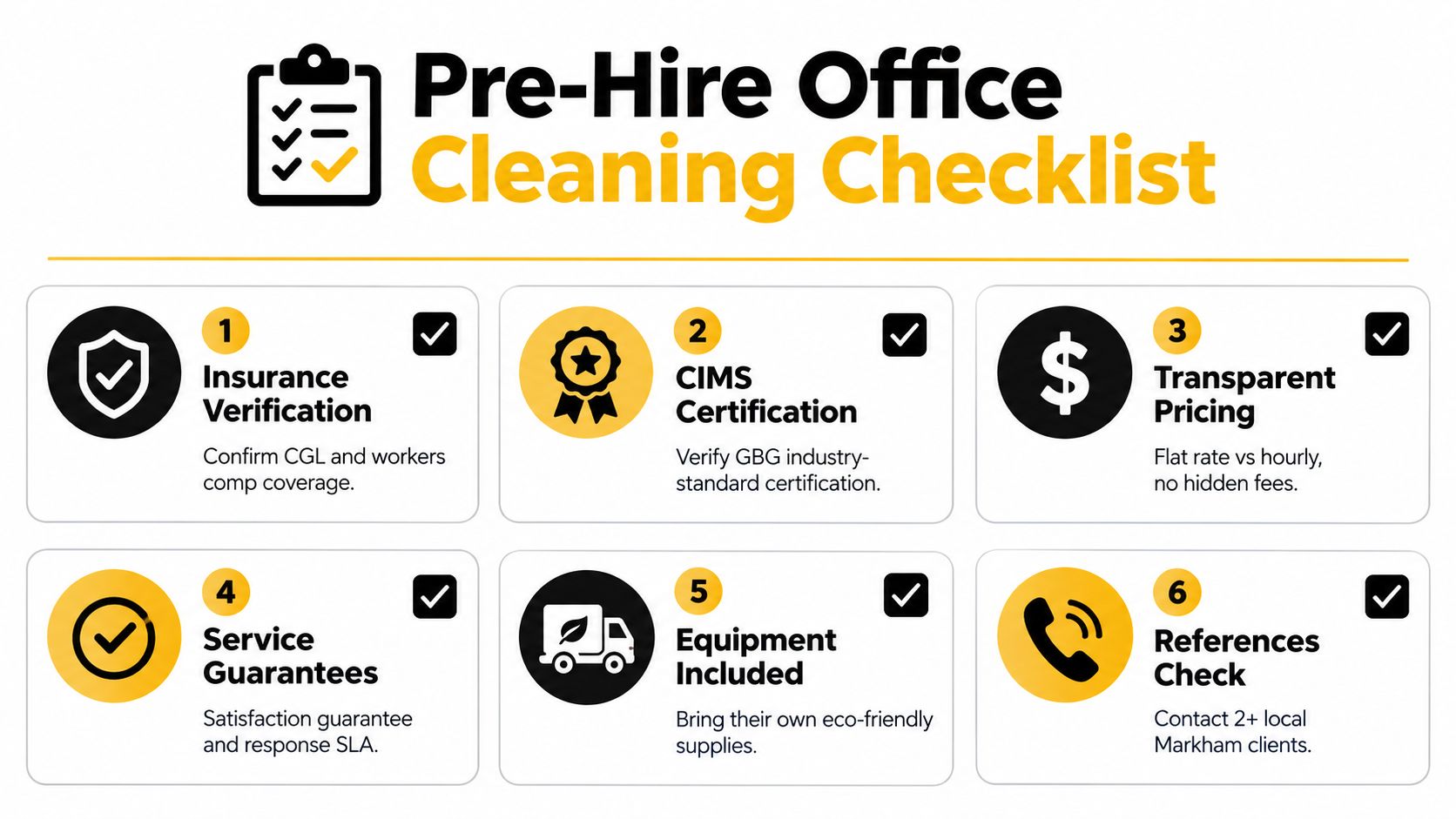
- Define the facility: Record occupancy pattern, room types, flooring, washrooms, kitchens, entrances, clinics, industrial areas, and restricted spaces.
- Verify insurance: Confirm commercial general liability and workers' compensation coverage, and ask when certificates are updated.
- Check compliance: Request the product list, SDS access, WHMIS training process, and disinfectant authorisation details where applicable.
- Compare pricing assumptions: Ask whether the proposal is hourly, square-foot, or scope-based, then identify frequency, supplies, equipment, exclusions, and additional-service rates.
- Test service guarantees: Confirm inspection frequency, complaint response, replacement staffing, emergency availability, and cancellation or pause terms.
- Review operational proof: Request references, a sample checklist, a sample report, supervisor details, and a clear process for recording corrective action.
Ask each provider what happens when occupancy changes, a tenant moves out, construction creates dust, or a spill occurs outside the normal service window. Those answers reveal whether the contract can operate under real conditions.
A small office may not need every available specialty treatment. It does need a written baseline, safe chemical handling, responsive communication, and a fair way to compare performance.
Arelli Cleaning offers customised office and commercial cleaning for Markham facilities, with recurring janitorial work, specialty cleaning, disinfection, floor care, post-construction cleanup, and flexible service arrangements. Businesses can use the checklist, request comparable quotes, and visit Arelli Cleaning to discuss a scope based on their facility type and operating schedule.








.webp)