A healthcare facility manager usually notices cleaning when something goes wrong. An inspection is coming. A patient comments on a washroom. A staff member flags missed disinfectant contact time in an exam room. In a medical setting, cleanliness isn’t a visual standard alone. It sits directly beside infection prevention, documentation, workflow control, and trust.
That pressure has only grown. The global healthcare and medical facilities contract cleaning services market was valued at USD 36.5 billion in 2024 and is projected to reach USD 54.9 billion by 2030, with a 7.1% CAGR from 2025 to 2030, according to Grand View Research’s healthcare and medical facilities contract cleaning market outlook. For clinic owners and facility managers, that growth reflects a practical reality. Medical office cleaning services now require systems, proof, and consistency, not just effort.
The six resources below work best as an operating toolkit. Used together, they help a clinic clean to a standard that staff can repeat, supervisors can verify, and inspectors can follow.
1. Medical Office Cleaning Compliance Checklist
A medical office without a written checklist usually relies on memory, habit, and verbal handoffs. That works until the day it doesn’t. In practice, the strongest cleaning programs separate tasks by room type, frequency, and accountability.
For a dental clinic, that means one list for operatories, one for reception, one for sterilization support areas, and one for washrooms and staff spaces. A physician office may need a simpler version, but it still needs named responsibilities and sign-off points. Laboratories often go further with colour-coded tools and area-specific steps to reduce cross-contamination.
What a useful checklist includes
A strong checklist should cover:
- Daily recurring tasks: High-touch surfaces, reception counters, chairs, door hardware, washrooms, break areas, and treatment spaces.
- Between-use tasks: Exam tables, armrests, light switches, stools, sink fixtures, and any touchpoint used during patient flow.
- Weekly detail tasks: Baseboards, vents, lower wall marks, privacy screens, and hard-to-reach ledges.
- Monthly verification items: Supply review, SDS access, damaged equipment replacement, and protocol updates.
Manual cleaning methods dominated the healthcare cleaning services market in 2024, and regular cleaning services also accounted for the largest service segment, according to Towards Healthcare’s healthcare cleaning services market sizing analysis. That matches what many clinic managers already know. Daily, repeatable cleaning still carries most of the workload in medical environments.
Practical rule: If a task matters during an inspection, it should exist on a checklist with a frequency, a location, and a name beside it.
A good checklist also creates a paper trail. In a medical lab, supervisors may verify sample preparation areas at set intervals. In a family clinic, front-desk staff may log waiting-room disinfection during busy periods. The exact format can vary, but consistency matters more than elegance.
What tends to fail
Checklists break down when they’re too long, too vague, or copied from a general office template. “Sanitize room” isn’t specific enough. “Disinfect exam bed rails, patient chair arms, faucet handles, drawer pulls, and light switch plate” is better. Mobile checklists with photo verification can help, but only if someone reviews them.
2. Health Canada-Approved Disinfectant Product Guide
Product choice causes more problems than many clinics expect. Some facilities buy a disinfectant that’s effective but harsh on finishes. Others choose a product staff like using, then discover the contact time is routinely missed. In both cases, the issue isn’t effort. It’s fit.

A practical product guide should list each disinfectant by approved use, application method, contact time, compatible surfaces, PPE requirements, and storage notes. For example, a dental office may use one product for operatory surfaces and another for glass, screens, or sensitive equipment housings. A paediatric clinic may also need products staff can apply quickly between room turnover without leaving heavy residue or scent.
What to confirm before purchase
The safest process is to verify products against official requirements, then test them in the actual space.
- Check approval status: Confirm the product appears on Health Canada guidance for disinfectants and sanitizers before standardizing it across the clinic.
- Check dwell time: Many products fail in the field because staff wipe too early.
- Check surface compatibility: Vinyl, coated metals, touchscreen surfaces, and dental chair materials can all react differently.
- Check SDS access: Staff need current safety information where they work, not buried in an office folder.
A common example is a clinic switching to a stronger chemistry after a contamination concern, then finding that plastics cloud, metal pits, or staff begin underapplying the product because it’s unpleasant to use. The better option is usually the one staff can use correctly, every time, on the actual surfaces in the building.
Contact time is part of the cleaning result. If the surface dries too fast or gets wiped too soon, the protocol hasn’t been completed.
For hand hygiene products, clinics should also align placement with workflow. Reception, triage, charting stations, and treatment room exits often need separate dispensers because behaviour follows convenience.
3. Medical Office Cleaning Service Provider Directory
Hiring a cleaning company for a medical office shouldn’t start with price. It should start with fit. A provider may be excellent in general office cleaning and still be a weak fit for a clinic with operatories, specimen handling areas, or strict after-hours access controls.
That’s why a local provider directory is useful only if it filters for healthcare relevance. A short list should include scope of services, insurance, health and safety documentation, experience in occupied clinical environments, and whether the provider can work with site-specific SOPs rather than a one-size-fits-all routine.
For readers comparing options in the GTA, Arelli’s medical office cleaning services page is one example of a provider description that outlines healthcare-specific cleaning support in a local market.
What to ask before shortlisting
When reviewing vendors, ask direct operational questions:
- Who trains the crew: In-house supervisors, external trainers, or ad hoc shadowing?
- How is quality checked: Site visits, digital audits, client communication logs, or only complaint response?
- How is cross-contamination reduced: Colour-coded cloths, dedicated area tools, and documented room sequencing?
- What happens during staff absence: Relief coverage, supervisor backup, or skipped tasks?
Commercial cleaning services account for 70.44% of the total cleaning services market by segment type, and contractual cleaning services hold 65.11% market share in that broader market, according to Market Research Future’s cleaning services market report. For medical offices, that reinforces a common operational choice. Many clinics outsource cleaning because they need dependable coverage, process discipline, and easier oversight of a non-core function.
A paediatric practice might prioritize toy and shared-surface sanitation. A legal office within a medical building may care more about confidentiality, secure access, and quiet after-hours work. The right directory helps narrow providers by operational reality, not just service area.
4. Medical Office Cleaning Contract Template
The contract is where vague expectations become expensive. In medical office cleaning services, most disputes come from unclear scope, unclear proof, or unclear response obligations. A good contract template prevents all three.
Some clinics ask for “nightly disinfection” and assume that includes every treatment room touchpoint, staff kitchenette, and washroom fixture. The cleaner may interpret that as visible surfaces only. The result is friction, not because either side is unreasonable, but because the contract never translated standards into tasks.
Clauses worth tightening
A solid medical cleaning contract should spell out:
- Scope by area: Waiting room, exam room, sterilization support, washroom, admin office, and staff room.
- Approved products and methods: Which disinfectants may be used, on which surfaces, and with what application rules.
- Service levels: Frequency, completion windows, lock-up duties, missed-service reporting, and emergency response expectations.
- Risk controls: Insurance, privacy expectations, key access handling, incident reporting, and worker training records.
Ontario clinics should have legal counsel review final language, especially where access, liability, and confidentiality overlap. A medical laboratory may also need clauses tied to restricted spaces or contamination events. A dental office may need more detailed wording around chairside areas and sterilization support zones.
One area many providers and clients under-document is business risk. The industry discussion often explains the practical benefits of outsourcing, but specific ROI and cost benchmarks are often missing, especially for smaller practices and local GTA comparisons, as noted in US&S’s discussion of medical office cleaning priorities and the underserved cost-benefit angle. That gap makes contract clarity even more important. If the financial case isn’t standardized, the service definition has to be.
For teams trying to tighten documentation habits, this external guide on reducing contract risks is a useful companion.
A contract should let a third party read it and understand what clean means in that building.
5. Medical Office Cleaning Staff Training Program
The fastest way to weaken a clinic cleaning program is to assume general cleaning experience transfers automatically into medical settings. It doesn’t. Medical environments involve different surfaces, different sequencing, different waste streams, and much less tolerance for improvisation.
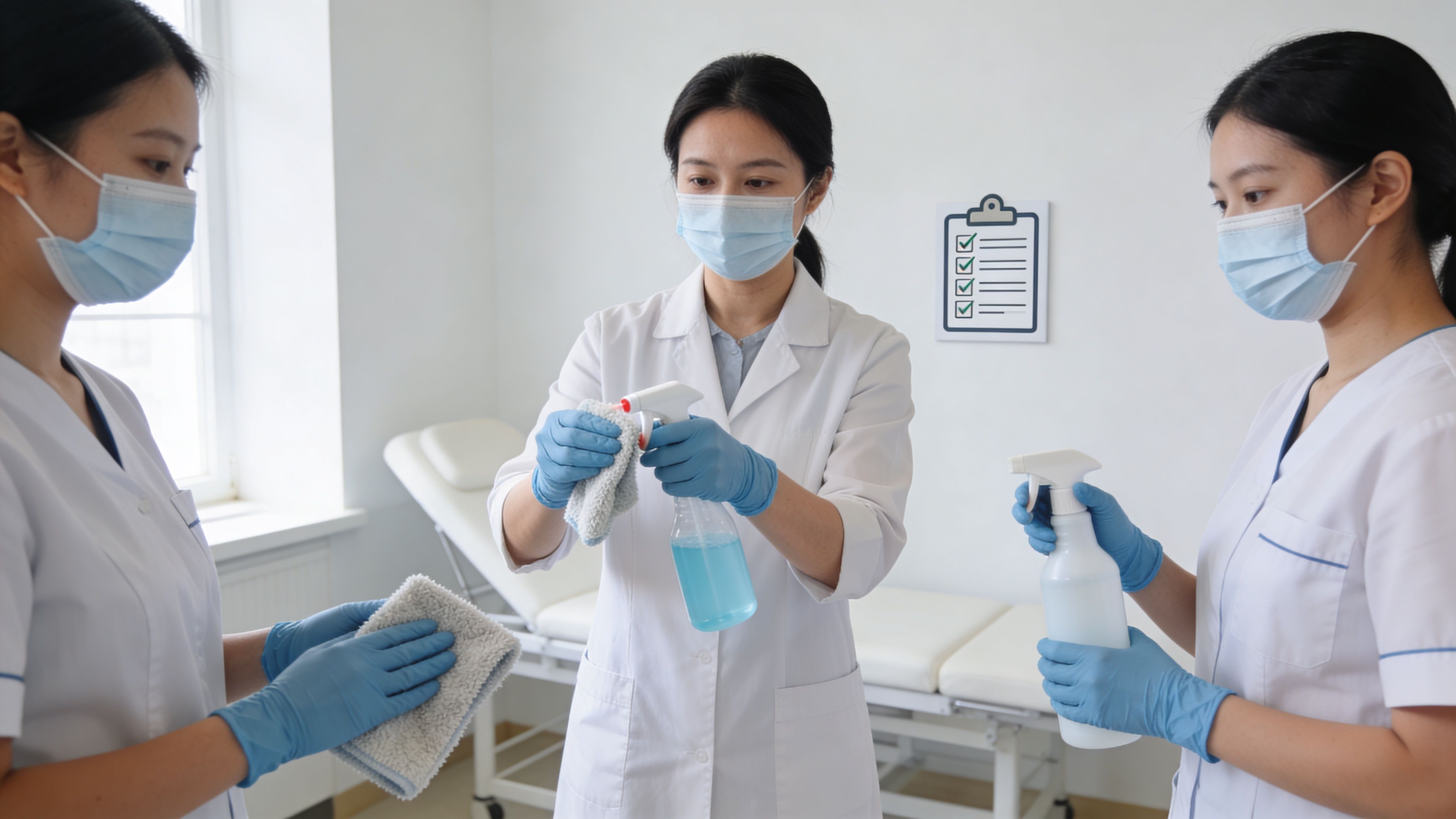
A useful training program covers infection control basics, product handling, PPE use, room sequencing, bloodborne pathogen precautions, WHMIS responsibilities, incident reporting, and privacy expectations. It should also explain why each step exists. Staff follow protocols more reliably when they understand the consequence of breaking sequence or reusing the wrong cloth in the wrong room.
What good training looks like on the floor
In a dental clinic, training should include operatory turnover support, chair and light touchpoint disinfection, and safe movement around instruments and sharps zones. In a walk-in clinic, staff need to work safely around active operations, evening lock-up, and variable room use. In a multidisciplinary practice, crews also need boundaries around charts, devices, and confidential documents.
The strongest programs use short written SOPs, hands-on demonstrations, supervised sign-off, and periodic refreshers when products or protocols change. Real scenarios work better than theory alone. For example, “what to do if a room was entered before contact time finished” is more useful than generic reminders to “be careful.”
This short training resource may help teams discuss baseline practices before site-specific instruction begins.
What to document
Training records should be easy to retrieve during a client review or compliance discussion. Keep:
- Attendance records: Names, dates, trainer, and topic.
- Competency sign-offs: Room procedures, product use, PPE, and incident response.
- Protocol updates: What changed, when, and who was retrained.
- Corrective coaching notes: Gaps found, action taken, and follow-up result.
A training program doesn’t need to be academic. It needs to be repeatable, observable, and documented.
6. Medical Office Cleaning Quality Assurance and Audit Guide
A supervisor walks an exam room at 7:15 a.m. The counters are clear, the floor looks fine, and the room smells clean. Ten minutes later, staff find an untouched light switch and no record of when the disinfectant was applied. That is the gap a quality assurance system is meant to catch.
Medical office cleaning services need an audit method that checks infection control tasks, not just general appearance. A presentable room can still fail on high-touch disinfection, contact time, product choice, or documentation.
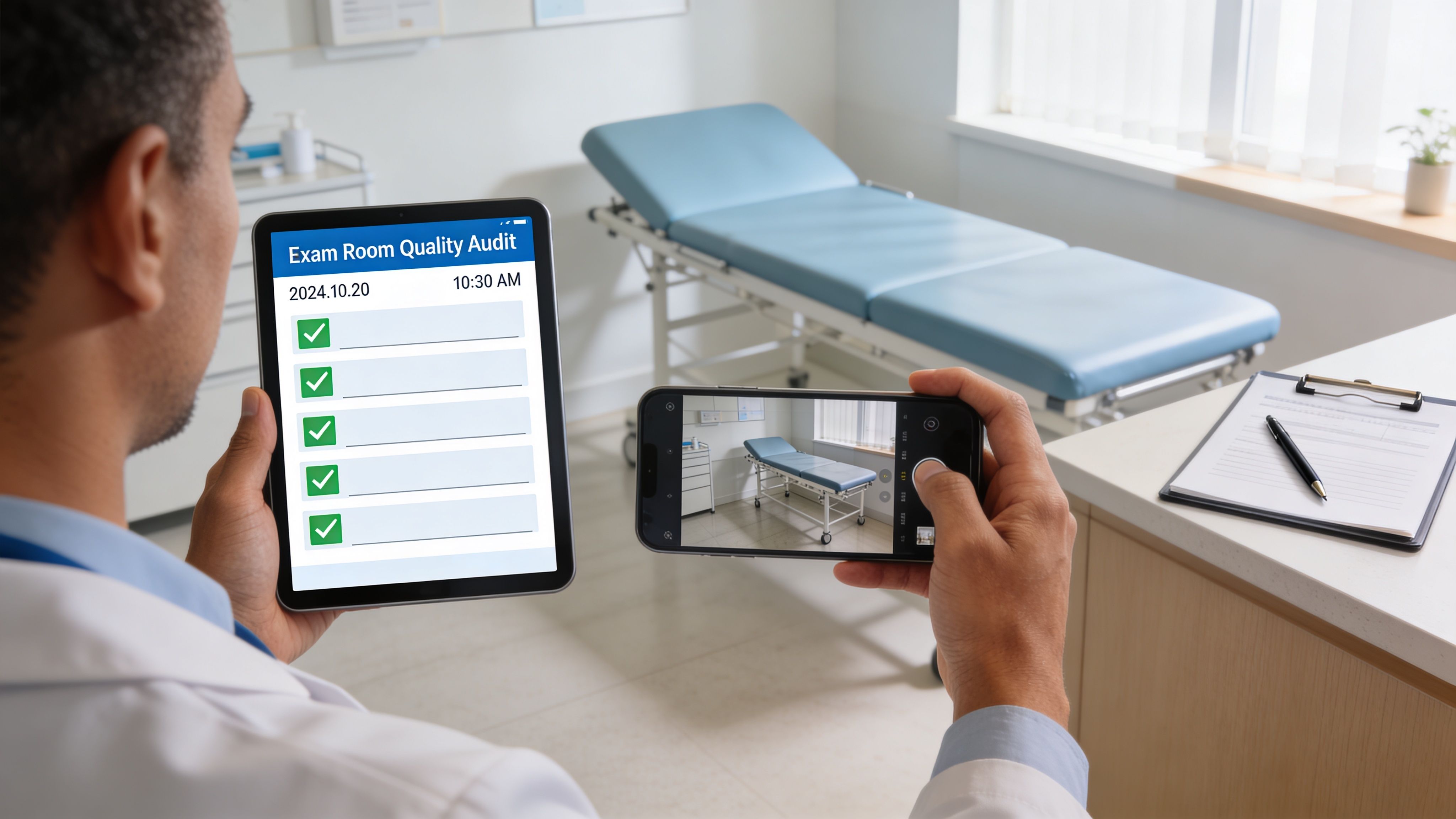
How to audit without creating paperwork for its own sake
An audit guide should help a manager answer three questions quickly. Was the task completed correctly? If not, how serious is the risk? What happens next?
That requires more than a generic pass or fail form. A usable toolkit includes room-specific checkpoints, photo examples of acceptable results, a simple scoring method, corrective action steps, and a set review schedule. Digital forms are useful if they shorten response time and create a record your team can retrieve during a client review, complaint investigation, or internal compliance check.
The strongest audits check both outcome and method. Outcome tells you whether the room is ready for use. Method tells you whether the work can be repeated safely across shifts, sites, and crews.
Useful audit criteria often include:
- High-touch compliance: Handles, switches, chair arms, sink fixtures, keyboards, tablets, and shared devices.
- Process compliance: Clean-to-dirty room sequence, cloth or mop separation, correct disinfectant, and observed contact time.
- Documentation quality: Timestamps, initials or technician ID, photos where required, and clear notes when a task was deferred or repeated.
- Corrective action control: Who fixed the issue, how fast it was corrected, and whether the same miss appears again in later audits.
A good audit form also separates cosmetic issues from infection control failures. Dust on a baseboard may need correction. A missed exam stool lever or reused cloth in multiple rooms needs immediate escalation.
Staff should not have to guess what acceptable work looks like. Supervisors should not have to guess whether a room was cleaned to standard.
Audit frequency depends on the setting and the risk profile. A physician office may use weekly supervisory inspections and a monthly trend review. A dental practice may add same-day spot checks between heavy treatment blocks. A clinic with high patient turnover may review a smaller sample more often instead of running one large audit at month-end.
Use the results to adjust operations. If one site keeps missing shared devices, revise the checklist. If contact time failures appear on evening shifts, review staffing levels, room turnover expectations, and supervisor coverage. If the same employee needs repeated correction, address retraining or reassignment.
That is what makes this resource useful as an operational toolkit rather than a file that sits in a binder. The audit should produce evidence, decisions, and a clear next step.
Medical Office Cleaning: 6-Resource Comparison
| Resource | Core Features | Quality & Compliance | Value & Pricing | Target Audience | Unique Selling Points |
|---|
| Medical Office Cleaning Compliance Checklist | Task-specific protocols; color-coded schedules; digital & printable; real-time tracking ✨ | ★★★★☆, Health Canada, WHMIS, OHSA ready | 💰 Low cost / high ROI, reduces legal risk | 👥 Medical clinics, dental, labs, multi-site managers | 🏆 Standardizes procedures; integrates with Arelli app for QA ✨ |
| Health Canada-Approved Disinfectant Product Guide | DIN verification; efficacy data; dwell times; SDS & surface compatibility ✨ | ★★★★★, Health Canada-approved listings; evidence-based | 💰 Cost comparisons per use; some products higher priced | 👥 Procurement, facilities managers, training leads | 🏆 Clears product selection; supports Arelli’s compliant product use ✨ |
| Medical Office Cleaning Service Provider Directory | Vetted profiles; licenses, certifications, client refs; pricing transparency | ★★★★☆, Verifies insurance & WHMIS; needs updates | 💰 Speeds selection; price-match & sample cleans available | 👥 Clinic managers, facility directors, office admins | 🏆 Pre-vetted GTA providers; positions Arelli as certified option ✨ |
| Medical Office Cleaning Contract Template | Scope, SLAs, insurance, confidentiality, termination, payment clauses | ★★★★☆, Legally vetted; requires jurisdictional review | 💰 Saves legal drafting time; lawyer review recommended | 👥 Procurement/legal teams, clinic owners, facility managers | ✨ Aligns with Arelli’s no-term / zero cancellation model; PIPEDA clauses 🏆 |
| Medical Office Cleaning Staff Training Program | Bloodborne & WHMIS training; infection control; hands-on certs; multilingual options | ★★★★★, Meets IPAC / CCOHS standards; audit-ready | 💰 Investment in time/resources; reduces liability & fines | 👥 Cleaning crews, supervisors, HR/training coordinators | 🏆 Hands-on certification; complements Arelli’s human-centric approach ✨ |
| Medical Office Cleaning Quality Assurance & Audit Guide | Inspection checklists; scoring rubrics; ATP/swab testing; photo & remediation workflows | ★★★★★, Measurable KPIs; supports 3rd‑party audits | 💰 Requires admin resources; high ROI via compliance & risk reduction | 👥 Quality managers, supervisors, compliance officers | ✨ Real-time reporting & dashboards; integrates with Arelli tech for rapid remediation 🏆 |
Building a Compliant and Resilient Cleaning Program
Medical office cleaning works best when it stops being treated as a stand-alone chore and starts operating like a controlled system. The checklist sets the daily standard. The disinfectant guide reduces product confusion. The provider directory improves vendor screening. The contract template clarifies expectations. The training program builds consistency. The audit guide confirms whether the work happened the way the clinic intended.
That integrated approach matters because healthcare environments don’t reward vague effort. They reward repeatable routines, room-specific protocols, and documentation that holds up under review. A clinic manager shouldn’t have to rely on assumptions such as “the team probably handled it” or “the room looked fine last night.” Medical office cleaning services need visible workflows and evidence.
One practical way to strengthen the program is to turn these six resources into a single operating binder or digital playbook. Keep approved products, room procedures, training records, contracts, and audit forms in one place. Then review them on a fixed schedule. If a product changes, update the SOP. If an audit finds a recurring miss, retrain that step. If a provider can’t document its process, treat that as a risk signal.
For teams standardizing procedures, this external guide to successful SOPs can help frame documentation in a more usable way.
When comparing vendors, ask for specifics, not promises. Ask how they train. Ask how they verify. Ask what happens when a cleaner is absent, a room is contaminated, or an inspection is scheduled. Get two or three detailed quotes and compare the systems behind them, not just the monthly fee. For GTA clinics that want a local option, Arelli Cleaning is one provider in that mix, particularly for facilities looking for documented tracking and healthcare-focused cleaning support.
Further reading:








.webp)