The strongest automation pitch in office cleaning is simple. Robots don't call in sick, software creates logs, and floor machines can cover large open areas on a schedule. That argument is appealing, especially for Toronto businesses under pressure to control labour costs and keep buildings visibly clean.
It’s also incomplete.
Industry discussion from companies such as Vanguard Cleaning and robot makers such as Avidbots points in the same direction. Automation works best on repeatable floor-care tasks in predictable spaces. It struggles when the environment changes, when corners tighten, when clutter appears, when a spill turns into a safety event, or when a facility needs judgement instead of route-following. That distinction matters more than many buying guides admit.
Janitors will Rule. Why Office Cleaning would always need the human touch? Because office cleaning isn't just about movement across square footage. It's about judgment, accountability, adaptation, and safe execution in live workplaces. For Toronto-area business owners, the practical question isn't human or machine. It's which work still depends on professional janitors and professional commercial cleaners, and how to choose a service provider that understands that reality.
1. Adaptability to Unique Facility Needs and Complex Environments
A dental clinic, a law office, and a warehouse can all look like "commercial space" on paper. In practice, they demand different janitorial decisions every shift.

The best evidence for this comes from workload research, not marketing copy. A California janitor workload study found that collecting trash, sweeping and mopping, vacuuming, and cleaning bathrooms carried the highest overall physical demands, and that janitors regularly work through differences between allocated time and actual time needed in real spaces (California Janitor Workload Study). That gap matters because real facilities don't stay static long enough for a one-size-fits-all routine.
Why human judgement changes the result
A professional office cleaner notices the meeting room that was used for a lunch-and-learn and needs spot work before the next client visit. A janitorial worker in a clinic adjusts product choice and sequence around regulated disinfection requirements. A cleaner in a warehouse changes approach around pallet dust, floor transitions, and active traffic paths.
Robots introduced for commercial cleaning since the late 1990s improved floor maintenance in open areas, but they still run into limits in tight corners, irregular layouts, and dynamic obstacles, as discussed in Vanguard's review of robotics in janitorial work. That doesn't make automation useless. It does mean facility managers should treat it as a tool, not a substitute for professional janitors.
Practical rule: If your building has irregular rooms, mixed-use areas, changing occupancy, or specialty spaces, ask how the provider assesses and updates task lists by area, not just by square footage.
A good evaluation starts with a walk-through. Business owners should expect the cleaning company to document area-specific needs, note exceptions, and explain how instructions get updated when the facility changes.
2. Superior Quality Assurance and Attention to Detail
Floor coverage is easy to measure. Quality isn't.
A robot can show where it travelled. It can't tell you whether dust was left on a ledge above reception, whether fingerprints remain on a glass entry, or whether a washroom "looks clean" but still feels neglected to staff and visitors.
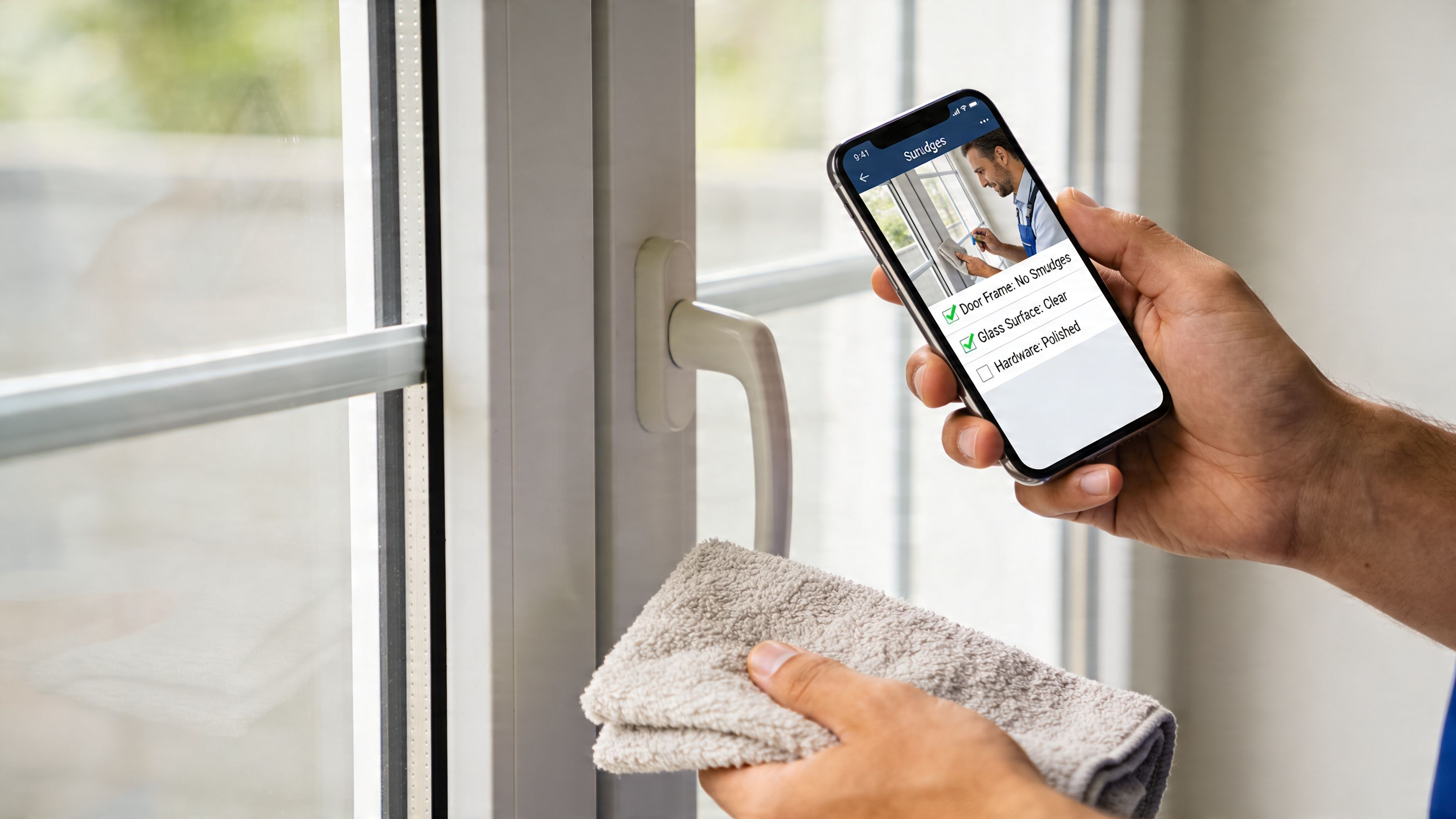
In the Greater Toronto Area, user satisfaction data points strongly toward that difference. A 2025 Toronto Board of Trade report found that 85% of 500 surveyed SMBs, educational institutions, and manufacturing facilities rated human-led services at 92% satisfaction for adaptive tasks, far above automation-heavy providers at 61% (Toronto Board of Trade findings summarized in verified market data). The reason isn't mysterious. Detail work depends on observation and correction in the moment.
What better quality assurance looks like
Quality in janitorial service usually comes from three things:
- Defined area standards: Reception, washrooms, kitchens, and boardrooms shouldn't all be inspected the same way.
- Visible accountability: Supervisors or cleaners should log issues, photos, and follow-ups in real time.
- Authority to correct on site: The worker has to be able to fix what they see, not wait for the next programmed cycle.
A post-construction clean-up shows the difference clearly. Fine dust on trim, residue on glass, debris in corners, and surface-specific finishing work all require trained eyes. The same is true in multi-storey offices, where benchmarked metrics from CIMS show human crews outperform robots in window cleaning and high dusting.
Clean isn't only what gets removed. It's also what gets noticed before a client does.
When comparing providers, owners should ask who inspects the work, how defects are documented, and how quickly missed items are corrected.
3. Detection and Response to Safety Hazards and Compliance Issues
Some of the most important cleaning work isn't cleaning. It's hazard recognition.
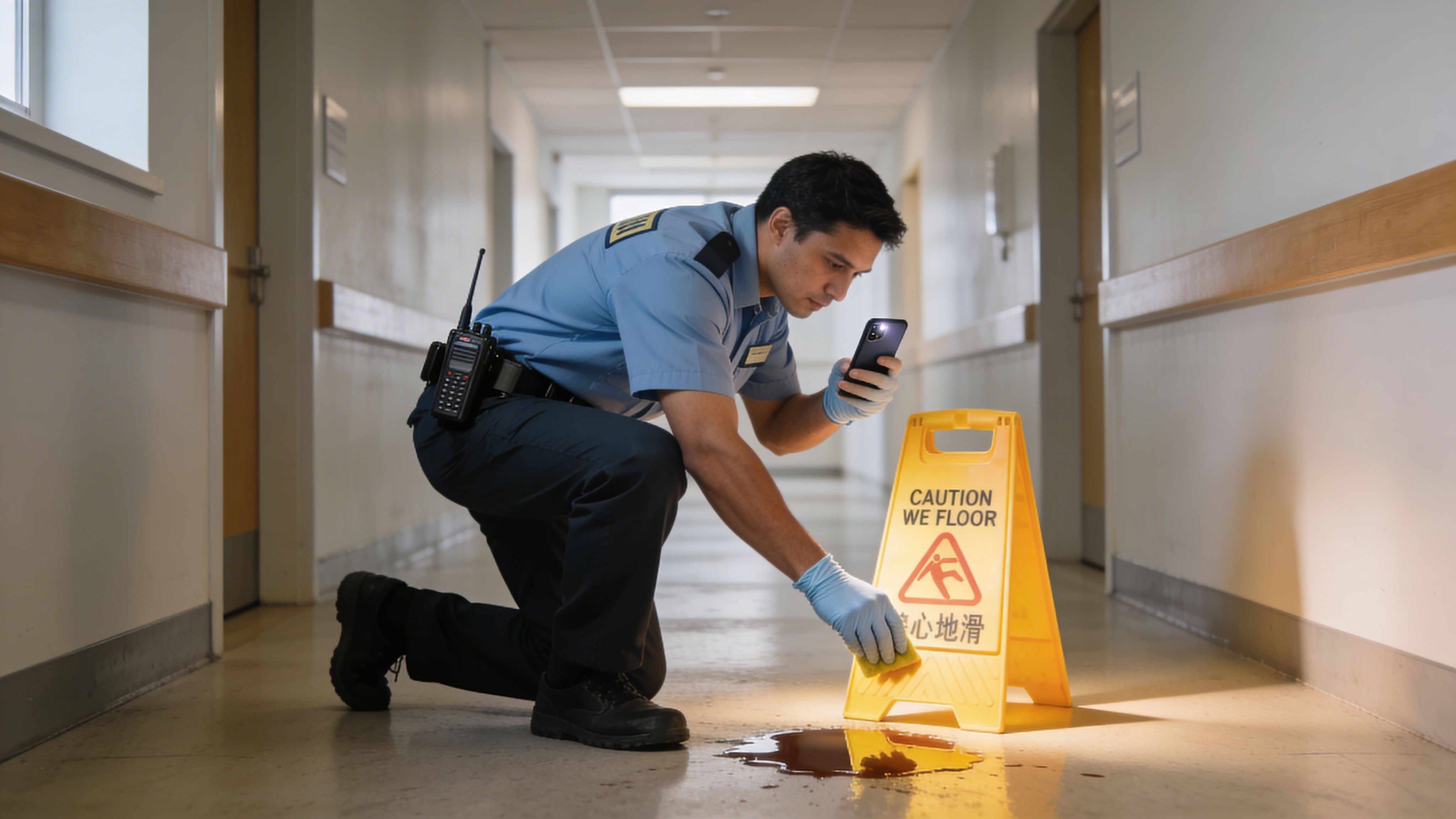
A janitor walking a facility can spot a leaking dispenser, broken glass near a desk cluster, a blocked fire route, a washroom floor becoming slippery, or a chemical bottle stored where it shouldn't be. A machine may avoid an obstacle. It won't necessarily interpret the risk.
Safety is part of the job, not a side task
California safety data shows why this matters. Janitors and cleaners ranked third in nonfatal injuries and illnesses, with 157.4 incidents per 10,000 full-time workers in 2019, compared with 86.9 for all occupations, and the societal costs of workplace injuries involving days away from work were estimated at $4.1 billion annually (janitorial safety statistics summary). The listed hazards include heavy lifting, repetitive motion, hazardous chemicals, bloodborne pathogens, slips, falls, equipment malfunctions, and workplace violence.
Those risks affect cleaners directly. They also show why trained human presence matters for the client site. The worker who understands WHMIS, notices a spill pattern near an entrance, or flags unsafe waste handling is helping protect the building, not just cleaning it.
Business owners should ask practical questions:
- Hazard reporting: Who reports spills, blocked exits, or damaged fixtures?
- Chemical control: How are products labelled, stored, and tracked?
- Escalation process: What happens when the cleaning team finds a safety issue after hours?
A childcare centre, clinic, or school can't treat janitorial safety awareness as optional. In those settings, professional office cleaners often act as the first people to see a problem before managers arrive the next morning.
4. Cost-Effectiveness Through Reduced Equipment Damage and Liability
The most common automation mistake is evaluating cost by labour line alone.
Robots can make financial sense in the right environment. Avidbots and other manufacturers are clear that automation creates value where routes are repetitive and floor plans are open. Fractal Robotique's guidance on selecting a commercial or industrial cleaning robot also points buyers toward facility type, task fit, and environment before purchase. That's the right way to think about the category.
Total cost is broader than machine price
In GTA facilities, automation adoption remains limited. Verified market data states that robotic scrubbers were used in only 12% of GTA facilities in a 2024 FMAC survey, while warehouses and dental clinics prioritized human touch for 92% compliance in safety audits versus 65% for fully automated trials. The same data advises providers to invest in crew training over bots for higher retention in high-touch services.
That doesn't prove robots are bad investments. It shows they are narrow investments.
A professional janitorial crew helps prevent costs that don't appear in a glossy robotics demo:
- Surface damage: Wrong pad, wrong dwell time, wrong route near delicate finishes.
- Equipment collisions: Contact with furniture bases, exposed cabling, displays, or specialized machinery.
- Water and residue issues: Overwet floors, missed edges, or incomplete drying that create slip risks.
- Missed early warnings: A human cleaner can spot a plumbing leak or damaged flooring before it turns into a repair claim.
A small office with changing furniture layouts and hybrid occupancy usually doesn't have the same economics as a large, open warehouse. That distinction is often buried in automation sales language.
Owners should calculate cost of service against damage prevention, compliance outcomes, and flexibility. A cheaper repetitive process can still become an expensive cleaning strategy if it misses the tasks that protect the building.
5. Real-Time Communication and Responsive Problem-Solving
Office cleaning is rarely perfect on autopilot because offices aren't static.
A tenant event runs late. A washroom gets heavy use after a training day. A reception area needs attention before a client meeting. A machine can follow a route. It can't negotiate a changed priority with a facility manager.
Responsiveness is a service feature
In the GTA, adoption of IoT monitoring still lags. Only 18% of commercial sites use it, according to verified market data, in part because integration costs start at CAD 15,000+ and humid industrial environments saw a 27% failure rate in that same dataset. By contrast, human-centric systems such as mobile communication and quality apps were reported as far more usable in day-to-day operations.
That distinction matters for commercial cleaning because communication solves problems before they become complaints.
A practical service workflow looks like this:
- Request comes in: The office manager flags an urgent issue.
- Cleaner or supervisor confirms: Someone acknowledges what changed.
- Work gets reprioritized: The team adjusts that shift's sequence.
- Proof follows: Photos, notes, or sign-off show what was done.
Operational test: Send one non-urgent request and one urgent request during the quoting process. The provider's response speed will tell you more than the proposal.
Here, hybrid models are most effective. Use technology for logs, photo verification, task tracking, and accountability. Use people for judgement, escalation, and service recovery. This addresses the central premise of Janitors will Rule. Why Office Cleaning would always need the human touch? Human communication closes the gap between plan and reality.
6. Employee Morale and Professional Environment Maintenance
People work differently in spaces that feel cared for.
That doesn't mean polished floors alone create culture. It means a clean office signals order, respect, and operational competence. Employees notice washrooms, kitchens, shared desks, and meeting rooms long before leadership sees a quarterly facilities report.
Cleanliness shapes perception inside the business
Verified GTA market data found that 72% of law offices and engineering firms cited "personalized human accountability" as a reason for renewals, and Toronto had 15,200 janitorial jobs in 2024, growing 3.8% amid worker shortages. Those facts point to a simple reality. Businesses still value people they can trust to maintain professional spaces.
In an office setting, morale often turns on small details:
- Reception appearance: Clients infer standards from what they see first.
- Break room upkeep: Staff use it every day and judge management accordingly.
- Washroom consistency: If this slips, confidence in the rest of the building often slips too.
- Meeting readiness: Clean boardrooms support client-facing work.
A human cleaning team can also work around occupancy patterns in ways software alone can't. That matters for firms balancing in-office days, executive meetings, and event schedules. For businesses reviewing local options for office cleaning in Toronto, this is one of the clearest selection filters. Ask how the provider minimizes disruption while still protecting visible standards.
A clean workplace isn't just hygiene. It's operational theatre. Staff and clients read it as evidence of how the business runs.
7. Health, Safety Compliance, and Specialized Disinfection Protocols
Disinfection isn't the same as general cleaning, and compliance isn't the same as appearance.
A polished surface can still be handled incorrectly. A machine can cover area without understanding contact times, product compatibility, or whether the setting requires a different protocol because of patient turnover, child occupancy, or regulated exposure concerns.
Specialized protocols still depend on trained people
Ontario labour reporting adds urgency here. Verified data states that cleaning workers experienced a 22% rise in workplace injuries in 2025, from 1,450 to 1,770 claims, with 35% linked to chemical exposures and slips in commercial settings, while WHMIS non-compliance citations increased 15% in GTA inspections (unsafe janitor working conditions context and related labour angle). That isn't just a worker issue. It is a client risk issue too.
Facilities with health-sensitive operations need janitorial teams that understand:
- Product selection: Which disinfectant fits the setting and surface.
- Application method: How to apply without creating residue or exposure problems.
- Dwell time: Whether the product had enough contact time to do its job.
- Documentation: What needs to be recorded for internal compliance.
Businesses don't need a cleaning company that simply says "we disinfect." They need one that can explain the protocol.
That is especially important in dental clinics, childcare centres, educational facilities, and high-traffic offices during respiratory illness season. Businesses reviewing PPE, storage, and worker protection policies may also find this complete guide to safety supplies useful as background reading.
For now, specialized disinfection remains a human-led discipline supported by tools, not replaced by them.
7-Point Comparison: Why Janitors Are Essential
| Item | Implementation Complexity 🔄 | Resource Requirements ⚡ | Expected Outcomes 📊⭐ | Ideal Use Cases 💡 | Key Advantages ⭐ |
|---|
| Adaptability to Unique Facility Needs and Complex Environments | Medium–High; needs assessments and on‑site decision making | Skilled staff, assessment time, documentation systems | Customized cleaning, improved compliance, fewer on-site issues | Dental clinics, labs, manufacturing, mixed-use facilities | On‑the‑fly adjustments; handles diverse surfaces and compliance |
| Superior Quality Assurance and Attention to Detail | Medium; QA protocols, inspections and corrective workflows | Trained personnel, inspection time, mobile photo documentation | Consistently high cleanliness; enhanced client perception | Law firms, client‑facing offices, post‑construction sites | Visual verification, immediate correction, accountability |
| Detection and Response to Safety Hazards and Compliance Issues | High; safety training, reporting workflows and emergency readiness | Certified staff (WHMIS), reporting tools, ongoing training | Reduced incidents/liability; documented compliance records | Childcare, schools, healthcare, regulated industrial sites | Early hazard detection, emergency response, compliance documentation |
| Cost-Effectiveness Through Reduced Equipment Damage and Liability | Low–Medium; care processes and reporting routines | Labor, insurance coverage, flexible scheduling options | Lower total cost of ownership; fewer repair claims | Growing businesses, equipment‑intensive firms, SMBs | Prevents damage, reduces liability, scalable pricing |
| Real-Time Communication and Responsive Problem-Solving | Medium; integrate app and clear communication protocols | Mobile app, responsive teams, 24/7 support infrastructure | Faster resolution, schedule flexibility, transparent records | 24/7 operations, manufacturing emergencies, events | Direct two‑way communication; rapid, documented responses |
| Employee Morale and Professional Environment Maintenance | Low–Medium; coordination with operations and event planning | Coordinated schedules, targeted cleaning, feedback loops | Higher employee satisfaction, productivity, better client impressions | Corporate offices, professional services, educational campuses | Enhances workplace morale and health; supports company image |
| Health, Safety Compliance, and Specialized Disinfection Protocols | High; certified disinfection procedures and recordkeeping | Specialized training, Health Canada‑approved products, documentation | Effective infection control; audit‑ready compliance records | Dental/medical clinics, childcare centers, labs | Surface‑specific disinfection, regulatory compliance (Health Canada, WHMIS) |
Making the Right Choice: A Framework for Selecting Your Cleaning Partner
Business owners don't need to choose between old-school janitorial service and futuristic automation. They need to choose the right operating model for their building.
The evidence points to a balanced conclusion. Robots and automated floor equipment can help with repetitive tasks in the right settings. They are most useful in large, open, predictable spaces where route efficiency matters more than judgement. But office cleaning and commercial cleaning in real workplaces still depend on human observation, adaptation, communication, and safe execution. That's why professional janitors and professional office cleaners remain central to service quality.
A practical selection framework is straightforward.
First, define the environment. A law office, clinic, warehouse, school, or mixed-use office each creates different cleaning demands. The more variable the site, the more human judgement matters.
Second, test the provider's operating discipline. Ask about training, WHMIS practices, inspection routines, issue escalation, and who updates task lists when your facility changes. Ask where they use equipment and where they rely on janitorial staff.
Third, pressure-test responsiveness. During the quoting stage, note how clearly they answer questions, how they handle special requests, and whether they explain limitations forthrightly. A provider that oversells automation often undersells the complexity of your building.
Fourth, look for proof in your own space. A sample clean, trial period, or detailed walk-through often reveals more than a polished proposal.
A company such as Arelli may be one option for Toronto-area buyers who want a human-centric model supported by systems and mobile oversight rather than a robot-first pitch. The key is not the brand name. It's whether the provider respects what cleaning work involves.
Use that standard, get 2 to 3 detailed quotes, and compare the companies on judgement, safety, communication, and accountability, not price alone.
Further Reading
Internal Resources:




.webp)