A facility manager usually starts looking into industrial carpet shampoo after the same pattern repeats. Entry lanes turn dark. Office corridors look worn before the week ends. Dust from warehouse traffic migrates into carpeted admin areas, and a routine vacuum no longer resets the appearance.
That’s the point where carpet care stops being a cosmetic task and becomes an operations decision. In commercial settings, the wrong method can leave sticky residue, long dry times, recurring spots, odour complaints, or compliance issues tied to chemical handling and indoor air quality. The right method protects the carpet, shortens disruption, and gives staff a cleaner, safer space to work in.
Key takeaways
- Industrial carpet shampoo is a professional process for managing heavy soil, traffic lanes, and operational downtime in commercial environments.
- Hot Water Extraction is the deep restorative standard when heavy soil removal matters most.
- Low-moisture encapsulation is often the practical maintenance choice when facilities need fast re-entry.
- Drying control matters as much as cleaning chemistry. Poor moisture recovery leads to wicking, mould risk, and repeat work.
- In Ontario, chemical choice and application method also affect WHMIS and indoor air quality compliance.
Understanding Industrial Carpet Shampooing
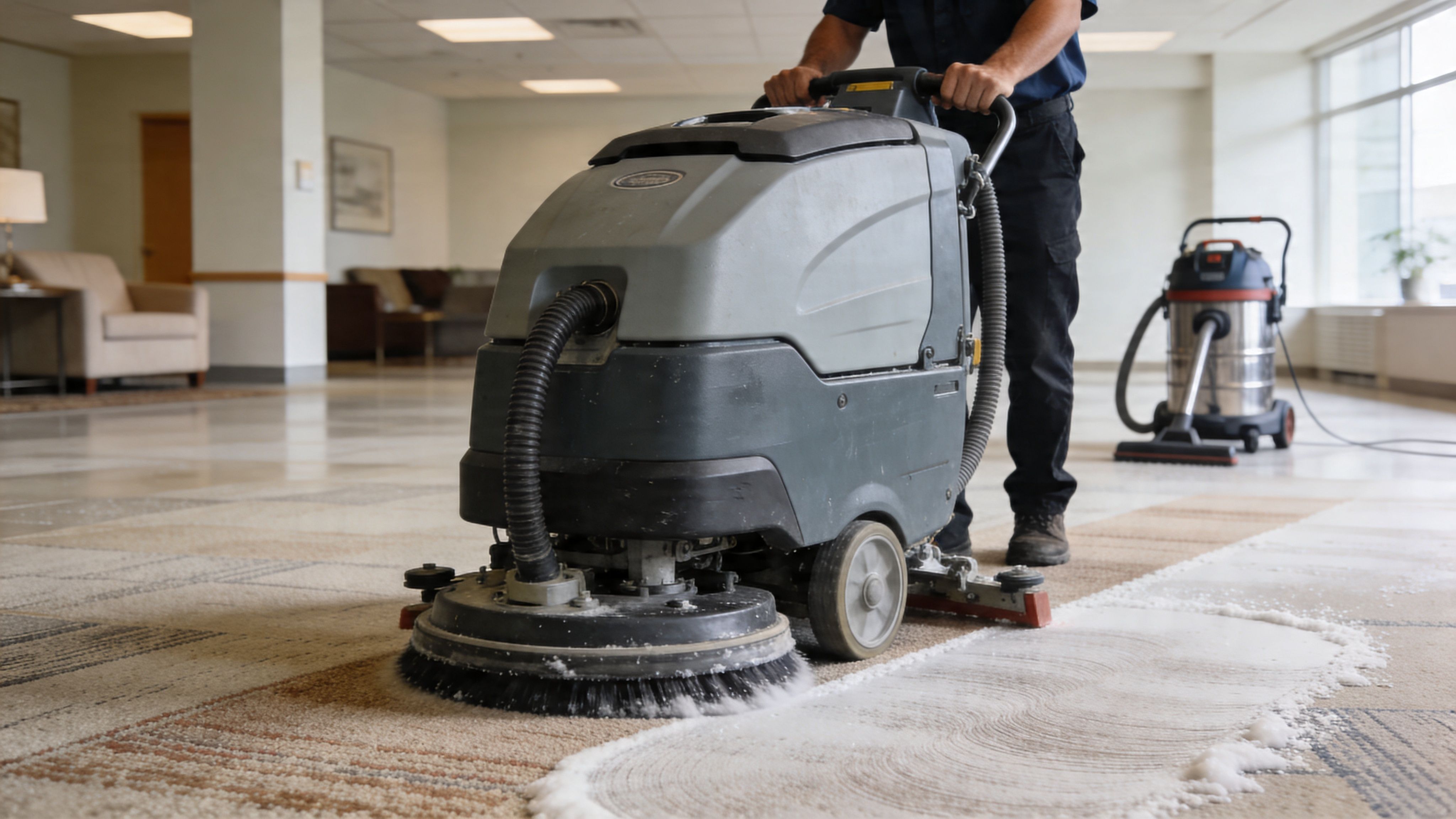
Industrial carpet shampooing isn't the same as residential carpet cleaning with a rental unit and a general detergent. In a commercial building, the carpet has to handle repeated traffic, abrasive dry soil, wheeled movement, and in many sites, contamination carried in from loading areas, plant floors, and winter weather.
In practice, industrial carpet shampoo means a controlled cleaning process built around soil load, carpet construction, occupancy, drying conditions, and safety obligations. The goal isn't just to make the carpet look better today. It's to protect the floor covering as an asset and reduce premature wear.
Where industrial sites get different
A warehouse office, school admin suite, dental clinic, and engineering firm may all have carpet, but the soil profile isn't the same.
Common commercial pressure points include:
- Entry contamination from salt, grit, and moisture tracked in from parking lots and receiving doors
- Dry abrasive soil that cuts into fibres when vacuuming and periodic deep cleaning aren't aligned
- Oily residue transfer from manufacturing and service environments
- Downtime limits in sites that can't leave walkways closed for long
- Indoor air expectations in occupied buildings where chemical odour and moisture become management issues
Clean carpet in a commercial building is a maintenance outcome, not a one-time event.
A direct definition
Industrial carpet shampooing is the use of commercial cleaning chemistry, agitation, extraction, and drying control to remove embedded soil from carpet in workplaces such as offices, warehouses, manufacturing facilities, schools, and clinics.
That definition matters because many failures come from treating commercial carpet like a domestic surface. A facility may need restorative cleaning in one area, interim appearance management in another, and strict product controls everywhere occupied staff work.
For buyers, the key question isn't “Do we need carpet cleaning?” It’s “Which method fits our soil load, traffic pattern, drying window, and compliance obligations?”
Choosing the Right Method and Shampoo
A plant manager calls after a Friday night carpet clean. By Saturday morning, the office corridor still feels damp, staff are complaining about odour, and the loading-office transition already looks dirty again. The problem usually is not that the carpet was cleaned. The problem is that the wrong method and chemistry were chosen for the soil load, drying window, and occupied-space requirements.
Comparing the two main methods
Commercial sites usually rely on two workable options.
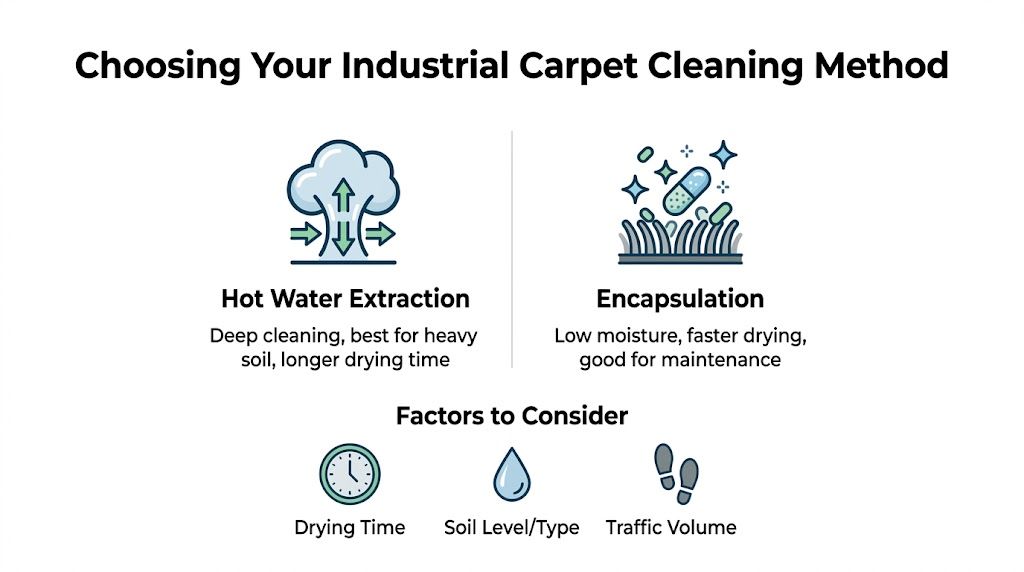
Hot Water Extraction fits restorative cleaning. Use it where carpet holds embedded soil, oily tracking, spill residue, or long-term buildup that interim cleaning will not release. It resets the carpet, but it also brings higher moisture load, longer drying control, and more risk if the building cannot support airflow, extraction quality, or access restrictions.
Low-moisture encapsulation fits interim maintenance. It is built for faster production, shorter dry times, and lower disruption in offices, schools, clinics, and mixed-use industrial spaces that stay occupied through the day. ISSA notes in its pricing and production rate guidance for carpet care that encapsulation supports high production rates and short return-to-service windows, which is why many contractors use it to maintain appearance between restorative cleans.
Comparison of Industrial Carpet Cleaning Methods
| Attribute | Hot Water Extraction (HWE) | Low-Moisture Encapsulation |
|---|
| Primary role | Restorative deep cleaning | Interim maintenance cleaning |
| Soil removal focus | Embedded soil and oily build-up | Appearance improvement and routine upkeep |
| Production rate | Slower in heavier conditions | Faster for routine maintenance |
| Drying profile | Longer drying window, needs strict moisture control | Shorter dry time |
| Appearance result | Deep reset | Helps hold appearance between deep cleans |
| Best fit | Heavy soil, restorative projects, periodic resets | 24/7 sites, office corridors, routine maintenance |
| Typical maintenance cost | Higher than interim cleaning | Lower for recurring maintenance cycles |
How to choose the method
Start with risk, not preference.
Choose HWE if the carpet shows bonded soil, dark traffic lanes, oily residue transfer, or neglected maintenance. In those cases, a low-moisture method may improve appearance for a short period but leave too much contamination in the pile.
Choose encapsulation if operations need the area back quickly and the carpet is on a controlled maintenance cycle. That trade-off matters in Ontario workplaces where prolonged dampness can create slip concerns, occupant complaints, and indoor air quality questions that facilities teams then need to document and address.
Use both if the building has mixed demands. That is common. Encapsulation handles routine appearance management in open office and corridor areas. HWE is then scheduled as a periodic reset in entrances, lunchrooms, and high-soil zones where residue and grit shorten carpet life.
A method is only “right” if it fits the building’s use, the staffing window, and the site’s tolerance for moisture and odour.
Choosing the shampoo itself
The shampoo has to match the method, the fibre, and the compliance burden.
For HWE, contractors often use an alkaline pre-spray to suspend oily soils before extraction. That can work well in industrial and warehouse-office settings, but higher-pH products need tighter control on dilution, dwell time, rinsing, and fibre compatibility. If the chemistry is too aggressive, or if it is not extracted fully, the carpet can re-soil faster and occupied areas may hold odour longer than the client expects.
For encapsulation, the product should dry to a brittle residue that can be removed by follow-up vacuuming. If it stays soft or sticky, the soil stays in play. The carpet may look good for a few days, then traffic lanes come back early.
A useful primer on how different professional cleaning chemicals behave can help buyers ask better questions about pH, residue, fibre compatibility, and occupied-space use.
In Ontario, shampoo selection is also a WHMIS and IAQ decision. The SDS has to be current. Staff need to know what is being applied in occupied space, what ventilation is required, and what residues or fragrances could trigger complaints in schools, clinics, and office environments. A product that cleans well on paper can still be the wrong choice if it creates documentation gaps or avoidable occupant exposure concerns.
What to ask about shampoo selection
- Fibre compatibility. Confirm the product suits the carpet type and any stain-resistant treatment.
- Residue behaviour. HWE products should rinse clean. Encapsulation products should crystallize and release on post-vacuuming.
- Odour profile. Low fragrance or low-odour options are often the safer choice in occupied buildings.
- WHMIS documentation. The provider should have current SDS records, label controls, and worker handling procedures.
- IAQ impact. Ask how the method and product affect ventilation needs, drying time, and occupant re-entry.
- Method match. The contractor should explain why that shampoo fits that machine, that carpet, and that operating schedule.
The Professional Shampooing Process
A missed production window, a clinic reopening at 7 a.m., or a tenant complaint about odour changes how this job should be run. Professional shampooing is not just a cleaning sequence. It is a controlled operation that has to protect carpet backing, limit indoor air complaints, and keep the area safe for staff and occupants in an Ontario workplace.
The process starts with inspection. A competent technician checks fibre type, traffic lanes, spot categories, seams, transitions, and any signs of weak backing or previous over-wetting. In commercial settings, I also want to know what surrounds the carpeted area. Air returns, nearby workstations, patient areas, and restricted exits all affect chemical use, machine selection, and how the crew stages the work.
Dry soil removal sets the job up properly
Dry vacuuming is where a lot of labour gets saved or wasted. If abrasive soil stays in the pile, shampoo and rinse water turn it into mud, which slows recovery and increases fibre wear during agitation. Entry mats, perimeter edges, and transition strips usually hold the heaviest load and need deliberate, slower passes.
This step also reduces risk. Less loose particulate in the carpet means less material disturbed into the occupied environment once brushing and extraction begin, which matters for indoor air quality in offices, schools, and healthcare-adjacent spaces.
Chemical application and agitation need control
After dry soil removal, the technician applies the selected prespray or shampoo at the correct dilution and coverage rate. Over-application is one of the most common field errors. It increases residue risk, lengthens extraction time, and can create avoidable IAQ complaints if odour or fragrance lingers in an occupied building.
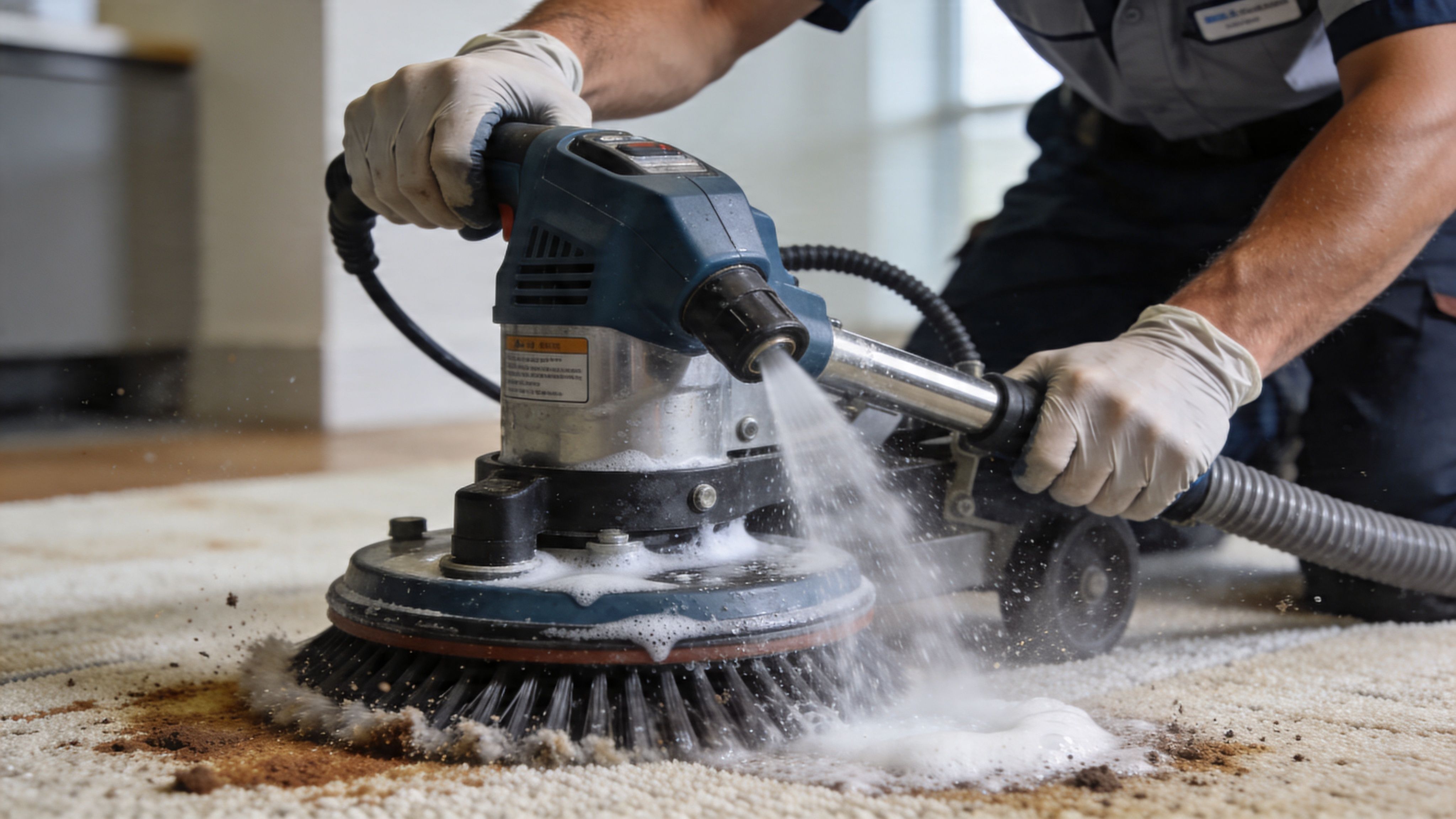
Agitation has a specific purpose. It works the chemistry through compacted traffic lanes, separates oily soil from the fibre surface, and improves consistency across the area being cleaned. The tool has to match the carpet. Counter-rotating brushes, cylindrical brushes, or a bonnet pass can all be appropriate depending on pile construction, soil load, and how sensitive the installation is to distortion.
A contractor should be able to explain four things clearly:
- What product is being applied and why it fits that carpet
- What machine is being used for agitation
- How dwell time is controlled without letting product dry in place
- How specialty spots are treated without over-wetting the surrounding area
For a broader look at the deep cleaning methods utilized by carpet cleaning pros, it helps to compare how different contractors pair agitation, chemistry, and recovery.
Extraction is where soil removal actually happens
For hot water extraction, recovery quality determines the result. Heat, pressure, flow, and vacuum have to be balanced to the carpet and the building conditions. More pressure is not automatically better. On glue-down commercial carpet or older installations, excessive solution flow can push moisture into the backing and extend dry times without improving cleaning.
Good operators watch the wand path, recovery rate, and hose setup closely. They do not flood corners, pause with the trigger engaged, or rush through traffic lanes where suspended soil is heaviest. On heavily soiled sections, an extra dry pass often does more for asset protection than another wet pass.
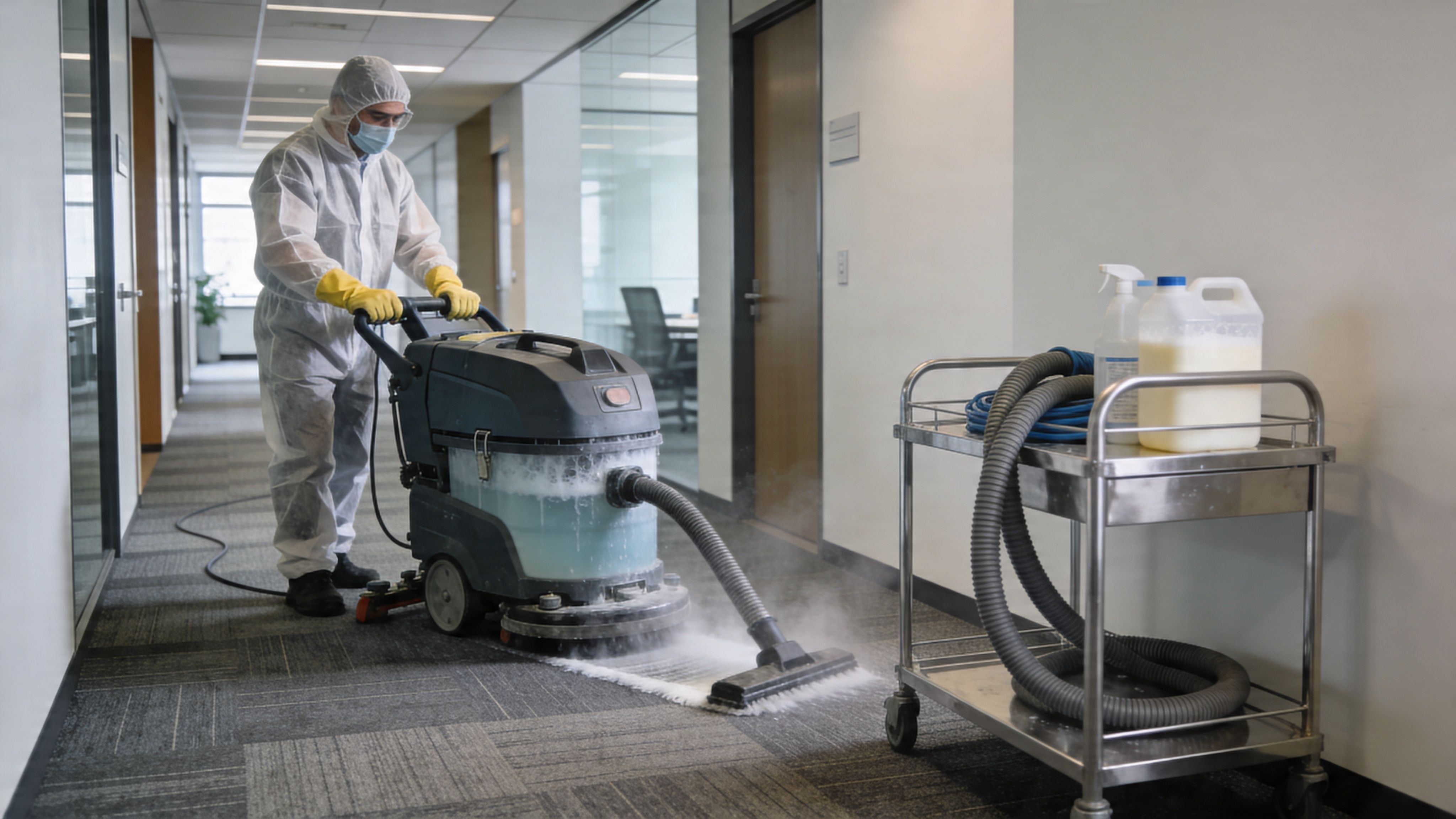
This visual shows the kind of machine handling that separates a professional result from a surface wash.
What a managed shampooing workflow includes
- Pre-inspection of carpet condition, access limits, and risk points such as seams, edges, and sensitive occupied areas
- Dry soil removal focused on entrances, lanes, and debris collection points
- Targeted pre-treatment for traffic build-up, filtration soil, and identified spots
- Controlled agitation matched to fibre type and soil conditions
- Extraction or low-moisture recovery pass based on the selected method
- Pile setting and appearance correction so the carpet dries evenly and presents consistently
- Final inspection for residue, missed spotting, moisture concentration, and safe release back to operations
In Ontario facilities, this sequence also supports compliance. The crew has to apply products according to label and SDS directions, contain slip hazards during wet work, and leave the area in a condition that does not create avoidable exposure or re-entry problems. A contractor who cannot explain dwell time, extraction control, and area release procedures is cleaning by habit, not by process.
Critical Post-Cleaning and Drying Protocols
A crew finishes at 9 p.m. The carpet looks clean under work lights. By morning, the entrance lane has wicked back, a boardroom corner still feels damp, and building staff are dealing with odour and slip-risk complaints before the day starts. That usually means the cleaning pass was only half the job.
Post-cleaning control protects the result and the building. In Ontario facilities, it also affects indoor air quality, safe re-entry, and whether the site avoids preventable moisture problems in occupied space.
Why drying is part of the cleaning job
Drying time has to be managed like any other production target. If carpet stays wet too long, soil can wick to the surface, residues stay active, and moisture can move into cushion, backing, or adjoining materials. In offices, healthcare settings, schools, and multi-tenant buildings, that creates an IAQ issue as much as a cleaning issue.
The practical target is fast, even drying, not just "less wet." That means controlling how much solution stays in the carpet, setting air movement immediately, and keeping traffic off the area until the fibre and backing are stable. A carpet that dries patchy often looks worse than one that was cleaned more lightly but extracted properly.
Grooming helps here for two reasons. It resets pile distortion after extraction and spreads concentrated moisture so the carpet dries more uniformly. On commercial glue-down carpet, that also reduces visible lane marks and tool patterns.
Common failures after shampooing
- Wicking shows up when soil left deep in the pile or backing rises during drying. The fix is usually better recovery and, in some cases, a follow-up treatment on known traffic lanes.
- Sticky residue points to over-application, weak recovery, or chemistry that was not matched to the method. Residue attracts new soil fast, so the carpet re-soils long before the next scheduled clean.
- Browning or uneven appearance often comes from prolonged dampness, overwetting, or fibre-specific chemistry errors.
- Late odour complaints usually mean retained moisture, not a failed deodorizer.
- Slip and tracking problems happen when re-entry is released too early and carts or foot traffic push damp soil and moisture into adjacent hard floors.
A carpet is ready for use when it is dry enough to resist wicking, safe enough for re-entry, and stable enough that normal traffic will not damage the result.
Post-clean checklist
- Groom the pile to level appearance and reduce moisture concentration in traffic lanes and wand paths.
- Set air movement immediately in enclosed rooms, perimeter zones, and heavy-use areas where drying tends to stall.
- Check edges, transitions, and spot-treated areas before leaving. These are common hold points for residue and moisture.
- Control re-entry timing so chairs, dollies, and early foot traffic do not crush damp fibres or transfer soil back onto the carpet.
- Document slow-dry conditions such as poor ventilation, dense pile, high indoor humidity, or shaded sections with limited airflow.
- Verify final moisture condition with touch, visual inspection, and site-specific judgement before releasing the area back to operations.
Crews that handle this stage well get fewer callbacks and fewer IAQ complaints. More important, they reduce the chance of turning routine carpet care into a building-risk issue.
Ensuring Safety and WHMIS Compliance
A night crew shampoos carpet in an occupied office suite, leaves product in an unlabelled secondary bottle, and props the janitor closet door open for ventilation. By morning, the carpet may look cleaner, but the site now has three separate risks. Chemical handling, indoor air quality, and occupant exposure. In Ontario, that is a management failure, not just a cleaning miss.
Ontario compliance affects method choice
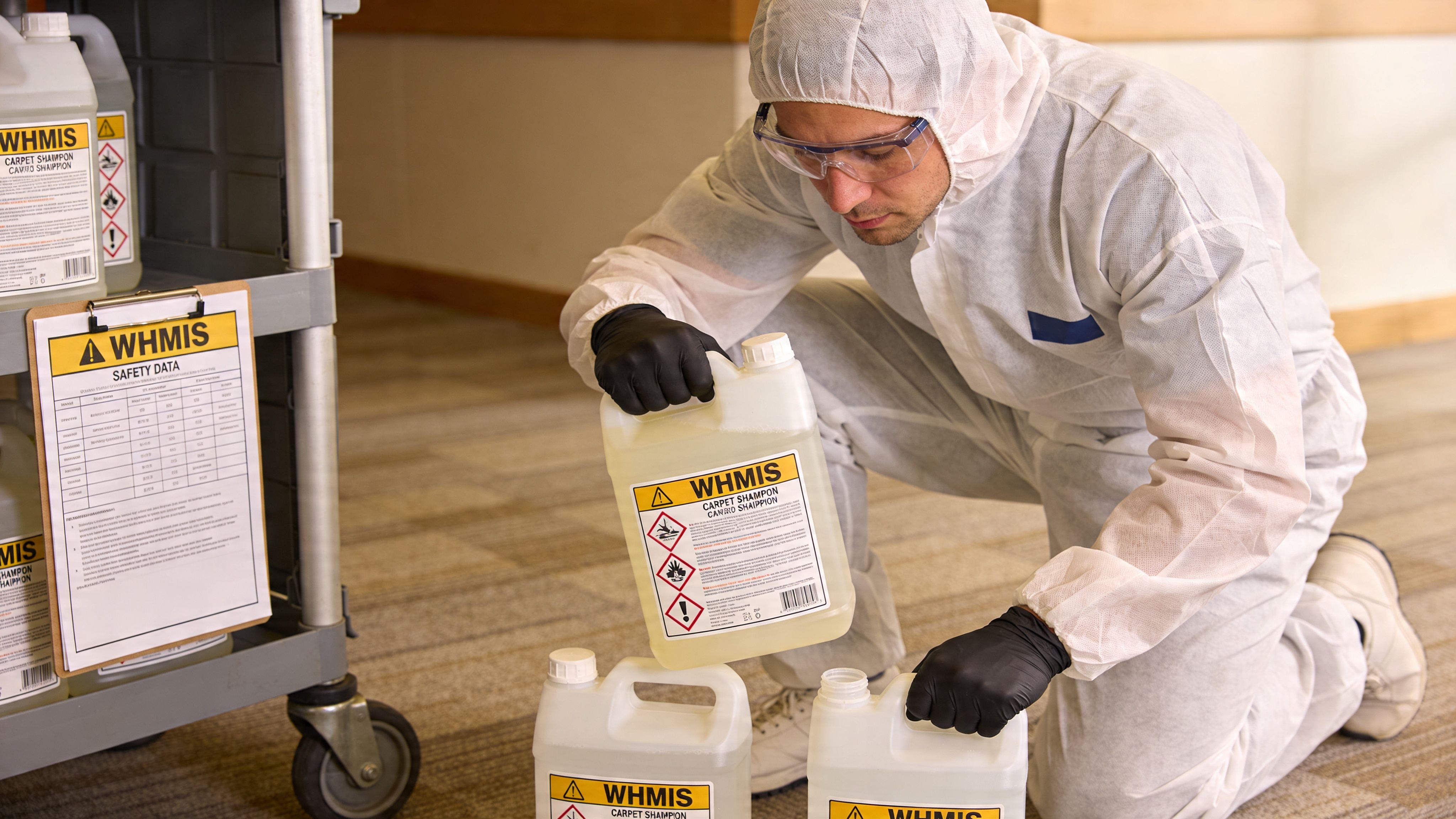
For carpet care in Ontario, WHMIS 2015 and site IAQ requirements should shape the job before the machine is filled. The product, dilution, application rate, storage setup, and ventilation plan all affect whether the work stays within the facility's safety controls.
That matters most in healthcare, education, multi-tenant offices, and any building with continuous occupancy. A shampoo that performs well in a vacant warehouse may be a poor fit for an office floor that reopens in two hours. The operational question is whether the chemistry and method fit the building's exposure profile, not whether the label promises strong soil removal.
What a compliant program looks like on site
A facility team or contractor should be able to show the controls behind the cleaning result, including:
- SDS access at the point of use, not buried in an office binder
- WHMIS labels on decanted products so staff know exactly what is in each container
- Documented dilution control to prevent overstrength mixes that increase residue, odour, and exposure risk
- PPE matched to the product and task, especially for spotters, defoamers, and presprays
- Storage practices that prevent cross-contamination, leaks, and unauthorized access
- Method selection for occupied areas where lower odour and lower moisture loads reduce IAQ complaints
This is also where procurement and operations meet. Buying the cheapest shampoo can raise labour time, increase rinse demand, and create more complaints from staff the next day. A lower-odour, low-residue product often costs more per litre and less per cleaned square foot once callbacks and downtime are counted.
Teams that need a reference point for commercial carpet shampoo service requirements should evaluate vendors the same way. Ask how they handle SDS access, secondary labelling, dilution accuracy, ventilation, and occupied-space controls.
Common compliance failures that affect carpet performance
Unlabelled or mislabelled secondary containers
This is one of the easiest WHMIS failures to prevent and one of the most common on busy sites. It creates exposure risk, weakens training, and makes incident response harder if a spill or splash occurs.
Overconcentrated shampoo mixes
Crews sometimes increase concentration to chase traffic lane soil. That usually creates more residue, more resoiling, and a stronger chance of odour complaints. It also increases unnecessary chemical exposure for the worker applying it.
Product mismatch in occupied spaces
High-fragrance or high-solvent products can trigger complaints even when the carpet looks fine. In schools, clinics, and offices, the safer choice is often a lower-odour chemistry paired with a method that limits airborne irritation and moisture load.
Weak documentation
If the site cannot show what product was used, where the SDS is stored, how staff were trained, or what controls were in place during cleaning, the program is hard to defend after a complaint or incident.
Good industrial carpet care protects fibre, controls exposure, and fits the building's operating conditions. If one of those breaks down, the cleaning process needs correction.
Creating a Maintenance Schedule and When to Hire a Professional
Carpet care works better as a schedule than as a reaction. Most facilities don't need the same process everywhere. They need a layered plan based on entry load, occupancy, and how quickly each area must return to use.
A practical scheduling framework
Use different service levels across the building:
- Daily or routine care for vacuuming, spot response, and entry mat management
- Interim low-moisture cleaning in corridors, reception zones, and other high-visibility areas
- Periodic restorative cleaning where embedded soil and traffic lane build-up can't be corrected by maintenance methods alone
For larger sites, this approach has a real financial effect. For a 50,000 sq ft warehouse, using low-moisture methods to extend carpet life by 2 to 3 years can save over $15,000 annually in the GTA, according to System4 Delaware’s summary of commercial carpet cleaning trends and cost pressures.
When outsourcing makes more sense
In-house teams often handle routine appearance work well. Professional support becomes more valuable when the site has one or more of these conditions:
- Heavy embedded soil that routine equipment can't remove
- Compliance sensitivity around occupied areas and product handling
- Limited drying windows where the wrong method would disrupt operations
- Recurring complaints about odour, wick-back, or rapid re-soiling
- Multiple carpet environments such as office areas attached to warehouse or production spaces
What to ask a professional cleaning provider
Before signing any service agreement, ask:
- Which method do you recommend for our traffic pattern, and why?
- How do you control residue and moisture recovery?
- What products are you using, and can you provide SDS documentation?
- How do you handle occupied areas and re-entry timing?
- What parts of the work are interim maintenance versus restorative cleaning?
- How will you document issues such as recurring spots or drying risks?
Facilities comparing providers can also review service details for commercial carpet shampoo options. Arelli Cleaning is one local option in the GTA, alongside other commercial contractors, and its offering is relevant for buyers who want carpet care as part of a broader facility cleaning programme.
The safest approach is still the simplest one. Use the checklist, get 2 to 3 quotes, and compare the method, chemistry, drying plan, and compliance process, not just the line price.
Frequently Asked Questions
What is industrial carpet shampoo
It’s professional carpet cleaning for commercial spaces using specialised chemistry, equipment, and drying control suited to heavy traffic, embedded soil, and occupied buildings.
Which method is better for an office connected to a warehouse
It depends on the soil condition and downtime tolerance. Restorative deep cleaning fits heavy contamination. Low-moisture maintenance fits areas that need faster re-entry.
How often should commercial carpet be shampooed
There isn't one schedule that fits every site. Frequency should be based on traffic, soil load, appearance standards, and how well routine vacuuming and matting are working.
Can the wrong shampoo damage carpet
Yes. Mismatched chemistry, excess residue, or poor moisture control can cause rapid re-soiling, texture issues, or appearance change.
Is steam cleaning the same as hot water extraction
In everyday conversation, people often use the terms interchangeably. In professional carpet care, the method is better described as hot water extraction.
Why do carpet spots come back after cleaning
That’s often wick-back. Moisture draws remaining soil from deeper in the pile to the surface during drying.
What should a contractor explain before starting
They should explain the method, shampoo choice, dwell time, agitation, moisture recovery, drying plan, and any safety controls for occupied areas.
When should a facility hire a specialist instead of handling it in-house
Hire a specialist when soil is embedded, drying windows are tight, compliance matters, or previous cleaning has left residue, odour, or repeat spotting.
Further Reading and Resources
A good resource list should help a facility team verify risk, not just compare cleaning methods. For industrial carpet shampoo decisions in Ontario, the useful references are the ones that help you confirm product handling, indoor air quality controls, and contractor documentation before work starts.
Internal resources
External resources
Use these references to check three things before approving any carpet shampoo work. First, confirm the chemical can be used, stored, and reviewed under WHMIS requirements. Second, confirm the drying and ventilation plan will protect indoor air quality in occupied areas. Third, confirm the contractor can explain residue control, recovery, and re-entry timing in plain terms.
That review helps prevent a common purchasing mistake. A low quote can still create higher operating cost if the method leaves excess moisture, odour complaints, slip risk, or repeat cleaning calls.






.webp)