A new property manager usually notices the same pattern within the first few weeks. The hardwood in the lobby still looks impressive from a distance, but traffic lanes are turning dull, entrance grit is leaving fine scratches, and someone on the cleaning team is using far too much water.
That's the moment hardwood floor care stops being a housekeeping task and becomes an asset-management issue. In commercial space, the floor isn't just a finish. It's part of the building's first impression, part of the safety program, and part of the maintenance budget.
The Foundation of Commercial Hardwood Floor Care
Commercial hardwood floor care works best when it's treated as a system. Cleaning is only one part of that system. The rest is scheduling, product control, moisture control, documentation, and fast decisions when small defects show up.
In practice, most expensive hardwood problems come from preventable mistakes. Teams over-wet floors. They use the wrong cleaner. They leave grit in place long enough to wear down the finish. Or they wait too long to escalate visible damage.
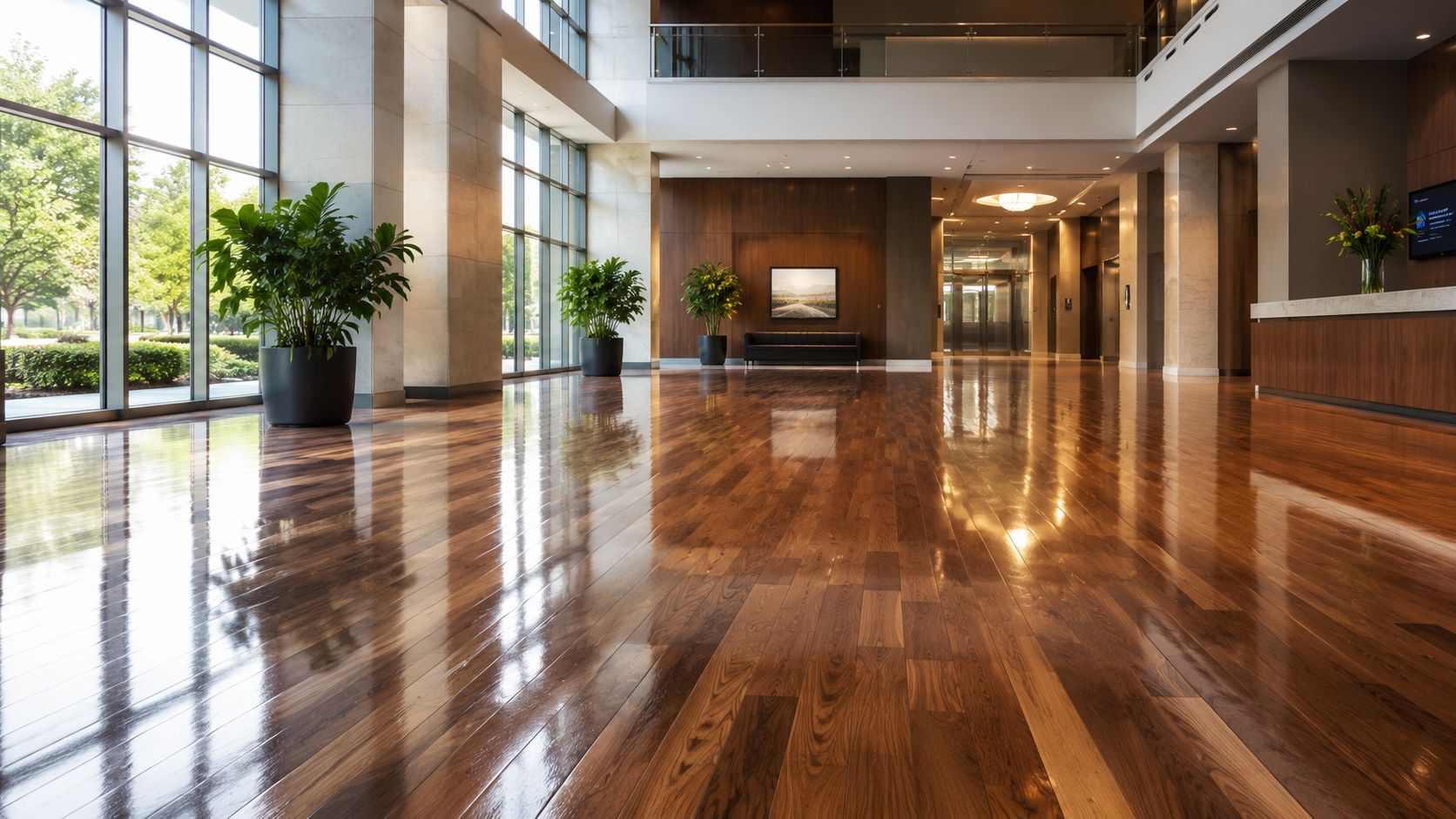
A lot of public advice focuses on the homeowner view, which is useful for basics. For a simple primer on routine habits and finish protection, Tip Top's guide for hardwood floors is a helpful reference. Commercial sites need the same fundamentals, but with tighter controls and clearer accountability.
Key takeaways
- Prevention beats restoration: Routine dust removal, controlled damp cleaning, and immediate spill response protect the finish better than occasional aggressive cleaning.
- Systems beat heroics: A written daily, weekly, and periodic schedule creates consistency across shifts, cleaners, and vendors.
- Product selection matters: Hardwood-specific, pH-neutral products are safer than generic all-purpose chemicals that can leave residue.
- Moisture is the hidden risk: Too much water during cleaning and poor indoor humidity control both shorten floor life.
- Small defects need triage: Scuffs, scratches, and seasonal gaps don't all need the same response.
- Professional service has a place: In-house teams should maintain the floor, not improvise restoration work.
Practical rule: If a floor care method leaves standing moisture, visible residue, or uncertainty about finish compatibility, it isn't a routine method. It's a risk.
A good maintenance program also needs ownership. Someone should be responsible for inspections, log review, product approval, and vendor coordination. If that responsibility is vague, the floor usually gets cleaned often but maintained poorly.
That's where a system-based cleaning culture matters. The approach behind Arelli Cleaning's operating model reflects a broader best practice in commercial cleaning. Clear workflows, safety controls, and communication matter as much as the mop pad itself.
A Scalable Maintenance Schedule for Your Facility
A new property manager usually sees the problem after a rainy week. The entrance looks dull, the main corridor has visible traffic lanes, and the cleaning crew says they are already mopping it every night. In most cases, the issue is not effort. It is the lack of a repeatable floor care system that assigns the right task to the right zone, documents the chemical in use, and gives staff a clear escalation path when routine cleaning is no longer enough.
The operating sequence is straightforward. Remove dry soil first. Use controlled damp cleaning second. Escalate embedded soil or finish-related issues to scheduled professional service. The National Wood Flooring Association outlines that basic order and warns against wet mops and steam mops because excess moisture and heat can shorten finish life over time, as noted in the NWFA maintenance guidance.
For a commercial site, that sequence has to live inside daily operations. It should sit in the same workflow as opening checks, spill response, shift inspections, supply control, and WHMIS documentation. If a cleaner has to guess which product is approved for hardwood, or if a supervisor cannot confirm where the Safety Data Sheet is stored, the schedule will fail under pressure.
Build the schedule by zone, not by square footage
Start with traffic categories. Entrance paths, reception approaches, elevator corridors, and breakroom routes need a different frequency than private offices or perimeter rooms. Grouping the floor this way makes labour planning easier and cuts a common mistake, which is over-wetting low-risk areas while high-abrasion zones are still carrying grit.
A practical schedule for most facilities looks like this:
Commercial Hardwood Floor Maintenance Schedule
| Frequency | Task | Purpose |
|---|
| Daily | Dust mop or vacuum bare-floor zones in entrances, lobbies, corridors, and visible traffic paths | Removes grit before it scratches the finish |
| As needed | Clean spills immediately with a dry or slightly damp cloth | Reduces moisture intrusion and staining risk |
| Several times per week | Repeat dry soil removal in active areas | Keeps abrasive debris from building up |
| Every 1 to 2 weeks | Damp clean with a lightly damp microfiber pad and hardwood-specific cleaner | Lifts soil film without over-wetting the floor |
| On inspection cycle | Check for dull lanes, scratches, gap changes, residue, and edge moisture near entries | Catches problems before they spread |
| Every 12 to 18 months | Arrange professional hardwood cleaning | Removes embedded soil and supports finish life |
Use that table as a baseline, then adjust by building use. A law office with controlled foot traffic can run a lighter rotation than a medical admin building with public access and wet winter entries. The point is consistency. Staff should know what happens daily, what happens on inspection day, and what gets escalated instead of improvised.
Daily controls that keep the system working
Daily work should be simple enough to survive a busy shift. Assign the dry pass to named zones, not to a vague instruction like "do the wood floors." Require spill cleanup at the time of discovery, with a quick recheck after the area dries. Log anything that suggests a finish issue, recurring moisture at an entrance, or residue that does not clear with approved routine cleaning.
This is also where compliance belongs. Approved hardwood products should be listed on the task card with the product name used on the WHMIS label and Safety Data Sheet. Pads, dilution method if applicable, storage location, and required PPE should be part of the same instruction set. That keeps floor care from drifting into "whatever is in the janitor closet," which is how teams end up using harsh degreasers, disinfectants, or folk remedies that create residue and finish damage. For a plain-language example of why improvised chemistry causes trouble, see this guide on protecting your wood flooring.
Weekly and periodic work should verify performance, not just repeat tasks
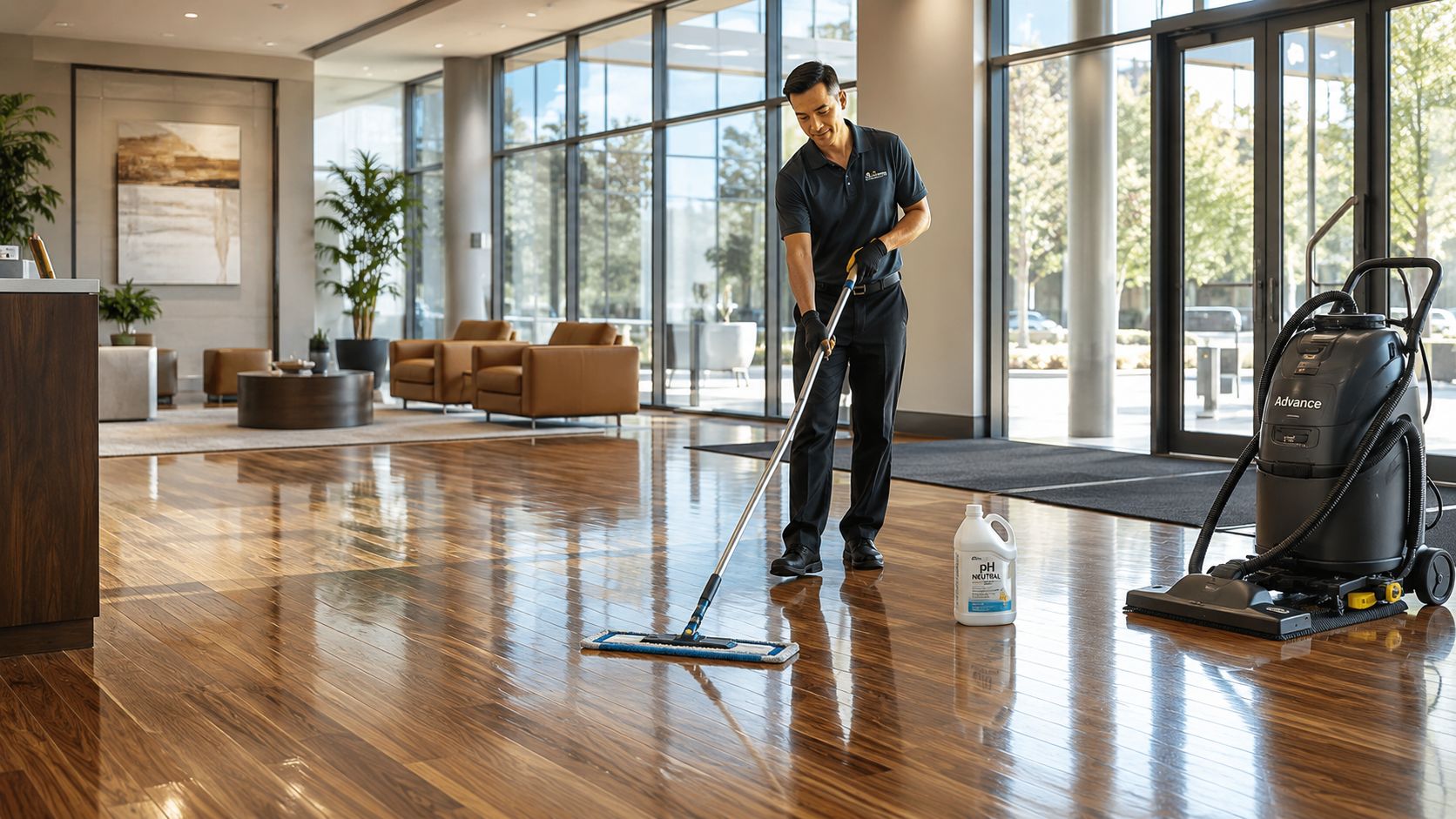
A damp clean only works if the floor is already free of loose grit. Use a lightly damp microfiber pad and change pads before they load up with soil. If one pad is being pushed through too much area, the team is spreading residue, not removing it.
Supervisors should also inspect under side lighting or from a low angle at least on the regular inspection cycle. Traffic lanes, haze, edge darkening near mats, and chair-track wear show up there first. Those checks help you decide whether the schedule is still matched to site conditions or whether one zone needs more frequent dry maintenance.
Scale through documentation and scope control
Scalable hardwood care depends on written standards that survive turnover. Map the floor by risk level. Post short task cards in supply rooms or digital work orders. Keep product approval, SDS access, and defect reporting in one place. Review logs often enough to spot repeat problem areas before they become restoration work.
If you use an outside janitorial provider, the contract should specify hardwood methods, approved tools, moisture limits, and reporting requirements for damage or finish loss. Generic "floor cleaning" language usually leads to generic methods. For managers setting expectations with a vendor or benchmarking their current scope, this page on office cleaning services for managed facilities is a useful reference point for defining responsibilities, inspections, and communication.
A schedule should fit the building's traffic, staffing, and compliance requirements. If it cannot be followed on a normal shift and audited afterward, it is not a working system yet.
Choosing Safe and Effective Cleaning Supplies
A property manager usually sees the mistake after the finish starts to haze. A cleaner was purchased for "all hard floors," the janitorial team used it across the site, and now the hardwood in the lobby looks dull by noon and tacky by the next day. At that point, the problem is no longer just product choice. It is a weak control system.
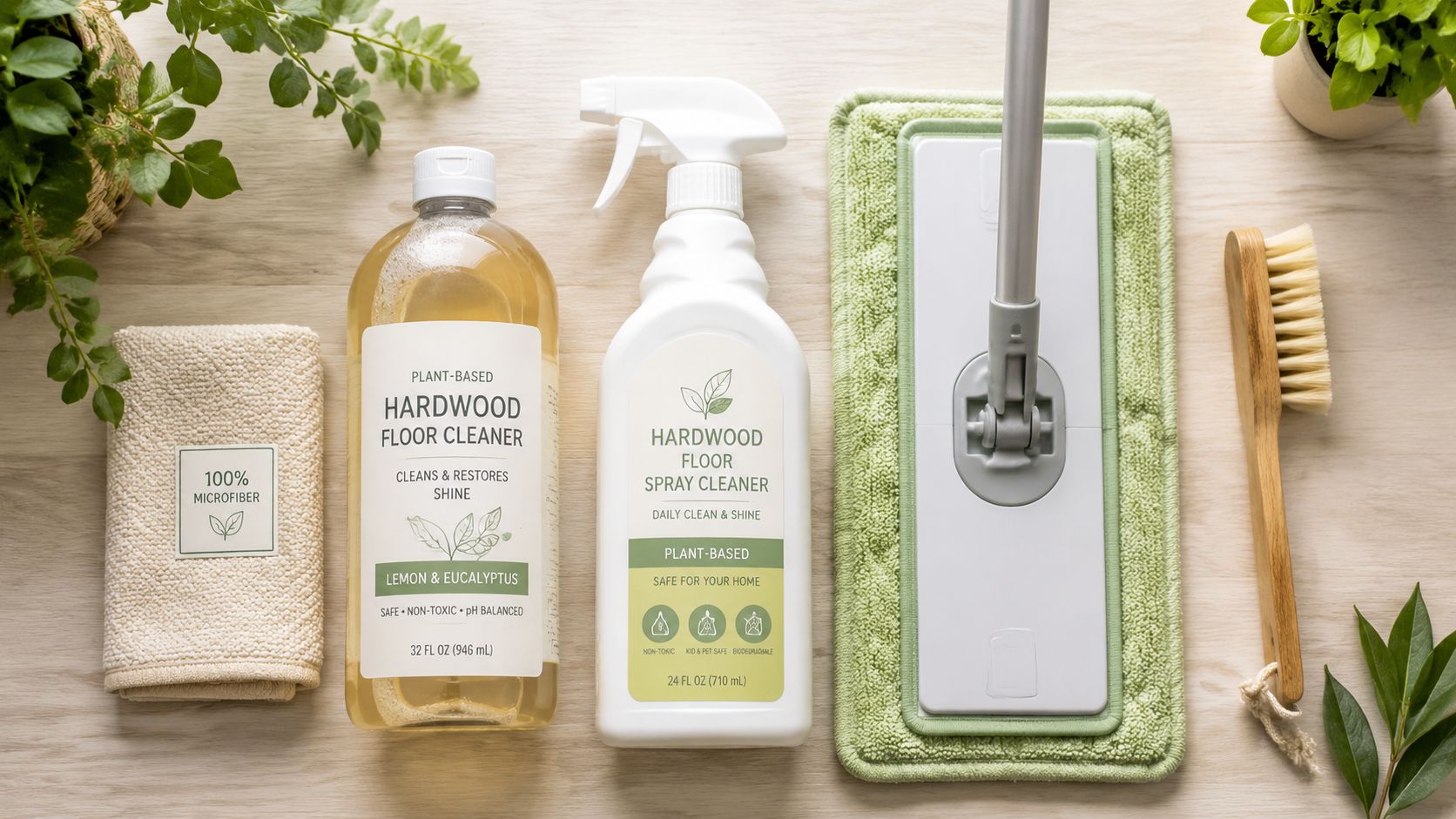
For commercial hardwood, supply selection has to fit the floor finish, the staffing model, and the site's compliance process. Start with one approved cleaner for routine use, one approved spot-treatment method, and a short list of approved tools. If staff have five options on the shelf, they will eventually use the wrong one.
The safest baseline is straightforward. Use a cleaner specifically approved for finished hardwood, paired with microfiber pads and controlled application. Avoid products that leave gloss enhancers, heavy surfactants, oils, waxes, or multi-surface residue behind. Those ingredients often create the complaints managers hear first: streaking, rapid resoiling, slip concerns, and a floor that looks worn before it is worn.
Build supply decisions into daily workflow
In a well-run facility, staff should not have to guess what belongs on hardwood. The approved product list should sit with the work order, SDS access, dilution instructions, and pad selection. WHMIS compliance works best when it is part of the task itself. The label, hazards, PPE, storage rules, and first-aid steps should be easy to find during the shift, not buried in an office binder.
That matters during turnover. New staff and relief staff are the group most likely to reach for bleach, ammonia, vinegar, or oil soap because the product seems familiar. On hardwood, familiar products cause expensive problems. This practical explanation of protecting your wood flooring is useful for clarifying why those shortcuts can damage finish performance.
Tools that support consistent results
The tool choice matters almost as much as the chemical.
- Microfiber flat mops and pads help control moisture and remove fine soil without pushing dirty water across the surface.
- A vacuum with a bare-floor setting or soft hardwood attachment removes grit without the scratch risk of a rotating beater bar.
- Measured dispensing bottles or auto-dilution systems reduce overapplication and make it easier to audit whether the team is following the standard.
- Clearly labelled storage keeps hardwood products separate from restroom, degreasing, and disinfecting chemicals.
Some tools create avoidable risk and should stay out of the hardwood scope unless the floor manufacturer or service provider has approved them.
- String wet mops hold too much water and make moisture control inconsistent from room to room.
- Steam mops combine heat and moisture in a way that can stress finishes and seams.
- Abrasive pads can scratch the coating even when the operator is trying to remove a small mark.
- Spray-heavy cleaning habits often leave residue because the floor gets more product than the pad can recover.
A simple screening standard for new products
Before any new supply reaches the floor, ask four questions.
- Is it approved for finished hardwood? If the label only says "hard surfaces" or "multi-purpose," that is not enough.
- What does the SDS require? Review PPE, storage, first aid, and any handling restrictions under your WHMIS program.
- What does it leave behind? A product that cleans adequately but leaves film will increase labour and customer complaints.
- Can night staff use it the same way every time? If the method is too complicated to repeat on a normal shift, it will fail in practice.
I usually advise managers to reject "one product for every floor" purchasing plans unless the manufacturer gives explicit hardwood approval and the site has tested it in a low-risk area. Inventory simplification sounds efficient. Finish correction, complaint response, and premature recoating are not.
For teams reviewing vendors or standardizing inventory across multiple sites, these commercial cleaning supplies used in facility operations provide a useful reference point for setting a tighter approval process.
Humidity also belongs in the supply conversation, even though it is not a chemical. If building conditions are too dry or too damp, no cleaner will solve the resulting movement, gapping, or finish stress. Good supply control supports hardwood care. It does not replace basic environmental control.
Handling Common Floor Damage and Minor Repairs
A tenant tours the space at 9 a.m., sees heel marks in the lobby, a sticky patch near the coffee station, and two boards that opened up overnight during a dry spell. The wrong response is to let every shift improvise a fix. In a commercial building, minor floor repair needs a controlled process with clear limits, approved materials, and a record of what was done.

Minor issues that staff can handle
Scuffs, black heel marks, and light residue are usually maintenance issues, not repair issues. Treat them that way. Use the least aggressive method that will remove the mark without changing the finish sheen around it.
Start with a dry microfiber cloth or pad. If the mark remains, use the site-approved hardwood cleaner on the cloth, not directly on the floor, and clean the affected spot with short controlled passes. Dry the area after spot cleaning so staff do not leave moisture sitting at board edges.
Sticky residue needs the same discipline. Soften the deposit with a lightly damp microfiber cloth, lift it, then dry the surface. Abrasive pads, excessive water, and strong degreasers create a second problem by dulling or scratching the finish.
Light scratches need a tighter decision rule. If the scratch only affects appearance and does not appear to break through the finish, log it and monitor it during routine inspections. If staff want to use a touch-up marker, stain pen, or repair kit, require manufacturer approval or written direction from the floor contractor first. That step belongs in the work order process and in your WHMIS documentation if a new product is introduced.
A floor care system works better when staff know which defects they can clean, which ones they can document, and which ones they must escalate.
A practical decision rule for floor gaps
Gaps cause confusion because some are normal wood movement and some point to environmental or moisture trouble. The first job is to classify the condition before anyone reaches for filler.
Use this decision framework:
- Monitor seasonal movement: Gaps that appear during dry indoor conditions and close when humidity stabilizes often do not need direct repair.
- Check whether the pattern is isolated or widespread: A few recurring gaps suggest movement. Random widening, uneven spacing, or loose boards suggest a larger issue.
- Review building conditions: Look at HVAC performance, indoor humidity trends, and any nearby water source before assigning a cosmetic fix.
- Inspect for distress around the gap: Cupping, staining, edge lift, soft spots, or movement underfoot should trigger escalation.
- Record the location and date: A simple photo log helps separate a seasonal callback from an active floor failure.
Avoiding premature gap filling saves property managers money. Filling a movement gap too early often leads to repeat work, visible patching, and staff time spent correcting a repair that should never have been attempted.
What to ask and what to avoid with fillers
Before anyone fills a gap, ask four questions:
- Is the gap seasonal or persistent?
- Have indoor conditions been checked and documented?
- Is there any sign of moisture entry, subfloor movement, or cleaning over-wetting?
- Will a filler restrict normal board movement or create a visible mismatch later?
In most commercial settings, fillers should be treated as a limited repair option, not a default response. Wood floors move. A patch that looks acceptable in one season can fail, shrink, or push out in the next.
The same restraint applies to finish correction. Staff should not try to solve worn spots or surface buildup with stripping methods intended for other floor types. If a manager is comparing procedures across mixed-surface facilities, this overview of strip and wax service methods for commercial floors helps clarify why hardwood needs a separate repair standard.
My rule for site teams is simple. Clean what is cleanable, document what is changing, and escalate anything that suggests movement, moisture, or finish failure. That approach scales across shifts, supports compliance, and prevents small cosmetic issues from turning into avoidable capital work.
When to Schedule Professional Floor Services
In-house teams should preserve the floor. They shouldn't try to perform restoration by improvisation. Once finish wear spreads across traffic lanes or moisture damage changes the shape of the boards, professional service is the safer and more economical decision.
Signs that routine cleaning is no longer enough
Look for broad dullness that doesn't improve after approved cleaning, scratches that appear to cut through the finish, staining that suggests moisture entry, or edge distortion near entrances and washroom-adjacent areas. These conditions usually mean the problem is no longer “surface dirt.”
Another trigger is repeat cleaning without visual recovery. If the team keeps cleaning and the floor still looks tired, the issue may be finish loss rather than maintenance failure.
Professional floor service is justified when cleaning stops improving the floor's condition.
Screening and recoating versus full refinishing
Two different service paths are often discussed.
Screening and recoating is a lighter intervention. It's suited to floors whose finish is worn but where damage is superficial. The goal is to refresh the protective layer before wear reaches the wood itself.
Sanding and refinishing is more invasive. It fits floors with deeper scratches, significant finish breakdown, or visible damage that can't be corrected through surface restoration alone.
A property manager doesn't need to diagnose the technical process alone, but should ask the contractor to explain:
- What condition they observed
- Whether the damage is in the finish or the wood
- How much disruption the work will cause
- What maintenance changes should follow the service
A sensible procurement approach
Don't wait for the annual budget panic. Build floor review into routine inspections and ask for opinions before the floor looks beyond recovery.
When comparing vendors, ask for hardwood-specific scope language, proposed prep steps, moisture precautions, and post-service care instructions. Be cautious if a contractor speaks in generic terms that could apply equally to vinyl, tile, and wood.
For facilities that also manage resilient floor maintenance, a page such as strip and wax service information can be a useful contrast. Hardwood care should not be specified the same way as resilient floor restoration, and that distinction matters during procurement.
Frequently Asked Questions About Hardwood Floor Care
Can a steam mop be used on commercial hardwood floors
No. Steam and hardwood aren't a safe pairing for routine maintenance. Heat and moisture can damage the finish and the wood, so commercial teams should stick to controlled dry soil removal and lightly damp microfiber cleaning.
What's the safest routine for an office lobby floor
Start with dry soil removal, then use a lightly damp microfiber pad only when needed. The practical difference-maker is consistency. Entrance grit has to be removed before it gets ground into the finish.
How should rolling office chairs be handled on hardwood
Use protective chair mats where they make sense and review the caster condition. Chair traffic creates concentrated wear in a small area, so floor protection and frequent inspection matter more than heavier cleaning.
Are engineered hardwood and solid hardwood maintained the same way
The daily care principles are similar. Both need controlled moisture, approved cleaners, and prompt spill response. The difference is that a manager should confirm the manufacturer's finish guidance before allowing any touch-up or restoration method.
How can a manager verify that a cleaner is actually hardwood-safe
Check the product guidance and make sure it's approved for finished hardwood, not just “floors” in general. Then confirm the site's WHMIS documentation, handling instructions, and application method. If the supplier can't provide clear surface compatibility guidance, don't approve it.
Is vinegar a safe low-cost option for hardwood floor care
Usually, it's better to avoid improvised chemistry on commercial hardwood. The safer route is a pH-neutral, hardwood-specific cleaner matched to the floor finish and the staff's training level.
What should staff do immediately after a spill
Blot or wipe it up right away with a dry or slightly damp cloth, then dry the area. The aim is to stop moisture from sitting at seams or low spots where it can affect the finish.
Where do most preventable mistakes happen
At entrances, under office chairs, and anywhere a team treats hardwood like a generic hard floor. Most mistakes come from too much water, the wrong cleaner, or delayed response to visible wear.
Who should own the hardwood care program in a facility
One accountable person should own the program, even if cleaners, supervisors, and vendors all touch the work. Without a single owner, schedules drift, products multiply, and nobody catches small failures early.
Further Reading and Resources
Good hardwood floor care is repetitive by design. That's why it works. A facility protects the floor when it standardises methods, limits product variation, tracks visible wear, and escalates damage before the finish fails.
Use the maintenance checklist ideas above to review your current program. If a site has visible wear, inconsistent chemistry, or no documented routine for spills and humidity review, correct the system first. When outside help is needed, it's smart to get 2 to 3 quotes and compare scope carefully.
Internal resources
External resources
If you're reviewing vendors for office or commercial floor care, Arelli Cleaning is one option to include in your comparison list. The practical approach is to use the checklist from this guide, ask detailed questions about hardwood-specific methods, and compare two or three qualified providers before making a decision.







.webp)