A facility manager often hears the same complaint in different words. The office smells “too chemical” after evening cleaning. Someone in a clinic says a washroom product triggers headaches. A parent asks what gets used in a childcare room. A staff member with asthma wants to know whether the disinfectant is necessary or whether there's a safer option.
Those questions used to sit with janitorial staff alone. They don't anymore. In commercial buildings, cleaning chemicals affect indoor comfort, occupant confidence, worker safety, and procurement risk. A product choice now touches WHMIS compliance, staff training, and even how a business explains its health standards to tenants, employees, patients, or visitors.
That's why hypoallergenic cleaning products matter. In practical terms, they aim to reduce common irritants and sensitizers while still doing the job. For offices, schools, clinics, warehouses, and shared buildings, that makes them less of a niche preference and more of a management tool.
Introduction Why Hypoallergenic Cleaning Matters Now
“Clean” isn't the same as “healthy.” A floor can shine and still leave a strong fragrance in the air. A washroom can be disinfected and still create avoidable irritation for staff who use it all day. Many facilities are now dealing with a simple reality. Occupants notice odours, residues, and air quality far faster than they notice a polished baseboard.
In commercial settings, that creates a chain reaction. Reception hears complaints. HR gets questions about sensitivity. Supervisors ask cleaners to switch products without a proper review. Procurement then has to sort through labels like “natural,” “eco,” “gentle,” and “non-toxic,” which often sound clear but don't always provide useful buying criteria.
Why the issue keeps surfacing
Several trends are pushing this conversation forward:
- Shared indoor space: Offices, medical spaces, schools, and industrial lunchrooms bring many people with different sensitivities into one environment.
- Stronger scrutiny: Buyers want to know what's in a product, what hazards appear on the SDS, and whether the disinfectant is approved for its intended use.
- Operational risk: A harsh product can damage surfaces, create odour complaints, or complicate staff training.
- Reputation pressure: Tenants, employees, and clients increasingly expect visible health and safety standards, not just a clean appearance.
A modern cleaning program has to protect both surfaces and people.
What decision-makers actually need
Most articles stop at “choose fragrance-free products.” That's useful, but incomplete. A commercial buyer also needs to know how to screen labels, review WHMIS documents, test products on site, train staff, and compare cost against value.
That is where hypoallergenic cleaning products become practical. They aren't a magic category, and they don't remove every health risk. But used properly, they give facilities a structured way to reduce avoidable irritants while maintaining cleaning performance.
Defining Hypoallergenic Cleaning Products
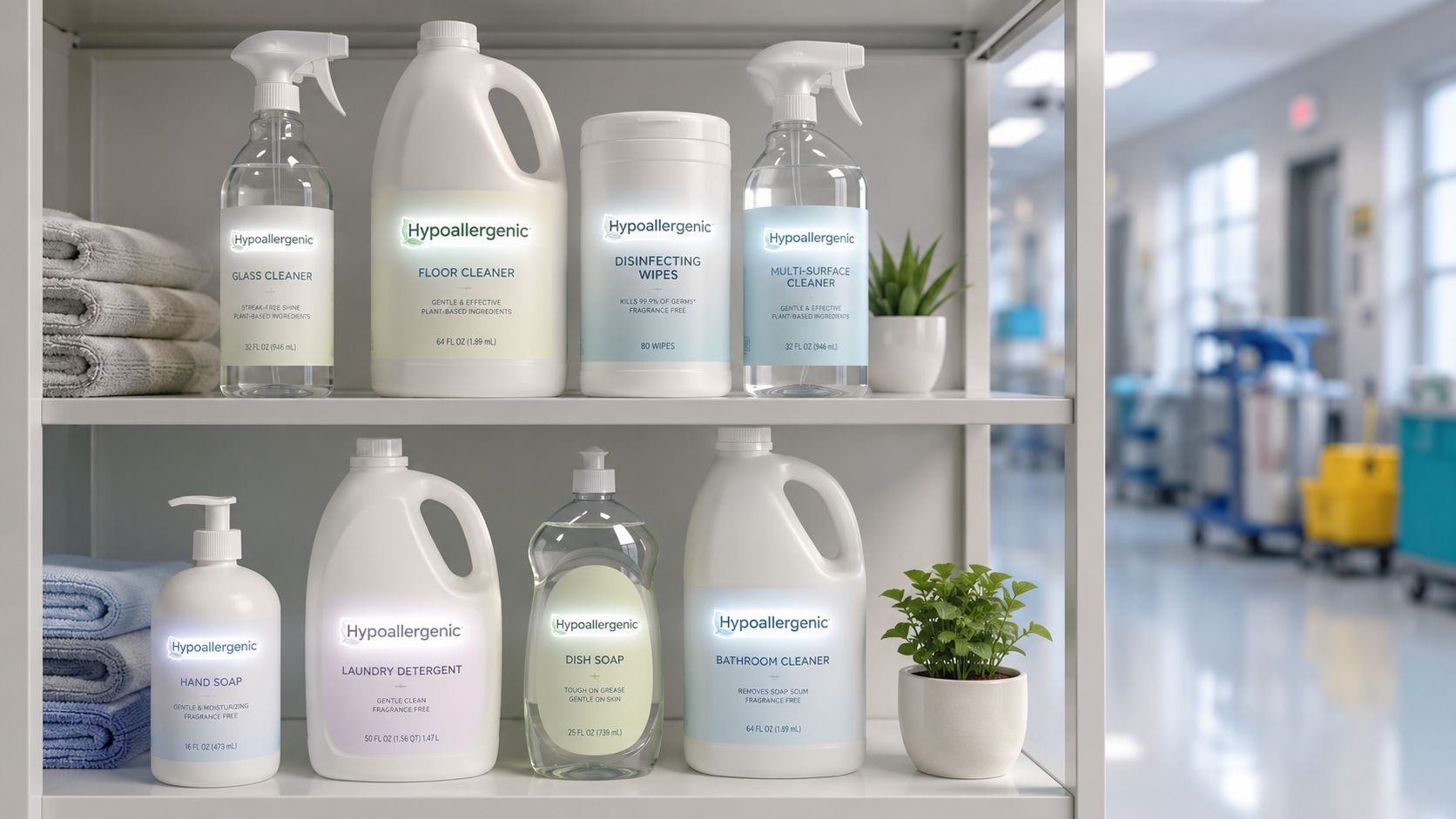
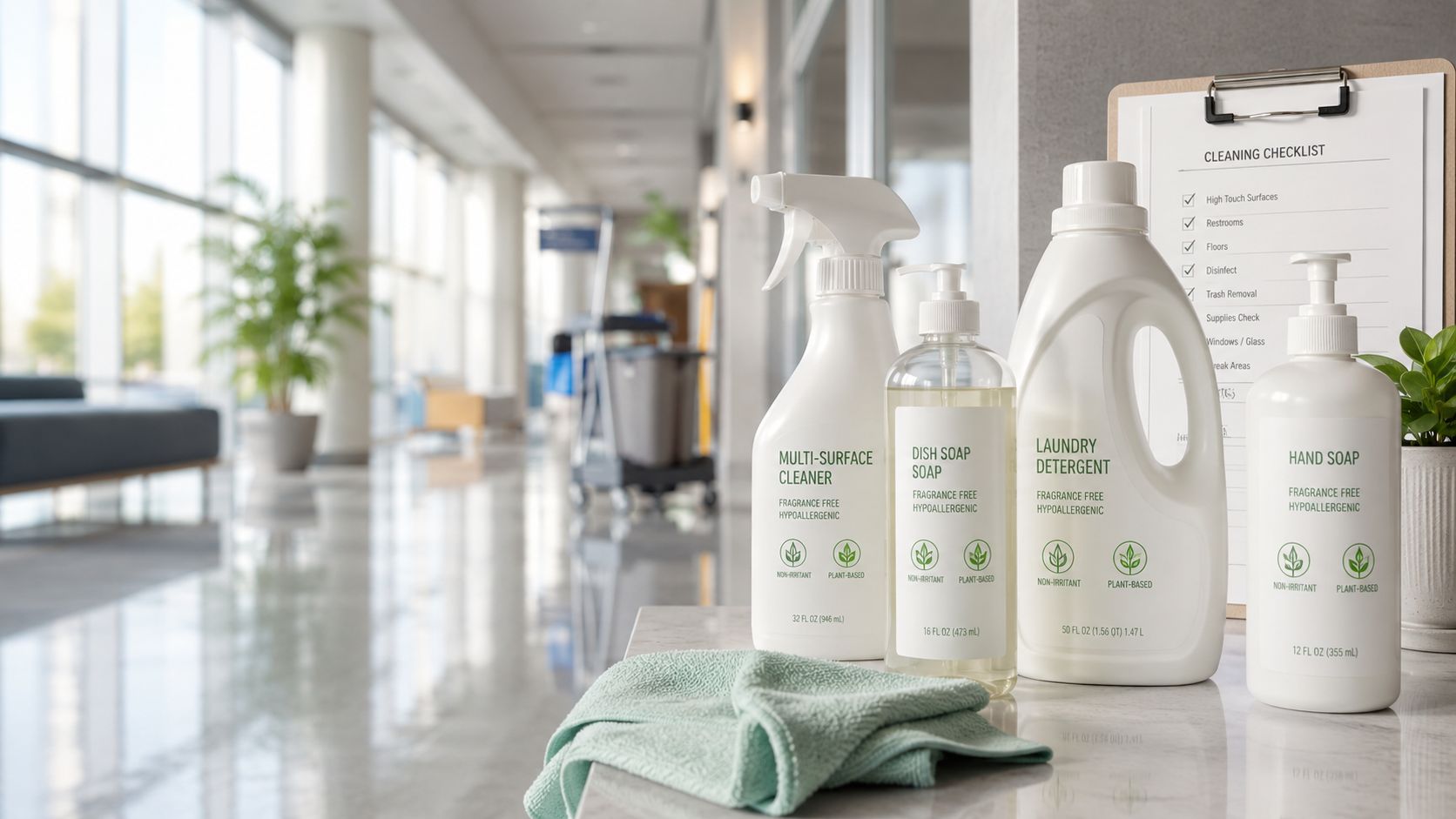
Hypoallergenic cleaning products are products designed to lower the likelihood of triggering allergic reactions, skin irritation, or respiratory discomfort. In commercial cleaning, that usually means reducing or avoiding ingredients that commonly cause problems in shared indoor environments.
That definition matters because “hypoallergenic” isn't a guarantee of zero reaction. It means lower risk, not no risk. A facility still has to review ingredients, intended use, dilution, ventilation needs, and staff handling procedures.
What these products are trying to avoid
Most procurement teams should start by screening out common irritants.
VOCs are volatile organic compounds. They can evaporate into the air during or after cleaning and may contribute to odour and irritation.
Phthalates are chemical compounds often associated with fragrance systems and other formulations. In product review, buyers usually treat added fragrance as a practical warning sign.
Other ingredients or product traits that often deserve closer review include:
- Added fragrance: Even pleasant scents can become a problem in enclosed offices, treatment rooms, and classrooms.
- Dyes and colourants: These don't usually improve cleaning performance, but they can increase exposure to unnecessary additives.
- High-irritancy chemistry: Products built around ammonia, chlorine bleach, or similarly harsh ingredients may be appropriate in some limited use cases, but they aren't ideal as a default daily product in occupied spaces.
- Residue-heavy formulas: If a product leaves film, that can increase repeat cleaning and user complaints.
For a consumer-oriented but useful primer on product selection, Fillaree's overview of skin-safe and gentle cleaners helps explain why lower-irritant formulations matter beyond marketing language.
What to look for instead
Canadian buyers can use concrete screening criteria. Guidance referenced by Consumer Reports and the U.S. EPA recommends looking for fragrance-free products, a neutral pH range of about 4 to 9.5, and safer disinfecting actives such as hydrogen peroxide at 3%, ethanol at 70%, or citric acid at 0.5% in appropriate applications, as outlined in this healthier cleaning products guide.
That's more useful than vague “green” branding because it gives a buyer measurable criteria.
A practical commercial example
Consider two all-purpose cleaners for an open-plan office. One has a strong fragrance, bright dye, and a high-irritancy profile on the SDS. The other is fragrance-free, within a neutral pH range, and intended for routine hard-surface cleaning in occupied spaces. Both may clean visible soil. Only one is likely to fit a low-irritant procurement standard.
Facilities that also need infection-control support should separate routine low-irritant cleaning from targeted disinfecting. In those cases, a formal commercial disinfection and sanitizing program should define when a disinfectant is required and which approved actives staff should use.
Navigating Certifications and Labels
A label can help, but only if the buyer knows what the label does and does not mean. Commercial cleaning products often carry a mix of certification marks, hazard statements, marketing language, and technical details. The job of procurement is to separate verified signals from soft claims.
Which labels deserve attention
Third-party certifications can help narrow a shortlist. They don't replace a site test or SDS review, but they often show that a product has gone through an external standard rather than relying only on the manufacturer's wording.
| Certification Logo | What It Means | Governing Body |
|---|
| UL ECOLOGO | Indicates the product has been assessed against environmental performance criteria for its category | UL Solutions |
| Green Seal | Indicates the product has been certified against Green Seal's environmental and health-focused standards | Green Seal |
| Safer Choice | Identifies products or ingredients screened by the program for safer chemical profiles | U.S. EPA |
| DIN on disinfectants | Shows the disinfectant has a Drug Identification Number for regulated sale and approved use in Canada | Health Canada |
Marketing words that confuse buyers
Some terms sound reassuring but don't tell a buyer much on their own.
- Natural: This isn't a reliable stand-alone procurement standard.
- Eco-friendly: It may point in a useful direction, but it needs proof behind it.
- Unscented: This can still mean masking fragrance has been added.
- Fragrance-free: This is usually the stronger choice when reducing irritant exposure is the priority.
If a label makes a health claim but doesn't give a buyer a certification, ingredient basis, or regulated identifier, it deserves extra scrutiny.
Why DIN matters for disinfectants
For routine cleaning, a low-irritant cleaner may be enough. For disinfecting, commercial buyers need a different threshold. In Canada, a disinfectant should have a Drug Identification Number, or DIN. That number tells procurement that the product is regulated for that use.
Without a DIN, a product may still clean. It should not be treated as a substitute for a regulated disinfectant in a clinic, childcare setting, or any facility where disinfection protocols matter.
Labels should lead to documents
A smart buyer doesn't stop at the front label. The next documents to request are the SDS, technical data sheet, dilution instructions, and any certification support sheet. International teams that compare products across markets may also find it useful to understand EU chemical regulatory compliance because it shows how formal classification and labelling systems are structured, even when the Canadian purchasing decision follows domestic rules.
Procurement Framework for Your Facility
Most buying mistakes happen when teams choose products too quickly. The label looks safe, the scent seems mild, and the price fits the budget. Then the product streaks glass, damages a floor finish, creates a handling issue for staff, or becomes impossible to source consistently.
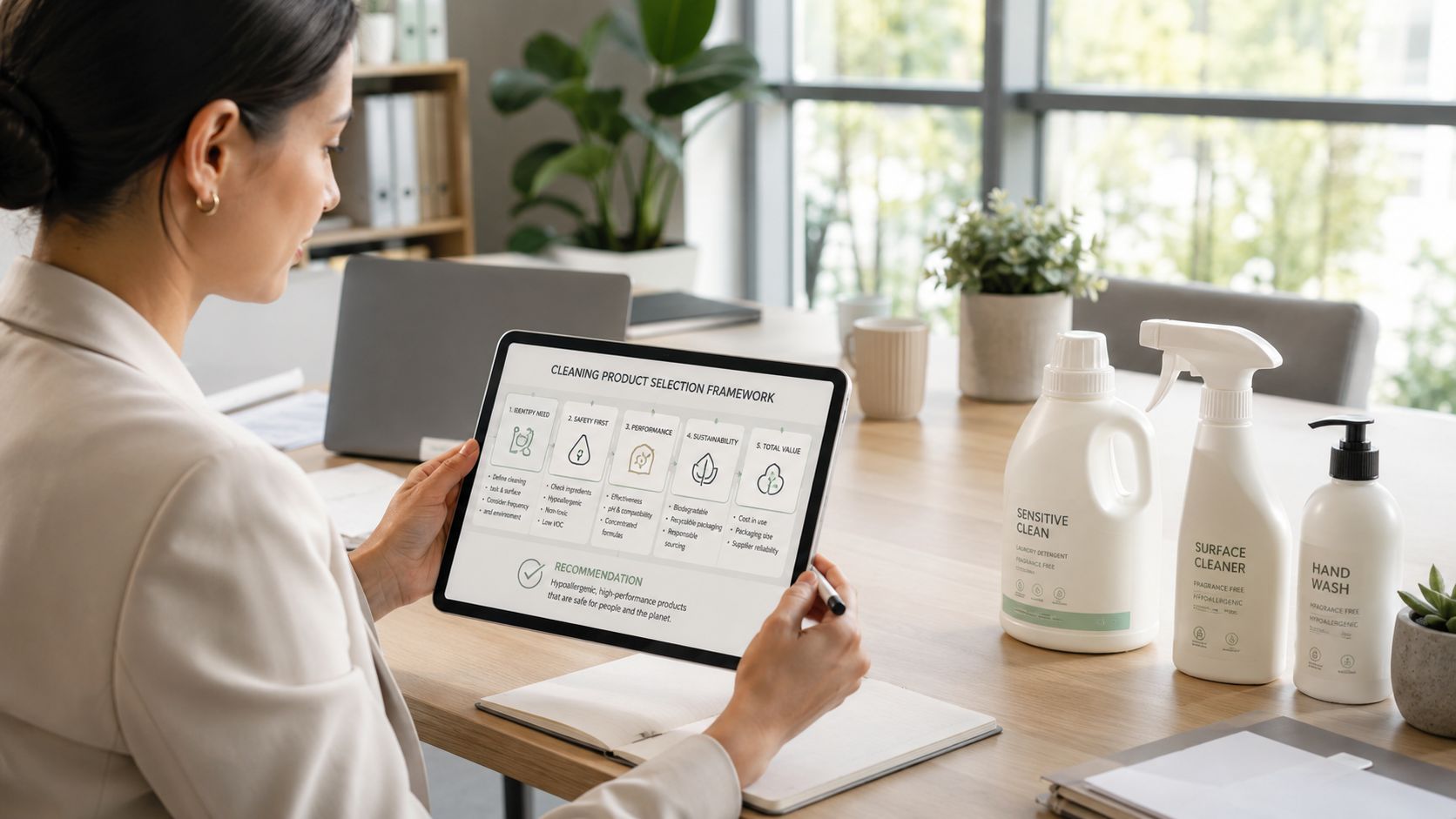
A better approach is a structured procurement framework.
Step one review safety before performance
Start with the SDS and WHMIS fit. If the product creates unnecessary handling complexity, it may not belong in a general program.
Use this safety checklist:
- Check the hazard classification: Review pictograms, hazard statements, and first-aid measures.
- Confirm intended use: A bathroom descaler, neutral floor cleaner, and ready-to-use disinfectant should not be treated as interchangeable.
- Review dilution instructions: Over-concentration can increase residue, odour, and exposure risk.
- Assess ventilation needs: Products intended for heavy-duty use in unoccupied areas may not fit daytime cleaning in active offices.
- Verify worker controls: PPE, storage, and training requirements must match the reality of the site.
Step two test on real soils and real surfaces
A product that performs well in a catalogue may fail in a real building. Office fingerprints, clinic touchpoints, warehouse dust, lunchroom grease, and washroom mineral buildup are different cleaning problems.
Pilot test products on the surfaces that matter most:
- Desks and touchpoints in offices
- Exam-room or treatment surfaces in healthcare-adjacent spaces
- Floors and partitions in schools and childcare
- Breakrooms and washrooms where odour complaints often begin
- Industrial common areas where soil loads are heavier
During the test, evaluate more than “does it clean?” Also check whether it leaves film, whether staff like using it, whether it changes room odour, and whether rework increases.
Step three protect the building assets
Surface compatibility is where procurement and operations often disconnect. A product can be safer for occupants and still be wrong for polished stone, coated flooring, wood finishes, electronics, acrylic partitions, or specialty fixtures.
Ask suppliers these questions:
- What surfaces is this product not recommended for?
- Does it require rinsing on any common office or commercial material?
- Will it affect floor finish, gloss, or protective coatings?
- Is it safe around touchscreens, metal trim, and painted surfaces?
For facilities comparing vendors and chemical systems, a review of available cleaning supplies for commercial use can help frame what categories should be standardized across a site.
Step four vet the supplier, not just the product
The same product can succeed or fail depending on supplier support. Commercial accounts need reliability.
A supplier should be able to provide:
- Consistent availability: Stock gaps create substitution problems.
- Training material: Staff need clear use instructions, not just a bottle label.
- Technical documents: SDS, data sheets, and certification support should be easy to obtain.
- Application guidance: The vendor should explain where the product fits and where it doesn't.
- Change control support: If a formula changes, the facility should know.
Practical rule: Standardize fewer products, train on them well, and match each one to a clear task.
Facility-specific priorities
Different buildings should weight criteria differently.
| Facility type | Main procurement concern | Typical priority |
|---|
| Office | Odour, occupant comfort, desk-safe cleaning | Fragrance-free daily cleaners |
| Childcare or school | Sensitive users, shared surfaces, communication with families | Low-irritant routine products plus clear disinfectant protocols |
| Clinic or dental office | Regulated disinfection and surface compatibility | DIN-bearing disinfectants plus careful product separation |
| Warehouse or industrial site | Soil load, safety training, breakroom and washroom comfort | Task-based selection with strong WHMIS discipline |
Best Practices for Program Implementation
A good product list doesn't fix a cleaning program on its own. Implementation is where many facilities lose the benefit. Staff may keep using the old dilution habit. Occupants may assume a weaker smell means weaker cleaning. Supervisors may not document the change properly.
That's why rollout should be treated as an operational change, not just a supply order.
Start with a controlled pilot
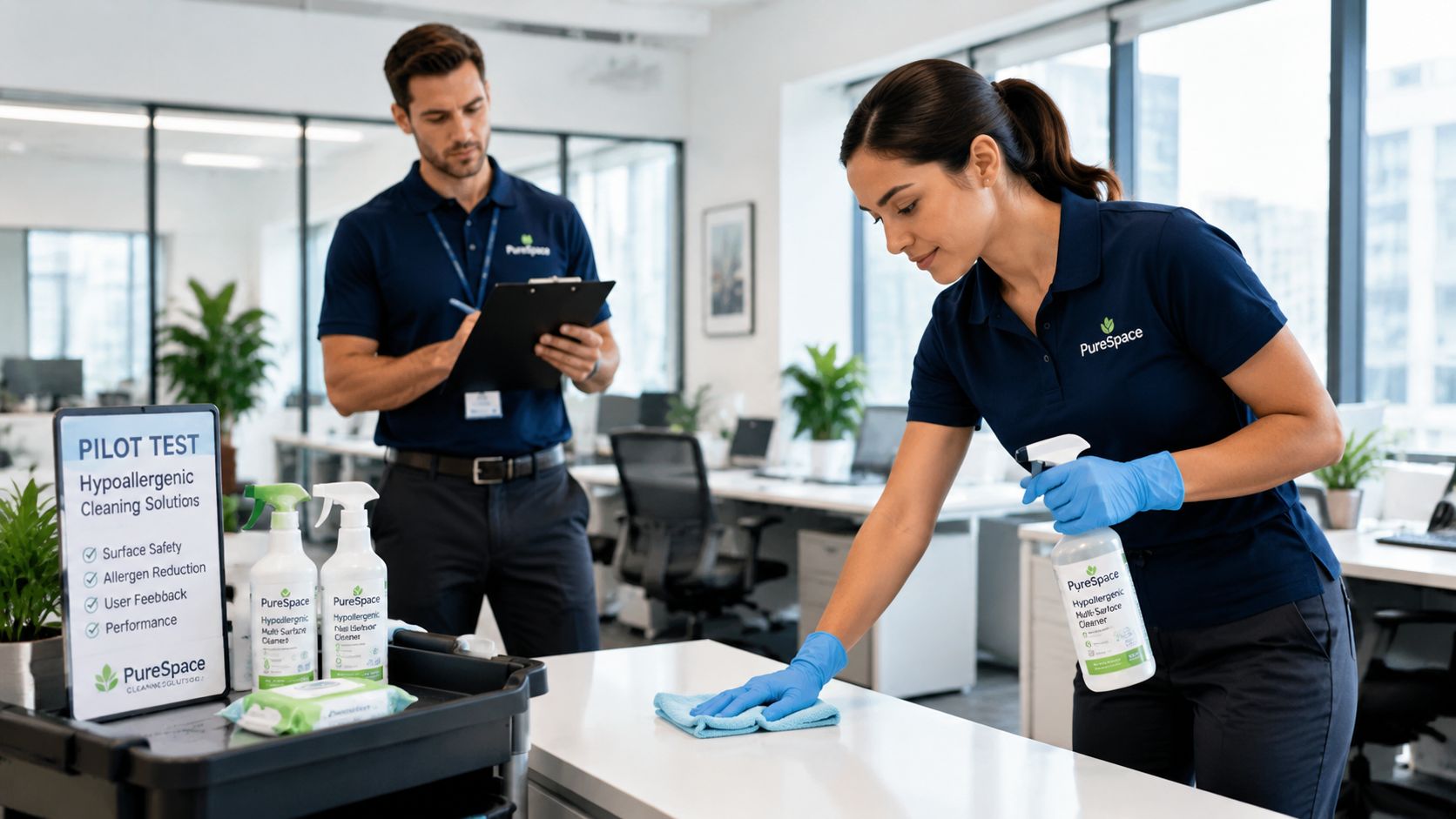
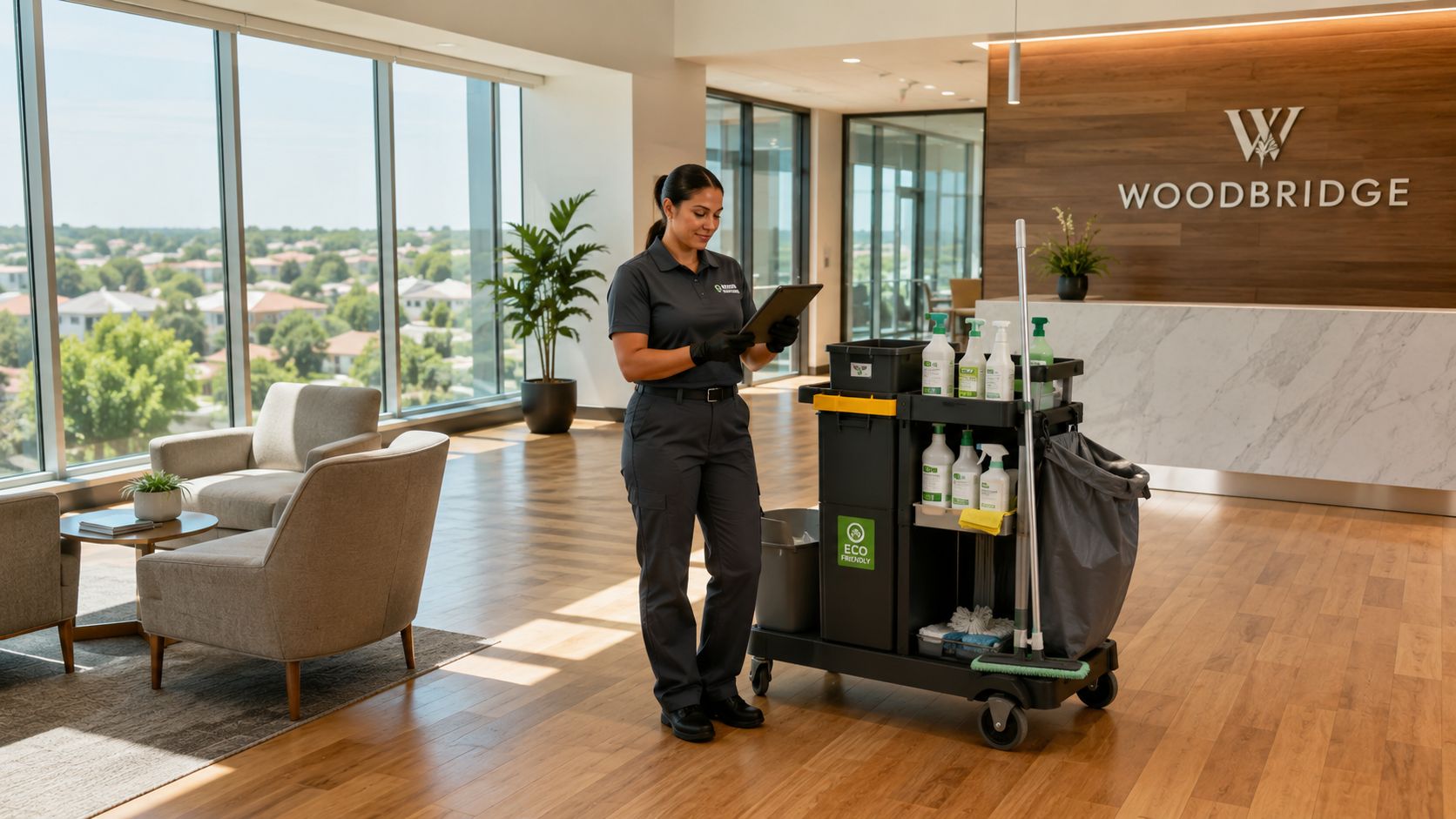
Choose a manageable area first. An office floor, clinic wing, or classroom block works better than a whole portfolio rollout. Use the pilot to compare odour, ease of use, occupant feedback, and any cleaning quality issues.
A careful selection process matters because, in a Canadian study of 41,570 participants, weekly exposure to green cleaning products was associated with lower odds of asthma than several other cleaning product categories, as reported in this Canadian respiratory health study. That doesn't mean every “green” product is automatically the right commercial choice. It does support the broader principle that reducing irritant exposure deserves serious attention.
Train the people who will actually use the products
Training should be simple, repeated, and task-based. Don't assume experienced cleaners will automatically adjust to a new system.
Cover these points in rollout sessions:
- Correct dilution: Many performance complaints are really mixing errors.
- Contact or dwell time: Staff must know when a product cleans and when it disinfects.
- Surface rules: Teams should know what not to spray directly.
- WHMIS updates: New products mean updated hazard communication.
- Storage and labelling: Secondary bottles and carts need consistent identification.
Communicate with building occupants
Occupants notice changes quickly. If the building suddenly smells less perfumed, some people will appreciate it and others may think the cleaning is weaker. Facilities should explain the change in plain language.
A short notice can say that the site is moving toward lower-irritant, fragrance-free product selection where appropriate, while maintaining cleaning and disinfection standards. For high-sensitivity spaces, that message can reduce confusion and improve trust.
Lower odour doesn't mean lower standards. It often means the product is better matched to occupied indoor space.
Update records and supporting systems
Implementation isn't complete until the paperwork catches up. That includes:
- WHMIS binders and digital records
- SDS libraries
- Cleaning SOPs
- Training sign-offs
- Inspection checklists
- Restocking lists
Facilities that pair hypoallergenic product selection with equipment methods can go further. For example, commercial steam cleaning may help some sites reduce dependence on stronger chemicals for certain tasks, provided the surfaces and use case are appropriate.
The Cost and Value of Hypoallergenic Cleaning
The budget objection is real. Some hypoallergenic cleaning products cost more upfront than conventional alternatives, especially when buyers compare bottle price alone. That's the wrong comparison.
Commercial buyers should look at total operating value, not just purchase price.
Where the value usually shows up
A better product program can create value in several ways:
- Fewer occupant complaints: Less time spent responding to odour or sensitivity issues.
- Better fit for occupied spaces: Day cleaning becomes easier when products don't linger in the air.
- Lower training confusion: A tighter, standardized chemical program is easier to manage.
- Reduced surface risk: Well-matched products are less likely to create avoidable finish damage or residue problems.
- Stronger procurement defensibility: It's easier to justify a buying decision built on SDS review, certifications, and defined criteria.
How to build the business case
A practical internal pitch usually works best when framed around risk control and consistency.
Use questions like these:
- Are current products generating recurring complaints?
- Are teams overusing disinfectants where a routine cleaner would do?
- Do staff need simpler dilution and handling rules?
- Would a fragrance-free standard improve occupant comfort in shared areas?
- Can the facility document why each product was selected?
This approach shifts the conversation from “why does this bottle cost more?” to “what problems does this program prevent?”
Frequently Asked Questions
What does hypoallergenic mean in cleaning products
It generally means the product is formulated to reduce the likelihood of triggering irritation or allergic response. It does not mean risk-free.
Are fragrance-free and unscented the same thing
No. Fragrance-free is usually the safer term for low-irritant procurement. Unscented can still include masking agents.
Can hypoallergenic cleaning products still disinfect effectively
Yes, they can, if the disinfectant is a regulated product for that use in Canada and has the appropriate DIN. Buyers should separate routine cleaning from disinfection rather than expecting one product to solve every task.
Are these products strong enough for industrial or high-traffic spaces
Often, yes, if the product is matched to the soil load and surface. The mistake is assuming “gentler” means “weak.” Commercial performance depends on task fit, dilution, contact time, agitation, and operator training.
Can someone still react to a hypoallergenic product
Yes. Lower risk doesn't mean zero risk. That's why pilot testing, SDS review, and occupant feedback still matter.
What should procurement ask a supplier first
Ask for the SDS, technical data sheet, certification details, dilution guidance, surface compatibility notes, and intended-use instructions. If the supplier can't provide clear documents, the buying process should pause.
Should every area of a facility use the same product
Usually not. Most sites need a small, controlled system of products. One for routine hard-surface cleaning, one or more for washrooms or specialty soils, and a regulated disinfectant where required.
Where can facility teams find general service questions
For broader operational questions about commercial cleaning scope and service standards, many buyers also review a provider's commercial cleaning FAQ.
Facilities that want to tighten product standards don't need to change everything at once. Use the checklist, test products in a pilot area, and get two or three quotes with the same safety and performance criteria. For organisations in the GTA comparing providers, Arelli Cleaning is one option to review alongside others, especially if the goal is a more structured office or commercial cleaning program.








.webp)