Toronto property managers usually choose a janitorial vendor by clearing WSIB, insurance, and licensing first, then scoring how well the team can execute the work. In practice, that means looking for current WSIB clearance, about $5 million in general liability coverage, and a written scope with task-level checklists, then judging reliability instead of chasing the lowest monthly number.
A cheap quote can look tidy on paper and still turn into a mess of tenant complaints, missed touchpoints, and endless follow-up. In Toronto, the stronger choice is usually the vendor that can prove process discipline, document completion, and survive an audit without scrambling.
Why the Lowest Quote Is Not the Smart Choice
The trouble with the lowest bid is that it often looks complete only until the first real busy week. A property manager in the Entertainment District can save money on paper and still spend the next six months chasing complaints, correcting missed rooms, and explaining why the building feels under-serviced despite a signed contract.
A vendor that underprices the work usually has to recover the margin somewhere. That shows up as thin supervision, inconsistent staffing, weak reporting, or a habit of treating the scope as a suggestion rather than a contract.
Practical rule: If a quote is noticeably cheaper, ask what was removed. In cleaning, the missing item is rarely decorative.
The hidden cost is rarely the invoice. It is the admin burden, the tenant friction, and the awkward moment when a building team discovers that the vendor cannot show clean documentation, current insurance, or a consistent supervisor trail.
For Toronto and Ontario buyers, this is why vendor selection works better as a process than a shopping exercise. Market guidance for the region repeatedly puts compliance first, then operations, then price, because a building is buying continuity, not just mops and vacuums. A good cleaning partner should behave like a controlled operation, not a freelancer with a van.
When a property manager reviews commercial cleaning services, the question is not who is cheapest. It is who can keep common areas, washrooms, and tenant spaces consistent without creating more work for the site team.
<iframe width="100%" style="aspect-ratio: 16 / 9;" src="https://www.youtube.com/embed/jwIUNL9hu7c" frameborder="0" allow="autoplay; encrypted-media" allowfullscreen></iframe>
Mandatory Compliance and Insurance Screening Steps
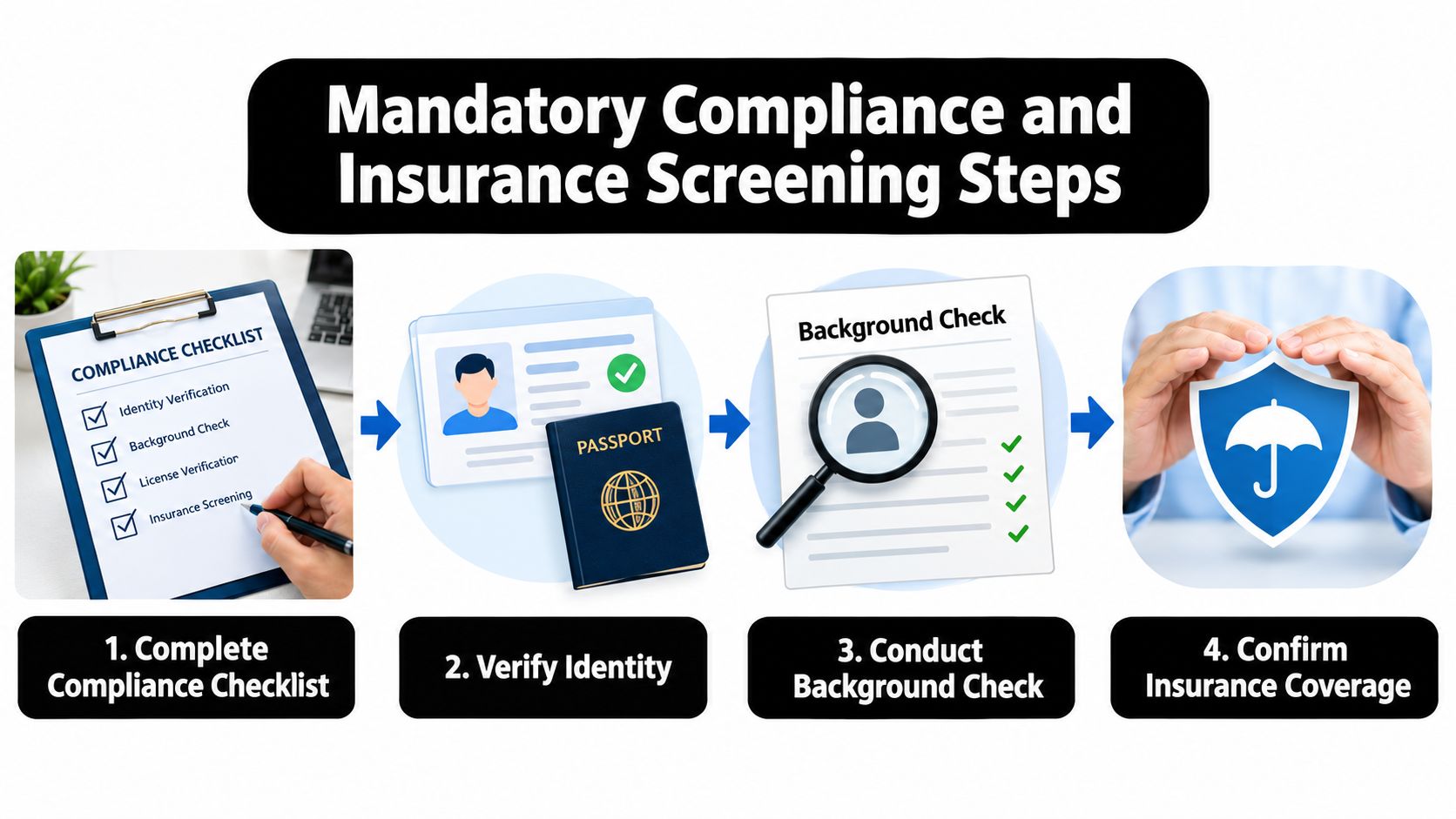
The first screen is not a site visit. It is paperwork. Toronto property managers typically start with WSIB clearance, current certificate of insurance, proof of licensing or incorporation, and a written scope that says what the vendor will and will not do. Ontario vendor guidance is blunt on this point, proposals that miss mandatory items are disqualified.
A sensible insurance ask for a typical office building is at least $5 million in general liability coverage. For higher-risk environments, the limits and coverage types often need to be stronger, especially where spill response, contamination, or specialised surfaces are part of the job.
What to verify before a walkthrough
- WSIB status: Confirm clearance for every jurisdiction where the company operates, not just the Toronto office address.
- Insurance wording: Make sure the certificate is current and names the property manager or ownership entity where required.
- Legal existence: Check incorporation or business registration so the vendor is a real operating entity, not just a trading name.
- Scope controls: Ask for the draft work scope before discussing price, because vague scope language usually becomes vague service.
BOMA Plus' Accredited Vendor Program is a useful benchmark because it expects government registration, provincial workers' compensation in every jurisdiction, valid liability insurance, a standard contract template, and executed contracts signed by both parties. That lines up with how serious buyers already think in Toronto, because a cleaning vendor is handling access, reputational risk, and repeat work.
A related lesson appears in insurance requirements for construction, where contract risk is reduced by verifying documents before work starts. The context is different, the habit is the same. Good buyers do not let a vendor explain compliance after mobilisation.
Vendors who hesitate on compliance documents usually do not become easier to manage later.
The fastest way to reduce risk is to ask for the documents first and the sales pitch later. If a vendor needs several reminders to produce basic records, that is already a performance signal.
The FAQ for Toronto buyers often comes down to one practical thing, so this vendor selection FAQ is worth keeping handy when the paperwork starts to pile up.
Writing an RFP That Separates Serious Vendors From Tire Kickers
An RFP only works when the scope is precise enough to force real answers. If the request just says “office cleaning,” every bidder will fill in the blanks differently, and the cheapest quote will usually be the one with the most optimistic assumptions.
Scope language that gets useful bids
A strong RFP names the building by floor, space type, and frequency. It should spell out restroom sanitation, waste removal, vacuuming, dusting, glass touchpoints, and any after-hours access rules. The more clearly the scope defines the job, the less room there is for pricing games later.
The market guidance for Ontario and Toronto selection also points to proposed operations, work plans, and deliverables, not just credentials. That matters because two vendors can both be insured and still deliver very different service quality.
To make bids comparable, ask for pricing in a monthly rate, plus separate line items for add-ons such as carpet cleaning, strip and wax, or disinfection work. That structure keeps the low base price from hiding expensive extras.
A practical way to frame the RFP is to require bidders to answer these questions in writing:
- What gets cleaned: List every space type and task.
- How often it gets cleaned: Daily, weekly, periodic, or event-driven.
- How work is verified: Checklists, supervisor sign-off, photos, or logs.
- Who manages the site: Name the operations contact and escalation path.
- What happens when service slips: Corrective action and response timing.
The vendor may be perfect on paper and still fail if the scope is loose. That is why a guide to create better RFPs is useful as a writing model, especially for managers who want the bid response to reflect actual operations, not sales copy.
RFP Evaluation Criteria Matrix
| Criteria | Weight | What to Look For |
|---|
| Compliance | High | WSIB, insurance, legal registration, mandatory documentation |
| Scope understanding | High | Clear task-by-task response, no vague assumptions |
| Operations plan | High | Supervisor coverage, staffing model, escalation path |
| Work plans and deliverables | Medium | Real schedule, checklists, reporting rhythm |
| Price | Medium | Transparent monthly rate and clean add-on pricing |
| References | Medium | Comparable buildings, consistent service history |
A useful internal reference during drafting is office cleaning in Toronto, because location-specific service patterns matter more than generic national templates.
The better RFPs are a little boring to read. That is a good sign. Vendors should be responding to a building's actual operating reality, not improvising a proposal around a vague wish list.
Scoring Execution Quality Beyond the Lowest Bid
Once the paperwork passes, the actual sorting begins. Toronto procurement practice leans on scope, experience, operations, and work plans, but most bad cleaning contracts fail in the gap between promise and Tuesday morning reality.
What execution quality looks like
The best vendors do not just say they supervise, they show the cadence. Weekly site walks, written findings, and visible corrective follow-up are strong signs that the operation is managed, not merely staffed.
Photo-verified completion is another practical test. If the vendor stores floor-by-floor or zone-by-zone photos after cleaning, disputes get shorter and audits get easier. That does not replace a human check, but it does remove the usual argument over whether a task was done.
Practical rule: A vendor that documents the work is usually less expensive to manage, even if the invoice is a bit higher.
Documented SLAs matter for the same reason. A contract that spells out response times and corrective-action timelines tells the property manager whether the vendor treats service failures as a process problem or a shrug.
Execution Quality Scoring Rubric
| Indicator | Max Points | What High Scores Look Like |
|---|
| Compliance readiness | 20 | Documents are current, complete, and easy to verify |
| Scope clarity | 20 | Vendor restates tasks correctly and flags assumptions |
| Operations plan | 20 | Named supervisor, routine site visits, clear escalation |
| Work plan and reporting | 20 | Checklists, photos, logs, and audit trail are built in |
| SLA rigor | 10 | Response and corrective timelines are specific |
| Price | 10 | Competitive, but not the main reason to select |
That approach gives property managers a cleaner side-by-side comparison than a price-only spreadsheet. It also makes reference calls more useful, because the caller can ask about schedule adherence, staff turnover, and how quickly problems were resolved.
For a site that needs controlled sanitising work, commercial disinfection and sanitizing should be assessed through the same lens, especially on documentation and supervision rather than marketing language.
A vendor can charge a little more and still be the better operational choice if the team leaves fewer unresolved issues behind. The invoice is visible immediately. The avoided headaches show up over the whole contract term.
Setting Up Trials, KPIs and Contract Negotiation Tactics
A trial period tells the truth faster than a polished proposal. Two to four weeks is usually enough to see how the crew behaves under normal building pressure, whether that means late access, unexpected spill response, or a rush of tenant traffic.
KPI tracking that is actually useful
The trial should be measured weekly, not vaguely remembered at the end. A simple tracker keeps the discussion grounded in service, not personality.
| KPI | Target | Actual | Notes |
|---|
| Schedule adherence | As agreed | | Track missed or late shifts |
| Task completion rate | Near complete | | Compare against the scope checklist |
| Complaint volume | Low and stable | | Separate minor and repeat issues |
| Response time | Prompt | | Measure from request to action |
| Corrective-action closure time | Fast | | Count days, not promises |
The contract needs just as much discipline. Payment terms, notice periods, escalation clauses, and termination rights should be clear before signatures move. A vendor can be excellent and still cause trouble if the contract locks the property manager into vague scope changes or one-sided penalties.
What to avoid in negotiation
- Unlimited travel or miscellaneous fees: These drift quickly and are hard to audit.
- Scope language that can stretch forever: The more elastic the wording, the more change orders later.
- Penalties only for the client: Good contracts cut both ways.
- Verbal scope changes: If it is not written, it becomes everyone's memory version.
Quarterly business reviews are worth asking for because they keep service from sliding. Written change orders do the same thing when the building adds space, shifts hours, or changes use.
For office accounts that need regular site visibility, office cleaning services should be judged on whether the vendor can keep up with the building's real rhythms, not just the starter scope.
A trial is not a formality. It is the cheapest way to find out whether the vendor can live inside the contract without creating extra work for everyone else.
The End-to-End Vendor Selection Workflow
The cleanest workflow is simple enough to repeat at every renewal. First, filter out vendors that fail compliance. Then issue an RFP with a defined scope, score the proposals on execution quality, run a trial, and lock the final contract to SLAs, reporting, and review dates.
Reusable selection sequence
- Compliance screen. WSIB, insurance, legal registration, and written scope controls.
- RFP issue. Floor-by-floor scope, task detail, frequencies, and pricing format.
- Execution scoring. Supervisor cadence, reporting, SLAs, and reference checks.
- Trial period. Two to four weeks of measured service.
- Contract close. Clear terms, written change controls, and review rhythm.
That sequence matters because Toronto's procurement environment already favours formal selection. The vendor that proves process reliability tends to win over the vendor that merely sounds affordable.
The same logic shows up in operational guidance for field teams, and proven field ops for 2026 is a useful external reference for how documentation, routing, and supervision shape repeatable service delivery. Cleaning is not identical to field service, but the management habit is.
Summary checklist
- Confirm compliance first.
- Write the scope tightly.
- Score execution, not just price.
- Use a trial before locking in.
- Keep quarterly reviews on the calendar.
Arelli Cleaning is one Toronto option that fits this kind of selection process with no-term contracts, flexible stop-and-go service, and technology-supported quality control. Other vendors may suit different buildings, but the selection method should stay the same.
If Toronto property managers want a cleaner vendor search, Arelli Cleaning can help with office and commercial cleaning through a process that starts with scope, documents, and service verification. Visit Arelli Cleaning to compare options, use the checklist in this article, and ask for 2 to 3 quotes that can be scored on execution rather than sales talk.









.webp)