A property manager usually notices the concrete floor when something has already gone wrong. Staff are tracking in winter salt. Forklift lanes look dusty by noon. A polished lobby starts to haze over. Someone slips near an entry. The floor that seemed low-maintenance turns into a safety, appearance, and upkeep problem all at once.
That’s why how to clean concrete floor surfaces in commercial settings isn't a housekeeping question alone. It’s a facilities question. The right process protects slip resistance, keeps dust down, reduces avoidable wear, and helps a building present itself properly to staff, clients, tenants, and inspectors.
Commercial concrete floor cleaning means a planned process of assessing the floor type, removing dry soil, choosing the right cleaning chemistry and equipment, treating contaminants safely, and protecting the surface so it lasts longer and performs as intended. That’s different from merely running a mop over it at the close of operations.
The Foundation of a Clean and Safe Facility
A commercial concrete floor usually causes trouble long before it fails. The first signs are more ordinary than dramatic. Fine dust in forklift lanes. A darkened path at the entrance after a snow day. Salt residue drying to a white film. A polished surface losing clarity because the wrong cleaner left buildup behind.
Those problems affect more than appearance. In Canadian facilities, concrete floor care ties directly to slip prevention, indoor cleanliness, finish life, and compliance. Winter conditions make that clearer. Road salt, sand, meltwater, and freeze-thaw traffic put far more stress on entry zones and service areas than many generic cleaning guides account for. If the cleaning plan ignores those conditions, the floor gets harder to maintain and more expensive to restore.
Key takeaways
- Concrete care supports safety first. Soil, moisture, grease, and salt residue all change traction under foot or under wheels.
- Canadian winters change the cleaning standard. Road salt needs active removal, not just a quick mop, because residue keeps attracting moisture and can wear finishes down over time.
- Routine chemistry should stay conservative. On sealed and polished concrete, neutral cleaners are usually the right starting point because aggressive products often create bigger repair costs later.
- WHMIS matters on the floor, not just in the binder. Staff need labelled products, current SDS access, and PPE that matches the cleaner and the task.
- Good floor care protects the full lifecycle of the slab. Cleaning, minor repair, protection, and scheduled maintenance all work together.
- Budget decisions have trade-offs. Saving money on pads, dwell time, or rinse steps often shows up later as haze, premature wear, or coating failure.
What good concrete care looks like
In practice, a well-managed program is consistent. Crews remove abrasive dry soil before adding water. Entrance matting and cleaning frequency increase during snow and salt season. Spill response is fast enough to prevent staining and reduce slip risk. Equipment is chosen for the surface condition and the traffic load, not just for how quickly a large area can be finished.
Training matters too. I have seen otherwise capable teams damage floors because the product in the janitor closet was designed for another surface. On commercial concrete, especially polished or sealed floors, the wrong degreaser or an overly aggressive pad can dull the finish in one pass. Recovery costs more than proper daily care.
A sound program also treats chemical safety as part of the cleaning process. WHMIS procedures, correct dilution, ventilation, and PPE are part of floor care in any warehouse, school, clinic, or mixed-use property. That becomes even more important when crews are handling stain removers, oil treatments, or products used in enclosed service areas.
Practical rule: The lower-cost approach is usually the one that prevents damage. Re-polishing a hazed lobby or repairing a failed coating costs far more than using the right cleaner, pad, and process from the start.
Assessing Your Floor and Preparing the Area
The biggest mistake in concrete care is treating every slab the same. Before cleaning starts, identify what you’re working on and what’s on it. Concrete can look similar at a glance, but cleaning decisions change depending on whether the floor is unsealed, sealed, or mechanically polished.
A basic field check helps. If water darkens and absorbs quickly, the floor may be unsealed or the protection may be worn down. If water beads up, there’s likely a sealer or coating in place. If the floor has a reflective finish, especially in offices, showrooms, or modern industrial interiors, assume it needs a polished-concrete approach until proven otherwise.
A practical assessment checklist
Before choosing equipment or chemicals, check these points:
- Surface type. Is it raw concrete, sealed concrete, polished concrete, or a coated floor over concrete?
- Soil profile. Are you dealing with dust, tracked-in grime, grease, rust, paint transfer, adhesive residue, or winter salt?
- Damage level. Look for pits, open joints, spalling, edge wear, hairline cracks, and previous patching.
- Traffic pattern. Forklift lanes, entry vestibules, receiving zones, washrooms, and lunchrooms all load the floor differently.
- Drainage and water tolerance. Some areas can handle wet work. Others need low-moisture methods.
- Operational constraints. Can the area be closed? Will cleaning happen around staff, patients, students, or inventory?
Preparation steps that prevent bad results
Most cleaning failures start in the prep stage, not in the scrub stage.
First, clear the space as much as operations allow. Move loose furniture, pallets, bins, display fixtures, and portable equipment. Wet cleaning around obstacles leaves dirty edges and can trap moisture in corners.
Second, put out visible safety signage and isolate the work zone. This matters in mixed-use commercial spaces where staff may still be moving through corridors or loading areas.
Third, dry-remove debris thoroughly. That means a microfiber dust mop, a broom suited to the debris load, or ideally a HEPA vacuum in dust-sensitive settings. Fine grit acts like sandpaper under foot traffic and scrubber pads.
A floor that looks “mostly clear” often still has enough fine debris to scratch a finish once water and pad pressure are introduced.
What to avoid before cleaning starts
| Issue | Why it causes problems | Better approach |
|---|---|---|
| Wet mopping over loose grit | Creates abrasive slurry | Sweep or HEPA vacuum first |
| Guessing the floor type | Can dull, etch, or strip the surface | Test absorbency and inspect finish |
| Cleaning around stored items | Leaves untreated zones and uneven appearance | Clear the area in advance |
| Using one chemical for all stains | Often ineffective or damaging | Match the treatment to the contaminant |
A Guide to Commercial Concrete Cleaning Methods
A Canadian loading bay in February can undo a week of cleaning in one morning. Road salt, sand, meltwater, and tire residue get tracked from the dock to the corridor, then dry into a gritty film that wears finishes and increases slip risk. A good cleaning method deals with that full cycle, not just the visible dirt.
Daily and routine cleaning
Routine concrete care should always start with the least aggressive method that will do the job. That protects the surface, controls labour costs, and reduces the chance of grinding soil deeper into the floor.
Dry soil removal comes first. In offices, schools, clinics, and retail spaces, microfiber dust mops are usually enough for daily pickup. In facilities with fine dust, packaging debris, or higher indoor air quality requirements, HEPA vacuuming is the better standard. It also helps in Canadian winters, when salt crystals and abrasive grit build up quickly around entrances and travel paths.
Wet cleaning should be controlled, not heavy. On sealed or polished concrete, use a pH-neutral cleaner and the minimum amount of solution needed to suspend soil. Too much water creates extra recovery work, drives dirty solution into joints, and leaves edges damp longer than the main field of the floor. That is where residue and slip complaints often start.
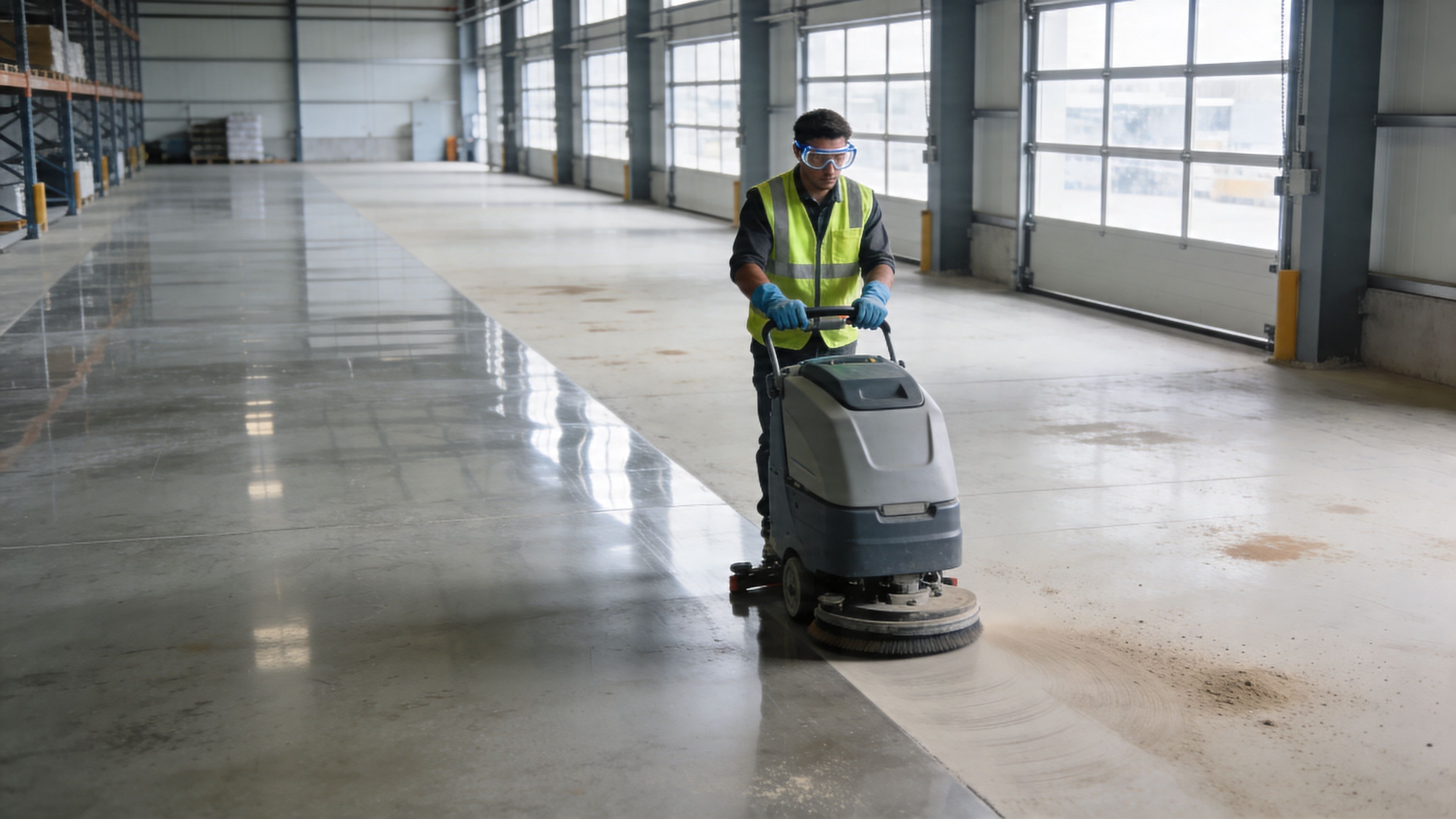
For larger areas, autoscrubbers usually beat string mops on consistency and hygiene. They apply solution evenly, maintain pad pressure, and recover dirty water in the same pass. In practical terms, that means fewer streaks, less residue, and shorter dry times in corridors, warehouse aisles, and common areas.
Degreasing and heavier soil removal
Production floors, service rooms, garbage areas, and loading zones need a different approach. Grease, rubber transfer, hydraulic drips, and layered grime do not respond well to light daily maintenance.
Start with the contaminant. Use a degreaser only where oily soil is present, and make sure the product is approved for the floor type and the workplace. In Canada, that means checking the safety data sheet, staff training, and handling procedures under WHMIS before the job starts. A stronger chemical is not always a better answer. On some floors, it creates more work by leaving film behind or interfering with later coatings.
Mechanical action matters as much as chemistry. Scrub with the least aggressive pad or brush that will break the soil, then recover the slurry fully. If dirty solution dries back onto the slab, the floor often looks dull and feels slick even after a lot of labour.
Aggressive pads have their place, but only on surfaces that can take them. Black pads or similar heavy-cut tools can mark decorative concrete, reduce gloss on polished floors, and shorten the life of protective treatments.
A working method for polished concrete
Polished concrete looks durable because it is dense and hard. It still shows neglect quickly. The usual problems are haze, fine scratching, salt residue, and gradual gloss loss from using the wrong pad, too much cleaner, or poor recovery.
A practical routine is simple:
- Dust mop or HEPA vacuum before any moisture hits the floor.
- Spot clean spills quickly, especially coffee, food acids, oils, and winter salt tracking.
- Autoscrub or damp mop with a pH-neutral cleaner and light solution flow.
- Use the pad type recommended for polished concrete, and change it before it loads up with grit.
- Recover completely and inspect corners, joints, and entrance zones for residue.
Pad maintenance gets overlooked. Dirty pads redeposit soil and can leave a grey haze that managers often mistake for permanent wear.
As noted earlier in the article, polished concrete responds best to consistent low-moisture cleaning and the right pad system, not harsh chemicals or overly aggressive scrubbing.
A short visual walkthrough can help teams understand machine handling and coverage patterns:
When power washing fits
Power washing is a targeted method, not a default method. It fits exterior aprons, service corridors, parking structures, waste areas, and some post-construction cleanup where drainage, runoff control, and overspray can be managed safely.
Interior finished concrete is a different matter. Water migration, splash onto walls or equipment, and slow drying can create more problems than the washing solves. In cold Canadian conditions, exterior wash timing also matters. A poorly planned wash can leave refreeze hazards at entrances and exits.
If you are comparing cleaning methods for exterior slabs or utility areas, this overview of commercial power washing services helps frame where pressure washing makes sense and where scrubber-based cleaning is the safer choice.
Clean concrete is only part of the job. The better result is a floor that stays safe, wears evenly, and does not cost more to restore six months from now.
Advanced Techniques for Stubborn Stains and Contaminants
A common Canadian winter call goes like this. The lobby was scrubbed last night, the concrete still looks dirty this morning, and staff are blaming the machine. In practice, that usually points to residue, salt carry-in, or a stain that needs the right chemistry and recovery method instead of more passes with a pad.
Concrete holds contamination differently depending on whether the slab is bare, densified, polished, or coated. That distinction matters. An unsealed service corridor can absorb oil deep into the pore structure, while a coated shipping area may only have surface film but show tyre marks, rust bleed, or salt residue around joints. The cleaning approach has to match the floor build-up and the contaminant.
Oil and grease
Oil spreads farther than it appears. On porous concrete, it migrates below the visible spot. On sealed floors, it leaves a slick film that traps dust and creates a slip risk.
Blot fresh spills first. Use absorbent material, remove it fully, then apply a degreaser approved for the floor type and the building’s WHMIS program. Staff should have the product label, SDS, and proper PPE before spot treatment starts. That matters in mixed-use commercial buildings where the same team may be cleaning public areas, back-of-house space, and loading zones in one shift.
Agitation helps, but extraction is what finishes the job. If slurry stays on the floor, the stain often reappears as the surface dries. For older contamination, set expectations early. Cleaning can reduce the visual impact a lot, but deep oil shadows may remain until the floor is mechanically restored or coated. If ownership is weighing restoration against replacement, it helps to review typical concrete coating cost ranges before approving a patchwork fix that will not hold up.
Rust, paint, and embedded marks
Rust needs control, not speed. Acidic removers can etch surrounding concrete, dull polished areas, and create a visible halo around the original stain. Test a small section first, isolate the spot, and neutralize and rinse according to the product directions.
Paint transfer, forklift scuffs, and black heel marks usually respond better to the right pad and spot treatment than to stronger chemistry. That is a useful trade-off for property managers working within a budget. Mechanical removal takes more time, but it often avoids surface damage and reduces the chance of a colour mismatch on decorative or finished concrete.
Construction residue is a different problem. Overspray, cured paint, mortar haze, and adhesive often move beyond cleaning into surface preparation. At that point, the question is not how to wash harder. It is whether the floor needs grinding, honing, or selective repair.
Road salt in Canadian facilities
Tracked-in salt deserves its own plan in Canadian commercial buildings. It is not ordinary winter dirt. Salt crystals abrade the surface under foot and wheel traffic, and dissolved residue can stay in joints, edges, entry mats, and low spots long after the visible slush is gone.
A practical process for interior concrete looks like this:
- Dry remove bulk salt first with controlled sweeping or vacuuming.
- Pre-treat residue with a cleaner suited to the floor finish. Mild acidic rinses are sometimes used on plain concrete, but they are a poor choice for polished, dyed, or sensitive surfaces.
- Scrub with enough dwell time to break residue, then recover the solution completely.
- Rinse if the product calls for it, and verify the floor is not left slippery.
- Inspect entrances, mat lines, and joints again after drying. Those areas often hold the remaining salt.
Pressure washing interior salted concrete usually creates more work. Water can migrate into joints, under walls, or into adjacent finishes, and drying times in cold weather are rarely ideal. At exterior entrances and service areas, timing matters too. Wash too late in the day and refreeze risk becomes a safety issue.
The long-term answer is operational, not just chemical. Good matting, faster pickup of slush, and extra winter touchpoints reduce how much salt reaches the slab in the first place. That lowers wear, cuts complaint calls, and gives the floor a better chance of lasting through another season without premature refinishing.
Repair, Finishing, and Protective Coatings
A clean floor gives you a reliable inspection point. That is when the true condition shows up. Hairline cracks, spalled edges, worn control joints, dusting, and old coating failure are easier to judge after soil, grease, and salt residue are gone.
Repairs need to match how the building uses the slab. In a distribution space, joint shoulder damage and wheel-path impact usually matter more than appearance because lift trucks will keep breaking weak edges. In a retail unit, a small patch that flashes through a decorative finish can become a tenant complaint even if it holds structurally. In both cases, repairs fail early if moisture is trapped below the patch or if residue is left in the defect.
Choosing the right type of protection
The finish should solve the problem you have, not the one a product brochure describes.
- Penetrating sealers reduce absorption and keep a more natural concrete appearance. They are often a practical fit for utility rooms, back-of-house areas, and some exterior-adjacent zones where you want easier cleanup without a film coating.
- Densifiers are typically used on polished concrete to harden the surface and reduce dusting. They work best where the slab is already in decent condition and the maintenance plan supports polished-floor care.
- Topical coatings such as epoxy or urethane add a wear layer that can improve cleanability, chemical resistance, and line-marking visibility. They are common in shops, service corridors, food-related areas, and spaces with repeated washdown.
Each option has trade-offs. Penetrating products do not hide repairs or surface variation. Densified and polished floors can look excellent, but winter traction and salt management need attention at entrances in Canadian facilities. Topical coatings can give better stain resistance, but they are less forgiving if the slab has moisture issues, freeze-thaw related movement near overhead doors, or weak preparation.
Surface preparation decides whether a coating lasts
Most coating failures I see are preparation failures first. The slab may still hold chlorides from tracked-in road salt, old degreaser residue, curing compounds, or moisture that was never tested before installation. If any of that remains, the coating system is being asked to bond to a problem layer instead of sound concrete.
Proper prep usually includes crack and joint repair, mechanical profiling, dust removal, and moisture testing before material is mixed. Product selection also needs to line up with WHMIS requirements, ventilation limits, odor concerns, and shutdown windows. Those practical constraints often decide what can be installed safely in an occupied Canadian building.
Budgeting for repair versus full resurfacing
Property managers usually have to choose between localized repairs and a larger refinishing project. The right call depends on traffic, contamination, tenant expectations, and how long you need the floor to last before the next capital cycle. For rough budgeting, this overview of concrete coating cost helps frame the main price variables before you request site-specific quotes.
Local patching and sealing often make sense when the slab is sound and the defects are isolated. A full coating system earns its cost in spaces with oils, repeated scrubbing, cart traffic, or hygiene requirements where cleanability affects operations every day. The expensive mistake is coating over a floor that still needs structural repair, moisture correction, or better entry controls for winter salt.
Developing a Maintenance Program for Safety and Compliance
By late February, many Canadian facilities are not dealing with one cleaning problem. They are dealing with three at once: tracked-in road salt at entrances, moisture around vestibules and loading doors, and fine grit that keeps grinding into the concrete finish. If the maintenance program does not adjust for winter conditions, the floor gets harder to clean, slip risk goes up, and staff start using stronger chemistry than the surface needs.
A workable program is built around traffic patterns, season, and the finish on the slab. Warehouses, retail units, parkades, food-adjacent spaces, and light industrial buildings do not soil the same way, so they should not be cleaned on the same schedule. In practice, the best plans are simple enough for staff to follow on a busy shift and specific enough to hold up during a safety review.
Sample concrete floor maintenance schedule
| Frequency | Task | Recommended Equipment/Supplies |
|---|---|---|
| Daily | Remove dry soil from entries, aisles, and high-traffic zones | Microfiber dust mop, broom, HEPA vacuum |
| Daily | Spot clean spills and visible marks | Neutral cleaner, absorbent cloths, warning signs |
| Weekly | Full damp cleaning or autoscrub of open areas | Autoscrubber, pH-neutral cleaner, clean pads |
| Weekly | Inspect joints, corners, and edges | Inspection checklist, flashlight, hand tools |
| Monthly | Review wear patterns and entry control effectiveness | Log sheet, matting review, supervisor walk-through |
| Periodic | Deep clean, stain treatment, or restorative service | Scrubber, specialty cleaners, contractor support if needed |
The schedule matters. The adjustment points matter just as much.
In a Canadian commercial setting, entry management is part of floor care, not a separate issue. Good matting, snow response, and faster removal of salt slurry will usually save more wear on the floor than adding another heavy scrub later. During winter, many sites need extra passes at entrances and along pedestrian routes, while summer programs often shift toward dust, rain tracking, and gum or organic debris.
WHMIS and PPE in day-to-day operations
Chemical handling needs written rules. Staff should know which product is approved for bare, densified, sealed, or coated concrete, how to dilute it, what PPE to wear, and what to do after a splash or misapplication. That is basic WHMIS practice, and it prevents a common problem in commercial buildings: one strong degreaser gets used everywhere because it seems faster.
At minimum, a floor-care program should define:
- Which products are approved for each floor type
- Where SDS documents are stored and how staff access them
- What PPE is required for routine cleaning versus degreasing or prep work
- How wet-floor control is handled in occupied areas
- Who can respond to unknown contamination and when routine staff must stop work
That last point is often missed. If contamination could involve blood, drug residue, sewage backup, or another regulated exposure, general floor care procedures are not enough. Managers who need a clear line between routine cleaning and higher-risk remediation should review Why DIY Biohazard Cleanup Is A Serious Health Risk.
Documentation also protects the budget. A simple log of cleaning frequency, slip incidents, salt loads, chemical use, and recurring stain locations helps property managers decide whether the problem is staffing, equipment, entry control, or a floor finish that no longer fits the building. Without that record, sites tend to overspend on corrective cleaning and underspend on prevention.
A maintenance program only works if staff can repeat it safely, with the equipment and time they have. Train to the prevailing shift conditions, inspect the results, and update the schedule when weather, tenancy, or traffic changes.
Evaluating Professional Services Versus a DIY Approach
Some concrete floor care can be handled in-house. Some shouldn’t. The right answer depends on floor size, finish type, contamination, equipment access, and the consequences of getting it wrong.
When in-house cleaning makes sense
DIY or internal janitorial care is usually reasonable when:
- The floor condition is stable and the work is routine.
- Staff already have the right machines and know how to use them.
- The surface is straightforward, such as standard sealed concrete with light to moderate soil.
- There’s time to clean properly, not just quickly.
Routine dust control, spot cleaning, and scheduled autoscrubbing often fit this model.
When to bring in a specialist
Professional help is worth considering when the floor has embedded oil, salt damage, post-construction residue, coating failure, polishing issues, or prep requirements before sealing or coating. It also makes sense when disruption has to be tightly controlled or when the building can’t carry the cost of trial and error.
If contamination includes hazardous material or unknown biological exposure, stop and reassess. General cleaning staff shouldn’t be pushed into specialist risk categories. This overview of Why DIY Biohazard Cleanup Is A Serious Health Risk is useful for understanding where ordinary cleaning ends and regulated hazard work begins.
What to ask a cleaning provider
Use a short screening checklist when comparing quotes:
- What concrete surfaces do you service regularly. Unsealed, sealed, polished, coated?
- How do you assess the floor before choosing a method?
- What products do you use, and are staff trained under WHMIS?
- What equipment will be on site?
- How do you handle residue, wastewater, and drying control?
- Can you provide a scope that separates routine cleaning from restoration or prep work?
- Are you insured for this type of service?
Pricing usually depends on square footage, floor condition, access constraints, stain type, finish sensitivity, and whether the scope includes repair or protective treatment. Get 2 to 3 quotes and compare the method, not just the price.
For GTA facilities, Arelli Cleaning service locations can be one option to review alongside other local providers.
FAQ
What’s the best way to clean a concrete floor in a commercial building
Start with dry debris removal, then use the least aggressive wet-cleaning method that fits the floor type. For many sealed and polished floors, that means a pH-neutral cleaner, controlled moisture, and proper recovery.
Can concrete floors be damaged by the wrong cleaner
Yes. Harsh chemicals can dull or etch certain finishes, especially polished concrete. The cleaner has to match both the surface and the contaminant.
How often should a commercial concrete floor be cleaned
That depends on traffic, use, and season. Entry zones and industrial lanes may need daily attention, while lower-traffic spaces can often follow a less intensive schedule.
Is vinegar safe on concrete
It shouldn’t be treated as a universal cleaner. In the salt-management context cited earlier, a 10% vinegar-water solution can be used as a pre-treatment before general cleaning on affected floors, but it needs to be handled carefully and followed by thorough rinsing.
What’s different about cleaning polished concrete
Polished concrete needs finer control. Dry dusting, pH-neutral chemistry, clean pads, and regular machine scrubbing with the right grit are more important than aggressive chemical strength.
Should concrete always be sealed after cleaning
Not always. Some floors need sealing or densifying, while others may only need routine maintenance. The right choice depends on porosity, use, and whether the floor is meant to remain natural, polished, or coated.
Can staff clean warehouse concrete floors without a contractor
They can handle routine maintenance if they have the right equipment, training, and chemical controls. Deep degreasing, post-construction cleanup, coating prep, or restorative polishing usually benefit from specialist support.
What should a property manager avoid
Avoid guessing the floor type, over-wetting the slab, using aggressive chemistry without testing, and treating winter salt like ordinary dirt.
Further reading
A Canadian concrete floor program usually starts to fail in late winter. Salt gets tracked past the entry matting, cleaning crews treat it like ordinary soil, and the slab starts showing residue, surface wear, or slip complaints. If you want to go deeper on the parts generic guides often miss, use the resources below to build better procedures around safety, chemistry, and long-term floor condition.
Internal resources
Arelli Cleaning operates across the GTA. That matters if you need site-specific support for multi-property standards, local winter conditions, or after-hours service coordination.
External resources
- CCOHS guidance on WHMIS and chemical safety
- WorkSafeBC information on controlling slip, trip, and floor hazards
- Government of Canada information on indoor hard-surface disinfectants and safe product use
- Concrete Ontario industry resources
- National Research Council Canada publications search for building envelope and material durability topics
Good concrete care is methodical. Identify the floor type, record what soils show up by season, verify staff training under WHMIS, and match the cleaning method to the slab instead of relying on one product for every problem.
If the work goes beyond routine cleaning, write a clear scope before requesting quotes. Include the floor condition, stain types, square footage, access limits, drainage, and whether winter salt, grease, or coating failure is part of the job. That step usually saves more money than trying to correct a rushed cleaning decision later.