Toronto typically applies between 130,000 and 150,000 tonnes of road salt each winter, while snow-clearing operations cover 14,700 lane kilometres of road and 7,900 kilometres of sidewalk, according to reported City of Toronto winter-maintenance figures. For a business, that infrastructure doesn't stop at the property line. Salt, grit, slush, and moisture enter through every busy doorway, turning seasonal cleaning into a form of preventative asset management.
The visible result is a dull lobby, marked carpet, or cloudy entrance glass. The less visible costs include worn floor finishes, damaged mats, moisture problems, airborne dust, and avoidable disruption. How seasonal cleaning keeps Toronto businesses looking their best is therefore less about occasional deep cleaning and more about matching cleaning methods to the contaminants each season brings.
Table of Contents
The Scale of Toronto's Seasonal Challenges
Toronto's winter operations create repeated contamination cycles inside commercial buildings. The city targets bare pavement on expressways within 2 hours, arterials within 4 hours, and local roads within 8 hours, which means commercial corridors repeatedly move from snow to meltwater to salt residue during the same workday, as documented in the City's winter operations reporting.
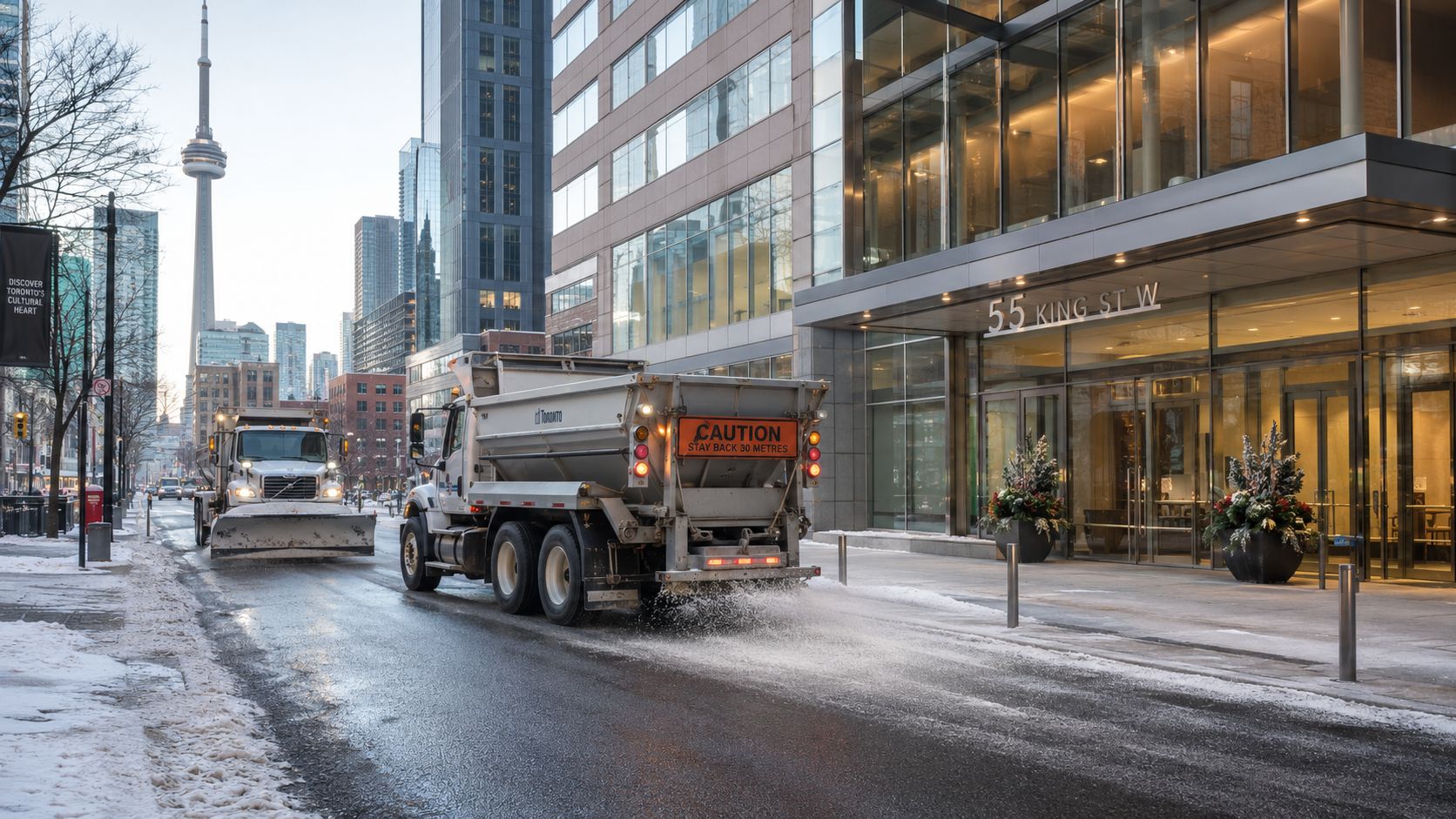
Why winter residue becomes an asset problem
Salt residue is more than a cosmetic mark. Grit carried indoors under footwear acts as an abrasive, while dissolved salt and meltwater can affect carpet fibres, floor finishes, entrance hardware, and the edges of resilient flooring. When moisture sits in a busy entryway, the same area can become both a slip concern and a source of repeated re-soiling.
The scale of provincial de-icing helps explain why Toronto facilities deal with this problem so persistently. Toronto's environmental guidance notes that Ontario applies 3–5 million tonnes of road salt annually, while Toronto-specific reporting describes average annual use of 130,571 tonnes and approximately 10,200 tonnes during a single storm. Those figures appear in the City's road-salt guidance.
Practical rule: A winter floor-care plan should respond to actual traffic and weather, not rely only on a fixed janitorial calendar.
The seasonal pattern beyond winter
Spring brings embedded grit, pollen, and winter film into the cleaning workload. Summer introduces humidity shifts that make moisture control important in basements, storage spaces, washrooms, and areas with weak air movement. Fall brings wet leaves, organic debris, and drainage issues near entrances.
These conditions call for different equipment, products, and frequencies. A Toronto office may need more frequent entryway attention in winter, extraction after the season, and ventilation coordination when pollen or humidity changes affect the indoor environment. Businesses seeking a location-specific plan can review office cleaning services in Toronto alongside their building's traffic patterns, flooring materials, and access points.
Defining Seasonal Cleaning for Commercial Spaces
Seasonal cleaning is a planned adjustment to commercial cleaning procedures based on predictable changes in outdoor contaminants, moisture, temperature, occupancy, and building use. It differs from routine janitorial work because it changes the cleaning response rather than repeating the same task list throughout the year.
A standard daily programme may include waste removal, washroom care, vacuuming, dusting, and mopping. A seasonal programme adds targeted work, such as salt-residue removal, carpet extraction, moisture inspections, glass cleaning, floor finish maintenance, and preparation for the next weather cycle. The right approach depends on the facility, but the principle remains consistent: cleaning should address the source and behaviour of the soil, not only its appearance.

Winter and spring priorities
Winter care starts at the threshold. Commercial properties should inspect entrance mats, remove excess slush before it spreads, vacuum abrasive grit frequently, and use cleaning products compatible with the flooring finish. Peel Region's winter-maintenance guidance for commercial properties recommends controlling nonessential entrances, documenting salt practices, and recognising that salt may be ineffective around -10°C.
Spring is the reset period. Carpet extraction, detail cleaning around baseboards and corners, glass cleaning, and removal of winter residue help restore surfaces that routine mopping can't fully recover. Organic debris requires a different approach from mineral residue, so product selection should follow the soil rather than defaulting to a stronger chemical.
Summer and fall adjustments
Summer programmes should focus on moisture-prone areas, odour control, restroom sanitation, and inspection of flooring that may react to humidity. Wet cleaning needs adequate drying time, particularly in enclosed areas where air movement is limited.
Fall is preparation season. Facilities should check mats, weather seals, drainage paths, and hard-floor finishes before snow arrives. A light maintenance intervention before winter can be more practical than waiting for a visibly worn surface to require a major restoration.
Businesses can combine these tasks with a broader commercial cleaning services programme, provided the scope identifies seasonal work separately from routine duties. A useful schedule records the task, trigger, responsible person, product, equipment, and inspection standard.
Indoor Air Quality and Ventilation Strategies
Seasonal contamination doesn't stay on the floor. Foot traffic can disturb fine grit and dried residue, while pollen, dust, cleaning aerosols, and moisture can move through occupied areas and ventilation pathways. A cleaning programme that produces a polished lobby but ignores airborne particles or damp conditions is incomplete.
Health Canada's guidance for improving indoor air quality in office buildings connects indoor air quality with ventilation, contaminants, temperature, humidity, building use, and occupancy. It also notes that ventilation rates should respond to occupant levels, renovations, and how a space is used. That makes seasonal cleaning part of a wider indoor-environment plan.
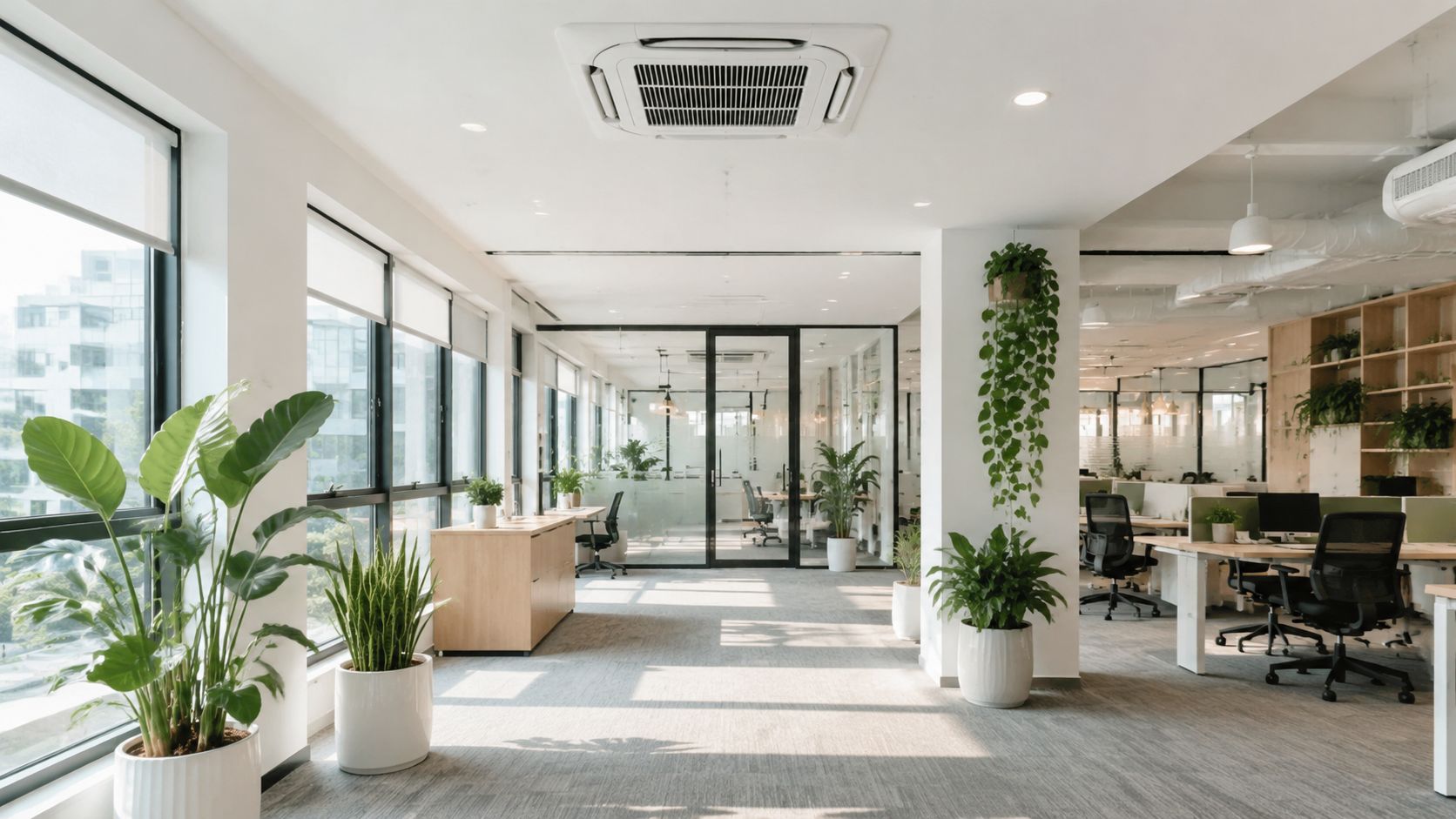
Connecting floor care with ventilation
Winter vacuuming should capture fine debris rather than redistribute it. HEPA-filtered equipment can be appropriate where dust control is a priority, especially around entrances, carpeted corridors, and occupied work areas. Wet floor work should be timed to allow drying and ventilation before high-traffic use resumes.
Spring requires coordination between carpet cleaning, filter changes, and ventilation inspections. Pollen entering through doors or open windows can settle on horizontal surfaces and be recirculated when staff or equipment disturbs it. Summer requires attention to moisture sources, condensation, and weak air movement. Cleaning alone won't correct persistent dampness, so facility managers should involve building operators when humidity or odour problems continue.
Product and chemical controls
Low-VOC products can support a more comfortable indoor environment, but product choice must still match the surface and soil. Stronger chemicals aren't automatically more effective, and excessive application can increase residue or odour without improving the result.
Cleaning crews handling hazardous products need WHMIS controls, including supplier labels, current safety data sheets, worker training, and workplace labels when products move into secondary containers. These requirements are described in the Ontario WHMIS and chemical-handling guidance.
For readers considering broader household ventilation principles, improving home air quality offers useful context, although commercial facilities need building-specific assessments. Businesses can also align surface cleaning with COVID-conscious cleaning practices, particularly when occupancy patterns or shared-space use changes.
Industry-Specific Seasonal Protocols
A corporate office, dental clinic, warehouse, and restaurant may all experience Toronto weather, but they don't experience it in the same way. The right seasonal protocol depends on the flooring, traffic, regulatory environment, moisture exposure, and consequences of contamination.
An office lobby usually needs threshold control, frequent vacuuming, neutral cleaning, and planned floor maintenance. A clinic needs those measures plus carefully documented disinfection of high-touch areas. A warehouse may need attention to loading docks, concrete surfaces, equipment tracks, and freeze-thaw exposure. Food facilities must also integrate cleaning with food-safety controls and regulatory pest control for food facilities.
| Facility type | Winter priority | Spring priority | Summer priority | Fall priority |
|---|
| Corporate office | Matting, salt and grit removal, lobby floor care | Carpet extraction, glass and detail cleaning | Moisture checks, ventilation coordination | Floor preparation and entrance inspections |
| Clinic or dental office | Slush control, documented disinfection, touchpoint care | Deep cleaning after winter soil buildup | Humidity monitoring and odour control | Readiness checks before colder weather |
| Warehouse or industrial site | Dock and concrete cleaning, moisture control | Debris removal and surface inspection | Degreasing where required, dust control | Drainage, sealant, and anti-slip review |
| School or childcare facility | Entryway containment and washroom attention | Deep carpet and high-touch cleaning during planned closures | Ventilation and damp-area inspections | Matting, drainage, and pre-winter readiness |
| Restaurant or food facility | Entrance safety and sanitation controls | Organic residue removal and detailed cleaning | Grease, odour, moisture, and pest prevention | Drainage and winter-entry preparation |
Why one programme leaves gaps
A one-size-fits-all scope often treats every floor as if it responds to the same product and frequency. That can lead to over-wetting carpet, using unsuitable chemicals on resilient flooring, or under-cleaning areas where contamination has greater operational consequences.
Clinic managers should ask how cleaning and disinfection are separated, verified, and documented. Warehouse managers should ask how crews handle dust, grease, loading-dock moisture, and equipment access. Restaurant operators should require clear boundaries between general cleaning, food-contact requirements, waste handling, and pest-prevention coordination.
For food-service businesses, restaurant cleaning services should be evaluated against the facility's actual workflow, not just a generic list of rooms. Seasonal cleaning works when the provider understands how the building operates.
The Four-Season Commercial Cleaning Checklist
A seasonal checklist should be specific enough for a supervisor to verify and flexible enough to reflect the facility's use. The following framework gives property managers a practical audit tool. Each task should be assigned to an internal employee, cleaning supervisor, building operator, or specialist contractor, with completion recorded after inspection.
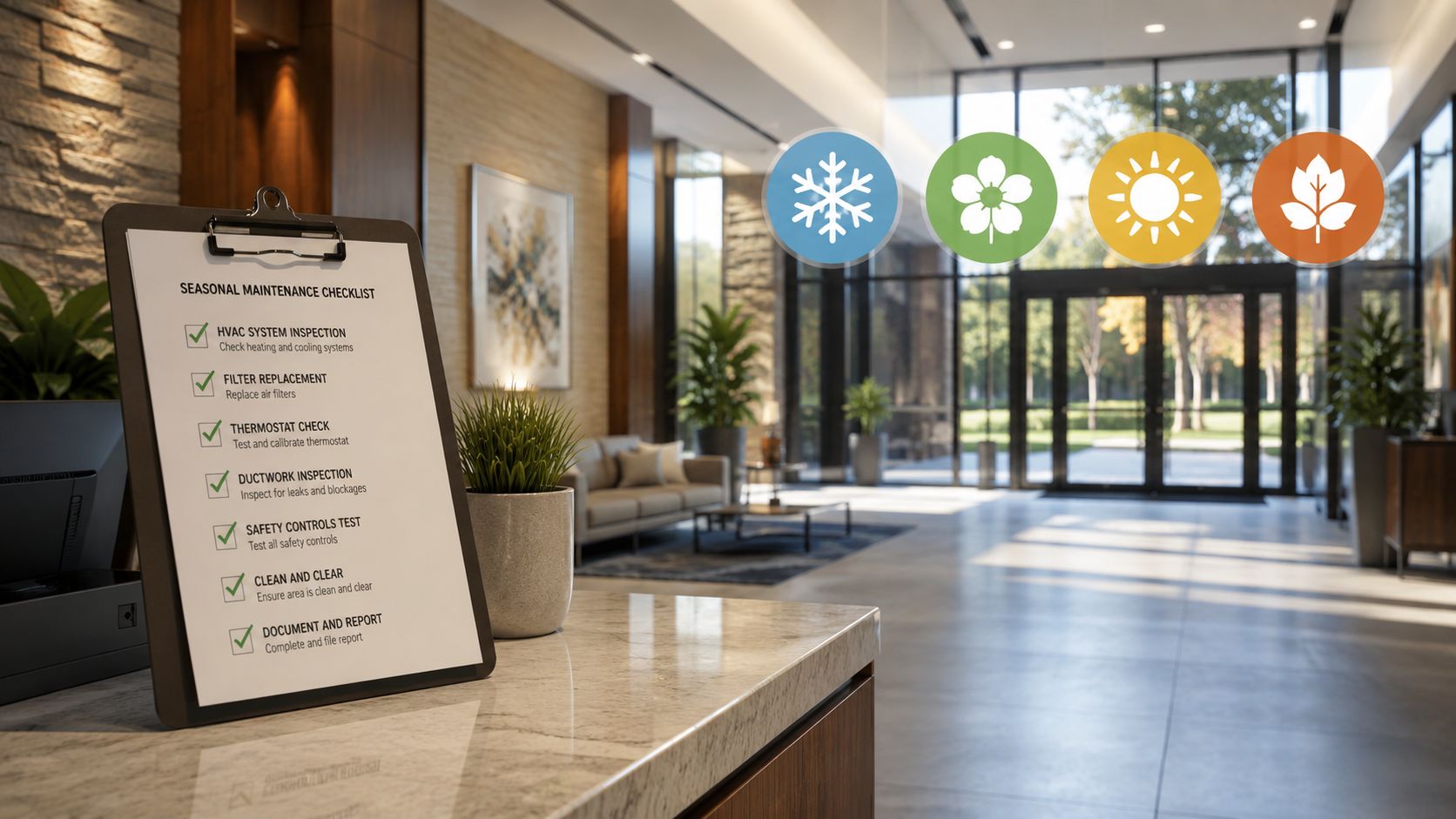
Winter readiness
From November through March, the threshold is the control point.
- Inspect entry mats: Confirm that mats lie flat, capture moisture, and can be rotated or exchanged when saturated. Assign the cleaning supervisor to check them during each service visit.
- Remove salt and grit: Vacuum dry debris before wet cleaning, then use a compatible neutral floor-care method for residue. High-traffic entrances may need attention more than once during a workday.
- Control runoff: Keep snowmelt away from walking paths, use wet-floor controls when needed, and check that drainage points aren't blocked.
- Review washrooms: Tracked-in contaminants can spread beyond the entrance, so washroom floors, fixtures, and touchpoints should receive appropriate attention.
Spring recovery
April and May are suitable for restoring surfaces affected by winter.
- Extract carpets: Schedule a professional extraction where routine vacuuming no longer removes embedded soil or odour.
- Clean glass: Remove winter film from windows, vestibules, canopies, and reception glazing. A facility may use commercial window cleaning as a separate specialist task.
- Coordinate filtration: Discuss filter condition and ventilation performance with the building operator before pollen complaints increase.
- Clear exterior debris: Inspect parking areas, walkways, loading zones, and drains for accumulated grit and organic material.
Summer and fall controls
Summer checks should focus on damp storage areas, basements, washrooms, and places with limited air movement. Fall should include weatherstripping, gutters, drainage, hard-floor finish condition, mat inventory, and the readiness of equipment used for wet weather.
A broader essential checklist for property managers can complement the cleaning audit, but the cleaning scope should still identify who performs each task and how completion is verified.
ROI and Asset Preservation Rationale
The financial case for seasonal cleaning starts with avoiding premature deterioration. Toronto businesses face repeated salt, grit, water, and freeze-thaw exposure because the city manages extensive road and sidewalk networks through winter. When a facility treats that soil as ordinary dust, it can shorten the useful life of flooring, mats, finishes, entrance hardware, and carpets.
The City's winter-salt guidance notes that Ontario's de-icing footprint spans 3–5 million tonnes of road salt each year. For property managers, the relevant question isn't whether salt enters the building. It's whether the building removes it before abrasive grit and dissolved residue remain in place.
Preventative care versus deferred work
Preventative cleaning usually costs less operationally than emergency restoration because crews can work during planned access windows, use routine equipment, and address isolated wear before it spreads. Deferred maintenance creates a different sequence: visible deterioration, occupant complaints, restricted areas, urgent scheduling, and a larger scope of work.
That doesn't mean every floor needs intensive treatment at every seasonal change. Over-cleaning can waste labour, leave excess moisture, or wear finishes through unnecessary chemical and mechanical action. The practical approach is condition-based scheduling, supported by inspections and records.
What managers should measure
A useful programme tracks condition rather than relying on appearance alone:
- Floor finish condition: Note dulling, residue, scuffs, edge wear, and areas where routine cleaning no longer restores appearance.
- Mat performance: Record saturation, movement, curling, and whether the mat is large enough for the traffic entering the building.
- Repeat complaints: Group reports by location, time, odour, moisture, dust, or slip concern.
- Reactive work: Compare emergency calls, unplanned closures, and restoration requests with scheduled seasonal tasks.
- Access disruption: Record whether planned cleaning reduces interruptions to staff, visitors, and tenants.
The cost of a cleaning contract should be assessed alongside product quality, staff training, floor-care capability, reporting, and schedule flexibility. A low quote that excludes extraction, entrance control, or periodic floor maintenance may shift costs into replacement and emergency work. A scalable programme is often more defensible than a flat scope that ignores Toronto's seasonal demand.
Choosing a Commercial Cleaning Partner in Toronto
A property owner evaluating providers should start with a site walk, not a generic price sheet. The provider should identify entrances, traffic routes, flooring types, moisture-prone areas, washrooms, loading zones, ventilation concerns, and periods when cleaning can happen without disrupting operations.
The strongest proposal will separate routine janitorial work from seasonal interventions. It should explain how the team removes salt residue, schedules carpet extraction, maintains hard-floor finishes, manages wet areas, and documents inspections. A provider that only promises a clean appearance hasn't shown how it will preserve the underlying assets.
Questions to ask before signing
- Winter capability: How will the team manage salt, grit, saturated mats, slush, and repeated entryway traffic?
- Floor-care knowledge: Which methods are suitable for the facility's resilient flooring, carpet, concrete, tile, or wood?
- Chemical safety: Are supplier labels, safety data sheets, workplace labels, and worker training current under WHMIS requirements?
- Disinfection process: How are surfaces cleaned before disinfection, and how are products selected for the intended use?
- Air-quality controls: What measures reduce dust, residue, odour, and unnecessary chemical exposure during occupied hours?
- Service flexibility: Can the schedule increase during demanding weather and change when occupancy or traffic shifts?
- Proof of performance: Will the provider supply inspection records, issue escalation procedures, insurance information, and references from similar facilities?
Red flags in proposals
Vague product descriptions make it difficult to assess compatibility or safety. Missing safety documentation, unclear supervision, no contingency plan for weather events, and pricing that treats every facility identically should prompt further questions.
The CCOHS sanitation sequence supports a practical order of work: use suitable PPE, clean and wash surfaces before disinfecting, wash hands with soap and water for at least 20 seconds, and use alcohol-based hand sanitizer at 60% alcohol or higher only when soap and water aren't available. A provider should be able to explain how those principles appear in training and supervision.
Arelli Cleaning is one Toronto-area option that offers scheduled commercial cleaning, floor care, carpet and window cleaning, Health Canada-approved disinfection, and flexible service arrangements. The same evaluation standards should apply to any provider, including Arelli: clear scope, safe products, documented quality checks, appropriate insurance, and a plan built around the facility's actual seasonal risks.
A request for proposal should ask for service frequencies, response expectations, green-certification details where applicable, staff training records, references from comparable Toronto facilities, and the process for changing the scope. Managers should obtain 2–3 quotes, compare inclusions rather than headline prices, and use the checklist above during each site visit.
Frequently Asked Questions
How does seasonal cleaning protect Toronto office floors?
It removes salt, grit, moisture, and other seasonal soils before they continue abrading finishes or spreading through high-traffic areas. Entryway control, frequent vacuuming, suitable floor cleaners, and periodic restorative care work together better than repeated damp mopping alone.
Why is winter cleaning different from routine janitorial service?
Winter introduces unusually persistent salt and slush contamination. The programme must address mat saturation, residue removal, drying, traffic control, and the repeated wet-to-dry cycle created by Toronto weather.
When should a business schedule carpet extraction?
Carpet extraction is appropriate when vacuuming no longer removes embedded soil, residue, or odour, and it can be planned after the winter season or during a lower-occupancy period. The correct timing also depends on carpet construction, traffic, drying conditions, and the building's ventilation.
Where should facility managers look for seasonal risk first?
Entrances, vestibules, elevator approaches, reception areas, washrooms, loading zones, basements, storage rooms, and poorly ventilated spaces usually deserve early attention. These locations combine traffic, moisture, soil, or limited air movement.
Who should own the seasonal cleaning plan?
The property or facility manager should coordinate the plan, while cleaning supervisors, building operators, security staff, and occupants may each have defined responsibilities. Clear ownership prevents tasks such as mat changes, drainage checks, or ventilation follow-up from being overlooked.
What should a provider include in a seasonal cleaning proposal?
The proposal should separate routine and seasonal tasks, identify products and equipment, state frequencies or triggers, explain safety controls, describe quality checks, and show how the service can scale with traffic and weather. It should also identify exclusions so the manager can compare quotes fairly.
How should cleaning support indoor air quality?
Crews should control dust, use appropriate filtration, avoid unnecessary chemical application, allow wet surfaces to dry, and coordinate with ventilation maintenance. Persistent humidity, odour, or occupant complaints require building-system investigation rather than more surface cleaning alone.
What should businesses avoid during winter?
They should avoid applying excessive de-icer, using unsuitable chemicals on flooring, leaving saturated mats in place, and allowing wet floors to reopen before they're safe. Toronto guidance recommends using the right amount of salt, following manufacturer instructions, re-shovelling after the product works, and clearing only areas people walk on, as described in the winter salt application guidance.
Further Reading
Internal resources
External resources
- City of Toronto road-salt reduction guidance, for responsible de-icer use.
- Peel Region winter maintenance guidance, for commercial property controls.
- Health Canada office indoor-air-quality guidance, for ventilation, contaminants, temperature, and humidity considerations.
- CCOHS-informed sanitation practices, for cleaning, disinfection, PPE, and hand hygiene procedures.
Use the checklist during the next site inspection, ask each prospective provider the questions above, and request 2–3 detailed quotes that separate routine cleaning from seasonal floor, carpet, window, and moisture-control work.
Arelli Cleaning offers Toronto businesses scheduled office and commercial cleaning, seasonal floor care, carpet and window cleaning, and Health Canada-approved disinfection aligned with changing facility needs. Visit Arelli Cleaning to discuss a practical seasonal programme and request a scope built around the property's traffic, flooring, and weather exposure.








.webp)