Is a workspace really being cleaned because the bins are empty and the floors look presentable? In the Greater Toronto Area, that assumption often confuses commercial cleaning with what many buyers know as janitorial services. This guide clarifies the difference, explains how hybrid occupancy changes service planning, and shows how facility managers can evaluate cleaning, safety, compliance, and quality assurance without relying on appearance alone.
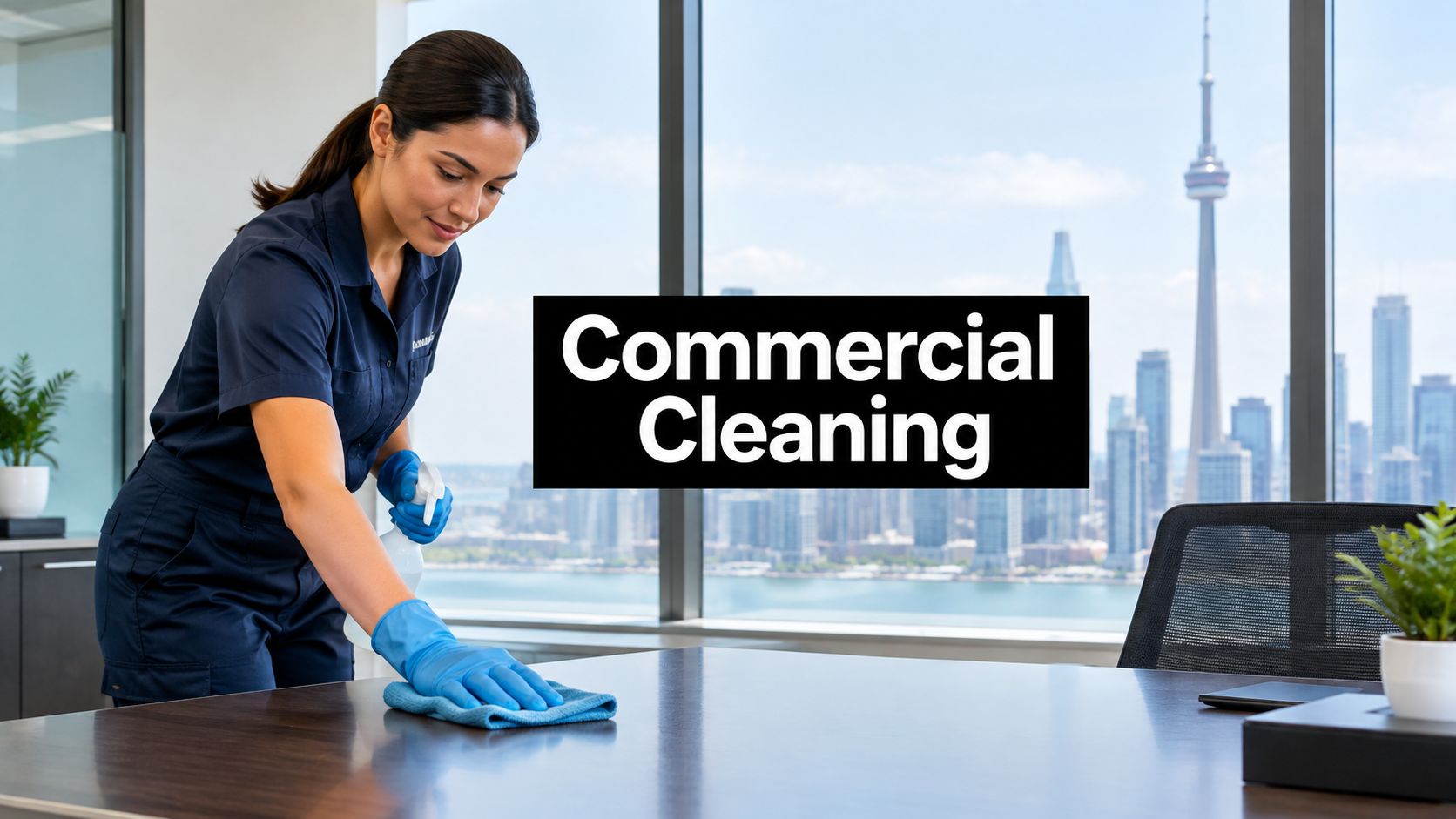
Commercial cleaning in the Greater Toronto Area covers routine upkeep plus specialised work that protects surfaces, supports occupant health, and prepares facilities for changing operational demands. Services commonly include floor restoration, carpet cleaning, high dusting, window cleaning, power washing, disinfection, and post-construction cleanup, alongside scheduled office cleaning. The specialty scope is illustrated by Arelli's specialty cleaning services, while its commercial cleaning service overview shows how recurring and project-based work can be combined.
Defining Commercial Cleaning Beyond Routine Janitorial Work
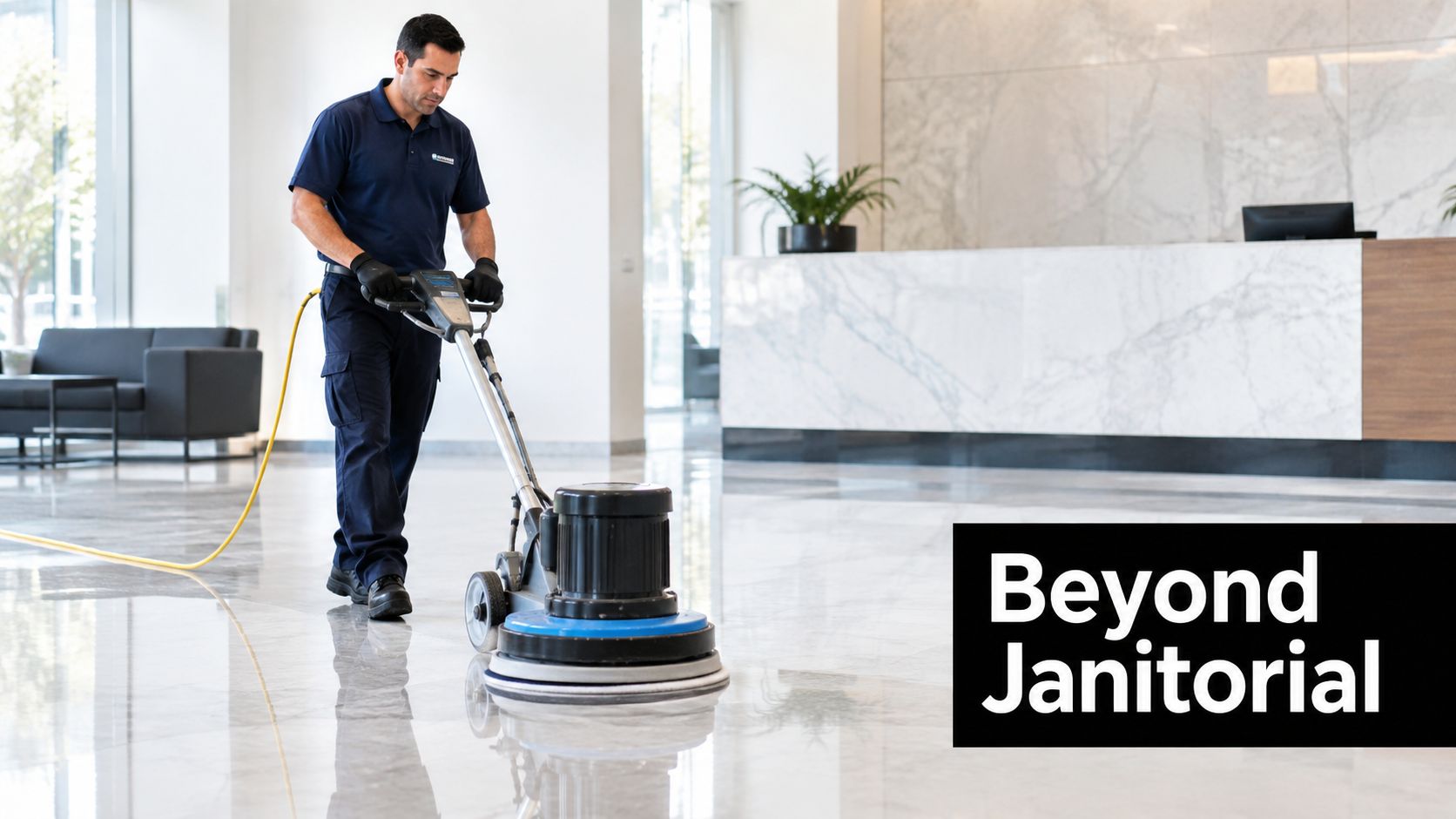
Routine janitorial service keeps a facility functioning day after day. It typically covers waste removal, vacuuming, mopping, washroom servicing, basic surface cleaning, and replenishing consumables. Commercial cleaning is broader. It includes periodic or technical interventions that routine crews may not perform during every visit, such as hard-floor stripping and waxing, carpet extraction, high-reach dusting, interior glass cleaning, post-renovation detailing, and pressure washing.
The distinction matters because a facility can receive frequent janitorial attention while still accumulating floor damage, embedded carpet soil, dust above normal reach, or construction residue. A cleaning specification that lists only “office cleaning” leaves too much room for interpretation. A stronger scope separates daily tasks, periodic maintenance, and event-driven work.
A practical distinction
| Service category | Typical purpose | Examples |
|---|
| Routine janitorial service | Maintain daily cleanliness and usability | Waste removal, vacuuming, mopping, washrooms, kitchens |
| Commercial specialty cleaning | Restore, protect, or address difficult areas | Floor refinishing, carpet extraction, high dusting, windows |
| Disinfection | Reduce contamination risk after appropriate cleaning | High-touch surfaces, shared equipment, selected clinical areas |
| Post-construction cleaning | Remove renovation and building debris | Fine dust, labels, adhesive residue, paint splatter |
Cleaning and disinfection also aren't interchangeable. The Canadian Centre for Occupational Health and Safety guidance on cleaning and disinfecting explains that visibly dirty surfaces should be cleaned before disinfection, because soil can reduce disinfectant effectiveness. Product labels govern dilution and wet contact time, so a quick spray followed by an immediate wipe may not satisfy the product's intended process.
Practical rule: A contract should identify what happens daily, what happens periodically, and what triggers an unscheduled response.
The Scale of Facility Maintenance in the Toronto Region
The GTA's cleaning challenge is geographical as much as operational. The region includes downtown towers, suburban professional offices, retail properties, schools, childcare facilities, clinics, warehouses, and mixed-use buildings. Each site presents different access rules, loading arrangements, floor materials, occupancy patterns, and security requirements.
The City of Toronto reports 185,772,057 square feet of office-space inventory across the Toronto Region, including 127,733,194 square feet within the city. Regional retail inventory totals 138,007,518 square feet, and commercial building permits total $5.331909 billion, compared with $24.906629 billion in total building permits. These figures come from the City of Toronto's regional indicators.
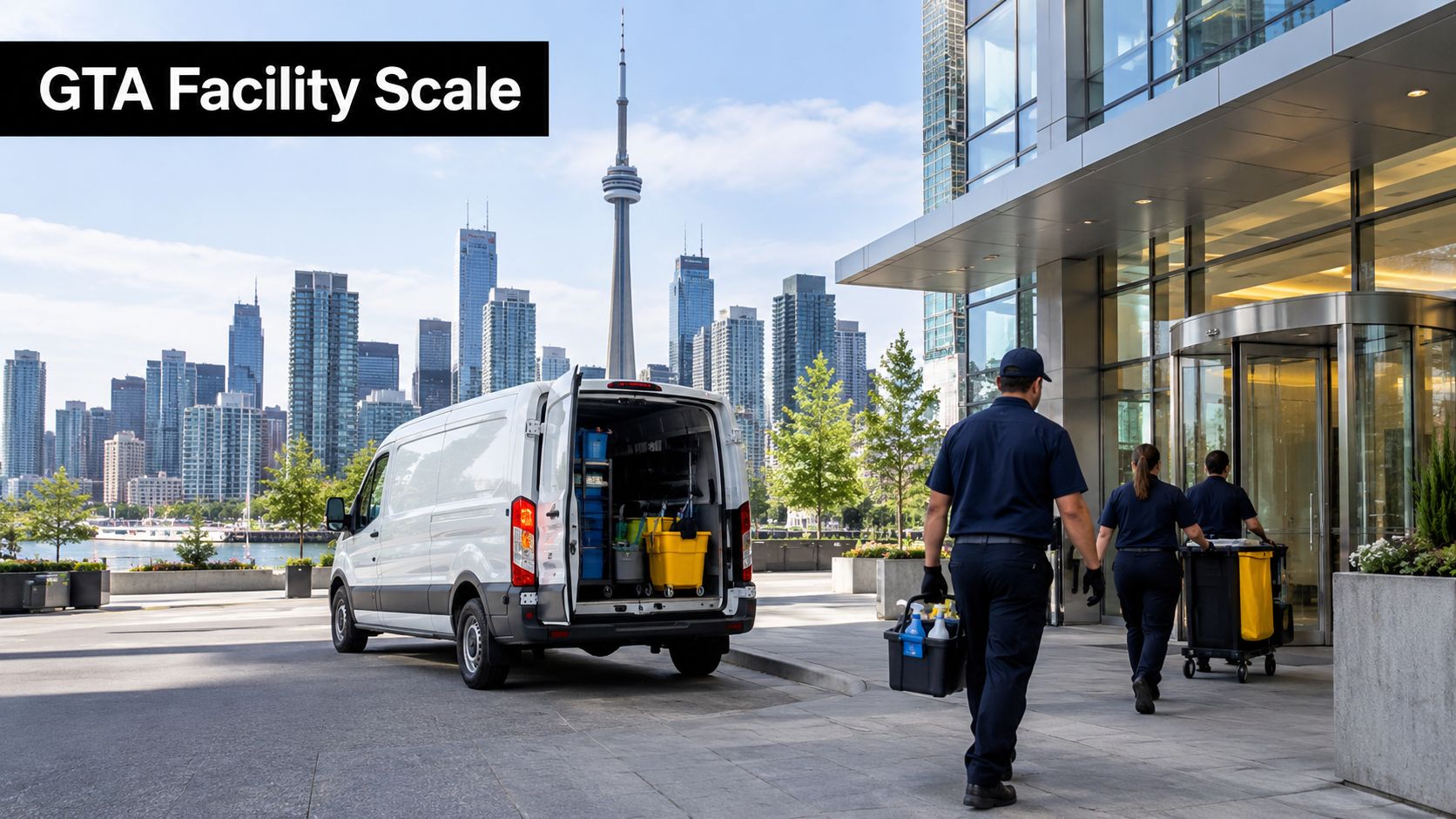
Office and retail inventories together exceed 323.7 million square feet, creating demand across many property types rather than only large corporate buildings. The same City dataset records 74,560 business establishments and 1,623,710 jobs in Toronto in 2025, which reinforces how widely workplace cleaning requirements are distributed.
What GTA scale changes for buyers
A provider serving several municipalities must manage more than headcount. It needs reliable scheduling, substitute coverage, secure key and access-card procedures, supervisor travel, supply logistics, and communication across sites. A missed evening visit at one location can affect the next morning's washroom condition, waste collection, meeting-room readiness, and client-facing appearance.
Ontario's labour-market profile identifies approximately 14,780 janitors, caretakers and heavy-duty cleaners in the Toronto region, with a “Moderate” employment outlook for 2025–2027. The profile reports that 40% of workers in this occupational group work in educational services and 25% work in management and administrative services, while 76% work full time and 68% work throughout the year. These figures are available in the Ontario labour-market occupational profile.
The practical conclusion is straightforward. Staffing reliability isn't an administrative detail. It directly affects whether high-occupancy offices, education facilities, and administrative workplaces receive the scheduled service.
Adapting Service Frequencies to Hybrid Occupancy Patterns
A fixed daily schedule can waste money in empty areas and still underserve crowded ones. Hybrid offices often concentrate attendance on particular weekdays, while kitchens, washrooms, reception areas, elevators, and collaboration rooms experience sharper use than private desks. The right schedule follows occupancy and surface risk, not square footage alone.
GTA office conditions make this especially relevant. In Q2 2025, the region's office availability rate was 20.1% and vacancy was 17.2%. Suburban vacancy reached 20.7% in Q4 2025, while the GTA recorded 1.6 million square feet of positive net absorption in Q3 2025. The GTA office market report from Avison Young describes a market with uneven recovery rather than one uniform occupancy pattern.
A frequency decision framework
Map actual use. Record employee attendance, meeting-room bookings, shared-kitchen use, visitor flow, shift changes, and building access restrictions. A floor that is mostly vacant may still contain a heavily used washroom core or shared kitchenette.
Separate zones by risk. Ordinary surfaces can follow a routine schedule, while elevator buttons, door hardware, reception counters, washrooms, kitchens, and shared keyboards require more frequent attention when use is concentrated.
Match visits to peaks. CCOHS workplace guidance gives daily cleaning as a baseline, with cleaning every 2–3 hours potentially necessary depending on workplace needs. Shift-based operations should be serviced between shifts or at least once during each shift. The CCOHS guidance for cleaning staff also identifies high-touch items that may need disinfection multiple times per day.
Protect low-occupancy days. Reduced service may suit lightly used desk areas, but it shouldn't eliminate washroom checks, spill response, waste control, or essential shared-space servicing. Fewer visits can create heavier recovery work after peak attendance days.
Review the schedule against evidence. Use complaints, inspection results, consumable use, occupancy records, and missed-task data. A flexible plan should change when the workplace changes.
Facility managers assessing workplace layouts can also consult these hybrid startup workspace tips for context on shared areas and flexible office use. The useful lesson isn't to copy a workspace design. It's to recognise that cleaning demand follows how people use the space.
Core and Specialty Services for Diverse GTA Environments
A lawyer's office, a childcare centre, a dental clinic, and a warehouse don't need the same cleaning specification. Core janitorial tasks may overlap, but surfaces, hazards, traffic, equipment, and documentation requirements differ. A useful scope identifies the facility's operating risks before selecting products or frequencies.
The Arelli office cleaning service for Toronto is one local example of a service model that can combine recurring office work with specialty requirements. Buyers should still compare the exact scope, supervision, products, records, and response process rather than choosing on service labels alone.
Commercial cleaning services by facility type
| Facility Type | Core Daily Needs | Specialty Commercial Services |
|---|
| Corporate office | Waste removal, vacuuming, washrooms, kitchens, touchpoints | Carpet extraction, floor care, interior glass, high dusting |
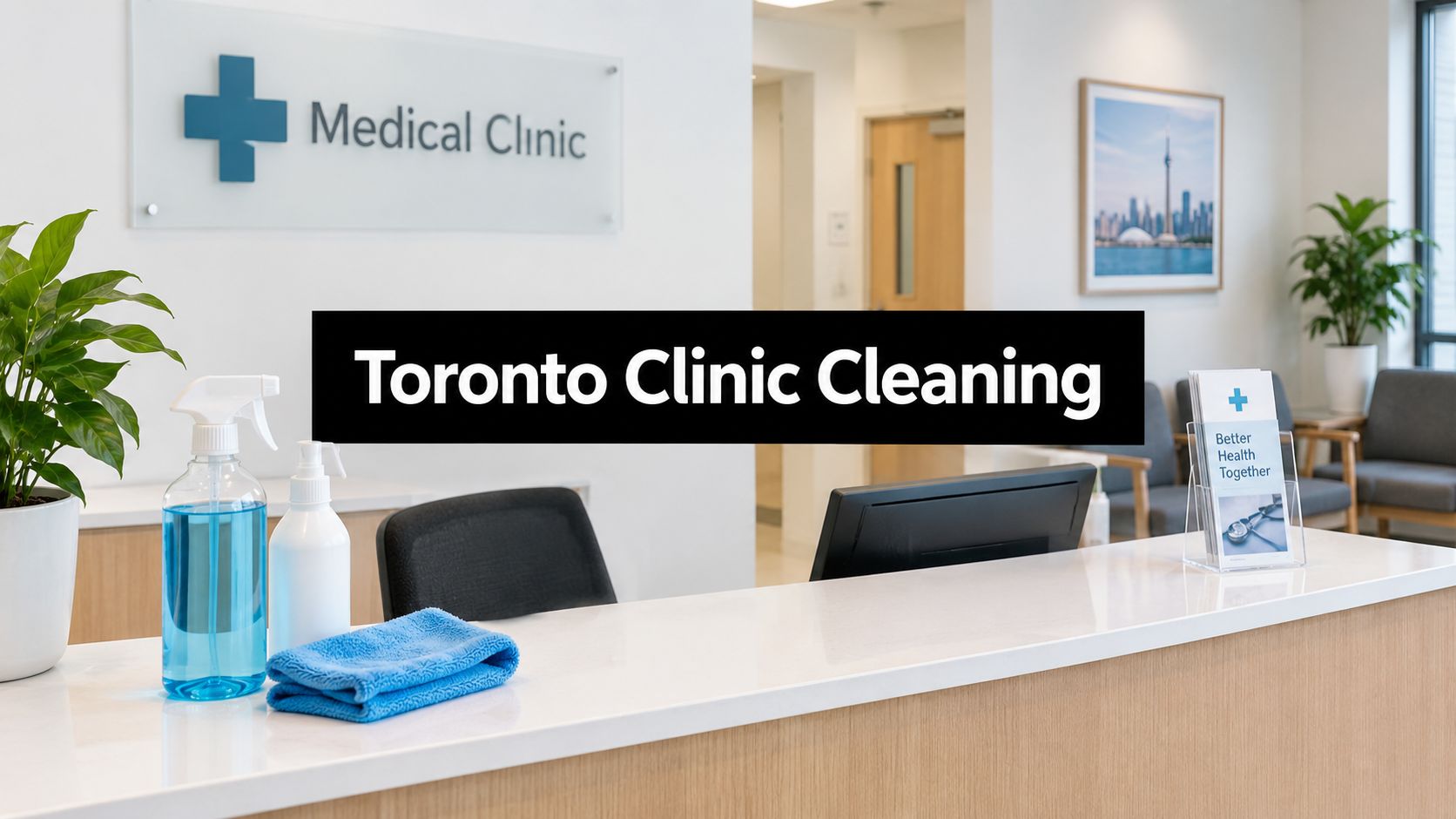
| Dental clinic | Clinical-area cleaning, washrooms, reception, waste handling | Risk-based disinfection, floor detailing, post-renovation cleaning |
| School or childcare centre | Classrooms, washrooms, kitchens, touchpoints, waste | Deep cleaning during closures, floor restoration, high dusting |
| Warehouse or industrial site | Break rooms, washrooms, debris control, traffic paths | Power washing, concrete-floor care, high-reach dusting, spill response |
| Retail or mixed-use property | Entrances, washrooms, waste, customer-facing floors | Glass cleaning, floor refinishing, pressure washing, seasonal work |
Where specialty work earns its place
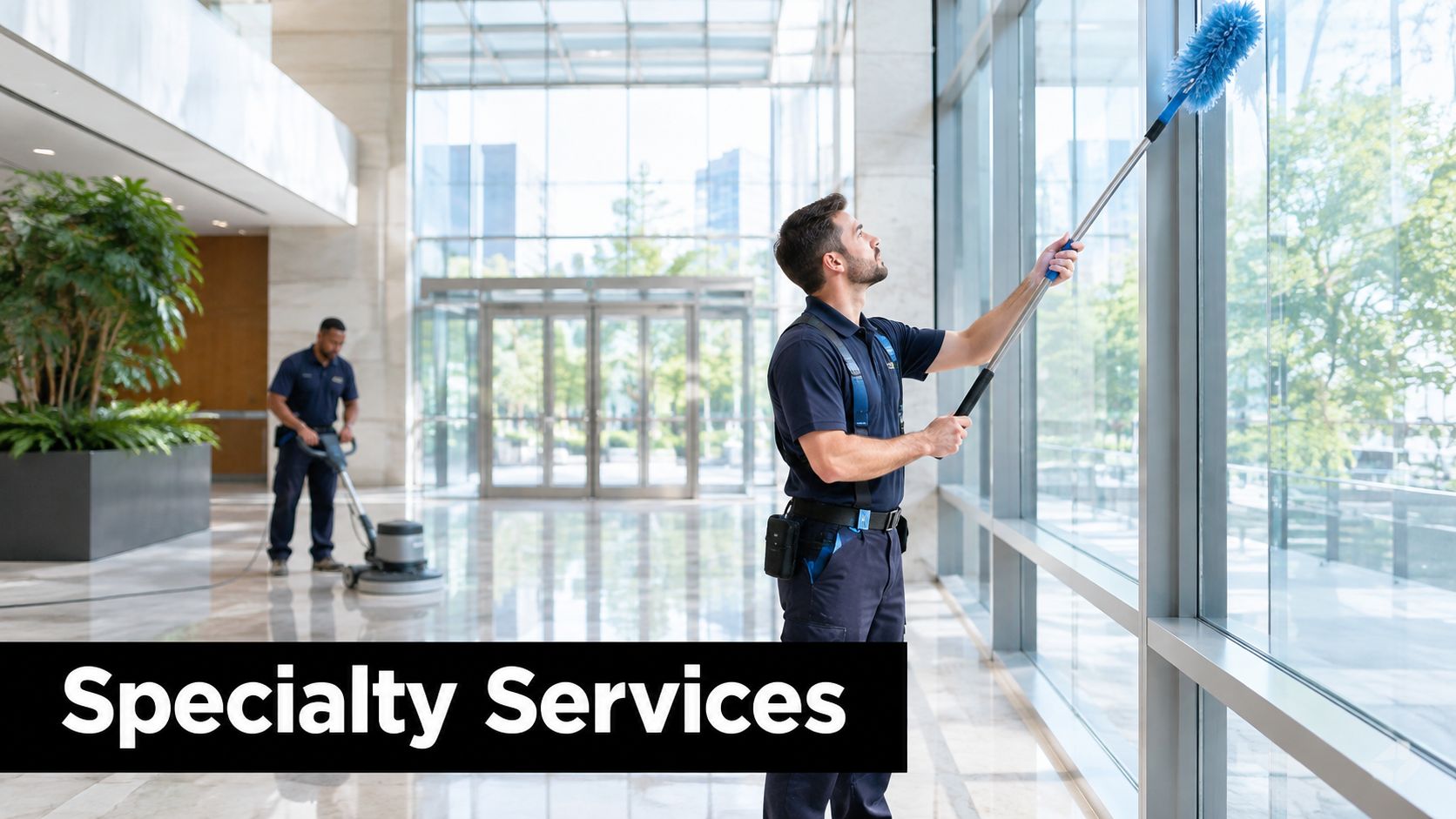
Strip and wax is appropriate when resilient hard floors need old finish removed and a new protective layer applied. It isn't a substitute for routine mopping, and it shouldn't be specified for every surface without checking material compatibility. Encapsulation carpet cleaning can support regular carpet maintenance with controlled moisture, while extraction may be more suitable when embedded soil or heavier soiling requires deeper recovery.
High dusting addresses ledges, beams, vents, pipes, and other high surfaces that ordinary tools can't reach safely. Power washing suits exterior concrete, loading areas, entrances, and selected hard surfaces, but water control, occupant access, drainage, and surface protection must be planned.
Food-service areas need a separate lens. Cleaning doesn't replace pest prevention, so a facility manager reviewing a kitchen scope may benefit from this practical resource on commercial kitchen pest control. The contract should define who handles sanitation, waste, grease, evidence of pests, and escalation.
Navigating WHMIS and Health Canada Compliance Standards
A clean-looking facility can still have a weak chemical-management programme. In Ontario, employers must understand the products used at their workplaces, how those products are stored and handled, and what information workers need before exposure.
CCOHS guidance on consumer chemical products in workplaces explains that consumer chemical products purchased by an employer for workplace use are subject to WHMIS requirements, even when they may have been exempt from supplier labelling or Safety Data Sheet obligations as ordinary consumer goods. Employers must identify hazards and provide education covering health effects, safe use, storage, disposal, emergencies, and first aid.
What a defensible chemical programme includes
A facility manager should be able to identify every product used on site, its storage location, the staff who handle it, and the training that applies. The programme should also cover dilution, incompatible mixtures, spill response, ventilation, personal protective equipment, and communication with occupants.
CCOHS identifies ingredients, storage conditions, ventilation, exposure duration, and exposure route, such as inhalation or skin contact, as factors that affect harm. The CCOHS guidance on working safely with cleaning products advises workers to read labels and available Safety Data Sheets, use products according to supplier instructions, participate in WHMIS training when hazardous products are handled, and wear suitable protective equipment.
Disinfection adds another control layer. Products should bear a Canadian Drug Identification Number where required, and staff must follow label dilution and contact-time instructions. A product that needs approximately 10 minutes of wet contact cannot deliver its intended process if it is sprayed and wiped immediately.
Health Canada treats cleaning as part of a broader indoor-health plan that includes ventilation, filtration, hand hygiene, respiratory etiquette, and staying home when ill. For carpets, Health Canada's office indoor-air guidance recommends maximising water extraction, increasing ventilation where appropriate, scheduling work when few or no occupants are present, and drying carpets within 24 hours. Entrances, mats, water, and snow also need attention because moisture and debris can affect indoor conditions.
The internal commercial disinfection and sanitizing service can be reviewed as one reference point, but every provider should explain how its actual products, records, and procedures fit the facility's hazards.
A Buyer Checklist for Evaluating Commercial Cleaning Providers
A low quote can become expensive when it excludes supervision, equipment, consumables, emergency response, or periodic work. The comparison should begin with a site-specific scope and end with evidence that the provider can perform it consistently.
Questions that expose operational maturity
- Scope clarity: Does the proposal list each room, surface, task, frequency, and exclusion?
- Coverage: Who replaces an absent cleaner, and how quickly does the supervisor respond?
- Training: Can the provider document WHMIS education and task-specific instruction?
- Insurance: Will the provider supply current liability and workplace coverage documentation?
- Access control: How are keys, cards, alarm codes, confidential documents, and secure areas managed?
- Quality checks: Are inspections documented, and does the client receive timestamped task or exception records?
- Specialty capacity: Are carpet, floor, glass, high-dusting, power-washing, and post-construction tasks performed in-house or subcontracted?
- Escalation: What happens after a missed clean, spill, complaint, renovation, or sudden occupancy change?
- Contract flexibility: Can service move between full routine coverage, stop-and-go visits, and project work as use changes?
What to ask and what to avoid
Ask for a sample checklist, a redacted inspection record, product information, and references from facilities with similar risks. Ask who supervises the site after hours, how exceptions are closed, and which tasks are verified rather than just marked complete.
Avoid a generic flat-rate quote that contains no site visit, no room-level scope, and no explanation of frequencies. Avoid promises of “deep cleaning” that don't define equipment, products, surfaces, dwell time, drying controls, or completion evidence.
A fair comparison should use 2–3 quotes, but the proposals must describe the same service. Otherwise, the cheapest number may reflect omitted work.
Modern Quality Assurance and Flexible Contract Structures
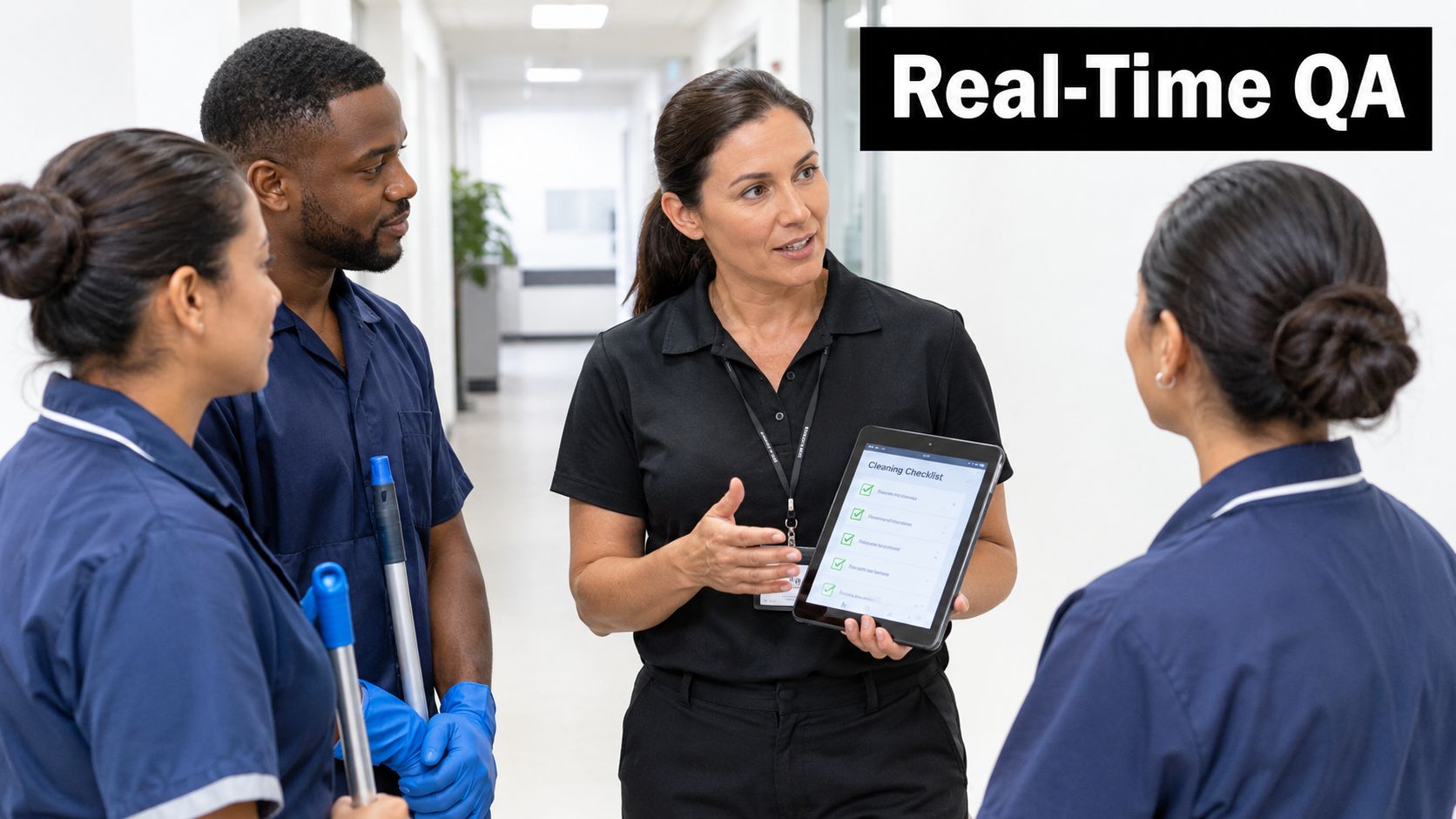
Paper sign-off sheets can confirm that someone wrote a checkmark. They can't always show which zone was completed, when it was completed, whether an exception was raised, or whether the supervisor followed up. Digital systems can strengthen accountability when they capture the right fields, including timestamp, location, task, product, exception, and resolution.
A useful quality system combines technology with human supervision. Mobile reporting can help a cleaner flag a blocked washroom or damaged surface, while a supervisor can inspect the site, communicate with the client, and adjust the work order. The system shouldn't become a substitute for site knowledge.
Flexible agreements need defined boundaries
A no-term or flexible arrangement can suit a business whose occupancy, lease, renovation schedule, or operating hours change. Flexibility only works when the agreement still defines notice periods, rates for extra work, minimum information needed for a schedule change, and the process for resolving service failures.
Arelli Cleaning can be included in a provider comparison as an example of a technology-supported model. Its published materials describe an Advanced Commercial Cleaning Management System, mobile communication, no-term contracts, 24/7 support, a price-match guarantee, and a free sample clean. Those features should be assessed against the buyer's actual requirements, just as any other provider's claims should be verified.
Property managers evaluating service contracts can also consult this guide for property managers in 2026 for broader contract-planning context. The principle applies across facility services: measurable scope, clear accountability, and workable change controls matter more than attractive wording.
Frequently Asked Questions About GTA Commercial Cleaning
What is the difference between janitorial and commercial cleaning?
Janitorial service usually refers to recurring daily or nightly upkeep, including waste removal, vacuuming, mopping, washrooms, and basic surface cleaning. Commercial cleaning includes that routine work plus periodic and technical services such as floor restoration, carpet cleaning, high dusting, windows, power washing, disinfection, and post-construction cleanup.
How often should a GTA office be cleaned?
The schedule should follow occupancy, traffic, surface risk, and shift patterns. Daily cleaning is a baseline for many workplaces, while high-touch areas may need multiple daily cycles. Low-use desk areas may support a different schedule, but washrooms, kitchens, entrances, waste areas, and spill-prone zones still require defined attention.
Why doesn't a fixed daily schedule always work for hybrid offices?
A fixed schedule can service vacant space while missing attendance peaks. A better plan maps occupied zones, concentrates work after high-use days, and preserves routine servicing for areas that remain operationally important even when desks are empty.
What should a facility manager request for WHMIS compliance?
The provider should identify workplace chemical hazards, provide relevant product information, explain storage and handling, document worker education, and maintain procedures for dilution, disposal, spills, exposure, first aid, and incompatible mixtures.
When is disinfection necessary?
Disinfection should follow cleaning where risk warrants it, particularly on high-touch surfaces and in environments with heightened infection-control requirements. The product label controls dilution and wet contact time. A generic claim that a facility was disinfected isn't enough without a defined process.
How should carpet cleaning be scheduled?
Carpet work should be scheduled when few or no occupants are present, with effective water extraction, ventilation where appropriate, occupant communication, and a plan to dry the carpet within 24 hours, as described in Health Canada's office guidance.
What changes after construction or renovation?
Post-construction cleaning needs a separate scope for fine dust, labels, adhesive residue, paint splatter, debris, glass, fixtures, and final detailing. The provider should identify what the contractor removes and what the cleaning team completes before occupancy.
Who should provide equipment and products?
The contract should state whether the provider supplies machines, tools, consumables, disinfectants, liners, and personal protective equipment. It should also identify approved products, storage arrangements, maintenance responsibilities, and any charges for project work.
How many quotes should a buyer obtain?
Obtaining 2–3 quotes gives a useful comparison, provided each provider receives the same floor plans, occupancy information, room list, task frequencies, specialty requirements, access rules, and response expectations.
What internal and external resources are useful?
For local coverage, review the Arelli service areas. Related internal resources include commercial disinfection and sanitizing and the Toronto office cleaning service. External references include CCOHS cleaning and disinfection guidance, CCOHS workplace cleaning guidance, and Health Canada's office indoor-air guidance.
Arelli Cleaning provides scheduled office and commercial cleaning across the GTA, including routine janitorial service, floor and carpet care, high dusting, power washing, disinfection, and post-construction cleanup supported by documented quality processes. Facility managers can use the checklist above, request comparable quotes, and visit Arelli Cleaning to discuss a scope suited to occupancy, risk, and site requirements.








.webp)