Most occupied North York offices need routine professional cleaning five nights per week, with daily restroom and high-touch surface attention; lighter offices may need three nightly visits. Clinics, childcare facilities, educational sites, and industrial operations require schedules based on use, exposure, and applicable standards.
A North York workplace can look presentable after an evening visit, yet its kitchen, washrooms, and meeting rooms can need attention again during the next occupied day. The practical issue isn't whether the office looks clean at closing. It's whether someone maintains shared spaces while employees and visitors use them.
Professional office cleaning means recurring maintenance performed against a written scope specifying tasks, locations, timing, and responsibility. Commercial cleaning is the broader category encompassing offices and other business premises. Neither term, by itself, defines an adequate service frequency.
The answer to how often should offices in North York be professionally cleaned? therefore depends on attendance and exposure, not a package name. Managers can use a schedule template from Facility Management Insights as a planning resource, then adapt it to actual site conditions.
- Occupancy triggers: Increase service when shared-space use rises.
- Correct sequence: Clean soil away before disinfection.
- Written scope: Assign every recurring task an owner.
- Quarterly reviews: Reassess attendance, complaints, and floor condition.
- Provider documentation: Require completion records and product information.
Table of Contents
7-Point Office Cleaning Frequency Comparison for North York
1. Daily Touchpoint Sanitation for High-Contact Surfaces
A door handle used throughout the day needs a different schedule from a shelf in an occasionally occupied office. Reception counters, shared phones, keyboards, light switches, elevator buttons, and printer controls belong on a touchpoint map, not merely a general dusting list.

The CCOHS infection-control guidance connects cleaning frequency to how often surfaces are touched and how many people use them. That supports a zone-based decision: a quiet private office shouldn't automatically receive the same touchpoint service as a busy reception area.
Match attention to exposure
- Light use: Inspect during occupied periods and include touchpoints in routine cleaning.
- Shared use: Add an operating-hours check rather than relying entirely on evening service.
- Heavy use: Arrange additional touch-ups around visitor peaks and shared-equipment use.
- Visible contamination: Trigger immediate cleaning rather than waiting for the scheduled visit.
For example, an accounting office could retain evening cleaning while assigning reception and copier checks to a daytime attendant. A medical-adjacent waiting area could require more frequent attention under the facility's infection-control policy. These are planning scenarios, not reported case studies.
Practical rule: Fewer contractor visits don't necessarily mean fewer hygiene tasks. Someone still needs responsibility for touchpoints between visits.
Product selection must follow the surface, intended use, and label. A product page such as the eco-friendly purifier cleaning formula isn't evidence that the product is suitable for office-surface disinfection. Providers should supply the relevant label and explain exactly where each product belongs.
2. Restroom and Kitchen/Breakroom Cleaning Frequency
Washrooms and kitchens need service continuity, not just a satisfactory appearance after cleaning. A clean sink doesn't resolve an empty soap dispenser, and an emptied bin doesn't resolve food residue on a shared counter.

Ontario's COVID-19 workplace safety guidance recommended cleaning frequently touched surfaces at least twice daily, including handles, counters, switches, and shared surfaces, providing a contextual benchmark rather than a universal present-day office requirement (Ontario workplace safety-plan guidance).
A practical office schedule combines recurring washroom and kitchen cleaning with daytime checks for supplies, spills, waste, and visible soil. A busy engineering workplace might add a lunchtime washroom inspection after employees report restocking gaps. A quieter legal office might retain occupied-day kitchen service while assigning refrigerator checks to a separate detailing task.
Separate cleaning from housekeeping
- Provider responsibility: Toilets, sinks, counters, agreed appliance surfaces, floors, and waste.
- Occupant responsibility: Personal dishes, labelled food, and clearing items that obstruct cleaning.
- Management responsibility: Supply purchasing, service escalation, and refrigerator-use rules.
- Shared responsibility: Reporting spills and protecting access during wet-floor work.
The service log should distinguish inspection, cleaning, disinfection, and replenishment. A signature without task detail won't reveal whether staff checked supplies or completed the full scope.
Restocking also needs a commercial definition. The contract should state whether labour, consumables, dispenser servicing, and emergency replenishment are included or separately quoted. That's more useful than assuming “washroom service” includes everything.
3. Nightly Routine Cleaning for General Workspaces
Nightly service is a practical baseline for workplaces occupied throughout the business week, but scheduled headcount alone is a poor guide. Managers should consider attendance, visitor traffic, shared desks, and how much food and waste employees generate.
Toronto's Employment Survey recorded 1,600,300 jobs across 73,180 establishments, with the Office category accounting for 49.3% of employment; the supplied occupancy-based interpretation supports professional cleaning two to five times weekly, depending on use (Toronto's 2024 Employment Survey).

A consulting office with regular client appointments could specify evening waste removal, traffic-lane vacuuming, accessible-surface cleaning, and entry-glass attention. A lightly occupied administrative office could reduce contractor attendance while retaining assigned hygiene checks on occupied days.
Compare the scope, not the visit label
An office cleaning service proposal should distinguish accessible desks from cluttered desks, traffic lanes from full-floor vacuuming, and spot-cleaned glass from complete glass detailing. “General cleaning” leaves too much room for different interpretations.
- Every visit: List the tasks required regardless of appearance.
- Condition-triggered work: Identify spills, excess waste, and unexpected visitor activity.
- Access rules: Define locked rooms, confidential material, and desk-clearance expectations.
- Quality review: Compare completion records with observed conditions and occupant feedback.
The trade-off is straightforward: fewer visits may be appropriate when actual use falls, but not when unchanged workload is compressed into less service time.
4. Meeting and Conference Room Reset Frequency
A boardroom used for successive client meetings needs a use-triggered reset. An internal room that remains unused doesn't necessarily need the same intervention, although routine inspection still matters.
Toronto evidence illustrates why a fixed weekday schedule can miss demand: downtown office occupancy averaged 73%, reached 86% on Wednesday, and fell to 44% on Friday, as reported for December 2024 (Toronto Metropolitan University's employment analysis.pdf)). Downtown isn't North York, but the contrast supports checking local booking data rather than assuming equal demand across the week.
Use bookings as service triggers
A law office could reset client boardrooms after heavily attended appointments while inspecting quieter internal rooms during routine rounds. An engineering business could flag training sessions or catered meetings for additional service without applying an arbitrary attendance threshold.
- After use: Remove waste, address spills, and clean shared touchpoints as needed.
- At routine service: Inspect tables, chair contact areas, accessible equipment, and floors.
- After events: Add food-area attention and a broader room inspection.
- For equipment: Follow the manufacturer's cleaning instructions for screens and controls.
A room booking is a useful cleaning signal, but it isn't proof that cleaning occurred. Completion still needs an assigned owner.
Whiteboards need an explicit rule because cleaners shouldn't decide whether project notes can be erased. Late bookings also require a defined response: an after-hours reset, an early service window, or a documented handoff to site staff.
5. Periodic Dusting, Vent, Glass, and Window Cleaning Schedules
High ledges, partition tops, vent exteriors, baseboards, and glass need their own maintenance plan. They shouldn't disappear from the scope because they don't require the same attention as washrooms or door handles.
CCOHS advises cleaning at least once daily, with higher-use workplaces potentially requiring attention every two to three hours, and shared areas cleaned between shifts or during each shift (CCOHS guidance for cleaning staff). That workplace guidance doesn't establish a universal interval for exterior windows, detailed cleaning, or every individual low-use surface.
Build a condition-based calendar
A twelve-month scope can place periodic tasks into monthly, quarterly, seasonal, and annual review slots. Those slots are proposed management checkpoints, not evidence that every office needs each task at that interval.
- High surfaces: Inspect accumulation and define safe access before scheduling work.
- Vent exteriors: Separate accessible surface cleaning from mechanical-system maintenance.
- Interior glass: Distinguish fingerprint removal from full-pane cleaning.
- Exterior glass: Confirm landlord responsibility, access arrangements, and weather constraints.
For example, a professional office could reserve periodic high-level work, then bring it forward after nearby renovations produce visible dust. Entry glass could receive condition-triggered attention while inaccessible exterior glazing remains under the building manager's programme.
A high-dusting service scope should identify included surfaces and access limitations. Managers can also consult commercial window cleaning frequency guidelines as a planning resource, without treating a generic interval as a site-specific standard.
The provider should explain whether access equipment, restricted-hours work, and additional preparation are included in the quotation.
6. Floor Care Frequency for Carpet and Hard Surfaces
Floor care should follow material, condition, traffic, and the manufacturer's maintenance requirements. Carpet extraction, hard-floor scrubbing, burnishing, and stripping aren't interchangeable services, and not every floor is suitable for each process.
Cleaning and disinfection are also distinct: CCOHS specifies removing visible soil before disinfecting, using a product with a Canadian Drug Identification Number where required, and following label instructions and protective-equipment requirements (CCOHS cleaning and disinfecting guidance). A disinfectant application doesn't replace appropriate floor-soil removal.
Map the floor before setting intervals
- Entrances and corridors: Inspect tracked soil and schedule routine removal around traffic.
- Carpeted workspaces: Specify vacuuming coverage and condition-triggered extraction.
- Hard floors: Identify the material, finish, approved products, and maintenance method.
- Specialized restoration: Require an assessment before approving stripping or refinishing.
- Service windows: Plan drying, access restrictions, and furniture movement.
An office with a heavily used lobby and quiet private rooms could concentrate vacuuming and inspections at the entrance while scheduling restorative work elsewhere only when condition warrants it. Applying the lobby's programme to every room could purchase unnecessary work.
Budget insight: Managers should compare the proposed process and treated area, not just the name of the floor-care package.
The provided evidence doesn't establish universal carpet-extraction or refinishing intervals. Providers should therefore explain their recommendations using observed conditions, maintenance instructions, and the office's traffic pattern rather than presenting unsupported calendar frequencies as industry requirements.
7. Specialized Facility Frequencies for Clinics, Childcare, Legal, Engineering, and Industrial Sites
An ordinary office-cleaning schedule shouldn't automatically become a clinic, childcare, or industrial cleaning specification. The facility's activities, users, safety policies, and applicable requirements need to determine the scope first.
A regional tenant survey found that 80% of tenants attended regularly on peak days, while 27% attended five days per week, reinforcing the distinction between peak attendance and continuous occupancy (Crown Realty Partners' 2025 tenant survey). Those findings inform office scheduling, but they don't establish clinical, childcare, or industrial cleaning standards.
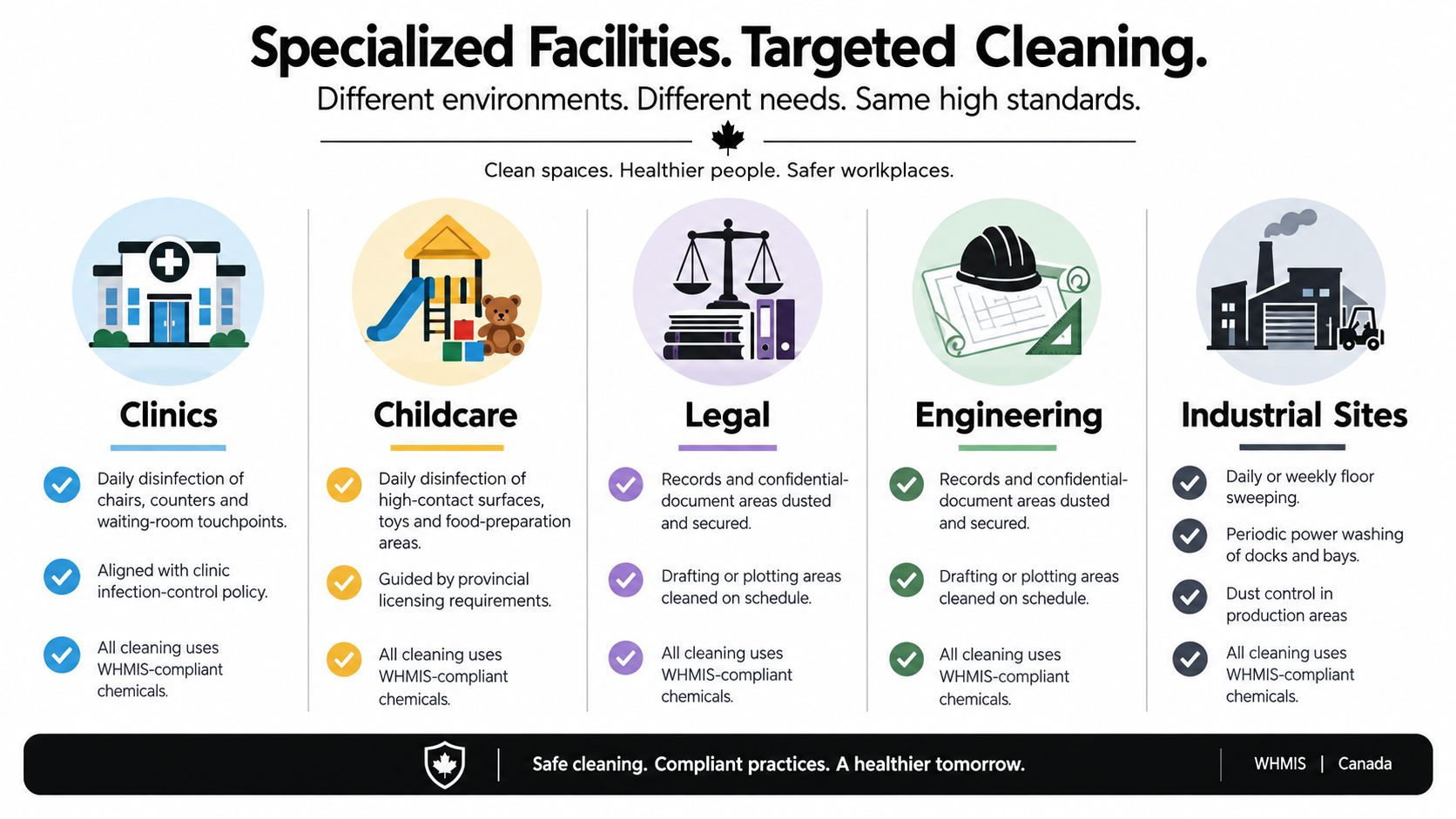
Let the facility policy lead
- Clinics: Separate administrative cleaning from treatment-area procedures and confirm infection-control responsibilities.
- Childcare and education: Obtain approved procedures for shared objects, food areas, and illness-response cleaning.
- Legal offices: Define confidential-document handling and restricted records-room access.
- Engineering offices: Identify sensitive equipment and materials that cleaners mustn't disturb.
- Industrial premises: Review hazards, permitted methods, restricted areas, and chemical documentation.
A clinic could commission additional waiting-room checks while retaining specialized treatment-area procedures under its own policy. A warehouse office could use a conventional office scope while operational aisles follow a separate safety-approved programme.
Provider selection should include relevant training records, WHMIS documentation, product information, and escalation procedures. A contractor's willingness to clean a space isn't proof that its staff are qualified for every task there.
For a neutral geographic starting point, the service-area directory can help managers identify coverage before assessing qualifications and scope.
7-Point Office Cleaning Frequency Comparison for North York
| Cleaning Service Area | Typical Frequency | Core Tasks | Best Suited For | Value Consideration |
|---|
| High-Contact Touchpoints | 1–3 times daily, based on occupancy | Clean and disinfect handles, switches, shared equipment, and counters | Offices with frequent shared-space use | Scales service to occupancy; midday visits add labour |
| Restrooms and Breakrooms | Daily; 2–3 times daily in high-traffic sites | Clean and disinfect, remove waste, restock supplies; deep-clean kitchen appliances weekly | Most workplaces, especially busy facilities | Helps manage hygiene, odours, and supply gaps |
| General Workspaces | 3–5 or more nights per week | Remove waste, vacuum traffic lanes, dust surfaces, clean entry glass | Offices, corridors, and reception areas | Prevents soil build-up; frequency can adjust with occupancy |
| Meeting and Conference Rooms | Weekly for light use; daily reset for heavy use | Clean tables, chairs, whiteboards, controls, and floors | Client-facing or frequently booked rooms | Use-based scheduling helps avoid cleaning unused rooms |
| Periodic Dusting and Glass | Monthly to quarterly; exterior glass often 2–4 times yearly | Clean vents, ledges, fixtures, baseboards, and windows | Facilities needing seasonal or detail cleaning | Scheduled work helps prevent visible build-up; access may affect cost |
| Floors and Carpets | Daily to several times weekly; deep cleaning every 3–12 months | Vacuum, mop, scrub, extract carpet, or strip and refinish floors | Sites with varied flooring and traffic levels | Protects flooring; specialty work may require off-hours and drying time |
| Specialized Facilities | Set by site risk, policy, and regulations | Sector-specific disinfection, dust control, floor care, and WHMIS-compliant chemical use | Clinics, childcare, legal, engineering, and industrial sites | Supports safety and compliance; may require specialized training and documentation |
Build a Schedule That Can Be Audited and Adjusted
An auditable programme separates contractor visit frequency from task frequency. The same office can need recurring evening service, operating-hours touchpoint checks, event resets, and condition-based specialist work.
Use a practical decision checklist
- Assign each zone: Record occupancy, visitors, shared equipment, food use, and access restrictions.
- Define every-visit work: Specify tasks that must occur, not just surfaces to inspect.
- Set periodic triggers: Record weekly, monthly, quarterly, seasonal, and annual review points.
- Name responsible people: Allocate between-visit checks and urgent responses.
- Review changes: Reassess after attendance, layout, operating hours, or facility use changes.
Compare costs and contract terms
No verified pricing range is available here. Managers should request explanations of charges for labour time, supplies, access equipment, specialist processes, restricted-hours work, and additional attendance rather than relying on an unsupported market benchmark.
What to ask includes who supervises the work, how completion is recorded, which products are used, what training applies, and how missed tasks are corrected. What to avoid includes vague scopes, unverified disinfection claims, unclear surcharges, and identical schedules for materially different spaces.
Frequently asked questions
How should frequency be chosen?
Use actual attendance, shared-space demand, contamination events, and applicable facility policies.
Why isn't weekly cleaning always enough?
A contractor's absence doesn't remove the need to maintain occupied washrooms, kitchens, and touchpoints.
When should service increase?
Review it after events, suspected illness, renovations, or increased occupancy.
Where should extra attention go first?
Prioritize visibly soiled surfaces and heavily shared hygiene-sensitive zones.
Who handles between-visit tasks?
The written scope should name site staff, a daytime attendant, or the contractor.
What proves disinfection was appropriate?
Product identification, label compliance, correct preparation, and task records provide a stronger basis than a generic promise.
Further reading
Useful internal starting points are the service-area directory, office-cleaning overview, and high-dusting scope linked above. No additional verified internal blog URLs are available in the supplied material.
For external reading, the linked CCOHS infection-control guidance, cleaning-staff guidance, and cleaning and disinfecting publication provide complementary starting points for frequency decisions, staff protection, and product use.
Managers should use the checklist to document site conditions and obtain two or three written quotes against the same scope. Arelli Cleaning is one North York-area option to compare. The appropriate choice is the provider and schedule that clearly balance cleanliness, safety, cost, and operational disruption, with documented responsibilities between visits.




.webp)