A facility manager gets an email at 8:12 a.m. A tenant has asked for proof that the building's disinfectants are approved for use in Canada. A staff member then asks where the Safety Data Sheets are stored. By lunch, someone else wants to know whether the spray bottle in the janitorial closet is a cleaner, a sanitizer, or a disinfectant.
That situation is common because “clean” and “compliant” aren't the same thing. A surface can look spotless and still leave a business exposed if the product claims on the label don't match Canadian rules, if staff can't show how the product was verified, or if no one can produce the paperwork during an audit.
For offices, schools, clinics, warehouses, and industrial spaces, a disinfection strategy is really a risk-control system. It helps protect workers, reassure clients, support procurement decisions, and reduce confusion when products are purchased, mixed, stored, and used across multiple shifts.
Introduction Why Every Facility Needs a Disinfection Strategy
At 8:12 a.m., a tenant asks for proof that the disinfectant used in your building is authorized for use in Canada. At 10:00 a.m., a supervisor needs the Safety Data Sheet. After lunch, a supplier substitutes one product for another, and your staff wants to know whether the new bottle is still acceptable. A disinfection strategy turns that kind of day from a scramble into a controlled process.
For a business owner or facility manager, disinfection is part purchasing control, part worker safety, and part recordkeeping. The goal is not just to buy a bottle that sounds effective. The goal is to show, with paperwork and clear procedures, that the product was reviewed, selected for the right use, stored correctly, and used according to its label. That is what due diligence looks like during an audit, client review, incident investigation, or internal compliance check.
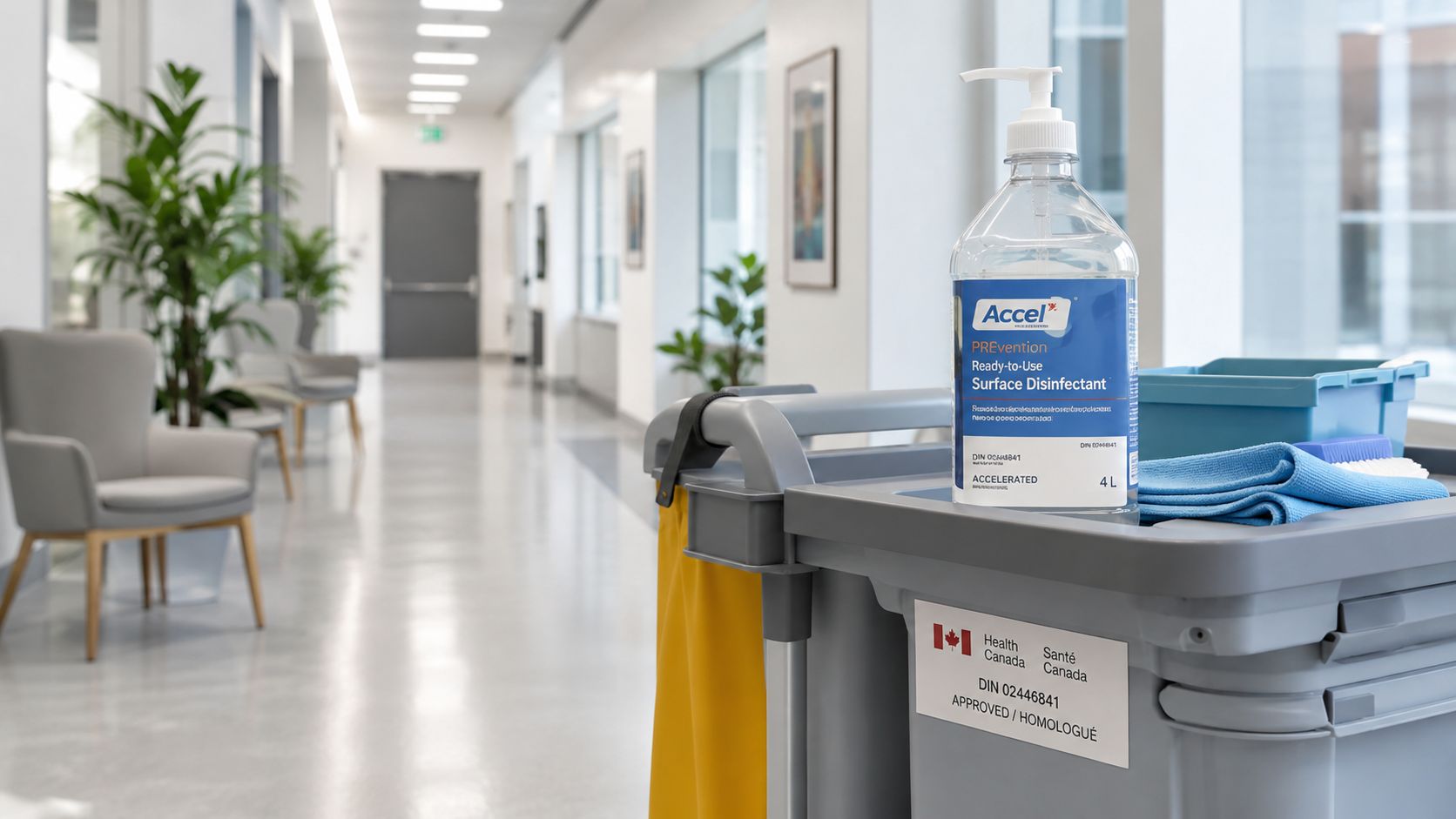
The operational risk is easy to underestimate because a clean-looking surface can hide process failures. A bottle may be in the wrong spray dispenser. Staff may not know the required contact time. A replacement product may arrive without anyone confirming whether its claims are authorized in Canada. In practical terms, a disinfection strategy works like a chain of custody. If one link is missing, product selection, training, storage, or documentation, the whole system becomes harder to defend.
That risk became more visible during COVID-19. In Canada, poison centre calls related to cleaners and disinfectants rose, including a 35% increase in January 2020 compared with January 2019. For facility operators, the lesson is straightforward. Higher product use brings higher stakes for training, labeling, dilution control, and safe handling.
A workable facility plan usually separates three activities: routine cleaning, targeted disinfection of higher-risk touchpoints, and periodic deep cleaning. For readers reviewing how those layers fit together operationally, Facility Management Insights deep cleaning offers useful background on where deep cleaning sits within a broader maintenance program.
Practical rule: If a business cannot show what product was used, why it was chosen, and whether staff followed the label, it cannot show due diligence.
What a facility should be able to prove
During an audit or client review, a business should be able to answer a short list of basic questions:
- Which products are being used for routine cleaning versus disinfection.
- Whether the disinfectant claim is authorized in Canada.
- Where staff can find the SDS and label instructions.
- How workers were trained on dilution, contact time, storage, and PPE.
- Who verifies replacements when a supplier swaps one product for another.
For that reason, Health Canada approved cleaning products are not just a purchasing topic. They are part of risk control, worker protection, and audit readiness.
What Health Canada Approved Really Means
The phrase “Health Canada approved” is often used loosely in marketing. In practice, it has a much narrower meaning for surface disinfectants.
For environmental surfaces in Canada, a product is only considered a disinfectant with a public health claim if it carries a Drug Identification Number, or DIN, issued by Health Canada. Products without a DIN that claim to kill germs aren't authorized for that purpose, and the DIN indicates that the product's safety, efficacy, and quality have been reviewed, as explained in this Canadian overview of Health Canada approved disinfectants.
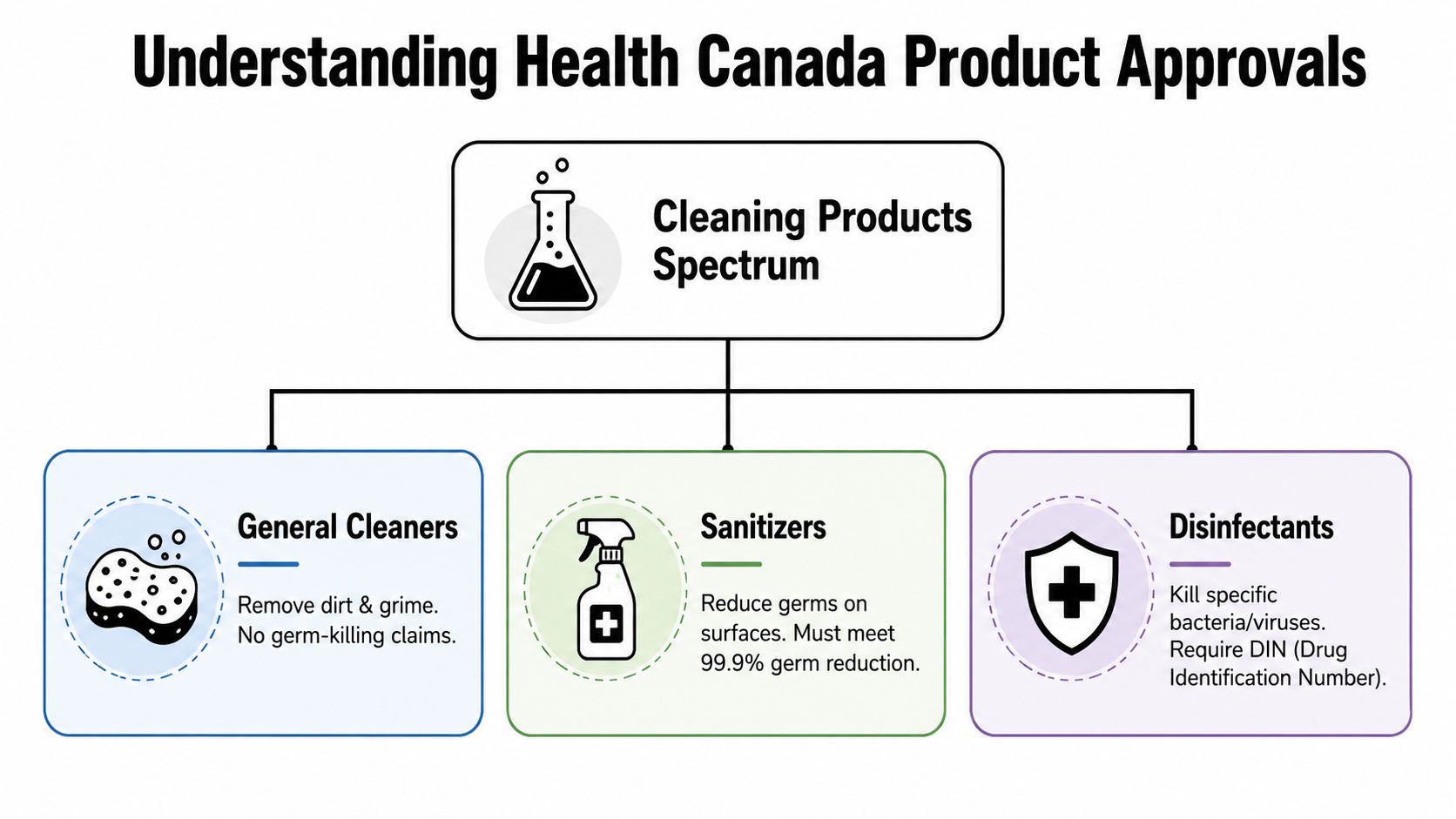
Three product categories that buyers often mix up
A simple way to remember the difference is to think of a ladder.
Cleaner
A cleaner removes dust, soil, grease, and residue. It may improve appearance and prepare a surface for disinfection, but it doesn't automatically come with an antimicrobial claim.
Sanitizer
A sanitizer reduces germs on a surface under its approved conditions. In buying conversations, many teams get confused because the word sounds stronger than it may be in regulatory terms.
Disinfectant
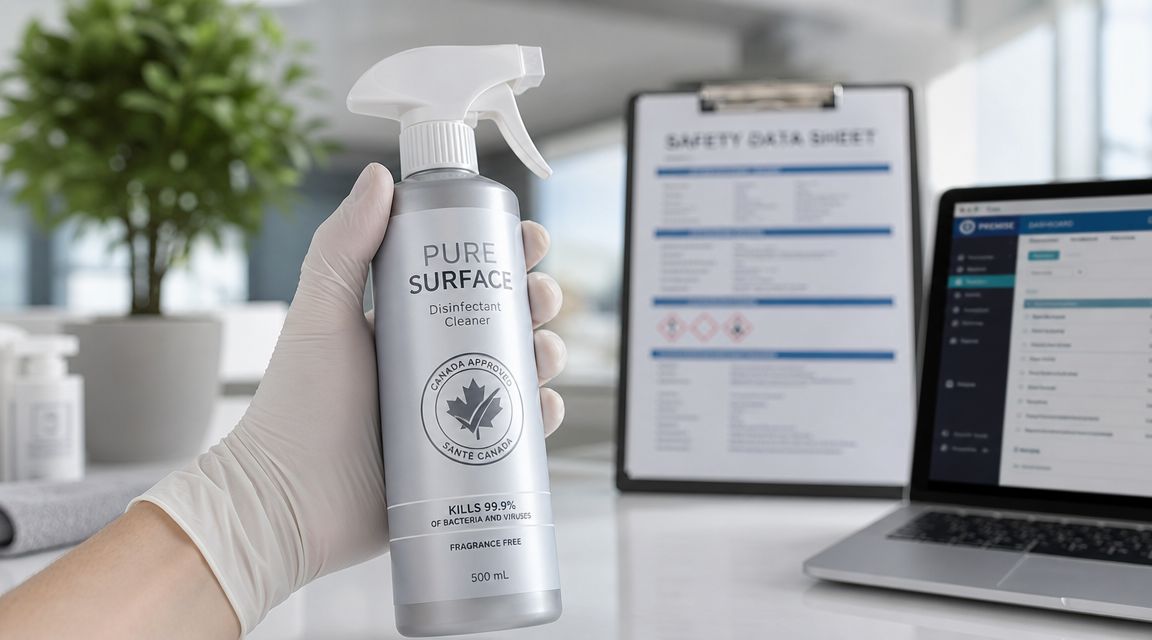
A disinfectant makes a public-health germ-kill claim for environmental surfaces. In Canada, that claim needs authorization. For chemical disinfectants, the practical sign is the DIN on the label.
Why the DIN matters so much
The DIN is the shortcut that non-experts can trust. It gives a buyer, supervisor, or auditor one concrete checkpoint on the label.
Health Canada's public guidance for environmental-surface disinfectants also points buyers to the importance of the approved number and the label itself. A product can't “sound professional” or use health-related language in sales material. The claim on the packaging has to match the authorization.
A bottle can be useful as a cleaner and still not be an authorized disinfectant.
That distinction matters in real buildings. An office reception desk, a childcare table, and a clinic exam room may all need different product decisions based on the risk, the surface, and the claim that must be supported.
A plain-language test for business owners
When a supplier proposes a product, a buyer can ask:
- Is this a cleaner, sanitizer, or disinfectant?
- If it's a disinfectant, where is the DIN on the label?
- Does the label claim match the use in the facility?
- Are staff expected to use it on surfaces that need a documented public-health claim?
Readers who want a plain-language overview of prevention language often used around cleaning and disinfection can also review VirusFAQ's virus prevention insights, which helps clarify common wording people see in everyday facility discussions.
How to Verify a Product's Approval Status in 3 Steps
A label check is a good start. Verification is stronger. Many businesses know they should look for a DIN, but they don't build a routine for confirming it before the product reaches the floor.
Health Canada's own guidance confirms that environmental-surface disinfectants are regulated under the Food and Drugs Act and require an 8-digit DIN to be legally sold with disinfectant claims in Canada. It also makes clear that using the official database is the reliable way to confirm approval, as described in Health Canada's disinfectant and sanitizer guidance document.
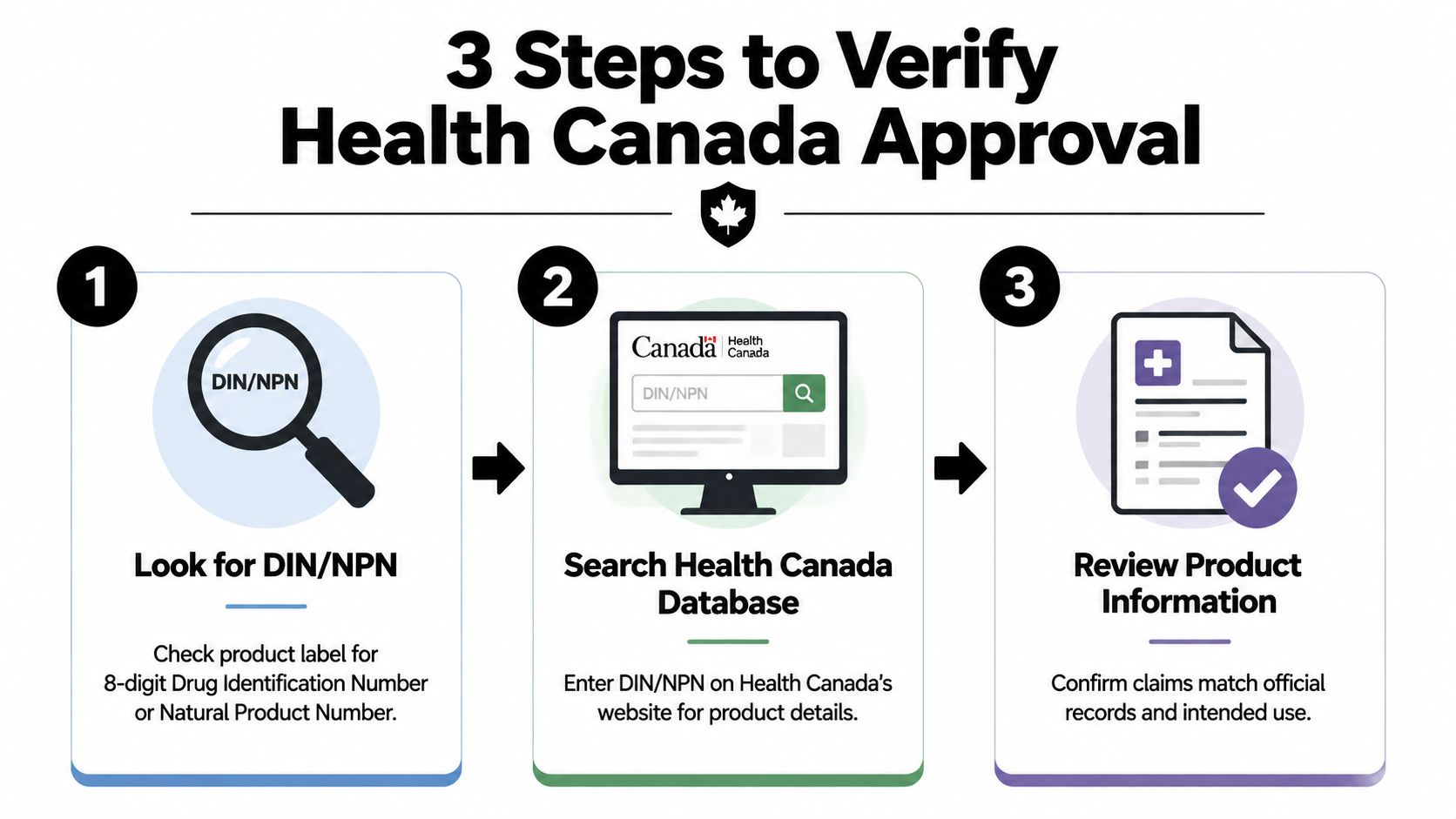
Step 1 Look for the DIN or NPN on the label
Start with the physical container or the manufacturer label on the case.
A compliant disinfectant claim should be tied to an approval number on the product. For most chemical disinfectants used on environmental surfaces, that's the DIN. Staff should be trained to look for the actual number, not just reassuring language such as “approved,” “hospital,” or “professional.”
What to check on the label
- The number itself. It should be presented as an 8-digit DIN where applicable.
- The brand name. It should match the product being delivered.
- The exact claim. A cleaner and a disinfectant can appear under the same brand family but serve different purposes.
- The use instructions. Contact time, dilution, and intended surfaces all matter.
Step 2 Search the official database
Once the DIN is found, the next step is to verify it through Health Canada's official records. This should be part of procurement onboarding, not something done only after a problem appears.
A short visual walk-through can help teams understand the process:
The key principle is simple. The database result should support what the label says. If the number, brand, or authorized use doesn't line up, the buyer should pause the purchase and ask for clarification.
Step 3 Match the record to the real product in hand
Due diligence often breaks down at this point. A product may have a valid-looking number, but the buyer still needs to confirm that the container received matches the record and intended use.
Verification isn't complete when the number exists. It's complete when the number, label, and use case all match.
A sensible receiving workflow includes these actions:
- Compare the DIN on the bottle against the database entry.
- Confirm the product name is the same, not just similar.
- Review the approved claim and directions for the intended setting.
- File the result in a purchasing or compliance record.
- Flag substitutions before staff begin using them.
This is especially important in multi-site operations where one location may order a different variant without telling the rest of the team.
Beyond the DIN Understanding Labels Safety and WHMIS
The DIN confirms authorization for a disinfectant claim. It doesn't guarantee that the product is being used correctly. A compliant facility has to manage both approval and application.
That means staff need to read the label as an instruction document, not as branding. The product label tells workers what surfaces the product is meant for, whether it needs dilution, how long the surface must stay wet, and what protective measures apply during handling.
What the label is really telling staff
Three label elements deserve special attention in daily operations:
Contact time
A disinfectant usually needs the surface to remain wet for the full stated period. If staff spray and wipe too quickly, the approved claim may not be achieved in practice.
Dilution instructions
Concentrates create a common compliance risk. If the solution is mixed incorrectly, the result may be too weak to work as intended or too strong for safe routine use.
Surface compatibility and precautions
Some products are suitable for hard non-porous surfaces but not for every finish, fixture, or device.
Why WHMIS still matters
WHMIS and DIN requirements do different jobs. The DIN addresses whether a disinfectant claim is authorized. WHMIS addresses workplace hazard communication, including labels, worker education, and access to the SDS.
A facility needs both systems working together. A product can be properly authorized and still create problems if workers don't know how to store it, dilute it, ventilate the area, or protect their skin and eyes during use.
Operational note: An approved product used the wrong way can create the same audit problem as the wrong product purchased in the first place.
Common mistakes that create avoidable risk
The most frequent issues are usually procedural, not technical:
- Using a disinfectant like a general cleaner without respecting contact time.
- Decanting into secondary bottles without proper workplace labelling.
- Mixing products by habit instead of following the label and site procedure.
- Assuming janitorial staff “already know” the PPE requirements.
- Treating WHMIS as enough even when the product claim itself still needs Health Canada authorization.
For business owners, the practical takeaway is straightforward. Buying health Canada approved cleaning products is the first control. Training, supervision, and label-based use are the controls that make the purchase meaningful.
A Procurement Checklist for Compliant Cleaning Products
Procurement is where many compliance problems can be prevented. If the wrong product enters the building, supervisors and cleaners have to work around the mistake. If the right review happens before purchase, operations become much simpler.
A purchasing checklist should be short enough to use every time and specific enough to stand up during an audit.

What to ask before approving any product
Is the product category clear
The buyer should know whether the item is being purchased as a cleaner, sanitizer, or disinfectant. If the answer is vague, that's a warning sign.
Can the supplier provide the label and SDS
The review should happen before the order is finalized, not after pallets arrive.
Does the claim fit the facility
A general office, childcare environment, warehouse lunchroom, and clinical setting may need different products and instructions.
Has the approval been verified internally
Someone on the buyer's side should check the approval number and retain a record.
Will staff be able to use it correctly
Concentrates, contact times, and PPE requirements should fit the realities of the site.
For teams sourcing products regularly, a documented supply review can be paired with a dedicated reference page for commercial cleaning supplies and facility product considerations.
What to avoid in supplier conversations
Not every problem looks dramatic. Many begin with casual wording.
Avoid these red flags:
“It's basically the same as your current product.”
Similar isn't enough when labels and claims differ.
“Everyone uses it.”
Popularity isn't proof of authorization or suitability.
“It's safe, so no special review is needed.”
Safety claims don't replace claim verification, SDS review, or training.
“The sales sheet says it kills germs.”
Marketing language isn't the legal standard. The approved label is.
A simple procurement decision framework
A practical approval flow often looks like this:
- Define the task and surface.
- Decide whether cleaning alone is enough or a disinfectant claim is required.
- Collect the label and SDS.
- Verify the approval number and claim.
- Review training and storage implications.
- Approve, reject, or request a safer fit-for-purpose alternative.
That process is slow only the first time. After that, it becomes a standard purchasing control.
Documentation and Working with a Professional Cleaning Provider
An auditor asks a simple question at 9:15 a.m. Which disinfectant is being used in the washrooms, and where is the proof that staff were trained to use it correctly? If the label is in a janitor's closet, the SDS is on another computer, and the training record is in someone else's inbox, the problem is no longer just cleaning. It is a documentation failure.
Good records work like a chain of custody for cleaning products. They show what was approved for use, why it was chosen, who was trained, and what changed over time. For a business owner or facility manager, that matters because due diligence is easier to prove when the paper trail matches the work on the floor.
What documents a business should keep ready
A useful compliance file should let a manager answer five questions quickly. What product is this. Is it approved for the intended claim. How is it used. Who was trained. When was it replaced or reviewed.
That file usually includes:
- A master chemical list with each product name, approval identifier where relevant, use area, and date added to the site
- Current SDS records stored where workers can access them without delay
- Site-specific procedures for dilution, contact time, storage, PPE, spill response, and disposal
- Training records for WHMIS and product-specific instruction, including refresher dates
- Change logs that show substitutions, discontinued products, and the reason for each change
- Purchase or service records that help confirm the product in use matches the product that was approved internally
Examples help here. Some facilities may choose disinfectants that appear on Health Canada's list for emerging viral pathogen claims, including products such as Hypo-Chlor 0.25% and Accel Prevention Plus Concentrate. The practical point is not to copy a product name from another site. It is to confirm that the product on your shelf matches the claim your operation relies on, and then keep the label, SDS, and training record together so you can prove that decision later.
A simple rule helps. If a staff member cannot pull the record in under a few minutes, the file system is not audit-ready.
How a professional provider can reduce audit pressure
A cleaning provider should support controls, not just complete tasks. In operational terms, that means fewer undocumented substitutions, fewer gaps between product selection and staff training, and fewer surprises during an inspection.
A provider can help by:
- maintaining a site-specific product register
- using approved products consistently across recurring services
- documenting any substitution before it reaches the building
- training workers on label directions, dilution, and PPE
- keeping service procedures for high-touch and higher-risk areas in writing
- organizing records so the client can review them during an audit or incident follow-up
For some facilities, outsourced support is also a way to standardize documentation across shifts and locations. Commercial disinfection and sanitizing support can fit into that system when the provider follows site-specific product controls and documented application procedures.
What to ask a cleaning provider
Ask questions that test the provider's process, not just their marketing language.
- Which products are used on this site, and what is each product intended to do?
- How do you verify approval status and label claims before a product is introduced?
- Where are SDS files, labels, and training records stored?
- Who approves substitutions when supply issues happen?
- How do you confirm dilution, contact time, and PPE rules are followed on each shift?
- What records can you give us if there is an audit, incident review, or complaint?
Those questions do two jobs at once. They help you choose a provider, and they create a documented expectation for how the work will be managed after the contract starts.
The strongest audit preparation is routine, plain, and complete. If your records already show what was used, why it was approved, and how staff were trained, an inspection becomes a file review instead of a scramble.
Frequently Asked Questions About Disinfectant Compliance
Is a cleaner the same as a disinfectant
No. A cleaner removes soil and residue. A disinfectant makes an antimicrobial claim for environmental surfaces and must meet the relevant Canadian approval requirements for that claim.
What is the difference between a DIN and an NPN
For non-expert buyers, the practical point is that the approval number on the label matters. The product category and claim need to align with the number shown, and the number should be verified against official records before use.
Do green or eco-conscious products still need approval
If a product is making a disinfectant claim for environmental surfaces, the marketing style doesn't remove the approval requirement. “Green,” “natural,” or “eco-friendly” language doesn't replace the need to confirm the applicable authorization and label claim.
Can a business use household products in a commercial building
Sometimes a product sold into the consumer market may still be suitable for a workplace, but the buyer still needs to check whether the claim, label instructions, hazard information, and approval status fit the commercial setting and task. The product category matters more than where it was merchandised.
What should a business do if a current product seems non-compliant
Stop relying on the unverified claim, review the label, check the official approval information, and escalate the issue internally. Then replace, reclassify, or restrict the product based on what the verification shows. It's also wise to document the review and staff communication.
Does a DIN alone prove that staff are compliant
No. It helps prove the product was authorized for its claim. Compliance also depends on training, label-based use, WHMIS controls, accessible SDS records, and documented procedures.
Who should own this process inside a business
The strongest setup is shared ownership. Procurement should verify products before purchase. Operations or facilities should control use on site. Health and safety should support WHMIS, SDS access, and training records.
Decision framework for choosing the right product type
| Task | Product Type | Key Feature | Health Canada Requirement |
|---|
| Removing visible soil from desks, floors, or counters | Cleaner | Removes dirt and grime | If no antimicrobial claim is made, it is treated as a cleaner |
| Reducing germs where a sanitizing claim is appropriate | Sanitizer | Germ reduction claim | Verify the product category and label claim carefully |
| Killing specified bacteria or viruses on environmental surfaces | Disinfectant | Public-health kill claim | Use a product with the applicable approval number on the label and verify it |
| Higher-risk areas with documented disinfection protocols | Disinfectant selected for the setting | Label must match intended use | Confirm the exact approved claim and use conditions before deployment |
Further Reading and Resources
For ongoing due diligence, readers can review Arelli Cleaning service areas across the GTA when comparing local support options. Useful internal reading also includes the earlier references to commercial cleaning supplies and disinfection support. For external regulatory review, the most useful starting points are Health Canada's disinfectant guidance, the official approval databases, and the government guidance document on disinfectants and sanitizers already referenced above.
Businesses that want help turning these checks into a repeatable site process can consider Arelli Cleaning as one option for office and commercial cleaning support. The practical next step is to use the checklist above, ask informed questions, and compare two or three providers on documentation, training, product verification, and day-to-day consistency.








.webp)