A property manager often meets facility maintenance in fragments. A light fails in one office. The carpet at reception is stained before a client visit. A washroom fixture starts leaking. Then a compliance reminder arrives, and the week shifts from planned work to interruption control.
That pattern feels normal in many buildings, but it's expensive in ways that don't always show up on one invoice. Canadian owners and operators are also dealing with a larger backdrop. Deferred maintenance is becoming harder to ignore as asset conditions, renewal backlogs, and lifecycle pressures increase, as noted in Public Infrastructure Canada context on data-driven maintenance and renewal pressure. For day-to-day operators, that means maintenance decisions need more structure, not more guesswork. For readers managing flooring-heavy spaces, Savera's expert commercial floor insights offer a useful example of how surface care fits into broader building upkeep.
Your Strategic Guide to Facility Maintenance
Facility maintenance solutions are most useful when they're treated as a business function, not a pile of separate service calls. A sound programme connects recurring cleaning, inspections, preventive work, specialty tasks, vendor coordination, and documentation into one operating model.
That matters to new property managers because the first mistake is usually scope confusion. Many teams think they're buying “cleaning” when, instead, they need a system for asset care, safety, occupant experience, and service accountability.
Key takeaways
- Maintenance is broader than janitorial work. It includes routine cleaning, inspections, preventive tasks, asset protection, and selected specialty services.
- Reactive work costs more than it seems. Emergency fixes interrupt operations, weaken budgeting, and often leave root causes unresolved.
- Clear scope prevents disputes. Buyers should separate daily core services from periodic or specialist work before requesting quotes.
- Technology changes the quality of oversight. Good systems show what was scheduled, what was completed, and what still needs attention.
- Canadian conditions raise the stakes. Deferred maintenance, climate stress, and aging assets make prioritisation more important than ever.
A practical approach starts with three questions. What must happen every day or every week? What needs to happen on a cycle? What work requires special equipment, training, or coordination with other vendors?
Those answers create the backbone of a maintainable building plan. They also help buyers compare providers on something more meaningful than a headline price.
Practical rule: If a provider can't explain how recurring tasks, periodic work, and documentation fit together, the service will likely stay reactive.
Defining Modern Facility Maintenance Solutions
A clear working definition helps. Facility maintenance solutions are the organised systems, services, and controls used to preserve building assets, support safe operations, maintain appearance, and keep a property functional over time. That includes cleaning, inspections, preventive upkeep, work tracking, and compliance-related routines.
This definition is broader than many readers expect. It doesn't treat maintenance as a single trade or one vendor category. It treats maintenance as coordinated stewardship of the built environment.
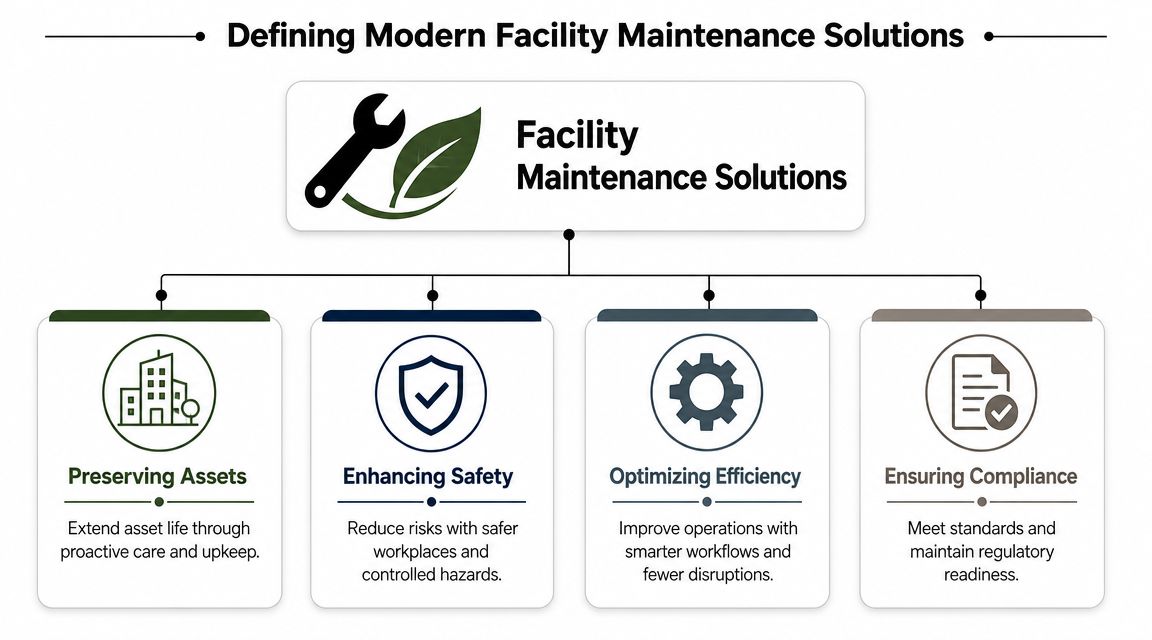
The four pillars
Preserving assets
Floors, fixtures, finishes, and shared spaces last longer when teams clean and maintain them on a schedule.
Enhancing safety
Slips, clutter, poor sanitation, and neglected wear points can turn a routine building issue into a safety problem.
Optimising efficiency
Planned work is easier to budget, assign, and verify than last-minute emergency response.
Ensuring compliance
Documentation, training, and repeatable procedures help facilities show that required work was completed.
One reason this field has become more disciplined is that operators now use standard financial benchmarks. The International Facility Management Association reports an average total maintenance cost of €28.82 per rentable square metre in a facilities benchmark, which gives property managers a common unit for comparing service levels and planning budgets through IFMA's maintenance cost benchmark.
Where readers often get confused
Janitorial work is part of facility maintenance, but it isn't the whole picture. Cleaning supports hygiene, appearance, and first impressions. A maintenance solution adds planning, scheduling, asset awareness, and accountability around that work.
Good maintenance isn't only about fixing what failed. It's about creating conditions where fewer things fail in the first place.
That's why experienced managers ask not only “Who cleans the building?” but also “How is the work scheduled, documented, checked, and adjusted?”
Core Maintenance vs Specialty Services
Most service confusion disappears once the scope is divided into core services and specialty services. Both matter. They solve different problems.
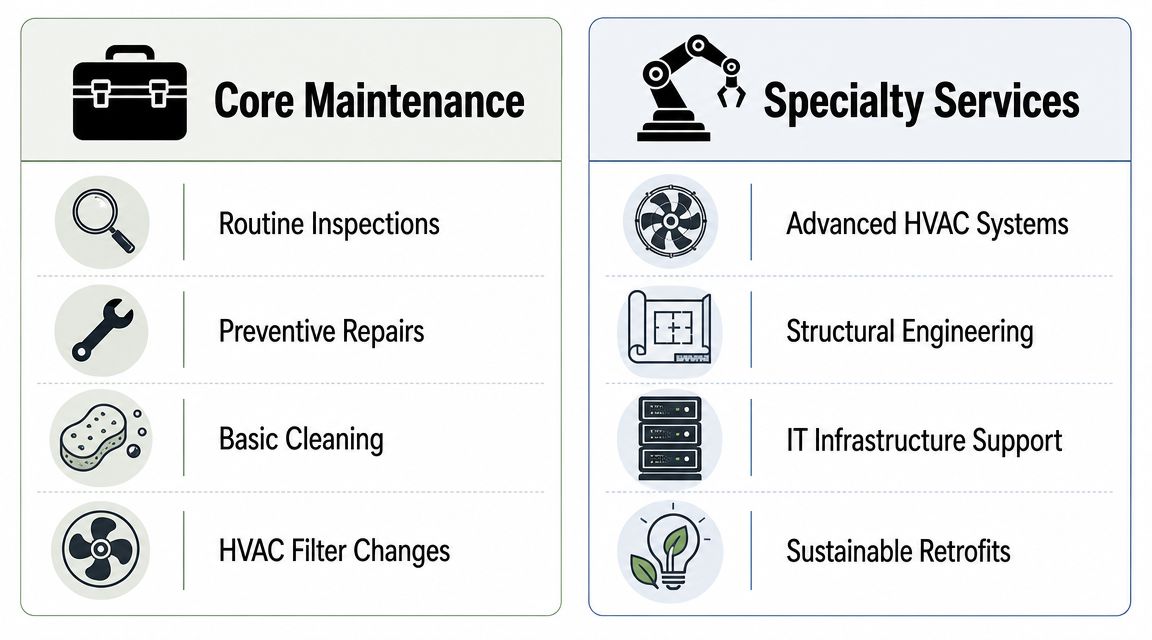
| Attribute | Core Services | Specialty Services |
|---|
| Frequency | Recurring and scheduled | Periodic, seasonal, or project-based |
| Main purpose | Daily functionality and cleanliness | Deeper restoration or unusual conditions |
| Staffing | General service crews | Trained crews with specific methods or equipment |
| Planning style | Included in routine scope | Quoted or scheduled separately |
| Typical examples | Basic cleaning, waste handling, simple checks | Carpet cleaning, strip and wax, high dusting, post-construction cleanup |
| Budget treatment | Operating routine | Planned periodic spend |
What counts as core work
Core maintenance services are the tasks that keep a property usable and presentable on a regular basis. In office and commercial settings, that usually includes routine cleaning, washroom care, waste removal, touchpoint attention, supply checks, and simple recurring inspections.
These tasks don't need to be dramatic to be important. They create the baseline condition of the building. When they slip, complaints rise quickly because occupants experience the decline every day.
For readers reviewing a cleaning-heavy scope, commercial cleaning services for office and facility support show the type of recurring work that often sits inside the core category.
What belongs in specialty work
Specialty services are less frequent but often more technical, labour-intensive, or disruptive. Common examples include carpet cleaning, strip and wax floor care, high dusting, detailed window washing, and post-construction cleanup.
A useful way to identify specialty work is to ask whether the task needs different equipment, a different crew, off-hours scheduling, or an altered safety procedure. If the answer is yes, it likely shouldn't be buried inside a vague “general maintenance” line item.
A practical example of bundling
In an industrial environment such as Patriot Forge, bundling regular cleaning with periodical floor care helps maintain a stronger overall sense of cleanliness than routine cleaning alone. That doesn't mean every building needs the same bundle. It means the best scope reflects how the space is used.
A warehouse with tracked-in debris has different needs than a legal office. A childcare facility has different sanitation priorities than a light-industrial site. Core work keeps conditions stable. Specialty work resets or restores conditions that routine service can't fully handle.
The Business Case for Proactive Maintenance
Proactive maintenance is easier to defend when it's framed as risk control. It protects operations, reduces service surprises, and supports better asset decisions over time.
The strongest argument is financial. Industry reporting cited by ToolSense notes that preventive maintenance can save businesses 12% to 18%, while unplanned downtime can consume roughly 5% to 20% of productive capacity. The same reporting also notes that 44% of unexpected downtime is caused by old equipment, and that unplanned downtime costs about $50 billion annually in aggregate terms. Those figures appear in ToolSense facility management statistics on downtime and preventive savings.
Health, safety, and continuity
A proactive programme reduces the number of neglected conditions that escalate into safety complaints or urgent disruptions. Spills are addressed before slip risks spread. Dust and debris don't accumulate in hard-to-reach areas for months. Consumables and sanitation routines stay consistent.
In spaces with shared occupancy, even small service gaps can change how safe the building feels. A building that looks unmanaged often is unmanaged in more ways than one.
For hygiene-sensitive environments, commercial disinfection and sanitizing support for shared facilities is one example of how scheduled cleaning can sit inside a broader maintenance strategy.
Asset protection and cost control
Reactive spending usually hides inside separate incidents. One emergency call for water extraction. One rushed carpet replacement. One after-hours cleaning response after a preventable issue. Individually, each event seems manageable. Together, they signal a weak maintenance model.
Preventive work protects surfaces and extends serviceable life. That's especially true for floors, washrooms, fixtures, and high-use common areas where wear is visible to occupants and visitors.
Operational lesson: The cheapest line item on a quote can become the most expensive choice if it increases emergency work and shortens asset life.
Brand and workplace experience
People judge a building quickly. They notice odours, entrance condition, washroom cleanliness, and whether surfaces look cared for. Clients use those cues to assess professionalism. Staff use them to judge whether the workplace is organised and attentive.
That makes maintenance part of the brand environment, not just the back-of-house budget.
How to Evaluate Facility Maintenance Providers
A provider should be evaluated on operating discipline, not promises alone. Buyers need evidence that the work can be planned, tracked, adjusted, and verified.
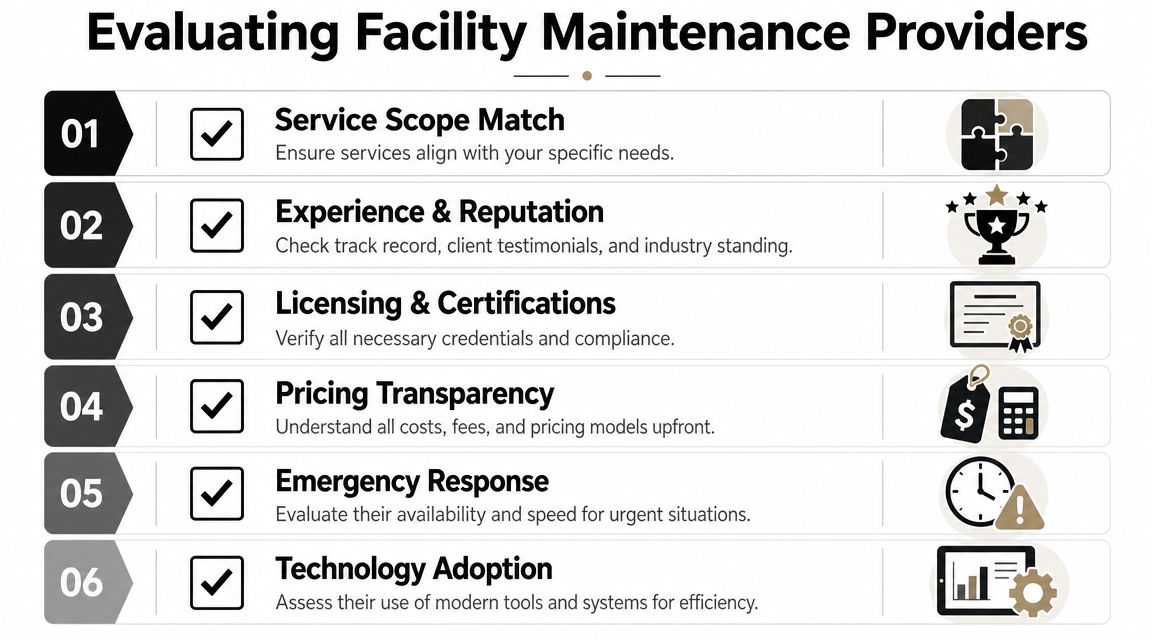
A practical evaluation checklist
Scope match
The provider should translate site needs into a clear routine, not a generic package. Ask what's included daily, weekly, monthly, and on request.
Safety and compliance controls
Insurance, bonding, WHMIS-related practices, incident reporting, and site-specific procedures should be documented.
Communication standards
Buyers should know who receives requests, how issues are escalated, and what records are retained after completion.
Quality verification
Look for inspections, completion logs, service notes, and a process for correcting misses.
Emergency response clarity
“Available when needed” isn't enough. A quote should describe what counts as urgent and how urgent work is handled.
Why technology matters
The biggest difference between basic service and mature facility maintenance solutions is often invisible at first. It's the system behind the work.
Matterport's facility maintenance guidance describes a model where platforms connect work orders, schedules, service histories, and equipment location data, while predictive systems can monitor inputs such as temperature, vibration, electrical current, and occupancy through sensors for earlier fault detection in Matterport's guide to maintenance technology and digital asset tracking.
That matters even in cleaning-centred programmes. A provider that documents recurring work, tracks issues by area, and keeps service history by asset or location is easier to manage than one relying on memory and scattered messages.
Questions worth asking in every quote meeting
How is work assigned and verified?
The answer should include schedules, inspections, and records.
How are periodic tasks tracked?
Floor care, deep cleaning, and project work shouldn't disappear between routine visits.
How are site issues tied to location?
“Second-floor kitchenette sink area” is more useful than “kitchen issue.”
How does the provider coordinate with other trades?
Many buildings need cleaning, maintenance, and specialist vendors working around each other.
A good comparison habit is to borrow hiring logic from adjacent trades. For example, this hiring guide for Melbourne painters is useful not because painting equals maintenance, but because it shows how buyers can evaluate scope clarity, workmanship expectations, and communication before signing.
Buyers should favour providers that can explain their process in plain language. If the process sounds vague during quoting, it won't become clearer after contract start.
Understanding Pricing Models and Cost Drivers
Price confusion usually comes from mixing different billing models into one comparison. A fair review starts by identifying how the quote is structured.
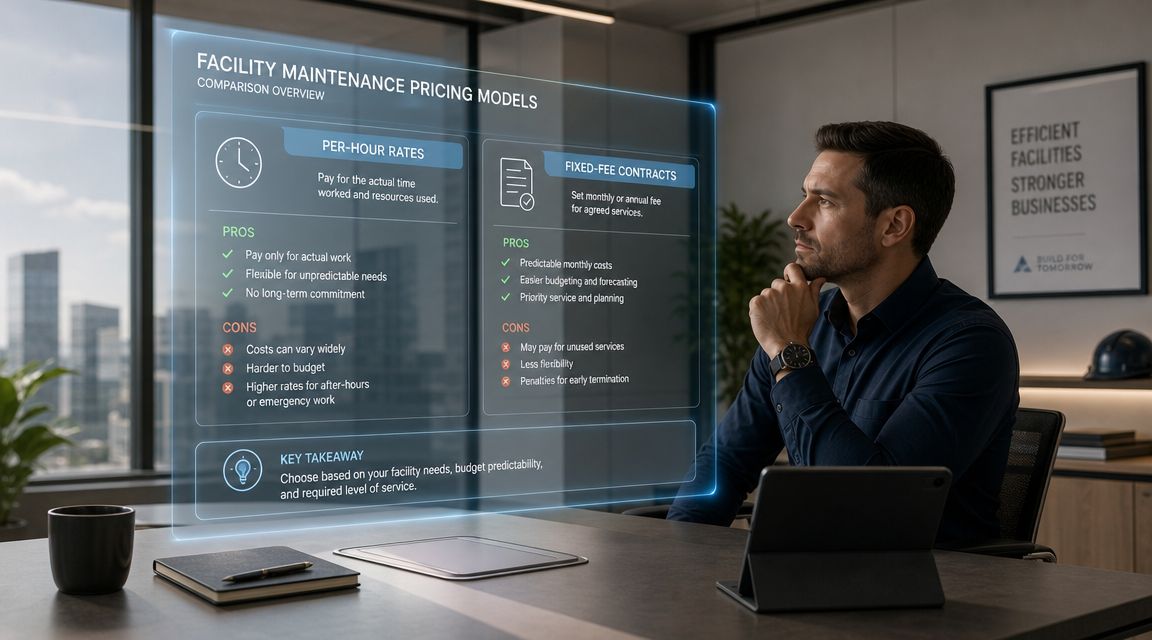
Common pricing models
Hourly pricing is straightforward when the scope changes often or when buyers need temporary support. It offers flexibility, but it can make monthly budgeting less predictable.
Per-area pricing works well when the building layout, service level, and frequency are stable. It's easier to compare across sites if the scope is consistent.
Fixed monthly contracts are often the simplest to administer for recurring service. They support budgeting well, but buyers need to read the exclusions carefully so that “fixed” doesn't hide frequent add-ons.
What actually drives cost
The main cost drivers are usually operational rather than mysterious.
Facility size
More area usually means more labour, more supplies, and more inspection time.
Service frequency
Daily, multiple-times-weekly, and periodic schedules create very different staffing patterns.
Building type
A standard office, a clinic, and an industrial floor each require different methods and quality controls.
Condition of the site
A neglected facility may need restoration work before routine service can hold the standard.
Specialty work
Carpet extraction, floor refinishing, high dusting, and post-construction cleanup often sit outside base routine pricing.
A short explainer can help teams compare models visually:
How to read a quote properly
A useful quote doesn't only state the number. It describes tasks, frequency, exclusions, supply assumptions, access constraints, and any periodic services that may be quoted separately.
That's why two quotes with similar totals can deliver very different results. One may include inspection routines and floor care planning. Another may cover only surface-level recurring cleaning.
The most reliable quote is usually the one that makes hidden work visible before the contract starts.
Integrating Solutions and Choosing Your Partner
A new property manager often inherits a building with three realities at once. The daily work must get done, specialty issues keep appearing, and nobody wants service gaps during the handoff. Choosing a maintenance partner is less about finding one company that claims to do everything and more about building an operating model that keeps standards, reporting, and accountability clear.
In practice, many facilities use a hybrid setup. Internal staff handle work that depends on site knowledge, tenant relationships, or immediate response. External providers handle recurring tasks, periodic projects, or specialized work that would be expensive to staff full-time. It works like a relay team. Each party has a defined lane, and the handoff matters as much as the individual runner.
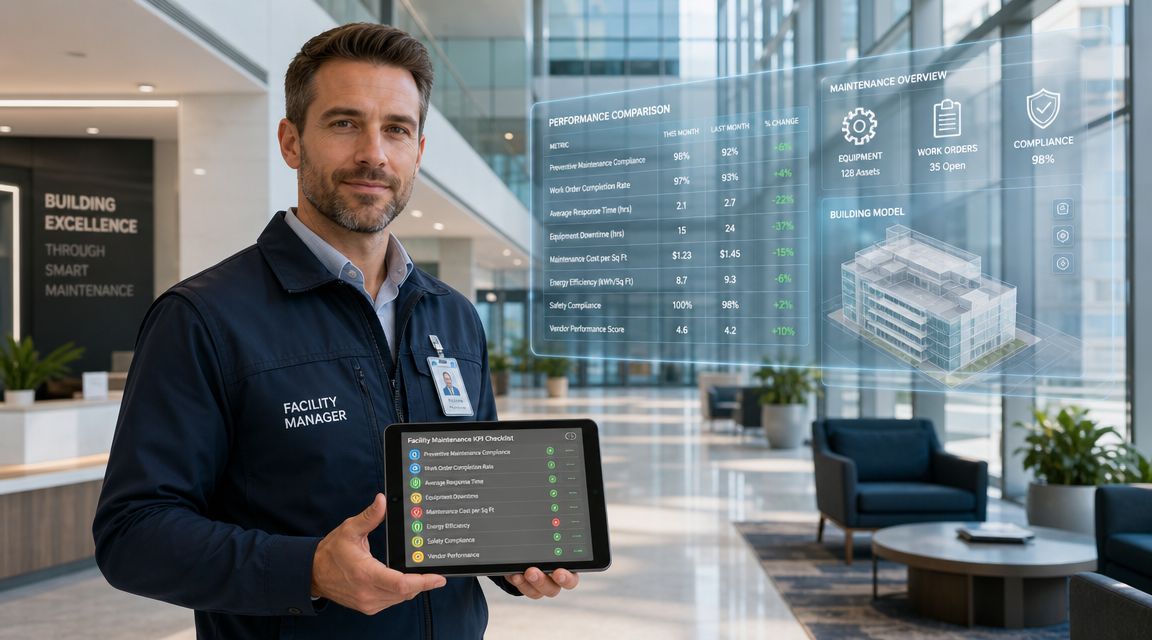
That structure only works if management can see what is happening. A useful partner should fit into your reporting process, inspection routines, and asset strategy, not sit outside them. If your building tracks response times, recurring deficiencies, work order closure, floor condition, or tenant complaints, your maintenance provider should support those KPIs with records you can review.
Questions that clarify fit
Ask questions that reveal how the provider will operate after the contract is signed, not just how they sell during the quote stage.
What work should remain in-house?
Keep tasks internal when they require site-specific judgment, sensitive access, or immediate availability.
What work is better outsourced?
Recurring cleaning, scheduled floor care, seasonal resets, and specialty projects often fit external delivery well.
How will coordination work day to day?
Confirm who handles scheduling, access, keys, after-hours entry, issue escalation, and communication with building staff.
What reporting will you receive?
Ask for inspection results, completion logs, corrective actions, and service history that can be reviewed against your standards.
How does the provider handle technology?
A good answer includes work order visibility, documented site notes, photo verification when appropriate, and a clear process for tracking recurring issues.
Warning signs during selection
Some proposals look acceptable until you test how they would work in a real building.
Scopes full of vague language
Terms like “as needed” or “standard service” create room for disputes unless tasks and frequencies are spelled out.
No clear escalation path
You need named contacts, response expectations, and a process for urgent problems.
Periodic work left off the calendar
Restoration and specialty tasks should be scheduled and reviewed, not remembered only after conditions slip.
Generic plans for very different buildings
A clinic, office, warehouse, and school have different risks, traffic patterns, and compliance concerns.
The best choice is usually the provider that helps you run the building with fewer blind spots. Price still matters, but clarity matters first. If two vendors quote similar totals and one can show inspection discipline, communication structure, and usable records, that provider will usually be easier to manage and less risky over time.
Use the final comparison like an operator, not only as a buyer. Request 2 to 3 detailed quotes. Then compare how each provider defines scope, documents performance, supports KPIs, and fits into your long-term asset plan before you compare price alone.
Frequently Asked Questions
These questions come up near the end of a buying process, but they shape results long after the contract is signed. A facility maintenance program works like an operating system for the building. If the rules, records, and response methods are weak, small problems spread into cost, disruption, and asset wear.
| Question | Short answer | What to look for | Common mistake |
|---|
| How often should an office review its maintenance scope? | Review it when occupancy, layout, or use changes. | Changes in traffic, complaints, and wear patterns. | Keeping the same scope after major operational changes. |
| Who handles liability if something is damaged during service? | The contract and insurance terms should define it clearly. | Proof of insurance, reporting steps, and damage protocols. | Assuming verbal assurances are enough. |
| What if service quality drops after onboarding? | Escalate quickly using documented examples. | Inspection records, response process, and correction timelines. | Waiting too long and relying on informal complaints. |
| How should a new provider onboard? | Through a site walk, scope confirmation, schedule setup, and communication plan. | Named contacts, access rules, and written task lists. | Starting service before the scope is final. |
| Should one vendor handle everything? | Not always. Many buildings do better with a hybrid model. | Coordination method between internal staff and external specialists. | Choosing convenience over fit. |
| When should specialty cleaning be added? | When routine service can't maintain the desired condition alone. | Seasonal wear, flooring condition, and project-related debris. | Treating restoration work as optional until standards collapse. |
| How can a buyer compare quotes fairly? | Compare scope, frequency, exclusions, and reporting. | Like-for-like task lists and periodic service detail. | Comparing totals without checking what's missing. |
| What's the first warning sign of a weak provider? | Vague answers about process and verification. | Clear schedules, inspection steps, and escalation contacts. | Focusing only on price or personality. |
Use this FAQ as a decision filter, not just a reference sheet. Each answer points back to a management discipline: scope control, risk allocation, service verification, vendor coordination, and asset protection. That shift matters because facility maintenance is not only a cleaning expense. It is part of how you protect uptime, control avoidable work orders, and preserve the long-term value of the property.
A practical next step is to convert these questions into a scorecard and use it during final proposal reviews. For organisations that need office and commercial cleaning as one part of a broader facility plan, Arelli Cleaning is one option to assess alongside other providers, especially where recurring cleaning, periodic floor care, and coordination with other building service vendors affect performance over time.










.webp)