
Beyond the Mop: A Strategic Framework for Choosing Your Next Cleaning Partner
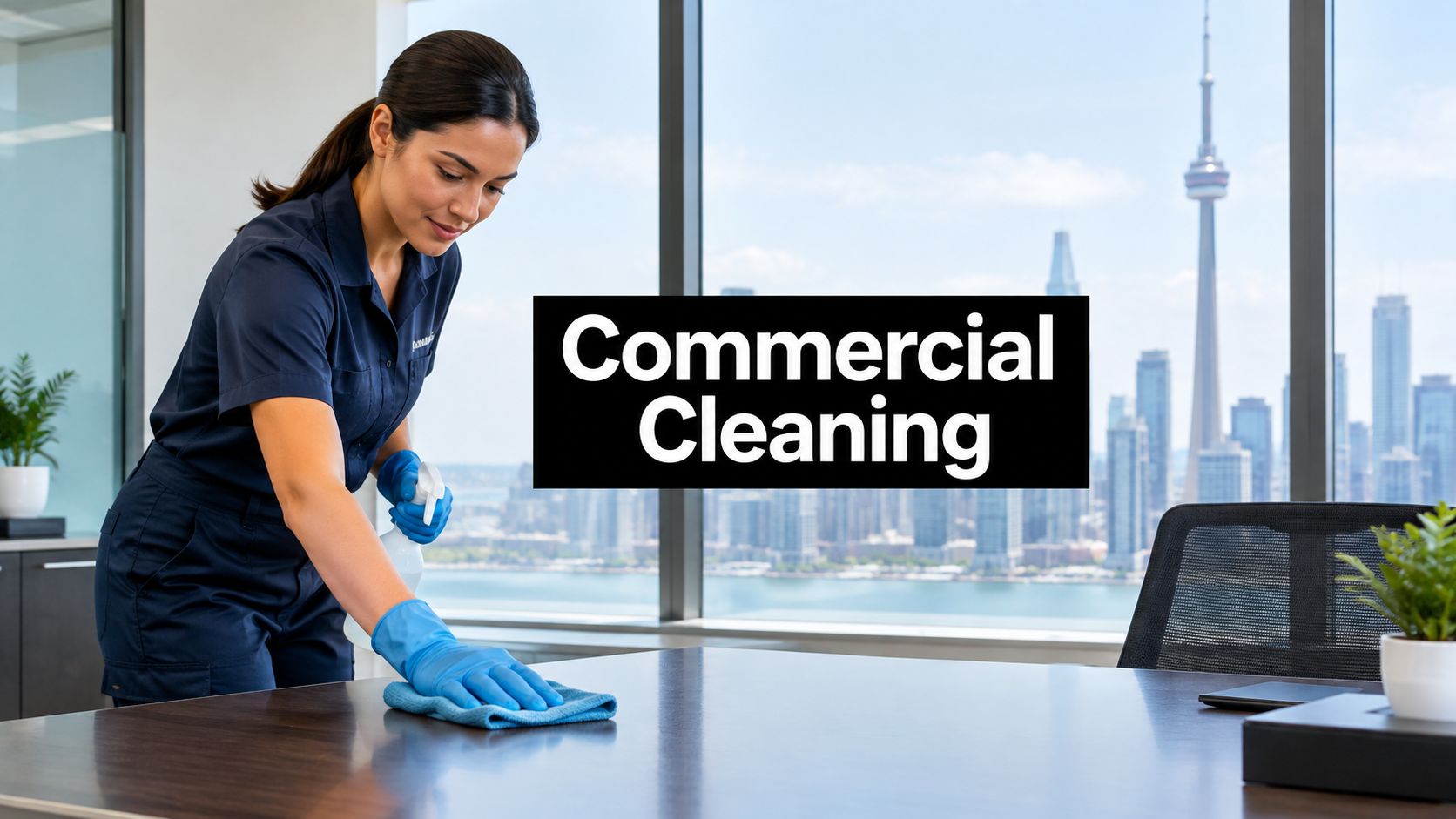
For facility managers and business owners in Toronto, the silent failure of a cleaning service can create operational risk fast. A missed visit, an unsecured door, or poor floor maintenance can turn into a safety issue, a compliance problem, or a client complaint. This guide to selecting a cleaning service for commercial facilities is built for practical decision-making, not brochure language. It uses a 9-point framework to help commercial property teams move beyond price shopping and choose a partner that supports safety, consistency, and facility value. The right provider does more than clean. It protects operations, supports staff, and reduces avoidable disruptions across offices, warehouses, clinics, schools, and mixed-use commercial sites.
1. Licensing, Insurance, and Compliance Certifications
A missed cleaning task is frustrating. An uninsured contractor injury, an unlabeled chemical bottle, or incomplete training records can become a claim, a Ministry issue, or a serious client concern.
Start the screening process here. If a vendor cannot send current proof of commercial general liability insurance, WSIB clearance, and WHMIS training records before the site visit, treat that as a risk signal. Fast, accurate documentation usually reflects disciplined supervision and stronger administrative controls.
In Ontario, compliance affects more than procurement files. It affects who is allowed on site, how chemicals are stored and used, how incidents are reported, and how well your organization can defend itself if something goes wrong. WHMIS training is the baseline. For buyers who want stronger process control, CIMS is worth checking because it points to documented procedures, quality management, and better audit readiness.
Ask direct questions:
- Request certificates for liability insurance and confirm policy limits.
- Ask for current WSIB clearance and whether subcontractors are covered under the same controls.
- Confirm whether staff are bonded if they will work in secured or high-access areas.
- Ask for WHMIS training records and site-specific safety training procedures.
- If disinfection is in scope, confirm the products used are appropriate for the facility type and that application procedures are documented.
- Ask whether the company holds CIMS certification or follows equivalent operating standards.
One trade-off matters here. Smaller firms can deliver strong service, but some do not maintain the same level of documentation discipline as larger operators. That does not rule them out. It means the burden of verification is higher, and the review should happen before award, not after a problem.
A useful test is simple. Ask the bidder to provide its compliance package before the walkthrough and note what arrives: current documents, expired certificates, partial records, or vague promises to send materials later. Procurement teams often learn more from that response than from the proposal itself.
For sites that also deal with disposal controls, recycling streams, or tenant waste obligations, this overview of commercial waste collection and compliance adds useful context on how cleaning scope can intersect with broader site compliance duties.
2. Flexible Contract Terms and No-Cancellation Penalties
A six-month-old cleaning contract can become a problem fast. Headcount changes, tenants leave, operating hours shift, and a scope that looked efficient at award can turn into avoidable cost by the second or third billing cycle.
For that reason, contract flexibility should be reviewed as an operational control, not just a legal detail. In commercial facilities across Toronto and the GTA, the better agreements allow scope changes without forcing the client into a full renegotiation or an expensive exit. The weaker ones hide margin in notice periods, minimum term language, and loosely defined add-on work.
The practical question is simple. If your site needs to reduce frequency, add a daytime porter, pause a low-priority area, or end service after a failed startup period, what happens next, and what does it cost?
Arelli is one example of a provider that offers zero-term contracts, which can suit SMBs that want flexibility if the fit is still unproven. That model is not automatically better for every facility. A longer term can secure rate stability and staffing continuity, especially for larger or more complex sites. The trade-off is straightforward. If a vendor wants a long commitment, the agreement should give the client clear service-level remedies, defined review points, and a clean termination process.
During contract review, focus on these points:
- Notice period: Confirm how much notice is required to end service, whether notice must align with calendar months, and when the clock starts.
- Cancellation charges: Check for administration fees, minimum monthly spend clauses, equipment recovery charges, or language that effectively creates a penalty.
- Scope adjustment rules: Ask how recurring service can be increased or reduced, who approves the change, and how revised pricing is documented.
- Out-of-scope work: Define what counts as extra work, including floor care, post-construction cleanup, consumables handling, and emergency response.
- Pilot or probation period: A 30-day or 60-day review window often gives better protection than a long fixed term with a weak exit clause.
One red flag shows up often. The proposal promises flexibility, but the service agreement says something else. Review the actual contract form before award, not after the vendor is selected.
Communication terms matter here too. If the company promotes after-hours responsiveness or digital service updates, confirm how requests are submitted and acknowledged. Providers that use client portals or live chat solutions should be able to show how change requests, approvals, and disputes are recorded.
A fair contract does not need to be short. It needs to be clear enough that a facility manager can explain the exit terms, change process, and billing implications without asking legal counsel to translate every clause.
3. 24/7 Customer Support and Real-Time Communication
A common failure point starts at 9:40 p.m. A tenant reports an overflowing washroom, the security desk emails the cleaning company, and no one knows who is on call. By morning, you are managing complaints, documenting the incident, and explaining why the issue sat overnight. That is not a cleaning scope problem. It is a communication system problem.
For facilities with evening occupancy, public traffic, medical tenants, food handling areas, or shared common spaces, response structure needs to be tested before award. Ask who receives urgent requests after hours, how calls are escalated, what the response-time target is, and how closure is confirmed. A generic inbox is not a service model.
The stronger vendors show a clear chain of responsibility. You should see named contacts, supervisor coverage outside business hours, and a documented process for incidents such as spills, washroom outages, biohazard concerns, access issues, or missed service. In Ontario, that matters for more than convenience. Delayed communication can create health and safety exposure, tenant friction, and poor documentation if an event later needs to be reviewed against site procedures or WHMIS-related handling requirements.
Technology helps, but only if it improves control. A client portal or mobile app should show when a request was submitted, who accepted it, what action was taken, and when the issue was closed. Ask for a live demo. Look for timestamps, inspection records, photos, deficiency tracking, and supervisor notes. If the system only sends messages, it will not help much during disputes or recurring service failures.
I usually advise clients to test the vendor the same way the site will use them. Send an after-hours request before signing. Call the emergency number. Submit a minor issue and see whether the acknowledgement is immediate, whether the wording is clear, and whether anyone follows through without being chased.
Useful questions to ask include:
- Who is the after-hours contact, by role and by name?
- What counts as an emergency, and what response times apply?
- How are service tickets logged, tracked, and closed?
- Can the provider separate tenant requests from property management requests?
- How are photos, inspection results, and corrective actions stored?
- Can the communication record be exported if there is a dispute or audit?
One red flag comes up often. The sales team promises instant access, but the operating model depends on voicemail, email forwarding, or one supervisor carrying the entire after-hours load. Another is a portal with no audit trail. If the provider cannot show who received the request and when action was taken, you will have a hard time enforcing accountability.
For teams comparing service communication models, this explainer on live chat solutions provides a helpful operational reference point.
4. Transparent Pricing with Price-Match Guarantee
Price matters. Hidden pricing matters more.
A quote should show how the provider priced the job, what is included in routine service, and what triggers additional billing. Without that detail, side-by-side comparisons are not real comparisons.
How to read a proposal properly
Look for the pricing method first. Some companies build around visit frequency, some around task bundles, and some around the complexity of the environment. A dental clinic, for example, should not be priced the same way as a low-touch administrative office if disinfection scope and product controls differ.
The more useful question is not “Who is cheapest?” It is “Which proposal is easiest to manage without surprises?” The article gap identified in guidance for buyers is exactly this problem: many resources advise comparing quotes but do not explain how to justify value or evaluate ROI in a disciplined way, as discussed in this piece on choosing the right commercial cleaning service for your business.
Arelli mentions a price-match guarantee, which may be worth comparing if two vendors appear operationally similar. Still, price-match language should never override scope quality, staffing depth, or compliance.
Ask for:
- Itemised recurring scope: Daily, weekly, and monthly tasks separated clearly.
- Extra-service definitions: Carpet work, high dusting, floor restoration, and emergency disinfection listed separately.
- Supply assumptions: Clarify who provides consumables and specialty products.
- Billing rules: Understand how missed access, after-hours requests, or site changes affect invoicing.
5. Quality Assurance and Performance Monitoring Systems
A clean site can still be poorly managed.
Facility managers usually see the problem after the first few weeks. The washrooms look acceptable on Monday, touchpoints slip by Thursday, and no one can explain whether the miss came from staffing, poor task instructions, or weak supervision. If the vendor cannot show what was inspected, what failed, and what was corrected, you are managing by complaint instead of by system.
The better test is simple. Ask how quality is checked when you are not on site.
Strong providers use scheduled inspections, site-specific scorecards, photo verification where appropriate, corrective-action records, and review meetings tied to actual service issues. In Ontario, that discipline matters more in regulated environments, where cleaning errors can affect health and safety obligations, documented procedures, and tenant confidence.
What to ask for
Request a real inspection form, not a sample filled with generic language. It should show the areas inspected, the standard being measured, the pass-fail method, the person responsible for follow-up, and the timeline for correction.
Then ask these questions:
- How often are inspections completed, and by whom? Supervisor checks and account-manager audits serve different purposes.
- What triggers a corrective action? A good answer includes thresholds, deadlines, and reinspection.
- How is recurring failure tracked? One missed task is different from a pattern across shifts or locations.
- Can the reporting be matched to our site risks? A medical clinic, school, and corporate office should not use the same audit emphasis.
- How are complaints logged and closed? Email chains are not a quality system.
A practical example helps. If boardroom dusting is missed three times in a month, the vendor should be able to trace the issue to the checklist, assignment, or supervision gap, correct it, and confirm on the next audit that the problem stayed fixed.
Red flags are usually easy to spot. Vague phrases such as “we check regularly” or “our team knows the routine” signal that the company may not have a documented QA process. Another warning sign is a scorecard with no site-specific standards. A Toronto office tower, a dental practice, and a light industrial facility do not share the same risk profile.
For buyers using a structured evaluation process, this is one of the nine criteria that deserves written verification. The goal is not a fancy dashboard. The goal is control. You need evidence that standards are defined, exceptions are recorded, and service quality can be reviewed objectively if performance drops.
6. Specialized Service Capabilities and Industry Expertise
A cleaner who performs well in a downtown office can still struggle in a clinic, warehouse, or mixed-use facility. The failure usually shows up in the details. Dwell times are missed, the wrong tools are used on coated floors, or crews enter controlled areas without understanding site rules.
Specialization matters because the cleaning scope changes with the operating risk. In a law office, the priority may be confidentiality, secure after-hours access, and quiet work around sensitive files. In a dental clinic, the discussion shifts to disinfectant use, touchpoint sequencing, and staff awareness around treatment rooms. In a warehouse, floor condition, airborne dust, spill response, and clear travel paths have more operational weight than appearance alone.
Ask each vendor to walk through your site type in specific terms. A capable contractor should be able to explain how they would handle your surfaces, traffic levels, restricted zones, contamination points, and scheduling constraints. If the answer sounds like a standard office checklist with a few extra tasks added on, the fit is weak.
In Ontario, this is also a compliance question, not just a service question. For facilities that use controlled products or require specialized chemical handling, crews should understand WHMIS labeling, safety data sheets, dilution control, and incident reporting. If a contractor claims healthcare, childcare, or industrial experience, ask what training supports that claim and what procedures change by environment.
Examples worth testing during the interview:
- Dental clinics: product selection, contact times, treatment-room touchpoints, sharps-area awareness.
- Law offices: secure entry procedures, confidentiality expectations, low-disruption evening routines.
- Engineering offices: mixed office and light industrial zones, dust around equipment, coordination with technical staff.
- Childcare centres: sanitation frequency, product safety, toy and washroom protocols, cleaning around occupied hours.
- Warehouses: auto-scrubber access, loading docks, spill response, floor wear, and aisle safety.
A useful follow-up is, "What would you do differently at our site than at a standard office?" Strong vendors answer with methods, not slogans. They mention floor finish compatibility, cross-contamination controls, equipment access, color-coded tools, or shift timing around production and occupancy.
Red flags are usually plain. Be cautious if a company lists every industry on its website but cannot describe the cleaning risks that come with any of them. The same applies if it offers specialty floor care, post-construction cleaning, or clinic disinfection but relies on general-purpose chemicals and generalist crew training for every account.
Arelli serves a mix of dental clinics, law offices, and manufacturing sites. That range may help buyers who want one provider across different facility types. A key test remains simple. The company should be able to explain your environment clearly, identify the main service risks, and show how its procedures change to match them.
7. Staff Reliability, Training, and Consistency
A contract can look fine on paper and still fail at 6:00 a.m. when the cleaner with the alarm code does not show up, the replacement has never seen your site, and no one can confirm what was missed.
That risk sits behind a lot of service complaints. The problem is rarely cleaning skill alone. It is crew stability, site-specific training, supervision, and whether the provider can keep standards steady when absences, turnover, or scheduling pressure hit.
For Toronto and Ontario facilities, this section deserves more scrutiny than it usually gets. A reliable vendor should be able to explain how staff are trained on WHMIS, site hazards, access control, incident reporting, and task sequencing for your building. General orientation is not enough for a medical clinic, childcare centre, multi-tenant office tower, or light industrial site.
What to ask about the actual crew
Ask who will clean the site, how long those staff typically stay on the account, and what happens when someone is away. If the answer is vague, expect inconsistency. For security-sensitive facilities, a regular crew reduces avoidable errors around keys, alarms, restricted rooms, and closing procedures.
Training also needs to be specific to your environment. A vendor should be able to describe onboarding for your site, not just company-wide basics. Ask whether new hires shadow an experienced lead, whether supervisors sign off before someone works alone, and how retraining is handled after a quality issue or safety incident.
The backup plan matters just as much as the primary crew. This resource on questions to consider when choosing a commercial cleaning service is useful because it raises absence coverage, but buyers should push further. Ask how replacement staff receive site instructions, where those instructions are stored, and who confirms that the handoff happened before the shift starts.
Use these screening questions:
- Crew consistency: Will the same cleaners attend the site regularly, and how often does the assigned crew change?
- Site-specific training: What training is required before someone cleans our facility, including WHMIS and any building-specific hazards?
- Absence coverage: How are relief staff briefed on alarm procedures, key control, priority areas, and client restrictions?
- Screening: Are police checks or background checks used for sites with confidential information, controlled access, or vulnerable occupants?
- Supervision: How often does a supervisor inspect the work in person, and how are deficiencies corrected?
- Documentation: Are site instructions, task lists, and incident notes kept in a form that replacement staff can use?
Two red flags come up often. One is a provider that promises a dedicated crew but cannot explain its retention or relief process. The other is a company that talks about training in broad terms but has no site file, no signed onboarding record, and no clear supervisor accountability.
Consistency is operational control. If a company cannot show how it maintains that control from shift to shift, the risk stays with the client.
8. Environmentally Responsible and Health-Safe Cleaning Practices
A crew can leave a floor looking spotless and still create problems for occupants. The usual causes are easy to miss during procurement. Over-applied disinfectant on touchpoints, high-odour products in poorly ventilated areas, cross-use of cloths between washrooms and kitchens, or chemicals that do not match the surface.
Environmentally responsible cleaning is not a branding exercise. It is a set of operating choices that affect indoor air quality, infection control, finish life, and complaint volume. The right standard depends on the facility. A daycare, medical office, multi-tenant lobby, and light industrial site do not share the same exposure profile.
Start with product selection and control. Ask for the site’s proposed chemical list, Safety Data Sheets, dilution method, and the reason each product is used in each area. In Ontario, that discussion should connect directly to WHMIS training, labelled secondary containers, and clear handling procedures. If the provider says it uses "green products" but cannot identify active ingredients, dwell times, or surface limitations, treat that as a procurement risk.
The better operators separate routine cleaning from disinfection and can explain when each applies. That matters because over-disinfecting raises cost, can damage surfaces, and often adds residue without improving outcomes in low-risk areas. Under-disinfecting creates a different problem. The point is fit-for-purpose cleaning, documented by area and use case.
Look for practical controls such as these:
- Microfibre systems with colour coding to reduce cross-contamination
- Closed-loop or measured dilution systems to limit overuse and inconsistent mixing
- Low-odour products for occupied spaces and sensitive populations
- HEPA-filtered vacuuming where dust control affects occupant comfort or air quality
- Written waste-handling procedures, including sharps or biohazard escalation where relevant
- Clear escalation rules for bodily fluids, outbreak response, or enhanced disinfection requests
Ask one more question that buyers often skip. How does the company verify that its environmental claims hold up at the site level? A credible answer may include product certifications, documented training, supervisor checks, and client reporting tied to the building’s actual risk areas. CIMS alignment is useful here because it points to documented processes rather than marketing language alone.
For Toronto office environments, this issue usually shows up in meeting rooms, washrooms, kitchenettes, elevator buttons, and other shared touchpoints. Buyers comparing local providers can review a Toronto-specific service example at office cleaning for Toronto workplaces.
One red flag stands out. If a vendor cannot explain why a given product, tool, and procedure belong in a specific space, it is not managing health risk or environmental impact with much discipline.
9. Reputation, References, and Industry Recognition
A vendor usually looks strongest during the sales process. The true test comes three months later, when a supervisor is away, a tenant complaint lands after hours, or access rules change with no notice. Reputation should be judged on how the company performs under that pressure, not on polished proposals or star ratings alone.
Online reviews have some value, but they rarely answer the questions that matter to facility managers in occupied commercial buildings. Reference checks do. Ask to speak with clients whose sites resemble yours in size, security requirements, occupancy pattern, and inspection exposure.
Ask references about operating discipline
Use reference calls to confirm how the contractor behaves after onboarding. Ask whether service quality stayed consistent after the first 30 to 60 days. Ask whether invoicing matched the quoted scope, whether issues were resolved without repeated follow-up, and whether replacement staff understood the site before starting work.
Industry recognition also needs context. Association memberships can indicate participation in the field, but they do not prove day-to-day execution. Client retention, supervisor continuity, and candid references usually tell you more about delivery risk than logos on a proposal.
A brief market check helps here. Toronto has no shortage of commercial cleaning providers, which makes it easier for weak operators to look credible in a tender process. Buyers who want a local point of comparison can review Arelli’s Toronto office cleaning service profile, then compare that information against references, site fit, and contract controls.
One red flag is easy to miss. If a company offers references but steers you only to long-term clients with simple sites, ask for a newer account, a larger facility, or a building with tighter compliance demands. Strong vendors can provide references that match the operational reality you need them to handle.
9-Criteria Comparison of Commercial Cleaning Services
| Category | Core Features ✨ | Quality & Reliability ★ | Value & Pricing 💰 | Target Audience 👥 | Unique Selling Points 🏆 |
|---|---|---|---|---|---|
| Licensing, Insurance, and Compliance Certifications | Business license, ≥$2M liability, WSIB, WHMIS, CIMS, background checks, Health Canada-approved products | ★★★★★: legal protection & trained staff | 💰 Moderate: may raise rates but reduces risk | 👥 Healthcare, education, govt, corporate | 🏆 Required for tenders; compliance-backed service |
| Flexible Contract Terms & No-Cancellation Penalties | Month-to-month, pause/resume, stop-and-go, no termination fees | ★★★★: client-friendly, flexible operations | 💰 Variable: may have higher per-visit pricing, lowers commitment risk | 👥 Startups, SMBs, growing firms | 🏆 No-term contracts & zero cancellation fees (Arelli) |
| 24/7 Customer Support & Real-Time Communication | 24/7 phone, mobile app, GPS, photo docs, incident tracking | ★★★★★: rapid response, reduces downtime | 💰 High value: tech adds cost but improves uptime | 👥 24/7 operations: healthcare, manufacturing, large offices | 🏆 Proprietary management system & real-time app |
| Transparent Pricing with Price-Match Guarantee | Itemized quotes, no hidden fees, price-match, tiered discounts | ★★★★: builds trust; scope must match for fair comparison | 💰 High: competitive rates + price-match assurance | 👥 Budget-conscious businesses, procurement teams | 🏆 Price Match Guarantee (Arelli) |
| Quality Assurance & Performance Monitoring Systems | Inspections, checklists, SLAs, metrics, photo verification | ★★★★★: consistent standards; measurable KPIs | 💰 Moderate-High: monitoring tech adds cost, saves issues | 👥 Healthcare, education, corporate accounts | 🏆 Proprietary QA system; SLA guarantees |
| Specialized Service Capabilities & Industry Expertise | Industry protocols, specialized equipment, post-construction, disinfection | ★★★★: expert handling of complex needs | 💰 Higher: premium for specialty skills/equipment | 👥 Healthcare, legal, manufacturing, dental clinics | 🏆 Customized protocols; Health Canada-approved disinfection |
| Staff Reliability, Training, and Consistency | Background checks, WHMIS training, consistent crew assignment, onboarding | ★★★★★: familiarity improves quality & security | 💰 Moderate: staffing/training reflected in price | 👥 Facilities valuing security & consistency (finance, healthcare) | 🏆 System-based crew empowerment and retention |
| Environmentally Responsible & Health-Safe Practices | Health Canada-approved products, eco options, proper disposal, microfiber | ★★★★: safer air & compliance; may need retraining | 💰 Moderate-High: eco products cost more but boost ESG | 👥 Sustainable firms, corporate ESG, healthcare | 🏆 Green options + Health Canada approvals |
| Reputation, References, and Industry Recognition | Awards, CIMS/ISO, testimonials, case studies, numerous clients | ★★★★★: proven track record & client trust | 💰 Premium: reputation can command higher rates | 👥 Risk-averse orgs, procurement teams, large enterprises | 🏆 Multiple industry accolades; trusted by numerous GTA clients |
Making Your Final Decision: The Facility Manager's Evaluation Matrix
Selecting the right cleaning service is a strategic decision. It affects health, safety, appearance, staff confidence, and day-to-day continuity. The most effective approach is to score each shortlisted provider against the nine criteria above using the same standard for every bidder. A simple five-point scale works well if the scoring notes are specific. One vendor may price well but fall short on staffing depth. Another may have strong compliance systems but weak communication. That contrast is exactly what the evaluation process should reveal.
This decision should not rest on price alone. Toronto’s commercial market is active, and demand for reliable cleaning remains strong as occupancy patterns, health expectations, and facility standards continue to shift. The right partner is the one that can document its process, explain its staffing model, respond quickly when conditions change, and maintain quality after the first month.
Secure two or three detailed quotes. Ask for real documents, not just assurances. Check references in your own facility category. Push on backup planning and service continuity. Strong providers usually welcome that level of scrutiny because it helps define expectations clearly from the start.
For businesses in the Greater Toronto Area, Arelli can be one option to include in that evaluation, particularly for buyers who value no-term contracts, WHMIS compliance, Health Canada-approved disinfectants, and technology-supported communication. For broader service coverage across the region, review the company’s GTA service locations.
Further reading
Internal resources
External resources