Dirty windows rarely show up as a line item emergency. They sit in the background until a client notices the frontage, staff start lowering blinds to cut glare from streaked glass, or maintenance teams realise the buildup is becoming harder to remove. That's usually the moment the key question appears: is window cleaning worth it as an operating expense, or is it just cosmetic spend dressed up as maintenance?
For most commercial properties, the answer isn't about shine. It's about whether the service protects the building envelope, reduces avoidable risk, supports a better working environment, and prevents a simple upkeep task from turning into a more expensive remediation problem. In that sense, professional window cleaning belongs in the same discussion as floor care, HVAC filter changes, and exterior inspections.
A commercial cleaning scope also matters. Professional window cleaning in a business setting usually means more than wiping accessible glass. It can include interior and exterior panes, frame and sill detailing, safe access planning, water-fed pole work for upper glazing, and scheduling that fits occupancy patterns. For facility teams comparing methods or building budgets, it helps to understand what it takes to achieve a perfect window shine without creating streaks, access issues, or unnecessary disruption.
Evaluating Window Cleaning as a Business Decision
The strongest business case for window cleaning is that it serves several objectives at once. It affects appearance, but it also supports asset care, operational continuity, and occupant experience. That mix makes it different from one-off cosmetic upgrades.
A practical way to judge value is to treat window cleaning as a maintenance decision, not a branding decision. The same facility manager who approves washroom consumables, periodic carpet extraction, or seasonal floor refinishing can evaluate window cleaning through the same lens: what problem does it prevent, what risk does it reduce, and what cost does it avoid later? For broader upkeep planning, many teams fold it into a wider commercial cleaning services programme rather than treating it as an isolated task.
Key takeaways
- It's usually worth it when glass condition affects operations. High-traffic frontage, tenant expectations, dust-prone sites, and multi-storey access all make the service easier to justify.
- The return often comes from prevention. Removing dirt, film, and bonded residue helps avoid harder cleaning later and may help preserve glass, frames, and seals.
- Safety changes the calculation. Once ladders, awkward access, or height are involved, the low-cost DIY assumption often breaks down.
- Fixed schedules aren't always efficient. Facilities get better value when service frequency matches building use and environmental conditions.
- Quotes only make sense in context. A lower price can still be the worse option if it excludes safe access methods, insurance, or scope clarity.
Clean windows are rarely the goal by themselves. The goal is preserving a functional, presentable building with the least operational friction.
The Tangible Business Benefits of Clean Windows

A property manager walks a site before a tenant tour at 8 a.m. The lobby floors were refinished, the washrooms are stocked, and the lighting checks out. Then the morning sun hits the front elevation. Water spotting, traffic film, and neglected glass signal a gap in standards that occupants notice immediately. That is why window cleaning belongs in an operations discussion, not a styling discussion.
For commercial properties, the return usually shows up in four places: first impressions that support leasing and tenant retention, better daylight performance, earlier detection of envelope defects, and a cleaner indoor experience around perimeter spaces.
Brand perception and tenant confidence
Glass at entrances and street level functions like a condition report that tenants and visitors read in seconds. Clean panes suggest the site is being monitored. Dirty panes suggest work is getting deferred until complaints force action.
That matters most where the glass is part of the customer or tenant journey. Entry doors, vestibules, reception glazing, conference room frontage, and ground-floor retail all carry more weight than a back-of-house elevation. A practical cleaning plan focuses on those high-visibility zones first instead of chasing a uniform finish across every elevation at the same interval.
Natural light and building performance
Guidance from manufacturers like Pella makes the conversation more concrete. Earlier manufacturer guidance notes that regular cleaning supports window performance, light transmission, and service life.
For a facility team, the operational question is simple. If glazing is a daylighting asset, surface contamination reduces the value of that asset. Dust, hard-water spotting, and urban film do not just change appearance. They also cut clarity in work areas, lobbies, classrooms, and patient-facing spaces where daylight quality affects how the building feels throughout the day.
The energy effect should be framed carefully. Window cleaning will not transform utility spend on its own. But on buildings designed to use daylight and seasonal solar gain, cleaner glass helps the façade perform closer to intent.
Preventive maintenance for glass and frames
The business case becomes stronger.
Deposits that sit on glass too long are harder to remove and increase the risk of scratching during later cleaning. Residue also collects at frame edges, tracks, and seals, where it can hold moisture and expose small failures that would otherwise be easy to miss. Regular service creates repeated, close-range observation of the façade. That is often when crews or site staff first notice failed seals, blocked drainage paths, cracked caulk, corrosion, or frame deterioration.
Tasks that preserve component life and reduce repair odds fit naturally inside a preventive maintenance budget. The same planning logic applies to adjacent exterior care such as budgeting for pressure washing, where the goal is controlled upkeep before soils and moisture create a more expensive problem.
Occupant comfort and workplace quality
Occupants rarely file a work order that says, "daylight transmission has declined." They do notice glare made worse by streaking, dusty sills near desks, and perimeter spaces that feel dingier than the rest of the floor. In clinics, schools, and offices, those cues shape how people judge the building's overall cleanliness.
That makes window cleaning a support function for workplace quality. It will not solve indoor environmental issues by itself. It does help maintain brighter common areas, cleaner sightlines, and a more consistent standard in the zones people use every day.
Clean windows do not need to pay for themselves through appearance alone. On commercial sites, the better rationale is lower avoidable wear, better inspection visibility, and fewer signals of neglect in spaces tied directly to tenant confidence and daily operations.
Calculating the Cost of Professional Window Cleaning
A property manager reviews two bids for the same building. One is priced by pane count. The other is higher, but it spells out access method, labour assumptions, and service timing. The second quote is usually closer to the actual cost of getting the work done without delays, rework, or avoidable safety exposure.
That distinction matters because window cleaning is priced by production conditions, not just glass quantity. A low per-window number can look efficient on paper and still become the more expensive option if the building has poor access, heavy mineral deposits, restricted work hours, or interior areas that require tenant coordination.
What usually drives the quote
Commercial pricing usually moves on a short list of operational variables:
- Access difficulty: Ground-floor storefront glass is straightforward. Upper glazing, deep setbacks, atriums, and tight exterior clearances add labour and setup time.
- Building height: Height affects crew size, equipment selection, and site planning.
- Window count and pane configuration: Many small panes can take longer than fewer large panels because edge work and detailing repeat across each unit.
- Soiling condition: Light dust is one scope. Traffic film, hard-water staining, adhesive residue, and post-construction debris are another.
- Cleaning frequency: Recurring service is more predictable. Deferred cleaning often takes longer because buildup has bonded to the surface.
- Interior versus exterior scope: Occupied offices, medical spaces, schools, and secured areas create access constraints that affect labour hours.
Facilities teams already budgeting for pressure washing will recognize the pattern. Exterior maintenance costs rise or fall with access, surface condition, scheduling limits, and the amount of preparation required before the first tool comes out.
How to read a quote properly
A useful quote does more than show a total. It defines what the contractor is assuming, which is what helps prevent change orders and disputes later.
Check for these items:
- Scope of work: interior glass, exterior glass, partitions, frames, tracks, and sills.
- Access method: ladders, lifts, rope access, or water-fed poles.
- Work schedule: daytime, after-hours, weekend service, or phased cleaning around occupants.
- Condition assumptions: whether the price covers routine soil only or includes removal of bonded residue and spotting.
- Site constraints: security check-in, parking limits, escort requirements, and any floor-by-floor coordination.
If a quote leaves those details vague, the number has limited budgeting value.
A practical budgeting rule
Use annual cost per cleaned square foot or per elevation served as the comparison metric inside your maintenance budget, then test it against building use. A lobby wall of glass at a client-facing property carries different operational value than rarely seen back-of-house glazing. The cleaning standard should reflect that difference.
The stronger budgeting question is whether delayed service increases total ownership cost. In many buildings, it does. Deferred cleaning can mean longer future service visits, more tenant complaints in public-facing areas, and less visibility during façade inspections. For commercial properties, that makes window cleaning easier to justify as a planned maintenance expense rather than a discretionary appearance item.
DIY vs Professional Service A Risk and ROI Analysis
A facilities team decides to clean exterior glass in-house to trim the budget. By the end of the month, the visible cost still looks low, but the actual cost has spread across overtime, supervisor time, equipment purchases, slower task completion, and a safety exposure the building now carries itself. That is the comparison that matters.
For commercial properties, the decision is less about who can wipe glass and more about who can deliver the required result at the lowest total ownership cost.
DIY vs. Professional Window Cleaning for Businesses
| Factor | DIY (In-House Staff) | Professional Service |
|---|
| Direct cost | May appear lower if tools are already on site | Paid service cost is defined in advance and easier to budget |
| Labour use | Pulls custodial or maintenance staff away from scheduled work | Outside crew completes the task without reducing in-house capacity |
| Quality consistency | Depends on staff skill, available time, and equipment condition | Usually more repeatable across larger elevations and recurring service |
| Equipment needs | May require ladders, extension tools, purified water equipment, or lifts | Provider typically supplies the equipment and maintains it |
| Safety exposure | Internal team and employer retain more exposure for height and access work | Trained crews usually work under established safety procedures and insurance requirements |
| Documentation | Internal work is often less formal unless the facility builds its own process | Service providers are more likely to document scope, access method, and exceptions |
| Speed | Often slower when fitted around other duties | Faster on route work because window cleaning is the crew's only task |
| Best fit | Small amounts of accessible glass and interior touch-up work | Multi-storey, high-visibility, complex-access, or risk-sensitive sites |
The practical test is simple. Compare internal labor hours, equipment ownership, training, supervision, and incident exposure against a contract price that transfers part of that burden to a specialist vendor.
Safety changes the ROI first. Fall protection, ladder use, lift operation, and exterior access planning are not side issues. They are cost drivers. If your team handles upper glass, the facility is also managing training records, safe-work procedures, equipment inspection, and the consequences of a mistake. A lower invoice line can still produce a higher operating cost.
Quality also affects asset management. In-house crews can handle routine touch-up work well, especially on lobby glass and partitions, but larger exterior scopes tend to expose limits in tools, access, and process discipline. Missed mineral deposits, inconsistent detailing around frames, and delayed rework all add labor without improving the final standard. Buildings already using office cleaning services for recurring janitorial work often find that window cleaning performs better as a separate specialist scope with its own frequency, access plan, and quality checks.
A more accurate way to frame the decision is this: in-house cleaning often changes the service level, the risk profile, and the management burden at the same time. That shift is easy to miss if the comparison stops at hourly wage versus vendor price.
When in-house cleaning can still make sense
In-house handling is reasonable under narrow conditions:
- Accessible interior glass with no ladder work
- Ground-floor doors and partitions that need touch-ups between scheduled visits
- Small sites where the glass area is limited and the finish standard is straightforward
- Properties with trained staff and existing procedures for low-risk glass cleaning tasks
Outside those conditions, professional service usually has the stronger business case. The reason is not appearance alone. It is the combined effect of labor allocation, safety control, service consistency, and lower disruption to core building operations.
On commercial sites, the cheaper method at purchase can become the costlier method over a full year if it adds rework, pulls staff off scheduled duties, or increases incident exposure.
How Often Should Commercial Windows Be Cleaned
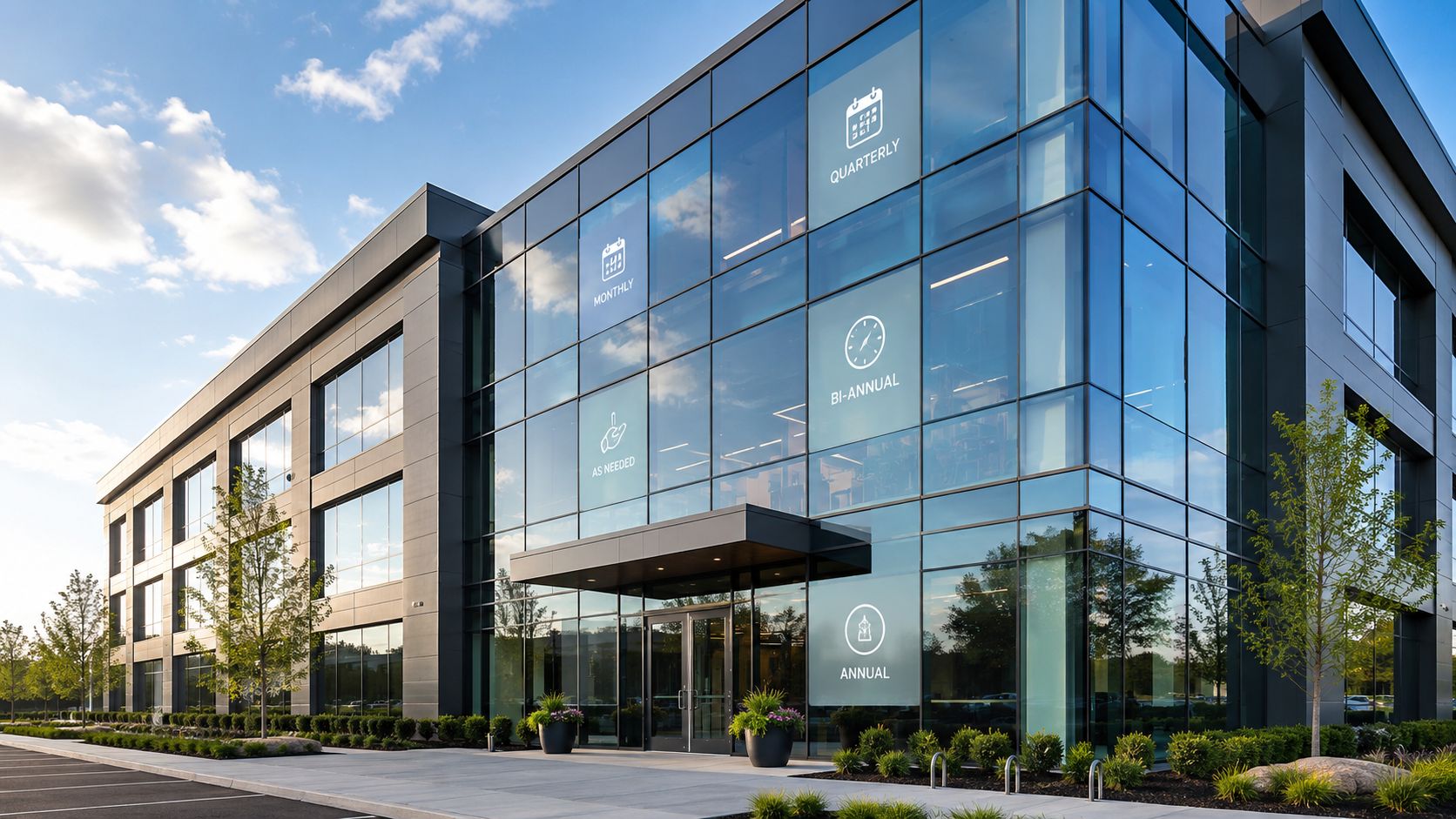
A property team approves twice-yearly window cleaning to control costs. By midwinter, street-level glass is carrying salt film, the lobby looks dimmer, and tenants near the perimeter start logging complaints about dirty sightlines. The issue is not appearance alone. The schedule no longer matches the building's exposure, tenant expectations, or maintenance risk.
Frequency works best as a maintenance standard, not a habit. Commercial windows should be cleaned often enough to prevent bonded soil, protect seals and frames from avoidable buildup, and keep public-facing areas at the finish level the site requires. That means the right interval depends on contamination rate, building use, and how visible the glass is to occupants, visitors, and inspectors.
A practical frequency framework
Most buildings fit into a few operating patterns:
- Street-facing retail, restaurants, and customer entrances: short intervals are usually justified because fingerprints, traffic film, and weather residue accumulate quickly and are noticed immediately.
- Multi-tenant office buildings: exterior glass often lands on a recurring cycle based on elevation and traffic exposure, while lobby glass and entry doors need much more frequent attention.
- Industrial, logistics, and roadside properties: exterior panes typically need closer monitoring because dust, exhaust, and mineral residue can adhere faster and become harder to remove if left in place.
- Schools, clinics, and medical offices: schedules usually need to line up with occupancy, inspection readiness, and a higher expectation for visible cleanliness in public areas.
Interior and exterior glass should not always follow the same calendar. Interior partitions, lobby panels, and entrance doors often need routine touch-up cleaning between full service visits. Teams already coordinating recurring janitorial scopes through office cleaning services for commercial properties usually get better results when those touchpoints are inspected regularly, while exterior window cleaning stays on its own specialist cycle.
Use condition triggers to adjust the schedule
A fixed quarterly or semiannual plan is easy to administer, but it can miss actual cost drivers. A better approach is to set a baseline frequency, then adjust based on field conditions.
Useful triggers include:
- Visible film on entry glass or storefront panes
- Seasonal salt, pollen, or irrigation spotting
- Nearby construction, roadwork, or facade work
- Tenant complaints about dirty perimeter glass
- Upcoming leasing tours, inspections, or executive visits
This approach improves budget control. You avoid over-servicing low-exposure glass, but you also reduce the chance that buildup sits long enough to require more aggressive cleaning or restoration later.
A simple rule for setting intervals
If dirty glass is seen daily by customers, tenants, or staff, treat window cleaning as a routine operating expense with short review intervals. If the glass is higher, lower-traffic, and less exposed to contaminants, a longer cycle may be reasonable, provided the condition is still inspected and documented.
The best schedule is the one a facility manager can justify in a budget meeting and defend during a site walk.
Decision Checklist for Hiring a Window Cleaning Service
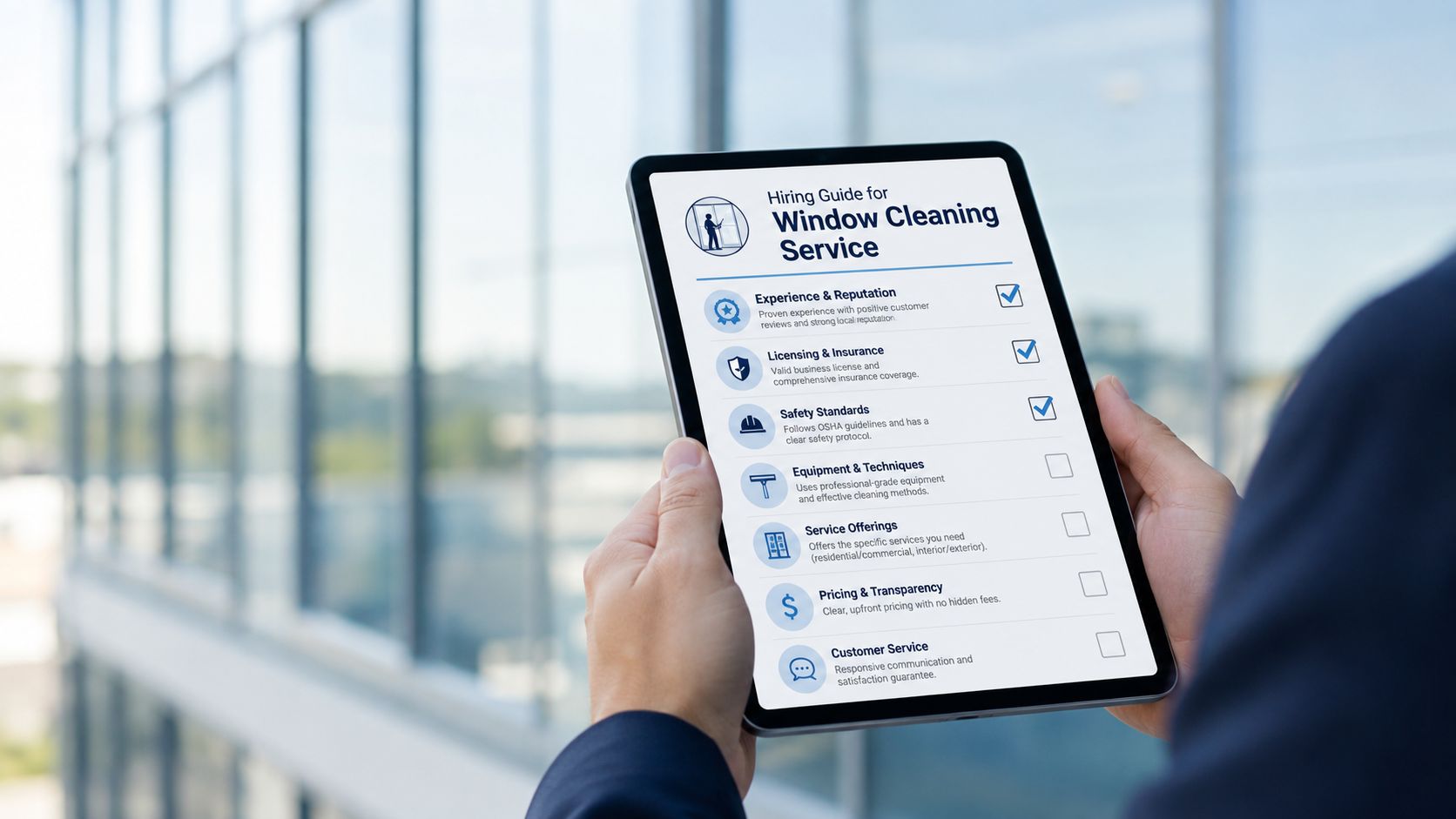
The buying process matters almost as much as the cleaning itself. A poor vendor can create access problems, missed windows, unclear invoicing, or safety exposure that lands back on the property team. A capable vendor makes the service routine and low-friction.
What to ask
- What exactly is included? Ask whether the quote covers interior glass, exterior glass, tracks, frames, sills, screens, or only visible panes.
- How will the crew access difficult areas? The answer should match the building. Water-fed poles, lifts, or controlled ladder work each have different implications.
- What insurance and safety documentation can they provide? Buyers should verify liability coverage and workplace safety compliance documents before approving work.
- How do they handle occupied spaces? This matters in offices, clinics, schools, and secure sites.
- What happens if the glass needs extra restoration work? Heavy mineral staining or construction residue should be identified before the job starts.
What to look for in the quote
A strong proposal usually has these traits:
- Clear scope language so no one argues later about what was or wasn't included.
- Defined service timing to avoid disruption to tenants, staff, or visitors.
- Method transparency so the facility knows whether the provider is using the right tools for the glazing.
- Site-specific notes that show someone assessed the property.
What to avoid
- Vague “all windows” wording without listing interior or exterior scope
- No mention of access method on buildings with height or awkward elevation changes
- Quotes that ignore safety planning
- Providers who can't explain how they deal with spotting, runoff, or occupant disruption
One neutral example of a broader service model is Arelli's commercial window cleaning service, which sits within a wider facility-cleaning offering. In practice, some buyers also value service features such as free sample cleans, live support, or flexible scheduling because those reduce uncertainty during vendor selection.
A professional quote should reduce ambiguity. If it creates new ambiguity, keep shopping.
Further Reading and Resources
A resource list should help a facility team act, not repeat links already used elsewhere in the article. For that reason, the references below focus on materials that support vendor screening, site planning, and policy alignment after the ROI case has been made.
Use these selectively. A property manager evaluating a quarterly service contract needs different material than a site supervisor building a glass-care scope into a broader maintenance plan.
If you need broader context on manufacturer care guidance, pricing models, or the tradeoff between in-house and outsourced cleaning, refer to the sources cited earlier in the article rather than a duplicated link list here. That keeps each reference tied to the claim it supports, which makes the article easier to audit and easier to use during vendor review.
Frequently Asked Questions
| Question | Answer |
|---|
| Is window cleaning worth it for a small office? | Often yes, if the office has client-facing glass, visible frontage, or perimeter areas where dirt becomes noticeable. For very small spaces with minimal accessible glass, periodic touch-ups may be enough. |
| Is it a maintenance expense or a cosmetic expense? | In many commercial settings, it's better treated as preventive maintenance. The value comes from preserving appearance, reducing buildup, and avoiding harder remediation later. |
| Should office staff clean windows in-house? | They can handle minor interior touch-ups on accessible glass, but once the task involves exterior work, height, or specialised equipment, the risk and labour trade-off usually favour a professional service. |
| What's the biggest mistake buyers make? | Buying on headline price alone. Scope gaps, poor access planning, and unclear safety responsibilities can make a low quote more expensive in practice. |
| Do all buildings need the same cleaning schedule? | No. Frequency should reflect frontage visibility, surrounding dust, traffic, seasonality, and occupant expectations. Trigger-based scheduling is often more efficient than a rigid one-size-fits-all cycle. |
| What should be included in a commercial quote? | The quote should define interior and exterior scope, access method, timing, and any assumptions about glass condition. That makes comparison between vendors much easier. |
| Is window cleaning useful for warehouses and industrial sites? | It can be, especially where exterior buildup, salt, or airborne particulates collect quickly. In those settings, the value is often operational and preventive rather than aesthetic. |
| Where can buyers check broader service questions? | Facility teams comparing cleaning scopes can review Arelli's FAQ page for general service and process information before requesting quotes. |
If you're reviewing whether window cleaning belongs in the operating budget, the sensible next step is to use the checklist above and get two or three comparable proposals. Arelli Cleaning is one option for GTA businesses that want window cleaning considered alongside broader office and commercial cleaning needs.












.webp)