The cheapest cleaning bid rarely represents the lowest total cost. A low monthly quote can exclude waste handling, supply restocking, after-hours access, inspection follow-up, or the communication needed when a cleaner can't enter the building. The result is rework, tenant complaints, missed inspections, and management time spent fixing preventable gaps.
Greater Toronto cleaning services are better understood as a compliance and consistency system for offices, clinics, schools, warehouses, and other commercial facilities. The service includes labour, scheduling, products, supervision, access procedures, waste logistics, documentation, and a clear method for correcting failures.
This guide gives busy facility and property managers a practical way to understand the market. It defines janitorial, office, and commercial cleaning, separates recurring work from specialty services, explains pricing models without pretending that one rate fits every building, and shows how Ontario requirements affect product selection and worker training. It also includes provider questions, evaluation criteria, and FAQs that can be used during procurement.
For a Toronto office, the right programme may centre on workstations, washrooms, kitchens, and meeting rooms. For a warehouse, it may prioritise particulate control, slip resistance, loading-area waste, and rapid response. A useful starting point for office managers is the Toronto office cleaning service area, but the same buying principles apply across the GTA.
Introduction to Greater Toronto Cleaning Services
The Greater Toronto Area is not a single building type or operating schedule. It includes high-rise offices, medical and dental clinics, schools, industrial facilities, warehouses, retail sites, and mixed-use properties. Each setting creates a different cleaning workload, access pattern, safety profile, and definition of acceptable quality.
The common misconception is that hiring cheap saves money. In practice, the lowest bid can become expensive when it leaves unclear scope, inconsistent staffing, weak supervision, or no process for documenting completed work. A facility manager still pays for the missing work, either through internal follow-up, repeated service, tenant dissatisfaction, or operational disruption.
Practical rule: Compare the cost of a complete cleaning system, not just the price of a visit.
A sound buying decision starts with four questions:
- What must be cleaned? Identify surfaces, rooms, traffic levels, washrooms, kitchens, waste points, and specialty areas.
- When can work happen? Set service windows around occupancy, access control, HVAC zones, security, and business continuity.
- What evidence is required? Decide whether the provider must supply checklists, inspections, incident records, product documentation, or corrective-action updates.
- Who owns the exceptions? Clarify responsibility for locked rooms, blocked loading areas, urgent spills, supply shortages, and missed tasks.
The GTA market supports local, service-intensive providers because demand is recurring and facilities vary widely. Ontario is described as Canada's largest provincial facilities-cleaning market, with independent industry commentary placing provincial janitorial and facilities-cleaning demand at roughly C$3.4 billion to C$3.7 billion. The same analysis identifies the Greater Toronto Area as the largest portion of that market because of its concentration of offices and commercial real estate. These figures and market observations are detailed in the Ontario facilities-cleaning market analysis.
The rest of this guide treats cleaning as an operational discipline. The aim isn't to promote a particular provider. It's to help a buyer recognise a complete scope, ask informed questions, and select a programme that remains dependable after the first few visits.
What Commercial Cleaning Means in the Greater Toronto Area
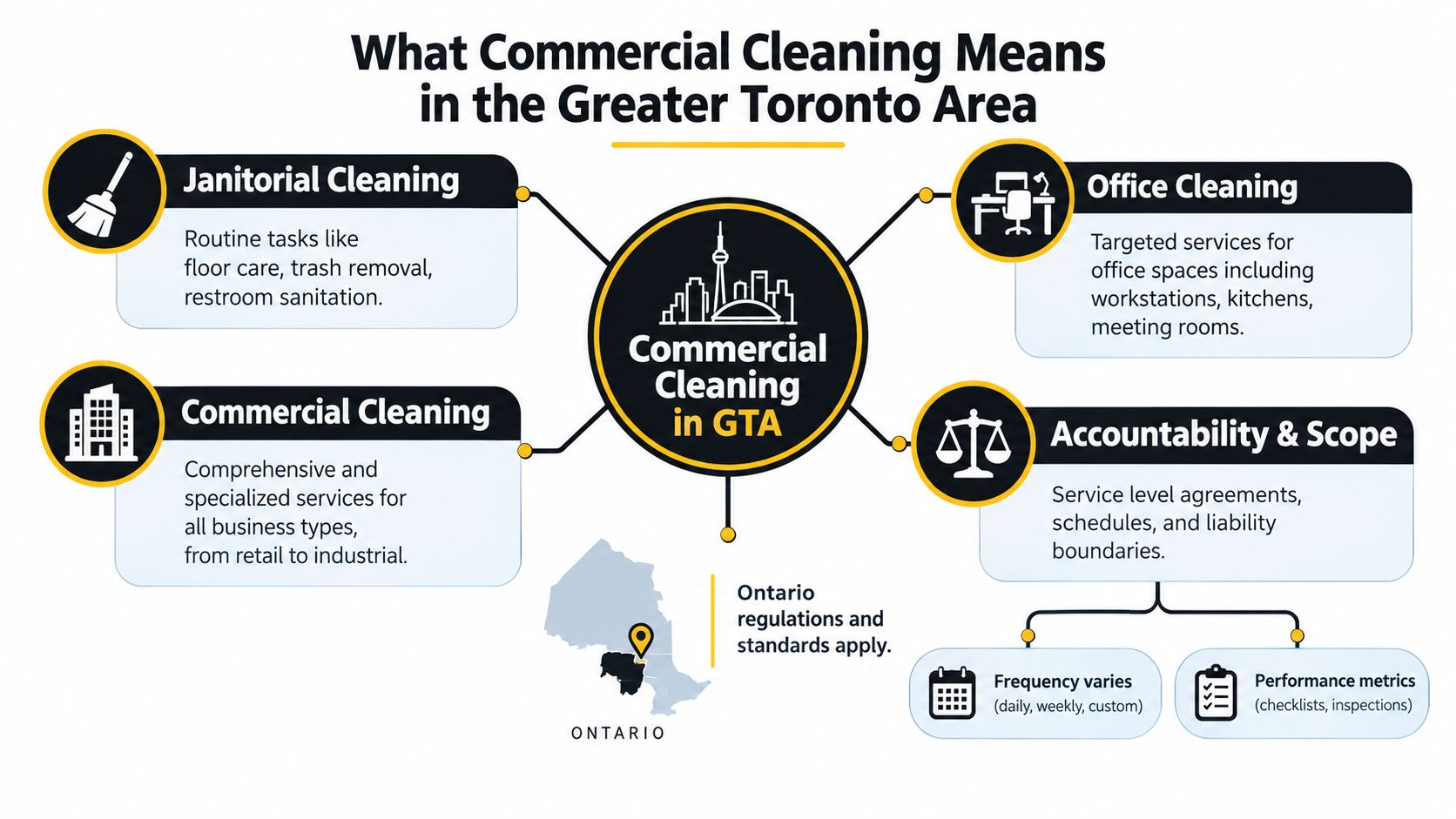
Commercial cleaning is the planned cleaning and maintenance of non-residential spaces. It can include routine janitorial work, office cleaning, washroom sanitation, floor care, waste removal, disinfection, post-construction cleanup, and other services defined by the facility's needs.
The terms overlap, but they aren't identical.
Janitorial, office, and commercial cleaning
Janitorial cleaning usually refers to recurring maintenance tasks. These may include vacuuming, mopping, washroom sanitation, surface wiping, replenishing consumables, and removing waste. The emphasis is continuity. A janitorial programme keeps a facility in an agreed operating condition through scheduled visits.
Office cleaning is a facility-specific form of janitorial work. It focuses on workstations, meeting rooms, kitchens, reception areas, washrooms, shared equipment zones, and other office features. Hybrid occupancy may require a flexible schedule rather than a fixed assumption that every desk is used every day.
Commercial cleaning is the broader category. It covers offices, retail facilities, clinics, schools, warehouses, industrial sites, and other business environments. The scope may include recurring cleaning and periodic specialty work, with the contract defining the boundary between routine service, restoration, emergency response, and client responsibilities.
The distinction matters because a quote labelled “office cleaning” may not include warehouse dust control, high-level cleaning, floor refinishing, post-construction residue removal, or regulated disinfection. A buyer should read the task list instead of relying on the service label.
Why the GTA structure affects buyers
Ontario's facilities-cleaning market is described as highly fragmented. More than 92% of roughly 12,400 Canadian janitorial establishments employ fewer than 20 people, according to the Ontario market analysis linked above. That structure helps explain why local providers can offer schedules and direct communication that match specific needs, while also making staffing depth, backup coverage, and supervision important questions for buyers.
A separate industry estimate places Canadian janitorial services at about C$8.8 billion in 2025 and projects about C$8.9 billion in 2026, with a reported 1.9% CAGR from 2020 to 2025. The same source describes a labour-heavy market with more than 40,000 businesses nationally in one 2026 estimate, and immigrant workers representing more than 55% of the national janitorial workforce, rising to over 70% in the Toronto and Vancouver metropolitan areas. These figures appear in the Canadian janitorial services market overview.
For a buyer, the implication is practical. Cleaning quality depends not only on the written checklist, but also on attendance, training, route planning, supervisor access, and rapid communication when conditions change.
Direct definition: Greater Toronto commercial cleaning is a recurring or periodic service system that maintains business facilities through defined tasks, schedules, products, staffing, supervision, and accountability controls.
For a technical perspective on surface-cleaning equipment and methods, VirusFAQ.com cleaning insights can provide useful background. Equipment doesn't replace process design, but it can support a suitable method when the surface, soil type, and facility risk have been assessed.
Core and Specialty Services You Will Find in Toronto
A useful service plan separates core recurring work from specialty work. Core work maintains daily conditions. Specialty work addresses periodic buildup, unusual surfaces, construction residue, high-level dust, exterior exposure, or a specific disinfection requirement.
Facility type determines the right combination. An office may need regular vacuuming, washroom sanitation, kitchen cleaning, and waste removal, while a warehouse may require more attention to floors, loading zones, dust, aisle safety, and equipment-adjacent areas. A clinic may need controlled product use and cross-contamination prevention rather than a generic surface-wiping routine.
After-hours scheduling is common across Toronto and nearby GTA municipalities. Local providers advertise 24/7 or extended service windows in Toronto, Mississauga, Brampton, Vaughan, Markham, Richmond Hill, and surrounding areas, as reflected by GTA service coverage information. Off-hours work can reduce interference with daytime traffic, access control, and normal building operations. It also creates a suitable window for higher-dwell disinfection, floor finishing, carpet extraction, and restoration tasks.
GTA Service Types Matched to Facility Needs
| Service Category | Typical Frequency | Best Fit Facility | Operational Note |
|---|
| Routine office janitorial | Daily, several times weekly, or custom | Offices, professional suites, shared workplaces | Define desks, kitchens, washrooms, floors, waste points, and secure rooms |
| Warehouse and industrial cleaning | Scheduled around operations | Warehouses, manufacturing sites, logistics facilities | Address particulate control, slip resistance, aisles, loading areas, and equipment access |
| Floor care | Periodic, based on traffic and flooring | Offices, retail, schools, commercial properties | Strip and wax or other restoration work may require restricted access and drying time |
| Carpet extraction | Periodic or incident-based | Offices, clinics, education, hospitality | Confirm drying, furniture movement, stain treatment, and re-entry procedures |
| Window cleaning and high dusting | Periodic | Offices, industrial sites, atriums, commercial buildings | Confirm height, equipment, access, insurance, and scheduling requirements |
| Power washing | Seasonal or periodic | Entrances, loading areas, exterior hard surfaces | Coordinate water access, drainage, pedestrian control, and weather conditions |
| Post-construction cleaning | Project-based | Renovated or newly built commercial space | Separate rough, detailed, and final cleaning scopes |
| Commercial disinfection | Routine, targeted, or incident-based | Clinics, dental offices, schools, offices, high-touch environments | Match the product and method to the intended setting and surface |
Specialty work should appear as a separate line in the scope. A recurring cleaner may not automatically include floor restoration, window work, high dusting, or construction cleanup. The specialty cleaning services information illustrates why these tasks need distinct planning.
A strong specification identifies who supplies products, which areas are excluded, how waste leaves the building, and what happens when a spill or urgent request falls outside the routine schedule. That detail prevents a broad service menu from becoming an incomplete operating plan.
Pricing Models and Contract Terms Explained
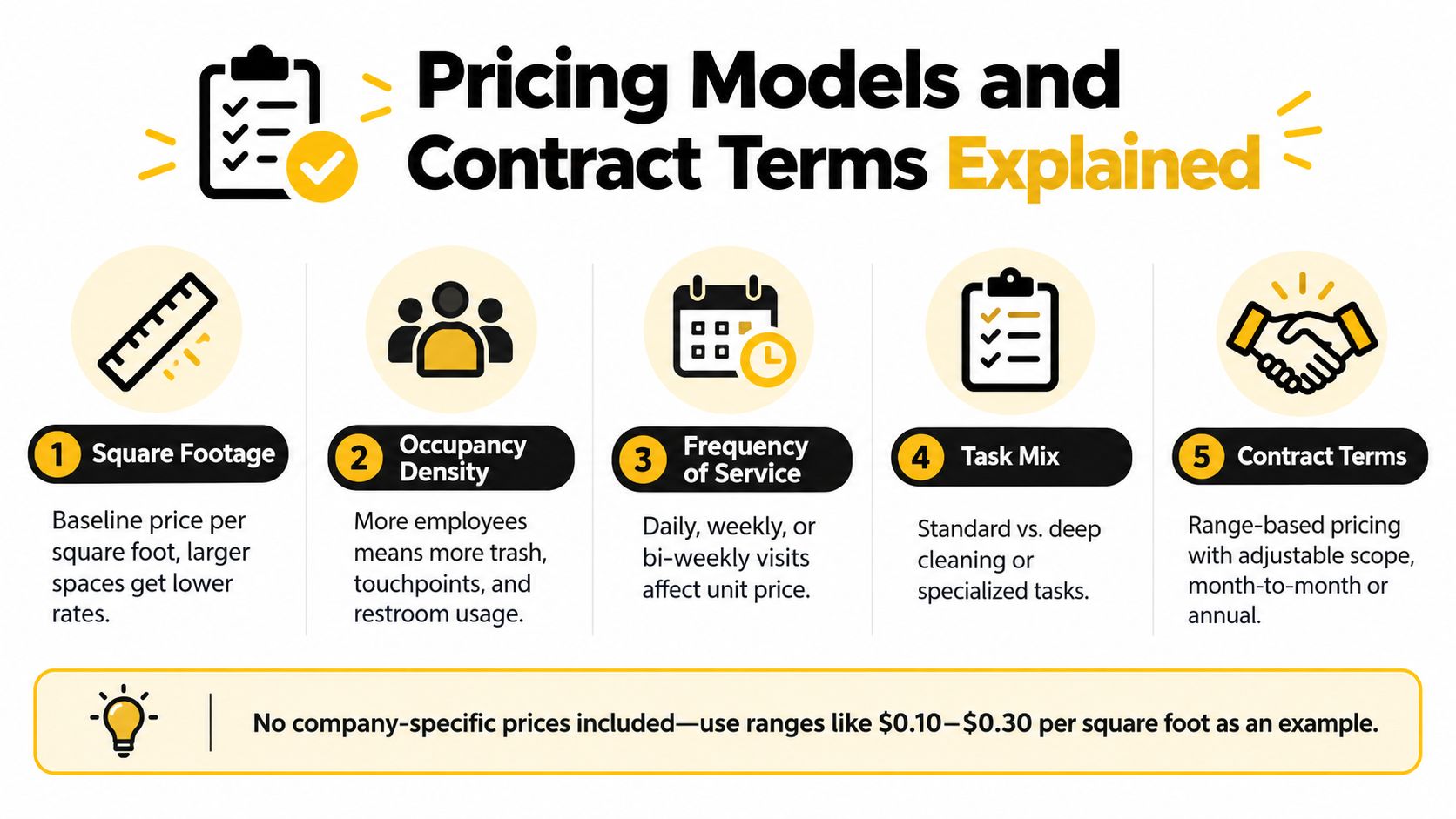
Commercial cleaning prices should be compared as ranges and total scopes, not as a universal rate. A provider generally considers square footage, occupancy density, service frequency, task mix, operating hours, floor types, washroom usage, waste volume, supply responsibilities, travel, access conditions, and specialty requirements.
A small office with low occupancy and simple finishes may require a different service pattern from a busy clinic or warehouse. Two spaces with similar floor area can therefore produce very different quotes.
Common commercial cleaning models
Per-visit pricing works when the scope and visit pattern are stable. It can be easy to understand, but the contract should explain what counts as an extra visit, an urgent callout, or a change in access conditions.
Monthly retainers create predictable budgeting for recurring service. The buyer should verify whether the retainer includes supplies, periodic tasks, inspection follow-up, and adjustments for occupancy changes.
Tiered packages can make comparisons easier when each tier clearly identifies frequency, rooms, task depth, response times, and exclusions. A low tier isn't necessarily poor value, but it may be unsuitable if the building's risk or traffic requires more control.
An online overview of cleaning pricing plans can help buyers see how service models are commonly presented, but every GTA facility still needs a site-specific scope.
Contract questions that prevent surprises
The onboarding stage often reveals logistics that a proposal misses. Many GTA buildings don't provide parking spaces for cleaning crews, and some don't offer an obvious garbage disposal area. Those constraints affect arrival times, equipment movement, waste handling, and the labour required to complete the work.
Before signing, ask:
- Scope changes: How are added rooms, occupancy changes, or seasonal tasks priced?
- Rework: What happens when an agreed task is missed or the result falls below the required standard?
- Access: Who supplies keys, access cards, alarm instructions, loading access, and parking guidance?
- Waste: Where can staff place garbage, recycling, or regulated materials?
- Term: Is the agreement month-to-month, annual, stop-and-go, or subject to a cancellation period?
- Price guarantees: Does a price-match promise apply to an identical written scope, and what exclusions apply?
A transparent contract states the work, schedule, supplies, response process, inspection method, cancellation terms, and assumptions. The cheapest quote is only comparable when those elements match.
Quality Assurance and Compliance in Ontario Workplaces
Clean appearance and compliant cleaning aren't the same thing. A facility can look tidy while workers lack product training, safety data, controlled dilution procedures, or a documented method for handling specialty tasks.
Chemical and disinfection controls
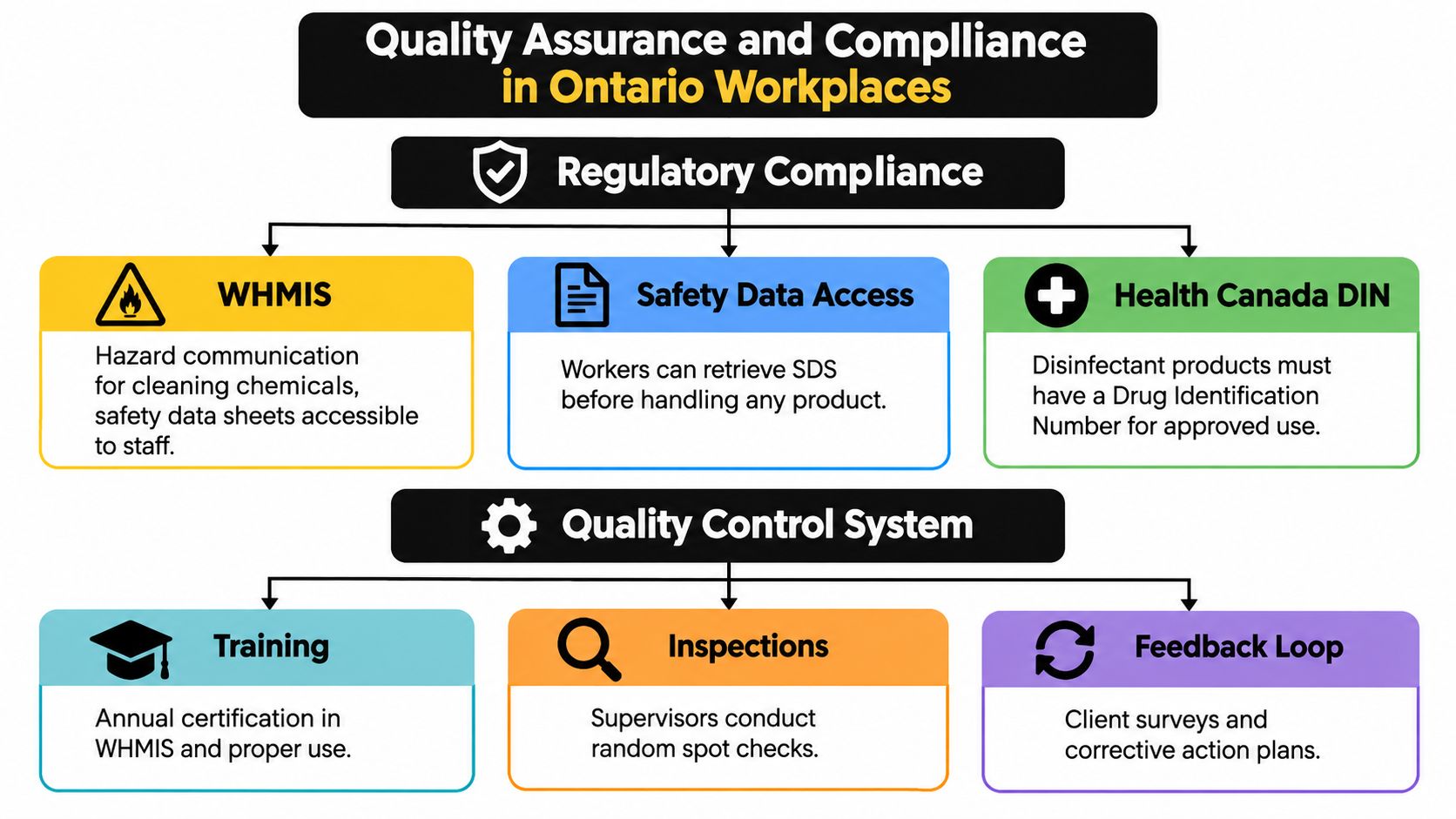
Health Canada states that workplace cleaning products don't require pre-market approval, but suppliers must meet WHMIS hazard-communication standards as a condition of sale. A responsible programme therefore gives workers access to labels and safety data, trains them to interpret hazards, and separates routine janitorial products from specialty chemicals used for stripping, waxing, extraction, or disinfection. The Health Canada guidance on disinfectant applications and workplace product requirements provides the relevant regulatory context.
Public Health Ontario states that disinfectants used on environmental surfaces should have a Health Canada Drug Identification Number, or DIN. A DIN is an 8-digit number confirming that the product is approved for use in Canada, as explained in the Public Health Ontario environmental cleaning guidance.
Health Canada's surface-disinfectant listings also show products approved for institutional and industrial use. That classification matters because the product must suit the facility setting and intended surface, not merely be selected for its perceived strength. The Health Canada emerging viral pathogen disinfectant listings offer a reference point for matching approved products to use settings.
The proof behind consistent work
A quality system should connect training, task instructions, supervision, inspection, client feedback, and corrective action. Technology can support scheduling, dispatch, proof of completion, and audit trails, but software is useful only when staff follow the underlying process.
Independent industry commentary reports that only 38% of cleaners use scheduling and dispatch software and 19% have adopted robotic equipment. Those figures are provided in commercial cleaning industry coverage. The practical lesson isn't that every facility needs robotics. It is that buyers should ask how a provider records attendance, handles missed tasks, escalates incidents, and demonstrates completion.
A compliance review can include:
- WHMIS records: Confirm training, product labels, and accessible safety data sheets.
- Product approval: Verify DIN information for disinfectants used on environmental surfaces.
- Task controls: Check dwell times, colour-coded materials where relevant, cross-contamination procedures, and floor-safety methods.
- Inspection evidence: Request sample checklists, supervisor inspection records, and corrective-action workflows.
- Site-specific training: Confirm that cleaners understand clinic, school, warehouse, or post-construction hazards.
For facilities that need targeted sanitation, the commercial disinfection and sanitizing service information provides an example of how disinfection can be treated as a defined service rather than an informal add-on.
How to Choose a Reliable Provider in the GTA
Provider selection should test the three factors GTA customers commonly value: competitive pricing, reliable customer service, and consistent quality. These factors are connected. A low price with poor response creates management costs, while excellent communication can't compensate for incomplete cleaning.
Start with a written site profile. Include floor areas, room types, occupancy patterns, washrooms, kitchens, waste points, floor finishes, access restrictions, preferred service windows, supply responsibilities, and specialty tasks. Give the same profile to 2 to 3 providers so the quotes can be compared on an equivalent basis.
A practical evaluation framework
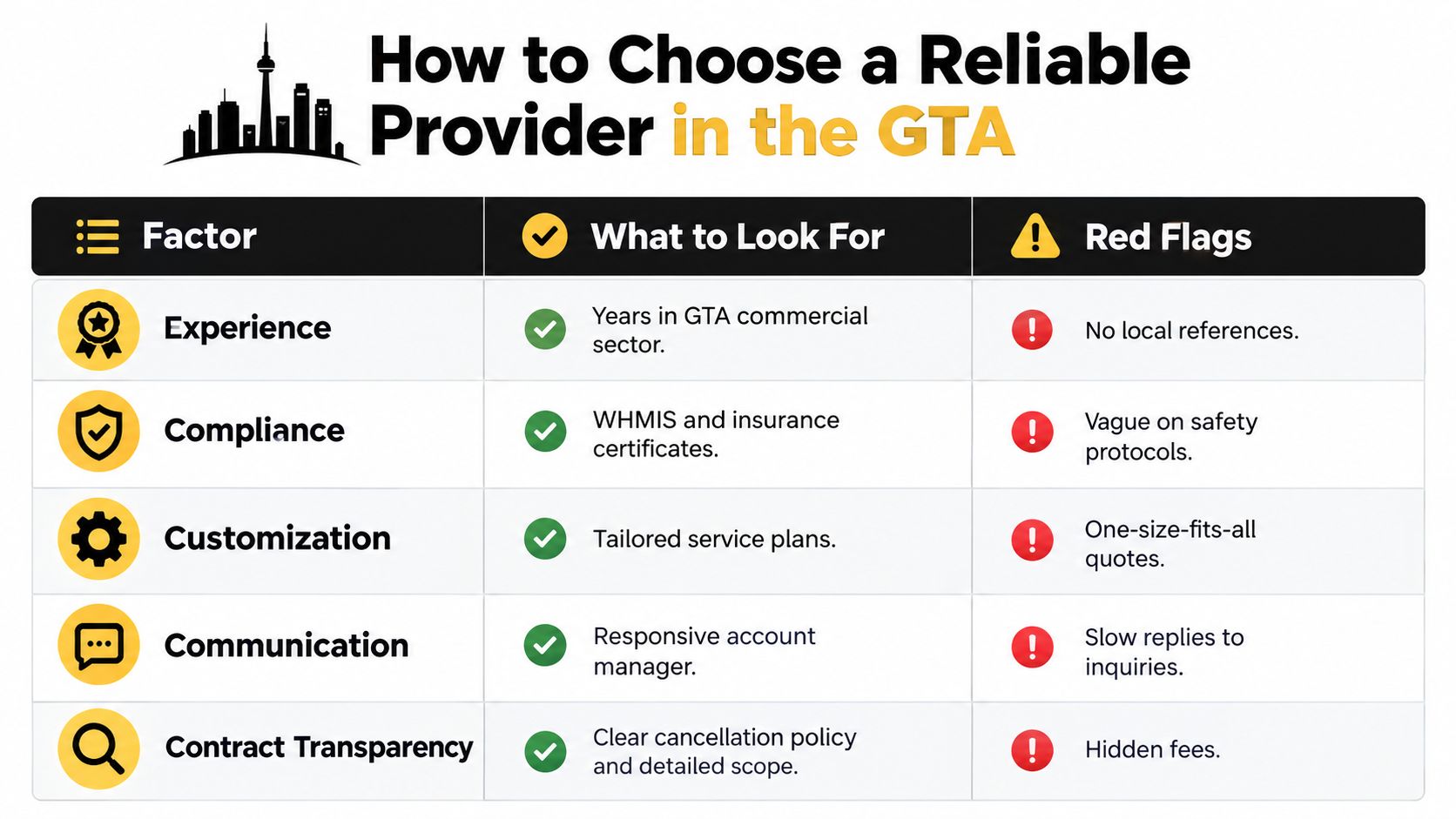
| Factor | What to Look For | Red Flags |
|---|
| Experience | Relevant GTA commercial references and experience with similar facilities | No local references or only residential examples |
| Compliance | WHMIS information, insurance certificates, product documentation, and clear safety protocols | Vague answers about chemicals, training, or incident handling |
| Customization | A tailored plan with rooms, tasks, frequency, exclusions, and service windows | One-size-fits-all quote |
| Communication | A named account contact, escalation route, and defined response expectations | Slow replies before the contract is signed |
| Contract transparency | Detailed scope, cancellation policy, extra-work process, and inspection method | Hidden fees or unclear exclusions |
A sample clean or trial period can reveal whether the provider follows instructions, protects surfaces, manages access, and communicates exceptions. It should be assessed against written criteria rather than general impressions.
Ask how the provider handles absences, supply shortages, locked rooms, parking restrictions, waste access, urgent spills, and missed work. Ask to see a sample inspection report or proof-of-work record. A technology-enabled service may offer stronger scheduling and audit trails, while a traditional service may rely more heavily on direct supervisor communication. The comparison should focus on the facility's required evidence and response speed.
A trustworthy quote makes the difficult parts visible before service begins.
Arelli Cleaning can be included in that neutral comparison when its service model fits the facility. Its published approach combines office and commercial cleaning, mobile communication, quality assurance, WHMIS controls, flexible service arrangements, and specialty services, but buyers should evaluate it against the same written scope and questions used for every provider.
Key Takeaways and Further Reading for Toronto Businesses
Greater Toronto cleaning services are easiest to evaluate when the buyer treats them as an operating system rather than a list of chores.
Key takeaways
- Price is only one input: A low bid can omit access, waste, supervision, supplies, or rework.
- Definitions matter: Janitorial cleaning is usually recurring maintenance, office cleaning is office-specific, and commercial cleaning is the broader category.
- Facility needs control the scope: Clinics, schools, offices, and warehouses require different products, schedules, and controls.
- Compliance must be visible: WHMIS training, accessible safety data, appropriate products, and DIN verification should be documented.
- Consistency needs evidence: Inspections, corrective actions, communication procedures, and proof of completion reduce ambiguity.
- Quotes must be comparable: Give the same site profile to 2 to 3 providers and review exclusions as carefully as inclusions.
Further reading
For local coverage, consult the GTA service areas, then review Arelli's resources on office cleaning in Toronto, specialty cleaning services, and commercial disinfection and sanitizing. The government references above are useful for product and workplace safety checks, while the Ontario facilities-cleaning market analysis provides market context.
Frequently asked questions
What are Greater Toronto cleaning services?
They are recurring or periodic cleaning services for commercial facilities across Toronto and surrounding GTA municipalities. The scope may include janitorial work, office cleaning, floor care, disinfection, waste handling, and specialty services.
How often should a Toronto office be cleaned?
The appropriate frequency depends on occupancy, traffic, washroom usage, food areas, floor finishes, and the facility's risk profile. A provider should recommend a schedule after reviewing the site rather than applying one default frequency.
Why does after-hours cleaning matter?
After-hours work can reduce disruption to occupants, access routes, HVAC zones, and daytime traffic. It also creates a controlled window for tasks that need more time, such as floor finishing or targeted disinfection.
When should a business request specialty cleaning?
Specialty work is appropriate when routine cleaning can't address the condition. Examples include construction residue, carpet extraction, floor restoration, high dusting, exterior washing, and certain disinfection requirements.
Where should cleaning staff dispose of waste?
The building owner or property manager should identify approved waste, recycling, and regulated-material disposal points before service starts. The location should be included in onboarding instructions.
Who is responsible for cleaning supplies?
The contract should name the responsible party. It should also identify approved products, replenishment duties, safety data access, and the process for replacing a product that isn't suitable for the facility.
What should a clinic ask a cleaning provider?
A clinic should ask about cross-contamination controls, product selection, DIN information for disinfectants, worker training, surface compatibility, dwell times, inspection records, and incident escalation.
How can a buyer compare quotes fairly?
Provide each bidder with the same site information and request matching detail on tasks, frequency, staffing, supplies, service windows, exclusions, extra work, inspections, and cancellation terms. Then compare the total operating scope, not just the headline rate.
What is the biggest mistake in selecting a cleaner?
Choosing on price alone. The safer approach assesses competitive pricing alongside customer service, consistent quality, compliance documentation, access logistics, and evidence that the provider can correct failures.
Arelli Cleaning offers office and commercial cleaning across the GTA, with recurring janitorial programmes, specialty cleaning, disinfection, quality controls, and communication processes designed around each facility's operating requirements. Businesses can review the service approach and request a discussion through Arelli Cleaning.








.webp)