Winter has ended, but the building still shows it. Salt haze sits on the lower brick. Loading-area concrete looks darker than it should. Entrance pads have algae in the shaded spots, and the glass never quite looks clean because the frames and sills are holding grime. For a Toronto property manager, that's rarely just a cosmetic annoyance. It's a maintenance signal.
Exterior power washing helps remove built-up soil, pollution, organic growth, and residues that can shorten the life of finishes and create safety issues around entrances, sidewalks, ramps, and service areas. On commercial properties, it also affects tenant perception, vendor access, scheduling, runoff control, and future work such as painting or sealing.
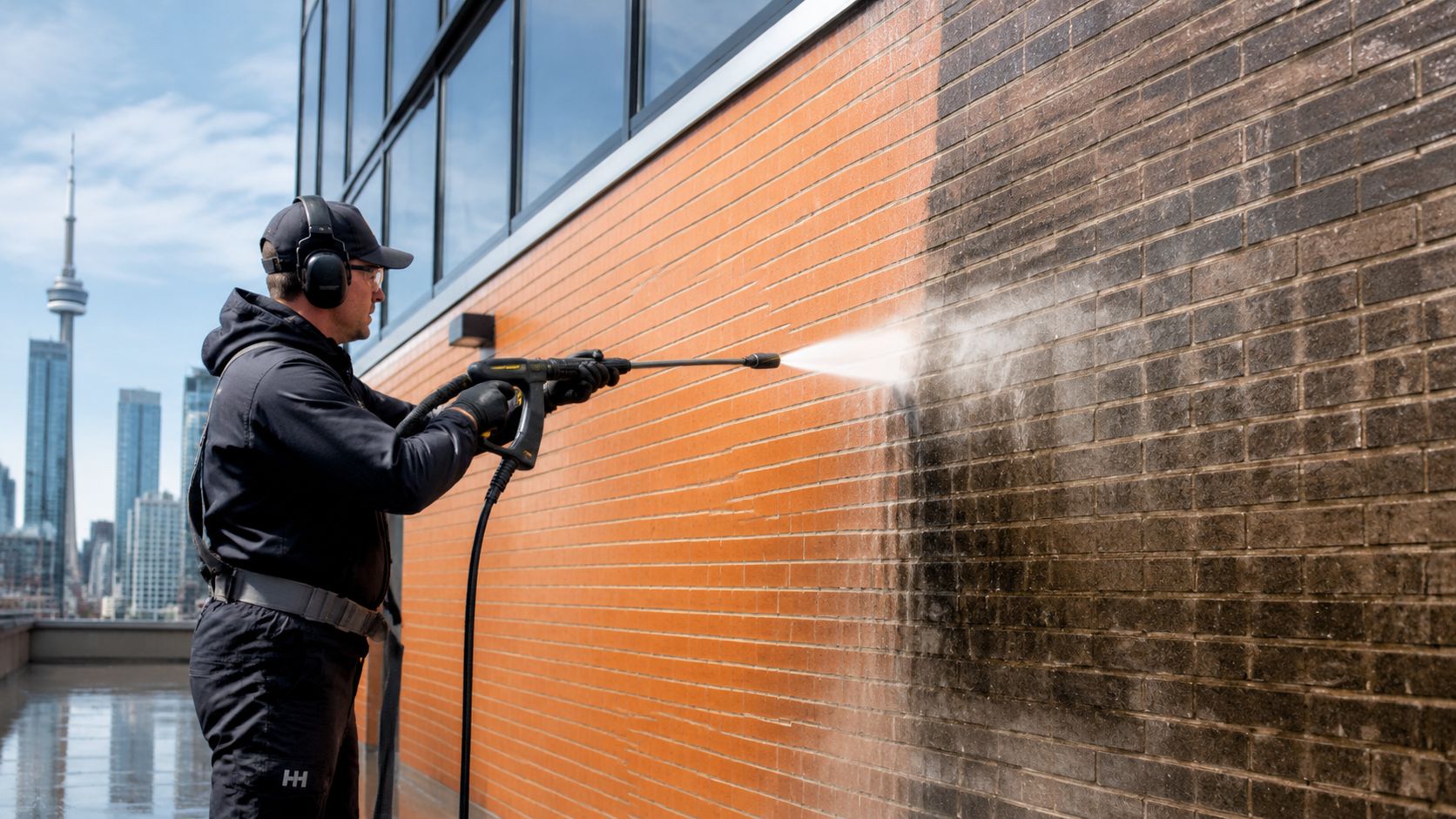
A quick visual reference can help set expectations. Many facility teams find before-and-after examples useful when scoping exterior cleaning, such as these Professional Window Cleaning transformations, because they show how much grime can accumulate gradually on ordinary surfaces.
Teams that bundle façade and glazing care often also review commercial window cleaning options, since dirty sills, frames, and adjacent cladding can make window work look incomplete.
Your Guide to Exterior Power Washing
Commercial exterior cleaning sits at the intersection of building science, safety, and operations. The right method protects surfaces. The wrong method can force water behind cladding, scar masonry, damage sealants, or send dirty runoff where it shouldn't go.
For Toronto properties, the decision is more technical than many buyers expect. Freeze-thaw cycles, traffic film, road salt, soot, and stormwater rules all change how a contractor should approach the job.
Key takeaways
- Power washing isn't one single method. Commercial contractors may use pressure washing, heated power washing, or soft washing depending on the surface and the contaminant.
- More pressure isn't always better. Delicate or porous materials often need lower-pressure, detergent-assisted cleaning to avoid damage.
- Toronto conditions matter. Freeze-thaw risk, urban pollution, and stormwater control should influence timing, equipment, and site protection.
- The best results come from matching method to material. Concrete, brick, EIFS, metal panels, window frames, and coated surfaces shouldn't all be treated the same way.
- Buying on price alone is risky. A useful quote explains method, runoff control, protection steps, access needs, and what the contractor will avoid cleaning aggressively.
Practical rule: Exterior power washing should be treated like preventative maintenance, not like a last-minute cosmetic fix.
What Is Commercial Exterior Power Washing
A Toronto property manager usually notices the need for exterior washing after a winter like this: the front walk is grey with salt film, soot has dulled the façade near the street, and splash marks have climbed the lower brick courses. At that point, commercial exterior power washing is less about appearance alone and more about controlled removal of contaminants before they shorten the life of finishes, joints, and paved surfaces.
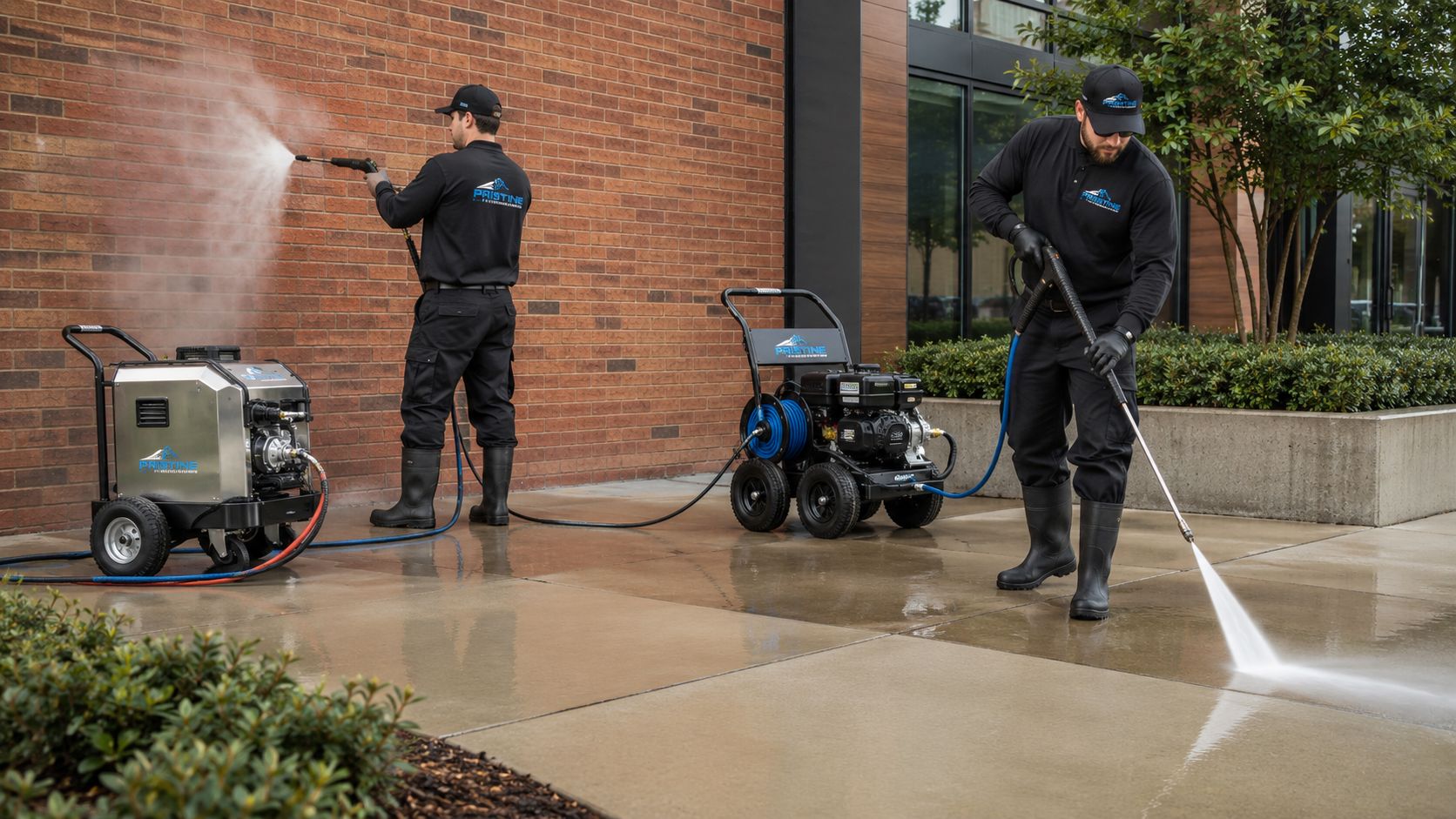
Commercial exterior power washing means cleaning building exteriors, hardscape, and related site surfaces with pressurised water, sometimes with heat and detergents, to remove traffic film, salt residue, biological growth, grease, and embedded grime. On a commercial site, that can include storefront concrete, loading areas, masonry walls, precast panels, metal cladding, dumpster pads, and other high-contact surfaces.
The terminology causes confusion because the industry uses three related terms for different tools and outcomes.
The three terms property managers hear most
- Pressure washing uses pressurised cold water to break loose soil from harder-wearing surfaces.
- Power washing usually means pressurised water with heat. Heat can improve cleaning where grease, food residue, or winter grime bonds tightly to the surface.
- Soft washing uses lower pressure and relies more on cleaning agents and dwell time than on impact.
A useful comparison is sanding versus dissolving adhesive. Pressure does the physical knocking loose. Chemistry and heat help separate what is stuck to the surface. Good commercial cleaning combines those tools based on the material, the contaminant, and the risk of pushing water where it should not go.
For Toronto properties, that distinction matters more than many first-time buyers expect. Freeze-thaw cycles can widen small cracks and open mortar joints. Road salt leaves residues that attract moisture. Urban pollution leaves a dark film on façades near traffic corridors. If washing is done carelessly, water can be driven into weak points, and any trapped moisture has a chance to create trouble during the next cold period.
PSI and GPM in plain language
Two equipment terms matter at buying time. PSI measures impact force. GPM measures water flow.
PSI works like the cutting force of a scraper. GPM works like the rinse volume that carries loosened contamination away. A contractor who talks only about high PSI may be overselling force while ignoring the rinse side of the job. The National Power Washing Authority explains that equipment selection for exterior cleaning depends on matching pressure and flow to the surface and soil load, not just choosing the highest output available, in its house exterior powerwashing guidance.
Some commercial contractors also use heat or steam where low-moisture cleaning has an advantage, especially around grease, gum, or sensitive areas where runoff control matters. In those cases, commercial steam cleaning services may be part of the discussion alongside standard washing methods.
Why commercial exterior washing is a facilities issue
On a commercial property, cleaning choices affect maintenance budgets, slip risk, tenant experience, and compliance. A loading dock may need grease removal. A retail entrance may need gum and salt cleanup to reduce slip hazards. A masonry wall may need a gentler approach so the face of the brick and the mortar are not worn down before their time.
Stormwater rules also shape the work. Dirty wash water can carry sediment, detergents, oil, paint particles, and other pollutants toward catch basins if the crew does not contain and recover it properly. That is one reason commercial exterior washing should be specified like maintenance work, with site protection, runoff planning, and material testing built into the job.
If you are trying to sort out the language contractors use, South Mountain Window Cleaning's recommendations give a helpful plain-English summary of how pressure washing and soft washing differ.
Pressure Washing vs Soft Washing Methods
The most important buying decision is often not whether to clean, but how to clean. Many exterior surfaces in the GTA look sturdy from the ground and still react badly to aggressive washing.
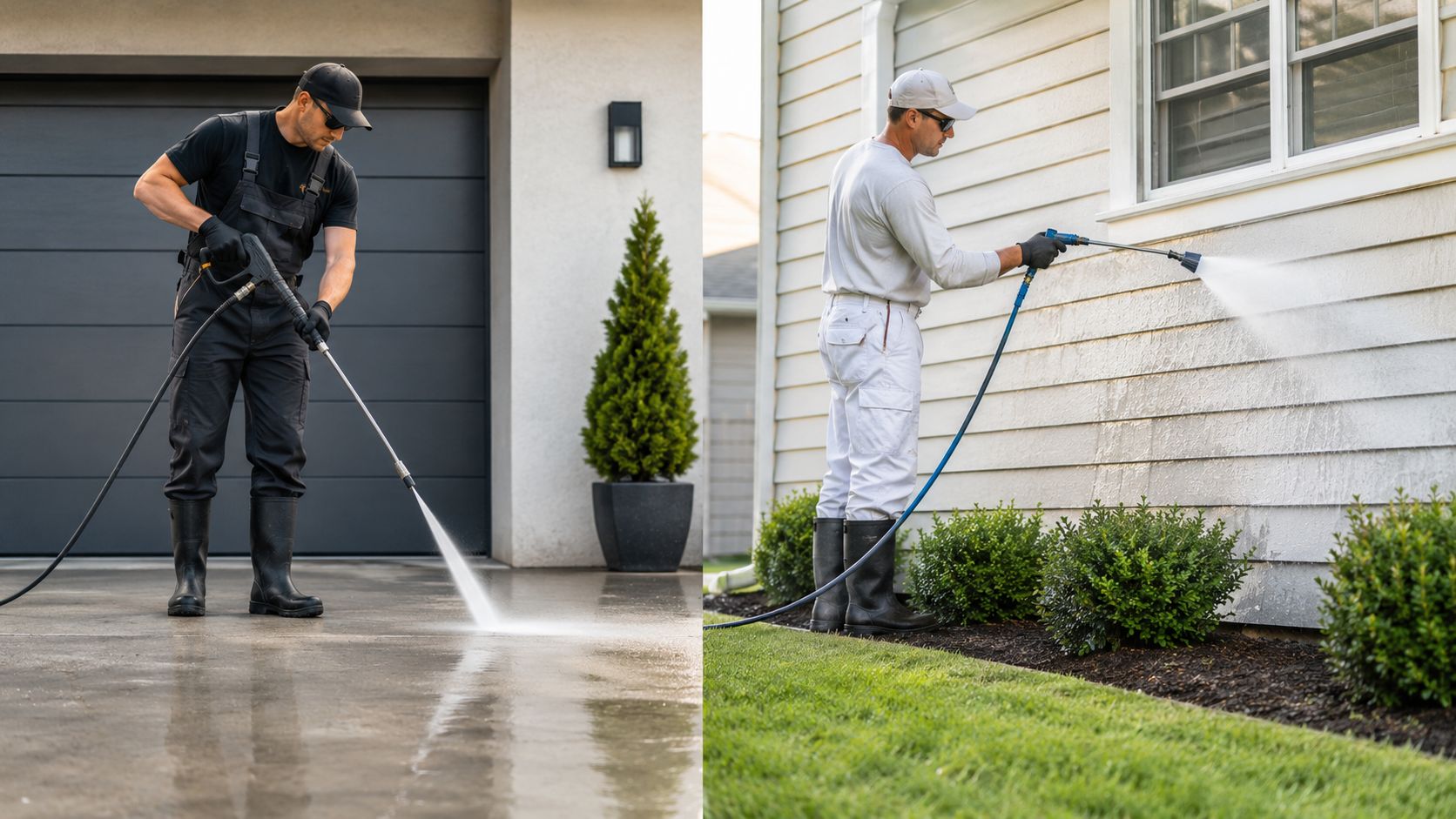
How the methods differ
Pressure washing depends mainly on the mechanical force of water. It works well where the surface can tolerate impact and where the soil needs to be broken free physically, such as on many hardscape areas, some masonry, and heavily soiled service zones.
Soft washing works differently. The operator uses lower pressure and lets detergents do more of the cleaning work. This is usually the safer option on delicate cladding, aging finishes, painted trim, roofing elements, some siding systems, and areas where forcing water inward would be a mistake.
Industry guidance consistently warns that while building-exterior equipment may operate within 1,200 to 3,500 PSI, sensitive materials such as siding, shingles, or porous masonry often require lower-pressure, detergent-assisted cleaning to avoid water intrusion, etching, and surface damage. That approach is outlined in Valcourt's guidance on maintaining building exteriors.
For buyers who want a second plain-language explanation, South Mountain Window Cleaning's recommendations are useful because they compare the logic behind each method without assuming every dirty exterior needs high pressure.
Some facility teams also compare washing methods with related low-moisture restoration services such as commercial steam cleaning when they're dealing with grease, detail work, or interior-adjacent surfaces.
Pressure Washing vs. Soft Washing for Commercial Properties
| Feature | Pressure Washing | Soft Washing |
|---|
| Primary cleaning action | Water impact and mechanical force | Detergent action with gentle rinsing |
| Typical use | Durable surfaces with bonded dirt or heavy residue | Sensitive or porous surfaces with organic growth, staining, or finish risk |
| Pressure level | Higher within the appropriate equipment range for the material | Lower pressure by design |
| Best-fit surfaces | Many concrete areas, some brick, service yards, loading areas | EIFS, painted siding, trim, shingles, delicate façades, some porous masonry |
| Main risk if misused | Etching, gouging, seal failure, water intrusion | Incomplete cleaning if chemistry or dwell time is poorly chosen |
| When buyers often choose it | Heavy visible grime on robust surfaces | Mold, mildew, algae, or material-sensitive elevations |
| Operator skill focus | Distance, nozzle angle, pressure control, rinse pattern | Chemical selection, dwell time, surface compatibility, controlled rinsing |
A practical way to choose
A property manager doesn't need to memorise machine settings. It's more useful to ask three questions:
What is the surface made of?
Brick, split-face block, precast, EIFS, metal panels, painted wood trim, and vinyl don't behave the same way.
What is being removed?
Salt film, soot, algae, grease, rust, and graffiti each respond differently.
What happens if water gets behind it?
This is the question many generic articles miss. If the answer is “possible swelling, staining, seal failure, or freeze damage,” the method must be conservative.
A competent contractor chooses the least aggressive method that still achieves full cleaning.
Where confusion usually starts
Many owners assume visible dirt equals a pressure problem. Often it's a chemistry problem, a dwell-time problem, or a runoff-control problem. More force can make the surface cleaner in the moment and more vulnerable afterwards.
That's especially true on older façades, patched masonry, deteriorated joints, window perimeters, and decorative coatings. A building can tolerate weather for years and still be damaged by one careless cleaning cycle.
Key Benefits for Commercial Properties
The strongest case for exterior power washing isn't “the building looks nicer.” That's true, but it's incomplete. The primary value comes from protecting the asset, reducing avoidable risk, and making other maintenance work more effective.
Asset preservation
Toronto buildings collect more than dust. They collect traffic film, soot, salt residue, organic growth, and airborne pollutants. Left in place, those soils can stain coatings, hold moisture against surfaces, and make defects harder to spot.
Cleaning restores visibility. Maintenance staff can see failing sealant, cracked mortar, rust bleed, coating wear, and drainage issues much sooner on a clean surface than on a dirty one.
Safer exterior circulation
Entrances, ramps, side paths, and waste areas often develop slippery organic buildup before anyone notices it formally. Algae and grime don't need to look dramatic to create a traction issue.
That matters on office, school, clinic, and warehouse properties where foot traffic is predictable and liability exposure is real. A clean path is easier to inspect and easier to keep safe.
Better presentation without repainting everything
A retail frontage, office entrance, or medical building may look “old” when the actual problem is accumulated residue. Washing can sharpen the appearance of brick, concrete, metal trim, canopies, and signs without rushing into a larger capital project.
For managers of client-facing sites, that perception shift matters. Clean exteriors support a more organised image for staff, visitors, tenants, and prospective occupants.
Better preparation for follow-on work
Exterior power washing is often a prep step, not the final step. Contractors may need the surface clean before:
- Painting crews arrive
- Sealants are repaired
- Masonry is inspected
- Concrete is sealed
- Windows receive detailed finishing work
A Toronto office manager planning seasonal upkeep may align exterior washing with other services, especially where façade presentation affects tenant or visitor experience. In those cases, buyers often compare building exterior work with broader office cleaning services in Toronto so the property presents consistently inside and out.
Safety and Environmental Compliance in Toronto
A good exterior wash plan for Toronto starts with one assumption. Water is useful, but uncontrolled water can create building problems.
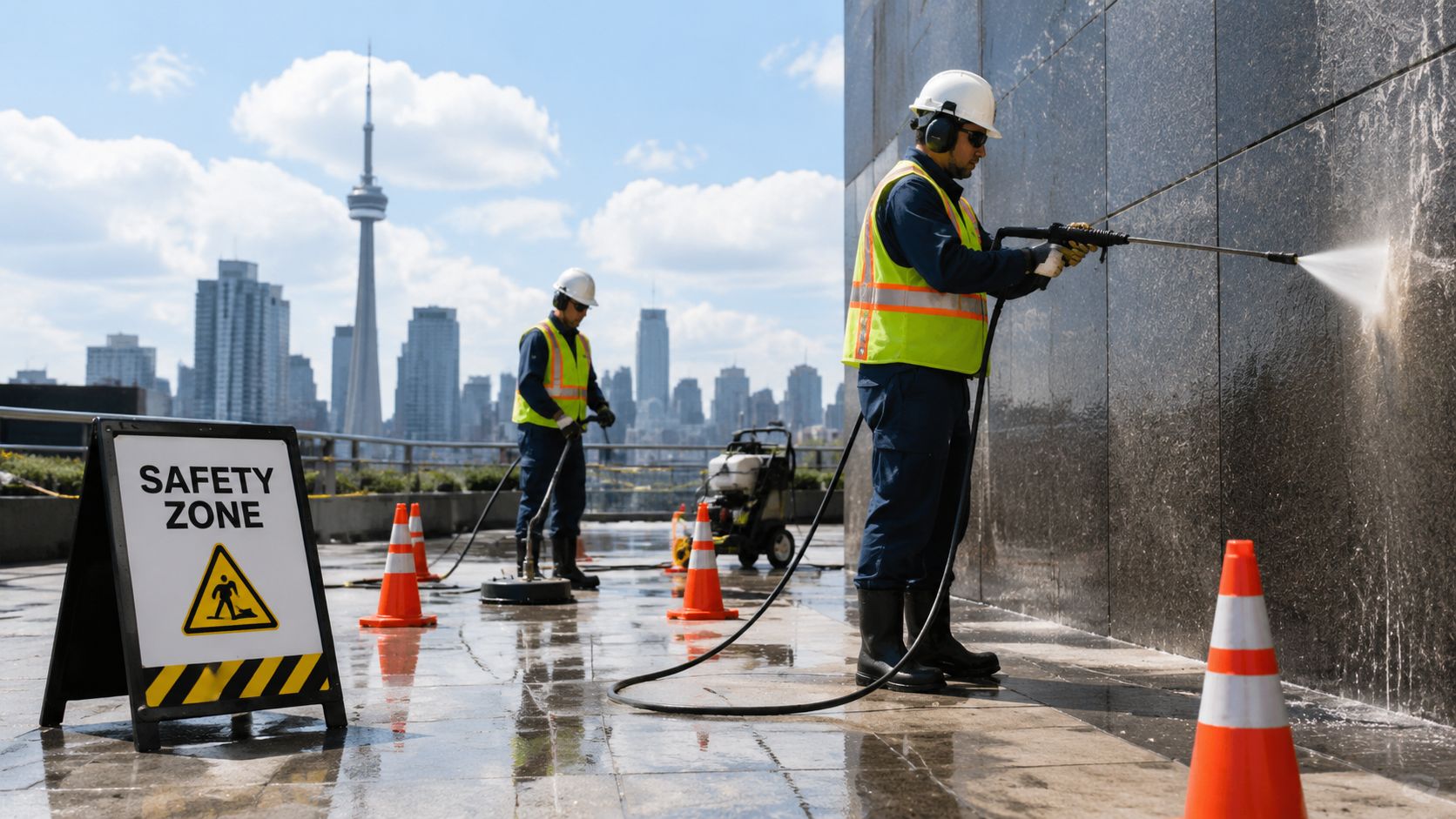
Freeze-thaw risk is a material issue
Southern Ontario's climate creates a serious timing and technique problem. If a contractor drives water into porous or aging assemblies, that moisture may not leave the system as quickly as the surface appears to dry.
Verified guidance notes that in Ontario's freeze-thaw climate, improper power washing can increase the risk of water intrusion, surface spalling, and joint failure in materials such as masonry and EIFS, and that Toronto stormwater rules make runoff control critical, as discussed in Alpha Exterior Solutions' article on power washing and gutter cleaning.
That warning matters most on:
- Older brick façades with weakened mortar joints
- Stucco and EIFS where trapped moisture can lead to hidden damage
- Window perimeters with aging sealant
- Parapets, ledges, and buried edges where water can linger
Runoff control is not optional
Commercial washing can produce dirty water carrying soil, oils, detergent residue, and loosened pollutants. On an occupied urban site, that creates both an environmental issue and an operational one.
A careful contractor should think through where water will travel before work begins. That includes storm drains, sloped sidewalks, garage ramps, plant beds, loading docks, and neighbouring pedestrian routes.
Key controls often include:
- Drain protection to stop contaminated runoff entering storm systems
- Work-zone isolation so pedestrians don't walk through wet or treated surfaces
- Detergent selection matched to the surface and the discharge risk
- Recovery planning where water collection or controlled disposal is needed
- Scheduling around weather so rain doesn't spread residue across the site
Site rule: If the contractor can't explain where the runoff goes, the cleaning plan isn't finished.
Worker and property protection
Exterior washing on commercial properties often involves ladders, boom lifts, extension wands, electrical awareness, hose management, and chemical handling. The visible cleaning is only part of the job. The invisible planning matters just as much.
A risk-aware work plan should account for:
- Public safety around entrances, exits, and sidewalks
- Surface protection for windows, hardware, signage, lighting, and landscaping
- Chemical handling with proper labelling and worker awareness
- Access control for loading areas and vehicle routes
One practical example. A warehouse may be easy to wash on a weekend, but far harder during active delivery hours because hoses, overspray, and wet pavement can interfere with trucks and staff movement. The method and schedule have to fit the site, not just the stain.
How to Hire a Professional Power Washing Service
Buying commercial exterior washing is less about finding a machine and more about finding judgement. Most problems happen when a vendor applies one method to every surface or prices the job without studying access, drainage, and materials.
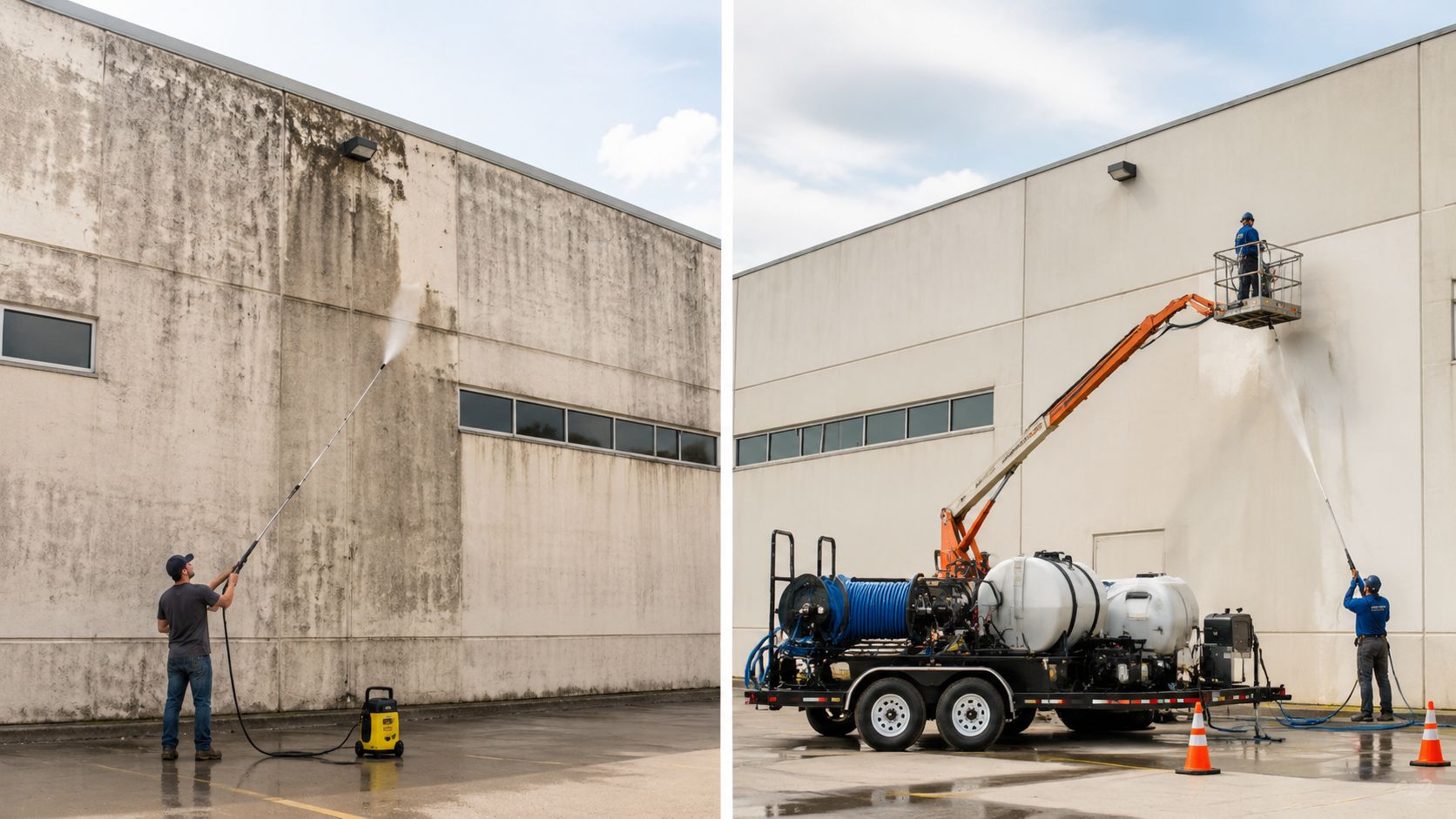
DIY versus professional service
A small owner-occupied site may be tempted to rent equipment. For isolated hardscape cleaning, that can look straightforward. Commercial properties are different.
A professional crew brings material-specific judgement, surface testing, access planning, and a way to manage runoff and public safety. They should also know when not to wash aggressively, which is often its primary value.
Businesses comparing vendors usually review exterior work alongside broader commercial cleaning services, especially when they want one provider or a coordinated maintenance plan. Arelli Cleaning is one GTA option that includes commercial power washing among its specialty services.
Questions to ask before approving a quote
Use these questions to separate a technician from a spray-and-go operator:
- What cleaning method will be used on each material? Ask them to distinguish between pressure washing and soft washing by surface.
- How will runoff be controlled? The answer should mention drain protection, containment, or another site-specific plan.
- What areas are excluded or treated cautiously? Good contractors identify weak mortar, failed sealants, deteriorated coatings, or delicate trim before starting.
- How will occupied areas be protected? Look for a plan for entrances, cones, signs, hose routing, and slip prevention.
- What access equipment is required? Ladders, lifts, extension poles, and water-source planning affect cost and safety.
- How will detergents be selected? They should explain compatibility with the surface and the contaminant.
What to avoid
Some warning signs are easy to spot:
- One-pressure-fits-all language such as “we blast everything clean”
- No site visit on a complex or multi-material building
- No mention of drainage or stormwater
- No discussion of existing damage
- No testing plan for older masonry, painted surfaces, or sensitive cladding
The lowest quote can become the most expensive if it leaves etching, leaks, damaged joints, or tenant complaints.
Common cost drivers
Commercial quotes vary because the job scope varies. Cost is usually shaped by the building size, height, access difficulty, soil load, water availability, surface sensitivity, protection needs, and whether special treatment is needed for grease, graffiti, or organic growth.
That's why it's smart to get 2 to 3 detailed quotes and compare scope, not just price. A useful quote should state what is being cleaned, what method will be used, what protection steps are included, and what assumptions the price depends on.
Frequently Asked Questions
How often should a commercial building be washed
Set the schedule by exposure, not by habit. A downtown Toronto property beside heavy traffic will collect diesel film, brake dust, and soot faster than a low-rise office on a quieter street. Buildings with tree cover, shaded north-facing walls, parking ramps, restaurant exhaust, or winter salt exposure usually need closer monitoring because those conditions hold moisture or leave residue behind.
For many properties, an annual review is a better starting point than a fixed calendar promise. The façade should be assessed after winter, when freeze-thaw stress may have opened small cracks or weakened joints, and again during the warmer season if grime is building in visible public areas.
When is the best time of year for exterior power washing in Toronto
Late spring through early fall is usually the safest window. The goal is not just cleaning. It is giving the surface enough time to dry so trapped water does not sit in mortar, behind cladding edges, or around failed sealants before a cold night.
Toronto weather makes timing more technical than many managers expect. A wall can look dry on the surface and still hold moisture in pores and joints, much like a sponge that feels dry on top but stays wet inside. That matters on masonry and older façades, where repeated freezing and thawing can turn a small moisture problem into spalling, efflorescence, or interior leakage.
Can power washing damage windows, seals, or siding
Yes. Damage usually comes from forcing water where it does not belong or from using more pressure than the material can tolerate. Window gaskets, aging sealant joints, painted trim, oxidized metal, EIFS, and weathered siding are all vulnerable if the operator gets too close or sprays upward into laps and joints.
The safer question is not "how much pressure will be used?" It is "how will the method be matched to each surface?" On a mixed-material commercial building, one setting rarely fits everything. Glass, metal panels, brick, precast, and caulking each respond differently to water impact, heat, and cleaning agents.
Is soft washing only for houses
No. It is often the better fit for commercial properties with delicate finishes or contamination that needs chemistry more than force. Soft washing works like using the right solvent before scrubbing a greasy pan. You loosen the bond first, then rinse with less mechanical stress.
That approach is especially useful on painted surfaces, decorative masonry, stucco-like systems, signage, and shaded walls with algae or organic staining.
Does exterior washing help before painting or repairs
Usually, yes. A clean surface gives maintenance staff and contractors a truer reading of the building condition. Dirt can hide failed joints, hairline cracking, coating breakdown, and water tracks.
Cleaning also improves repair planning. If a mason or sealant contractor is pricing work on a dirty wall, some defects will be missed and others will be misread.
Is hot water always better than cold water
No. Hot water helps with grease, oily residue, and some traffic film, but it is not automatically safer or more effective on every façade. The contaminant and the substrate both matter.
For example, heated water may help on loading areas or around waste handling zones. On a more delicate elevation, the better answer may be lower pressure, the right detergent, and controlled rinse volume.
What should a property manager document before work starts
Document existing conditions in a way that protects both the building and the budget. Start with dated site photos of stained areas, cracks, failed caulking, rust marks, open joints, damaged coatings, and any spots where water already enters the building. Then note pedestrian routes, delivery access, drain locations, planted areas, outdoor outlets, and surfaces that may become slippery.
In Toronto, stormwater planning belongs in that record too. If detergents or wash water could reach catch basins, the contractor should explain the containment or recovery plan before work begins, not after hoses are already on the ground.
A practical next step is to use the checklist above, get 2 to 3 detailed quotes, and compare methods, protection steps, and runoff planning rather than price alone. For GTA businesses that want one more option in that comparison, Arelli Cleaning provides office and commercial cleaning services, including specialty exterior work, across multiple service areas listed on its GTA locations page.









.webp)