A Toronto property manager often sees the same pattern. The floors look fine on Monday. By Thursday, a tenant reports an unstocked washroom, a clinic asks what disinfectant was used, and a site supervisor wants proof that shared facilities were cleaned when scheduled. The problem isn't always visible dirt. It's the gap between work that appears done and work that can be verified.
That gap matters more in Toronto than many generic cleaning guides suggest. Office towers, mixed-use properties, childcare spaces, dental clinics, warehouses, and education sites all sit inside a more structured operating environment than “clean and reliable” can cover. Ontario's facilities cleaning market has been estimated at about C$3.0 billion by 2025, and Canada had 34,008 business locations in janitorial services in December 2023, which points to a mature market where buyers should expect documented systems, not improvised service.
Introduction Why Expectations Matter for Toronto Property Managers
Property managers rarely struggle to find a cleaning company. They struggle to find one whose standards stay clear after the site tour, after the first month, and after the first complaint. A polished proposal can hide soft details such as vague frequencies, unclear escalation paths, or missing safety records.
That's why expectations need to move beyond appearance. A commercial cleaning company should be treated like any other building operations partner. The provider should have a defined scope, a repeatable process, site-specific controls, and a way to prove work was completed.
What a property manager is really buying
A useful way to think about cleaning is to compare it to HVAC maintenance. No one judges an HVAC contractor only by whether the air “felt okay” on one afternoon. Managers expect schedules, logs, service records, and a clear response process. Cleaning should be managed the same way.
For Toronto properties, that means expectations should include:
- Clear scope: Which rooms, touchpoints, washrooms, entrances, and shared areas are included.
- Defined frequencies: Daily, periodic, and as-needed tasks should be separated in writing.
- Proof of completion: Logs, reports, inspections, and follow-up notes should exist.
- Compliance support: Chemical safety, disinfectant selection, and recordkeeping should be organised.
- Reliable communication: Someone should own issues, updates, and changes to scope.
Direct answer: What Toronto property managers should expect from a commercial cleaning company is not just a clean-looking building. They should expect a managed service with documented scope, measurable standards, communication discipline, and Ontario-ready compliance records.
Why vague promises create avoidable risk
“High quality service” sounds reassuring until a tenant asks why a breakroom wasn't sanitised properly, or a worker asks where the washroom cleaning record is posted. At that point, language like “we usually do that” isn't useful.
Busy managers need a simpler filter. Can the provider define what gets cleaned, how often, with which products, under which safety controls, and how missed work is corrected? If the answer is fuzzy, the relationship will stay reactive.
Understanding What Commercial Cleaning Really Covers in Toronto Buildings
A Toronto property manager can walk the same building with two different cleaning vendors and hear the same phrase, “full service cleaning,” from both. The problem is that those words can cover very different tasks, frequencies, and compliance responsibilities.
Commercial cleaning needs to be read in layers, like a scope map for the building. One layer covers daily upkeep. Another covers periodic restoration work. A third applies where sanitation rules, product records, and posted logs matter. If a proposal blends those together, it becomes hard to compare prices and even harder to hold anyone accountable later.
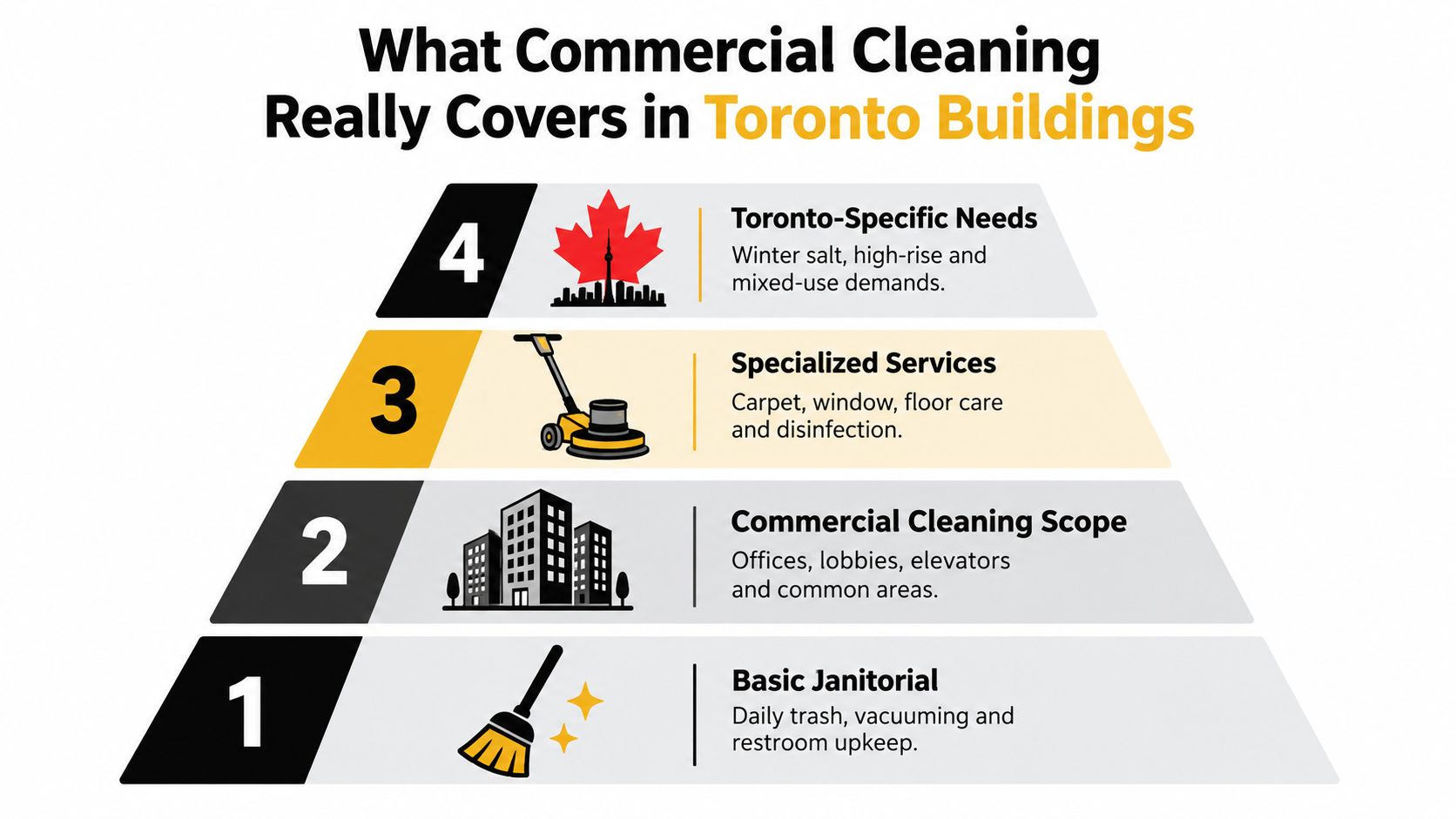
Tier one is routine janitorial work
This is the daily operating layer. It usually includes garbage removal, vacuuming, damp mopping, washroom cleaning, spot wiping, and basic dusting. In a standard office or mixed-use property, this work keeps the space usable and presentable from one day to the next.
It also sets the baseline for everything else. If routine work is inconsistent, managers end up using specialised services to solve problems that should have been prevented earlier.
Tier two is shared-area and building-wide care
As foot traffic increases, scope expands beyond workstations and private offices. Entrances, lobbies, stairwells, elevators, shared kitchens, locker rooms, and tenant common areas often need their own task lists and frequencies. Toronto winters make this even more specific. Salt film, slush tracking, and saturated entry mats affect floor appearance, slip risk, and how often entrances need attention.
For managers reviewing Toronto office cleaning service expectations, this is often the point where quotes start to look similar on the surface but differ in practice. One provider may include interior glass, lunchroom appliances, and lift lobbies. Another may price those separately. “Office cleaning” sounds clear until you ask what is included by area.
Tier three is specialised periodic work
Routine work covers daily upkeep. Specialised work covers restoration tasks that need different equipment, scheduling, staff training, and pricing.
Common examples include:
- Carpet care: extraction, stain treatment, and restorative cleaning
- Hard floor care: machine scrubbing, stripping, sealing, and finish maintenance
- Window cleaning: interior glass partitions and higher-access areas
- High dusting: vents, ledges, warehouse racking, and overhead surfaces
- Targeted disinfection support: situations where contact time and product selection must match the surface and use case
These services should appear separately in a proposal. If they are buried inside a general monthly price, managers can miss what is included, what is occasional, and what will trigger extra charges.
Tier four is regulated sanitation and compliance-sensitive cleaning
This is the layer generic cleaning guides often skip. In some Toronto buildings, the question is not only whether a surface looks clean. The question is whether the service can stand up to an inspection, an incident review, or a tenant health concern.
Ontario settings tied to food handling, childcare-adjacent operations, clinics, industrial lunchrooms, or higher-risk shared spaces may require more than routine cleaning. The provider may need to follow written washroom cleaning logs, maintain WHMIS training records, keep current SDS sheets on site, confirm that disinfectants have a Health Canada DIN, and show that tasks are managed through a documented system rather than crew memory alone. A contractor with CIMS-aligned management practices will usually be better prepared to show how staffing, inspections, complaint handling, and corrective action are controlled.
The difference matters. A spray bottle label is not proof of compliant disinfection. Managers should expect to see the product name, the DIN where applicable, safe handling information, and a process that matches the space being cleaned.
Ontario food-premises rules add another reminder that “clean” and “sanitised” are not interchangeable. Food-contact surfaces have defined cleaning and sanitising expectations under the provincial regulation (Ontario food premises regulation context). In mixed-use properties, even one shared area can change what the cleaning company needs to document.
What should appear in a proposal
Before price becomes the focus, the scope should answer a simpler question: what type of cleaning is being bought in each part of the building?
A usable proposal should spell out:
- Areas covered
- Tasks by area
- Frequency for each task
- Periodic specialised services
- Excluded items and extra-charge services
- Compliance-related requirements for washrooms, shared kitchens, or regulated spaces
- Products or product categories used, including where SDS and disinfectant records are kept
That level of detail protects both sides. It gives the cleaning company a clear operating plan, and it gives the property manager something concrete to inspect, question, and enforce.
Service Standards KPIs and Quality Assurance You Should Expect
At 8:30 a.m., the lobby looks fine, but a tenant emails to report an empty soap dispenser, no washroom check on the door, and sticky elevator buttons after the morning rush. That is the difference between cleaning that looks acceptable at a glance and cleaning that is being managed to a standard.
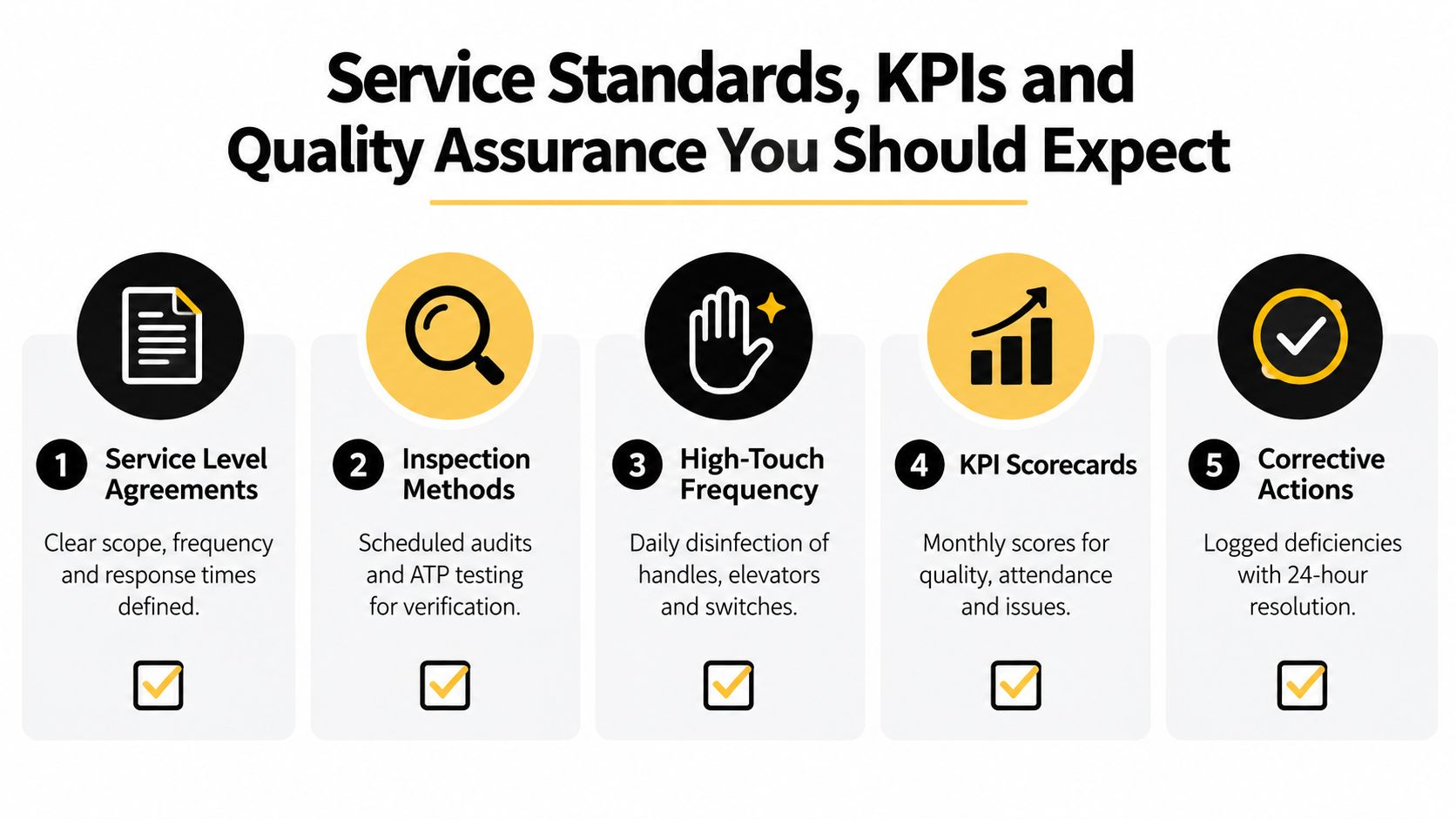
What measurable cleaning looks like in practice
Ontario infection prevention guidance gives property managers a useful benchmark for high-touch cleaning frequency and documentation in higher-risk settings, even if a typical office or mixed-use building does not need hospital-level oversight (Public Health Ontario environmental cleaning guidance). The lesson for commercial properties is simple. Standards should be visible, checkable, and tied to the parts of the building that create the most complaints and the most risk.
That usually starts with four areas. Washrooms. Entrances. Elevators and touchpoints. Shared kitchens or amenity spaces.
A good cleaning report should do more than say the site was serviced. It should show what was scheduled, what was completed, what was inspected, what failed, and who closed the gap. If a contractor claims strong quality control but cannot produce washroom logs, inspection records, or corrective action notes, the manager is being asked to trust a result without seeing the process that produced it.
KPIs that actually help manage a building
Some KPI lists are built for presentations, not buildings. Property managers need measures that answer a basic operations question. Did the service happen as agreed, and is there proof?
Useful cleaning KPIs usually include:
- Attendance reliability: Was the scheduled shift fully covered?
- Scope completion: Were the required tasks completed in each assigned area?
- Inspection pass rate: Did supervisor or manager spot checks meet the written standard?
- Deficiency response time: How quickly were misses logged, assigned, and corrected?
- Washroom readiness: Were soap, paper, liners, and washroom check logs maintained as required?
- High-touch compliance: Were touchpoints cleaned at the agreed frequency in high-traffic periods?
- Chemical record accuracy: Are SDS files current, and can the provider identify the DIN for disinfectants where applicable?
That last point often gets missed in generic cleaning advice. In Ontario, proof matters as much as appearance. A polished floor does not confirm that a washroom was checked on schedule, that staff had the right SDS on site, or that a disinfectant used in a health-sensitive area had a verifiable Health Canada DIN. Managers should expect those records to be organized and easy to produce.
Quality assurance should work like a control loop
Quality assurance works like a maintenance checklist for an HVAC system. The unit may sound normal, but operators still inspect, record readings, correct faults, and confirm the fix. Cleaning needs the same discipline.
The loop is straightforward:
- Set the standard in writing
- Inspect against that standard
- Record any deficiency
- Correct it and verify the correction
If one step is missing, the system weakens. A missed washroom check with no log entry becomes a tenant complaint. A complaint with no corrective record becomes a pattern. A pattern with no review meeting becomes a contract dispute.
Useful quality controls include:
- Scheduled supervisor inspections
- Photo-supported issue tracking for repeat problem areas
- Dated washroom and common-area check logs
- Complaint records tied to corrective action
- Periodic service reviews based on occupancy, season, and building use
- Management systems aligned with CIMS-style documentation and accountability practices
Why visual checks are only one layer
Visual inspection still matters. It is just not enough on its own.
A corridor can look tidy while touchpoints were skipped. A washroom can smell clean while dispensers are empty and no one can show when it was last checked. A staff member can say the right disinfectant was used, but if the DIN cannot be verified and the SDS is missing, the manager has no compliance trail.
That is why experienced property managers ask narrow, testable questions. Who signs the washroom log? How often are elevator buttons cleaned during peak traffic? Where are SDS records stored on site or digitally? Who reviews failed inspections, and how fast must corrections be completed?
Clear answers show that the contractor is managing a system, not just reacting to what looks dirty.
Onboarding Sample Cleans Communication and Reporting That Builds Trust
Strong cleaning relationships usually show their quality early. The first walkthrough, first trial clean, and first weeks of communication tell a manager more than polished sales language ever will.
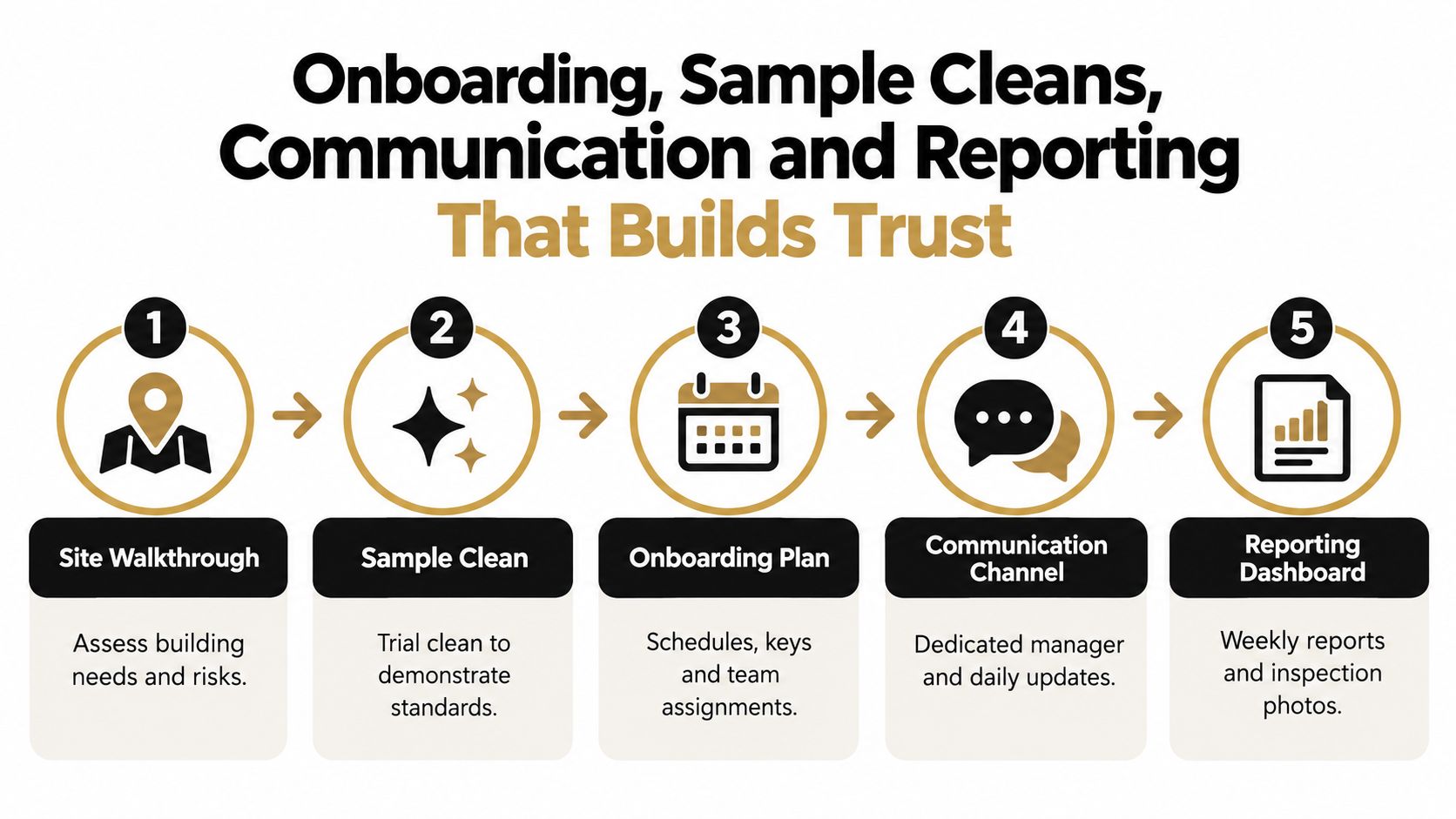
The first phase should reduce ambiguity
A proper start usually includes a site walkthrough, review of access procedures, scope confirmation, and identification of building-specific concerns. In one property, that may mean after-hours alarm protocols. In another, it may mean separating a public washroom schedule from a private tenant washroom schedule.
A sample clean can be especially useful because it turns promises into observable work. Managers can see whether the provider notices edge details such as corners, touchpoints, supply presentation, and traffic patterns. They can also see whether the team follows instructions or defaults to a one-size-fits-all routine.
What to watch during a sample clean
The result matters, but so does the method. Useful observations include:
- Preparation: Did the team arrive knowing the site and scope?
- Sequencing: Did they clean in a logical order, or bounce around randomly?
- Surface judgement: Did they use the right approach for glass, floors, and shared equipment?
- Attention to risk areas: Did they notice entries, washrooms, and hand-contact points?
- Follow-up: Did someone ask for feedback and document changes?
The sample clean is less like a performance test and more like a preview of future habits. Sloppy communication during the trial usually becomes ongoing friction later.
Communication rhythms that make operations easier
Property managers don't need constant updates. They need dependable updates. A provider should define who the main contact is, how routine issues are reported, how urgent concerns are escalated, and how service changes are confirmed.
That might look like a daily note for a sensitive site, or a weekly summary for a standard office. The exact format matters less than consistency. If a tenant issue appears, there should be one accountable person who owns the response.
Reporting should prove the work happened
A useful report doesn't need to be elaborate. It should help answer three questions:
- What was scheduled?
- What was completed?
- What needs attention next?
Some providers use simple checklists. Others use mobile reporting with timestamps, inspection notes, and photos. For example, Arelli Cleaning offers app-based support and live communication as part of its service model, which is relevant for managers who want a clearer record of site activity without chasing updates.
In practical terms, the best onboarding process leaves fewer assumptions behind. That's the trust-builder.
Compliance Insurance and Chemical Safety Non Negotiables in Ontario
A missed cleaning task can create a tenant complaint. A missed compliance record can create an inspection problem, an injury claim, or a dispute over who was responsible. For Toronto property managers, this part of vendor review works like checking the wiring behind a wall. Tenants may never see it, but the building depends on it.
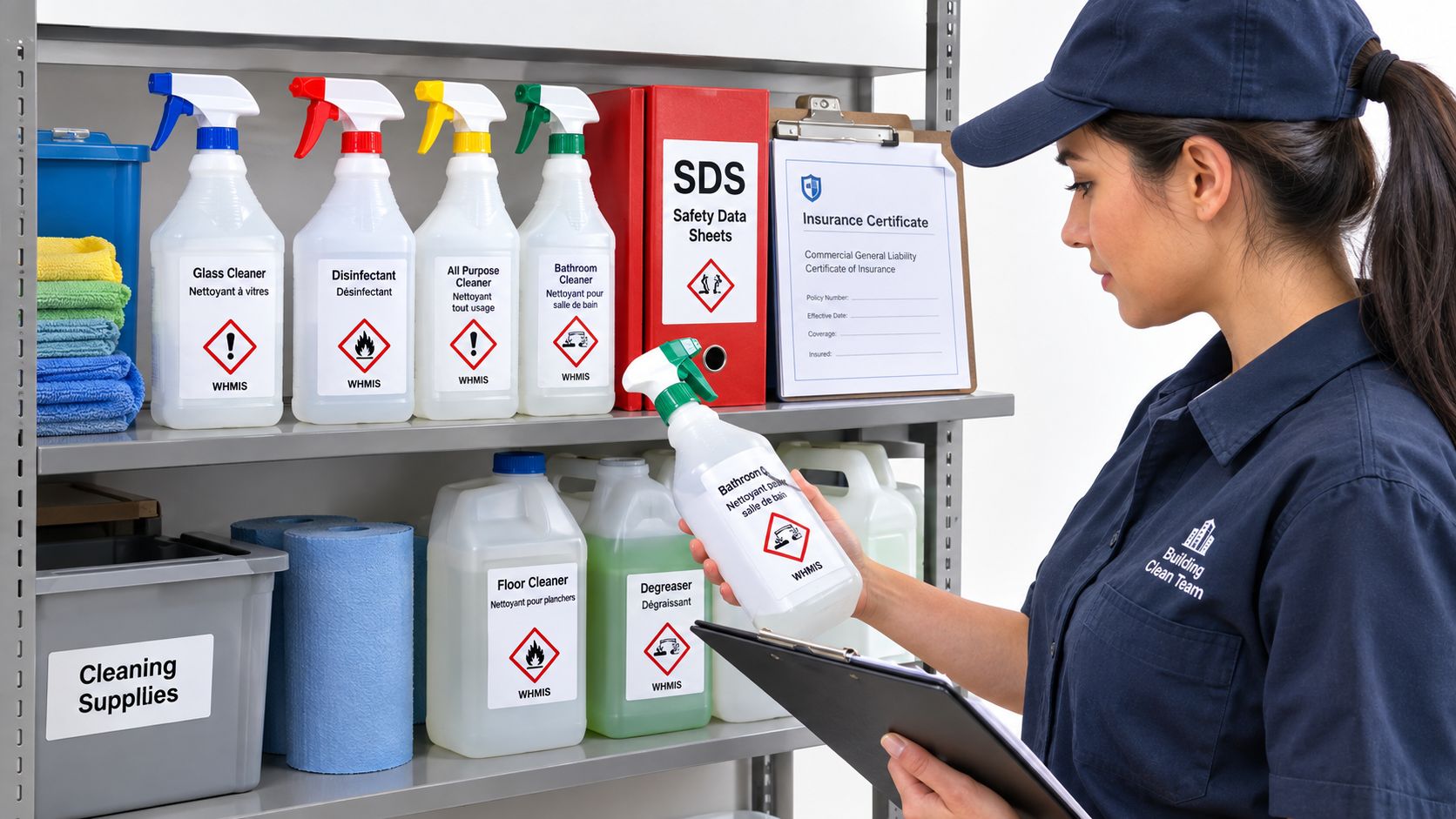
WHMIS and SDS controls should be ready before startup
If a cleaning company brings chemical products into an Ontario workplace, a manager should expect proof of WHMIS compliance before regular service begins. That means current Safety Data Sheets, clear product labels, worker training records, and site procedures for safe use, storage, and spill response.
Ontario managers do not need to become chemical safety specialists. They do need a basic paper trail. A practical review should answer simple questions: What products are coming on site? Where will they be stored? How are they diluted? What personal protective equipment applies? If a bottle is transferred to another container, how is that workplace label handled?
A good provider can walk through those answers without hesitation. If the team on site cannot produce SDS access or explain product hazards in plain language, the risk is already showing.
Disinfectants should be checked like any other regulated building input
Disinfection claims should be treated the same way managers treat fire equipment tags or elevator inspection records. The label has to match the job.
If a provider says it is disinfecting, ask for the product list and verify that each disinfectant has a Health Canada DIN. Then confirm that the intended use matches the property type and task. Contact time matters too, because a product that sits for the wrong amount of time may be used incorrectly even if the bottle itself is approved.
This is one reason managers often review a provider's commercial disinfection and sanitising support before approving the scope. The useful question is not whether a team can spray and wipe. It is whether the company can show which disinfectant is being used, why it was selected, and how staff are instructed to apply it properly in an office, retail, industrial, or shared common-area setting.
Washroom cleaning records are now part of compliance proof
Ontario has added a clear documentation expectation for washrooms. Under O. Reg. 480/24, employers and constructors must make records of the two most recent washroom cleanings available to workers, either posted nearby or accessible electronically.
For property managers, the lesson is straightforward. A washroom log is no longer a nice extra. It is part of the operating record. A cleaning company should be able to explain who completes the record, when it is updated, where it is stored or posted, and how missed entries are corrected.
That requirement changes what “done” means. A washroom may appear clean at 3 p.m., but if the record is missing or inconsistent, the site still has an avoidable exposure.
Insurance and management systems should support the same standard
Insurance should be reviewed with the same discipline as chemical controls. Ask for proof of general liability coverage, workers' compensation clearance, and confirmation that the company's scope of work matches the services being performed on your property. A contractor handling day porter duties, waste removal, washroom sanitation, and disinfection should have documentation that reflects those activities.
Management systems matter for the same reason. They show whether the company runs on repeatable procedures or memory. A CIMS-aligned approach is useful here because it points to documented supervision, training, quality control, and issue tracking rather than informal habits. Certification is one signal. The larger point is whether the provider can produce a consistent system for training, inspections, incident reporting, and corrective action.
Clean floors are visible. Compliance proof is what protects the building when someone asks for evidence.
Pricing Contracts Flexibility Emergency Response and Technology
Price matters, but contract design often matters more after the first service issue. The cheapest quote can become the most expensive if it lacks flexibility, creates confusion about extras, or slows down urgent response.
Cost drivers that actually change a proposal
Commercial cleaning proposals usually rise or fall based on a few practical factors:
- Building type and risk profile
- Cleaning frequency
- Occupancy level and traffic
- Specialised floor or glass care
- After-hours access requirements
- Reporting and supervision expectations
- Regulated sanitation needs
That's why ranges are more useful than single figures. Two offices with similar square footage can need very different service plans if one has shared washrooms, food-prep areas, and extended hours.
Contracts should match operational reality
Some properties need stable nightly service year-round. Others need stop-and-go flexibility because of vacancy, tenant turnover, school calendars, or phased occupancy. A strong contract should make those realities manageable rather than punitive.
Emergency response deserves similar scrutiny. Managers should know who answers after-hours calls, how spill or incident response is escalated, and whether urgent support is part of the agreement or billed separately.
Evaluating Commercial Cleaning Proposals Beyond Price
| Evaluation Criteria | What Good Looks Like | Red Flag to Avoid |
|---|
| Scope clarity | Detailed task list by area and frequency | Broad promises with no room-by-room detail |
| Contract flexibility | Clear pause, change, and cancellation terms | Lock-in language that makes service hard to adjust |
| Emergency response | Named contact and documented escalation process | Generic inbox or unclear after-hours support |
| Special services | Periodic work defined separately from routine cleaning | Hidden extras that appear after onboarding |
| Reporting | Simple, regular proof of completion and issue tracking | No written record beyond invoicing |
| Technology use | Tools that support inspections, updates, and logs | Tech used as a sales term without operational purpose |
A useful rule for quote comparison is to normalise the scope first, then compare price. If one proposal includes washrooms, touchpoints, consumables checks, and reporting while another does not, they are not competing offers yet.
Technology should support visibility, not replace management
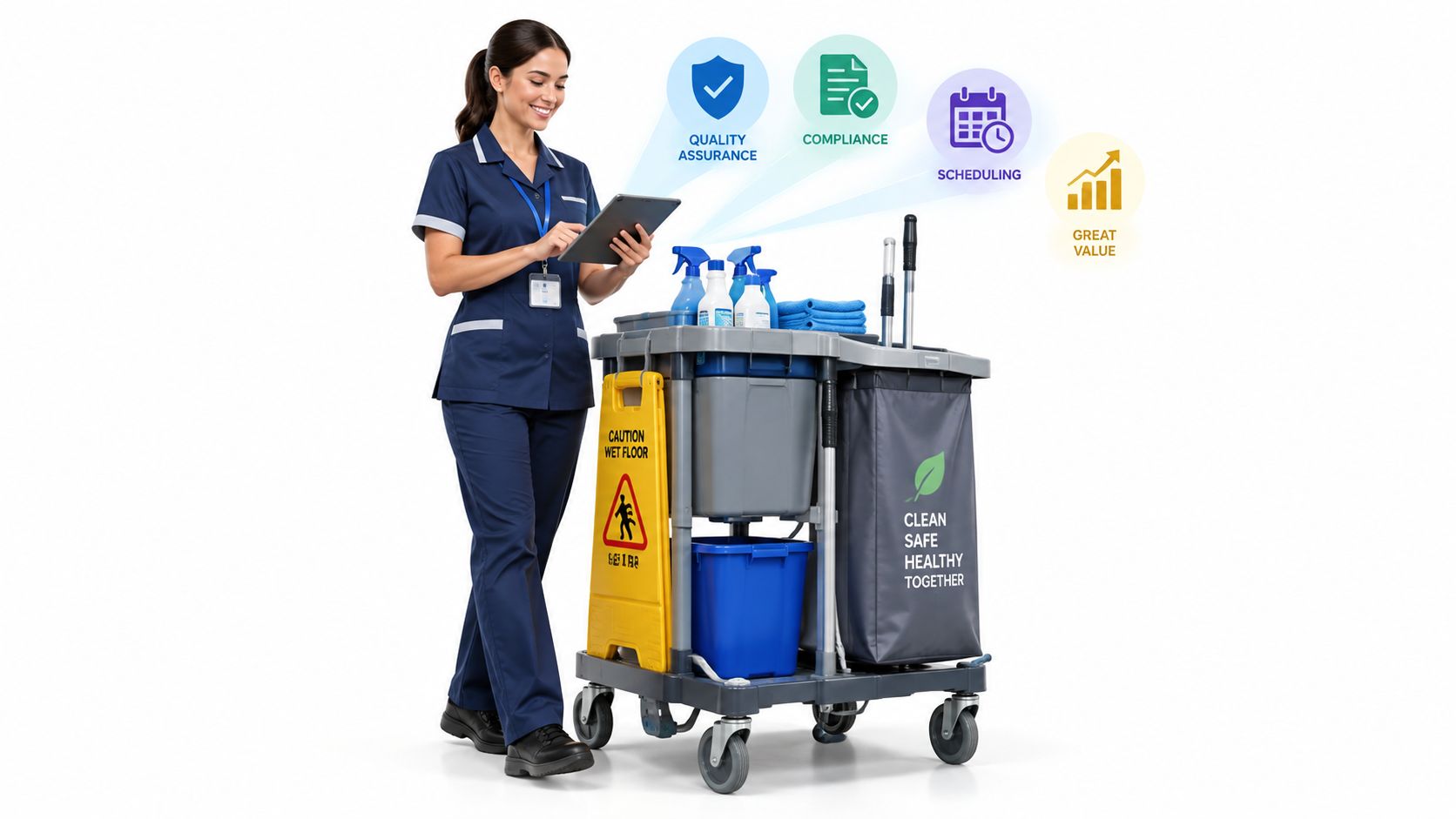
Cleaning technology is helpful when it makes service easier to verify. Mobile check-ins, inspection logs, and issue tracking can reduce back-and-forth and create a better paper trail. But no app can compensate for weak staffing, unclear scope, or poor supervision.
The strongest proposal usually isn't the one with the most features. It's the one that makes expectations easiest to understand and easiest to enforce.
Red Flags Vetting Questions and Your Final Decision Checklist
A familiar Toronto scenario goes like this. The lobby looks fine during a site walk, but a week later a tenant reports an empty soap dispenser, a washroom log is missing, and building staff cannot find the SDS binder for products used on-site. The floor was shiny. The management system behind it was weak.
That is why the final decision should test proof, not presentation. A cleaning company is easier to manage when its service works like a documented operating routine: tasks are defined, chemical safety records are accessible, washroom cleaning can be verified, and supervisors can show what happened without a scramble. For Ontario property managers, that standard matters as much as appearance.
Common red flags
Some warning signs show up before the first clean even starts.
- The scope sounds polished but stays vague. If the quote says "full cleaning" without room-by-room tasks and frequencies, you are buying promises instead of a service plan.
- Compliance records are treated like extras. A capable provider should be ready to show WHMIS-related training records, SDS access, product labels, and washroom log procedures without delay.
- Disinfectant claims are unclear. If a company cannot explain which products it uses, where they are used, and how DIN verification is handled, the sanitation plan is not ready for review.
- Management systems are hard to see. If inspections, corrective actions, and supervisor follow-up live only in someone's memory, consistency will depend on the individual cleaner on shift.
- The handoff process is thin. No trial clean, no site-specific notes, and no escalation contact usually means more problems after start-up.
- The contract protects the cleaner more than the building. If changing frequencies, adding areas, or ending service is unnecessarily difficult, day-to-day management gets harder than it needs to be.
Property managers who oversee several vendor categories can also use Safety Space's subcontractor best practices to tighten vendor oversight beyond cleaning.
What to ask before choosing
A good vetting call should work like a pressure test. You are checking whether the company can translate general promises into site-level proof.
How do you separate routine, periodic, and specialised work in the scope?
This shows whether pricing and expectations are built on a real work plan or a blended estimate.
What proof of completion do supervisors review?
Look for inspection forms, issue tracking, photo support where appropriate, and a clear process for fixing misses.
Where will SDS and product information be kept, and who can access them on-site?
The answer should be simple enough for your staff to follow during a busy shift.
How do you choose disinfectants, and how do you confirm DIN status for products that require it?
This question separates broad sanitation language from a verifiable process.
How are washroom cleaning records handled for buildings where posting or electronic access is required?
A prepared contractor should already have a method.
What management system supports consistency across sites?
Listen for specifics such as inspections, training refreshers, corrective action logs, and a framework aligned with CIMS-style management practices.
What happens if service fails at 10 p.m. or a spill is reported after hours?
You need a named contact, a response path, and a realistic timeline.
Can you support a sample clean or trial start?
A short trial often reveals more than a polished proposal.
If you want a plain-language reference while comparing bids, the commercial cleaning buyer FAQ can help your team keep the same questions in front of every provider.
Final decision checklist
Use one checklist for every bidder. That sounds basic, but it is how you keep a strong presentation from hiding weak controls.
- Match each quote to the same scope
- Confirm who supervises the account
- Review sample logs, inspections, and issue reporting
- Check how WHMIS, SDS access, and product labelling are handled
- Ask how DIN verification is documented where disinfectants are used
- Confirm the washroom record process for your building
- Test after-hours response before signing
- Choose the company whose standards are easiest to verify
A clean-looking building can still have service gaps. The stronger choice is the provider that can show a repeatable system, clear records, and Ontario-ready compliance habits before problems reach your tenants.








.webp)