A facility manager usually notices the training problem before they can name it. One cleaner finishes quickly but skips inspection. Another uses the wrong product on a finished surface. A supervisor gives one method on Monday, another gives a different method on Wednesday, and by Friday the client says the washrooms look inconsistent.
That's not just a staffing problem. It's a systems problem.
Commercial cleaning training is the organised process used to teach cleaners how to work safely, follow standard procedures, use chemicals and equipment correctly, and deliver the same quality across shifts, sites, and supervisors. In a mature operation, training isn't a speech on day one. It's a documented, measurable system tied to quality assurance, safety, and compliance.
The High Cost of Untrained Cleaning Teams
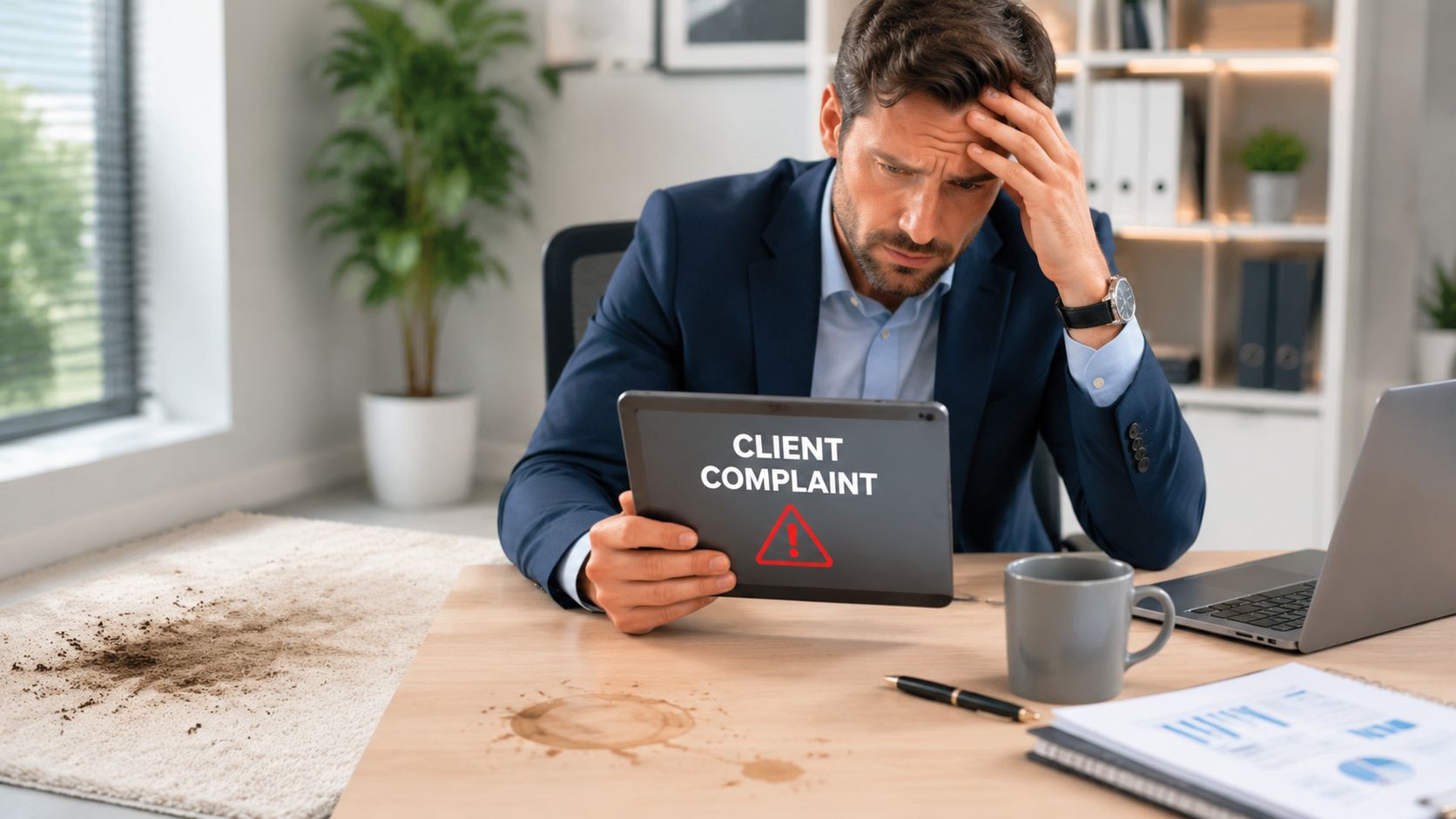
A weak training system rarely fails all at once. It shows up in patterns. Missed corners. Wrong dilution. Restrooms cleaned in the wrong order. Supplies used too quickly. Rework on the same floor section. A client complaint that says, “It looked fine yesterday, but not today.”
The operational pressure is real. A commercial cleaning industry white paper reports employee turnover averaging around 200% annually and reaching as high as 400% in some cases, which means some firms replace their workforces multiple times in a year (commercial cleaning turnover white paper). When turnover is that high, informal shadowing stops being enough. A company needs repeatable onboarding, clear work standards, and records that survive staff changes.
What untrained teams cost in practice
The cost isn't only visible dirt. It spreads across operations:
- Quality drift: One employee follows the room sequence correctly, another improvises.
- Safety exposure: Chemical handling, PPE use, and ergonomics get treated as optional habits instead of required practice.
- Supervisor overload: Front-line leaders spend their shift correcting avoidable mistakes instead of coaching improvement.
- Client friction: Complaints often come from inconsistency, not total failure.
- Rework and waste: Teams clean the same area twice because the first pass didn't meet the site standard.
Direct answer: Commercial cleaning training is a business system for producing safe, consistent, auditable cleaning performance at scale.
Key takeaways
- Training must be structured: High-turnover environments need documented and repeatable instruction, not verbal handoffs.
- Curriculum alone isn't enough: Strong programs combine SOPs, hands-on coaching, competency checks, and audits.
- Measurement matters: If a company can't verify skill retention, it can't prove service quality or compliance.
- Onboarding should be staged: New hires need a defined path from orientation to supervised practice to independent work.
- Technology helps scale consistency: Digital SOPs, records, and mobile access make training easier to manage across sites.
The Blueprint for a High-Performance Training Program
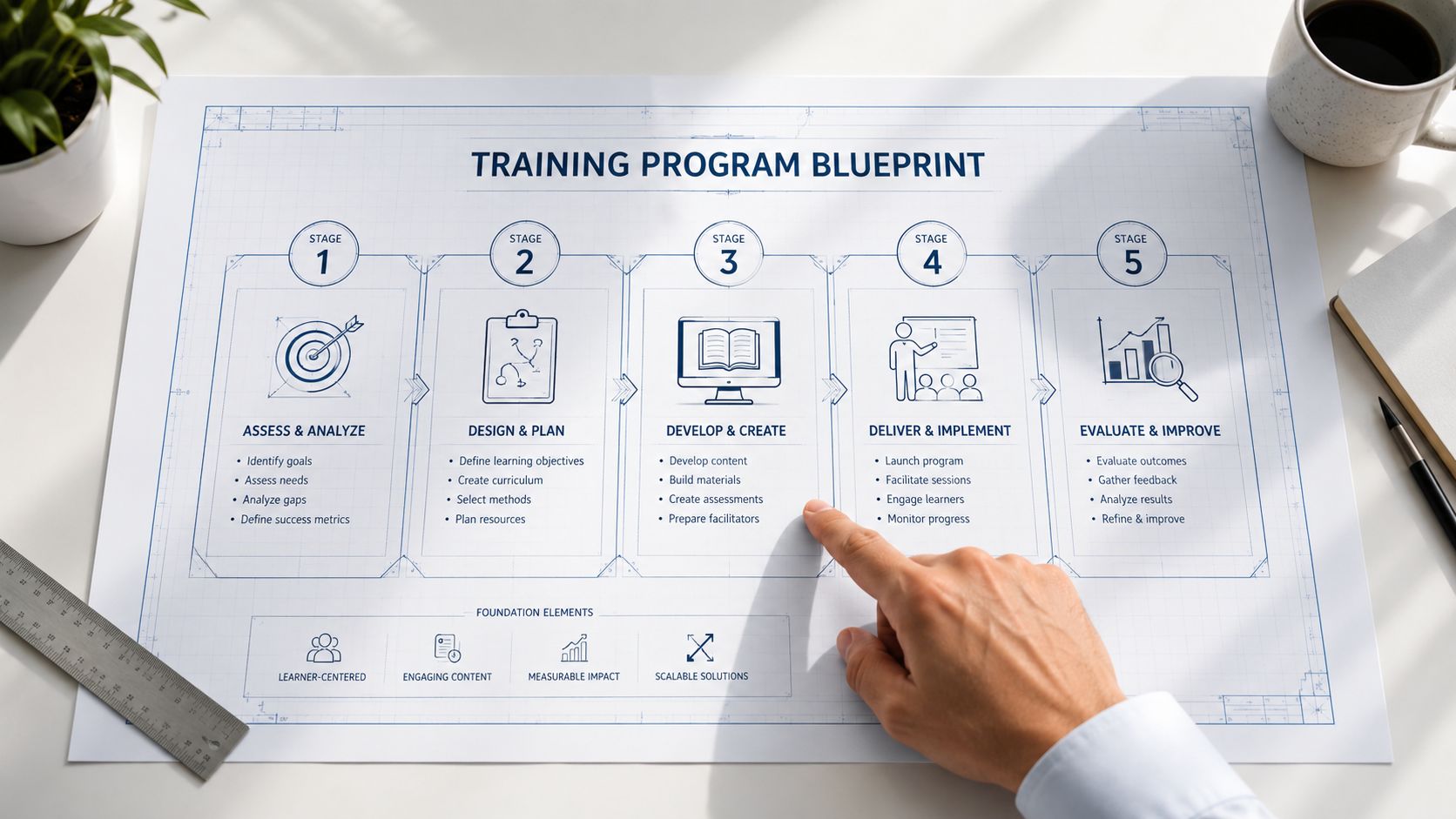
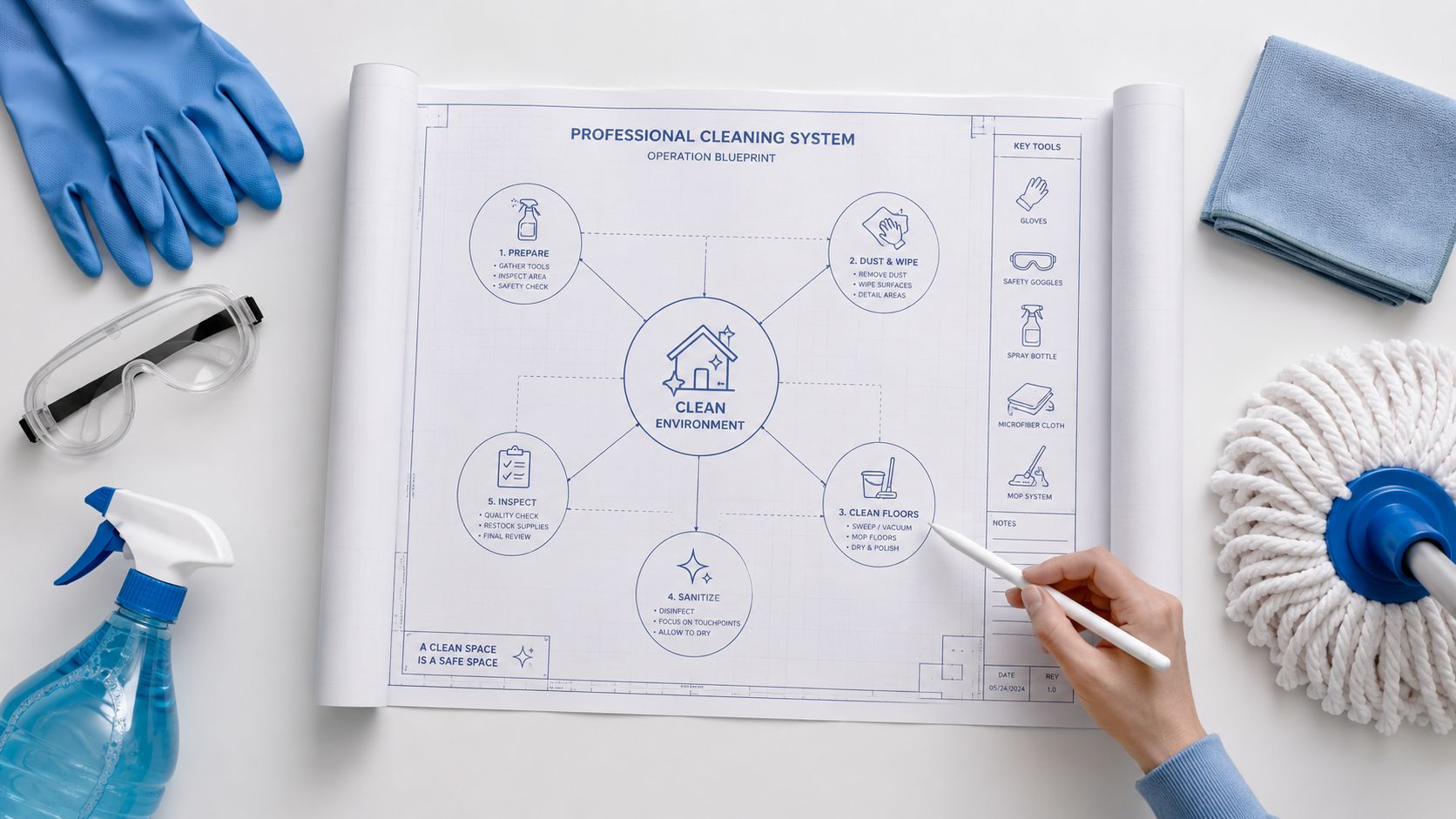
A training program works best when it follows a fixed operating cycle. Industry guidance from ISSA on cleaning company training programs recommends a structure built around a formal needs assessment, defined modules, practical on-the-job instruction, and competency testing through exams, practical checks, or direct observation.
That sequence is strong because each stage solves a different problem. Assessment identifies the site's true needs. Modules standardise the message. Hands-on practice turns theory into muscle memory. Testing verifies skill. Audits keep the standard from slipping.
The five-stage model
| Stage | What happens | Why it matters |
|---|
| Assessment | Review site risks, surfaces, workflows, client expectations, and role requirements | Prevents generic training that doesn't match the facility |
| Modular SOPs | Break work into teachable units such as washroom cleaning, floor care, chemical use, and incident response | Makes training easier to repeat and update |
| Hands-on practice | New staff perform tasks under supervision using actual site tools and products | Builds confidence and correct technique |
| Competency testing | Verify skill by quiz, observation, return demonstration, or checklist | Confirms that training was retained |
| Continuous audits | Inspect work, document gaps, and assign coaching or retraining | Turns training into an ongoing quality system |
What each stage should look like on the ground
Assessment starts before the first lesson. A warehouse, childcare centre, law office, and dental clinic don't have the same risk profile. The assessment should document traffic patterns, sensitive surfaces, washroom count, spill risks, chemical storage conditions, and any client-specific rules.
The second stage is where many companies get stuck. They have “training”, but no modular SOP library. Instead of one large manual, use short modules. One module for microfiber use. One for restroom zone separation. One for auto-scrubber pre-checks. One for glass and touchpoint cleaning. That lets supervisors retrain a single gap without repeating the entire curriculum.
Strong training systems are built so a new supervisor can teach the same task the same way without relying on memory.
Hands-on practice should happen with the actual mop system, the actual dilution equipment, the actual vacuum, and the actual work order expectations. If part of the workforce learns remotely or between shifts, principles from designing engaging remote employee training can help companies keep digital modules clear, short, and easy to apply in the field.
A practical decision rule
Use this test when reviewing any training programme:
- If it explains tasks but not standards, it's incomplete.
- If it teaches standards but doesn't verify skill, it's weak.
- If it verifies skill once but never audits later, it won't hold up under turnover.
- If it links training, testing, and site inspection, it's scalable.
Developing Your Core Curriculum Modules
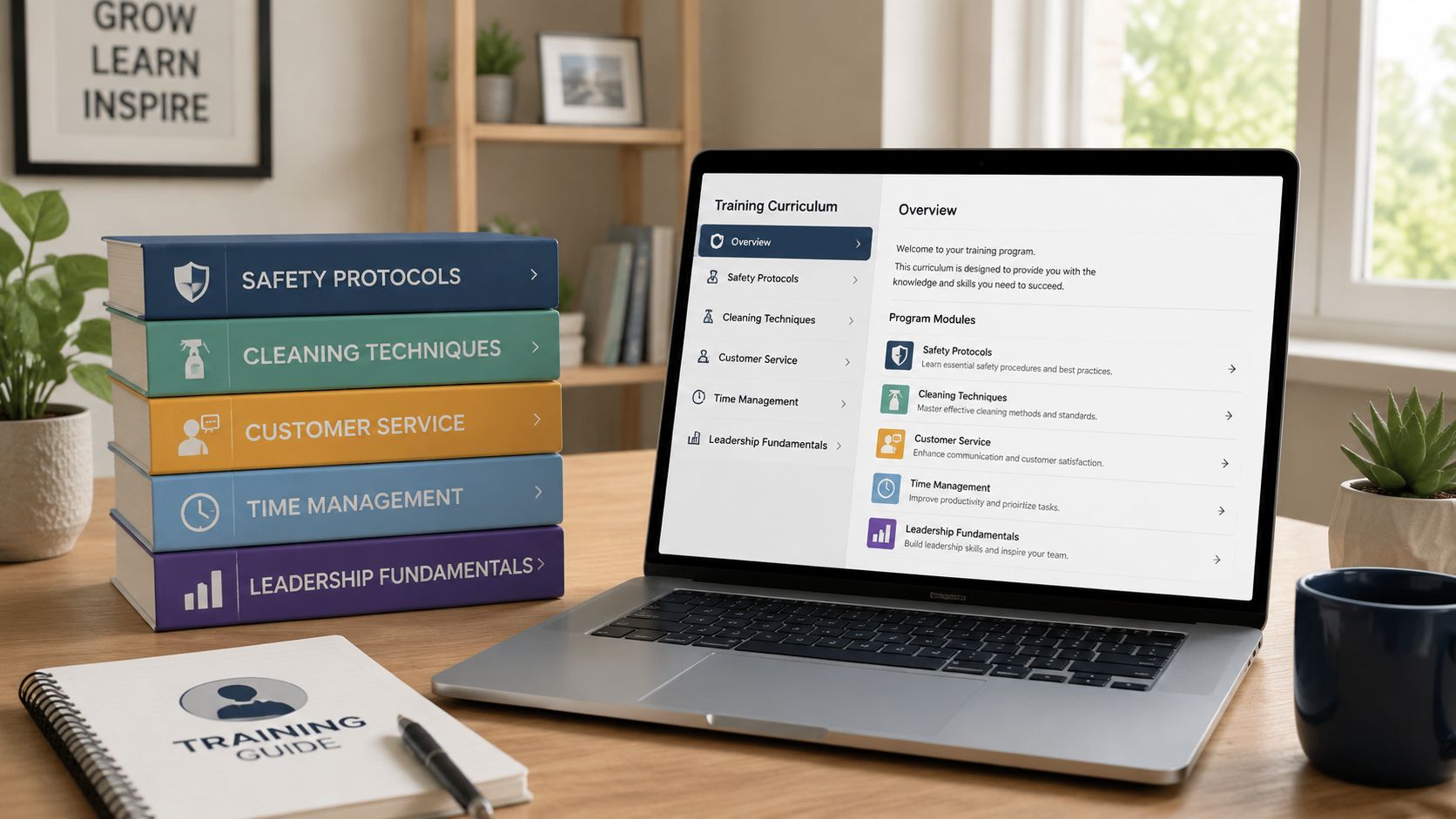
A curriculum only scales if it answers two operational questions clearly. What does every cleaner need before working with limited supervision, and what does each role need to perform to standard at a specific site? If those lines are blurry, training grows into a long orientation that feels busy but does not improve quality scores, reduce incidents, or hold up in an audit.
Build the curriculum the same way you build a cleaning scope. Break the work into repeatable units, define the standard for each unit, then assign proof of competency. That turns training from a set of topics into a control system.
California's janitorial employer resources provide a useful frame for the safety side of the curriculum. The California janitorial employer resources group training around safety orientation, hazard communication, ergonomics, chemical handling, bloodborne pathogens, and personal protective equipment. Those areas transfer well to office, institutional, and mixed-use environments because they address the errors that lead to injuries, contamination, service failures, and compliance problems.
Safety and compliance
Start here. A cleaner should complete this module before any production training, because unsafe habits spread fast once they show up on the floor.
Include the operating basics:
- Site orientation: entry points, restricted areas, alarms, security rules, incident reporting, and emergency contacts
- Hazard communication: product labels, Safety Data Sheets, secondary container labelling, and what to do with an unmarked bottle
- Ergonomics: lifting, cart handling, vacuum use, repetitive-motion reduction, and setup that reduces strain
- PPE use: what to wear, when to change it, where to dispose of it, and what PPE is site-specific
- Biohazard boundaries: sharps awareness, bodily fluid response limits, and escalation procedures
The training objective is not “can repeat the rule.” It is “can apply the rule during a real task.” That distinction matters. A cleaner may remember that gloves are required and still contaminate a sink area after cleaning a toilet because the decision point was never taught. Good modules train the judgment trigger. What changed, what risk appeared, and what action follows?
For audit purposes, tie this module to observable behaviours. Example: “changes gloves between restroom zones” is measurable. “Understands glove use” is not.
Chemical handling and product selection
Chemical training should work like a map legend. If the symbols are unclear, the whole route breaks down.
Each product in use should have a defined place in the system:
- Approved product list: what products are allowed at the site and what each one is used for
- Dilution and dispensing: how to use dilution stations or pre-measured formats without guesswork
- Dwell or contact time: especially for disinfectants, how long the surface must stay wet to meet label instructions
- Surface compatibility: what is safe for stone, stainless steel, finished wood, vinyl, screens, and coated surfaces
- Storage and transport: labelled bottles, closed containers, cart setup, and separation from personal items or food
This module should also prevent a common operations problem. Staff often memorize product names but cannot choose the right product under changing conditions. Training should present the decision in plain language. Is the goal soil removal, disinfection, spot treatment, or floor restoration? Product choice follows the purpose.
At sites with higher hygiene requirements, the standard has to match the service promise. Teams assigned to higher-risk touchpoints need task-specific instruction tied to documented workflows for commercial disinfection and sanitising services, because appearance cleaning and risk-reduction cleaning are measured differently.
Practical rule: If a cleaner cannot explain the purpose, dilution, and dwell time of a product, that product is still in supervised-use status.
Equipment operation and care
Equipment modules should teach more than operation. They should teach control.
A vacuum, auto-scrubber, or microfiber cart affects four business outcomes at once: speed, quality, safety, and equipment life. If training only covers start-up, the company pays later through skipped edges, damaged surfaces, battery issues, and preventable repairs.
Typical equipment modules include:
Vacuum and backpack vacuum use
Teach cord control, filter checks, entry and exit patterns, edge detailing, and how to clean a room without missing low-visibility areas.
Auto-scrubbers and floor machines
Cover pre-use inspection, pad or brush selection, solution and recovery tank handling, battery charging, shutdown cleaning, and signs that the machine should be taken out of service.
Microfiber systems and carts
Train colour coding, cloth folding, mop rotation, clean-versus-soiled tool separation, and cart organization that supports room sequence instead of slowing it down.
Each equipment module should end with a simple field verification. Can the employee inspect it, use it safely, store it correctly, and identify a fault before damage occurs? If not, the skill is not complete.
Standard operating procedures for routine cleaning
SOP modules are where consistency is built. They convert service expectations into repeatable actions that a trainer, supervisor, and auditor can all recognize the same way.
Use a three-part structure for each SOP:
- Sequence: the order of work
- Tools and products: what must be used
- Quality checkpoint: what “done correctly” looks like
That format keeps the module teachable and auditable. A washroom SOP, for example, should show the route through the room, the colour-coded tools, the approved chemistry, and the finish standard for fixtures, floors, dispensers, and touchpoints. A supervisor can then coach against the same standard used in inspection scoring.
Examples of SOP-based topics include:
- Washroom cleaning sequence
- Desk and touchpoint cleaning
- Breakroom and kitchenette cleaning
- Garbage removal and liner replacement
- Floor care by surface type
- Closing inspection and reset
Short visual SOPs tend to hold up better than long manuals. They are easier to retrain, easier to audit, and easier to revise when a site changes scope or adds equipment.
Infection control and cross-contamination prevention
This module needs more depth than many general cleaning programs give it. “Spray and wipe” is not a method. It is a habit, and habits are not the same as standards.
Train the mechanics of contamination control:
- Clean-to-dirty movement: where to start and how to progress through a room
- Tool separation: cloth, mop, and glove separation by zone or task
- Touchpoint priority: high-contact surfaces that need consistent attention
- Disposal protocols: how to remove used PPE and contaminated disposables safely
- Escalation rules: what stays within routine service and what requires supervisor direction or a specialist response
The depth of this module should change by facility type. A dental clinic, daycare, warehouse office, and engineering firm do not share the same risk profile. The framework can stay consistent, but the examples, practice scenarios, and verification standards should reflect the environment.
That is the pattern for the entire curriculum. Train the task, define the standard, verify the skill, and document the result. Once every module is built that way, the program becomes measurable instead of theoretical.
From Onboarding Checklists to Full Competency
A supervisor opens a building at 6:00 p.m., hands a new cleaner a cart, points to three restrooms and two offices, and says, “You should be fine.” By the end of the week, quality scores dip, paper products are missed, dwell times get rushed, and the account manager is answering complaints that started with training, not effort.
That is the gap between orientation and competency.
A checklist confirms that someone attended training. Competency confirms that the person can produce the required result, in the required sequence, under normal site conditions, without creating safety or compliance problems. For an operations team, that difference matters because competency is what protects quality scores, inspection results, and client retention.
A useful way to build this is to treat onboarding like a staged release, similar to qualifying a machine before it goes into full production. You do not test one button and call the system ready. You verify each function, then the full cycle, then repeatability.
A workable 30-day onboarding pattern
Many cleaning companies use a short core onboarding period, then follow it with coached field practice over the first month. The timeline matters less than the control points inside it. The employee should move forward only after demonstrating the standard, not merely after spending a certain number of days on payroll.
Days 1 and 2: orientation plus demonstration
Start with the operating basics that allow someone to work safely and follow site rules:
- Job and site expectations: access, timekeeping, uniform, communication, incident reporting, and who to call when something is outside scope
- Safety and compliance basics: PPE, chemical label reading, dilution rules, SDS access, slip-and-fall prevention, and emergency procedures
- Equipment and cart setup: microfiber use, vacuum checks, mop system, signage placement, and stock organization
- Priority SOPs: restrooms, common areas, trash handling, touchpoints, and end-of-shift reset
Do not stop at explanation. A trainer should demonstrate a full task at normal working speed, then repeat the same task slowly enough to explain the critical details. New hires often miss the small points that drive inspection outcomes, such as where to place the cart, when to change cloths, or how to check a room before exiting.
Week 1: supervised repetition in a limited zone
The employee should clean a small, controlled area while a supervisor observes the work in real time. The goal is not coverage. The goal is repeatable technique.
Score a few items that predict later performance:
- Room sequence: did the cleaner follow the site-specific order of work
- Chemical selection and use: did the cleaner choose the correct product and use it according to label instructions
- Tool control: did the cleaner keep cloths, mop heads, and gloves separated correctly by task or zone
- Self-inspection: did the cleaner check the finished room against the site standard before leaving
This stage works like setting the foundation on a building. If sequence, safety, and inspection habits are weak here, speed will only hide the problem until a client or auditor finds it.
Weeks 2 and 3: controlled independence
Now increase the area, but keep observation active. The cleaner should begin working more independently, with daily spot checks against the site SOPs and quality checklist.
During job execution, hidden habits surface. A new employee who looked strong in training may start skipping corners, shortening dwell times, overusing chemical, or failing to reset the cart between rooms. Those are not minor details. They are early indicators of future QA failures.
Supervisors should document coaching by task, not with vague notes like “doing better.” Record what was observed, what was corrected, and whether the employee performed the task correctly on the second attempt. If you want a framework for tying those checkpoints to outcomes, this practical guide on training metrics is a useful reference.
Week 4: verification under normal conditions
By the fourth week, the employee should complete a standard assignment while the supervisor verifies both process and outcome. That means checking more than whether the room looked clean at the end.
Confirm that the cleaner:
- followed the correct workflow
- used the right products and tools
- met the site inspection standard
- handled exceptions properly
- completed resets, restocking, and closeout tasks without prompting
At this point, the training record should show more than attendance. It should show demonstrated ability by task. That record becomes part of your auditable training system and helps explain later field performance. If a site's restroom scores drop, you can check whether the issue started with an unclear SOP, weak coaching, or a cleaner who was released before demonstrating proficiency.
A visible training path also helps with hiring. Companies that explain how employees progress from orientation to independent work often attract applicants who want structure and accountability. Many employers use a commercial cleaning careers page to show that training is part of the operating model, not an afterthought.
What often goes wrong
The failure pattern is usually predictable:
| Weak onboarding | Strong onboarding |
|---|
| One shadow shift | Repeated supervised practice with documented checkpoints |
| General orientation | Site-specific instruction tied to actual SOPs |
| Verbal explanation only | Demonstration, return demonstration, and observation |
| Attendance recorded | Skills verified by task |
| Released to solo work by schedule | Released to solo work by demonstrated standard |
The core mistake is simple. Managers confuse exposure with proficiency.
A cleaner can sit through orientation, sign a checklist, and still be unable to clean a restroom in the right order, prevent cross-contamination, or inspect their own work before leaving the area. Full competency requires proof in the field. That is what makes training scalable, measurable, and defensible during client reviews, internal audits, and supervisor handoffs.
Measuring Success with Assessments and Quality Assurance
A supervisor walks a site at 6:00 a.m. The lobby looks fine, but the restroom failed inspection again. The same problems keep showing up. Wrong cloth in the wrong area. Missed edges near partitions. Chemical bottle not labelled correctly. At that point, the question is no longer whether training happened. The critical question is whether your training system can prove who was taught, what standard was demonstrated, how performance was checked, and what happened after the failure.
That is the difference between a training program and a control system. A program delivers instruction. A control system connects instruction to inspection scores, retraining, and compliance records.
Green Seal's GS-42 standard for commercial and institutional cleaning services is useful because it treats training as documented, recurring work tied to service delivery. The standard sets clear training expectations across onboarding, first-year development, and ongoing education. That framework matters because cleaning quality drops when training records, field observations, and QA findings live in separate places.
Measure three layers, not one
A strong assessment system works like a chain of custody. Each link answers a different question, and a break in one link weakens the whole record.
1. Knowledge
Use short checks for information that staff must recall correctly without guessing. Chemical safety, PPE, dilution rules, hazard communication, and escalation steps fit here.
Knowledge checks are fast and useful, but they do not prove task execution. A cleaner can pass a quiz and still sequence a restroom incorrectly.
2. Demonstrated skill
This is the release point for real work. A supervisor observes the employee performing the task on site, using the actual tools, surfaces, and time constraints they will face on the job.
The checklist should score the steps that affect safety, consistency, and finish quality. For example, a restroom evaluation might include setup, product selection, high-to-low sequence, touchpoint disinfection, floor detail, inspection, and cart breakdown.
3. Field performance
This is where training either holds or slips. Quality inspections, customer complaints, rework logs, and supervisor spot checks show whether the standard remains in place after onboarding.
If your commercial cleaning supplies and site-ready product systems vary by building, field performance data also helps confirm whether the problem came from skill, product confusion, or inconsistent site setup.
Build an auditable evidence chain
A measurable system should let a manager pull one employee record and answer four practical questions without hunting through emails or paper files:
- What training module was assigned?
- When was competency observed and scored?
- What did later QA inspections show?
- What retraining or coaching followed the defect?
That record is what makes the system scalable. It lets an account manager explain a quality dip to a client with evidence instead of opinion. It also lets an operations leader see whether a recurring defect belongs to one employee, one supervisor, one building type, or one weak SOP.
Repeated inspection failures usually point to a broken training loop, not just careless work.
Turn defects into retraining rules
Many cleaning companies stop at the inspection score. They mark the room down, correct the issue, and move on. That fixes the symptom for a day. It does not fix the cause.
A better method is to map each common defect to a required response. The logic should be simple enough that every supervisor applies it the same way.
| QA finding | Likely cause | Required training response |
|---|
| Wrong chemical or dilution | Product identification gap or site variation | Reassign chemical handling module, then complete supervised product selection |
| Cross-contamination in restroom work | Sequence failure or cloth control failure | Repeat restroom procedure observation with step-by-step scoring |
| Missed edges, corners, or low-visibility areas | Weak route pattern or self-inspection habit | Coach route pattern, then verify close-out inspection on next shift |
| Poor equipment condition after use | Incomplete shutdown and maintenance habit | Retrain on post-use equipment care and inspect cart/equipment at shift end |
This approach makes QA useful for more than defect detection. It turns inspection data into training assignments, and training assignments into documented corrective action.
Teams building scorecards and follow-up rules can use this practical guide on training metrics as a planning reference.
Questions that reveal whether the system actually works
Ask these questions during internal audits, supervisor reviews, or vendor evaluations:
- What inspection score or defect trend triggers retraining?
- Can a supervisor show the exact checklist used for skill verification?
- Are comments required when a task fails observation?
- How long after a failed inspection must corrective coaching be documented?
- Can management compare training completion with QA trends by site or by employee?
Weak systems show the same warning signs every time. Attendance is recorded, but skill is not scored. Refreshers are assigned by calendar, not by defect pattern. QA reports sit in one folder, and training records sit somewhere else. That setup creates blind spots, and blind spots become repeat failures during client reviews, internal audits, and compliance checks.
The goal is straightforward. Training should produce evidence of competence, and QA should confirm that competence holds under normal operating conditions. When those two systems connect, you can manage cleaning quality the same way you manage any other business process. With standards, records, and corrective action.
Leveraging Technology for Modern Training and Compliance
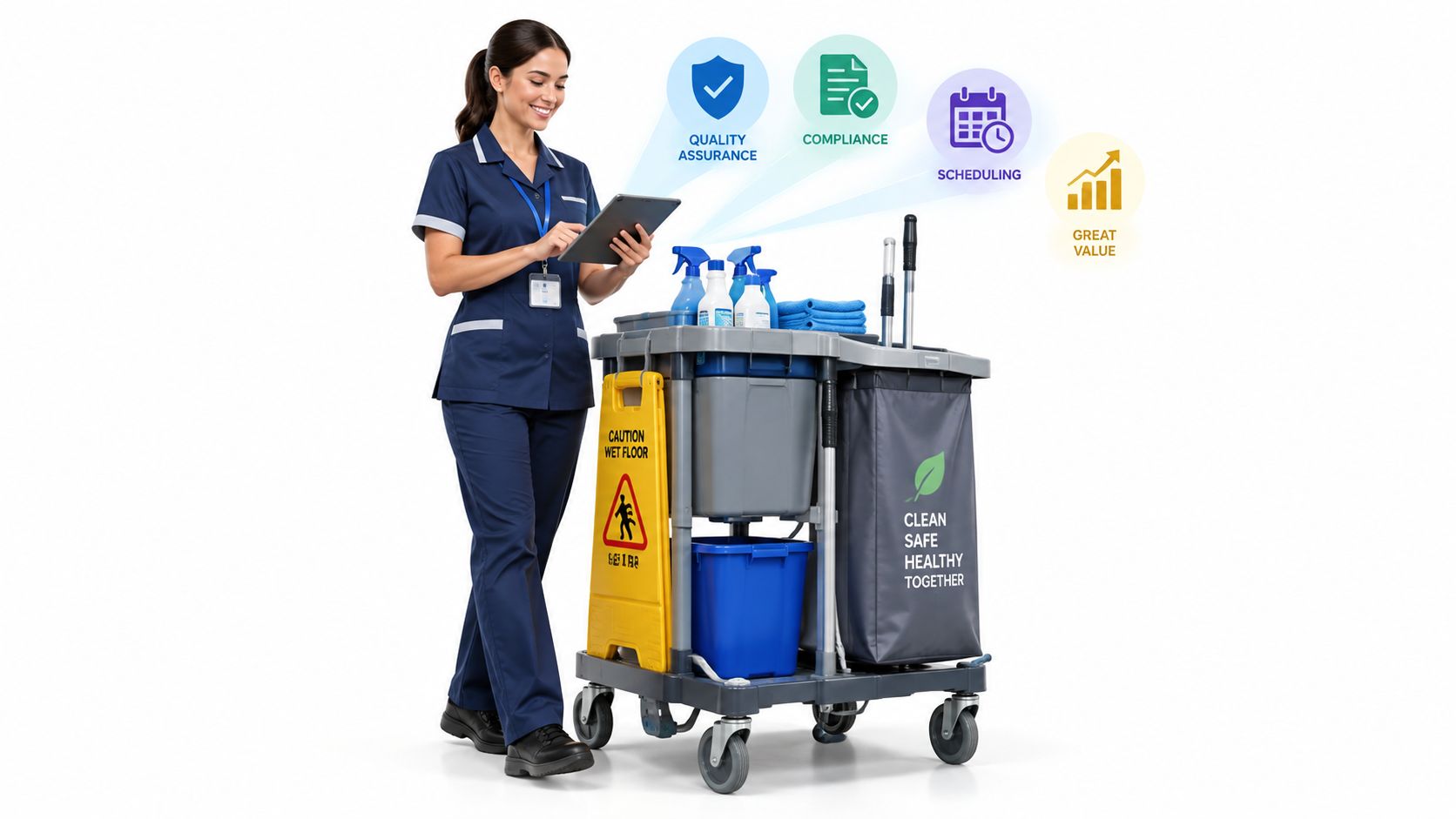
A paper binder in the janitor closet can still be useful, but it won't scale well across multiple shifts, supervisors, and sites. Modern training systems work better when staff can access SOPs, checklists, and records from a phone or tablet while they're doing the work.
Technology doesn't replace supervisor coaching. It makes that coaching more consistent and easier to document.
Where digital tools help most
Mobile SOP access
Staff can review the current version of a restroom procedure, floor-care sequence, or shutdown checklist on demand. That reduces the “I was shown something different” problem.
Training completion records
Managers need to know who completed onboarding, who passed a practical observation, and who is due for refresher training. Digital records make that visible without chasing paper forms.
SDS and product reference access
If chemicals are used across several sites, digital access to product information helps staff confirm handling requirements quickly. That's especially useful when products or packaging change.
For organisations that want to standardise carts, dispensers, labels, and training-ready product kits, a supplier page such as commercial cleaning supplies for facility operations shows the sort of categories that can be aligned with training modules.
The operational advantages
A good digital setup improves four things at once:
- Consistency: Every site sees the same SOP version.
- Speed: Supervisors can assign retraining immediately after an inspection.
- Audit readiness: Records are easier to retrieve during client or compliance reviews.
- Scalability: New sites can launch from an existing training library instead of rebuilding from scratch.
Choosing the right level of technology
Not every company needs a custom platform. Some can run an effective system with shared folders, digital forms, mobile-friendly SOPs, and a simple inspection app. The key is fit, not flash.
Use this decision framework:
| Situation | Useful technology level |
|---|
| Single site, stable team | Shared digital SOPs, cloud storage, simple checklists |
| Multiple sites, several supervisors | Mobile inspections, training records, task assignment workflow |
| High-compliance environment | Document control, retraining logs, audit trail, role-based access |
The mistake to avoid is buying software before defining the workflow. If the company doesn't know how it assesses competency, documents coaching, and closes QA gaps, software will only digitise confusion.
Frequently Asked Questions About Cleaning Training
A cleaning team can finish every task on the schedule and still miss the result the client is paying for. That usually happens when training stops at orientation and never matures into a system that verifies skill, documents performance, and ties both back to quality scores. These questions address the practical issues operators and buyers run into when they want training to produce measurable, auditable results.
What is commercial cleaning training in simple terms
Commercial cleaning training is the system a company uses to teach, observe, verify, and document how work gets done. The teaching matters, but the control layer matters just as much. If training is not documented and checked on the floor, it is a speech, not a system.
A useful way to view it is this. Curriculum tells people what good work looks like. Verification confirms they can do it under normal site conditions. Documentation proves it happened and gives supervisors something they can audit later.
How often should refresher training happen
Refresher training should run on two tracks. One track is scheduled. The other is triggered by evidence.
Scheduled refreshers keep standards from fading over time. Triggered refreshers happen after inspection failures, product changes, equipment changes, safety incidents, client complaints, or repeat defects on the same task. If a company waits for annual retraining alone, it is usually responding too late.
Who should own the training programme
Operations should own the system because operations owns the result. Supervisors should handle much of the floor-level coaching and skill verification. Management should maintain document control, completion records, and accountability by role.
That split works like quality control in any other process. One group designs the standard, one group checks execution, and one group keeps the records clean enough to stand up in an audit. If ownership is vague, updates stall, retraining is inconsistent, and no one can explain why performance varies from site to site.
How should training change for clinics, warehouses, and childcare sites
The framework can stay the same, but the risk profile must change the module content, practice scenarios, and pass criteria.
A clinic needs tighter cross-contamination controls, room sequencing, and touchpoint discipline. A warehouse needs more attention on floor conditions, traffic lanes, loading areas, spill response, and equipment awareness. A childcare site needs close attention to product suitability, high-touch surfaces, classroom routines, and methods that reduce residue and recontamination.
The mistake is using the same lesson plan everywhere and calling it standardisation. Real standardisation means the training structure is consistent while the site-specific controls are adjusted to match risk.
Can a small cleaning company build a strong training system without a large budget
Yes. Start small, but build with auditability in mind.
A short SOP library, a supervisor observation form, a simple skills sign-off record, and a retraining log can support a disciplined program. That setup is often enough to show who was trained, what they were trained on, who verified competency, and when follow-up was assigned. A smaller system with clear records usually performs better than a larger one filled with outdated documents and inconsistent coaching.
What should a buyer ask a cleaning provider about training
Ask questions that reveal the operating system behind the promise. How are new hires onboarded by role and facility type? How is competency verified on the floor? What events trigger retraining? How are records stored and retrieved during a client review? How does training connect to inspection scores or recurring defects?
Buyers who want a sharper checklist can review these commercial cleaning service FAQs before requesting proposals.
What should buyers avoid when comparing providers
Avoid broad claims with no operating detail behind them. “Our staff are fully trained” is not enough.
Look for evidence of control. A credible provider should be able to explain its SOP process, skill verification method, retraining triggers, supervisor responsibilities, and recordkeeping approach. If the company cannot show how training is measured and corrected, consistency will depend too much on individual effort at each site.
Where can readers learn more
The best next step is to compare providers using the same criteria. Ask each company to show how it documents onboarding, verifies competency, assigns corrective coaching, and connects quality inspections back to retraining. That comparison tells you far more than a generic claim about experience or service quality.
If you're reviewing office or commercial cleaning providers in the GTA, Arelli Cleaning is one option to include in that comparison. The most useful next step is simple: ask for clear training details, review the inspection process, and get informed quotes based on scope, facility type, and compliance needs.









.webp)