A Richmond Hill business owner usually isn't struggling to find a cleaning company. The harder problem is choosing the right type of cleaning partner before service gaps, unclear scope, or contract friction show up after onboarding. In a city with an active service economy and formal competition among incorporated cleaning firms, buyers have options, but they also need a better way to compare them than scanning review pages or asking for the cheapest quote.
That's especially true in office and commercial cleaning, where the wrong fit often looks acceptable in week one and costly by month three. Richmond Hill's local labour market gives a practical signal here: Indeed listed 330 part-time cleaning job openings in Richmond Hill, Ontario, which points to real demand across recurring service environments and also suggests staffing competition matters. For facility managers, that means vendor reliability, supervision, and schedule discipline deserve as much attention as price.
This guide reviews cleaning businesses in Richmond Hill, Ontario through a decision framework rather than a popularity contest. The goal is simple: match provider type to facility type, service complexity, and operational risk. Businesses refining workflows may also find ideas in this piece on optimizing maid service operations.
Key takeaways
- Match the provider to the facility type: Office janitorial, industrial cleaning, and specialty exterior or exhaust work often require different vendors.
- Treat labour stability as a buying factor: In a busy local hiring market, staffing depth affects consistency.
- Use pricing as a benchmark, not a verdict: In Ontario, Bark shows a typical cleaner rate of CAD $40 to $55 per hour, but commercial contracts may price by frequency, square footage, or scope.
- Ask how quality is documented: Communication systems, inspections, and issue-resolution workflows matter more than broad promises.
- Watch for contract clarity: Transparent terms and scope definitions are often more valuable than a low starting quote.
1. Arelli Cleaning

A common Richmond Hill buying scenario looks like this: a business starts with routine office cleaning, then later needs floor work, disinfection support, post-construction cleanup, or service across different room types. The selection problem is no longer "who cleans well." It becomes "which type of provider can cover a changing scope without creating extra vendor management risk."
Arelli Cleaning fits most clearly in the general office and multi-use commercial category. Its service positioning covers recurring janitorial work for offices and commercial sites, with adjacent support for settings such as schools, clinics, and warehouses. For buyers using this article as a decision framework, that places Arelli in the group to assess first when the facility is not highly industrial and not limited to a single specialty task.
One operational detail stands out. Arelli highlights a digital logbook, app-based communication, and crew quality-control reporting. Those features do not prove execution on their own, but they are relevant buying signals because they make service easier to verify, document, and review over time.
Best fit and why it stands out
Arelli appears most suitable for small to mid-sized offices, mixed-use commercial spaces, educational facilities, and healthcare-adjacent environments that need a broad scope and regular communication. That matters in practical procurement terms. A provider with only basic janitorial capacity may cover today's cleaning checklist but still leave the client sourcing separate vendors for floor restoration, post-renovation cleaning, or periodic exterior-related work.
This section's main takeaway is category fit. Arelli is not the choice to benchmark against industrial cleaning specialists or niche exterior contractors. It is the provider type to compare against other general commercial firms that offer recurring interior service plus a wider menu of add-ons.
What to verify before requesting a quote
- Service category: General office and multi-use commercial, rather than industrial or single-trade specialty cleaning.
- Operational oversight: Ask how the digital logbook is used in practice, who reviews reports, and how missed tasks or complaints are closed out.
- Scope flexibility: The company presents a broad service range, including janitorial cleaning, floor care, window cleaning, power washing, post-construction cleanup, and disinfection.
- Contract risk: Arelli emphasizes no long-term contracts and no cancellation fees, which can reduce switching friction if requirements change.
- Pricing method: Costs are quote-based, so buyers should compare proposals against scope definitions, inspection frequency, and response commitments, not price alone.
For a Richmond Hill business owner, the useful conclusion is straightforward. Put Arelli on the shortlist when you want one general commercial cleaning partner that can support routine service now and absorb adjacent needs later. Then test whether its reporting process, staffing coverage, and scope flexibility are strong enough for your building, not just persuasive in sales copy.
2. ServiceMaster Clean of Markham/Richmond Hill
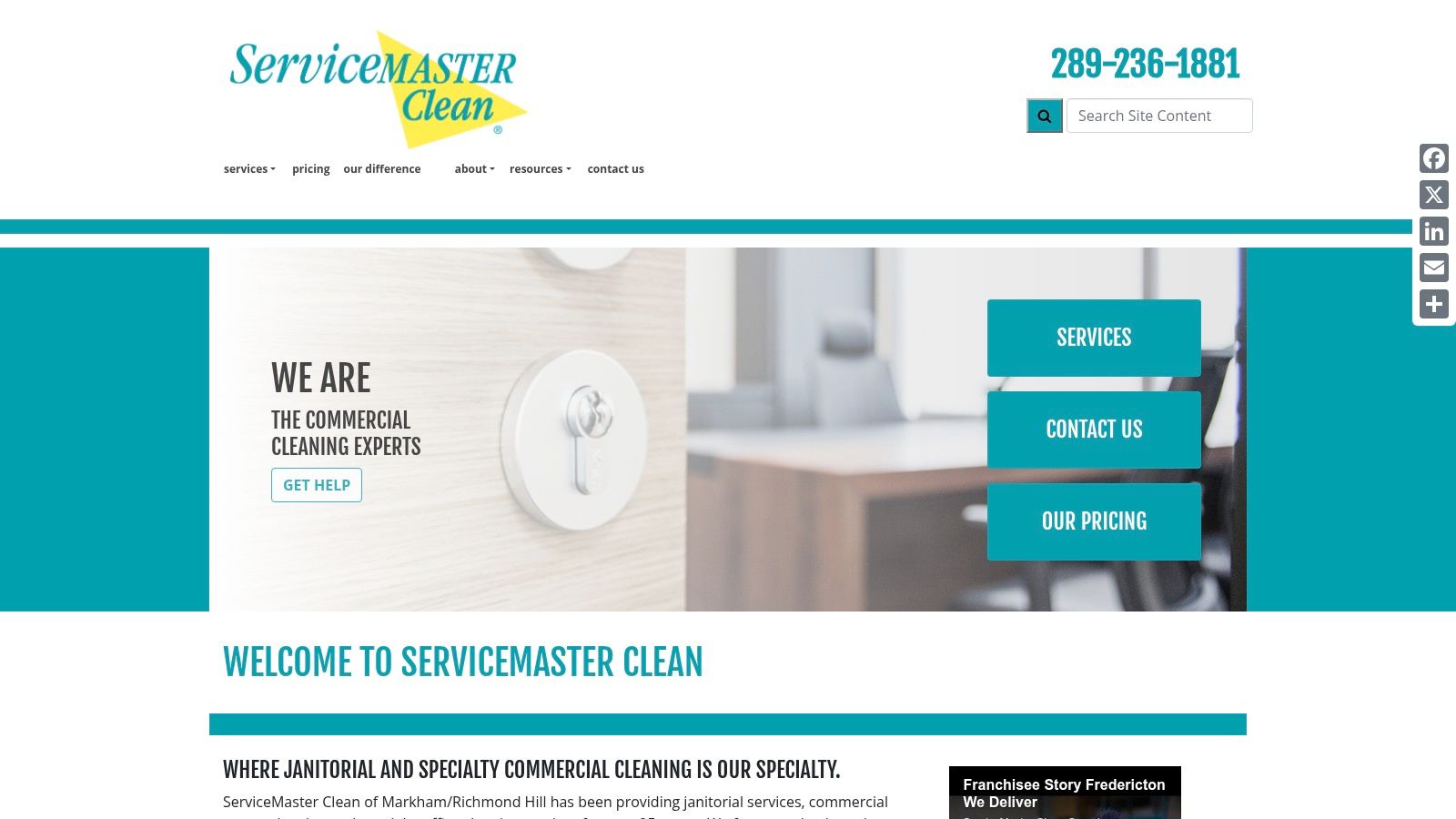
ServiceMaster Clean of Markham/Richmond Hill is a practical choice for buyers who want a familiar commercial janitorial brand with local-area coverage. Its service mix is centered on office cleaning, carpet care, hard-floor maintenance, disinfection, and specialty cleaning for facilities that need a more procedural approach.
This kind of provider often appeals to clinics, administrative offices, and shared commercial properties where predictable process matters more than a highly customized boutique experience. The franchise model can also be useful for buyers who prefer standardized systems and recognizable operating language during procurement.
Best fit for regulated or procedure-heavy spaces
ServiceMaster is especially relevant when infection-control language, documented cleaning routines, and scheduled maintenance programs matter in the buying decision. Facilities with healthcare-adjacent use, frequent public traffic, or a need for ongoing floor-care support may see a better fit here than with a smaller general janitorial firm.
A careful buyer should still verify who performs inspections, how often site audits happen, and how issues are escalated locally. Franchise systems can provide structure, but local execution still determines daily experience.
- Good fit: Offices, clinics, common-area contracts, and facilities that want floor care plus janitorial service in one relationship.
- Watch closely: Crew consistency, escalation path, and whether site-specific standards are documented in writing.
- Likely buying style: Quote-based, walk-through-first, service-plan driven.
A strong franchise operator can be very reliable. A weak onboarding process inside a strong brand still creates avoidable service friction.
3. Stratus Building Solutions Toronto North Richmond Hill

Stratus Building Solutions fits buyers who think in portfolios rather than single suites. Its positioning tends to suit offices, retail locations, and light industrial sites that need custom scopes and after-hours scheduling across more than one location or tenant profile.
For multi-site managers, the key value isn't just cleaning itself. It's whether the company can carry a consistent playbook from one property to another without rebuilding the scope from scratch each time.
Where Stratus can make sense
Stratus is worth shortlisting when a buyer needs regional coverage, green-cleaning options, or a structured service model that can scale with additional space. That often matters for property managers, multi-unit operators, and organizations that expect space changes, tenant turnover, or phased expansion.
The main caution is the same one that applies to many franchise-led providers. Buyers should confirm what is standardized and what is local. A written scope, quality-control routine, and response-time expectations matter more than broad customization claims.
- Best fit: Multi-tenant offices, retail groups, light industrial users, and growing businesses with more than one site.
- Strength: Scalable scheduling and process-oriented site planning.
- Trade-off: Online pricing and service detail are limited, so comparison depends on the quote conversation.
4. TOPMAX Cleaning Richmond Hill

TOPMAX Cleaning is easier to place in the “routine office and janitorial” category than in heavy specialty work. Its Richmond Hill-facing material points toward regular office cleaning, disinfection, and common-area upkeep, which makes it more relevant for smaller and medium-sized commercial spaces than for complex industrial environments.
That's not a weakness. It's often a better match for a buyer who wants dependable day-to-day service without paying for an oversized vendor structure.
A straightforward office-cleaning candidate
TOPMAX appears best suited to businesses that need recurring maintenance cleaning rather than highly specialized compliance support. Shared offices, professional-service firms, and lower-complexity commercial units may prefer a provider that stays focused on predictable janitorial tasks and standard schedules.
What buyers should examine thoroughly is quality control. The public-facing information is serviceable, but it doesn't surface as much detail about certifications, inspection routines, or digital reporting as some other providers do.
- Best fit: Office suites, common areas, and recurring janitorial schedules.
- Ask early: Who inspects the work, how missed tasks are handled, and whether the crew remains stable over time.
- Possible drawback: Less visible detail online around QA systems and compliance posture.
5. Cleaning Plus Commercial Cleaning Richmond Hill

Cleaning Plus is a useful example of a provider that appears to prioritize insured commercial work and ongoing client relationships. That positioning matters in Richmond Hill because commercial buyers aren't choosing only between informal operators. The city has a documented base of established firms, including PAL'S CLEANING SERVICES INC., listed as an active Ontario business corporation with a Richmond Hill address in Canada's Business Registries, which supports the view that formal vendor credibility is part of this market.
For procurement teams, that means “insured” and “commercial-focused” aren't empty descriptors. They're often minimum filters.
Best for buyers who want a conventional commercial vendor profile
Cleaning Plus is likely to appeal to offices and commercial properties that want a traditional janitorial relationship built around routine service, common-area maintenance, and periodic deep cleaning. Buyers who don't need a lot of technology language or broad specialty bundling may prefer a simpler commercial-only profile.
A useful benchmark for office buyers comparing providers is to review service scope against office cleaning service expectations, especially around washrooms, touchpoints, kitchens, and periodic detail tasks. If a quote looks low, the missing value often sits inside an underwritten scope rather than a more efficient operation.
Insurance and incorporation don't guarantee quality. They do reduce a category of procurement risk that many small businesses overlook until there's a claim, a missed shift, or a dispute.
6. Smart Kare

Smart Kare stands out for buyers who want cleaning and light facility support under one umbrella. Its positioning spans commercial and industrial cleaning, post-construction support, and some facility-maintenance adjacency. That makes it more relevant to warehouses, auto-related facilities, and operational sites than to a law office looking only for nightly vacuuming and washroom cleaning.
For some managers, bundling is efficient. For others, it creates too much dependence on one vendor. The right answer depends on how the building is run internally.
Better suited to operational facilities than pure office space
Smart Kare may be worth prioritizing when the facility includes warehouse space, industrial activity, or maintenance coordination that extends beyond visible office surfaces. In those environments, the vendor's ability to support multiple work types can simplify scheduling and reduce handoff issues between trades.
The buying risk is scope drift. When one company handles cleaning plus adjacent tasks, the statement of work needs to be tighter, not looser. Otherwise, both sides can end up with different assumptions about what is included.
- Best fit: Warehouses, mixed-use facilities, industrial-adjacent operations, and sites wanting one point of contact.
- Key question: Which tasks are janitorial, which are maintenance, and how are they billed separately?
- Potential concern: Public-facing detail about quality systems and certifications appears limited.
7. GPM Cleaning Services Power Sweeping Richmond Hill

GPM Cleaning Services shouldn't be compared to office janitorial firms on the same basis. It's a specialty contractor focused on power sweeping for parking lots, plazas, loading areas, warehouses, and underground garages. For property managers, that's an important distinction. Exterior cleanliness often affects tenant and visitor perception before anyone enters the building.
This is the kind of vendor that complements an interior cleaner rather than replacing one.
When exterior sweeping deserves its own provider
Large retail sites, industrial properties, and commercial complexes often need route-based sweeping and debris control that standard janitorial teams don't handle well. In those cases, a specialist like GPM can be the better operational decision, especially if the site includes garages, loading docks, or larger paved areas.
Buyers comparing exterior providers should define seasonality, debris type, access windows, and whether pressure cleaning is also needed. Some facilities may combine sweeping with periodic commercial power washing support under separate schedules.
- Best fit: Parking lots, plazas, industrial yards, loading zones, and underground garages.
- Not ideal for: Daily interior office cleaning.
- Ask about: Route frequency, access constraints, and how service is documented after each visit.
8. Pressure-Kleen Richmond Hill

Pressure-Kleen belongs in the specialty compliance category, particularly for food-service and heavy-duty exterior or residue-removal work. Its emphasis on kitchen-exhaust cleaning and pressure washing makes it more relevant to restaurants, hospitality sites, waste areas, and industrial spaces than to standard office contracts.
That distinction matters because many businesses overestimate what a general janitorial provider should handle. Exhaust systems, grease, and heavy residue usually require a separate technical service relationship.
A strong add-on vendor for hospitality and industrial needs
Pressure-Kleen makes sense when the facility's cleaning needs intersect with safety-sensitive systems or stubborn exterior contamination. Restaurants, commissary spaces, and sites with grease buildup or waste-area washing needs often need a specialist with equipment, containment methods, and off-hours work capability.
The right comparison here isn't “Is this better than an office cleaner?” It's “Does this business need a specialist at all?” If the answer is yes, the shortlist should shift accordingly.
General office cleaning and compliance-heavy specialty cleaning are different purchases. Treating them as one category usually creates service gaps.
9. StarClean Services Industrial Cleaning

StarClean Services is better evaluated as an industrial contractor than as a standard commercial cleaner. Its positioning around plant cleaning, production-floor work, degreasing, and customized industrial programs places it in a narrower but highly important category for Richmond Hill and York Region facilities with operational cleaning demands.
That specialization matters because one of the common local content gaps is confusion between residential expectations and commercial standards. For industrial operators, that gap is even more serious. Cleaning a production environment isn't just “more cleaning.” It often involves different methods, equipment, scheduling, and risk controls. Buyers evaluating industrial scopes should also compare them against broader industrial facility cleaning requirements so the quote reflects the environment rather than a basic janitorial checklist.
Where StarClean fits best
Manufacturing and heavy-duty sites that need customized procedures are the natural fit. A production floor, warehouse process area, or equipment-heavy environment often requires a provider that can work around operations and adjust methods to site conditions.
Smaller office-only buyers will likely find this level of specialization unnecessary. Industrial managers, by contrast, may find it essential.
- Best fit: Plants, manufacturing spaces, production-floor environments, and industrial support areas.
- Not the first choice for: Small professional offices with conventional nightly cleaning needs.
- What to clarify: Shutdown windows, chemical compatibility, equipment access, and contamination control approach.
10. King Quality Cleaning Richmond Hill
King Quality Cleaning appears to serve a broader mix of office, restaurant, residential, post-construction, and exterior cleaning needs. That makes it relevant for smaller properties, mixed-use buildings, and local operators that value flexible scheduling and a nearby provider over enterprise-style systems.
This sort of company can be a practical fit when the property itself is mixed. A small commercial unit with occasional turnover, event activity, or residential overlap may benefit from that flexibility.
A local option for mixed-use and smaller-scale needs
King Quality is likely to appeal most to buyers whose needs don't sit neatly inside one commercial category. Smaller offices, storefronts, event spaces, and mixed commercial-residential arrangements may prefer a provider with a wider menu and local responsiveness.
The trade-off is that buyers should ask more questions about standardization. When a company covers many service types, the burden shifts to the client to confirm inspection routines, crew specialization, and what “commercial standard” means for their specific site.
Top 10 Richmond Hill Cleaning Companies Comparison
| Provider | Core services & coverage | Quality & compliance | Target clients | Value & pricing | Unique selling points |
|---|
| Arelli Cleaning | Daily office + specialty (strip & wax, carpet, windows, power wash, post-construction, disinfection); GTA coverage | Proprietary ACCMS + mobile app, CIMStandard & WHMIS compliance, Health Canada–approved disinfection, 300+ clients, ~4.7–4.8 ratings | SMB offices, schools, clinics, warehouses, multi-site local portfolios | Price Match Guarantee, no-term contracts, zero cancellation fees, free 45-min sample clean, instant quotes (no published flat rates) | Tech-enabled real-time QA, 24/7 live support, free sample cleans, flexible stop-and-go service |
| ServiceMaster Clean (Markham/RH) | Daily/weekly janitorial, carpet & hard-floor care, disinfection, specialty office/healthcare | 25+ years local presence, QA programs, healthcare-grade protocols aligned with Health Canada | Offices, clinics, healthcare facilities | Quote-based pricing (no public rates); franchise model | Longstanding local reputation, strong healthcare cleaning protocols |
| Stratus Building Solutions (Toronto North) | Site-specific scopes, green cleaning options, after-hours service, multi-site scalability | National franchisor with defined process playbook and documented procedures | Multi-tenant properties, multi-site portfolios, offices & retail | Scalable solutions, quote-based pricing | Scalable, consistent playbook; green-cleaning options |
| TOPMAX Cleaning (Richmond Hill) | Routine office janitorial, disinfection, common-area maintenance; local crews | Localized Richmond Hill presence; limited public QA/cert detail | Small–medium offices seeking regular day-to-day service | Online quote request; no published package pricing | Focused on day-to-day office janitorial with local responsiveness |
| Cleaning Plus (Richmond Hill) | Routine office cleaning, common-area maintenance, periodic deep cleans; insured crews | Emphasis on insured commercial work and long-term client relationships | Businesses prioritizing insurance coverage and continuity | Quote-based; limited online pricing/metrics | Fully insured crews and client-retention focus |
| Smart Kare | Daily janitorial, post-construction, industrial/warehouse cleaning, facility maintenance | 25+ years experience; bundling cleaning with light maintenance | Industrial sites, warehouses, auto dealerships, offices needing maintenance | Quote-based pricing; single-point-of-contact options | Ability to combine cleaning + light maintenance for one vendor |
| GPM Cleaning Services (Power Sweeping) | Industrial-grade power sweeping for parking lots, plazas, garages, docks; route/project scheduling | Heavy-duty equipment for exterior sites; route-based scheduling | Property managers, retail plazas, industrial sites, malls | Project/route pricing varies by site access; complements interior janitorial | Niche exterior power-sweeping expertise for large sites |
| Pressure-Kleen (Richmond Hill) | Pressure washing, certified kitchen-exhaust cleaning, heavy-duty/post-fire cleanup | Compliance-focused for food-service environments; certified exhaust cleaning | Restaurants, hospitality, retail, industrial facilities | Quote-based; often after-hours work due to equipment/noise | Certified kitchen-exhaust service and post-fire residue cleanup |
| StarClean Services (Industrial) | Plant & production-floor cleaning, degreasing, customized industrial programs | Tailored methods/equipment for heavy-duty cleaning; GTA/York Region coverage | Manufacturing plants, heavy industrial facilities | Site-visit quotes required; not focused on small office contracts | Industrial-grade capability and custom cleaning programs |
| King Quality Cleaning (Richmond Hill) | Office cleaning, post-construction, residential & event cleaning, power washing | Local operator with flexible scheduling; limited enterprise QA detail | Small offices, mixed commercial/residential properties | Quote-based per site/frequency; no published packages | Versatile service mix for mixed-use properties and local flexibility |
Your Next Step A Checklist for Choosing Your Cleaning Provider
A Richmond Hill business owner comparing quotes often faces a familiar problem. Three vendors may offer "commercial cleaning," yet each is built for a different operating environment. One is set up for general office routines, another for industrial surfaces and heavier soil loads, and a third for specialized work such as pressure washing or kitchen-exhaust cleaning. The right decision starts with category fit.
That is the practical value of this list. It is less a ranking than a screening tool. If you classify providers by specialty first, office, industrial, or specialty, you reduce the risk of buying a service model that looks acceptable on paper but performs poorly on site.
Use this shortlist method
- Classify the site first: General office, industrial, exterior-focused, or compliance-sensitive hospitality.
- Document the scope in operational terms: List rooms, cleaning frequencies, washrooms, kitchens, touchpoints, floor types, consumables, and periodic tasks.
- Request a small comparison set: Two or three written quotes is usually enough to compare inclusions, exclusions, escalation procedures, and scheduling assumptions.
- Test quality control methods: Ask for inspection routines, issue logs, response times, and the named account contact.
- Read the contract as carefully as the price: Focus on cancellation terms, change-order language, extra-service charges, and vague wording such as "as needed."
A written scope matters more than headline pricing. Commercial cleaning proposals often look comparable until you examine what has been excluded. Floor care, washroom supplies, interior glass, after-hours access, and periodic deep cleaning are common sources of cost drift if they are not defined before service begins.
What to ask and what to avoid
Ask who supervises the account, how missed tasks are corrected, how substitute staff are briefed, and how the provider handles scope changes if your footprint expands. Then ask a harder question. What type of facility is this company structurally built to serve most often? That answer usually tells you more than marketing language does.
Avoid choosing on monthly price alone. Avoid broad promises such as "full service" when the quote does not specify tasks, frequencies, and responsibilities. Avoid contracts that make switching providers unusually difficult. Buyers who want a broader risk lens may find this outside resource on a mold remediation companies near me guide useful because the procurement logic is similar. Specialized service work is easier to manage when scope, documentation, and accountability are defined before the first visit.
The lower-risk choice is the provider whose operating model fits your building, schedule, and consequence of failure.
Richmond Hill has a varied enough vendor base that most businesses can find a suitable match. The advantage usually goes to the buyer who compares providers by specialty alignment, documentation quality, and service controls.
Further reading can sharpen that review process. As noted earlier, Arelli's service-area coverage may be relevant for multi-location buyers. Industry resources from ISSA and IFMA are also useful for setting realistic expectations around cleaning standards, documentation, and facility-management oversight.
If you are collecting quotes for office or commercial cleaning in Richmond Hill, Arelli Cleaning is one provider to include in the comparison set. Based on the points covered earlier in the article, it may fit buyers who want flexible contract terms, digital quality tracking, and one vendor that can cover recurring janitorial work alongside specialty cleaning.









.webp)